
A ‘servant leader’ honored: The nation pays tribute to Jesse Jackson, civil rights icon
How Jesse Jackson was shaped by Southern segregation − and went on to reshape American political life

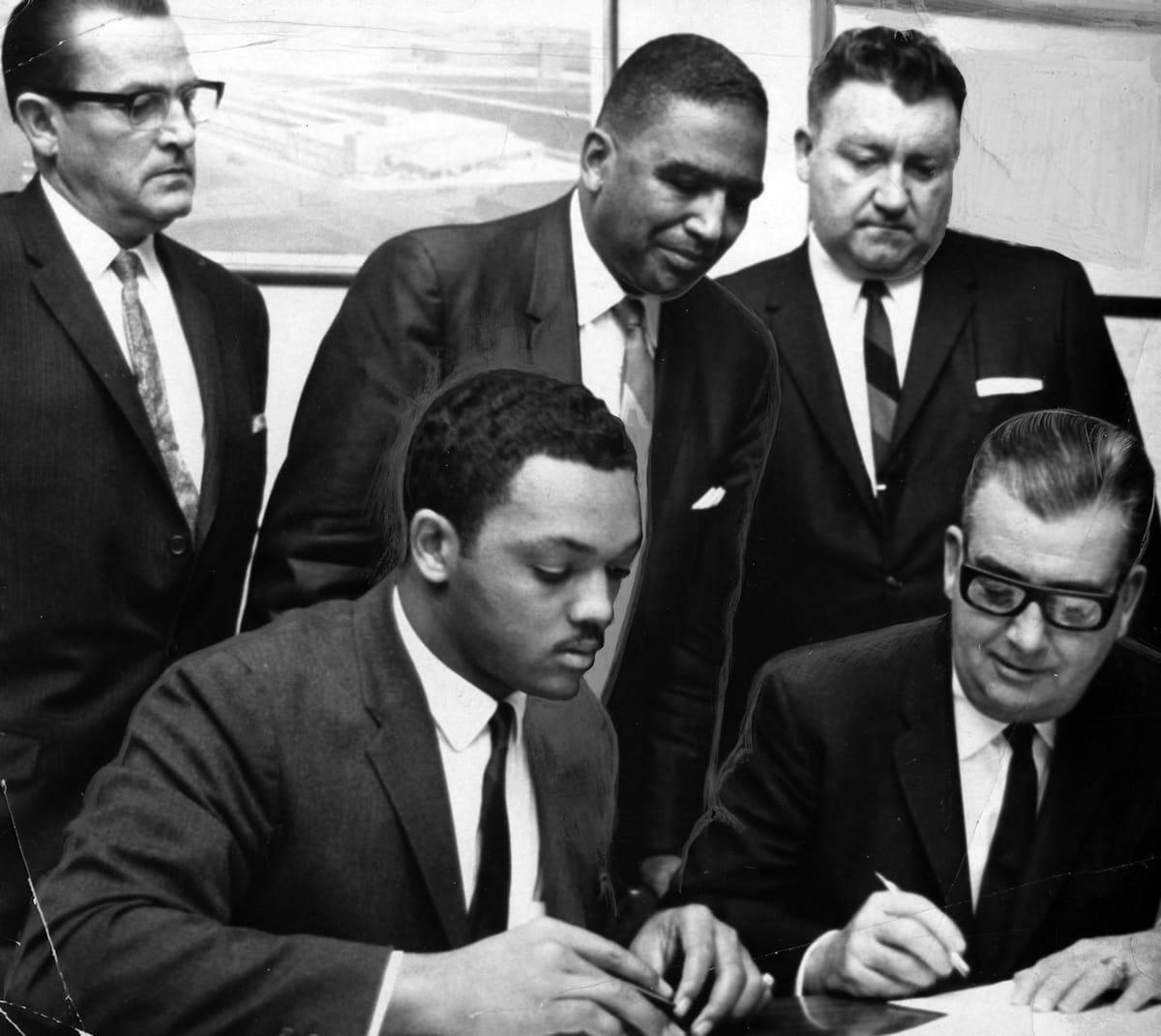
by Shauneen Miranda and Jacob Fischler, SC Daily Gazette
February 17, 2026
WASHINGTON — Tributes poured in across the country for the revered civil rights figure the Rev. Jesse L. Jackson Sr., who died Tuesday morning at 84.
The two-time Democratic presidential hopeful and Greenville, South Carolina, native died peacefully, surrounded by his kin, according to his family.
Jackson, who was active in the civil rights movement as a college student, worked alongside the Rev. Martin Luther King Jr. as a young adult before King’s 1968 assassination.
Leading his own political movement, Jackson became known for his populist message, charismatic delivery and organizing prowess that elevated the role and influence of Black political leaders and helped shape the modern Democratic Party.
“Our father was a servant leader — not only to our family, but to the oppressed, the voiceless, and the overlooked around the world,” Jackson’s family said in a statement.
“We shared him with the world, and in return, the world became part of our extended family,” his family added. “His unwavering belief in justice, equality, and love uplifted millions, and we ask you to honor his memory by continuing the fight for the values he lived by.”
Illinois Gov. JB Pritzker, a Democrat, ordered flags to fly at half-staff Tuesday in Jackson’s honor in the state where he lived and worked for many years.
The family statement did not list a cause of death. Jackson was diagnosed in 2013 with Parkinson’s disease. His diagnosis was updated last year to progressive supranuclear palsy, according to a November statement from the Rainbow PUSH Coalition that Jackson founded.
Tributes from Obama, Trump and Biden
Former President Barack Obama, the first Black president, and his wife, Michelle Obama, said Jackson’s runs for the presidency “laid the foundation” for Barack Obama’s successful 2008 campaign. And Chicago native Michelle Obama’s “first glimpse of political organizing” was at the Jacksons’ kitchen table, they said.
“From organizing boycotts and sit-ins, to registering millions of voters, to advocating for freedom and democracy around the world, he was relentless in his belief that we are all children of God, deserving of dignity and respect,” they wrote. “Reverend Jackson also created opportunities for generations of African Americans and inspired countless more, including us.”
President Donald Trump paid tribute, dubbing Jackson “a force of nature like few others before him” and a “good man, with lots of personality, grit, and ‘street smarts,’” in a social media post Tuesday.
House Minority Leader Hakeem Jeffries, the highest-ranking Black member of Congress, honored Jackson as a “legendary voice for the voiceless, powerful civil rights champion and trailblazer extraordinaire,” in a social media post.
“For decades, while laboring in the vineyards of the community, he inspired us to keep hope alive in the struggle for liberty and justice for all,” the New York Democrat said.
Jeffries expressed gratitude for Jackson’s “incredible service” to the country and “profound sacrifice as the people’s champion.”
Former President Joe Biden called Jackson “a man of God and of the people. Determined and tenacious. Unafraid of the work to redeem the soul of our Nation.”
South Carolina legacy
U.S. Rep. Jim Clyburn, a South Carolina Democrat and longtime friend of Jackson, said the civil rights leader lived a life “defying odds,” in a statement Tuesday.
“Reverend Jackson showed us that if we all work together – we can bend the arc of the moral universe and change history,” Clyburn said while also pointing to Jackson’s impact on “the nation, Black Americans, and movements to encourage civic participation around the world.”
U.S. Sen. Tim Scott, a South Carolina Republican who is the party’s highest-ranking Black elected official, honored Jackson’s legacy as a leader and role model.
“I don’t have to agree with someone politically to deeply respect the role Jesse Jackson, a South Carolina native, played in uplifting Black voices and inspiring young folks to believe their voices mattered,” Scott wrote on social media. “Those that empower people to stand taller always leave a lasting mark. Rest in peace.”
Jackson’s legacy will live on in the next generation, South Carolina state Sen. Deon Tedder said during a news conference Tuesday.
“The future generation, they’re picking up that torch, they’re picking up that mantle,” said Tedder, a Democrat, gesturing to students from the state’s historically Black colleges and universities. “The baton has been passed, and now what you see is the future.”
South Carolina state Rep. Hamilton Grant recalled seeing Jackson at the July 9, 2015, signing ceremony of the law that removed the Confederate flag from Statehouse grounds entirely. The flag was taken down the next day, 15 years after it came off the Statehouse dome in a compromise Jackson opposed.
“For him, being from South Carolina, to see that moment, and me being there in close proximity with him, meant the world to me,” Grant told the South Carolina Daily Gazette. He said Jackson paved the way for Black leaders like him and helped instill in him pride in his identity.
The South Carolina House and Senate held moments of silence in Jackson’s honor Tuesday.
“There are so many little boys and little girls in South Carolina who can look in the mirror now and say, ‘I am somebody!’ because of this native son,” state Sen. Karl Allen, a Democrat, said.
Shaping Democratic politics
Jackson leaves behind a legacy of political and social justice work that spanned decades.
He founded the Rainbow PUSH Coalition, a national social justice organization whose name evoked Jackson’s multiracial voter base and the theme of his 1984 Democratic National Convention speech. That organization was formed by a merger between Operation PUSH, which Jackson founded in 1971, and the Rainbow Coalition.
In his 1988 bid for the presidency, Jackson based his campaign in Iowa prior to that state’s presidential caucuses and made the official announcement of his candidacy at a farm in Greenfield on Oct. 10, 1987.
He finished in fourth place in the caucuses but went on to briefly become the frontrunner for the Democratic nomination by winning a coalition of Black and Latino voters and white liberals, though he ultimately came in second in delegates to Michael Dukakis.
Similar blocs propelled Obama to victory two decades later and continue to form national Democrats’ base.
Two of Jackson’s sons, Jesse Jackson Jr. and Jonathan Jackson, would represent Illinois in the U.S. House. Jonathan Jackson remains in office after first winning election in 2022.
U.S. Sen. Bernie Sanders, a democratic socialist from Vermont who endorsed Jackson’s 1988 campaign, said in a Tuesday statement Jackson had been a friend and ally for nearly 40 years and credited Jackson with founding modern progressivism.
“His creation of the Rainbow Coalition, a revolutionary idea at the time, that developed a grassroots movement of working people — Black, white, Latino, Asian-American, Native-American, gay and straight — laid the foundation for the modern progressive movement which is continuing to fight for his vision of economic, racial, social and environmental justice,” Sanders wrote. “Jackson has had a profound impact upon our country. His politics of togetherness and solidarity should guide us going forward.”
‘Equal justice is not inevitable’
Georgia U.S. Sen. Raphael Warnock, a Democrat and a Baptist pastor, recalled the influence Jackson’s presidential runs had on a young Warnock growing up in public housing.
“With an eloquence and rhythmic rhetoric all his own, Jesse Jackson reminded America that equal justice is not inevitable,” he said. “It requires vigilance and commitment, and for freedom fighters, sacrifice. His ministry was poetry and spiritual power in the public square. He advanced King’s dream and bent the arc of history closer to justice.”
Jaime Harrison, a former chair of the Democratic National Committee, said Jackson’s 1988 run, which culminated with a speech at the party convention that lauded the United States’ multiracial identity, inspired him.
As “a poor Black kid from South Carolina,” Harrison said he was drawn to Jackson’s command of the convention hall after accumulating more than 1,000 delegates.
“He did not win the nomination,” Harrison wrote. “But he won our imagination.”
Adrian Ashford contributed to this report.
SC Daily Gazette is part of States Newsroom, a nonprofit news network supported by grants and a coalition of donors as a 501c(3) public charity. SC Daily Gazette maintains editorial independence. Contact Editor Seanna Adcox for questions: info@scdailygazette.com.
How Jesse Jackson was shaped by Southern segregation − and went on to reshape American political life
A civil rights activist who ran for president twice and became a Democratic power broker, Jackson was an American political icon. But above all, he was a Southerner
By Gibbs Knotts, Coastal Carolina University and Christopher A. Cooper, Western Carolina University
Holding hands with other prominent Black leaders, the Rev. Jesse Jackson crossed the Edmund Pettus bridge in Selma, Alabama, on March 9, 2025, to commemorate the 60th anniversary of “Bloody Sunday.” Like several survivors of that violent day in 1965, when police brutally attacked civil rights protesters, Jackson crossed the bridge in a wheelchair.
Jesse Louis Jackson was born Oct. 8, 1941, in Greenville, South Carolina, a town firmly entrenched in the racially segregated Deep South. This time and place aren’t footnotes to Jackson’s life, but rather key facts that shaped his civil rights activism and historic runs for the U.S. presidency. Jackson died on Feb. 17, 2026, at age 84.
Growing up in the segregated South shaped Jackson’s attitudes, opinions and outlook in ways that remain apparent today. While he lived in Chicago for most of his adult life, he remained a Southerner. And other Southerners viewed him as such.
Jackson biographer David Masciotra said the South gave Jackson “a sense of the oppression and the persecution that he wanted to fight.”
As scholars of Southern politics, we see Jackson’s Southern identity as essential to understanding his life. Southerners often identify with the region, even after leaving the geographic South. As sociologist John Shelton Reed once wrote, Southernness has more to do with attitude than latitude.
A segregated childhood
In the South Carolina of Jackson’s youth, water fountains, bathrooms, swimming pools and lunch counters were all segregated. While white people his age attended Greenville High School, Jackson attended the all-Black Sterling High School, where he was a star quarterback and class president.
His experience of segregation shaped how Jackson viewed his life.
“I keep thinking about the odds,” Jackson told his biographer and fellow South Carolinian Marshall Frady in 1988, marveling at the “responsibility I have now against what I was expected then to be doing at this stage of life.”
“Even mean ole segregation couldn’t break in on me and steal my soul,” he later told Frady.
If Jackson had been white, a star student like him might have enrolled at Clemson University or the University of South Carolina. Or he might have said yes when he was offered a contract to play professional baseball.
Instead, Jackson rejected the contract because the pay would be approximately six times less than a white player’s and went North, to the University of Illinois.
He did not find a more welcoming atmosphere in Champaign, Illinois. According to biographer Barbara Reynolds, the segregation that he thought he had left behind “cropped up in Illinois to convince him that was not the place to be.”
In the fall of 1960, Jackson transferred to North Carolina Agricultural and Technical State University, a historically Black college in Greensboro, North Carolina, to complete his sociology degree.
His return to the South marked Jackson’s emergence as a leader in the growing Civil Rights Movement.
Greensboro was a center of this struggle, with large, regular demonstrations, often led by local students of color. Six months prior to his arrival in Greensboro, four Black students from North Carolina A&T refused to leave the whites-only Woolworth lunch counter, launching a sit-in movement that soon drew national attention.
Jackson himself led protests to integrate Greensboro businesses. After one pivotal student march on City Hall, he was arrested and charged with inciting a riot. In jail, Jackson wrote a “Letter From a Greensboro Jail,” a rhetorical tip of the hat to Martin Luther King Jr.’s “Letter from a Birmingham Jail.”
A move north
Jackson’s second move north, in 1964, stuck.
Like so many other Black Southerners who participated in what later became known as the “second great migration,” Jackson went to Chicago. He attended Chicago Theological Seminary, inspired not by a deep love of scripture but by what Jackson perceived as the church’s ability to do good on this earth.
As North Carolina A&T’s president, Dr. Sam Proctor, advised Jackson, “You don’t have to enter the ministry because you want to save people from a burning hell. It may be because you want to see his kingdom come on earth as it is in heaven.”
Jackson thought his time in Chicago “would be quiet and peaceful and I could reflect.”
It was anything but. Following the path of King and other religiously inspired civil rights activists, Jackson continued his civil rights organizing, leading Operation Breadbasket, an initiative of King’s to boycott businesses that did not employ Black workers.
Presidential aspirations
Over the next few years, Jackson took on ever more high-profile organizing, patterned after the life and work of King – another Southerner. As the former King aide Bernard Lafayette once said, “I mean, he cloned himself out of Martin Luther King.”
In 1984, Jackson turned to politics, running for the nation’s highest office.
Announcing his bid for the presidency, Jackson pledged to “help restore a moral tone, a redemptive spirit, and a sensitivity to the poor and dispossessed of this nation.”
But the campaign always represented more than a policy platform. Jackson wanted to mobilize more Americans to vote and to run for office, especially the “voiceless and the downtrodden.”
Jackson finished third in the 1984 Democratic primary but with a remarkably strong showing, taking 18% of all primary votes. He performed especially well south of the Mason-Dixon Line, winning both Louisiana and the District of Columbia. He also performed well in the Mississippi and South Carolina Democratic caucuses.
This surprising success inspired Jackson to run for president again. In 1988, he did even better, winning nearly 7 million votes and 11 contests, and sweeping the South during the primary season.
He won the South Carolina caucuses and the Super Tuesday states of Alabama, Georgia, Louisiana, Mississippi and Virgina. In his second run, Jackson more than doubled his share of the white vote, from 5% in 1984 to 12% in 1988.
Jackson finished second in the Democratic primary to Massachusetts Gov. Michael Dukakis, who would go on to lose the 1988 presidential election to George H.W. Bush. But Jackson’s strong results solidified his position as a major figure in American politics and a power broker in the Democratic Party.
A towering figure in American politics
Jesse Jackson’s two presidential runs fundamentally altered the U.S. political landscape.
Beyond being the first Black candidate to win a state primary contest, Jackson also helped end the primary system by which the winner of a state would receive all the state’s delegates. Jackson claimed the system hurt Black and minority candidates and advocated to implement reforms that had been first recommended following the 1968 Democratic primary.
Back then, the party had pushed for a system in which delegates could be allocated based on the proportion of the vote won by each candidate, but it wasn’t adopted in every state.
Starting in 1992, following Jackson’s intervention, candidates receiving at least 15% of the vote officially received a proportion of the delegates. These reforms opened up the possibility that a minority candidate could secure the Democratic nomination through a more proportional allocation of delegates.
Jackson’s background also reinforced the importance of the Black church in Black political mobilization.
Perhaps most importantly, Jackson expanded the size and diversity of the electorate and inspired a generation of African Americans to seek office.
“It is because people like Jesse ran that I have this opportunity to run for president today,” said Barack Obama in 2007.
The long Southern strategy
Jackson’s political rise coincided with and likely encouraged the exodus of racially conservative white voters out of the Democratic Party.
The Republican Party’s Long Southern Strategy – an opportunistic plan to cultivate Southern white voters by capitalizing on “white racial angst” and conservative social values – had been underway before Jackson’s presidential bids. But his focus on social and economic justice undoubtedly helped drive conservative Southern whites to the GOP.
Today, some political thinkers question whether a distinct “Southern politics” continues to exist.
The life and career of Jesse Jackson reflect that place still matters – even for people who have left that region for colder pastures.
This story, originally published on March 12, 2025, has been updated with Jackson’s death on Feb. 17, 2026.
This article is republished from The Conversation, a nonprofit, independent news organization bringing you facts and trustworthy analysis to help you make sense of our complex world. It was written by: Gibbs Knotts, Coastal Carolina University and Christopher A. Cooper, Western Carolina University
Read more:
- How Jesse Jackson’s populist fight for economic and racial justice resonates today
- How Obama’s presidential campaign changed how Americans view black candidates
- Before Kamala Harris, many Black women aimed for the White House
The authors do not work for, consult, own shares in or receive funding from any company or organization that would benefit from this article, and have disclosed no relevant affiliations beyond their academic appointment.