Arrests of immigrant parents create mental health crisis for children
A Mom Called 911 For an Ambulance. NYPD Sent Handcuffs; 2 NC local governments are testing guaranteed income for people leaving incarceration.

It's Friday July 10, 2026 and in this morning's issue we're covering: Arrests of immigrant parents create mental health crisis for children, New Mexico regulators announce 16 community solar projects are online, generating power, A Mom Called 911 For an Ambulance. NYPD Sent Handcuffs, Therapy in a tent: The healthcare many homeless Californians need but aren’t getting, New Orleans Haitian community reeling in the wake of U.S. Supreme Court ruling, How The Death Penalty At 50 Is Far More Broken Than We Knew, Can guaranteed income help people leaving incarceration? Two NC local governments are testing it.
Media outlets and others featured: Minnesota Reformer, Source New Mexico, MindSite News, CalMatters, Verite News, The Marshall Project, North Carolina Health News.
Charlotte's Documenters, powered by Charlotte Journalism Collaborative, has launched and I'm one of multiple people that will be providing coverage of under-reported public meetings in Mecklenburg County, North Carolina. City Bureau in Chicago runs the Documenters program. -- Ben Ledbetter, Editor of Down Ballot
Arrests of immigrant parents create mental health crisis for children
By Claudia Boyd-Barrett, KFF Health News (Minnesota Reformer) Published: June 24, 2026
This article first appeared on KFF Health News.
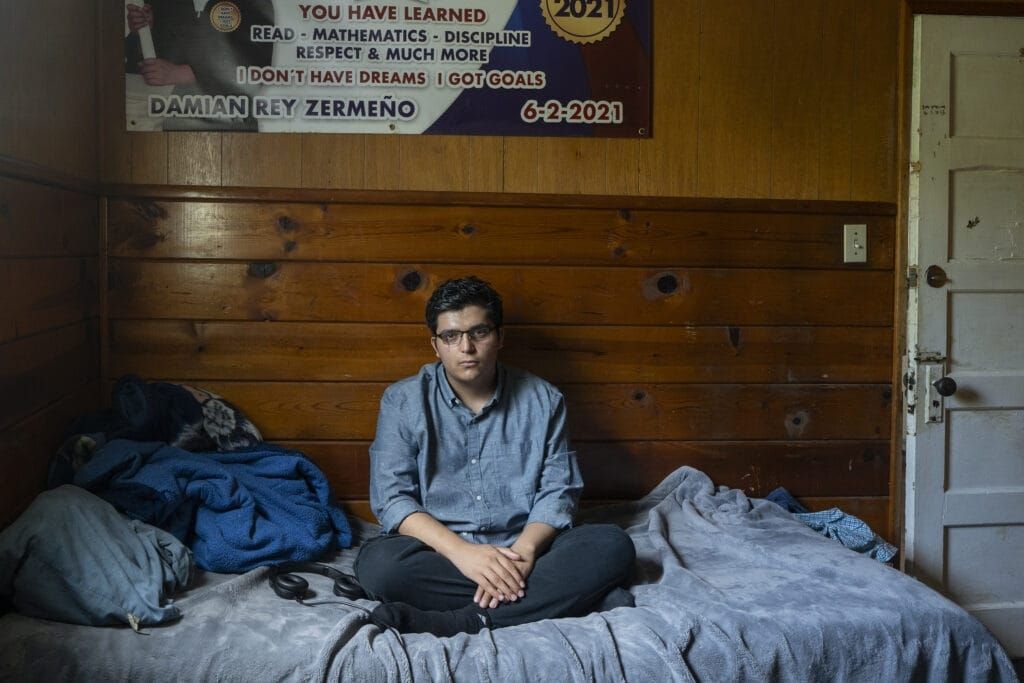
LOS ANGELES — Damian Zermeño, 15, sensed something was wrong the moment he got home from school.
His aunt sat at the dining table, sobbing. His father, who’d walked him to the bus stop that morning and promised to take him to dinner when he got back, wasn’t there.
Saúl Zermeño, a 45-year-old single dad, had gone to a routine check-in appointment at an Immigration and Customs Enforcement office that morning, a requirement he’d complied with for years. The father had deferred action that allowed him to stay and work in the U.S., according to his attorney. But that day, Oct. 3, officers deported him to Mexico, where he hadn’t lived since he was 9 years old. Zermeño had been Damian’s sole caregiver since he was a baby because his mother chose not to be involved in the boy’s life, the family said.
Suddenly, Damian, who was born in the U.S., found himself separated from his father by thousands of miles and a heavily guarded border. The previously cheerful 10th grader, who doesn’t have a driver’s license and can make a few basic dishes but isn’t used to cooking for himself, faced navigating his teenage years alone, his dad’s presence reduced to a two-dimensional image on his phone.
“I thought it wasn’t true,” Damian said. “I just went to my room. I didn’t want to leave. I didn’t even want to eat.”
Damian is among an estimated hundreds of thousands of children, most of them U.S. citizens, separated from a parent by the Trump administration’s deportation policies. Their mothers and fathers have been deported or locked for months inside detention centers, often miles away from where their families live. These children are separated, sometimes violently, from the adults they depend on. Parents have been arrested while dropping kids off at school, inside their homes, and at immigration check-ins with their children present. Most people detained have no criminal conviction. (Being in the U.S. without authorization is typically a civil offense). With their parents gone, kids’ lives are plunged into fear and uncertainty.
As a result, a generation of children from immigrant families are exhibiting mental health problems that could affect them for years.
Parents, therapists, and others who work with immigrant families said they’ve already encountered preschoolers with speech delays, elementary school children who talk of suicide, and teenagers too anxious to leave the house. Research has shown repeatedly that separating children from their parents harms their health and development. The stress of losing a primary caregiver creates havoc in a child’s brain and body, increasing their risk for mental and physical health problems, including depression, anxiety, post-traumatic stress disorder, a weakened immune system, and developmental delays.
“You can just see it in their faces; it’s almost like the light has been dimmed in their eyes,” said the Rev. Tanya Lopez, a pastor at Downey Memorial Christian Church who regularly visits immigrant families as part of a support organization made up of Los Angeles-area religious leaders.
The health risks from this stress response are long-term. People who experience parental separation and other traumatic events as children are more likely to have heart disease, diabetes, cancer, and other chronic conditions as adults.
In a statement, the Department of Homeland Security said ICE does not separate families, and that parents are asked if they want to be removed from the country with their children or to designate a safe person for them to stay with in the U.S.
However, a report by the Women’s Refugee Commission and Physicians for Human Rights found that many parents aren’t given that choice, and that ICE often doesn’t ask detainees if they have children or take steps to ensure that children left behind are safe. Saúl Zermeño said ICE officers didn’t ask about his son or check on Damian’s well-being when he was deported.
For days after his father’s deportation, Damian didn’t want to leave his room, eat, or go to school. He stopped talking to his friends. He stopped playing his favorite video game, Fears To Fathom. When he returned to school a week later, the teenager would cry in class or walk out overwhelmed with sadness. Even his favorite subject — English — lost its appeal.
Damian and his father were inseparable; family members joked that they never saw one without the other. Zermeño took Damian, who has attention-deficit/hyperactivity disorder, autism, and other health conditions, to his medical appointments. He cooked for him and combed his hair. He loved to take Damian to his favorite Thai restaurant or to get boba drinks after school. As much as they joked around and played pranks on each other, Zermeño also taught Damian the importance of work by bringing him along to construction jobs and to find supplies at Home Depot.
Damian used to get annoyed with his father’s motivational chats about responsibility. Now they’re one of the things he misses most.
“I thank my dad every day for teaching me to be strong before he left,” Damian said.
Elsewhere in Los Angeles, Jacob, a shy 9-year-old with cropped, curly hair, skinny limbs, and a serious expression, was missing his mom. On a Saturday in May, he clung tightly to his father’s hand as they walked among homeless people, street peddlers, and the stench of urine that hangs in the air outside the building where they live in a cramped apartment. He hoped his mom would soon be released from immigration detention so that he could hug her again.
“If my mom was here, I’d be happy,” he said. “Right now, I’m not.”
Jacob is in some ways a typical 9-year-old. He likes playing Roblox and Street Fighter. He dreams of becoming a police officer and of owning a guard dog, “because you can train them and they defend you.”
But he also endured a harrowing journey, even before being separated from his mom in January. Jacob’s family fled their home country of Colombia in 2024 because members of a paramilitary group threatened to kill them, his father, Andreis, said. During their journey to the United States, Jacob saw dead bodies while trekking through the jungle, was kidnapped and robbed at gunpoint with his parents, witnessed a rape, and had to sell candy and beg for money, his dad said. KFF Health News is not using the father’s or son’s real name because the family fears it would jeopardize their asylum cases.
After the family arrived in Los Angeles, Jacob suffered from nightmares and an intense fear of being alone. He started to recover once he began attending school and got connected to therapy through the school district, his dad said. For a short while, the family felt they had found peace.
Then, immigration officers detained Jacob’s mother at a check-in appointment while he and Andreis sat in the waiting room. The mother has a pending asylum application and no criminal record, Andreis said. The father said he and his son broke down when officers informed them of his wife’s detention, handing them a bag with her wallet and cellphone. They returned home without her, leaving Jacob inconsolable.
“He was terrified,” the father said, fighting back tears, his voice growing quiet as he recounted that moment. “He was crying with rage.”
After that, Jacob didn’t want to eat or go to school. When he went to school at his dad’s insistence, his teacher called home to ask why he was crying in class. Jacob couldn’t sleep. He acted out. He blamed his dad.
“When will my mom come back?” he asked his dad. “Why do they have my mom? I miss my mom.”
At the same time, Andreis said, he was going through his own crisis, trying in vain to console his son while wrestling with grief, worry, and desperation over what happened to his wife. He stopped his work as a laborer for two weeks to take care of Jacob, but that created financial stress and meant he sometimes couldn’t afford to fund his wife’s commissary account so she could buy better food and make phone calls. Jacob lived for those phone calls.
Jacob listed all the things he missed about his mom, including her cooking (rice with meat, corn cakes with egg), visiting the park together, and her taking him to get his hair cut, treating him to McDonald’s on the weekend, and bringing him to church. Most of all, he missed being close to her.
“I would lie down with her, and I’d watch videos with her,” he said. “My mom would hug me and I’d hug her.”
Sometimes he sprayed her perfume on himself so he could smell her.
After almost five months at the Adelanto ICE Processing Center, Jacob’s mother was released based on a habeas corpus petition in May. The family is still living in fear of detention or deportation. The father worries he too could be detained, and what that would mean for Jacob. Andreis is currently appealing a removal order for the two of them.
A recent analysis published by the Brookings Institution estimates that over 200,000 children — including 145,000 U.S. citizen children — have likely had at least one parent detained since President Donald Trump returned to office. About a third of those children are under age 6. The number of children with detained parents is expected to grow as the federal government pours over $200 billion into immigration enforcement, including funding from the GOP’s One Big Beautiful Bill Act and a $70 billion appropriation Trump signed this month.
More than 4.6 million U.S. citizen children live with a parent at risk of deportation, according to the report.
Families broken
Noemi, a Guatemalan mother and asylum seeker, stood in the parking lot at an ICE office north of Los Angeles, her three children wailing and clinging to her, glass from the family’s car scattered at their feet.
Moments earlier, immigration agents had smashed a window and forced her partner out of the car while he waited for Noemi and the kids to finish a check-in appointment. While they were inside, officers tried to separate Noemi from the couple’s children, ages 9, 7, and 1, but gave up after the kids started screaming, Noemi said. Meanwhile, her partner, a Mexican national who’s lived in the U.S. for almost 20 years, was sent to the ICE detention center in Adelanto.
“It was something tragic, something inexplicable that happened that day,” said Noemi, who asked to withhold her full name because she fears government retaliation for sharing her story. “It’s something that marks you for your whole life. My family was broken.”
Located in the Mojave Desert, the privately run Adelanto ICE Processing Center is the immigration detention center closest to Los Angeles and one of the largest in the U.S. It held a daily average of over 1,700 people as of April, and a facility next door called the Desert View Annex held an additional 426.
Since her partner’s detention in December, Noemi said, their children haven’t been the same.
How one Minnesota family is managing life after deportation
Her 7-year-old daughter, till then usually happy and smiling, became depressed and refused to eat. Her once-high grades plummeted, and she forgot the names of letters and numbers in both English and Spanish. She and her 9-year-old brother struggled to sleep and asked constantly about their dad, wondering if he was taken because they’d done something wrong.
“Why is this happening to us?” they asked her. “We’re good. We’re studying.”
Noemi’s youngest daughter went back to crawling for three months, even though she’d already learned to walk before her father was taken. The little girl would cry out in her sleep, “Pa! Pa!”
Sofia Mendoza, a therapist who works with immigrant families at a community clinic in Los Angeles County, said separated children can experience a form of grief. It’s hard for them to come to terms with their parent’s absence because the parent is still alive, but not with them. This can disrupt the child’s bond with that parent and their ability to form trusting relationships in the future, she said.
Many children also become extremely anxious, angry, and fearful, Mendoza said. Young children often complain of physical symptoms such as stomachaches, develop separation anxiety, and regress to earlier behaviors like bed-wetting. Older children may have panic attacks, nightmares, and difficulty focusing, Mendoza said. Caregiver loss is also associated with increased risk of suicide and substance use in children.
Norma Gómez, a project manager for the Mixteco Indigena Community Organizing Project in Oxnard, said after immigration raids shook the community last summer, her 9-year-old daughter refused to go to school for a week and was afraid to leave her mom and dad, even though they’re legal U.S. residents. She’d seen other kids at school crying because family members had been detained. Gómez showed her daughter their U.S. residency documents to reassure her. The child asked to make copies for her classmates, hoping they would protect them too.
‘Time to be an adult’
Back in East Los Angeles, Damian is living with one of his aunts and struggling to adapt to not having his father around. He said his grades have dropped because he can’t focus in school. He no longer wants to do things he used to enjoy with his dad, such as going out to eat.
“Fun is over,” he said. “It’s time to be an adult right now.”
Being without his father has forced Damian to become more independent, he and his aunt Claudia Zermeño said. Before, his dad did almost everything for him. Now, Damian does his own laundry, helps with housework, and styles his own hair. He’s protective of his aunts, who are both devastated by their brother’s absence; he hugs them frequently and tells jokes to try to cheer them up. He doesn’t want to upset them more by showing his own sadness.
Damian receives therapy both in and outside of school. He said he’s learned breathing exercises that have helped, but he still feels sad and worried a lot of the time. Sometimes he feels angry.
“I try my hardest to think, to stay focused,” he said. “But with everything that’s going on, I can’t keep the facade of ‘everything’s normal’ when I feel heartbroken.”
Saúl Zermeño, now living in Guadalajara, said he’s worried about his son’s health. Damian has a genetic condition called neurofibromatosis Type 1, which causes tumors to grow on nerve tissue in his body, including one in his head that, if not checked regularly by a doctor and monitored by his family, could interfere with his brain. He also suffers from epilepsy and was born with only one kidney, which means he tires easily and doesn’t play sports. Saúl is afraid his son won’t get the care he needs without him there. As Damian’s legal guardian, Claudia Zermeño is doing everything she can for him, but she has two children of her own and is also caring for her mother, who has neurological problems from a stroke.
Damian talks with his dad as often as he can. He hopes to visit his father in Mexico, but he doesn’t have a passport and, as a minor under 16, there are more requirements to get one without his dad present. Saúl is working with an attorney to get permission to legally return to the U.S., but the process is complicated and uncertain.
So, for now, Damian’s hanging on to hope that his dad will be allowed to return and is trying to become the man he believes he should be. He’s making plans to get his driver’s license when he turns 16 this month. He’s given up his goal of going to college and instead wants to get a job right after high school to help his aunts and send money to his dad.
He still cries, but only when he’s alone in his room.
KFF Health News is a national newsroom that produces in-depth journalism about health issues and is one of the core operating programs at KFF—an independent source of health policy research, polling, and journalism. Learn more about KFF.
New Mexico regulators announce 16 community solar projects are online, generating power
By Joshua Bowling (Source New Mexico) Published: July 8, 2026

The New Mexico Public Regulation Commission on Wednesday announced that more than one-third of its planned 47 community solar power projects are operational.
SUBSCRIBE: GET THE MORNING HEADLINES DELIVERED TO YOUR INBOX.
When fully built out, the community solar program is expected to deliver 200 megawatts of renewable energy in areas serviced by Public Service Company of New Mexico, Southwestern Public Service Company and El Paso Electric, the PRC announced. As of Wednesday, 16 projects are online — stretching from Clovis to Santa Fe — and collectively generating about 71 megawatts of power.
The community solar program, which consists of large, shared installations that several customers can draw power from, is aimed at business owners, renters and people who’d prefer not to install rooftop panels, the PRC noted in a Wednesday news release.
While the current project has yet to reach its full goal of delivering 200 megawatts across 47 developments, the PRC in 2024 approved a 300-megawatt expansion, which has yet to be scheduled.
The projects currently online include the Cuidando Los Niños Community Solar Project and Central New Mexico Community College Community Solar Project in Belen; the Pino solar project in Las Vegas; Global Give a Book Community Solar Project in Los Lunas; Bent Bow Solar, LLC in Salem; SLT Las Cruces and Wings for Life Community Solar Project in Las Cruces; Curry Road North and Clovis Concrete North in Clovis; Locker 505 Community Solar Project in Rio Rancho; Reynolds in Tularosa; WESST Project and Ben Thomas in Roswell; SLT Hidalgo in Lordsburg; Rockhound Sol Community Solar Garden in Deming and Juniper Sol Community Solar Garden in Santa Fe.
Trina Jellison, CEO of the anti-child homelessness nonprofit Cuidando Los Niños, told Source NM she was excited to see the project come online.
Although the site is in Belen, PNM customers in Albuquerque can sign up to receive energy from it. Jellison said it overlaps with her nonprofit’s goal of addressing youth homelessness in large part because a portion of the energy is dedicated to low-income residents.
“Not everybody can afford to put solar on their house,” she said.
The PRC’s community solar website, csnewmexico.com, has instructions on how residents can join the program.
While the state’s efforts continue to build community solar projects, federal funding for residential solar projects is currently under litigation.
The federal government has cut more than $177 million in grant funding to New Mexico since President Donald Trump took office in early 2025, and the lion’s share of those cuts were to the U.S. Environmental Protection Agency’s “Solar for All” program, according to a recent New Mexico Department of Finance and Administration report.
About $156 million of those cuts were to the solar program, which sought to help install solar panels in low-income communities. New Mexico Attorney General Raúl Torrez signed onto a multi-state lawsuit in October to challenge the cuts.
As of Wednesday, the case is still pending in the U.S. Court of Federal Claims.
A Mom Called 911 For an Ambulance. NYPD Sent Handcuffs
by Abigail Kramer, MindSite News
July 7, 2026
This story was produced as part of a collaboration between MindSite News and The City Reporter, New York City’s digital independent journalism site. Sign up for the The City Scoop newsletter here.
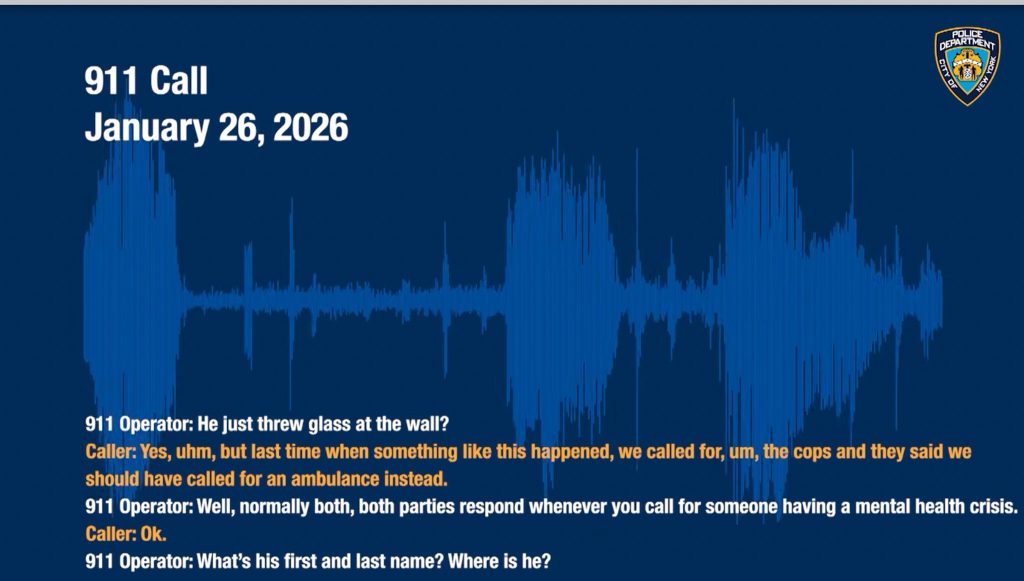
Genaro watched as four police officers crowded out of the elevator, their boots thudding through the narrow hallway of the apartment building where he lives with his parents and brother, in Flushing, Queens. The officer in front carried a shield that blocked her from head to knees, as though she were facing down a riot, though Genaro was alone.
He tried to explain that this wasn't what his family needed. He'd called 911 to ask for an ambulance for his older brother Steven, who is diagnosed with schizophrenia. Steven had been agitated and moody for weeks, not sleeping and smoking too much marijuana. Earlier that evening, he'd started an argument with their father, yelling and pounding on a kitchen cabinet.
When things like this had happened before, Genaro, who was 20 years old when the police came, tried to lay low in his room and focus on his homework. But that night, in October 2024, he felt fed up. He walked into the kitchen and told Steven not to disrespect their father. Steven got angrier and knocked over the family's TV, which shattered on the floor. Genaro’s temper snapped, and he punched Steven in the face.
Their mother, Gloria, who barely comes to Steven's shoulder, stepped between her sons and told Genaro to do what doctors and social workers had always instructed if Steven was in a crisis: Call 911 and ask for an ambulance to take him to the hospital. (Gloria asked to be identified by her first name to protect the family’s privacy. Genaro and Steven are middle names.)
By the time Genaro led the police into the apartment, Steven was sitting on the sofa, sobbing like a child. His parents assumed that soon, someone would lead him downstairs to an ambulance.
But that's not what happened. Instead, a police supervisor from the 109th Precinct showed up and started asking questions — not about whether Steven was okay, but who had done what to whom; who had broken what. “He had like a really bad attitude. Everything just got escalated,” Genaro said.
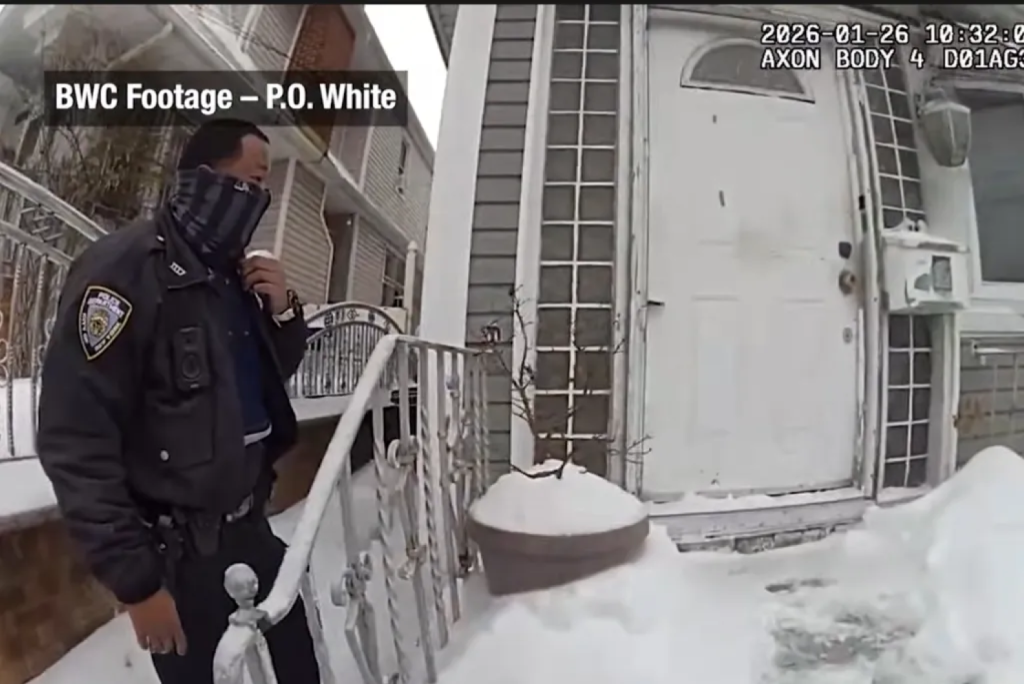
The supervisor told his officers to put Genaro and Steven in handcuffs. They were both under arrest — Genaro for assault; Steven because of the broken TV. Genaro remembers the officer nearest him asking if they could do the handcuffing outside, where Gloria wouldn't have to watch. The supervisor said no. Gloria started to scream and bang on the table, “like her heart was breaking,” Genaro said.
Gloria, who doesn’t speak fluent English, remembers pleading with a Spanish-speaking officer. Genaro was such a good kid; he’d never been in trouble. And Steven, her vulnerable, unpredictable son — what would happen to him in jail?
“How is it possible that this is happening right now?” she asked. “We were asking for help. We were not asking for the police to come.”
Broken Promises
The New York Police Department responds to upwards of 149,000 mental health emergency calls each year.
In the worst-case scenarios — the ones that make news — the person in crisis ends up dead, as has happened at least 24 times since 2015.
But even when everything goes according to plan, police encounters can cause irreparable harm. People in crisis end up in jail. They regularly get handcuffed, forced onto gurneys, strapped down and injected with sedatives against their will.
Many describe it as like being kidnapped: Their dignity is snatched away, their autonomy erased. They feel degraded. They are terrified that it will happen again.
It is hard to find an expert who argues that sending cops or hauling people to ERs is a good way to respond to most mental health emergencies. Police are not trained as mental health providers; hospital psychiatric units are usually full and admissions criteria are narrow. Once people in crisis get to the hospital, they are nearly always sent away with a referral to an outpatient clinic — which will also likely be full, with a waitlist. Researchers consistently find that sending mental health teams to respond to emergencies is safer, cheaper and more effective than sending police.
For years, officials across the city and state have promised to build better, more humane ways to respond to people in crisis.
For years, however, those promises have been broken.
Gov. Kathy Hochul said in 2022 she would fund intensive, street-based programs to work with people at highest risk of landing in hospitals or jails. Those programs have waitlists of hundreds.
A succession of New York City mayors promised to deploy mobile crisis teams to deescalate emergencies. The teams are so underfunded and understaffed that families sometimes wait days for them to show up.
In 2021, the city launched B-HEARD, a pilot program that sends mental health workers and EMTs, instead of police, to respond to 911 calls. Each mayor since has promised to expand the program across the city. And yet, five years after its launch, B-HEARD teams respond to fewer than 7% of citywide mental health emergency calls made to 911.
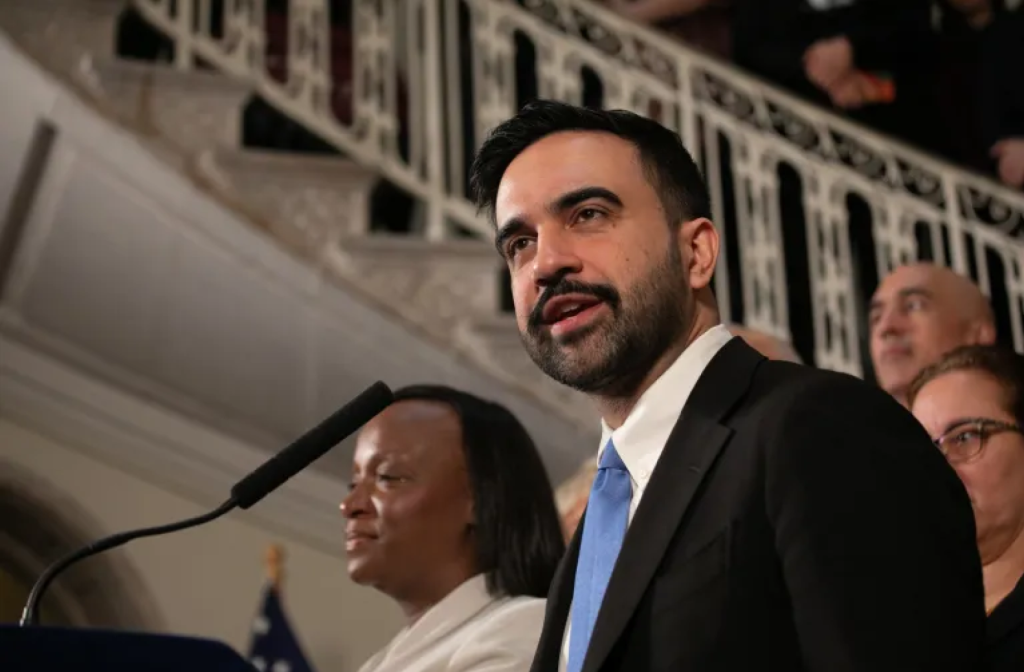
The current mayor, Zohran Mamdani, has made even bigger promises than his predecessors, campaigning on a plan to triple the size of the mobile crisis program, grow B-HEARD so big that many neighborhoods have multiple teams, and create a new, $1.1 billion city agency to oversee an “unprecedented City investment in mental health services.”
Six months into the Mamdani administration, however, those reforms are nowhere to be seen. After police shot 22-year-old Jabez Chakraborty, who was holding a knife during a mental health crisis in January, Mamdani took the comparatively small step of opening a new Office of Community Safety, with a budget of only $260 million, to oversee not only B-HEARD but violence prevention, domestic violence and other programs. The city budget, adopted June 30, includes no new money for B-HEARD.
"The Mamdani administration is committed to strengthening and expanding B-HEARD,” wrote Mamdani spokesperson Sam Raskin in an emailed statement. “When New Yorkers are experiencing behavioral health crises, they should be met with trained health professionals who can respond appropriately and connect them to ongoing care.”
‘We’re Alone’
After Steven and Genaro were arrested, police locked them in holding cells at their local precinct. Steven’s stomach hurt so badly from anxiety that he was transferred to Queens Hospital Center, where he spent the night shackled to a bed with a police officer watching him. Hospital staff prescribed medicine for his stomach pain but no one gave him a psychiatric evaluation or treatment.
His parents, worried sick, brought his psychiatric medication to the precinct, but officers turned them away. By the time he was arraigned and released, two days after his arrest, Steven was exhausted, afraid and confused.
At home, the fear only closed in tighter. Growing up, it had seemed to Steven that his horizons were infinite. He was a soccer player, tall and handsome with close-cropped black hair and big, gentle eyes. At 19, he was recruited to play for a professional team in the Dominican Republic, the Delfinas del Este. But while he was there, his luck broke. His best friend died, and he had knee surgery and was cut from the team.
After he came home, it was like his life had snapped shut. He felt like a failure, and it seemed like other people were looking at him and thinking the same thing. Steven started hearing voices. He couldn't relax, couldn't sleep, couldn't go outside. He smoked weed to slow down his mind but it made him irritable and aggressive.
His parents, contending with the relentless, stagnant grief of watching their child disappear inside a stranger, rearranged their lives so that Steven would never be left alone. Gloria quit her job as a home health attendant so she could go with him to his psychiatry and therapy appointments.
But after the arrest, Steven stopped wanting to leave the apartment at all. News footage played over and over in his mind of people being killed by police. He was scared when the doorbell rang. It seemed that police cars were slowing down when they drove past. He couldn’t shake the dislocating feeling of not really being a person — at least not in the eyes of the police or the people at the hospital or the arraignment court.
Steven locked himself in his bedroom, “just constantly thinking, ‘Is it really worth the risk, going outside or going to the store?’” he said.
Meanwhile, in the living room, his family circled around what had become an impossible question: What would they do next time Steven ended up in crisis?
They knew they’d never call 911 again, but there seemed to be nowhere else to turn. “We’re searching, searching, searching," Steven’s father said, but “we’re alone.”
Which is why Gloria was surprised, a few weeks after her sons’ arrest, to get a call with an unsolicited offer of help from an activist named Peggy Herrera.
Unheard
Peggy became an unexpectedly public figure in the world of mental health advocacy in 2019, after she called 911 to ask for an ambulance. Her 21-year-old son, Justin, was having a ferocious panic attack, breaking things and threatening to kill himself.
By the time cops arrived, Peggy was locked out of her apartment and Justin — terrified of being arrested — refused to come outside. Police wanted to break down the door, but Peggy stood in front of it. Body camera footage, which aired on local news at the time, shows what happened next: Three cops push Peggy to her knees and cuff her hands behind her back. When Justin comes outside to help his mom, they take him face-down on the sidewalk before EMTs strap him to a gurney. Peggy’s voice is raw, screaming, “Leave my son alone!”
In 2021, Justin filed a complaint against the city that, over several years, grew into an ongoing class-action lawsuit with the potential to fundamentally change how New York responds to mental health emergencies. Peggy became an activist, working to keep other people with mental health problems away from cops and out of jail. "People have an illness or they have trauma and what we do is criminalize them and put them in handcuffs," she said. "They deserve to be treated like human beings."
There was a moment when it seemed like city officials — along with much of the rest of the country — were listening. In September 2020, amid nationwide Black Lives Matter protests, outrage erupted in Rochester, New York, over body camera footage of a Black man named Daniel Prude, who was forcibly hooded and pinned to the ground by police after his family called 911 for help during an episode of psychosis. He asphyxiated and later died.
“I placed a phone call to get my brother help, not to have my brother lynched,” Daniel’s brother Joe Prude told the press.
As activists called to defund the police, dozens of cities sent delegates to study a 30-year-old program called CAHOOTS, in Eugene, Oregon, that trained EMTs and crisis workers — most of whom had experienced mental illness themselves — to respond to emergencies. Until the program lost funding in 2025, CAHOOTS teams handled about 20% of Eugene’s 911 calls, saving the city millions of dollars a year without a serious injury or fatality. After Prude’s death, nearly 100 new alternative crisis response programs cropped up across the country.
New York City rolled out B-HEARD, starting with a pilot program in three police precincts in Harlem. The goal, officials said, was to get people into voluntary, community-based services, avoid police encounters, and stop the revolving door of the emergency room.
It wasn’t long, however, before political momentum swung back towards policing and forced hospitalizations. As shutdowns related to the COVID-19 pandemic lifted, New Yorkers saw a spike in crime and an increase of visibly mentally ill people on the street. In 2022, a 40-year-old woman named Michelle Go was pushed to her death in front of a subway train by a man with a long history of psychiatric hospitalizations.
Then-Mayor Eric Adams instructed police to take more people to ERs against their will. Gov. Hochul followed suit, making it easier for hospitals to forcibly commit patients to psychiatric wards.
Meanwhile the expansion of B-HEARD stalled out. The program currently operates in fewer than 40% of the city’s police precincts, responding during limited hours to a remarkably narrow range of 911 calls. Even if a B-HEARD team had been available in Steven’s neighborhood, he would likely have been found ineligible. Like most cities with similar programs, B-HEARD screens out incidents involving weapons or violence, according to the Mayor’s Office of Community Mental Health. In practice, however, dispatchers rely on an unusually broad definition of violence — including yelling or property damage.
If a person is “banging on a car or they’re destroying items in the house, that would trigger a police response,” Assistant Chief Ebony Washington testified at a 2024 City Council hearing.
To Peggy and other advocates, the failure to expand and invest in B-HEARD is a betrayal. “What’s the point if it doesn’t get to the families who need it?” What people in crisis need, she said, is “trained peers: people who’ve been through it and know how to help you.”
So when Peggy heard about a Spanish-speaking mom whose two sons faced criminal charges after a mental health emergency, she decided to help them fight in court.
‘Don’t take it!’
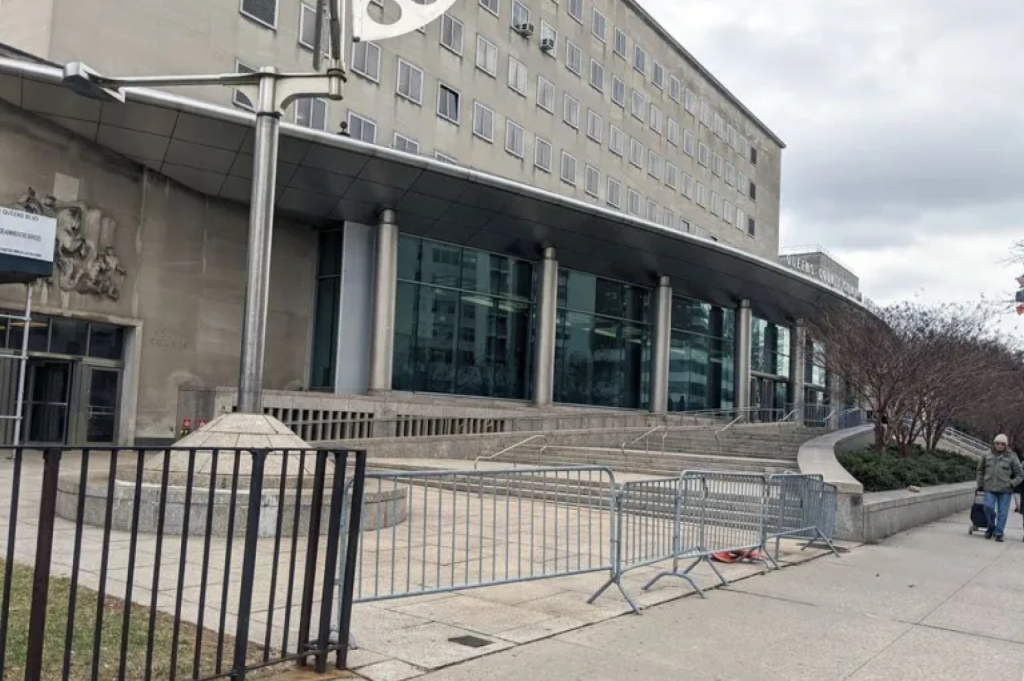
Early on the morning of his first hearing, Steven and his parents sat in an underground room of the Queens Criminal Court. Dozens of defendants surrounded them, waiting in a swampy atmosphere of tedium and fear to be called before a judge. Public defenders bustled in and out with stacks of folders, each representing a client they had likely never met.
When Steven’s lawyer arrived, she called him into a hallway to explain what was about to happen: He was facing a charge of disorderly conduct, she said, but the prosecutor was willing to offer him an Adjournment in Contemplation of Dismissal.
ACDs are common, in part, because they are efficient for lawyers and judges. If Steven stayed out of trouble for 12 months, the charges would be dropped. ACDs can pose liabilities for defendants, though, since their arrests continue to show up in immigration cases. If they are arrested again, they stand to face two sets of charges.
Steven’s lawyer didn’t explain that he had the option to fight the charge against him.
As Steven and his parents filed back into the courtroom, Gloria texted Peggy, trying to understand what Steven had just agreed to. Peggy — stuck in traffic on the Jackie Robinson Parkway — sent vehement replies:
“Don’t take it!”
“You are going to fight these charges!”
“He did nothing wrong!”
Once Peggy arrived, the attorney acknowledged that Steven could ask for a trial instead of accepting the ACD. He was called to the bench, and the judge set a date for another hearing.
Genaro’s court date was the following day. Peggy coached him ahead of time to tell his public defender that he wanted a trial — not an ACD or any other deal. But he was called to the bench without even a word with his lawyer.
Prosecutor and defender conducted rapid-fire negotiations and, in less than two minutes, Genaro found himself accepting a one-year ACD.
"I didn't really know what else to do," he said afterward.
‘A Pain in the Ass’
With Steven's next court date coming up and the ACD hanging over Genaro’s head, Peggy didn’t have to go far to find them a legal adviser: Her brother was happy to help.
Victor Herrera is small, pointy-featured and argumentative. In the 1980s, he found legal codes and grievance procedures the way some people find religion: inside Attica prison, where he was notorious for filing complaints against guards, he said. People have to listen when you’re “a pain in the ass.”
After he got out, Victor ended up in the New York City homeless shelter system, where the atmosphere seemed as despotic and deliberately humiliating as prison. He started filing complaints about drug use and missing property — being a pain in the ass.
In response, Victor said in a 2016 lawsuit, shelter staff followed what he characterized as a deliberate practice inside city homeless shelters to silence difficult residents: They called 911 to report him as an “emotionally disturbed person.”
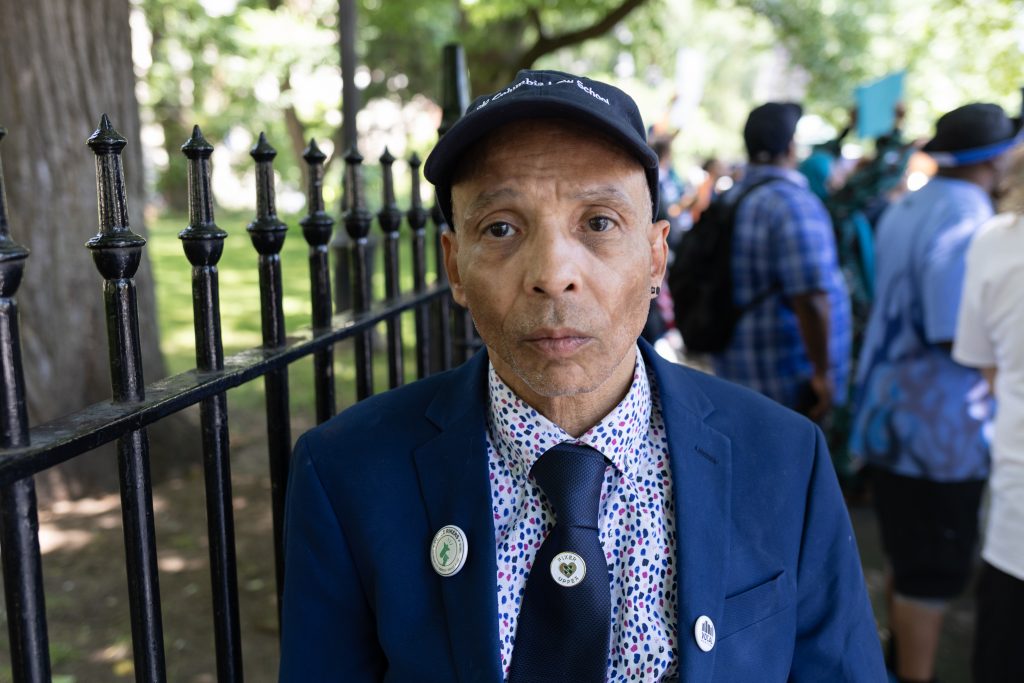
Nine times between 2014 and 2016, police and EMTs put Victor in handcuffs and strapped him to a gurney. At least once, officers slammed him against a wall and put him in a chokehold, according to his legal filings. Five times, he was injected with sedatives or antipsychotics against his will. He tried to tell police and doctors that he wasn’t experiencing a mental health crisis, he said, but when someone in a uniform says you’re crazy, nobody else is going to listen to you. “You’re dismissed, you’re dismissed, you’re dismissed,” Victor said.
Within a year, New York City paid Victor a financial settlement on behalf of its homeless services agency, public hospitals, the NYPD and the fire department. Two private shelter operators soon followed. The settlements don’t include admissions of guilt but Victor keeps photocopies of the checks. They’re proof, when he needs it, that he got heard.
The Department of Social Services did not respond to requests for comment.
After the lawsuit, Victor became one of the first clients of a city-funded Intensive Mobile Treatment program, which helped him get an apartment, encouraged him to become an advocate, and provided treatment for his depression and PTSD. A decade later, he still has flashbacks to being strapped down and sedated. “It can happen anywhere,” he said. “I just relive all that.”
When it happens, he goes home and climbs into bed with his cats, Boots and Socks. “I start questioning whether I’m still valid to be living,” he said. “The most traumatic, for me, was going to a hospital and not being heard.”
What gets him out of bed is the knowledge that people are counting on him.
‘We Have to Help Each Other’
By the time Steven had his second court date, in February 2025, the Trump administration had allowed immigration agents into city courthouses. Steven’s father, who isn’t a citizen, stood across the street and waited while Victor accompanied Steven to his hearing.
An hour later, they came out with good news: The charges had been dropped and the case was dismissed. Steven’s dad wiped tears from his eyes and shook Victor’s hand.
Victor offered to help Genaro contest his ACD. When he called the public defenders’ office, he was told that they never collected evidence — not even body camera footage of the arrest. (Steven, The City Reporter and MindSite News filed a freedom of information request for the footage in Jan. 2025. As of publication, the NYPD had not provided it, despite multiple appeals. The department also did not respond to requests for comment for this story.)
For Peggy and Victor, it was an ugly confirmation that not much had changed. After all the news stories and the promises from officials and politicians, “the system is just not set up for people who struggle with mental health,” Peggy said. “We have to help each other.”
Their best hope might lie in the lawsuit that Peggy’s son Justin set in motion five years ago.
The lawsuit now includes 10 named plaintiffs, though Justin is no longer one of them. He was shot and killed in July 2022, at his own 24th birthday party. The grief still feels like a physical obliteration, Peggy said — like a part of her body was ripped off. But the lawsuit, she said, is part of Justin’s legacy: something he left behind to make the world better.
In January, city attorneys filed a letter in court indicating that they’re ready to explore a settlement. If that happens, the terms could include a detailed, enforceable plan with a clear timeline to build a citywide, non-police response for New Yorkers in crisis, said Jenny Marashi, a lead attorney for the plaintiffs.
“Imagine if we could meet people in their most vulnerable moment with compassion instead of force,” Marashi said.
The blueprints exist for a better solution, she continued. “What you need is a number you can call, where people can come right away, with the discernment to know what you need — which is almost never an emergency room. Ideally those people are led by peers with their own experience” of what it’s like to be on the other side of a mental health call.
“Then imagine there are places to go for help, where people actually wanted to be, designed by people who use the services,” she said. “Think about the people that you know. How many of them have had at least some moment where they just couldn’t handle this freaking super hard life?”
If we imagine we’re creating a system for all of us, it could be a “thread we can follow” — not just to manage emergencies, but toward a reality where New Yorkers treat one another better in the most frightening, vulnerable moments of their lives.
“We could actually have a more healing and safe world,” Marashi said. “Let’s dream big.”
Reporting for this story was supported by the O'Brien Fellowship in Public Service Journalism. MindSite News' work in New York City is supported by the van Ameringen Foundation.
This article first appeared on MindSite News and is republished here under a Creative Commons Attribution-NoDerivatives 4.0 International License.
Therapy in a tent: The healthcare many homeless Californians need but aren’t getting
By Marisa Kendall, CalMatters

This story was originally published by CalMatters. Sign up for their newsletters.
Like many people who are or have been homeless, Jessica Scott struggles with debilitating anxiety.
When she finally moved from her stepfather’s car into a Sacramento apartment a few weeks ago, she said one thing played a major role in helping her take that step: Therapy.
“When you’re panicking so much that you can’t really talk to people, it’s difficult to do anything,” Scott said. That included making – and keeping – the numerous appointments required to find subsidized housing.
Scott used to have her therapy sessions with Anthony Villanueva, a clinician with One Community Health, on a park bench because she had nowhere else to go. But her most recent session in early July was on a blowup couch in her new living room. She credits her ability to get this housing — her first in two and a half years — partially to Villanueva teaching her breathing exercises to calm herself down.
Media stories, politicians and splashy state-funded mental health initiatives tend to focus on people who live on the street in the grip of psychosis or other severe mental illnesses — a highly visible but statistically uncommon problem. That overlooks a much quieter but more widespread issue: All across California, unhoused people are suffering at alarming rates from less obvious but potentially enervating mental health conditions, including anxiety, depression and post-traumatic stress disorder.
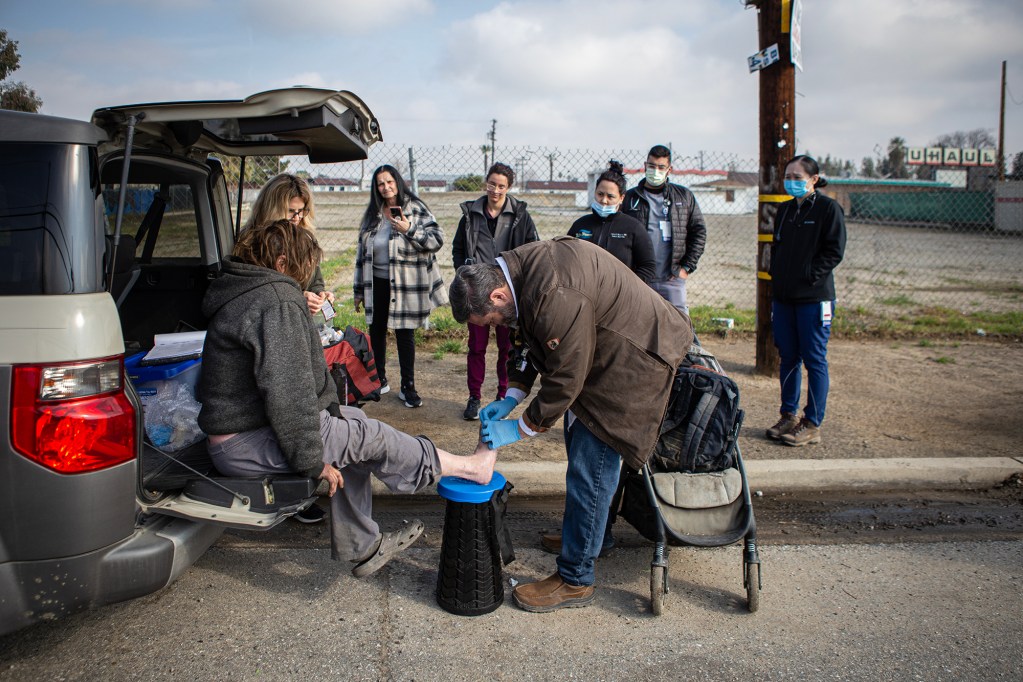
Some of those people manage to navigate the healthcare system, find a therapist and make regular trips to a clinic. Most do not. To fill that void, therapists are meeting their patients wherever they are, conducting therapy in a tent, a homeless shelter or a car on the side of the road.
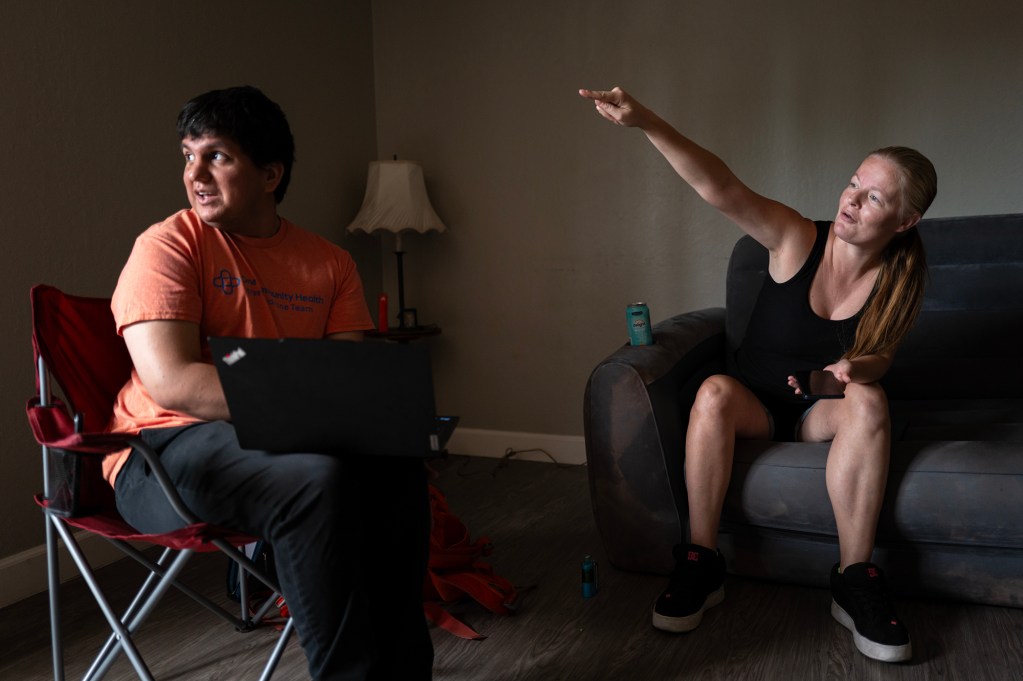
That care is a major help to people like Scott. But there are far from enough street therapists to see everyone. Recent estimates put California’s homeless population at nearly 182,000, and a UCSF study of homeless Californians found that 48% of them reported symptoms of serious depression and 51% reported anxiety.
Doctors, nurses and clinicians who work with people on the street told CalMatters the numbers are even higher. They estimate between 80% and 90% of their patients have a mental health condition that could benefit from therapy – most commonly depression, anxiety and PTSD.
“I have no capacity to see the amount of patients that we have,” said social worker Lisette Carmona, who provides street therapy in Los Angeles with the USC street medicine team.
That’s despite the fact that street medicine, which brings basic medical care (sometimes including therapy) directly to homeless people in encampments and shelters, has rapidly expanded over the past few years. What started in the 1990s as a small, grassroots movement has ballooned into at least 70 teams in 34 counties in California, said USC Street Medicine Director Brett Feldman, who is considered one of the founding fathers of the field. In 2022, the state made it easier for those teams to bill Medi-Cal, helping them grow even more.
But they’re still vastly outnumbered, a problem with broad implications, because therapy isn’t just about making people on the street feel better. Practitioners say it also can be a crucial step to getting them into housing. The housing process is difficult and complicated, requiring people to go to the DMV to replace lost identification, answer a lengthy list of questions to determine their eligibility and apply for multiple waiting lists. It can take months or even years, often with plenty of setbacks along the way.
“It’s kind of a daunting process for anybody,” said Joann Bianchi Wojick, associate behavioral health director of LifeLong Medical Care's Trust Health Center, which sends a street medicine team out to encampments in Oakland. “But when you’re feeling anxious or depressed, and you have more difficulty organizing your thoughts and your to-do list and your actions, it can feel so overwhelming."
Once someone does get into housing, if they haven’t already learned to regulate their emotions in therapy, they risk lashing out at their landlord or new neighbors. That can be a quick ticket to getting evicted and landing back on the street.
That’s why street therapy is “so, so important,” said Dr. Katherine Koh, one of the country’s early pioneers of street psychiatry, who practices in Boston.
“It needs to be part of the treatment,” she said. “I really think just meds alone is rarely going to be the solution for anybody. It’s teaching people the skills that hopefully will continue to help maintain and regulate their behavior when they move into housing, because if they don’t have that, they’re just going to end up back on the street.”
Trauma on the streets leaves mental scars
While schizophrenia is what often comes to mind when people talk about mental health and homelessness, other ailments are far more common. The UCSF study of homeless Californians found that while two-thirds reported symptoms of mental health conditions, just 12% experienced hallucinations. Depression and anxiety were much more prevalent.
Some of that is caused or exacerbated by childhood trauma. A review by The Lancet Public Health journal of more than two dozen studies found that 90% of homeless adults had been through at least one adverse childhood experience, and more than half had been through four or more.
Living on the street is also terrible for people’s mental health. They suffer mental scars left by physical and sexual assaults experienced while homeless, psychological damage from having to maintain a constant state of hypervigilance and the mental anguish of feeling unwanted by society.
“It’s just causing a lot of suffering in our patients’ lives,” said Dr. Shane Collins, a psychiatrist on the USC street medicine team.
California’s “housing first” system prioritizes getting people into housing above all else, promising mental health care and other services will come once someone moves indoors. But housing is in short supply, and thousands of people are stuck waiting on the street without mental health care. Meanwhile, Gov. Gavin Newsom has put a significant focus recently on helping unhoused people with schizophrenia and other acute mental illnesses. He launched CARE Court, a court-based program that connects people in psychosis with treatment, and backed a 2024 statewide bond to fund mental health and substance use treatment beds.
In addition, some cities, including Los Angeles, have mobile outreach teams dedicated to helping people on the street with severe mental illnesses.
But for the thousands of unhoused people dealing with less-obvious mental health conditions, it’s easy to fall through the cracks.
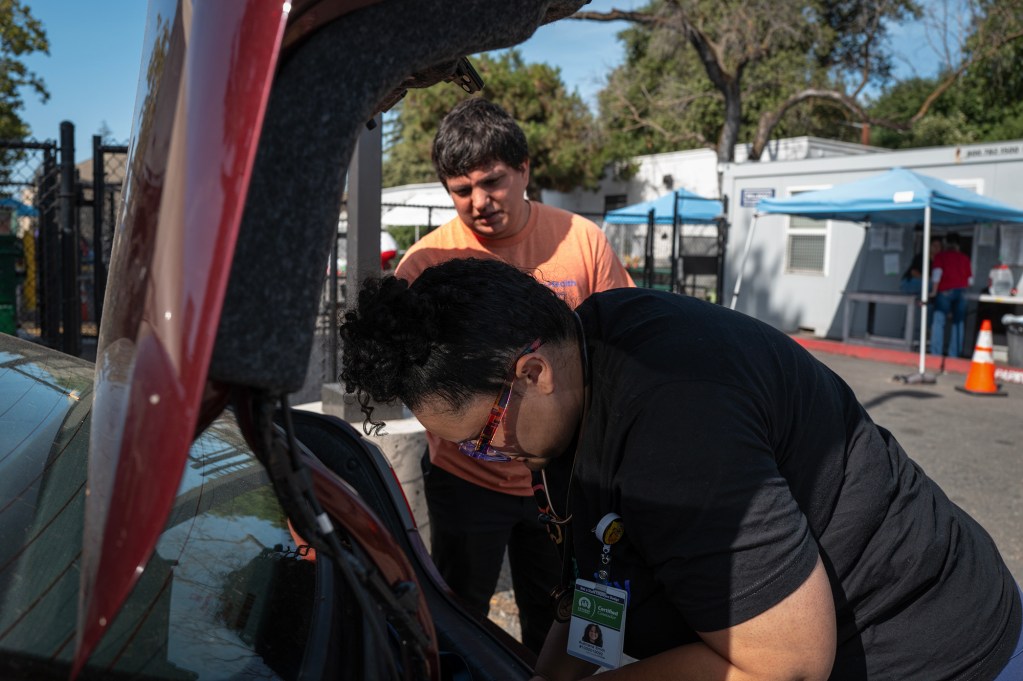
Terri Roman, 57, has been homeless for 10 years. That’s plenty of time for the day-to-day brutality of life on the street — from drivers leaning on their horns at 4 a.m. just to be cruel and wake her up, to other unhoused people stealing her belongings — to take a toll on her mental health.
“The hard thing to cope with is the dislike of homeless people from everybody,” said Roman, who lives in an RV in Oakland with her partner and a dog named Bonehead. “It feels like nobody wants you anywhere.”
Like so many unhoused people, she’s also experienced bloodcurdling trauma while homeless. She witnessed a murder and then had to testify in court against the alleged killer — her own ex-boyfriend. Another time, she was grabbed, slapped and kicked by two masked men trying to steal her car at a gas station in the middle of the night.
“That’s really damaging,” she said. “Now I’m hyper-vigilant. I go off on people.” She glanced around as she spoke, constantly scanning her surroundings.
She could really use someone to talk to and help her process her trauma, Roman said.
When she asked her local street medicine team about counseling, they referred her to the Native American Health Center. She went for eight months. But it was hard to get there if she didn’t have money for gas. And she’d lose track of the appointments, with her phone constantly running out of battery and having nowhere to charge it. She missed three appointments, and said the center dropped her as a patient. Now she’s waiting to get back in.
It would help immensely if a therapist came to see people on the street instead, she said.
“Then homeless people would feel they had someone to turn to,” Roman said. “Or they would feel they’re not alone.”
Meeting people where they’re at
Some lucky street medicine teams have a psychiatrist, but psychiatrists willing to go to homeless encampments are scarce and their time is expensive. That means they often go out on the streets just one day a week, and tend to focus on diagnosing mental health conditions and prescribing medications. That leaves little time for therapy.
Collins, the psychiatrist on the USC street medicine team, estimates his team can provide therapy to only about 5% of the patients who could use it.
If street medicine teams do provide therapy, it’s usually done by social workers like Carmona, who works alongside Collins.
“I am doing therapy anywhere where my patient is at,” she said. “So you can find me on the riverbed, you can find me in a tent…Wherever the patient is comfortable, that’s where I'm conducting their therapy.”
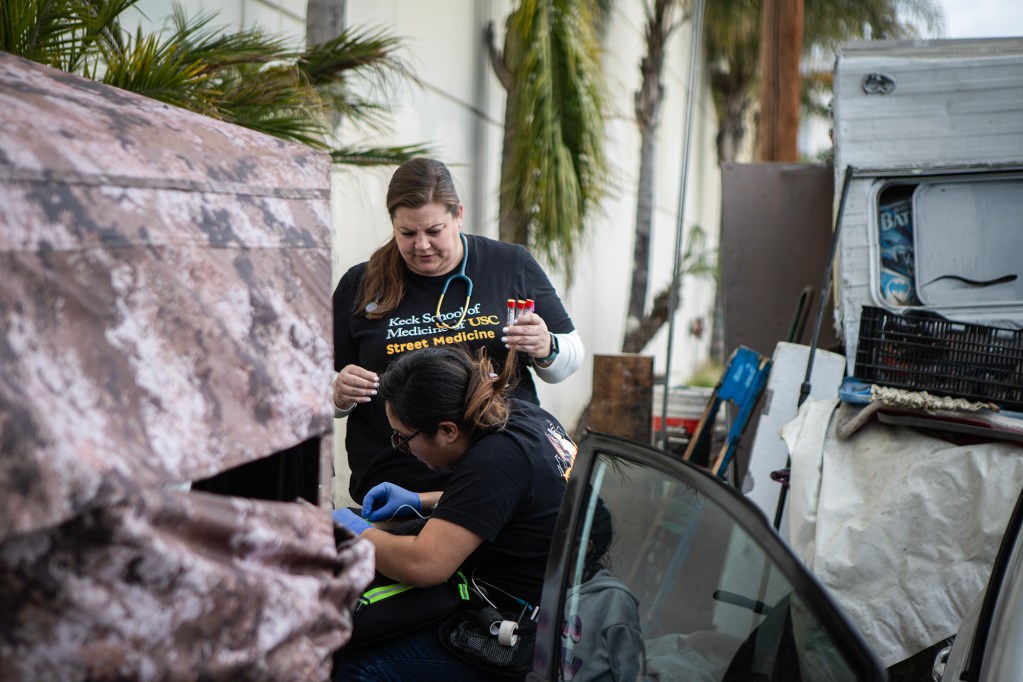
Her sessions can last anywhere from 15 minutes to an hour and a half, depending on the patient. She sees some people once a week and others more sporadically. Because her patients can’t escape to a quiet room to be alone when they are upset, or zone out in front of the TV, Carmona thinks up alternative coping strategies for them, such as coloring and journaling. She also does short-notice calls for patients in crisis.
For Bert Andernié, 52, therapy helps him deal with the soul-crushing disappointments he experiences on the streets of San Francisco. For example, in May, his caseworker told him he’d gotten a housing placement. Later, he was told that actually, no, there wasn’t a spot for him. He still doesn’t know what happened.
“I was so pissed I was crying on the bus,” he said. “I was livid.”
Andernié doesn’t have many other people to talk to about his problems, so he hashed out his frustration with the therapist he got matched with after applying for the city’s General Assistance benefits.
“It’s nice to have somebody say, ‘yeah, you’re right, that is messed up,’” he said.
The debate over how to best use scarce therapy resources
Not everyone agrees that conducting therapy on the street is a good use of time. Some medical providers prefer to wait until someone is housed, or at least in a shelter.
Hollywood 2.0, a mental health team that prioritizes the sickest unhoused people in Los Angeles’ Hollywood neighborhood, doesn’t do traditional therapy on the street.
“It’s really hard to catch folks and catch them sober,” said psychiatrist Dr. Chance Cruz. “A lot of times I can't even get a logical answer out of someone because they’re high. So that person couldn’t engage in therapy at that time.”
Dr. Chad Koyanagi, one of the national pioneers in street psychiatry who practices in Hawaii, prescribes medication but doesn’t do therapy on the street. “Probably their focus is going to be on finding their next meal, not their relationship with their parents,” he said. “That stuff is going to be dealt with at a later time when their basic needs are taken care of.”
Patients in therapy must feel safe before they can recover, and that’s often impossible when living on the street, said Rory Rieger, who oversees the Ritter Center’s behavioral health team in Marin County.
“There’s only so many things you can do when a person has that many vulnerabilities and is that stressed,” he said. “Therapy really doesn’t work for someone who is that stressed out.”
What his patients really need to make a dent in their mental health is housing.
Carmona “vehemently disagrees" with the idea that clinicians can’t do real therapy on the street, and says that idea caters to the comfort of the therapist, not the patient.
Carmona has seen patients who seemed hopeless when she met them quickly regain their optimism after starting therapy. The wins aren’t always monumental. Some weeks, it’s small victories, such as when a patient gets upset but refrains from self-harm.
Other teams use a both-and approach, such as LifeLong Medical Care in Alameda County. Initially, their street therapy is often crisis management — helping someone cope with losing their belongings in a sweep or get through their depression, said Bianchi Wojick, associate behavioral health director of the LifeLong Medical Care clinic. Once someone gets into a shelter or housing, they can more deeply explore their past trauma.
Even without an official therapist, regular medical check-ups on the street can look a lot like therapy. It’s not uncommon for patients to spill their hearts, or even cry, while an empathetic nurse is taking their blood pressure on the sidewalk.
For Valerie Campos, gamechanging mental health care didn’t come on the street — it came in a tiny home. She’d grown up homeless and then continued the pattern as an adult in Southern California, ending up getting trafficked and sexually abused. That trauma devastated her mental health. She developed PTSD, as well as depression and anxiety so severe that she couldn’t drive a car on the freeway.
“It was just terrible,” said Campos, 49. “It was hard to live minute by minute sometimes.”
During the COVID-19 pandemic, Campos moved into a tiny home transitional housing program in Redondo Beach. All of a sudden she had access to something that had seemed unreachable on the street: counseling.
Counselors came to Campos’ tiny home every two weeks and stayed as long as she needed. They didn’t judge her or her past, and so she began to open up, talking about her childhood, her homelessness, and everything she’d been through.
They taught her coping skills, the warning signs that could indicate her depression was rearing up again, and how to journal and keep track of her moods. They helped her get medication for depression and anxiety. She learned to recognize, and stop, her self-sabotaging behaviors.
“I’m a whole different person,” Campos said. “I’m back on the freeway, driving.”
Four years ago, Campos moved from the tiny home into her very own apartment in Gardena, thanks to a federal housing voucher. She isn’t sure how much longer she’ll be able to stay, as the program paying for her apartment — the federal Emergency Housing Vouchers — is running out of money, and Campos has been told her subsidy will end in December.
But she does know that getting mental health support saved her. Without it, she wouldn't have been able to hold down an apartment. And without an apartment, she doesn’t think she would have made it.
“I don’t think I would be here right now,” she said, “if it wasn’t for the counseling and the housing.”
This story was reported with support from the Rosalynn Carter Fellowship for Mental Health Journalism.
This article was originally published on CalMatters and was republished under the Creative Commons Attribution-NonCommercial-NoDerivatives license.
New Orleans Haitian community reeling in the wake of U.S. Supreme Court ruling
by Cris Seda Chabrier, Verite News New Orleans
July 8, 2026
Between French hymns and Kreyòl singing, the fear and outrage at the recent U.S. Supreme Court ruling that allowed the government to end legal protections for Haitians was palpable among congregants at First Haitian Baptist Church.
“Gangs take over businesses, homes,” Pastor Jean Wilfrid Alexis, who leads the congregation, told Verite News after a recent Sunday service. “To go there is to go to die.”
The termination of temporary protected status (TPS) in Mullin v. Doe is expected to affect roughly 350,000 Haitians and 4,000 Syrians nationwide, leaving them unable to obtain legal employment and live in the United States. Greater New Orleans has a Haitian population of around 2,300, according to the latest U.S. Census estimates. The ruling will affect approximately 10 people in First Haitian’s congregation, according to church leaders.
Naomi, a former TPS holder and congregant, came to the United States with her children, who are now adults, in 2021. She has been unemployed since February and said, through a translator, that she felt broken by not being able to work.
Since 2025, the Trump administration has stripped nationals of at least eight countries of TPS, including Venezuelans and Hondurans, that, with a population of almost 29,000, are the largest group of Latino immigrants in the Greater New Orleans area.
The majority of immigrants do not have criminal records, according to Transactional Records Access Clearinghouse data. Haitians tend to fill low-paid positions in healthcare that are chronically understaffed, such as elderly care and nursing home assistants.
Nora Ahmed, legal director at the American Civil Liberties Union of Louisiana, said that the Trump administration has been stripping legal status from documented immigrants to then deport them.
“What this administration has largely done since it came to power was identify, I always say, documented people, and then sought to arrest documented people because they know exactly where they are and what they're doing, because by and large they report to ICE,” she said.

Congress created TPS in 1990 to give status and work authorizations for people fleeing war, natural disasters and other “extraordinary and temporary conditions” that prevent migrants from safely returning home. President Donald Trump and former Secretary of Homeland Security Kristi Noem attempted to end TPS for Syrians and Haitians in June 2025, but were blocked by lower courts.
Haiti first received TPS in the wake of a catastrophic 2010 earthquake. It has been continually renewed for that country because of political instability and other natural disasters. In 2021, the Biden administration extended it due to the assassination of President Jovenel Moïse and the subsequent takeover of Port-au-Prince by gangs.
“It is temporary protected status based on the country's condition, that is the key,”said Guerline Jozef, the founder and executive director of Haitian Bridge Alliance, a nonprofit that is co-counsel on NTPSA v. Noem, another legal challenge to the termination of TPS for Haitians and Venezuelans.
In Mullin v. Doe, the Supreme Court held that a provision in the TPS statute barred any lawsuit challenging the Department of Homeland Security secretary’s decision to extend or end TPS on non-constitutional grounds.
“The Court said that questions of whether the DHS secretary followed the law cannot be heard by courts in the first place, meaning that in the future even an openly unlawful decision to grant or terminate TPS could be entirely insulated from judicial review,” wrote Aaron Reichlin-Melnick in an explainer published by the nonprofit American Immigration Council.
The Supreme Court majority determined that President Trump's racist remarks — such as saying that the Haitian community in Springfield, Ohio eats cats and dogs — did not violate the Constitution’s equal protection clause. The justices did not take into consideration a leak of internal emails that showed DHS moved to terminate the protections without seeking input from the State Department.
The ruling follows increasing partisan polarization in the nation's highest court, whose decisions have led to ample criticism and plummeting public confidence as people see the Republican majority supportive of the Trump administration’s agenda. Critics say the ruling is underscored by historic racism and white supremacy.
“It is very disturbing, very concerning that in 2026 we still have justices who are willing to fall in line with the anti-Black extreme racist ideology in government, including a Black justice, to show you how deeply ingrained this mentality is, and continues to be,” Jozef said.
While TPS was never supposed to provide a clear legal pathway to permanent residency or citizenship, Haitians made their homes in the United States with the legal protections, and now they face deportation to a country beset by gang violence and massacres. In February, four Haitian women deported from Puerto Rico were found decapitated and thrown into a river within months of arriving in Haiti, according to Leonard Prophil, a Haitian community leader who lives in Puerto Rico.

The First Haitian Baptist Church congregation is no stranger to this violence.
“I have one lady who has her husband in Haiti, who now he cannot go public because he's hiding himself because he had been kidnapped,” said Estaniel J. Pierre, the finance manager of the church who has helped members protected by TPS. “They will not find anything, anywhere, any place to live, any house to live, because the gang members, they took their houses. If they go back, they will be homeless.”
There are few avenues for migrants stripped of TPS to legally remain in the U.S., particularly because the Supreme Court decision coincides with a constantly shifting legal landscape. Lawyers representing refugees in New Orleans say they cannot keep up with the changes in law and that they are struggling to reach clients that have been detained by U.S. Immigration and Customs Enforcement (ICE).
“You have five bases for asylum. The nexus has to be based on race, religion, nationality, political opinion, [particular social group]. Everybody understands political opinion, right? But membership in a particular social group, like young men who are being recruited to be in gangs (or young women), where the courts are trying to say, ‘Well, that's not really a particular social group,’ and they're trying to make it as difficult as possible for respondents or applicants to meet the standards,” Regine Dupuy, an attorney with NOLA Diaspora Immigration Law, said.
The decision will likely result in family separations and tear away people from communities, according to advocates.
On Sunday, Pastor Alexis displayed a photograph of a congregant — a father taking a selfie with his two young children. The man has been in ICE detention for at least a month. As he displayed the photo, he urged the congregation to support his family.
“If you cannot do anything, you cannot work, you don't have anything to eat,” Pierre, the church’s finance manager, told Verite News. “We can support you as a church.”
This article first appeared on Verite News New Orleans and is republished here under a Creative Commons Attribution-NoDerivatives 4.0 International License.

How The Death Penalty At 50 Is Far More Broken Than We Knew
The racial disparities, the arbitrary outcomes, the endless waiting and the risk of executing the innocent persist.By Maurice Chammah and Jill Castellano
Additional data reporting by Steven Rich
Graphics by Jill Castellano
This article was first published by The Marshall Project, a nonprofit news organization covering the U.S. criminal justice system. Sign up for their newsletters, and follow them on Instagram, TikTok, Reddit and Facebook.
Fifty years ago, Americans set out on a polarizing mission: to find a just and fair way to punish the worst of the worst crimes by execution.
In some ways, this was a surprising choice. In 1972, a narrow majority of the U.S. Supreme Court had scrapped the country’s entire death penalty system, calling it “morally unacceptable,” “racially discriminatory” and “arbitrary.” It seemed possible that Americans might join our peers in Europe and Latin America, many of whom had ended executions for good.
This article was published in partnership with The Guardian.
But then Americans, as we often do, went our own way. In the summer of 1976, the Supreme Court issued another landmark decision, Gregg v. Georgia, that brought the death penalty back with a set of attempted fixes intended to make it less arbitrary, including guidance for jurors and automatic appeals.
On the 50th anniversary of Gregg v. Georgia, The Marshall Project analyzed more than 9,000 death sentences handed down across the nation since states brought the punishment back. The analysis also coincides with the release of “The Last 12 Weeks,” The Marshall Project’s new podcast with Serial Productions and The New York Times. The podcast features a case that has dragged on for more than 30 years, and the data suggests this is typical: People on death row and the families of their victims often have to wait decades for a resolution to their cases.
And most of the time, the outcome is not an execution.
If one goal of the death penalty is to deter crime, it’s hard to imagine anyone being deterred by a very low chance of being executed decades in the future. Last week, Ohio Gov. Mike DeWine called for his state to abolish the death penalty, due to its failure as a deterrent and the emotional cost to victims’ families.
“Our system is an epic fail,” said Frank Baumgartner, the University of North Carolina at Chapel Hill professor who spent years gathering the data along with researchers from the Death Penalty Information Center. “Every flaw they sought to rectify has been a failure, and now there are new problems that didn’t used to exist.”
Black people are still overrepresented on state death rows. And whether someone gets the death penalty still depends more on where they commit a crime than on the crime itself. But the new data also reveals how rarely a death sentence ends as lawmakers intended: Fewer than 1 out of every 5 people sent to death row has been executed.
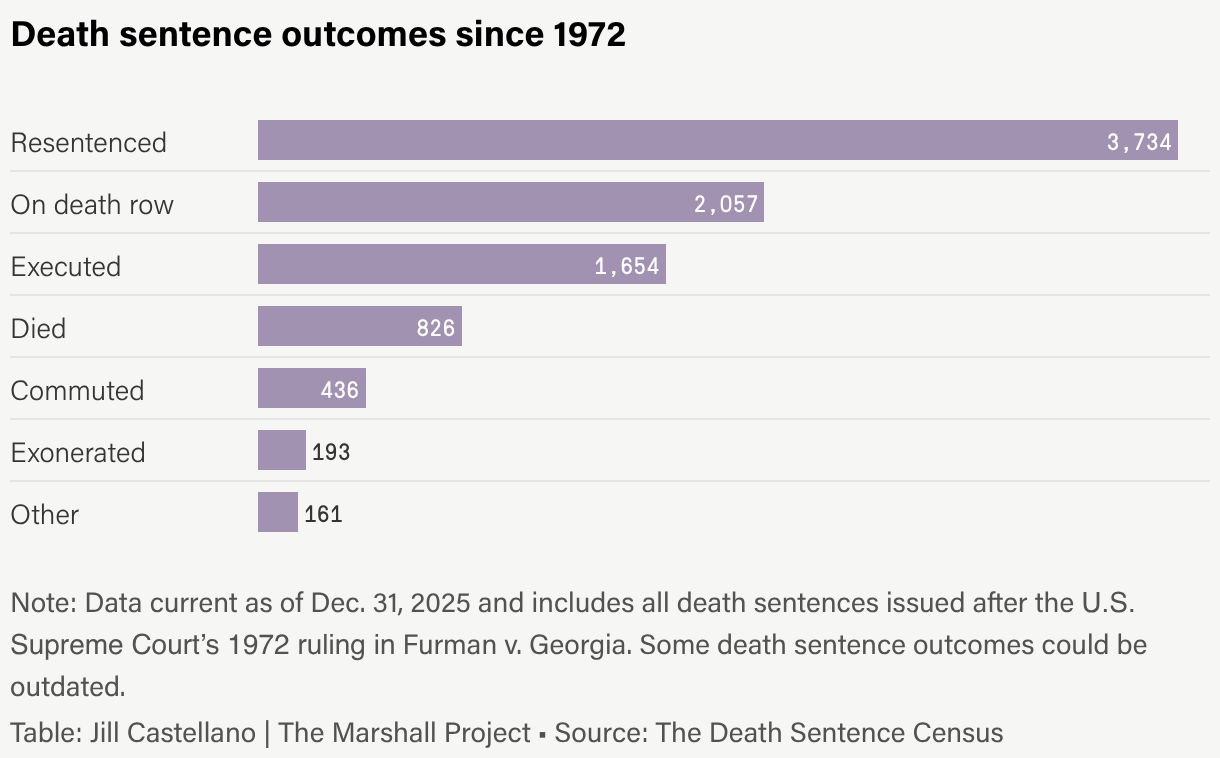
Supporters and opponents of capital punishment can debate who is to blame for this dysfunction, but the new data gives us a window into why the death penalty remains so broken.
States passed new laws and started issuing new death sentences in 1972, inviting the Supreme Court to approve these efforts a few years later. Soon after, a network of highly skilled defense lawyers emerged — often with federal funding — to specialize in death row appeals. (We feature several such lawyers in “The Last 12 Weeks” podcast.)
These lawyers often opposed the death penalty as racist and immoral. They dug into trial transcripts and sent out investigators who found all kinds of problems, from prosecutors making racist statements and kicking Black people off juries to defense lawyers literally falling asleep at trial. Eventually, defense lawyers convinced the Supreme Court to nix the death penalty for crimes committed before the defendant turned 18 and for people with intellectual disabilities.
All of these developments — the failures at trial and the defenses’ successes at finding them — help explain why more than a third of death sentences handed down over the last 50 years have been thrown out by the courts. When that happens, prosecutors can seek a new death sentence, and sometimes they do so multiple times. Curtis Flowers, whose case was made famous by the podcast “In the Dark,” faced the death penalty in Mississippi courts six times before the charges against him were finally dropped.
But in other cases prosecutors have agreed to let the defendant plead guilty in exchange for a life sentence, or jurors refused to give the death penalty again. “It's such an inefficient system, as you're wasting huge amounts of money on capital trials that end up in reversals 20 years later,” Baumgartner said. These trials regularly hit the million-dollar mark to pay for all the lawyers, investigators, and expert witnesses involved.
The 1990s saw the emergence of DNA testing and legal efforts to overturn wrongful convictions, like the Innocence Project. It became more common for judges to free people from death row — 1 out of 50 cases since 1972 — due to evidence of their innocence.
But it wasn’t always a court that stepped in to stop an execution: In more than 400 cases, a governor or president has commuted someone’s death sentence. The reasons vary. Sometimes it’s because a state abolishes the death penalty, as 23 have done. Other times, a leader wanted to stop a successor from executing people; President Joe Biden freed 37 men from federal death row before leaving office. (He did not free three men convicted of mass shootings whose commutations would have been especially controversial: Dylann Roof, Dzhokhar Tsarnaev, Robert Bowers.)
Another big reason why people are not executed can be boiled down to politics. Support for the death penalty in polls has declined to around 50%. Amid pressure from activists and the public, pharmaceutical companies began refusing to sell their products for lethal injections. Governors like Ron DeSantis of Florida and Greg Abbott of Texas made executions a priority, and their states found new suppliers or alternate methods like firing squads. But others gave up.
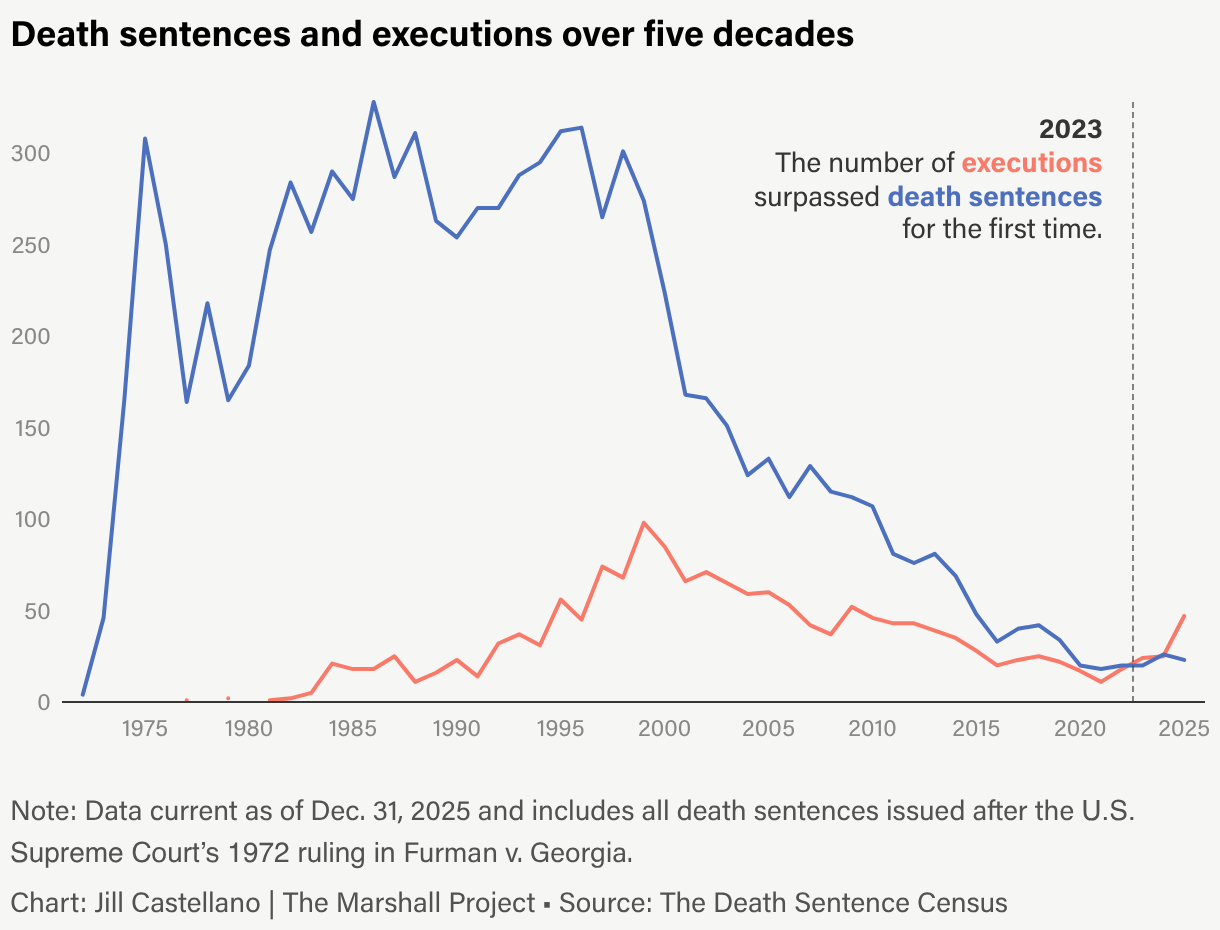
Meanwhile, some governors oppose the death penalty on paper, but risk political blowback if they go too far. Gov. Gavin Newsom of California and Gov. Josh Shapiro of Pennsylvania both halted executions in their states, but neither has commuted any sentences. The result is that more than 700 people remain on death row in those states — a de facto life sentence that costs far more taxpayer money, given the ongoing appeals.
Of the more than 9,000 death sentences over the last half-century, 8% of cases have ended with the condemned person dying by causes other than execution. Some of those ended in suicide. At least one person was killed by another prisoner.
Put together complex legal processes and political ambivalence, and the result is a system that takes a very long time to reach unpredictable outcomes.
The average person executed last year waited on death row for almost 27 years. Three decades ago, the average wait was only 12 years. The irony is that lawmakers have spent a lot of that time trying to limit appeals and quicken executions. They have evidently failed, while also increasing the risk of executing innocent people, by restricting what kinds of evidence they can bring to court.
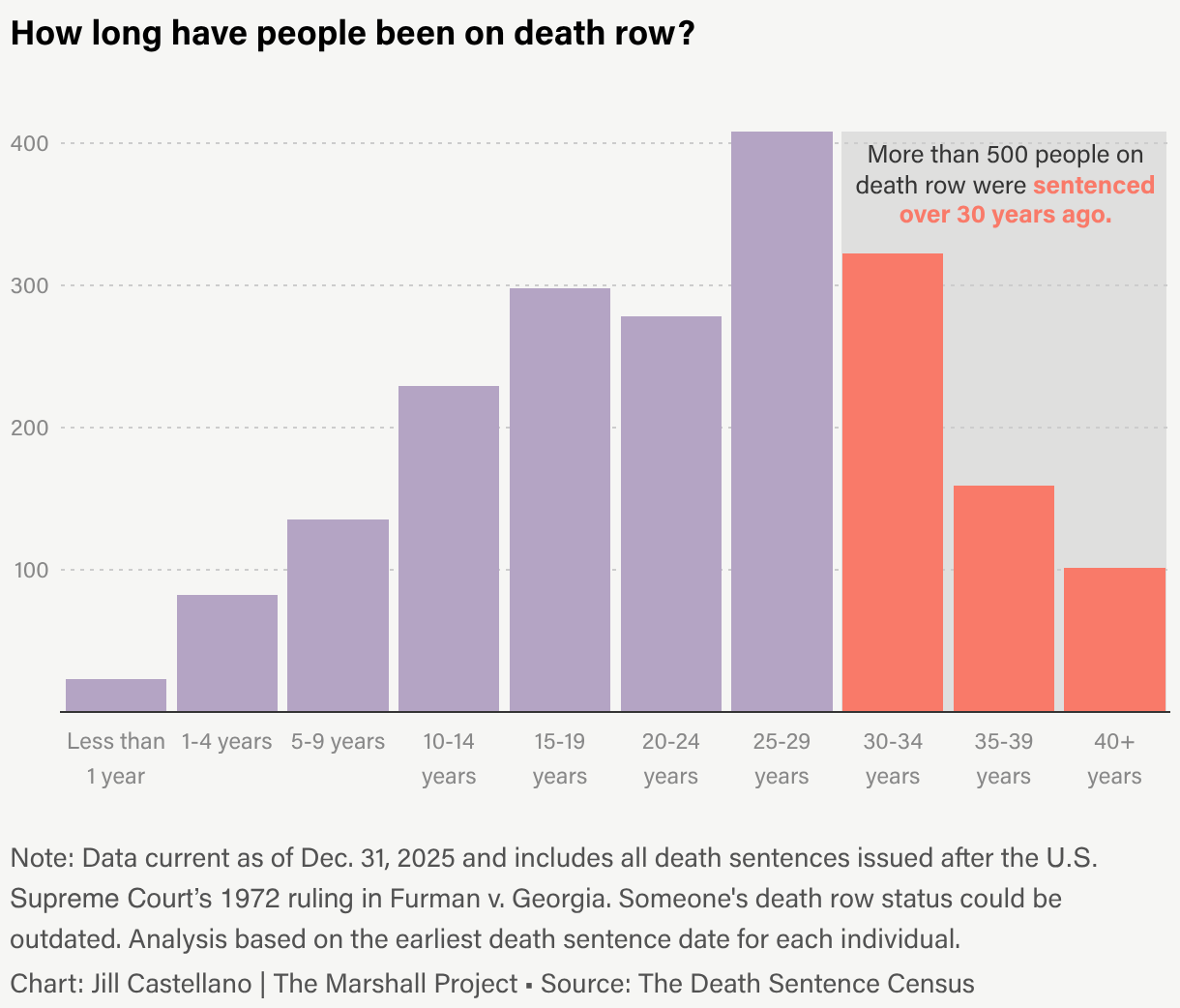
There are now more than 2,000 people on death rows across the country. More than a quarter of them have been there for more than 30 years. “They’re not leaving, so they’re just going to go into geriatric care,” said Baumgartner.
The punishment’s future is anything but clear. Jurors are sending fewer people to death row. At the same time, President Donald Trump is pushing for a revival and talking about bringing back firing squads. But there is little indication that any of the problems that have bedeviled the punishment for the last half century — the racial disparities, the arbitrary outcomes, the endless waiting, the risk of executing the innocent — have been fixed, or whether they can be.
Can guaranteed income help people leaving incarceration? Two NC local governments are testing it
by Rachel Crumpler, North Carolina Health News
July 6, 2026
By Rachel Crumpler
James Earquhart, 66, walked out of prison in December.
After 15 years behind bars, he suddenly had to find a place to stay, look for work and figure out a way to rebuild his life.
“It’s a lot of complications getting out and not having anything to come to,” Earquhart said.
About a month later, he got a call with unexpected good news: His name had been drawn in a lottery for a new pilot program in Durham named ROOTED (Resources & Opportunities for Ongoing Transition, Empowerment & Dignity).
Earquhart is among 107 formerly incarcerated people living in Durham getting monthly financial assistance through the program — $8,400 over the course of a year. Participants must earn no more than 60 percent of area median income, have spent at least nine consecutive months incarcerated and have been released after Jan. 1, 2024.
Earquhart has used the money to pay rent at a transitional house, buy clothes and cover other necessities. While working a landscaping job, he said the program’s monthly payments have helped ease the financial strain of starting over.
“Without it, right at this point in time, I would probably be out there on the street,” he said.
Every year, more than 18,000 people are released from North Carolina state prisons, and thousands of others leave county jails. Many return to their communities without the resources or support needed to rebuild their lives and face barriers to basic needs such as housing, employment and health care.
The city of Durham, along with Mecklenburg County, is testing whether guaranteed income can help formerly incarcerated people stabilize their lives and reduce costly cycles of recidivism.
An April 2026 report from the North Carolina Sentencing and Policy Advisory Commission found that 41 percent of nearly 12,000 people released from North Carolina state prisons in fiscal year 2023 were re-arrested within two years, and 37 percent were sent back to prison.
This revolving door into prison has a steep price: Housing one person in a North Carolina prison costs taxpayers more than $54,000 per year.
With incarceration carrying financial and community costs, Durham and Mecklenburg officials are exploring whether guaranteed income can be a cost-effective way to help people succeed after release and thus reduce the need for future spending.
Early outcomes are encouraging, program leaders say, and they’re going to keep tracking the results to help government officials decide whether to keep funding the initiatives.
“Our goal is to stabilize, to bring a greater sense of well-being and to ultimately reduce or eliminate recidivism,” said Shannon Delaney from Durham’s Community Safety Department, which is overseeing the ROOTED program.
Looking for reentry support? Check out our resource page.
Why guaranteed income?
Guaranteed income programs provide unrestricted, recurring cash payments to people to boost their financial stability. In recent years, local governments across the nation have launched such programs with varying payment amounts, duration and populations served, including pregnant women and people experiencing homelessness.
While critics question this use of public funds, a growing body of research suggests guaranteed income programs reduce financial stress, improve mental and physical health outcomes and increase housing and food security. Recipients primarily spend the money on groceries, rent and debt reduction.
Lauren Brinkley-Rubinstein, who studies incarceration and health, is part of a multidisciplinary team of researchers from Duke University that is evaluating Durham’s ROOTED program.
Only a handful of guaranteed income programs, she said, have specifically focused on serving formerly incarcerated people. It’s a population that faces steep economic barriers because many leave incarceration with little or no savings, and their criminal records hurt their chances of finding jobs. Only 37 percent of people released from state prisons in 2024 reported employment within a year after their release date, according to N.C. Department of Commerce data. Their median wages were just $8,518.
“I think it’s particularly important for this population,” Brinkley-Rubinstein said. “The experience of incarceration is so destabilizing, that when people leave, it is very difficult to find a job.
“Giving people a small amount of cash, relative to what it takes to survive, I think can go a really long way.”
Durham officials aren’t starting the ROOTED program from scratch. In March 2022, the city launched a similar one-year guaranteed income pilot program called Excel as part of Mayors for a Guaranteed Income, a nationwide initiative. The pilot, funded mostly by a donation from Twitter co-founder Jack Dorsey and other private donors, provided $600 per month in unconditional cash payments to 109 formerly incarcerated participants.
Researchers at the Center for Guaranteed Income Research at the University of Pennsylvania’s School of Social Policy & Practice evaluated the program. Their 82-page report published in February 2025 found recipients were significantly more likely to maintain full-time employment and had higher food security and housing stability, compared with the control group not receiving payments. Recipients also reported less difficulty abstaining from substances, staying away from criminal activity and avoiding probation or parole violations.
After seeing those results, Durham City Council members allocated $1 million to launch another one-year guaranteed income program.
“Our goal is shared prosperity, and so one way to do that is to make sure people who have the toughest time finding housing and jobs have some support to give them a little bit longer runway to find that,” Durham City Council member Carl Rist told NC Health News. “It’s both to really provide that support for individuals, but also we know, as a community, it’s one way to reduce crime.”
While Rist acknowledges there are skeptics of guaranteed income, he argues the investment is worthwhile and cost-effective if one year of supplemental income helps prevent the steeper public cost of reincarceration.
ROOTED gives participants a choice between two payment structures: steady monthly payments of $700 or larger payments at the beginning of the program that taper over the course of the year. Researchers hope the comparison will show whether one option is more successful than the other, which could shape future guaranteed income programs.
Jesse Lopez, a research scientist at the Wilson Center for Science and Justice at Duke Law who is evaluating the ROOTED program, said the payment structures were selected fairly evenly by participants.
“Those who chose the larger upfront payment described using it to just get rid of some immediate obstacles, like they needed to repair a vehicle, they needed to reinstate a driver’s license, they needed to put down a down payment or deposit for rent,” Lopez said. “Other people were trying to be very strict and were thinking in terms of a budget and wanting to create stability and plans, so they can avoid overspending and build long-term financial discipline.”
At the start of the study, Lopez said a large number of participants were dealing with food, housing and financial instability.
Lopez doesn’t expect guaranteed income to eliminate every barrier participants face, but he hopes studying the results will show where the payments make the biggest difference. Researchers will compare participants’ outcomes to those of applicants not selected for the program.
Mecklenburg tests the approach
Mecklenburg County, home to North Carolina’s largest jail, is testing a similar initiative. More than 1,000 people returned to the county from state prison in 2025.
Sonya Harper, who has led Mecklenburg County’s Criminal Justice Services for a decade, said many people seeking reentry assistance arrive with “next to nothing.”
“They don’t have housing plans, they don’t have any source of income or job or anything, and that’s our starting point,” Harper said.
Criminal Justice Services launched RAMP Up (Reentry Assistance Mobility Program) in July 2024 after Mecklenburg County commissioners allocated $500,000 for the pilot program. The program provides $600 a month for a year to 60 randomly selected formerly incarcerated Mecklenburg County residents.
Program eligibility is narrower than Durham’s program, as RAMP Up excludes people convicted of certain violent felonies, firearm offenses and sexual offenses. Harper said county leaders intentionally adopted narrower eligibility to reduce the likelihood of public pushback.
Before receiving their first payment, participants had to complete a financial literacy workshop. They also complete quarterly budgets throughout the year. Harper said those requirements are important because they reinforce that the payments are a temporary boost, not permanent assistance participants should come to rely on.
“We settled on it being $600 per month because we wanted it to be enough funding to where it could be impactful and make a change each month, but we didn’t want it to be so much that folks could become dependent on it,” Harper said.
Another 60 residents were selected as a comparison group so county leaders could better measure the program’s impact on reentry outcomes.
Harper said housing outcomes have been one of the clearest signs of the program’s impact. At enrollment, more than two-thirds of RAMP Up participants were living in transitional or temporary housing. By the end of the year, that number was reversed — 69 percent were living in permanent, stable housing. Harper attributes that improvement to many participants putting their payments toward housing.
In contrast, only 47 percent of the comparison group said they had permanent housing at the end of the year, and 13 percent of them said they were homeless.
In the first year of the program, only 5 percent of RAMP Up participants had been re-arrested and were back in custody. Before entering the program, participants had been arrested an average of 8.7 times and had most recently spent an average 49 months incarcerated.
Those initial results convinced county leaders to continue the pilot. The RAMP Up program just started its third cohort July 1, and Harper said data from all three years will be compiled into a report that county commissioners will use to determine whether to make the program permanent with recurring funding.
“If you’re able to meet your basic needs, you’re less likely to be out and reoffend,” Harper said. “This is much less expensive than what it would be to keep somebody housed in either a state prison or even in our county jail.”
That’s been the experience for Earquhart, who said the monthly supplemental income has put him in a better position to rebuild his life.
One of his biggest goals in the coming months is finding an apartment he can afford so he can move out of the congregate transitional housing where he currently pays $175 a week.
“I’m not where I want to be, but I’m getting there,” he said.
This article first appeared on North Carolina Health News and is republished here under a Creative Commons Attribution-NoDerivatives 4.0 International License.