Clinicians part of mental health calls in Golden State
Virginia Lawmaker Weighs in on White’s Ferry Impasse; Danville, Va. city council member continuing recovery following attack


It's Friday, December 26, 2025 and in this morning's issue we're covering: She goes to police calls in a Prius. It’s part of new approach to mental health emergencies, Greenhouse Gas Emissions Drop to Pandemic Levels in Sign of Local Climate Laws’ Impact, Virginia Lawmaker Weighs in on White’s Ferry Impasse, Supreme Court rebuffs current U.S. president's planned National Guard deployment to Chicago, Separate journeys, together: How Lee and Blair Vogler handled the life-changing attack and its aftermath, Shutoffs loomed in third year of receivership. Can Jackson afford its own water system?
Media outlets and others featured: CalMatters, THE CITY, Montgomery Community Media, Capitol News Illinois, Cardinal News, Mississippi Today.
She goes to police calls in a Prius. It’s part of new approach to mental health emergencies
By Cayla Mihalovich, CalMatters

This story was originally published by CalMatters. Sign up for their newsletters.
Briana Fair, a mental health clinician with the San Mateo Police Department, received a dozen voicemails from the same distressed caller over a single weekend this month. She knew the voice. It was her client, saying that a celebrity has been hacking her phone, that she needed help moving into a different apartment and why was the process taking so long?
“Normally, she won’t call like this unless she’s starting to get towards a crisis,” Fair said.
If Fair keeps her close, it will ensure she is connected with the services she needs and prevent her from calling 911 dispatch, reducing the possibility of a full-blown crisis involving officers or unnecessary hospitalizations.
“I fill in the gaps,” said Fair. “It’s just a matter of getting her the right supports.”
It’s working, according to a new study of San Mateo County’s efforts from Stanford’s John W. Gardner Center for Youth and Their Communities, which found that pairing law enforcement officers with mental health clinicians reduces the likelihood of costlier and more intrusive interventions.
Fair was hired four years ago as part of a program to pilot this approach, also known as a “co-responder model,” across San Mateo County’s four largest cities — Daly City, San Mateo, Redwood City and South San Francisco. The idea was to free up police officers and provide alternatives to incarceration and hospital emergency rooms for people in a mental health crisis. Since then, the model has rolled out to police departments in nearly every city in the county.
Researchers behind the Stanford study found the co-responder model decreased involuntary psychiatric holds by approximately 17% and reduced the likelihood of future mental health 911 calls among the four pilot cities. The hold allows a hospital to keep someone for up to 72 hours to determine if they are a danger to themselves or others. Given the reduction of roughly 370 involuntary psychiatric holds over the course of two years, researchers Tom Dee and Jaymes Pyne estimated an annual cost savings of roughly $300,000 to $800,000.
“We’ve got to look to alternatives and really understand that police are not the best equipped to handle mental health crisis situations,” said San Mateo County Executive Officer Mike Callagy, who proposed the pilot after seeing cases that resulted in officers using force and in lawsuits.
During each visit with her client, Fair tries to help her check something off a list of things that have been bothering her. Today, they’re sitting next to one another as they call California’s social services department to ask about in-home care. They’re placed on hold and after five minutes, her client lets out a deep sigh.
“I know, it’s a lot,” Fair said. “That’s why I’m here.”

As jazz music plays in the background of the call, Fair picks up a bottle of dry shampoo from the desk, reads the label aloud and asks her how she likes it. She brought the product over during one of their last visits — a bandaid solution that she devised because her client was having trouble bathing herself.
“Have you tried it yet?” she asks. “Want me to spray it for you? Brush it first.”
Her client takes her hair out of its ponytail, brushes it with her fingers and runs her hands along the part. Fair stands up from her chair, shakes the bottle and mists it over her head.
“Does it feel better?” she asks.
“Yes, but you sprayed it in my mouth,” her client says, letting out a big laugh. “It feels fresh.”
Rising number of mental health calls
Stanford’s research adds to a growing body of evidence about the positive impact of alternative first response programs, which have proliferated across the country amid calls for police reform in the aftermath of George Floyd’s murder in 2020. Those reforms are so nascent that not much is known about them, Dee said, and his study is one of a handful that provides a credible evaluation.
“This is a common-sense reform with a great deal of promise,” he said. “That being said, it’s not a cut-and-paste kind of reform. There are serious design and implementation details that matter for realizing the promise of these sorts of initiatives.”
Some of those details include having buy-in from the police, training dispatchers on how to triage calls, and integrating mental health staff.
San Mateo Police Chief Ed Barberini said it was a “risky proposition” when his agency decided to participate in the pilot program, worrying that his officers would push back. But mental health calls were on the rise, he said, and without clinical expertise, police officers were being put in a difficult position. That sentiment has been shared by law enforcement agencies across the state, some of which have recently distanced themselves from mental health calls.
“We recognized that we were triaging problems and just finding short-term solutions,” said Barberini. “I’m pleasantly surprised with how things have turned out.”


Prior to the pilot program, San Mateo police officers who responded to mental health 911 calls had to decide whether to send the person to the hospital for a 72-hour involuntary hold, arrest them, or leave them to their own devices. By pairing them with a clinician, the agency has been able to provide safety planning, follow-up calls and connections to community partners for people in mental health crises.
Mariela Ruiz-Angel, director of Alternative Response Initiatives at Georgetown Law’s Center for Innovations in Community Safety, said a co-responder model is fantastic — but it’s just the beginning of what a progressive city looks like.
“This is really about evolving to a level in which we don’t have to send out cops or fire for basic-level need calls,” she said. “The idea was never about taking cops out of the equation altogether. The idea was that we don’t have to center them as the main response of 911. We don’t have to make public safety about cops. Public safety is about the appropriate response.”
De-escalating a family feud
The pilot program cost approximately $1.5 million over the course of two years, split between the county and the four participating cities. Once it ended, the San Mateo Police Department — an agency consisting of 116 sworn officers — converted Fair’s role to a permanent position as the agency’s first-ever mental health clinician. The city is also using grant money to employ an additional mental health clinician part-time. Every other participating city has also found a way to sustain its program.
On a Monday morning, Fair responds to emails from police officers who have asked her to follow up with people they interacted with over the weekend. This time of year has been busy, Fair says, because the holidays can be lonely. In the last week alone, she’s had to respond to a variety of crises: evaluating a kid who had an interrupted suicide attempt and responding to a transgender youth who wanted to stab themselves.
A radio sits next to her desk. She pauses to listen more intently as a dispatcher relays information about a person who thinks they’re being followed by a federal agent. A family member called in to report the episode. A few minutes later, Fair slings her backpack over her arm, sticks the radio in her pocket and quickly winds her way through the hallway to the garage. In the backseat of her county car – a white Toyota Prius – is a bulletproof vest, which she says she rarely uses.
Outside an apartment complex, Fair pulls over and turns on her flashers. The process, also referred to as “staging,” is when she parks two blocks away so police officers, who have already arrived, can vet the scene to make sure it’s safe for her arrival.
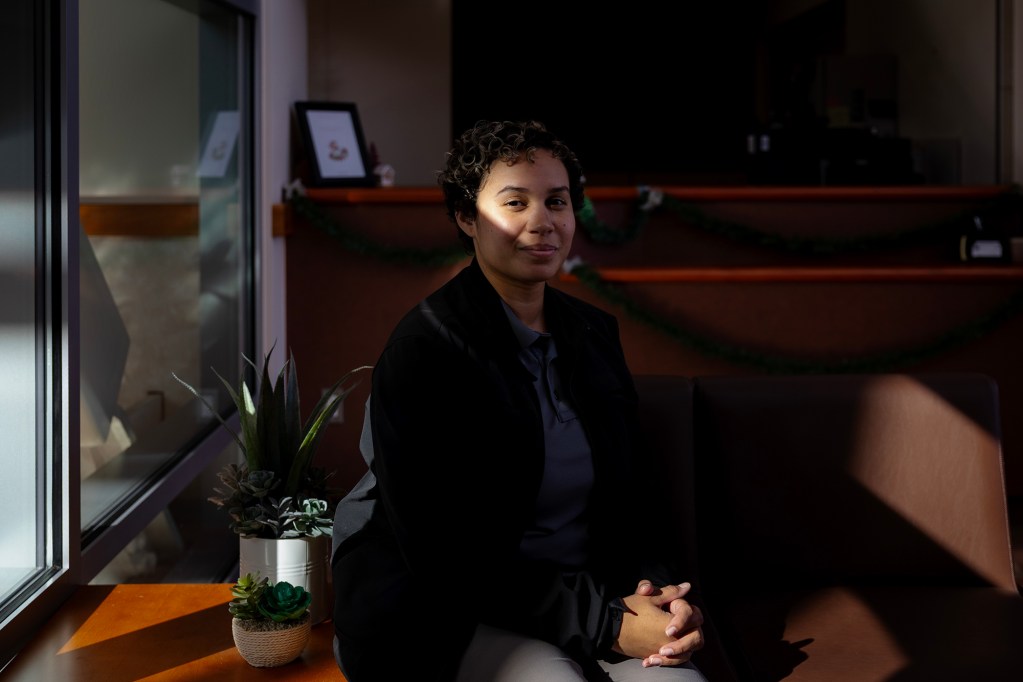
A few minutes later, she opens the car door and jogs over in her black Nikes and tan cargo pants. An officer introduces her to the family and from there, Fair’s work unfolds. She moves back and forth between the family and their loved one, who’s sitting across the street on a bench, as she collects information from both parties: Is there a mental health history? What kind of substances have they used before? Are they currently receiving any treatment? Have they been hospitalized before? Did they make any threats? What do you want to see happen today?
After 10 minutes, Fair pulls one of the officers aside to let him know that the person doesn’t need to be hospitalized. “Let’s safety plan,” she tells him. It’s what the agency does if they receive a call that doesn’t rise to the level of an involuntary psychiatric hold. At that point, officers say, they’re “just playing peacemaker.”
Fair huddles beside the family to explain that the situation is no longer a police matter or a mental health crisis, but rather, a family matter. Still, she doesn’t want to leave them feeling alone. They create a “safety plan” that everyone can get on board with so that, as she later explains, “We don’t get another call in 10 minutes because they’re arguing down the street.”
“We get calls like this — where it sounds like it’s going to be wild — and then we get here and it’s just a family matter,” she said. “It happens.”
Cayla Mihalovich is a California Local News fellow.
This article was originally published on CalMatters and was republished under the Creative Commons Attribution-NonCommercial-NoDerivatives license.
Greenhouse Gas Emissions Drop to Pandemic Levels in Sign of Local Climate Laws’ Impact
Phasing out fuel oil in buildings, improved energy efficiency and cleaner, greener cars contributed to a 5% decline between 2023 and 2024.
by Samantha Maldonado Dec. 23, 2025, 4:17 p.m.

In 2024, the city’s greenhouse gas emissions dropped to levels not seen since 2020, during the COVID-19 pandemic — a sign, environmentalists say, that new climate policies are making a difference.
The city’s latest annual greenhouse gas inventory shows a decrease of about 5% in emissions citywide compared to the previous year and a 25% cut since 2005, when the city began tracking its emissions.
Greenhouse gas emissions — which include carbon dioxide, nitrous oxide and methane, among others — trap heat and warm the planet. They also worsen air quality, causing and exacerbating harmful health outcomes, such as asthma.
In New York City, the major sources of greenhouse gases are residential and commercial buildings, manufacturing, cars and trucks, landfills and wastewater treatment. But significant drops in those emissions came as a result of increased energy efficiency and the phase-out of fuel oil in buildings, as well as the rise of hybrid and electric cars as well as fuel-efficient gas vehicles.
The pandemic spurred the largest drop in emissions since tracking began, with a 9% decline between 2019 and 2020 — including a 21% decline in transportation emissions — as people stayed home or left the city entirely.
In 2024, transportation emissions were more than 16% higher than in 2020, but emissions from buildings and waste were 5% and 3% lower, respectively. Compared to 2005 levels, in 2024, transportation emissions were down more than 22%, waste emissions by over 19% and buildings almost 27%.
In 2024, emissions from natural gas increased 15% compared to 2005, but were still at decade low.
Elijah Hutchinson, executive director of the Mayor’s Office of Climate and Environmental Justice, pointed out that the annual drop in natural gas emissions was equivalent to taking almost 600,000 gas cars off the road—about the amount registered in Brooklyn.
“Reduced reliance on fossil fuels and a shift to electric transportation are driving cleaner air across the city,” Hutchinson said. “Expanded composting and anaerobic digestion programs are keeping more food and yard waste out of landfills. At the same time, New York City continues to scale up clean energy.”
Tough New Laws
Several city laws and initiatives — and standards set at the federal level — helped explain the decrease in emissions in 2024.
A program through the Taxi and Limousine Commission mandated a minimum of 5% of rides from for-hire car services like Uber or Lyft be electric (or wheelchair-accessible) by 2024’s end — a goal that was exceeded. According to a citywide sustainability report update, 8.6% of Lyft and Uber rides took place in electric vehicles in February 2024. The minimum percentages will rise each year, with a goal of all rides electric or accessible by 2030.
Two citywide laws targeting buildings, the largest source of the city’s greenhouse gas emissions, also were in effect in 2024.
For instance, a law prohibits the use of fossil fuels in new buildings with six or fewer stories. (The ban goes into effect in 2027 for taller buildings.) That means developers must include water heaters, heating systems and stoves powered by electricity rather than gas or oil. Earlier laws required the phase-out of highly polluting fuel oil in buildings, leading to replacement with gas or electricity.
Large buildings also had to abide by the carbon emission caps set by Local Law 97 starting in 2024 and prepare to reduce their emissions as the limits get stricter in coming years. Property owners have taken steps to comply by installing solar or switching to more efficient appliances, among other carbon-cutting actions.
Under the same law, the city is required to cut emissions 40% by 2030 and 80% by 2050, compared to 2005 levels.
In large part, the city’s ability to continue to achieve those declines in emissions depends on the rate and extent to which the state transitions the city’s electric grid to cleaner sources of power and delivers that power to the boroughs.
Currently fossil fuels account for almost all electric generation, as gas generation took the place of the emissions-free nuclear power that served the city until 2021, after former Gov. Andrew Cuomo ordered the Indian Point nuclear reactor shut down. The completion of Empire Wind, an offshore wind project, and a transmission line to bring hydropower from Canada, would replace Indian Point’s loss.
Victoria Cerullo, director of urban engagement at the New York Climate Exchange, said the numbers show the success of policymaking and enforcement.
“While there is more work to do, the city has made great strides over the past few years to reduce building emissions with Local Law 97 implementation and the phasing out of dirty heating oils, which has played a big role in this downward trend,” said Cerullo, who previously worked in the Mayor’s Office of Climate and Environmental Justice.
“These aren’t just numbers in spreadsheets. They represent healthier outcomes for people who live in the city, and if we want a more affordable city, bringing down greenhouse gas emissions is an important part of that equation.”
Cerullo said the city should continue helping property owners comply with Local Law 97, swapping diesel- and gas-powered vehicles for electric, using more sustainable materials and processes in construction and advocating for clean energy development.
Government Transportation December 23, 2025 Fran Murphy
 Fran Murphy
Virginia Lawmaker Weighs in on White’s Ferry Impasse
It’s been five years since the cable at White’s Ferry snapped and life got a little more isolated for residents in Upcounty.
This year the Fair Access Committee will hold a rally to raise voices and hopes for a re-opening of the centuries-old service that crossed the Potomac between Dickerson, an unincorporated community in Montgomery County, and Leesburg in Loudoun County.
The dispute between the Ferry owner, Chuck Kuhn, and landowners on the other side, the Devlin family, has showed little sign of resolution. Recently the county offered a $3 million-dollar public subsidy to help reopen the Ferry. But at the time of this writing little seems to have come of it.
Now a new voice from the Virginia side of the river is weighing in on the unresolved dilemma. Virginia Delegate David Reid, who also works as the Vice Chair of the Virginia House Transportation Committee, made his concerns known in an opinion column for Loudoun Now.
According to the article, Reid will spearhead legislation establishing a state-led work group to find a way to get the Ferry back in operation on the Potomac again.
Reid cites several ways to end the current impasse including negotiation, easement, or acquisition that remains respectful of personal property rights.
With an eye toward more sophisticated water travel he concludes, “after five years, it’s time for a reset and a fresh approach to reopen Whites Ferry with active involvement from the state’s transportation professionals. Water transit can provide the region and the Commonwealth with additional capacity without the high costs of road or rail construction.”
Supreme Court rebuffs Trump’s planned National Guard deployment to Chicago
by Brenden Moore and Hannah Meisel, Capitol News Illinois
December 23, 2025
Article Summary
- In a 6-3 decision Tuesday, the U.S. Supreme Court left in place a lower court order barring President Donald Trump from deploying National Guard troops to Chicago while the underlying legal challenge continues.
- Justices said the administration failed, at least at this stage, to show legal authority to use the military for domestic law enforcement in Illinois, echoing lower court findings that political opposition does not amount to “rebellion.”
- The case stems from Trump’s Chicago-focused "Operation Midway Blitz” immigration enforcement campaign this fall, which sparked protests and clashes between civilians and federal agents
This summary was written by the reporters and editors who worked on this story.
SPRINGFIELD — The U.S. Supreme Court on Tuesday kept in place a lower court’s ruling temporarily barring President Donald Trump from deploying National Guard troops to Chicago as part of his administration’s crackdown on illegal immigration.
The 6-3 ruling, which comes more than two months after the Trump Administration made an emergency appeal to the high court, effectively prevents the federal government from using federalized troops in Chicago while the underlying court case challenging the deployment continues.
“At this preliminary stage, the Government has failed to identify a source of authority that would allow the military to execute the laws in Illinois,” the court wrote in the unsigned opinion denying the request for a stay.
Conservative justices Samuel Alito, Neil Gorsuch and Clarence Thomas dissented.
Trump administration lawyers had argued the judicial branch had no right to “second guess” a president’s judgment on national security matters or resulting military actions.
The ruling represents a major setback for the Trump administration and a triumph for Gov. JB Pritzker and state Democratic leaders, who fiercely opposed and pushed back on the concept and practice of federal troops patrolling American streets.
Pritzker called the ruling “a big win for Illinois and American democracy.”
“This is an important step in curbing the Trump Administration's consistent abuse of power and slowing Trump’s march toward authoritarianism,” the governor said in a statement. “American cities, suburbs, and communities should not have to face masked federal agents asking for their papers, judging them for how they look or sound, and living in fear that President can deploy the military to their streets.”
Attorney General Kwame Raoul, whose office presented the state’s case, was also pleased with the court’s ruling.
“Nearly 250 years ago, the framers of our nation’s Constitution carefully divided responsibility over the country’s militia, today’s U.S. National Guard, between the federal government and the states — believing it impossible that a president would use one state’s militia against another state,” Raoul said. “The extremely limited circumstances under which the federal government can call up the militia over a state's objection do not exist in Illinois, and I am pleased that the streets of Illinois will remain free of armed National Guard members as our litigation continues in the courts.”
Read more: Judge’s block on deploying National Guard extended indefinitely as Supreme Court weighs case | DOJ lawyer says it’s ‘wrong to allege’ Operation Midway Blitz is over
In early October, Trump ordered the federalization of 300 Illinois National Guardsmen over Pritzker’s objections and deployed 200 members of the Texas National Guard to Chicago.
The order came in as tensions flared outside the U.S. Customs and Immigration Enforcement’s processing facility in Chicago’s near-west suburb of Broadview, which had become the epicenter of protests against the Trump administration’s Chicago-focused "Operation Midway Blitz” immigration enforcement campaign launched in September. The administration claimed activists were violent and the National Guard was needed to protect federal agents and the ICE facility.
Trump’s deployment of troops to Los Angeles this summer marked the first time in 60 years that a president had taken control of a state’s National Guard without a governor’s consent. He’s also authorized troop deployments to Washington, D.C. and Portland, Oregon. All have been met with legal challenges, but the attempted deployment to Chicago was the first to reach the nation’s high court.
Operation Midway Blitz’s heavy immigration enforcement presence in Chicago and its suburbs continued through mid-November when U.S. Customs and Border Patrol Commander Gregory Bovino and his 200 agents abruptly left the area. During the more than more than two months of aggressive enforcement actions, agents arrested more than 3,000 people in the U.S. without legal authorization.
National Guard troops were only active for a day at the Broadview ICE facility before U.S. District Judge April Perry issued a temporary restraining order blocking their deployment. While Texas guardsmen were sent back to their state at the same time Border Patrol agents left Chicago last month, the 300 members of the Illinois National Guard have remained under the Trump administration’s authority. Federal officials have said both the Illinois and Texas guardsmen spent their time doing training exercises.
After their deployment, clashes between federal agents and civilians shifted from Broadview to Chicago neighborhoods, where agents — including Bovino, often used force like tear gas and other riot control weapons like tear gas and pepper balls to disperse crowds.
Read more: Bovino ordered to make daily court appearances after three days of tear gas in Chicago | Judge grants restraining order protecting protesters, journalists in Chicago-area clashes
As those confrontations shifted, so did the arguments from Trump Administration lawyers, who said the militarized manpower was necessary to protect federal agents and property from “rioters” that they alleged have aimed fireworks at agents “and have thrown bottles, rocks, and tear gas at them.”
In a separate lawsuit, protesters, journalists and clergy won a preliminary injunction last month restricting agents from using from using riot control weapons. But after an initial ruling in the case from the 7th Circuit Court of Appeals cast doubt on the judge’s legal authority to limit how immigration agents do their jobs, the plaintiffs asked that the case be dropped. Perry’s Oct. 9 ruling, in which she found “no credible evidence that there is a danger of rebellion in the state of Illinois,” was later backed up by a three-judge panel on the 7th Circuit Court of Appeals, which wrote that “political opposition is not rebellion.”
Raoul argued that the troop deployment violates Illinois’ rights as sovereign state to carry about its own law enforcement, as well as 1878 Posse Comitatus Act that bans the military from participating in domestic law enforcement.
National Guard members are often federalized for overseas missions. At the state level, the are often deployed by governors to respond to natural disasters and civil unrest.
Prior to this year, the last time a president federalized a state’s National Guard without a request from a state’s governor was in 1965, when President Lyndon B. Johnson sent federal troops to protect civil rights protesters in Alabama without the cooperation of segregationist Gov. George Wallace.
Capitol News Illinois is a nonprofit, nonpartisan news service that distributes state government coverage to hundreds of news outlets statewide. It is funded primarily by the Illinois Press Foundation and the Robert R. McCormick Foundation.
This article first appeared on Capitol News Illinois and is republished here under a Creative Commons Attribution-NoDerivatives 4.0 International License.

Separate journeys, together: How Lee and Blair Vogler handled the life-changing attack and its aftermath
Lee and Blair Vogler each had their own whirlwind of challenges during his hospitalization. While Lee, a Danville City Council member, was fighting for his life after being set on fire, Blair was getting constant news from doctors, learning about burn injuries and taking care of their family.
by Grace Mamon December 8, 2025
 Grace Mamon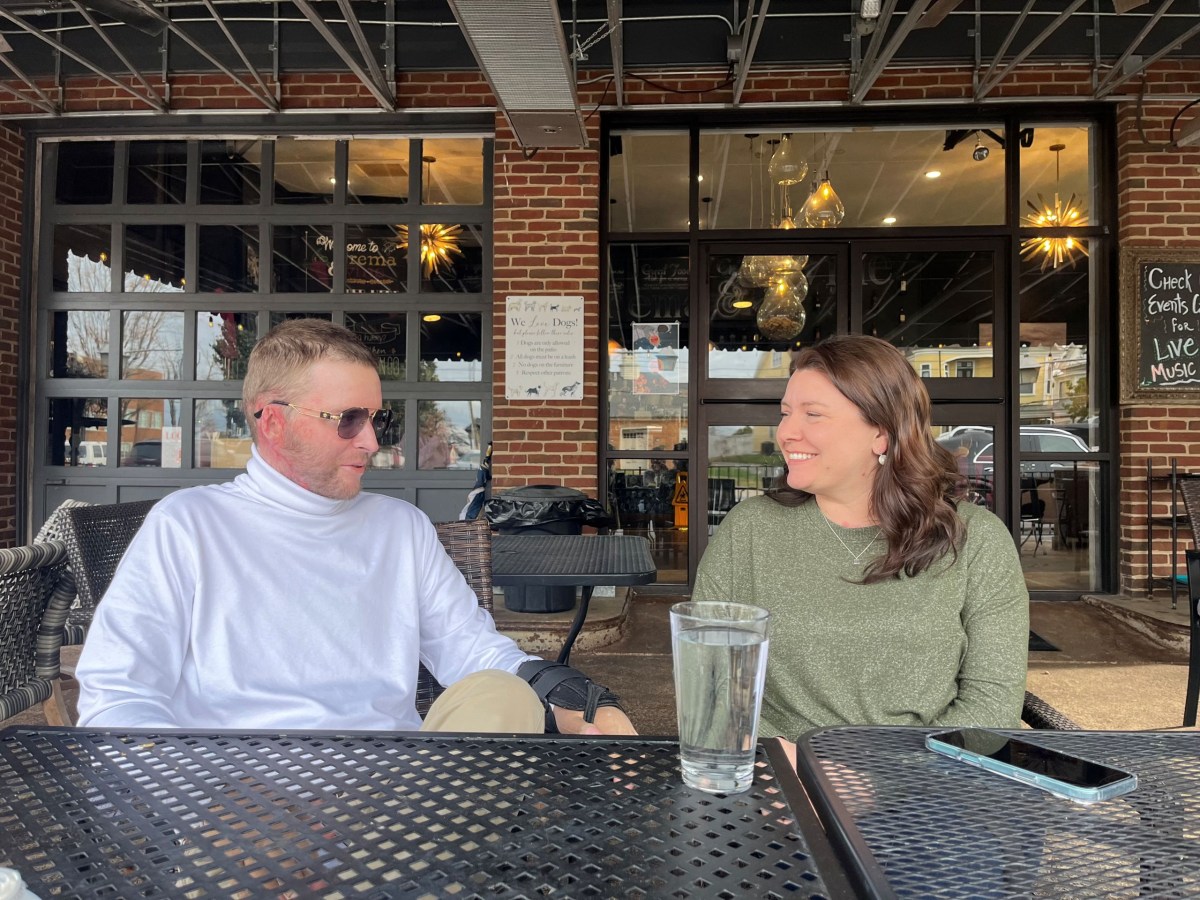
Blair Vogler was at work on a Wednesday morning in July when her phone rang with a call from her husband. The couple were planning to leave work early to attend a funeral later that day, and Blair was running late.
Thinking that Lee Vogler was calling to ask if she had left yet, Blair didn’t answer the first time.
“Then it rang again, back to back, and I thought, ‘Well, I’d better answer,’” she said. “So I did, and I just heard him yelling.”
Lee, a Danville City Council member, had just been set on fire at his workplace on Main Street.
That was four months ago, and the Vogler family has since experienced ups and downs, progress and setbacks, support, rumors, surgeries, therapy, media attention and medical bills.
Shotsie Buck-Hayes, 30, was arrested and charged with aggravated malicious wounding and attempted first-degree murder a few hours after the attack. He’s been indicted on both charges, and a third of breaking and entering with intent to commit murder while armed with a deadly weapon.
A trial date will be set during Danville Circuit Court’s January term. In a partially complete psychological examination, Buck-Hayes has been determined to be competent to stand trial, though sanity at the time of the offense is still being evaluated, according to court records.
Buck-Hayes told Danville police during questioning that he attacked Lee — and planned to kill him — because Lee had had an affair with his wife.
Lee missed much of the news about the suspect immediately after the attack, as he was unconscious in the hospital for about a month with second- and third-degree burns to over half of his body.
The story below is based on a long interview with Lee and Blair, about four months after the attack. During the interview, Lee said he could not talk about the suspect until after the trial was over.
While her husband was unconscious, Blair received dozens of daily updates from his doctors and nurses, while also weighing decisions about their two young children without his input.
When Lee woke up, he still couldn’t talk, walk, feed himself or touch his face.
After exceeding his doctors’ expectations, Lee was released from the hospital in late October, months earlier than expected. One of the first things he did was attend that evening’s city council meeting.
He’s also been able to go to his son’s middle school football games, attend his daughter’s modeling shows and dress up with his family for Halloween.
But his recovery isn’t over.
Lee is still getting used to the new way his body moves and behaves. He’s sometimes surprised when he’s unable to do something that he used to do regularly, like turn a round doorknob or make the “hang ten” hand sign.
His voice has gotten stronger since his release from the hospital, and it now sounds much like it did before the attack. His face also looks much the same, though he now sports a beard and glasses because he can’t yet shave himself or put in contacts.
He can walk on his own — and even shuffle, guarding his son playing basketball — but his movements are stiffer than before.
Life looks different for the Voglers, and it always will.
For them, and for many others in Danville who read the July 30 headlines in disbelief, there will always be life before and life after that Wednesday morning.
Blair: How a normal day changed in the blink of an eye
It’s hard now for Blair Vogler to sum up her husband’s three-month hospitalization. Some moments from that time stand out in perfect clarity, and others are a blur.
She was constantly inundated with new information about his condition and learning about burn injuries and their complications.
Blair is a nurse in Reidsville, North Carolina, but she’s learned more than she ever hoped to know about burns in the past few months.
“One of the biggest things I learned was just how burns are such a different beast than any other kind of injury,” she said. “Every organ of your body, its functionality is affected, and physically, emotionally, psychologically, there are so many ups and downs.”
She was at work when she got the call from Lee on the day of the attack. She had been in nurse mode all day, and she had to stay in that mindset to process what had happened to her husband.
Neither Lee or Blair is certain about whether he actually dialed her number himself.
Lee was yelling into the phone, Blair said, and she didn’t understand what was happening until one of his coworkers took the phone and began explaining the situation.
Her first thoughts: How bad is it? Is he talking? What hospital is he going to?
“I just started going into that nurse-mode line of questioning to process in a non-emotional way,” she said.
Initially, she was told that it didn’t seem that bad — Lee was breathing, talking, and he knew what was going on.
But when first responders told Blair over the phone that he would be airlifted to a burn unit in North Carolina, and not taken to Danville’s hospital, she knew it was worse than it seemed.
Blair remembers being flustered — she couldn’t find her keys, so her coworker drove her to the helipad where Lee would be airlifted, but she couldn’t remember where exactly that was.
When they got there, she jumped over the locked gate and ran to the ambulance, which had also arrived. That’s when she learned that over 60% of his body had been burnt.
“As soon as I saw him I knew it was bad,” she said.
Still, it was hard for her to tell the extent of his injuries right away.
“When I first saw him, you couldn’t really tell how bad the burns were because everything was black, everything was charred,” she said. “I just remember seeing his eyes, his blue eyes with the black all around them.”
His teeth were black too, which immediately signaled to her that he had an airway injury. She told the first responders to intubate him, or put a tube down his throat for ventilation.
That nurse-mode detachment was quickly replaced with emotion when Lee began talking to her.
She was running her hands through his hair — the only part of his body she could touch — while he lay in the ambulance, even though the first responders had told her to leave the vehicle.
“Blair, I’m not going to make it,” he said.
He said it almost calmly, the way patients sometimes talked to Blair and other nurses after they’ve accepted the worst-case scenario.
That’s how he sounded when he told her, “I’m not going to make it. I can’t feel anything. I love you, I love the kids, I’m sorry.”
She pushed back, telling him over and over again that he would make it. “There were some expletives thrown in there,” she said.
After that, the first responders made her leave the ambulance so they could intubate and airlift Lee.
After the helicopter left, everything moved quickly, Blair said. But she held on to that last moment with Lee before she left the ambulance.
“I really didn’t know if it’d be the last time I’d ever talk to him,” she said. “And I didn’t talk to him again for a month.”
Lee: Voices and sounds, and then nothing
Lee said he has some fuzzy memories of that interaction with Blair. Mostly, he can remember voices and sounds, but he can’t visualize the moment.
He remembers asking a first responder if he was going to die.
“Not today,” he said.
Though he can’t remember those moments clearly, he remembers how he felt. Lee said he’s had concussions, been in car accidents, broken bones, but he’s never felt anything like those burns before.
“My body felt like it was shutting down… . I had never had that feeling of everything leaving my body,” he said. “That’s when I think I told Blair that I wasn’t going to make it, something’s really wrong.”
Lee remembers feeling the helicopter leave the ground, and then nothing else.
Blair: Watching her husband’s condition worsen overnight
Blair traveled to the burn unit at the University of North Carolina-Chapel Hill that afternoon.
She had met doctors, nurses and other hospital staff, and she was trying to remember all of their names. She had given her phone to someone else, unable to deal with the incessant notifications. She had already called her children, shifting back into mom mode, to explain as best she could what had happened to their dad.
When the medical staff told her she could see Lee in the intensive care unit later that evening, she wanted to go alone.
It’s a moment that stands still in her memory. She remembers where everyone was standing as she entered the room — and immediately got angry.
“You brought me to the wrong room,” she told the nurse. “This is not my husband.’”
She was livid that the hospital staff had made that mistake, after everything she had been through that day.
But it wasn’t the wrong room. “Blair, this is Lee,” the nurse told her.
“This is not Lee,” Blair said.
“He looked absolutely nothing like himself at that point,” she said. “You could see the injuries to his face, they had shaved his head, and he was so swollen from all the fluid that they had to pump in. It took me a while to believe it was actually him.”
She was grateful then that she had already decided that her kids wouldn’t come to the hospital right away, and that they would stay with her sister instead.
Blair had called 11-year-old Kingston and 7-year-old Ava separately earlier that day, explaining things to them in different ways.
“[Kingston] is 11, but he’s a very mature 11-year-old,” Blair said. “He’s very aware and competent, so I wanted him to hear it from me.”
With Ava, Blair was more high-level with her explanation.
“Dad’s hurt, I’m going to stay at the hospital for a while, and you get to have a sleepover with your cousins,” she told her daughter.
Protecting her kids was the only agency Blair felt like she had at that time. She had to trust the doctors and nurses at the hospital to do their job, and she had to do hers as a mother, she said.
Even then, there were limitations on what she could do.
Blair’s sister told her that a reporter from the Associated Press came to the door that afternoon while Kingston and Ava were there.
“That was really hard for me to hear afterwards, because my 7-year-old is there and she doesn’t know what happened,” Blair said.
Reporters overwhelmed Blair too on her drive to Chapel Hill. About 20 minutes into the trip, Blair said that calls from unknown numbers began flooding in.
Each time, she answered in case it was one of Lee’s doctors, and then hung up when it wasn’t.
“Every time I answered it would be a different reporter,” she said. “I wasn’t even at the hospital yet, so that made everything a whole different level of surreal.”
The rest of that first night in the hospital also felt surreal, Blair said.
Hospital staff barely left Lee’s room at all. A physician’s assistant pulled a stool and a computer on wheels and sat next to the bed.
“They were back and forth changing and tweaking every little thing all night long,” Blair said. “That’s when we learned that with burns, you don’t have all the injuries upfront.”
It can take up to 72 hours for symptoms to appear, Blair learned. All night long, Lee’s condition kept worsening.
The lab work, the infections, his lungs, the surface area, his blood pressure, all got worse and worse as the night went on.
By the next morning, doctors were talking to her about putting him on dialysis, a treatment for patients with failing kidneys. Luckily, that didn’t end up happening, Blair said.
“He was teetering on the edge,” she said. “For a while, things kind of went like that.”
The team of doctors told Blair that Lee’s injuries were “survivable,” but not that he would survive.
“The way they said it, it was hopeful but not guaranteed. … That was kind of the mantra for the next few days.”
Blair: Surgeons, children and tough calls
Three burn surgeons worked together on Lee’s first skin graft surgery. Afterward, they said it was one of the biggest skin grafts they had ever done, Blair said.
Over 60% of his body had been burnt, and the surgeons had to take an additional 30% of his skin to create grafts. That left 95% of his body open, meaning it had no intact skin, Blair said.
Blair decided to bring both Kingston and Ava to the hospital for the surgery, although they still wouldn’t see their father yet.
Instead, they got to meet members of the staff — surgeons, therapists and aftercare team members. The kids were encouraged to ask any questions they had.
They got badges and surgical hats, and the staff gave Ava a book about burns that they give to children who are burn patients.
The head surgeon came out of the operating room to talk to the kids during Lee’s surgery. She shook their hands and introduced himself by her first name. That was important, especially for Kingston, who wanted to feel like he was being told everything about his dad’s condition.
Later that day, when Blair asked her kids how they were doing, Ava surprised Blair with her response.
“Dad’s safe, he’s being taken care of,” she told her mom.
While she was still sitting with Ava, Blair got a call about the surgery, and she had to shift out of mom mode again.
Over the course of Lee’s operation, the surgical team had realized that his injuries were worse than they thought. Everything that they thought was a second-degree burn had converted to a third-degree burn.
“How can someone survive being 95% open?” Blair asked one of the surgeons.
The doctor was blunt.
“I’m not God. I’m a surgeon,” she said. “We’ve done our best, but it’s in the Lord’s hands now.”
Lee had another surgery on Aug. 27, the night before their 15th wedding anniversary, Blair said. Afterward, the surgeons told her that his body was resisting the antibiotics to treat infections, which are common in burn patients, especially when so much healthy skin has been taken for grafts.
It was the first time one of the doctors told her in real time that Lee might not make it. Then the doctor, crying, gave Blair a hug.
“I had to decide, do I bring the kids up here, do I call my parents, do I give it 24 hours, what do I do?” Blair said.
Other than the day of the attack, it was the scariest time for her.
She decided to wait. She was relieved when Lee started responding to antibiotics, after the doctors had switched them several times.
It had been several weeks since the attack by that point. That’s when Lee’s kids started asking to see him.
Blair: The way faces heal
Blair got Kingston and Ava into therapy the week after the attack, and the therapist told her to trust her gut about when they should see their dad.
The kids were going to have trauma either way, the therapist said.
Lee was still unconscious, so he couldn’t help her decide what was best.
“I didn’t have his input on what I should do, when they should come, I was making all the decisions on what’s best for everybody,” Blair said. “I knew what I thought he would want me to do.”
She waited for the swelling in Lee’s face to go down before bringing the kids to see him. Skin grafts to the face work differently than elsewhere on the body, Blair learned.
Doctors create a solution of skin cells using a skin cell sample and spray it onto the wound. This method can reduce scarring and accelerate healing. That was a blessing when it came to the kids’ visit, Blair said.
“It’s not that his face wasn’t burned badly, it was,” she said. “It’s just the way faces heal.”
Kingston and Ava actually thought their father looked younger than he had before when they saw him for the first time. They also thought it was funny that he was bald, because they had never seen him without hair, Blair said.
“He was still sedated, he still had everything hooked up to him, so we talked about the ventilator, all of the IVs, everything,” she said. “They were just really curious, and they were surprised at how good his face looked.”
The kids had already returned to school by then, Blair said.
She was initially nervous about that too, worried about how they would do in class and about what other kids would say, especially since Kingston was starting his first year of middle school.
She met with their principals, teachers, guidance counselors, who all put her at ease. The kids themselves were eager to go back to school too, not wanting to stand out any more than necessary by starting late.
“If someone says something to you or asks you something, it’s perfectly fine to tell them that you’re not going to talk about that,” Blair told Kingston and Ava.
Luckily, that hasn’t happened. “Adults have actually been harsher than the kids,” Blair said.
It helped that Lee was the baseball coach at Kingston’s middle school last year. Mostly, other kids just asked Kingston how Coach Lee was doing and when he’d be back.
Those were questions Kingston couldn’t answer. Lee was still unconscious, and doctors were predicting that he’d be in the hospital for at least six more months.
But a few weeks after Kingston and Ava saw Lee for the first time, he woke up.
Lee: Dreams, progress, setbacks, pain
Waking up, Lee wasn’t fully conscious right away. He drifted in and out of lucidity, and sometimes Blair and his doctors weren’t sure if he was really present or not.
“It wasn’t like I woke up and all of a sudden I was doing all of these things,” Lee said. “There was a time when I was really out of it.”
He was agitated and suspicious. At one point, he thought Blair was an imposter version of herself, and he was afraid and combative.
It was very emotional for her, she said, and it’s another time that sticks out vividly in her mind.
For Lee, it’s hazier. As they talk about that time, he asks Blair questions to confirm certain details — what the surgeons said about his first surgery, the name of the tube that was in his nose, a funny comment he made as he was regaining consciousness.
“It was hard to see,” she said. “You’ve gone a month without talking to someone that you talked to every day. One minute they know you and a few hours later, the next time they wake up, they’re scared of you.”
Some moments felt like Groundhog Day for Blair, she said, as she watched him wake up without remembering what happened the last time he was alert.
Later on, hospital staff would ask Lee, “Hey, do you remember when you did this?” or “Do you remember when this happened?”
His answer was usually no. He couldn’t tell the difference between real memories and dreams.
“Things that I thought were real, were not real,” he said. “It took a while to unwind that.”
He couldn’t talk when he first woke up, so he communicated with his family by blinking. Once for yes, twice for no. Then he began winking at Kingston and Ava.
Lee said the first fully conscious memory that he can put his finger on is ordering breakfast one day.
“My mind still wasn’t right, and I couldn’t think of what I actually liked for breakfast,” he said. “My mind for some reason went to what I know Kingston likes to eat for breakfast, which was scrambled eggs with cheese and orange juice.”
Blair came up with the name “the Kingston Special” for that breakfast.
Lee hasn’t spoken much about the difficulties of his recovery since he got back to Danville, mostly because he prefers to focus on the positive.
But there were some really hard days after he woke up, not only physically, but mentally too.
“There were days when I was just so down, and I couldn’t move,” he said. “I felt pain in every inch of my body, like down to my bones. It wasn’t a type of pain that I could equate to anything else.”
He couldn’t walk or feed himself, and he quickly learned that he would have to throw his pride and ego out the window.
“I was fully dependent on other people for basically everything,” he said. “That was really hard for me for a while. I don’t like asking for help, so that was a great lesson I learned through this.”
He also spent time in the hospital catching up on the news of the attack that had been reported across the world.
Most of the Danville community was supportive, in words and deeds. People brought gift cards to Blair’s family to take the kids out to eat or go to the movies, or offered to babysit or do yard work.
But there were some folks, mainly through social media comments about the alleged affair, who weren’t as kind to the Vogler family. Lee and Blair said they wouldn’t talk about the suspect or alleged motive, citing the ongoing legal case.
The vitriol on social media was only difficult to deal with because Blair was concerned about protecting her kids, she said.
“They’re already having to hear terms and have conversations they shouldn’t have at 7 and 11,” she said. “But people are going to say what they’re going to say, and I have no qualms about that.”
Lee said it didn’t bother him too much, given everything else he was going through.
“I look at it like this. I was set on fire and lived through it, so someone saying something on Facebook is not really going to hurt me,” he said. “If it makes them feel better to take the time out of their day to comment, God love them. I hope it helps them through their day.”
He made progress with walking laps, doing one more lap around the hospital floor than the day before. He had made it up to four laps in a row — a big feat, considering he initially celebrated making it to the end of the hallway and back — when his last skin graft surgery rolled around.
The surgery would focus on his neck, excising skin from his legs to graft onto the burns.
Afterward, his neck didn’t bother him, Lee said, but his legs hurt badly, hindering his plans to keep walking.
“I had just started making progress, and then I was set back and I was in so much pain,” Lee said.
Blair tried to encourage him to get up and walk, but Lee told her no. Frustrated by the setback, he asked her to feed him, even though he could now feed himself using utensils with extended handles that compensated for his limited range of motion.
It’s not that he couldn’t do it himself, but after that surgery, he just didn’t feel like doing anything.
“I retreated in a sense,” Lee said. “I wasn’t quitting, but I needed some sort of pause. It was too much.”
As his legs started to heal, Lee began walking again, surpassing his previous record for number of laps around the floor. One day he did 24, and the next day he did 70, he said.
Somewhere in that process — the timeline still isn’t super clear for him — a tracheostomy tube had been removed from his neck, and other tubes and electrodes were no longer needed. Those were positive steps that made him feel like he was progressing, he said.
Staff began talking about moving Lee (and the hundreds of photos that his mom had used to decorate the room) out of the ICU. Once he had moved, doctors told him he could be a candidate to go home.
“Tell me what I’ve got to do to go home and I’ll do it,” Lee told the doctors.
The medical staff put a date on his MyChart — Oct. 21 — that could possibly be the day he went home.
“Once I saw that, I was like, you cannot stop me from getting out of here on that day,” Lee said. “Blair will tell you, I was obsessed with it.”
Lee knew Kingston had a football game on the 21st, and Ava had a modeling show a few weeks later. He also knew that Danville’s city council would meet that day, and before he was attacked, he hadn’t missed a city council meeting in over a decade.
“If you don’t want me to get out of here yet, you never should’ve put that date on there,” Lee told his doctors. “If I don’t go home that day, I will be far less productive here.”
He had a checklist of things to complete before he could go home, with occupational therapy requirements being the main hold up.
The OT team agreed to sign off on his release if he could come back down to the hospital three times a week to do occupational therapy as an outpatient.
“So that’s what I’ve been doing since,” Lee said. “We’re down there Monday, Wednesday, Friday.”
Lee and Blair: Getting back to normal when everything is different
Since he’s been home, Lee has been able to return to some aspects of his previous life — attending city events, going on family outings, and helping plan the annual Harry Johnson Holiday Classic middle school basketball tournament.
But there are other things that are drastically different.
“Opening doors,” Lee said. “The round knob is hard to get a grip on and turn it… . There’s been some times in the house where I forget and accidentally shut it behind me, and then I have to call, ‘Hey I’m stuck.’”
Lee is working on improving his grip strength, but he doesn’t have much function in his left hand due to nerve damage. His right hand is better, though his thumb and index finger on that hand don’t have much feeling either.
This prevents him from shaving himself, and he’s nervous to let someone else do it, so he’s been sporting a beard lately — a new look for him. He also can’t put in his contact lenses, so he’s wearing a new pair of glasses.
“It’s dumb, but my pose in every picture since I was a teenager was the hang ten, and I really can’t do it yet,” Lee said. “I’m doing a thumbs up until I can get my fingers to cooperate.”
He realized this during the Veterans Day parade in Danville, when he tried to make the signal without thinking and realized he couldn’t do it.
As his recovery continues, Lee is looking forward to throwing a baseball with Kingston, who’s a pitcher, and picking up Ava as part of a choreographed father-daughter dance near Christmas.
Blair helps him with some exercises and physical therapy at home, mostly stretching and massaging the parts of his body that received skin grafts.
“With burns, and skin grafts, the skin contracts in certain areas as it tries to heal. This is another thing I learned,” Blair said. “So in the bends of his elbows, under his arms, his neck, all that skin tries to contract. Basically, we have to massage it and stretch it so that it kind of microtears and forms back.”
At one point during his hospitalization, Lee had 12 different conditions — pneumonia, a GI bleed, which is common for burn patients, a gall bladder complication, and significant lung injuries.
Some longer-term burn complications are still with him. He developed a condition called heterotopic ossification, or HO.
“Basically, you get bone growth in the muscles and the joints and places that aren’t normal,” Blair said.
“I have it in both elbows and shoulders,” said Lee.
“Which is another thing that limits his range of motion and functionality,” Blair added.
The couple explained the condition, after chronicling the details of Lee’s hospitalization and recovery, while sitting at a restaurant’s outdoor patio on a recent November Saturday.
Lee wore braces on both hands, but he was able to feed himself without utensils, which he couldn’t do when he left the hospital almost a month before.
Eventually, he will be able to get laser surgery to remove the bone growth, which will help his range of motion return to “pre-injury level,” Blair said. But they have to wait until the HO stops progressing first, and there’s no way to know when that will be.
Blair has also been learning about mentorship programs for burn injury survivors and their families. Other survivors might make a good community for Lee, because although she was there every step of the way with him, she can’t fully understand his experience.
“I can listen, and I can empathize, but only to a certain degree,” Blair said. “I know what it’s like as a family member, but I don’t know what he’s gone through and I never can.”
Conversations with other family members of burn patients were a big help in getting her through Lee’s hospitalization, she said. One time, she was able to return the favor when a burn patient came in with similar injuries to Lee’s.
She was in the waiting room when that patient came in, and she struck up a conversation with his wife.
“As much as it helped me to have people talk about what they’ve been through and getting to the other side, it was just as cathartic for me to do that for her,” Blair said. “Just to know there’s help and spread awareness.”
Lee is looking forward to getting back to his work at Showcase Magazine, which he hopes to do by the end of the year.
He and his family are enjoying time together after months apart and looking forward to Christmas, especially since there was a time where he thought he wouldn’t be home for the holiday.
The day he left the hospital, Lee’s doctors and nurses had a send-off party, shaking pom-poms and holding up signs. When they asked what song he wanted to play as he walked out of the hospital, Lee didn’t have to think very hard.
“‘Comin’ Home’ by KISS,” he told them.
Before the attack, Lee affectionately referred to his hometown of Danville as “the comeback city” and himself as the “comeback kid.” No one expected that his comeback would include recovery from extensive burn injuries.
The old nickname has a new meaning, but it’s one that still fits.
Shutoffs loomed in third year of receivership. Can Jackson afford its own water system?
by Alex Rozier, Mississippi Today
December 19, 2025
Days before this past Halloween, Aidan Girod received a frightening note atop her water bill: “FINAL NOTICE.” The letter said Girod had three weeks to pay her outstanding balance before JXN Water would turn off her tap.
At the start of the year, the north Jackson waitress received a $2,000 statement that included the several previous months she hadn’t gotten a bill for. As the utility revamps its historically plagued billing system, residents throughout the city have recently received an invoice for the first time in months, if not years.
Girod, a mother to three young children, agreed to send $300 a month as part of a payment plan. Then in September, she received a bill again charging her $2,000, which JXN Water told her was due to a leak. But a plumber, to whom Girod paid $180, said they couldn’t find it.
She said a second plumber also couldn’t find a leak. After one of her dozens of phone calls with the utility, JXN Water applied a credit to her bill, although it wasn’t clear to Girod how they decided on the amount. Then in October, she received two water bills, including the one with a final notice, that showed two different balances.
Months later, she still isn’t sure how much she owes, whether she has a leak, or if the utility is getting ready to shut her water off.
“It has been very stressful,” said Girod, who said she’s had to skip paying other expenses to afford her water bill. “I have a 3-month-old daughter, I’ve given birth during all of this. A lot of that strain has been on simply making sure I have running water for my children.”

Ted Henifin, whom residents, business leaders and public officials have credited with rescuing Jackson’s water system from its darkest moments, says his hands are tied. JXN Water, the third-party utility he runs, needs a surge in revenue to keep afloat, and it needs to come soon.
But procuring those funds, Henifin admitted, is all the more complicated in a city with a strained relationship between its water supply and residents, many of whom haven’t trusted what comes out of their faucets or what shows up on their bills for years.
Just last month, the 5th U.S. Circuit Court of Appeals revived a class-action lawsuit by residents against Jackson, alleging the city misrepresented the water’s safety after detecting levels of lead over the legal limit in 2015.
In the first two years after he took over in 2022, Henifin knew he needed a proof of concept for residents to buy in. In that time, JXN Water resolved widespread pressure issues, winterized a treatment plant that succumbed to recent cold snaps, and repaired hundreds of sewer line failures. Also, for the first time in a decade, Jackson’s system is in compliance with all federal drinking water requirements, the utility said recently, including the lingering lead violation.
While residents praised the utility for its work, they soon learned it came with a high cost. This spring, JXN Water announced it had exhausted $150 million in funds from Congress set aside for daily upkeep of the system, which includes paying staff and routine maintenance.

The utility is a few years away from sustaining itself financially, Henifin projects, and reaching that point means both increasing monthly bills and more aggressively pursuing unpaid balances. With a collection rate of about 70% – far below the national average of over 90% – JXN Water is losing over a million dollars a month.
“We figured we’d get around to the billing at some point,” Henifin said in a recent interview at his Belhaven office. “Unfortunately the timing between running through the ($150 million of) federal funds and us getting to the billing weren’t exactly aligned.
“So we’re finding the need to get the billing done and collections up faster than we would’ve liked. But I still don’t think we would’ve done it any differently. You got to get the water system and sewer working before you can start beating on people about paying their bill.”
In September, JXN Water shut off water to nearly 1,800 accounts, and Henifin said he expected that number to be higher in October. Based on those counts, the utility has turned off service to roughly 10% of Jacksonians in 2025 alone.
One of those ratepayers, Dominique Grant, had no idea when she would catch up on her past due balance. A single mother of three, Grant recently fell behind after not receiving a bill for two years, she said. JXN Water told her to make a down payment of $1,900, half of her total balance, to initiate a payment plan, Grant said.
After she didn’t come up with the money, instead prioritizing bills like her mortgage and car loan, the utility shut off her water in October.
“I have to ask myself, am I going to take my whole check and pay this water bill, or spread it out to pay my car note, insurance, light bill, mortgage,” said Grant, a case manager at a local hospital. “Unless I take out a loan, I just don’t have $1,900 to give them.”
Between bathing and meals, Grant said she spent over $100 a week on bottled water for her family, or about what JXN Water charges her for a whole month.
Henifin and other local officials referenced a “culture of nonpayment” in Jackson that spread after the city installed a faulty metering system from Siemens in 2013. Since then, residents became accustomed to inconsistent and inaccurate billing. Amid metering issues and the COVID-19 pandemic, city officials forewent water shutoffs for much of the past decade.
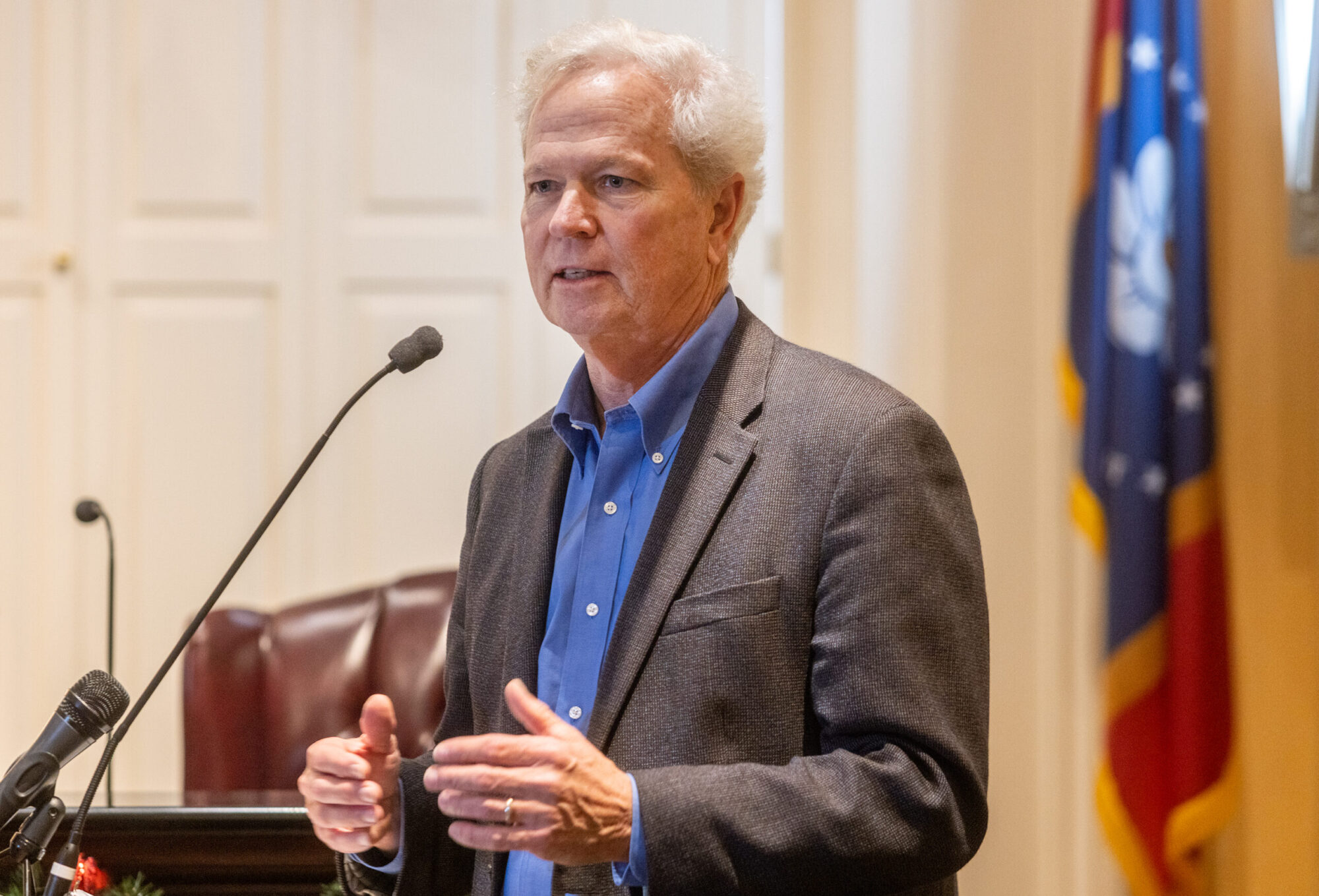
With that track record in mind, JXN Water in 2023 proposed a billing system based on property values so customers would see the same amount every month. The state Legislature, though, passed a law blocking the idea soon after.
Henifin also set up a discount on water bills for homes that receive food benefits through the federal SNAP program. But a recent court ruling blocked JXN Water from automatically applying the discount because of privacy laws. Henifin recently estimated fewer than 600 accounts receive the discount, which is about $30 a month.
About 11,000 homes in Jackson, or nearly one in five, receive SNAP benefits, according to Census data, which means just 5% of eligible customers are receiving the water discount.
Since the utility began its widespread shutoffs, both officials and residents have increasingly spoken out against JXN Water, citing a lack of affordability in a city where more than a quarter live below the poverty line. Heightening those tensions is a pending proposal to increase rates, which the utility says would increase the average bill by 12%.
At a recent court hearing, City Attorney Drew Martin panned the utility for not sooner considering its revenue and billing strategy, leading to steeper rate hikes that are tougher for residents to swallow. In October, the Jackson City Council voted to recommend reversing the 2022 order putting Henifin in charge of Jackson’s water system, in large part because of recent shut offs and billing disputes.
U.S. District Court Judge Henry Wingate, who appointed Henifin as third-party manager, has not acknowledged the city’s vote. Wingate did, though, order an injunction against Henifin’s recent attempt to push through the rate increase without the judge's approval. Wingate said he would make a ruling on the increase no sooner than Dec. 19.
Sitting with Mississippi Today in his brightly lit office, Henifin stood firm on the high bill amounts that Jacksonians have contested over the past year, even the ones that somehow tallied into the tens of thousands. Rep. Fabian Nelson, a Democrat whose district includes Jackson, recently submitted letters to Wingate from residents with bills as high as $70,000.
With new meters at nearly every property, the manager was confident the utility had accurate readings of customers’ usage. In most cases with abnormal balances, JXN Water tells the resident they have a leak.
While some, such as Girod in north Jackson, hired plumbers who dispute the diagnosis, Henifin doesn’t budge. JXN Water can tell there’s a leak, he said, simply by looking at a meter and seeing the consumption run up continuously throughout the day.

Henifin suspected a number of residents have “slab leaks” under their home’s foundation, which the average plumber may not be able to find. That’s why the utility now recommends specific contractors for customers to call, he said.
On the customer service side, Henifin conceded there’s much room for improvement, saying residents too often leave phone calls with inconsistent answers. In addition to better training, he’s hoping to have more capacity for in-person appointments, a service JXN Water recently opened at the city’s Medical Mall.
“People seem to forget we weren’t born a fully functional utility,” Henifin said. “ We were born out of no utility, essentially, and had to create everything along the way.
“We (first) focused on getting the infrastructure to deliver water, get the sewer to stay in the ground. And now we get into the customer service experience and the billing. There’s nowhere to go but up.”
Yet in the meantime, residents and landlords who either can’t afford their bills or get answers through the call center are left with few options if they want to keep their water on.
Jennifer Welch, a property manager in Jackson who sits on the city’s newly created Housing Task Force, criticized JXN Water over limited transparency. Welch and other landlords, who in some cases went two or three years without receiving a bill, have tried to ask the utility for clarity around their accounts but received little response, she said.
“I have reached out to (Henifin) personally to let him know I have real concerns about the billing department,” said Welch, who said she’s met with Henifin throughout his time in Jackson. “He’s downplaying (the billing issue). I’ve just talked to too many people who are struggling.”
A group of nonprofits, including Forward Justice, the Mississippi Poor People's Campaign, and the ACLU of MS, argued in court filings that JXN Water has shown little flexibility in its shutoff process, especially for residents who simply aren't able to make down payments on the large debts they've accumulated after years of not receiving bills.
"The threat of losing water service cannot make people quickly find money they don’t have, unless it comes at the expense of forgoing other essential needs like food and medicine," the groups wrote in a Nov. 7 letter to Wingate.
During a recent hearing at the Capitol, Democratic Sen. Sollie Norward said a woman in his Jackson district recently received a $20,000 water bill. While JXN Water allows customers to enter into payment plans, its policy requires customers with debt to make an initial down payment beforehand.
After forgiving some of the owed balance, the utility asked the woman to pay $4,000, the senator said. But that was still higher than she could afford, Norwood said, and eventually JXN Water shut her water off.
"I don't know how she got there, and she doesn't know how she got there," he said. "Yes, shutting off water gets attention, but it also creates other problems."
Grant, the single mother whose water was disconnected, cobbled together the $1,900 she needed for a down payment and, after four weeks, finally got her tap back running. After feeling the toll of not having service, she decided to take out a small loan and put off other bills to come up with the money. Still, Grant said JXN Water has unfair expectations of residents' financial flexibility, especially when many had no idea what they owed for months or years.
"They need to just have a better grasp on things," she said. "Nobody has thousands of dollars just sitting around to spare."
This article first appeared on Mississippi Today and is republished here under a Creative Commons Attribution-NoDerivatives 4.0 International License.