Democrats win SC's US Senate seat for the first time since 1998
Rural voters across the country played a decisive role in midterm elections, Alaska and Mississippi races still to be determined; Asheville, NC voters oust incumbent mayor

It's Friday November 6, 2026 and in this morning's issue we're covering: What SC voters had to say about the midterm election, Rural Voters Helped Democrats Win South Carolina’s US Senate Seat, Rural Voters Play Decisive Role in Midterm Elections, Roney’s decisive victory shows her ability to build consensus, supporters say, Alaska voters could face a long wait for election results, Who won Mississippi’s midterm Senate race? We may not know for a while, NC voters approve all 3 constitutional amendments on ballot, OPINION: Prop. 40’s failure points to the tax California already pays for its wealth: Politics overrun by money.
Media outlets and others featured: South Carolina Daily Gazette, The Daily Yonder, Barn Raiser, Asheville Watchdog, Votebeat, Mississippi Today, NC Newsline, CalMatters.

What SC voters had to say about the midterm election
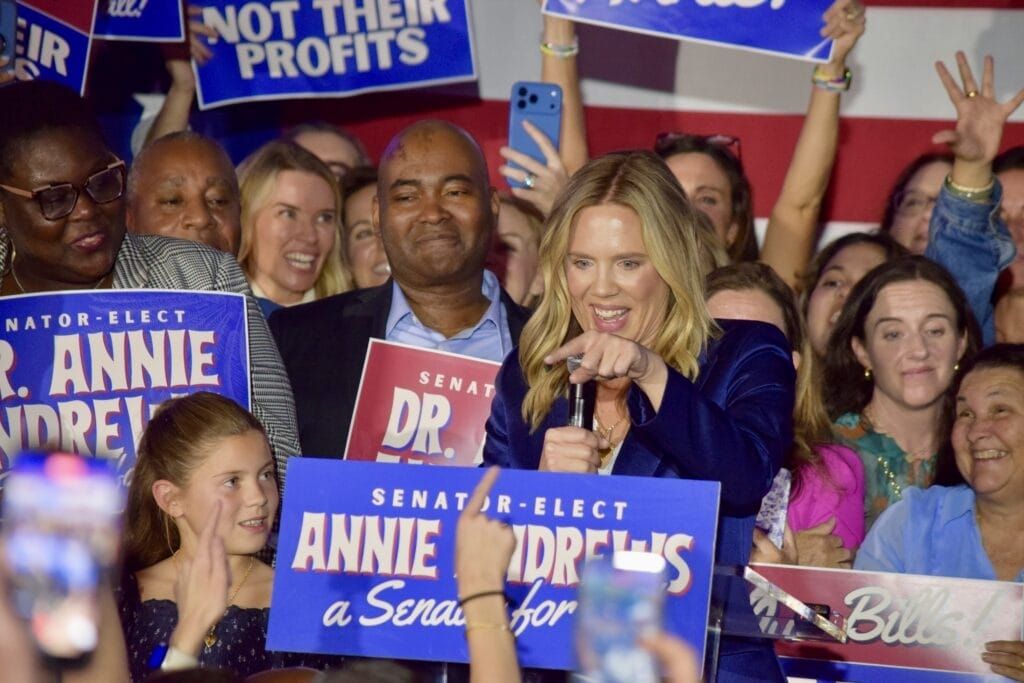
At polling places across the state, voters said they were supporting Annie Andrews, the Democrat who won a seat in the US Senate.
By Skylar Laird, Jessica Holdman, Katharine Wilson (South Carolina Daily Gazette)
Published: November 5, 2026
Ahead of the vote-counting for Tuesday’s historic election in South Carolina, SC Daily Gazette reporters headed to the polls to hear what mattered most to voters.
The election brought record-high turnout for a year without a presidential race on the ballot. Democrat Annie Andrews achieved a major upset by turning a U.S. Senate seat in South Carolina blue, while Republican Alan Wilson clinched his bid for the Governor’s Mansion. In the Lowcountry, Democrat Nancy Lacore declared victory in the 1st District, while other congressional incumbents held onto their seats.
Here’s what some of the voters told the Daily Gazette about their decisions.
In Columbia
Among the more prominent vote-casters Tuesday was outgoing South Carolina Gov. Henry McMaster, who cast his ballot Tuesday morning at the Lourie Center in Columbia.
Asked about the state’s tight U.S Senate race between Andrews and Darline Graham, the younger sister of the late U.S. Sen. Lindsey Graham, the GOP governor predicted Darline Graham would win.
The night’s events proved McMaster wrong.
“You never know how the voters are going to react, but South Carolina traditionally is a conservative state,” McMaster told reporters early in the day. “Ms. Andrews, according to what I’ve read, is quite far from the conservative side. That’s a big plus for Senator Graham. I think she will prevail.”
South Carolina’s longest-serving governor in state history will depart in January after a 10-year tenure. McMaster said the transition will be smooth, as “that’s the easiest thing in the world to do.” The governor said he still has work to do in his remaining days, but his office will help the winning candidate learn the role.
“We will cooperate with whomever wins in any of these offices, whatever they want to know from us, we’ll give you,” McMaster, the former state attorney general, said about all of the statewide offices on the ballot.
Also in Columbia, the price of groceries and gas drove a lot of voters to the polls.
“Prices are way too high, and it has to change,” said Nyquobi Ross, a 22-year-old freelance writer in Columbia. “My pockets cannot handle this.”
Throughout the early afternoon, a steady stream of people voted at the county election office, a barrier-free voting location for people throughout the county.
Deanthony Franklin, a 19-year-old musician, voted for the first time Tuesday. He usually doesn’t pay much attention to politics, but when he noticed his grocery bill and gas bill rising, he felt he needed to participate, he said.
Franklin wants President Donald Trump out of office, he said. Without the president on the ballot, he voted for every Democrat.
“You’ve got to do something,” Franklin said. “You can’t just sit around and expect change to come overnight.”
For Zai Shiver, education was the biggest issue. A former educator, the nearly-60-year-old wants to see more funding go toward the state’s public schools.
Shiver declined to say who she voted for but noted she did want to see change in the state Department of Education.
In that election, Superintendent Ellen Weaver won re-election over Democrat Sylvia Wright.
“Definitely there need to be some major changes to better educate the children, to give them supplies that they need, to deal with their home lives and issues that they may have with their home lives,” Shiver said about her vote.
Richland County, which includes the state capital, is a blue county in a red state.
In Lexington
Across the river in Lexington County, which is Graham’s home and a Republican stronghold, the Gazette expected responses to be different. But the only voters who would talk to Gazette reporters also expressed frustrations with Graham.
Griffin Archer said his top priority while voting in West Columbia was to keep Graham from winning.
“She’s completely unfit for office,” the 23-year-old civil engineer said. “She has no qualifications. And I don’t think her deceased brother was doing a very good job, anyway.”
At the Saxe Gotha Presbyterian Church in Lexington, voters had no line around 3 p.m.
Kelly Council, a College of Charleston student, said she travelled back home to vote for Andrews.
“I saw what was happening with Darline Graham, and she just seemed like she was put into a position rather than actually working to fight for it,” Council said.
David Terry, also from Lexington, said he could not in good conscience vote for any of the U.S. Senate candidates. In the governor’s race, he said he “unfortunately” voted for Wilson.
“I wish the Wilsons would quit running, too,” Terry said. “We need a lot of new people all over the place.”
Khalil Smith, a 24-year-old security guard, said he voted for all Democrats because he wanted to vote for change.
“I’m not going try to sway people in one direction. I think if you have the right to vote, you should vote. It does count,” Smith said. “You might not think it does, but it most definitely does.”
Charleston area
Keisha Pinckney, 39, cast her ballot at West Ashley High School on Tuesday for Andrews, though she had some reservations about the former pediatrician.
“She wasn’t my first choice, but she became my only choice,” said the stay-at-home mom and substitute teacher.
Pinckney said she was more excited about Democratic Rep. Jermaine Johnson’s bid for the Governor’s Mansion. She said his message, advocating for improvements to the state’s schools and roads, rang true for her.
Lori Spillers, who moved to West Ashley from Michigan more than 30 years ago, said she felt a bit uninformed about the statewide candidates.
“All I heard in the news was about Darline Graham and Annie Andrews, and I thought they were both horrible candidates,” the 56-year-old nurse said.
Even the candidates for governor, she said, she hadn’t heard much about, though she ultimately voted for Attorney General Alan Wilson.
“I guess because I feel like South Carolina has done really well with the Republican governor, so I just voted for the Republican,” she said. “Hopefully that’ll continue South Carolina on the track it’s been on.”
In particular, she pointed to South Carolina’s economic strength as a positive.
John and Mari Shine, of North Charleston, both voted straight Democratic tickets.
But it was the Senate race they were watching most closely.
“Polls have been wrong, but if everything aligns like they’re predicting, then we’re hoping to have a celebration tonight,” said John Shine, a 45-year-old screenwriter.
“We need change. Something needs to happen,” his wife added.
The 49-year-old accountant said she saw the ads against Andrews calling “radically left.”
“And I was like, oh, that sounds good to me,” Mari Shine said. “I just want a strong middle class and for everyone to be treated fairly.”
“The demonization of everything that is even moderate at this point has pushed middle America so far to the right that it’s no longer accurate anymore,” he husband added.
Thomas Maltese cast his ballot at the North Charleston Sports Complex for Andrews too.
“I’m really hoping to see if we can turn South Carolina blue,” the 43-year-old software engineer said.
Hoping, he said, but not getting his hopes too high in the ruby red Palmetto State. For Andrews, anyway, he got his wish.
Maltese, who grew up in New York but has lived in South Carolina for the last 14 years, calls himself an independent. He said Andrews’ policies align more with his political beliefs.
“I feel like Annie has battled harder for it instead of just being given it,” he said of Andrews vs. Graham.
At the watch parties
At Johnson’s watch party, at Brookland Baptist Church in West Columbia, spirits stayed high throughout the night, even when Johnson trailed Wilson.
Musical group John Lakin and Friends sang to a crowd of more than 100, sometimes passing the microphone around the room. People stood and clapped along to songs, and dancing broke out later in the evening.
Johnson briefly pulled ahead of Wilson after a large drop of Democratic votes from Richland County. Shouts interrupted a speech by Rep. Gilda Cobb-Hunter, an Orangeburg Democrat, and the crowd erupted into cheers.
Tre Tailor, the event’s emcee; Rep. Gilda Cobb-Hunter; Roshanda Pratt, who works for Johnson’s campaign; and Tawana Allen embraced at the front of the room, watching the results on a large screen at the front of the room.
“I feel confident. I feel positive,” said Allen, a 66-year-old retiree who has lived in Columbia for about 30 years. “The whole day, I’ve felt positive, and I just think, hey, South Carolina needs to change.”
Allen remembers when Jim Hodges, the last Democrat to be governor, was in office. She’s spent the two decades since then hoping another Democrat might win, she said.
Similar celebrations took place across the state, at Andrews’ party at the Charleston Marriott downtown in Charleston. People sang along to “Carolina on My Mind” and cheered when results showed Andrews ahead.
Bill and Susan Taylor, of Chapin, made the drive down to celebrate.
“We love Annie,” Susan Taylor said. “She’s amazing.”
People mingled and chatted at the State Fairgrounds, where most of the statewide Republican candidates gathered to watch results come in. But the mood there was more somber than celebratory for most of the night.
As the results came in, Dawn Pierce of Lexington County said she was “a little nervous,” but added that it was great to be at the event to see people and celebrate.
Rural Voters Helped Democrats Win South Carolina’s US Senate Seat
by Sarah Alexander Melotte, The Daily Yonder
November 4, 2026
In deep red South Carolina, Annie Andrews will be the first Democrat Senator in three decades. The state’s rural voters pushed her over the edge into victory, according to a Daily Yonder analysis of preliminary voting data.
In South Carolina, historically deep-red rural counties flipped blue this cycle, which coincided with significant increases in turnout from Democratic voters, all the way from the largest cities to the most rural parts of the state. Democrat Annie Andrews would not have been able to beat incumbent Republican Darline Graham without help from the state’s rural voters. Senator Graham was appointed to sit out the remainder of the term of her late brother, Lindsey Graham, who died in July at the age of 71.
Without the 138,500 rural voters who supported her, Andrews would have only garnered 44% of South Carolina’s popular vote.
Because the margin for this race was so close, decided by barely a percentage point, every type of county, from the cities to the countryside, contributed to Andrews’ win. But it is a surprising break from recent trends that rural voters have contributed to the deciding margin, swaying a red southern state in the direction of the Democratic candidate.
The following map shows the vote share for Democratic Senate-elect Annie Andrews. Shaded counties highlight areas that flipped from red to blue in 2026 compared to the previous midterm cycle. Out of the state’s 46 counties, 15 formerly red counties shifted blue this year. Six of those counties were rural.
The last time South Carolina elected a Democratic senator was in 1998, when incumbent Fritz Hollings beat Republican challenger Bob Inglis. The state has been red ever since. In 2024, Trump won South Carolina by 18 points.
The following chart demonstrates the vote share for the Democratic candidate in the 2022 South Carolina US Senate election compared to this year’s election. Across all types of counties, the share of voters who supported the Democratic candidate increased.
In nonmetropolitan, or rural, counties, 51% of midterm voters in South Carolina cast their ballots for Annie Andrews.
Note: Major metro suburbs are suburbs of cities with more than one million residents. In South Carolina, these suburbs surround the North Carolina city of Charlotte. Medium-sized cities have populations between 250,000 and one million residents. Small metros have fewer than 250,000 residents. Metropolitan counties are based on the Office of Management and Budget’s list of 2013 Metropolitan Statistical Areas (MSA). Counties outside of MSAs are nonmetropolitan, or rural, for the purposes of this analysis.
Many of the rural counties that carried Andrews to victory were located in the Black Belt region, a cluster of majority-Black communities that lies southeast of the capital city of Columbia. Turnout in many of these Black Belt counties was significant, including rural Allendale County, which saw the Democratic candidate win by more than 10 percentage points compared to last cycle.
But that trend wasn’t concentrated in one region. The number of voters who supported the Democratic candidate increased by 414,800 compared to the last cycle. Rural Clarendon County, where Trump won by a margin of 12 points in 2024, turned blue this year, supporting Annie Andrews by a 6-point margin.
This article first appeared on The Daily Yonder and is republished here under a Creative Commons Attribution-NoDerivatives 4.0 International License.

 Justin Perkins
This story was originally published by Barn Raiser, your independent source for rural and small town news.
Rural Voters Play Decisive Role in Midterm Elections
Surprising facts from Tuesday’s midterms
By Justin Perkins, Barn Raiser, November 5, 2026
Democrats made seismic waves in Tuesday’s elections, winning majorities in both the House and Senate in a stunning rebuke to President Donald Trump and Republicans on Capitol Hill.
As of Wednesday evening, Democrats had flipped 7 Senate seats (Kansas, Maine, Texas, South Carolina, Iowa, Ohio and North Carolina), taking 54 seats total in the Senate, with races still to be called in Alaska and Mississippi. The party flipped at least 35 seats in the House, according to NBC News, winning 242 seats, well above the 218 needed for a majority. More seats are poised to fall to Democrats as the results continue to trickle in.
Rural voters played a decisive role in the midterm results, as the war on Iran, tariffs, deportation policy, the economy, political corruption and extreme wealth inequality soured voters on the Republican agenda and spurred them to the polls. Data from the Washington Post found rural counties swung 15.3 points in favor of Democrats compared to 2024. Meanwhile, majority-Hispanic counties swung 28.5 points in Democrats’ favor and younger counties (those where the majority of voting-age citizens is between 18-44) swung 21.3 points toward Democrats.
Historic precedents were broken across the country.
Kansas: Methodist pastor Adam Hamilton became the first Democrat elected to the Senate from Kansas since 1932, ending a 94-year drought in a state Trump won by 16 points in 2024.
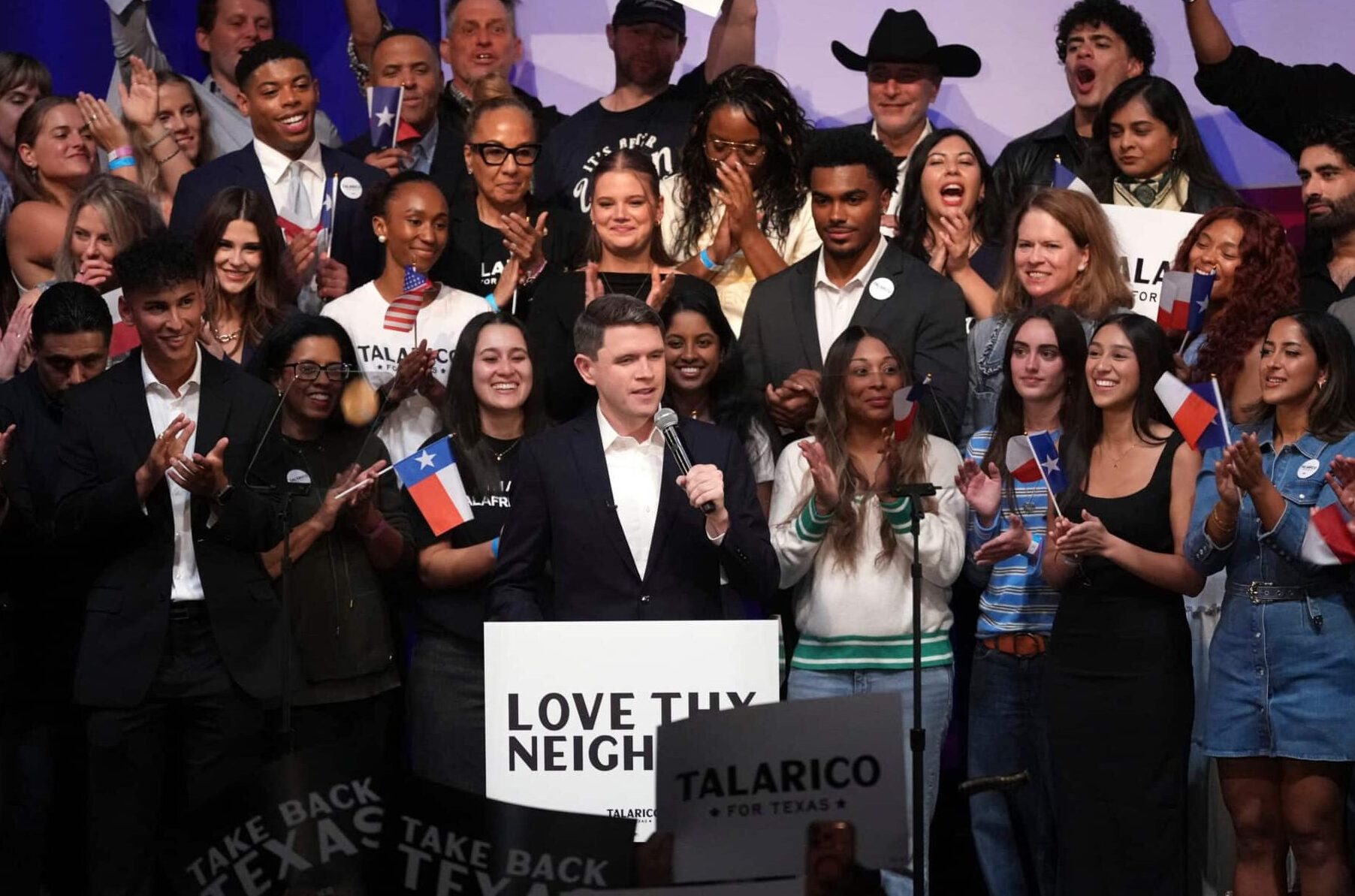
Texas: Former seminarian James Talarico, a member of the Texas House, became the first Democrat to win a Texas Senate seat since 1988. In the governor’s race, Gina Hinojosa ousted two-term incumbent Greg Abbott to become Texas’ first Latina governor and the first Democrat to win the office since Ann Richards in 1990.
Ohio: Rep. Marcy Kaptur, who holds the record as the longest serving woman in the House of Representatives, survived a GOP gerrymander and was reelected to her 23rd term. Kaptur represents Ohio’s 9th Congressional District, and was first elected in 1983 at the age of 36.
Michigan: Public health doctor Abdul El-Sayed overcame a spending spree by pro-Israel dark money to become the first Muslim American elected to the U.S. Senate. In his victory speech, El-Sayed said, “To AIPAC [American Israel Public Affairs Committee], who spent $42 million against us, thank you for giving me the opportunity to beat you twice.”
Georgia: Keisha Lance Bottoms became the first Black woman elected to govern a state in U.S. history.
Maine: Fifth-generation logger Troy Jackson pulled off an upset victory over Republican Sen. Susan Collins, who has served as U.S. Senator for Maine since 1997. Just months earlier, Jackson was running in Maine’s gubernatorial election—the only candidate to sign the People’s Pledge to not accept dark money. In July, Jackson stepped into the Senate race after Graham Platner dropped out. “I will be thinking about generations of Mainers who worked in our woods, built our ships, kept our mills running, the people who built this state and deserve a government that works for them,” Jackson said in his victory speech. “That is what I am going to fight for every damn day.”
Rural voters made their voices heard elsewhere in surprising ways.
North Carolina: Former Army paratrooper Richard Ojeda pulled off a stunning victory in the state’s 9th Congressional District—a race Cook Political Report had characterized as “solid Republican.” Ojeda, a former Trump voter who turned to support of Bernie Sanders in 2020, beat out Rep. Richard Hudson, the chairman of the National Republican Congressional Committee and the fifth-highest ranking Republican in the U.S. House. Ojeda’s rural district has been represented by a Republican since 1963. Earlier this year, Ojeda emphasized his support for the Veterans Administration and rural health care, saying in an interview with Barn Raiser, “When these rural hospitals lose their funding that comes from Medicaid, they’re going to shut down. And when the hospital shuts down, it literally destroys a community that relies on that hospital.”
Texas: Fifth-generation Texas rancher and Texas Farmers Union Secretary Clayton Tucker was elected the first Democratic agriculture commissioner in nearly 40 years. The agency’s last Democratic commissioner was Jim Hightower. Hightower was crucial in generating support for Tucker, a former State Director of Our Revolution who was steeped in Texas’ rich populist history. Tucker’s outspoken opposition to corporate agriculture monopolies and the state’s accelerated data center growth helped him build a large coalition across the state. After being elected, Tucker said on social media: “[W]hen Texans stand together to protect our land, our water, and our communities from the Greedy Few, organized people can beat organized money.”
Rural counties showed some of the largest swings in Democrats’ favor, especially Latino majority counties along the South Texas border, such as Starr, Webb and Dual counties. In 2024, Trump won Starr County, where about 97% of residents are Hispanic or Latino, with 58% of the vote; on Tuesday, 77% of the county voted for Talarico. Seward County, a Latino majority county in Kansas, saw a swing of more than 45 points in Democrats’ favor. All told, the largest state swings in the country occurred in Texas, North Carolina, Mississippi and Rhode Island.
Early demographic results point to notable trends. According to data from the New York Times, while nearly every group swung in favor of Democrats, some of the biggest shifts came among Hispanic voters and voters ages 18-44. Both groups had had swung heavily in favor of Republicans in 2024, and their return to the Democratic fold points to a segment of the electorate deeply uneasy with the presiding political power and ripe for generational change.
The trend holds even when factoring for race. Both white and nonwhite voters ages 18-29 respectively swung 30 and 32 points in favor of Democrats, with Republicans losing their 2024 advantage among white voters ages 18-29. Education, however, remains a clear divide. Democrats made a 14-point inroad among white Americans with no college degree, but Republicans still hold a 19-point advantage among the group. However, Democrats hold a 55-point advantage among nonwhite Americans without a college degree, who swung 23 points to the left.
Despite spending the last few weeks telling the public to vote as if he was “on the ballot” this election, President Trump quickly sought to deflect blame for Republicans’ losses. “I wasn’t on the Ballot and if I was, we would have won IN A LANDSLIDE!” he posted on his own social media platform Tuesday night.
What’s ahead for Democrats?
Even with Democrats’ sweeping victories, an arguably bigger test awaits. How the party uses its control of Congress to govern in the final two years of Trump’s presidency will dictate whether victories in 2026 could become liabilities in 2028.
The ways Democrats interpret Tuesday’s results will shape the contours of their party’s public image in 2028. Does voter turnout simply show a realignment of the electorate? Or, does it represent voter reaction to a deeply unpopular president who has enriched himself along with the corporate PACs and billionaire donors who backed him? Will the newly empowered Democrats in Congress break with their past and combat the corporate monopolies that have consolidated control of our food system? Will Democrats pay more than lip service to a health care crisis in which many rural people can’t afford health insurance, while too many rural hospitals have closed or are on the verge of closing? Will they root out the dark money that fuels the corporate-backed legislative agenda that has left millions suffering from poverty and food insecurity?
Democrats and progressives still have a decided disadvantage in rural areas, the result of years of political and economic neglect. According to the AP Voter Poll of the 2026 electorate, rural and small town voters made up 35% of the overall vote.
The poll found overall 57% of rural and small town voters voted in favor of Republicans, while 41% voted in favor of Democrats. Among those same voters, 45% said Trump was not a factor in their vote, while 33% said their vote expressed opposition to Trump and 22% said their vote expressed support for Trump. (For a comparison, Pew Research reported in 2016 that Trump won the support of 59% rural voters in 2016 and 69% of rural voters in 2024.)
In other words, one should not separate Democrats’ newfound vitality, as demonstrated by the resurgence of progressive, democratic socialist-oriented candidates, from the party’s need to build organized coalitions in rural and Republican-dominated areas.
In a recent post, Jared Abbott, a researcher at the Center for Working-Class Politics, wrote:
[A]bandoning rural America means that [progressives] undermine our longer-term strategic prospects by ceding large swaths of the country to far-right domination.
Bhaskar Sunkara, president of the Nation and founding editor of Jacobin, put it this way in the Guardian:
[T]he fact that even a victory like this leaves Republicans with so much support tells us about the extreme polarization of the country and the limits on how much electoral punishment a disastrous administration can expect.
To break through, Democrats need to do better in rural and semi-rural areas, and they need to reverse the trend of class dealignment in a more systematic way by making their party the party of working-class concerns and interests. That means fighting for higher wages, stronger unions, affordable housing and healthcare, and giving working people a reason to believe that Democrats will make their lives better.
Other questions facing Democrats: What leaders will it choose? Will those leaders promote legislative priorities that align with the message voters sent on Tuesday? Or, will progressive momentum hit the sinkhole of a D.C. consultant class and corporate-backed establishment Democrats who helped orchestrate the party’s abandonment of rural America and have proven ineffective at combating the right-wing’s authoritarian playbook?
The leadership of both the House and Senate agriculture committees has yet to be chosen. Democrats have an opportunity set a new course for farm and rural policy.
“The real implications are long term,” says Aaron Lehman, president of the Iowa Farmers Union. Founded in 1915, the group threw its support to Democrats Josh Turek for the Senate and Rob Sand for governor. Lehman tells Barn Raiser:
Are we going to see a return to the status quo that has been so badly disrupted by [the Trump administration], or are we going to see a real reset in policy that reflects what’s going on in our rural communities and farms. If we only just want to return to the status quo, I think we’re going to be disappointed. …We’ve always known that rural communities have a huge proportion of swing voters, and organizing in rural communities resonates.
One of those candidates determined to buck the status quo was Chris Jones, a retired water scientist running for agriculture commissioner.
“Just the fact that he’s running has forced every other candidate to talk about water quality in Iowa, when they would have never touched it because it is the third rail of politics in Iowa,” Suzan Erem, Iowa farmer and Barn Raiser elections editor, told Ryan Grim in an interview with Drop Site.
Jones ultimately lost to the Republican incumbent Mike Naig—a former Monsanto lobbyist—by 5 points. But his campaign arguably changed the terms of debate in Iowa, with candidates on both aisles across House, Senate and the governor’s race being forced to address Iowa’s nation-leading cancer rates and poor water quality due to industrial ag runoff. “The movement that powered our campaign will be there to keep holding corporate agricultural polluters accountable,” Jones said in a statement after the election.
Matt Hildreth, the executive director of Rural Organizing, who served as rural outreach director for the Harris-Walz campaign in 2024, also highlighted the relentless, courageous work of rural organizers. He tells Barn Raiser:
The 2026 midterms were Democrats’ biggest rural comeback since 2010. After more than a decade in which rural America moved steadily away from the party, Tuesday’s results reversed the slide: In 2027, more rural Americans will have a Democratic governor, a Democratic House member and at least one Democratic senator than at any point in more than a decade.
The Rural Democracy Initiative, established eight years ago, now supports the work of 168 rural-focused organizations (including Barn Raiser) in 23 states. Sarah Jaynes, the group’s executive director, tells Barn Raiser:
Rural people are economic populists who want to see higher paychecks, restrictions on corporate power, and be able to afford the essentials. They are angry about corruption in Washington and oppose the ICE [Immigration and Customs Enforcement] overreach that is causing chaos in our communities. Through years of organizing, rural groups have built the relationships to channel this frustration into action. Whether it’s overcoming cynicism or navigating new red tape for a mail-in ballot, they helped people overcome barriers to cast their ballot. Their votes yesterday shook up the political establishment. Now we’re excited to get to work with our new elected leaders to deliver for rural working people.
An issue that resonated with farmers across the country is the unchecked power of the food-system monopolies.
Dan Osborn’s independent bid for Senate was another sign of voters rejecting the status quo. While he gained an early lead, Osborn ultimately lost by 6 points to Republican incumbent Pete Ricketts. Yet, Osborn, a military veteran and union member who led a 2021 Kellogg’s strike in Omaha, helped turn a solid Republican seat into a competitive race by centering the enforcement of antitrust law and breaking up corporate monopolies.
“Dan Osborn made Nebraska a real race by talking about the issues farmers and working families feel every day,” said Farm Action co-founder Maxwell in a statement. “That message isn’t going away. We hope Senator Ricketts hears what Nebraska’s rural voters were saying, and puts them ahead of the corporations that control their markets.” Maxwell went on to say: “From Iowa to Florida, voters rewarded candidates who stood up the meatpackers, the pesticide giants and the corporate lobbyists writing farm policy in Washington.”
Osborn will have another opportunity to run for a Nebraska’s U.S. Senate seat in 2030. It remains to be seen where he will lead what he called in his concession speech, “a historic grassroots movement of independents, Republicans, Democrats and Nebraskans of all backgrounds.”
In Tennessee’s gerrymandered 9th District, Justin Pearson, who lost by 1 point, also appeared to leave the door open for another run. Conceding the election to MAGA-affiliated Brent Taylor, Pearson told his supporters:
Your work has not been in vain. This is not the end of our movement, but only the beginning. Together, we have ensured that hundreds of thousands of everyday Tennesseans know that they have the power to take on the wealthiest people in the world and build the better future we all know we deserve.
I will continue to fight for the people of Tennessee and my constituents as a proud State Representative for District 86 and look forward to returning to all 15 counties [in the 9th District] to share my gratitude and continue building our Movement for Justice Rooted in Love.
God does everything well, and because of our historic campaign, Tennessee politics will never be the same.
How dark money lost big
The 2026 midterms were the most expensive ever, with a record $11.9 billion in election spending, surpassing the $8.9 billion spent in 2022.
Democratic candidates outspent Republicans by $800 million according to Open Secrets, which predicted Democratic candidates will have spent more than $2.2 billion by the end of the cycle compared to $1.4 billion for Republican candidates. When it comes to “dark money” Republicans had the advantage, with $2 billion as opposed top $1.7 billion for Democrats. Underlying that figure, however, was a deep division in the Democratic Party itself about where that money came from and what it bought.
Nowhere was this more evident than with voter’s rejection of spending by pro-Israel groups. El-Sayed’s Senate win in Michigan and Randy Villegas’s win in California’s 22nd Congressional District proved notable examples. Villegas, a political science professor, beat out an opponent with significant pro-Israel funding, as El-Sayed was, and who was also backed by Democratic Congressional Campaign Committee.
Villegas’s Republican opponent, David Valadao, ended with $1.7 million in cash on hand, receiving more than twice as much money from PACs than the average House candidate, according to Open Secrets. Villegas, on the other hand, vowed not to take corporate campaign donations.
“With today’s election results, the Central Valley proved what’s possible when working people come together and refuse to let billionaires, Washington, and special interests decide our future,” Villegas said in a statement on Tuesday night. “The people of the Valley made their voices heard loud and clear: the Central Valley is not for sale.”
All told, voters offered a stunning defeat to dark money.
According to Open Secrets’ analysis of federal campaign finance disclosures, nearly 10% of all contributions came from 10 ultra-wealthy donors. Elon Musk led the pack, contributing more than $445 million to Republican candidates, political action committees and outside spending groups. (Musk’s SpaceXAI is building some of the largest data center projects in the country.)
Among Musk’s largest donations was $168 million for the Senate Leadership Fund, which transferred a majority of its funds to back PAC favoring Republican Ken Paxton, the Texas Attorney General who lost to Talarico.
In the lead-up to the election, Talarico referenced Musk as a modern-day Goliath: “We are going up against our own Goliaths—those billionaire megadonors, those corporate PACs, the entire Washington D.C. establishment.”
On Tuesday, Talarico followed up: “Tonight we defeated Goliath.”
 DAN DeWITT

Roney’s decisive victory shows her ability to build consensus, supporters say
by DAN DeWITT November 4, 2026
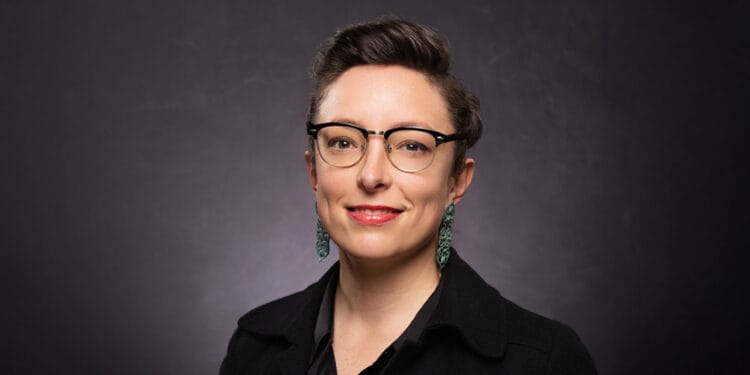
The line that drew probably the loudest cheer at Mayor-elect Kim Roney’s very loud victory celebration Tuesday was one that directly addressed voter frustration with the status quo.
“We’re going to get some stuff freaking done!” Roney said to the packed house at the Gray Eagle Music Hall.
She and her supporters were buoyed by early returns showing a wide lead that was on its way to becoming a rout. The unofficial vote count showed Roney with a lead of more than 16 percentage points.
Though Roney, who has served on the Asheville City Council since 2020, ran as a progressive against another progressive, she benefited from the same public dissatisfaction that led to Republicans’ losses across the country, said Chris Cooper, a professor of political science and public policy at Western Carolina University.
He’d expected a close election, he said, and the large margin of victory “just reinforces that this was a change election,” Cooper said. “That change came for Democrats in what amounted to a party primary, and that change came for Republicans in the partisan elections.”
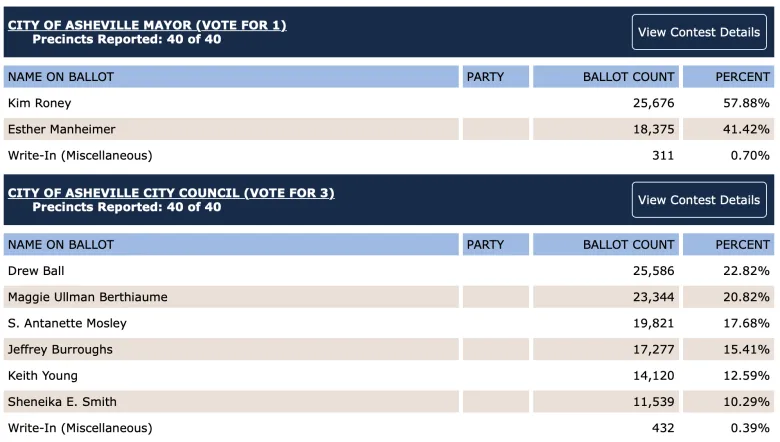
Asheville City Council, meanwhile, will feature two new members, County Commissioner Drew Ball, who led the field of six candidates with 22.8 percent of the vote, and a replacement for Roney to be appointed by council members. Bucking the anti-incumbent trends, they will be joined by current Councilmember Maggie Ullman, who finished second, and Vice Mayor Antanette Mosley, who finished third.
Roney spoke to the Watchdog Tuesday night but didn’t respond to additional questions Wednesday about what tops her priority list of things to do. She ran on a platform that included increasing transparency in government, addressing the lack of affordability for workers and improving services for homeless residents.
She also ran against the narrative from Manheimer’s campaign that cast doubt on her ability to build the consensus needed to realize such goals. Roney is better at bucking other council initiatives than building support for her own, her opponent said.
But Roney’s big win might help change that, bringing other council members around to her positions, said supporter Miranda Escalante, a bartender and co-chair of the Asheville Food & Beverage United, a service workers advocacy group.
With such strong public backing, Escalante said, “I think whoever is on council is going to have to work with Kim and the agenda she sets.”
Escalante said she was “pleasantly surprised” by the overwhelming victory and that it showed another form of consensus building, rallying supporters around a central theme — elevating the concerns of working Ashevillians.
For example, she said, Asheville Food & Beverage United had never before endorsed a candidate but decided to endorse Roney with the support of 97 percent of its members.
“People were really excited about having just a new mayor and the things that Kim stands for, the working people,” Escalante said.
It was a theme that Roney repeated several times during her speech to supporters Tuesday night and in a brief interview afterward.
“This is not surprising to me because my neighbors have seen what’s possible, and they believe in a plan that results in better outcomes for their lives,” she said in the interview.
“I am so grateful that Americans across the country — across the South, in small towns, in big towns, in rural areas — are tired of how things are going,” she said, linking her campaign to the broader revolt against the status quo.
“Americans realize that authoritarianism, hate, war, and the billionaire oligarchy don’t have our best interest in mind,” Roney said in her speech. “Now, working-class people are going to prove that not only can we win, but we can lead.”
She pledged to work with state and federal elected leaders, which Manheimer’s campaign had touted as one of the mayor’s greatest strengths. Roney also brought up names that could make this collaboration easier.
“We’re going to bring transparency, courage, and integrity to the office as we work with Senator Roy Cooper and Congressman Jamie Ager,” she said, referring to two newly elected federal leaders.
Democrats on Tuesday secured majorities in the U.S. Senate, the U.S. House of Representatives and the North Carolina House of Representatives and dramatically narrowed the Republican advantage in the state Senate.
Ullman and Ball both said they are prepared to work with Roney to find agreement on priorities. The city recently voted to spend $100,000 of Tropical Storm Helene recovery funds on a long-range strategic plan, Ullman said, which “will tell us where we’re going to focus.”
She added that she hopes it will provide strategies to address “affordability and housing,” as well as smart growth, community safety and storm recovery.
Ball listed as potential priorities “zoning reforms and making it easier to build missing middle housing that fits within the character of existing neighborhoods.”
He is confident he can work with Roney and council members on such issues, he said, saying he ran “as kind of the kumbaya candidate — to work together and try to find consensus and move things forward.”
Roney’s victory was about more than the broader demand for change, several people interviewed for this story said.
“Kim obviously ran a very effective campaign,” Ullman said.
Roney worked hard, with a clear understanding of her constituency and effectively enlisted supporters to work with her, Cooper said. “She campaigns like an organizer.”
Roney offered proof of this in her acceptance speech, saying her supporters had knocked on 11,000 doors during the campaign.
“We mobilized a mighty network of volunteers and neighborhoods, and we reached out directly to our friends and asked them to vote,” she said. “Those conversations and connections across the city made tonight’s win possible.”
It helped create backing far beyond her home and longtime stronghold of West Asheville. She won 31 of the city’s 40 precincts, according to the results posted on the North Carolina State Board of Elections website.
One of the few she lost was Precinct 5.1, in North Asheville, where Manheimer won 62.1 percent of the vote and where the mayor’s supporters continued to express doubts about Roney’s ability to build consensus Tuesday afternoon.
Sandra Byrd, a retired University of North Carolina Asheville professor and administrator, handed out sample ballots outside the precinct’s polling place, St. Eugene Catholic Church. She worried that the city would “lose ground” in attracting Helene recovery funds if Roney was elected.
“It takes time to build relationships,” said Byrd, 78, and “Manheimer has worked hard to build relationships with people.”
“Esther offers us experience. I also think she’s a good negotiator,” Byrd said, and brought up a central point of Manheimer’s campaign: her success in helping secure millions of storm recovery dollars to Asheville.
“She’s comfortable on a national and state platform to try to get help for us at a time when we still need help,” she said.
Another Manheimer supporter, Jamie McBride, pushed back on the notion that Asheville needed a change in leadership, praising Manheimer and the council, which she said seems “to have the same goals as most of the people who live here.”
McBride, who said she is in her 70s, said she was lucky to have been able to afford to buy a home 17 years ago, at the tail end of the Great Recession. She sympathized with young people struggling to afford housing, she said, but pointed to, among other city actions, its funding of several affordable housing complexes.
“I think things are going pretty well,” she said.
Not for many Asheville workers, including Joyce Slattery’s three adult children. Slattery handed out flyers for City Council candidate Jeffrey Burroughs Tuesday at Calvary Church in West Asheville, the polling place for a precinct where Roney captured 73 percent of the vote.
Though she lives outside the city, Slattery said, she was definitely rooting for Roney.
Slattery’s children can’t afford “to live [in Asheville] unless they have five or six roommates,” she said. Slattery knows the city has worked to address the lack of affordability, “but the younger folks are not seeing it,” she said. “They’re not feeling it. It’s not translating.”
Manheimer, who has held the mayor’s job for 13 years and served on council for 17, likely suffered from such discontent whether or not she was responsible, Cooper said.
“Voters don’t spend their spare time trying to understand the limits of the mayor’s power, but they expect the mayor to deliver and the reality is the mayor in Asheville is fairly weak, and there’s not a lot of institutional power,” he said.
Roney will face the same expectations, he said.
Michael Tait, 40, who handed out Roney flyers on behalf of the Sunrise Movement WNC climate-action advocacy group, said he realizes the limits of the mayor’s ability to tackle big issues such as affordability.
But he, like Roney herself, cited the power of the movement she has built and her close connection to it.
She’s “more open to talking to the working class than I think Esther is,” Tait said, “and she’s just more in tune with the general needs of working-class people throughout Asheville.”
Asheville Watchdog welcomes thoughtful reader comments on this story, which has been republished on our Facebook, Instagram, TikTok, and YouTube pages. Please submit your comments there.
Asheville Watchdog is a nonprofit news team producing stories that matter to Asheville and Buncombe County. Dan DeWitt is The Watchdog’s deputy editor/senior reporter. You can reach him via email at ddewitt@avlwatchdog.org. The Watchdog’s reporting is made possible by donations from the community. To show your support for this vital public service go to avlwatchdog.org/support-our-publication/.

This article was originally published by Votebeat, a nonprofit news organization covering local election administration and voting access.
Alaska voters could face a long wait for election results
Dion Nissenbaum, Votebeat
Nov 4, 2026 at 2:23pm EST
Get insider knowledge about how elections are run across the country. Sign up for Votebeat’s free weekly newsletter and never miss an update.
While elections across America were decided fairly quickly Tuesday night, the country is probably going to have to wait weeks to learn the outcome of one of the most hotly contested and controversial U.S. Senate races: Alaska.
That’s because of some idiosyncrasies in the state aptly known as the Last Frontier. Alaska is the biggest state and one of the most remote. Its roughly 600,000 registered voters are spread out across an area twice the size of Texas, with many areas accessible only by plane or boat. The state builds in a long grace period after Election Day for ballots to make their way to election offices.
John Lindback, a former elections official who oversaw the processes in Oregon and Alaska, said Alaska is “a very, very difficult place to conduct elections” and needs extra time to ensure all votes from remote areas are counted.
“If you’re a control freak, the director of the division of elections job in Alaska is not for you because the place is so huge,” he said. “They have their own schedule for counting, and they don’t deviate from that, and they don’t make apologies for it.”
Alaska stands out because it is one of two states in the nation (along with Maine) to use ranked choice voting to regularly choose congressional representatives.
The origins of the ranked choice voting stretch back to the 1800s in Europe, when Denmark embraced it as a way to choose leaders. The first place in America to use it was Ashtabula, Ohio, in a 1915 election to select city council members, according to the Massachusetts Institute of Technology Election Data and Science Lab.
Hawaii uses it for special federal and county elections, according to the MIT lab. Three counties and 36 cities also use it.
In some states, if no candidate wins a majority of votes on election night, there must be a subsequent runoff election. With ranked choice voting, the idea is that the runoff happens within the same election because voters have already ranked the candidates by preference. Advocates say it allows for better representation and an outcome that most closely resembles what people want. Critics say it is confusing to voters.
Voters in Maine narrowly approved the switch to ranked choice voting in 2016, with 52% support, and the state became the first to use the system in statewide races in 2018. In 2020, Alaska voters also narrowly approved the shift, with 50.6% of the vote, and started using it in 2022. (An effort to repeal ranked choice voting in Alaska fell just 743 votes short in 2024. This year, another measure to repeal the system is too close to call, but those in favor of keeping it in place held a narrow lead as of Wednesday.)
Alaska allows voters to rank candidates by preference. If no candidate gets more than 50% of first-choice votes, the candidate with the fewest votes is eliminated, and their votes are redistributed based on the voters’ second choices. The process continues until one candidate gets a majority.
The state’s primary system selects the top four vote-getters for the general election, regardless of political affiliation. That means there were four U.S. Senate candidates on the November ballot: incumbent Republican U.S. Sen. Dan Sullivan, Democratic challenger and former congresswoman Mary Peltola, retired schoolteacher Daniel J. Sullivan, and Republican Gerald Heikes, a drywall contractor who has unsuccessfully run for office several times.
This race catapulted into the spotlight in the waning days of the campaign after The New York Times linked Peltola aides to an effort to recruit the retired schoolteacher to join the race in hopes of fracturing the Republican vote by putting another candidate on the ballot with the same name as the incumbent. Peltola has denied involvement in the effort, which has triggered state and federal investigations. There are only a small number of scenarios under which the second Dan Sullivan’s presence on the ballot would make a difference in the outcome.
The race appeared on Wednesday to be heading for ranked choice tabulation. Peltola held a narrow lead over the incumbent senator, but had less than 50% of the vote. Heikes had more than 4,800 votes — about 2% of the total. And the second Sullivan was in last place with 3,500 votes, about 1.6% of the total.
If Heikes voters ranked the incumbent senator as their second choice, it could be enough to secure Sullivan a third Senate term.
Alaska’s vast geography also complicates the timeline for counting votes. The state allows certain absentee ballots to arrive up to 10 days after Election Day, creating a lag in declaring winners. If needed, Alaska officials say they will start using the ranked choice process on Nov. 18, more than two weeks after Election Day.
Dion Nissenbaum is Votebeat’s senior national reporter and is based in Houston. Contact Dion at dnissenbaum@votebeat.org.
Votebeat is a nonprofit news organization covering local election integrity and voting access. Sign up for their newsletters here.
Who won Mississippi’s midterm Senate race? We may not know for a while
by Michael Goldberg, Mississippi Today
November 4, 2026
Democrat Scott Colom was within striking distance Wednesday of pulling off an historic upset in Mississippi’s U.S. Senate race between him and Republican Sen. Cindy Hyde-Smith, but the race remained too close to call.
As Mississippians woke up Wednesday morning and the nation turned its attention to the Magnolia State, a razor-thin margin separated Colom, a Democratic district attorney in north Mississippi, and Hyde-Smith. As of 3 p.m., Colom led by 65 votes in incomplete and unofficial results.
A legal fight is likely. Ballots remained uncounted in Hinds County, the most populous area of the state and a Democratic stronghold and in counties along the Coast where Hyde-Smith has maintained an edge. Thousands of affidavit and mail-in ballots also remain to be counted.
The midterm race saw a massive turnout, with nearly 1 million people voting, rivaling presidential election turnout in Mississippi.
Colom addressed reporters at his campaign headquarters on Wednesday morning, saying that he has a clear path to victory.
"I'm very happy with where we stand," Colom said. "I'm confident once the process lays out where the ballots are, we're going to win, because the people of Mississippi turned out in historic numbers to make this race possible."
Colom said his campaign had deployed attorneys across the state to monitor local election officials counting the remaining ballots and processing affidavit and absentee ballots that could arrive over the next week.
“We will protect the process of this election,” Colom said. “We will protect the integrity of this election.”
At a watch party on Tuesday evening, Hyde-Smith all but declared victory.
“I assure you I will continue to be your U.S. senator,” she said.
That was before Colom took the lead.
By late morning on Wednesday, shortly after Colom addressed reporters, Hyde-Smith's campaign manager, Jake Monssen, issued a statement thanking supporters and pointing out that thousands of ballots remained uncounted.
"With the vast majority of Election Day ballots reported, the margin is measured in just dozens of votes," Monssen said. "We have thousands of outstanding ballots, including affidavit and absentee ballots, which still must be processed and verified under Mississippi law. Our campaign is closely monitoring the remaining count. We remain confident that when every legally cast vote is fully and accurately counted, Mississippians will have reelected Cindy Hyde-Smith."
It appeared many groups are gearing up for a fight.
On Tuesday night, the state Democratic Party filed a court challenge claiming several precincts in DeSoto County had problems, including delayed openings, “extraordinary waiting periods” and a shortage of regular ballots and affidavit ballots. The party withdrew the complaint Wednesday.
LIVE: 2026 Mississippi election results
Kelcy Higgins, a Mississippi-based political operative and community organizer and director of the Magnolia Project, called for volunteers to help with Election Day fallout.
"The work of the 2026 election is not over," Higgins said. "Affidavit ballots remain to be reviewed and counted across Mississippi's precincts, and we must ensure that every eligible vote is properly counted. Mississippi needs election protection volunteers now to help protect the process and make sure every eligible vote is counted and no voter's voice is left out."
Colom, a district attorney in northern Mississippi, would be the first Democrat elected to the U.S. Senate from the state since John Stennis in 1982. He would be the first Black person elected to the U.S. Senate from Mississippi since Reconstruction, when the state Legislature elected Hiram Revels in 1870 and Blanche Bruce in 1875.
Hyde-Smith is the first woman to be elected to federal office in Mississippi.
Most forecasters had rated the Mississippi Senate race as safely Republican. But on the issues defining the midterms in Mississippi and beyond, voters left little doubt it would be a referendum on President Donald Trump -- on soaring consumer prices exacerbated by tariffs and his war with Iran.
Colom has campaigned hard, crisscrossing the state and receiving help from the national party.
Dan Pffeifer, a political commentator and former senior advisor to President Barack Obama, said Colom “has run a campaign that is a model for Dems trying to flip very red states.”
Hyde-Smith, a Brookhaven cattle farmer, was first appointed to the Senate in early 2018 to replace longtime Republican Sen. Thad Cochran. She won two races against former U.S. Agriculture Secretary Mike Espy, in a special election in late 2018 and a regular election in 2020. Early in this race, she appeared confident she would gain a third victory, in part from the continued endorsement of Trump.
Hyde-Smith's main campaign message was to label Colom an extremist, and the "most radical Senate candidate of our lifetime." She attempted to label him as a puppet of far-left national Democrats, with a spokesman calling him a stooge of Senate Majority Leader Chuck Schumer and to billionaire donor George Soros.
Update, 11/4/2026: This article has been updated to show results as of 3 p.m., which remain incomplete and unofficial. It has also been updated to show that the state Democratic Party withdrew its complaint in DeSoto County.
This article first appeared on Mississippi Today and is republished here under a Creative Commons Attribution-NoDerivatives 4.0 International License.


NC voters approve all 3 constitutional amendments on ballot
By Greg Childress (North Carolina Newsline) Published: November 4, 2026
North Carolina voters approved all three constitutional amendments on the ballot Tuesday.
The amendments authorize lawmakers to impose limits on local governments’ power to raise property taxes, cap the state income tax, and require photo ID for all voters — not just those voting in person.
The controversial, Republican-backed property tax amendment was approved with 60% of voters casting votes in favor and 40% against the measure.
Supporters had predicted voters feeling burdened by local property tax increases would approve the amendment, which GOP lawmakers said is a response to excessively high property taxes. Seniors in particular are cost-burdened by high taxes, they complained.
“Families are getting ripped off as some, but by no means all, local governments rake in billions more than inflation and population growth warrant,” state House Speaker Destin Hall, R-Caldwell, said in the spring.
The amendment gives lawmakers the authority to set a limit on local governments’ ability to increase property taxes by creating a levy limit. But it doesn’t specify how or how much the limit would be. Legislators would work out the details and set the levy limit later, likely in 2027.
Local government officials, progressive advocacy groups and Democratic lawmakers who oppose the measure say state lawmakers already have the authority to do this without a constitutional amendment.
They worry that limiting the amount of tax revenue local governments can collect could have dire consequences for local governments, which could be forced to cut services. Local property taxes help pay for vital needs like public safety, education, and public health.
State income tax amendment
The state income tax amendment was approved with 62% of voters casting votes in favor and 38% against. The amendment establishes a maximum income tax rate of 3.5%. It keeps North Carolina’s income tax rate from being raised higher than 3.5% for personal and corporate income taxes in the future.
North Carolina’s personal income tax rate stands at 3.99% and it’s slated to fall to 3.49% in 2027.
Supporters of the Republican-backed amendment argued that a higher state income tax makes North Carolina less competitive in attracting business and jobs.
Sen. Ralph Hise, R-Mitchell, noted that Tennessee, which borders North Carolina, does not have a personal income tax.
Critics argued that the legislature could lower the income tax rate without enshrining the policy in the state constitution.
House Democratic leader Robert Reives of Chatham County said even if the cap on the personal income tax rates passes, costs are still going to be passed on to North Carolinians through fees and sales taxes.
“You’re still getting taxed,” he said in May. “It’s just not coming through personal income tax.”
Photo ID amendment
The photo ID amendment was approved by 60% of voters with 40% voting against.
All voters in the state are already required to show ID when voting in person and by mail, but the photo requirement for mail-in voters was not in the constitution. The amendment enshrines the requirement in the constitution, which makes it more difficult for future legislators to overturn it.
Supporters argued that the Republican-backed amendment creates one standard for all voters, provides an additional identity safeguard and allows lawmakers to enact laws that may include exceptions to the photo ID law.
But critics argued that the amendment is unnecessary because state law already requires a photo ID for mail ballots.
“Really, what this is an effort to make more permanent a commitment to limiting access to the ballot for eligible voters,” Alexander Sirota, executive director of the N.C. Budget and Tax Center, told NC Newsline.
OPINION: Prop. 40’s failure points to the tax California already pays for its wealth: Politics overrun by money
By Yousef Baig, CalMatters

This commentary was originally published by CalMatters. Sign up for their newsletters.
California voters have done right by their local billionaires. They appear to have rejected the wealth tax.
With most ballots counted and almost six percentage points needed as of Wednesday morning, a political fight that garnered national attention has reached an unsatisfactory end for many Californians. In a moment of deep economic angst, as a populist backlash against tech companies and widening inequality grew louder, the ultrarich in California have won — again.
This should not be considered a shock. When Google co-founder Sergey Brin began mobilizing an opposition campaign to defeat Proposition 40, powered by an infinite war chest and not one but two poison-pill ballot measures to cancel it out, this seemed inevitable. Because for all the talk of California being a test case for wealth taxes, the truth is California already pays a tax for its wealth: Our political system is suffocated by money.
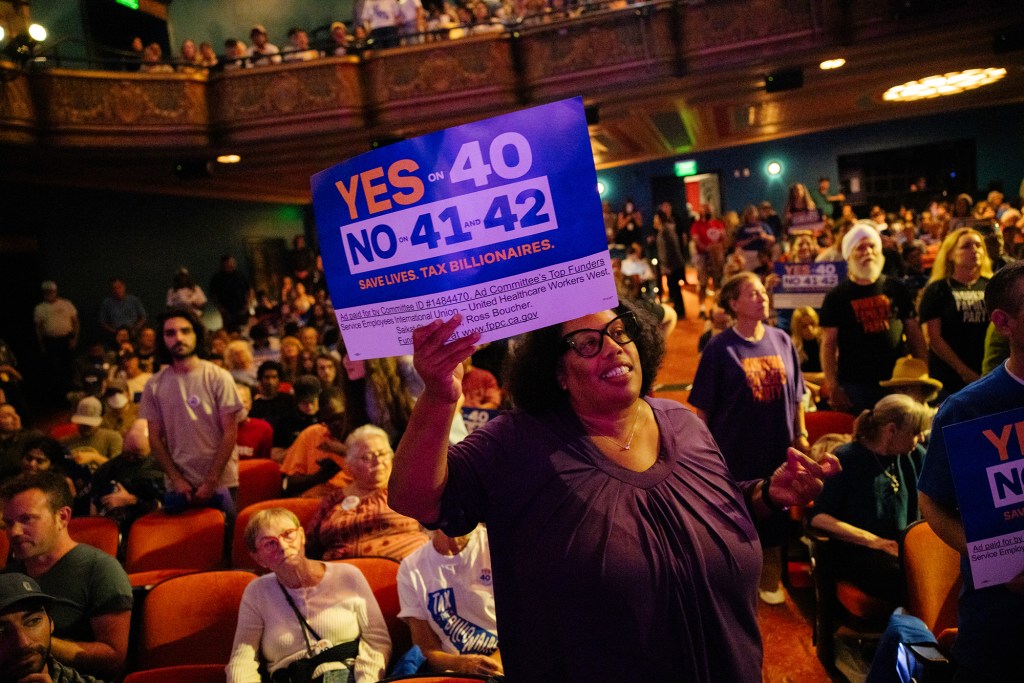
The initiative by SEIU-United Health Care Workers West would’ve imposed a one-time 5% tax on the assets that actually create excessive wealth, generating an estimated $100 billion to help backfill federal cuts to Medi-Cal. Since it targeted stocks, bonds and business holdings, it was seen as an act of war. Brin and his allies left nothing to chance, raising $379 million to fight it.
We won’t need much analysis to identify what swayed voters. The playbook for defeating the tax was simple: Stoke economic fears and confuse Californians.
Prop. 40’s authors may have even doomed their own campaign with an amendment provision that opponents seized on. If a supermajority — two-thirds of the Legislature — wanted to retool the tax, they could, so long as “the statute is consistent with and furthers the purposes of the 2026 Billionaire Tax Act.” Opponents created ads proclaiming politicians would use this clause to come after our retirement accounts.
It lit up social media. Some Californians are so cynical that they figured seven out of 10 state lawmakers would vote to extend a billionaire tax to people with fewer zeros and commas invested. It also made one of Brin's countermeasures, Proposition 42, an easy sell. It would bar taxes on personal property and its passage would make it almost impossible to enact a similar tax in the future. It was ahead in the count Wednesday morning.
Ultimately the most persuasive reason to reject the tax was the possibility it would stifle innovation or scare off the companies that anchor the state’s economy. Even worse, it might chase away the owners and executives who control these market-making conglomerates — their tax dollars leaving with them.
Gov. Gavin Newsom, a presumed contender for president, threw his support behind the “no” camp more than a year ago and started echoing this talking point shortly thereafter. He later said he would welcome a wealth tax at the federal level, even though we all know how that would go — even if it is the correct approach.
Nevermind that the research on capital flight is largely settled. Earlier this year, I spoke with Cornell University sociologist Cristobal Young, who literally wrote the book on this (it’s called “The Myth of Millionaire Tax Flight: How Place Still Matters for the Rich”). Decades of research show that it is much easier for the ultrarich to threaten to leave than actually do it, Young said. Brin and Larry Page and Peter Thiel did flee, but they are outliers. Study after study, on wealth taxes domestic and abroad, consistently show that taxes don’t compel rich people to move, and certainly not enough to compromise a $300 billion state budget.
Still, their departure fueled a report by the Hoover Institution, a conservative think tank at Stanford University, which suggested California risked income tax losses and would receive far less than what was promised by Prop. 40’s proponents.
The Hoover report also presumed billionaires pay income taxes like everyone else. In 2021, ProPublica received a trove of IRS files on the richest people in America — many of whom would have been affected by Prop. 40. The investigative newsroom uncovered how the ultrarich artificially lower their income and instead derive their wealth through their investments. Billionaires exploit loopholes in the tax code to amass vast fortunes and pay the government as little as possible.
In most instances, their effective tax rate is lower than the people who work for them. Buy. Borrow. Die. That’s what they do.
The little they do pay — the Stanford economists said it was as much as $5.8 billion annually to California’s coffers — represents a fraction of the $123 billion in income taxes the state collects overall.
If voters weren’t worried Prop. 40 was a slippery slope or would sacrifice the state’s golden goose, then they subscribed to the myriad other critiques: It’s badly written. It’s only for healthcare. It’s socialism.
I didn’t like it, either — for a while. Then the Legislature kicked the can on fixing the state’s budget problem and swiftly killed a Citizens United reform proposed by Assemblymember Chris Rogers of Santa Rosa, mirrored after a novel law in Hawaii to curb political spending.
Suddenly the Prop. 40 battle became a much simpler feud between billionaires and everyone else in California. Opponents were spending hundreds of millions to fight a tax they could afford. Meanwhile, I’m trying to figure out if my wife and I can buy a home and pay for child care on two incomes.
The speed and scale of inequality is intensifying in California and nationwide. A majority of Americans believe billionaires are a threat to democracy, especially millennials and Gen Z. If corporations continue to flood the political sphere with limitless sums of money, the ballot box is one of the remaining places we can register our opposition.
Initial returns this week also suggest Proposition 4 could fail. This was a measure that would have reversed a 1988 ban on financing political campaigns with public dollars. It is the sort of policy that helps reduce the influence of money in politics and empower candidates who are not beholden to the donors that helped them get elected.
Instead, California has once again resurfaced the ironies that define this incredible state. We talk about progress but struggle to deliver it. We dislike what excessive wealth is doing to our state but avoid reining it in. We create world-changing technologies but oppose boundaries that ensure our safety.
California may have the biggest economy of any U.S. state, but that does not make it a lab for innovative policy. It simply means we are home to giant companies and smart people. The issues we like to boast about, such as environmentalism or civil rights, are rife with contradictions and trade-offs.
Prop. 40 should have never been considered a litmus test for wealth taxes. It should not discourage them, either. California voters have backed income taxes on millionaires and high-earners to fund mental health treatment and education over the last two decades. As Young, the Cornell researcher, uncovered, those taxes didn't cause an exodus. Proposition 3, which makes a tax for public school funding permanent, officially passed early Wednesday morning.
If there is a glimmer of hope, it is that Brin and other billionaires stepped into the sunshine. The record spending and attack ads and political gamesmanship was done out in the open. Many Californians took notice, whether they backed Prop. 40 or not.
The state’s billionaires may have avoided this wealth tax, but voters won't forget how some of the richest people on the planet behaved when fairness was on the ballot.
This article was originally published on CalMatters and was republished under the Creative Commons Attribution-NonCommercial-NoDerivatives license.