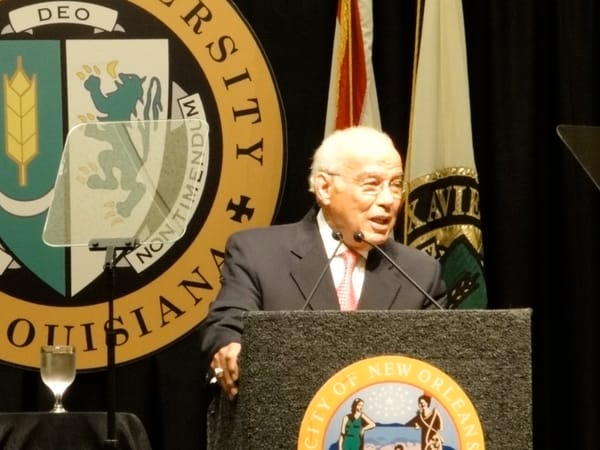
Feds bar Minnesota from investigating Minneapolis ICE shooting
Many L.A. fire survivors face insurance delays and can’t return home a year later


Editor's note: The Minneapolis shooting of Renee Good by an ICE agent is a developing story.
It's Friday, January 9, 2026 and in this morning's issue we're covering: Feds bar Minnesota from investigating fatal ICE shooting, prohibit access to evidence, Yes, state and local prosecutors can charge federal law enforcement agents with crimes. But it isn’t easy, NC ski industry hopes for snow to power comeback after Helene damage kept tourists away last year, Many L.A. fire survivors face insurance delays and can’t return home a year later, The Data Center Rush in Appalachia, Troubled Teen Industry Rocked by Lawsuits, Sexual Assault Charges, Built by peers, backed by the state: Inside North Carolina’s expanding peer support network, Inside the Battle for the Future of Addiction Medicine, An Appleton school prepares students for skilled trades. It’s not easy, Stuart Community Hospital opens for emergency and inpatient care, Arizona voters approved in-state tuition for undocumented students. The state left implementation to chance.
Media outlets and others featured: Sahan Journal, MinnPost, Carolina Public Press, CalMatters, The Daily Yonder, MindSite News, North Carolina Health News, KFF Health News, Wisconsin Watch, Cardinal News, Arizona Center for Investigative Reporting.
 Andrew Hazzard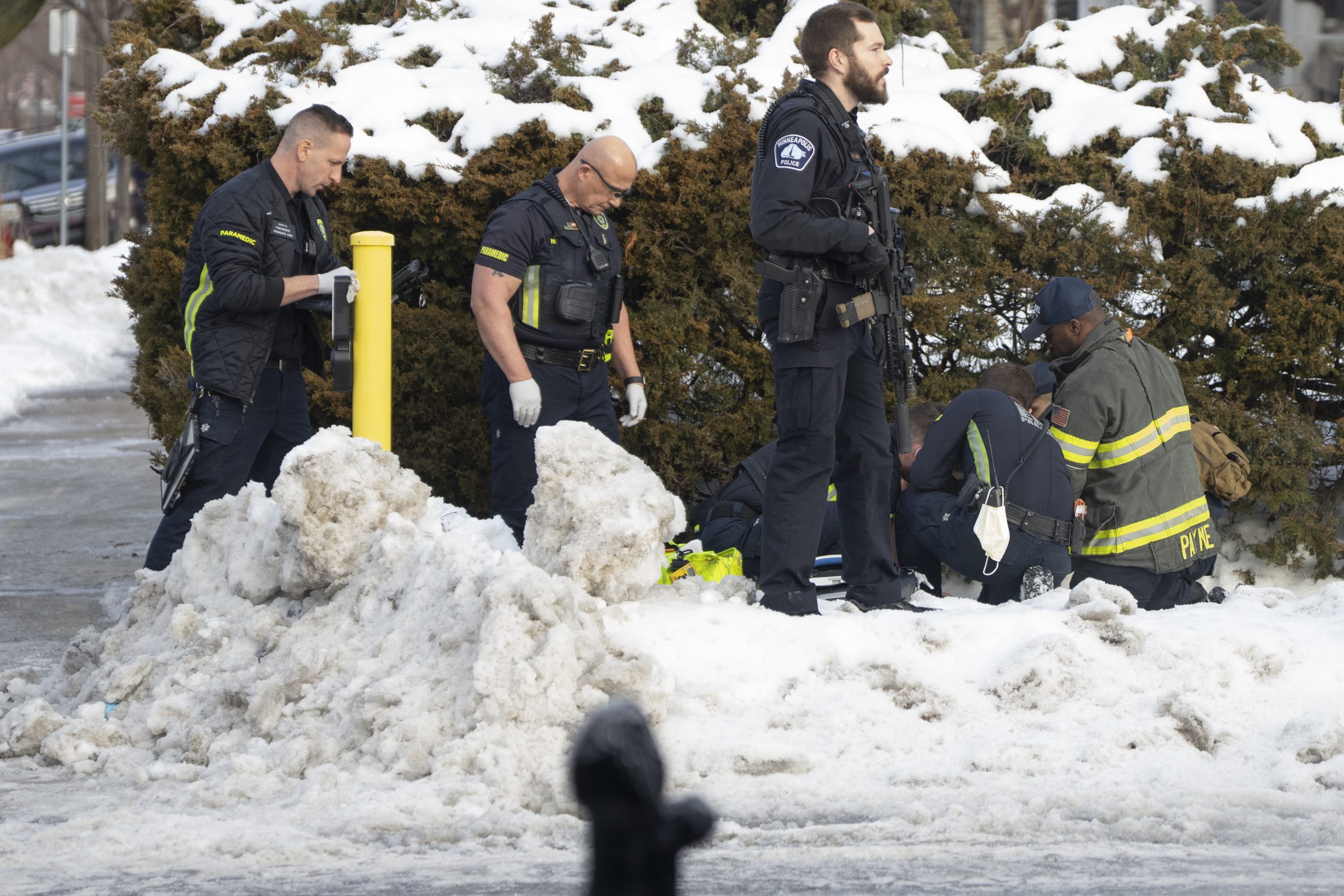
Feds bar Minnesota from investigating fatal ICE shooting, prohibit access to evidence
Minnesota Governor Tim Walz said Wednesday that the FBI and BCA would investigate the killing of Renee Good together. Now, federal officials are freezing state and local agencies out of the case.
When the stakes are high, access to information is essential.
Support independent journalism when it’s needed most.
DONATE NOW
Federal law enforcement will “solely” lead the investigation into an immigration agent’s fatal shooting of a woman in Minneapolis, and will not work with Minnesota agencies, state authorities revealed Thursday morning.
The Minnesota Bureau of Criminal Apprehension (BCA) said Thursday that the Federal Bureau of Investigation (FBI) and the United States Attorney’s Office decided against collaborating with state and local agencies in probing the Wednesday killing of Renee Nicole Good.
BCA Superintendent Drew Evans said in a written news release that his agency talked with the Hennepin County Attorney’s Office, FBI and U.S. Attorney’s Office Wednesday, and it was agreed that the BCA would partner with the FBI.
“Later [Wednesday] afternoon, the FBI informed the BCA that the U.S. Attorney’s Office had reversed course: the investigation would now be led solely by the FBI, and the BCA would no longer have access to the case materials, scene evidence or investigative interviews necessary to complete a thorough and independent investigation,” said the BCA news release.
Good, 37, was shot and killed by an Immigration and Customs Enforcement (ICE) agent on Portland Avenue near E. 34th Street at about 9:45 a.m. Wednesday morning.
“Without complete access to the evidence, witnesses and information collected, we cannot meet the investigative standards that Minnesota law and the public demands. As a result, the BCA has reluctantly withdrawn from the investigation,” Evans said in the BCA statement.
In the aftermath of the killing Wednesday, Minnesota Governor Tim Walz said the BCA would be working on the investigation with the FBI. The BCA investigates law enforcement shootings in Minnesota.
Sahan Journal reporters saw FBI forensic teams on the scene of the shooting at about 11 a.m., and witnessed a BCA team arrive on the scene in the early afternoon.
This is a developing story. Please check back for updates.
Yes, state and local prosecutors can charge federal law enforcement agents with crimes. But it isn’t easy
by Shadi Bushra, MinnPost
January 7, 2026
Minnesota Attorney General Keith Ellison and Hennepin County Attorney Mary Moriarty called for local investigations after a U.S. Immigration and Customs Enforcement agent shot and killed an unarmed woman in Minneapolis.
Minnesota attorneys who specialize in police misconduct cases say the federal government is unlikely to be able to block state or local prosecution of a federal agent — though Trump administration comments Wednesday suggest they would vigorously fight any attempt to do so.
Unless there’s “some wild-eyed legal theory out there that someone picks up to defend this guy… I think it’s going to be a very tall order for a federal judge or the Department of Justice to block [prosecution] from happening,” said Joshua Newville, an attorney with Halunen Law in Minneapolis who has experience with civil police misconduct cases.
Related: Federal agents shoot and kill motorist during ICE crackdown
A 2025 paper by a University of Wisconsin Law School attorney offered a similar conclusion: While federal officers have some special legal protections, they are not immune from state and local prosecution.
Observers captured the shooting on video from multiple angles. They show an officer approaching an SUV, grabbing the door handle and demanding the driver open the door. The SUV begins to pull forward and a different ICE officer standing in front of the vehicle fires into the SUV at close range, jumping back as the vehicle moves toward him.
Homeland Security Secretary Kristi Noem claimed the agent acted in self-defense and that the victim, Renee Nicole Good, 37, was committing “domestic terrorism.” But Minneapolis Mayor Jacob Frey described the agent's actions as “reckless” and unnecessary.
Newville said the real issue is how far the federal government will go to try to complicate state and local court cases, and to what degree courts acquiesce to the feds.
“It sets us up for a further confrontation between state and federal government with regards to each government's power and their authority,” Newville said. “I think it just makes it more likely that we will see a conflict that the courts will have to weigh in on.”
The federal government may try to put its thumb on the scales of justice by arguing no federal laws were broken, but if there is strong enough evidence that the ICE agent broke state or local laws, “I don’t see how the federal government could deprive state and local law enforcement and prosecutors from pursuing charges.”
Related: DHS deploys 2,000 federal agents to Minneapolis area to carry out largest immigration operation ever
Robert Bennett of Minneapolis-based Robins Kaplan LLP has long represented victims of law enforcement overreach, including a victim of former police officer Derek Chauvin, who was convicted on both state and federal charges for the 2020 murder of George Floyd.
The Chauvin cases were an example of how federal and state prosecutions can move in parallel, when those in charge want them to. That scenario is not likely in this case.
“Based on what you’ve already seen today with [President] Trump’s public statements and [Secretary] Noem’s public statements, there’s never going to be a federal prosecution,” Bennett said.
Bennett described the federal officers he has worked with and prosecuted over the last five decades as being very well trained, conscious of the legal nuances of their positions, and generally professional.
“The conduct going on now in Minnesota is not that of a well-trained organization that understands the limits of its power and the limits on the use of force,” he said, noting that unlike the FBI or ATF, ICE is operating “more like an American iteration of the secret police.”
Attorney General Keith Ellison said during an appearance on MS NOW that there needs to be state involvement. “There needs to be a situation where the feds are not just investigating the feds,” Ellison said.
Moriarty said in a statement earlier in the day that her office was “pushing hard for a local investigation which is the only way to ensure full transparency and review by our office. We will use every available lever to ensure a local, transparent investigation takes place."
Related: Amid fears of ICE raids, Minneapolis businesses say some customers staying home
At a news conference Wednesday, Minnesota Department of Public Safety Commissioner Bob Jacobson stressed the state’s involvement in the investigation, but noted that it is “working in conjunction with the FBI.”
“We don't comment on active investigations, but also keep in mind that this investigation is in its infancy,” Jacobson said. “So any speculation about what had happened would be just that — and we will not engage in speculation.”
This article first appeared on MinnPost and is republished here under a Creative Commons Attribution-NoDerivatives 4.0 International License.

NC ski industry hopes for snow to power comeback after Helene damage kept tourists away last year
by Jane Winik Sartwell, Carolina Public Press
January 5, 2026
Looking to hit the slopes this winter in Western North Carolina? For the ski industry in the mountains, 2026 is about more than just powder. It's about proving the mountains are back.
Tropical Storm Helene hit less than two months before ski season started last winter. On Sugar Mountain in Avery County, the ski patrol building went up in flames, the parking lot buckled, falling trees knocked down the night-light system, the ski shop flooded and minor landslides marred the mountain.
Ironically, after all that, last year was a very good weather year for skiing. It snowed 76 inches on Sugar Mountain.
[Subscribe for FREE to Carolina Public Press’ Daily, Weekend and Election 2026 newsletters.]
“That definitely made us work very, very hard to recover from Helene and the damage that she did to the ski area,” Kim Jochl, president of the NC Ski Association and vice president at Sugar Mountain Ski Resort, told Carolina Public Press.
“It speaks to the resiliency of the people who live here, the people who work here. They understand the value of working hard so that we can open when the snow flies and the temperatures drop.”
As hard as Jochl and her colleagues worked to recover, it was impossible for last ski season to be a true economic boon for the region. Many, at the time, believed the mountains were completely out of commission.
Jochl hopes this year will be a repeat of last year’s voluminous snowfall. Early signs suggested she may get lucky. When David Jackson, president of the Boone Chamber of Commerce, looked out his window on Dec. 9, it looked like a picture-perfect snowy winter postcard.
“We need a win, and this is an opportunity for a win,” Jackson told CPP that day. “People can see that this area of the state is healed, and can continue to offer something that no other area in the state can.”
Ski industry workforce challenges
Finding enough people to staff the ski slopes is a challenge every year, but after Helene, it's an even bigger concern.
Winter sports in Western North Carolina are fueled by seasonal employees who bounce between summer and winter jobs. This summer, those warm-weather jobs, like rafting and hiking tours, were stilted by the physical and economic woes of Helene. In response, some workers moved elsewhere or sought more consistent employment.
“It's just taken a little bit longer for some of the resorts to get what they need in terms of employment,” Jackson said.
“It's been harder this year across the board, whether that's directly at the resorts or at the restaurants and hoteliers that support that tourism. It's been weighing on the minds of businesses much more so than we hoped it would, certainly at this stage of recovery.”
At Sugar Mountain, Jochl has relied on foreign labor for 60 of the ski resort positions, an increase of 20 positions from last year.
That labor has helped the ski mountains bounce back.
“The ski areas, from a business perspective, have moved on,” Jochl said. “Everything's been fixed.”
Pocketbook problems
The ski resorts may be back in full force. But that doesn’t mean the skiers are.
Many Americans are tightening their belts this year, thanks to persistent inflation, trade wars and political instability. Huddled around the kitchen table, reviewing the yearly budget, a ski trip could be the first thing on the chopping block for some families.
“North Carolina prospects (meaning they have interest in travel to our state) list the top three concerns impacting their decision to take a leisure trip as inflationary pressures on household budgets, availability of great travel deals and concerns about personal finances,” Marlise Taylor, director of tourism research at VisitNC, told CPP.
“The good news for us is that North Carolina has historically performed relatively well in times of economic uncertainty as compared to other states. Our geographic location and variety of affordable activities tend to still be attractive during these times.”
Still, Jochl believes in one simple principle: if there’s lots of snow, there will be lots of skiers.
“It seems like people find a way to ski no matter what challenges they face in their life,” she said.
Is climate change affecting WNC slopes?
Jochl has been measuring the yearly snowfall on Sugar Mountain for 24 years. She doesn’t see a pattern of dwindling snowfall due to climate change.
“It's random,” she said. “We don't really see any downturn towards higher temperatures or less snowfall. The climate changes every year.”
But looking at her data, a couple troubling patterns do arise.

Between the winter of 2001-2002 and the winter of 2012-2013, it snowed an average of 82.6 inches per year. From the winter of 2013-2014 to last year, it snowed an average of only 63.6 inches. That’s a 23% decline in average annual snowfall between the two halves of her data.
What’s more, out of those first 12 seasons, five had snowfall greater than 100 inches. Since 2014, there have been zero seasons with snowfall greater than 100 inches.
Still, this year is already proving strong for snowfall in the mountains. With winter just getting underway, Sugar Mountain has seen 16 inches of snow.
“Our message to ski visitors this year is, first of all: thank you for coming back,” Jackson said. “You knew that we had it in us.”
This article first appeared on Carolina Public Press and is republished here under a Creative Commons Attribution-NoDerivatives 4.0 International License.

Many L.A. fire survivors face insurance delays and can’t return home a year later
By Levi Sumagaysay, CalMatters

This story was originally published by CalMatters. Sign up for their newsletters.
A year after the deadly Los Angeles County fires, California’s property insurance market remains problematic; survivors are suing insurers over delayed or denied claims; and most of the state’s policyholders are likely to see their premiums rise.
Seven in 10 L.A. fire survivors have yet to return home, some in part because of insurance claim delays, according to a new survey released this week by Department of Angels, a nonprofit group that was formed after the fires.
The survey also found that 4 in 10 insurance policyholders have experienced insurability issues, such as huge premium increases and dropped coverage, although state law mandates a one-year moratorium on insurers canceling or not renewing customers’ policies after the governor declares a state of emergency. Those with homes that did not burn down but are still standing are especially likely to have seen big increases in their premiums, according to the survey of 2,443 adults from Nov. 18 to Dec. 2, 2025.
Insurance premiums for everyone, not just fire survivors, were already expected to rise under new rules by Insurance Commissioner Ricardo Lara. The commissioner, under pressure to improve availability of insurance in the state, last January implemented a plan that aims for quicker rate reviews and allows insurers to use catastrophe modeling and reinsurance costs in setting their rates. The plan took effect just days before the L.A. fires.
Now the response to the fires could also lead to even higher insurance premiums across the board, said Amy Bach, executive director of consumer advocacy group United Policyholders.
“I advocate for disaster survivors, but also for the entire community of policyholders,” Bach said. “For every ‘Eliminate the List’ bill, for every improvement we make to prevent post-disaster trauma around under-insurance, there’s a cost.” She said such actions will have ramifications for both insurance affordability and availability.
“Eliminate the List,” which Gov. Gavin Newsom signed into law last year, requires insurance companies to pay 60% of personal property coverage limits, up to $350,000, to policyholders who experience a total loss without requiring them to submit a detailed inventory for at least 100 days.
Still, Bach knows that such mandates are necessary to improve survivors’ experiences after a fire, and lawmakers are introducing new bills to address their concerns. Her own group released a survey in November, reporting policyholder complaints that included insurer communication delays, claims payment delays and being assigned multiple claims adjusters.
The Department of Angels survey found that customers of State Farm and the last-resort FAIR Plan — the two largest insurers in California — were the most dissatisfied with their insurers’ response. California’s insurance department is investigating State Farm’s response to the fires, and has taken legal action against the FAIR Plan over its response as well, especially to smoke-damage claims. Those insurers, along with other companies, are also facing policyholder lawsuits.
“Our customer feedback reflects a different experience than what is being reported,” said Tom Hartmann, a State Farm spokesperson, in an email. “We’re supporting more than 13,500 customers affected by the wildfires, more than any other carrier, and have already paid over $5 billion to help them recover.”
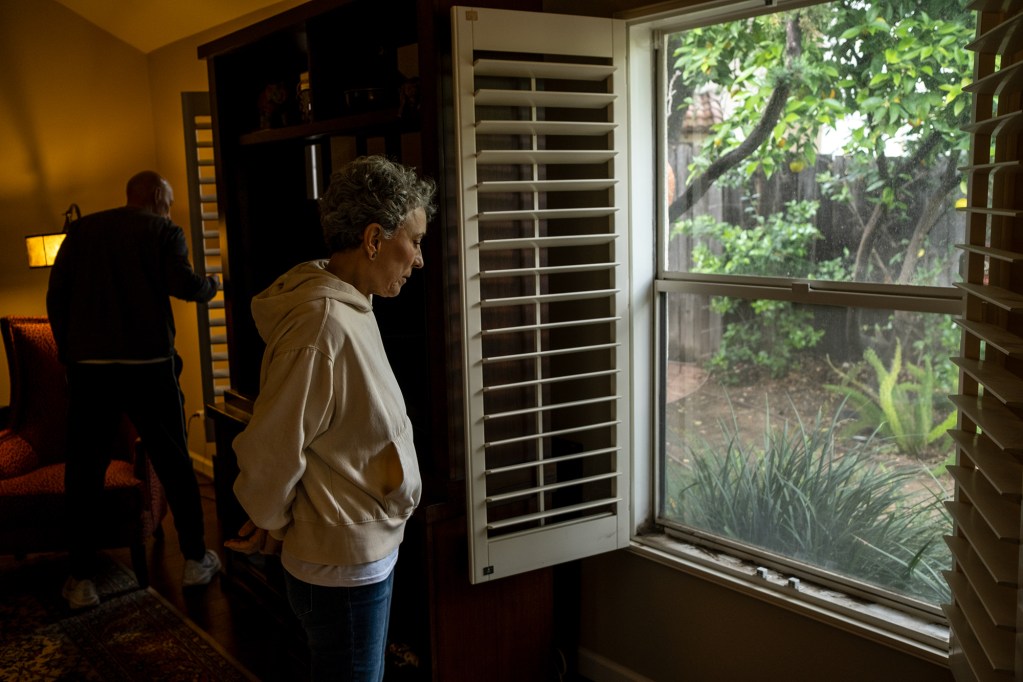
“We’ve paid almost $200,000 out of pocket to repair our home because of the FAIR Plan’s blanket denials of our remediation,” said Angela Giacchetti, a spokesperson for the Department of Angels who worked on the survey. She’s also a fire survivor whose Altadena home did not burn down but was badly damaged.
“While we are unable to comment on individual policyholders' claims, the California FAIR Plan does not direct where policyholders reside,” said Hilary McLean, a spokesperson for the plan. “The FAIR Plan evaluates every claim on its own merits and pays all covered claims up to the individual policy limits.”
The FAIR Plan said in a press release this week that it has handled about 5,400 claims and paid almost $3.5 billion to policyholders. It also said it “has taken steps to enhance its ability to serve policyholders” by securing a line of credit and reinsurance, helped by a $750 million catastrophe bond made possible by a new law allowing the FAIR Plan to get bond financing through the California Infrastructure and Economic Development Bank.
The American Property Casualty Insurance Association says insurance companies have paid $22.4 billion of the expected $40 billion in total claims from the L.A. fires.
The Department of Angels survey also found 79% of survivors are facing financial hardships, with more Black, Asian and Latino survivors falling behind on their rent or mortgage payments. In addition, 40% of those surveyed said they were very dissatisfied with the local, state and federal response to their needs.
Newsom said Tuesday that he is working with state lawmakers, the banking industry and others on new loans for rebuilding, and that the state will expand eligibility for the CalAssist Mortgage Fund. The governor’s office did not respond to CalMatters’ questions about whether he plans to propose any aid for renters who survived the fires, and about what else he is doing to continue to press the federal government for long-term disaster funding.
“This report says exactly what we’ve been hearing,” said Michael Soller, spokesperson for the insurance department. “Wildfire survivors want action and they want results.” He said the issues in the survey are top priorities for the department, and among other things pointed to a task force on smoke damage that the department has convened.
A bill sponsored by Lara and introduced by newly appointed Senate Insurance Committee Chair Steve Padilla, the Democrat from San Diego, late Tuesday would require insurance companies to submit to the state their disaster-recovery plans related to handling claims; double penalties for violations of fair claims practices during an emergency; expand upfront claims payments; give policyholders status updates within five days whenever their adjuster is replaced; and more.
This article was originally published on CalMatters and was republished under the Creative Commons Attribution-NonCommercial-NoDerivatives license.
The Data Center Rush in Appalachia
by James Branscome, The Daily Yonder
January 7, 2026
The demise of the coal industry left much of Appalachia in economic tatters, with lost jobs, spoiled water, and depopulated communities across the coalfields of Kentucky, West Virginia, and Virginia. Now, in an ironic twist of the region’s energy history, tech companies and data center developers are eyeing these same rural landscapes with ambitious plans to power the artificial intelligence revolution.
From the hollows of Tucker County, West Virginia, to the former strip mines of Wise County, Virginia, proposals for massive data center complexes are sparking both hope and fierce resistance. Proponents promise economic revitalization and tax revenues for struggling communities. Critics warn of environmental degradation, soaring utility bills for residents, limited job creation, and the stripping away of local control over development decisions.
The stakes are enormous. According to a September 2025 report from the Energy & Manufacturing in Appalachia initiative, approximately 92 gigawatts of data center capacity are currently in the pipeline across the United States, with seven gigawatts being added monthly by the end of 2024. Traditional data center hubs like Northern Virginia’s “Data Center Alley” are becoming saturated, pushing growth toward rural regions in Pennsylvania, West Virginia, and Kentucky.
Where Data Centers Stand Today
Northern Virginia remains the undisputed capital of the data center world, with roughly 300 operational facilities across Fairfax, Loudoun, and Prince William counties. Northern Virginia is one of the world’s largest internet interconnection hubs. But capacity constraints and community opposition are forcing the industry to look elsewhere. West Virginia has thrown out the largest welcome mat in the region.
In Appalachia proper, data center development remains nascent but is accelerating rapidly. Southwest Virginia’s Wise County hosts the Mineral Gap Data Center, which came online in 2023 and is powered by a 3.4-megawatt solar array built on former strip-mined land—widely promoted as the first abandoned mine land converted to solar in Virginia. OnePartner ATAC runs a facility in Duffield, Virginia.
In January 2025, developers announced plans for Kentucky’s first hyperscale data center in Louisville, a 400-megawatt campus to be developed by PowerHouse Data Centers and Poe Companies, with utility service from Louisville Gas and Electric. The Lane Report noted the project is expected to begin operations by late 2026. It will likely represent a demonstration of what can be exported to Eastern Kentucky.
Southwest Virginia’s Growing Pipeline
Beyond the Wise County proposals, data center interest is spreading across Southwest Virginia, often into communities with minimal regulatory frameworks to evaluate such projects.
In early December 2025, Wythe County announced its first data center: a 99-acre AI computing campus at Progress Park to be developed by Solis Arx, a newly formed digital infrastructure company led by CEO Rob Noll. Cardinal News reported that county officials project the facility will represent more than $1 billion in total investment. County Administrator Stephen Bear told the Wythe County Board of Supervisors that the project would generate more than $10 million in annual tax revenue by 2028, making Solis Arx the county’s single largest taxpayer.
The company claims its facility will consume only about 2,000 gallons of water daily—roughly equivalent to a restaurant—by using closed-loop and air-based cooling systems rather than the evaporative cooling that can require hundreds of thousands of gallons per day at older facilities. Appalachian Power will provide electricity, with water supplied by the town of Wytheville.
At a December 9, 2025 board meeting covered by Cardinal News, nearly all of the dozen residents who spoke during public comment opposed the project or raised concerns about electricity rates, water supplies, environmental impacts, and the loss of rural character. Resident Hannah Ainsworth questioned the trajectory of such development: “It’s 99 acres proposed today, but what about next year, in three years? At what point is our region unrecognizable?”
Board of Supervisors Chairman Brian Vaught acknowledged a significant vulnerability in how such projects arrive. Wythe County is one of approximately seven Virginia counties that lack zoning ordinances governing where data centers can be built. “So until that’s addressed, if you don’t live in the town of Wytheville or the town of Rural Retreat, one of these could pop up as your neighbor,” Vaught said, according to Cardinal News.
Pulaski County may not be far behind. The 2025 Virginia General Assembly allocated $15 million for site readiness improvements—including road extensions, grading, and natural gas pipeline work—to support what budget documents describe as “up to $3.0 billion in capital investment” through construction of a data center and power plant. The project remains under nondisclosure agreements, with no developer publicly identified, according to Inside Climate News and Cardinal News.
Montgomery County supervisors are also weighing the issue. Cardinal News reported in mid-December 2025 that local officials are considering commissioning a study on data center zoning—a sign that even communities without active proposals recognize the need to prepare for an industry expanding rapidly across the region.
The Wise County Vision: Mine Water Cooling
One of the most ambitious proposals involves transforming 65,000 acres of former coal mining land in Wise County, Virginia, into an energy hub including data centers. A nonprofit venture called Energy DELTA Lab, managed by Will Clear and Will Payne, envisions building a massive 450-acre “Data Center Ridge” on top of old mining lands that could be powered and cooled using billions of gallons of water that naturally replenish in abandoned underground mines.
In a December 2025 report, the Thomson Reuters Foundation detailed how the entrepreneurs hope to prove the feasibility of their idea to Texas-based Energy Transfer, which owns the land managed by Penn Virginia Operating Co. Unlike neighboring areas plagued by acid mine drainage, the Wise County coalfields lack the mineral pyrite that contaminates water. The underground mine water maintains a temperature of 55 degrees or below, roughly 10 to 15 degrees cooler than river water typically used for data center cooling elsewhere in Virginia.
Payne told the Thomson Reuters Foundation that the water quality makes the site attractive for data center cooling. He acknowledged, however, that the region faces deep skepticism about outside development. “Anyone looking at expanding in the region, there is skepticism because there have been so many stories of promises made but not kept,” Payne said, according to the Reuters report.
Canary Media reported in September 2024 that tax revenues from data centers could help address the region’s fiscal crisis. Will Clear told Canary Media that local government finances face an existential threat without new development. The Virginia Mercury reported in July 2024 that a 36-megawatt data center could provide about $464 million in capital investment and create approximately 40 high-income jobs.
West Virginia’s Controversial Push
West Virginia has become the most aggressive state in pursuing data center development, passing sweeping legislation in April 2025 that strips local governments of regulatory authority over such projects. House Bill 2014, championed by Governor Patrick Morrisey as the centerpiece of his economic development agenda, prohibits counties and municipalities from enforcing zoning ordinances, permitting requirements, noise regulations, or code enforcement on certified microgrid districts or “high-impact” data center projects.
The law also diverts most property tax revenue from data centers away from local taxing bodies to state coffers. Under the final version, only 30% of property tax proceeds go to the host county, with five percent divided among the state’s other 54 counties. The West Virginia Gazette-Mail reported that this formula is estimated to cost counties and school districts millions of dollars.
Upon the bill’s passage, Morrisey declared it “the economic development bill of the session,” according to the Gazette-Mail. “West Virginia is America’s energy state, and this law is going to demonstrate it to the whole country that we are ready for action,” Morrisey said in a statement reported by Mountain State Spotlight.
At least four major data center projects are now publicly known in West Virginia. The most controversial involves Fundamental Data LLC, a Virginia-based company seeking to build a 1,656-megawatt natural gas power plant and data center complex on 500 acres between the towns of Thomas and Davis in Tucker County. The Wall Street Journal reported that the proposed facility could eventually span 10,000 acres across Tucker and Grant counties if fully realized.
Kentucky: Multiple Proposals, Growing Debate
Kentucky’s data center conversation has moved quickly from possibility to reality. Beyond the Louisville hyperscale campus, the Kentucky Lantern reported in August 2025 on a proposed multi-billion-dollar “technology campus” with data centers in Mason County, though key details remain thin, and local reaction has included both hope and skepticism.
In Oldham County, Louisville Public Media reported that residents organized against a proposed hyperscale data center, and the controversy has become a statewide case study in zoning disputes, noise concerns, and rural quality-of-life politics. The fight illustrates how quickly economic development proposals can become community flashpoints when a hyperscale project lands on rural ground.
The Economic Equation
The Promise of Tax Revenue
Proponents argue that data centers represent one of the few realistic options for diversifying Appalachian economies devastated by coal’s decline. The numbers from Virginia’s experience are eye-catching. According to Loudoun County officials quoted by the Citizens Voice in December 2025, data centers generate 35 to 40% of the county’s General Fund revenue, with fiscal contributions jumping from $1 million in fiscal year 2018 to $875 million in 2024. That figure is projected to reach $1.1 billion by fiscal year 2026.
A PricewaterhouseCoopers study cited by Virginia Business found that between 2017 and 2021, data centers contributed $54.2 billion to Virginia’s gross domestic product. Southwest Virginia localities have positioned themselves to capture some of this wealth by implementing the state’s lowest regional property tax rate on data center equipment at 24 cents per $100 of assessed value, compared to $3.70 in Prince William County, according to Virginia Business.
The Jobs Question
Critics contend that data centers deliver far fewer permanent jobs than their industrial footprint suggests. According to an October 2025 report from ReImagine Appalachia, most data center employment is in construction, and those jobs are often contracted from outside the communities where facilities are built.
A typical data center adds up to 1,500 workers during construction but employs only about 50 full-time workers when operational, according to a 2024 Virginia state report cited by the Thomson Reuters Foundation. Those permanent positions are primarily security or janitorial staff.
At an April 2025 town hall meeting in Davis, West Virginia, covered by 100 Days in Appalachia, electrical engineer Brian Reed—whose family has been in Tucker County since 1896—challenged the jobs pitch. “$12 an hour isn’t a job, you can’t survive,” Reed said. “The operators in the plant where I work make $43 an hour. That’s a job that makes a difference. So don’t offer jobs that are for security people that are going to starve to death.”
Nationwide, data center employment grew from 306,000 to 501,000 workers between 2016 and 2023, according to the Bureau of Labor Statistics. But more than 40% of those jobs are concentrated in just three states, far from Appalachia’s coalfields, as reported by West Virginia Watch.
Environmental Concerns
The Water Challenge
Data centers rank among the top ten water-consuming commercial industries in the United States. A medium-sized facility can consume around 110 million gallons of water annually for cooling, with some consuming up to 5 million gallons daily, according to a report from the University of Tulsa. The Environmental and Energy Study Institute reported that data centers in Northern Virginia collectively consumed nearly 2 billion gallons of water in 2023, a 63% increase from 2019.
Water consumption varies significantly based on cooling technology. Evaporative or wet cooling requires substantial water withdrawals and raises concerns in drought-prone areas like Maricopa County, Arizona, which has been inundated by data center developments. Air cooling reduces water needs but increases electricity consumption. The Wise County proposal’s closed-loop mine-water cooling approach attempts to change the equation by using cool underground mine water as a heat sink, potentially eliminating dependence on surface water or municipal systems.
Water concerns are particularly acute in some Appalachian locations. Tucker County, West Virginia, suffered through a severe drought in 2024 that forced emergency water pumping from the Blackwater River. 100 Days in Appalachia reported that in neighboring Thomas, the reservoir reached its lowest level in 60 years, rendering water unusable due to high iron concentrations.
In a December 2025 Brookings Institution podcast, Davis Mayor Al Tomson expressed concern about cumulative water impacts. “We’ve suffered a drought for the last two summers,” Tomson said. “We’ve had to go to our secondary water source, which is the Blackwater River. But if the data centers start drawing water out of the aquifer... I’m concerned that it’s gonna affect the source water for the creek that we’re using right now.”
Noise Pollution
The constant hum of cooling systems and backup generators has emerged as one of the most contentious issues for communities living near data centers. According to TechTarget, facilities produce noise levels between 55 and 85 decibels from cooling fans, mechanical chillers, and ventilation systems—sounds that are particularly intrusive in rural areas where residents moved seeking quiet.
In Northern Virginia, Amazon Web Services data centers near the Great Oak subdivision in Manassas have drawn persistent complaints. WUSA9 reported that residents describe the sound as a low roar combined with a high-pitched whir. “These data centers are loud, noisy beasts, and they are being built too close to residential areas,” community activist Roger Yackel told WUSA9. “That’s not something that we should have to live with.”
The Prince William Times reported in December 2022 that noise remediation can cost millions of dollars, and unless regulators apply pressure, companies may be slow to implement solutions. In Tucker County, the prospect of constant industrial noise near the tourist towns of Davis and Thomas—known for stargazing, hiking, and natural beauty—has fueled fierce opposition.
Air Quality and Diesel Risk
Large data centers typically rely on diesel backup generators that produce air pollution during testing and emergencies. The Parsons Advocate of Tucker County reported that the Fundamental Data project there would include 30 million gallons of diesel fuel storage to back up its natural gas power plant.
The West Virginia Department of Environmental Protection approved an air quality permit for the Tucker County facility in August 2025 over strenuous community objections. The Intermountain newspaper in Elkins, West Virginia, reported that more than 1,600 written comments were submitted during the public comment period.
“We are extremely disappointed that the West Virginia DEP really isn’t upholding their mission to protect our air, land, and water,” Nikki Forrester of Tucker United told The Intermountain. “They discussed at the public meeting that they’ve never rejected an air quality permit before.”
Community Backlash: Three Overlapping Camps
Across Appalachia, community reactions to data center proposals tend to fall into three overlapping camps. The first is the development coalition: county officials, industrial development authorities, some trades, landowners, and utilities who argue that data centers represent a once-in-a-generation chance to replace the coal-era tax base and keep young people local.
The second is the quality-of-life coalition: nearby residents, tourism businesses, and preservation groups focused on noise, light pollution, traffic, and land conversion. The third is the accountability coalition: people who might tolerate a project if rules are strict, demanding transparency about corporate identity, enforceable limits, and binding community benefits.
In Pittsylvania County, Virginia, grassroots organizing successfully blocked Balico LLC’s proposal to build what would have been Virginia’s largest natural gas power plant at 3,500 megawatts alongside a hyperscale data center campus.
In Tucker County, residents formed Tucker United within weeks of learning about the Fundamental Data proposal. West Virginia Watch reported that the group now counts hundreds of members. “No Data Center in Tucker County” signs have proliferated in windows, storefronts, and on vehicles throughout Davis and Thomas.
One recurring complaint involves the lack of transparency from developers. Fundamental Data’s air permit application was heavily redacted, with the company claiming confidential business information. The firm’s public website consists only of a logo and a copyright notice, as noted by 100 Days in Appalachia.
“The company hasn’t come down and spoken with us at all,” Forrester told Corporate Crime Reporter in August 2025. “From a local leadership standpoint, none of us were aware that this was even a possibility. It feels like it’s a power grab where they want to get rid of any local control, take the money, and leave West Virginians to suffer.”
WVVA reported in April 2025 that more than 1,000 West Virginians signed a petition asking Governor Morrisey to veto HB 2014. He signed it anyway.
Utility Companies in the Mix
This is not just a technology story—it’s a utility planning story. Several major utilities are positioning themselves to serve the anticipated data center boom in Appalachia.
American Electric Power, the parent company of Appalachian Power in West Virginia and Kentucky Power in eastern Kentucky, has emerged as a key player. Data Center Dynamics reported in February 2025 that AEP expects to bring 4.7 gigawatts of new data center capacity online in 2025 alone and has customer commitments for 20 gigawatts of incremental load by 2030.
Louisville Gas and Electric will serve Kentucky’s first hyperscale data center campus. Dominion Energy, Virginia’s largest utility and the company most directly tied to Northern Virginia’s data center concentration, is expanding infrastructure across the Commonwealth. In Southwest Virginia, Appalachian Power and Dominion Energy provide electricity to the region where the Energy DELTA Lab project is proposed.
FirstEnergy has announced $15 billion for power infrastructure investments to support data center growth, according to the Energy & Manufacturing in Appalachia report. The company serves customers across Ohio, Pennsylvania, West Virginia, Maryland, and New Jersey.
PJM Interconnection, the regional grid operator covering much of coal-country Appalachia, has become central to debates about supply, demand, and rate impacts. West Virginia Public Broadcasting reported that projected data center load growth far exceeds new supply coming online in the near term.
Will Electric Bills Rise?
The short answer appears to be yes, and in some cases dramatically. Data center demand has already contributed to soaring wholesale electricity prices across the PJM Interconnection, the regional grid that serves West Virginia, Pennsylvania, Ohio, and other mid-Atlantic states. Stories of ratepayer protests about rising electricity prices are appearing all across the mountains.
Mountain State Spotlight reported in October 2025 that the cost to secure an adequate power supply in PJM’s annual capacity auction jumped from $2.2 billion for 2024-2025 to $14.7 billion for 2025-2026, an increase of more than 500%. CNBC reported that an independent monitor found data center demand, both actual and forecast, accounted for $9.3 billion, or 63%, of that total. In the December 2025 auction, prices hit $16.4 billion, with PJM falling short of its reliability target for the first time. Nearly all of the 5,250-megawatt increase in projected demand was attributable to data centers.
Monitoring Analytics, a specialized firm that acts as an independent monitor for the PJM Interconnection, said in its June report: “Data center load growth is the primary reason for recent and expected capacity market conditions, including total forecast load growth, the tight supply and demand balance, and high prices.”
These costs are spread across the entire grid, affecting ratepayers throughout the region. CNBC reported in November 2025 that residential electricity prices surged 13% in Virginia, 16% in Illinois, and 12% in Ohio during a recent 12-month period, well above the six percent national average.
A Harvard Law School study released in September 2025 warned that utilities may be subsidizing data center growth by shifting infrastructure costs to residential and other ratepayers. The Union of Concerned Scientists reached a similar conclusion in an October 2025 analysis: “The wealthiest companies are building extraordinarily expensive data centers that you and I are subsidizing.”
Cathy Kunkel, an energy consultant at the Institute for Energy Economics and Financial Analysis, told Mountain State Spotlight: “One of the principles of electric rate regulation is that the entity that’s imposing cost on the system bears those costs to the extent possible. The historical way transmission cost allocation has been done is just not keeping up with that principle when it comes to data centers.”
Corporate Players in Appalachia
Two overlapping groups of corporations are driving the data center push into Appalachia. The first consists of hyperscalers—the companies whose cloud and AI services create the underlying demand: Amazon (AWS), Microsoft, Google, and Meta. Even when they aren’t named publicly, they often sit behind developer NDAs or vague references to “Fortune 100” clients, as the Kentucky Lantern has noted in its coverage.
Amazon Web Services has the largest data center footprint nationally, with hundreds of facilities in Northern Virginia alone. Google has committed $25 billion for data centers and infrastructure, including a $3 billion deal with Brookfield Asset Management for hydropower electricity, according to the Energy & Manufacturing in Appalachia report.
The second group consists of developers, landholders, and power partners—the visible local actors. PowerHouse Data Centers and Poe Companies are developing Kentucky’s first hyperscale campus in Louisville. Compass Datacenters and QTS Data Centers are building the Prince William Digital Gateway in Virginia, billed as the world’s largest future data center complex at 23 million square feet, according to Virginia Business.
In West Virginia, Fundamental Data LLC of Purcellville, Virginia, is pursuing the massive Tucker County project. TransGas Development Systems of New York is proposing two off-grid power plants in Mingo County for what the applications call the “Adams Fork Data Center Energy Campus,” according to Mountain State Spotlight. Texas-based Fidelis New Energy has proposed a data center complex in Mason County.
In early December, ten Mingo County residents filed a federal lawsuit seeking to halt the Adams Fork project, alleging violations of the Endangered Species Act, Clean Water Act, and National Environmental Policy Act.
Questions Communities Should Ask
What Advocacy Groups Recommend
Several organizations have developed frameworks to help communities evaluate data center proposals and advocate for responsible development. Their recommendations share common themes: transparency, local control, binding commitments, and protection for existing residents and ratepayers.
Virginia Data Center Reform Coalition
The Piedmont Environmental Council and nearly 30 environmental, preservation, and climate advocacy groups formed the Virginia Data Center Reform Coalition in late 2023. Julie Bolthouse, the Council’s director of land use, told Inside Climate News in December 2023 that an “ever-increasing data center footprint” has resulted in “higher utility rates, new transmission lines, declining air quality, reduced water supply,” and a loss in Virginia’s “hard-fought climate goals.”
The coalition has articulated four pillars of reform. The first is enhanced transparency, requiring disclosure and statewide reporting on data center energy use, water consumption, and emissions. The second is state oversight, establishing state-level regulatory review to evaluate regional impacts. The third is ratepayer protection, safeguarding residents and businesses from subsidizing billions of dollars in infrastructure that data centers require. The fourth is incentivizing sustainability by connecting tax exemptions to clean energy and efficiency standards.
“There needs to be more transparency around this industry; we need to know how much energy, how much water, and their emissions,” Bolthouse told Data Center Dynamics in November 2024. “Our localities are ill-equipped to handle the regional implications that are coming from these massive projects.”
PennFuture’s Model Ordinance
PennFuture, a Pennsylvania environmental nonprofit, has created a model zoning ordinance and educational video series to help municipalities prepare for data center development. The organization developed its model after reviewing ordinances passed in Pennsylvania and Northern Virginia.
The model ordinance addresses water consumption, power consumption, noise, and aesthetic concerns. According to PennFuture’s website, “Municipalities must take seriously their responsibility to plan for this new land use and avoid being caught unaware, as many were when the distribution center boom struck Pennsylvania in recent years.”
Donna Kohut of PennFuture told the Republican Herald in August 2025 that Pennsylvania faces serious risks from legislation that would fast-track data center approvals. “By allowing developers to side-step critical and constitutionally required environmental protections, our elected officials would be allowing for unfettered destruction of Pennsylvania’s natural resources and risking the health of our local communities,” Kohut said.
ReImagine Appalachia
ReImagine Appalachia, a coalition focused on sustainable economic development in the Ohio River Valley, published a report in October 2025 titled “Is Responsible Data Center Development Possible?” The report argues that data centers can benefit communities if proper safeguards are implemented.
The organization recommends that data centers be located on shuttered industrial facilities rather than greenfields, ideally co-located with factories or greenhouses that can benefit from waste heat recovery. Components should be procured locally to contribute to the region’s manufacturing sector. Strong labor standards should ensure local workers are hired in development and construction, including prevailing wage requirements, project labor agreements, and registered apprenticeship programs.
“Attracting new industries to our communities should not be a race to the bottom,” ReImagine Appalachia wrote. “The new growth of data centers in the region is a call to assess how our policy models have historically favored economic and project development that benefits extractive, exploitative, absentee corporations at the expense of our communities, workers, and lands.”
NAACP Environmental and Climate Justice Principles
In September 2025, the NAACP and environmental justice advocates released guiding principles for data center development following a convening in Memphis, Tennessee, of nearly 70 climate and community advocates. The gathering was prompted in part by concerns about Elon Musk’s xAI data center in South Memphis, which the NAACP has challenged legally over unpermitted gas turbines in a historically Black neighborhood.
The NAACP’s framework demands that companies disclose water and energy consumption, emissions, subsidies, and corporate ownership details as soon as they propose new projects. Energy efficiency standards and environmental commitments must become legally binding through community benefit agreements.
“No community should be forced to sacrifice clean air, clean water, or safe homes so that corporations and billionaires can build energy-hungry facilities,” the NAACP stated in the principles, as reported by The Verge. Abre’ Conner, director of the Center for Environmental and Climate Justice at the NAACP, told The Verge that the principles put tech companies “on alert” that “if they do not meet our demands... we move into other forms of advocacy, including filing litigation.”
An Uncertain Future
The data center rush into Appalachia encapsulates the region’s century-long struggle with extractive industries and outside development. Like coal before it, data centers promise jobs and prosperity while communities worry about bearing the environmental and social costs.
Julie Bolthouse, director of land use at the Piedmont Environmental Council, offered a warning to West Virginia Watch in June 2025: “What you’re going to get if you do it this way is the worst players, the ones that didn’t need to be in Northern Virginia. The players that are wanting that lack of regulations because they didn’t want to abide by rules and didn’t want to or need to protect communities, which is worse for West Virginia and the communities.”
The U.S. Department of Energy projects that data centers could consume between 6.7 and 12% of total U.S. electricity by 2028, up from 4.4% in 2023. That growth will require new power generation somewhere, and Appalachia’s abundant natural gas, available land, and water resources make it attractive despite the challenges.
Whether the region can chart a different path than its coal experience remains to be seen. The battles playing out in Tucker County, Wise County, Wythe County, and communities across the region will help determine whether data centers become genuine engines of renewal or simply the latest chapter in Appalachia’s long history of extraction without lasting benefit.
As one Tucker County resident put it at an April town hall covered by 100 Days in Appalachia: “It’s been so long and such a hard fight, and then all of a sudden it feels like this is gonna kick the legs out from the stool from everything that’s already here.”
EDITOR'S NOTE: Full, unedited version of this article can be found on James Branscome's Substack.
James Branscome is a retired managing director of Standard & Poor’s and a former journalist whose articles have appeared in the Washington Post, York Times, Business Week, and Mountain Eagle of Whitesburg, Kentucky. He was a staff member in 1969-71 at the Appalachian Regional Commission, a lobbyist for Save Our Kentucky in Frankfort, and a staff member of the Appalachian Project at the Highlander Research and Education Center in New Market, Tennessee. He was born in Hillsville, Virginia, and is a graduate of Berea College in Kentucky.
This article first appeared on The Daily Yonder and is republished here under a Creative Commons Attribution-NoDerivatives 4.0 International License.

Troubled Teen Industry Rocked by Lawsuits, Sexual Assault Charges
by Art Levine, MindSite News
December 31, 2025

Hundreds of former patients accuse UHS Hospital in Illinois of sexual abuse
Universal Health Services Inc., one of the largest operators of behavioral health facilities in the country, was pulled back into the news this month as Illinois prosecutors charged a former mental health counselor with repeatedly sexually assaulting children as young as 7 over an eight-year span ending in 2004.
On Dec. 1, Cook County prosecutors filed five counts of assault against Edmund Rivers, 68, a former counselor at Hartgrove Behavioral Health Hospital in Chicago. The facility is the target of several civil lawsuits, and prosecutors say five more alleged victims came forward after attorney Martin Gould announced the first lawsuit against the hospital late last year.
The mental health facility is not an outlier in Illinois: Gould says he represents more than a thousand patients who say they were abused physically, sexually and/or psychologically at youth residential treatment centers across the state, including but not limited to UHS facilities. “But the worst appears to be Hartgrove, with hundreds of sexual abuse plaintiffs,” he told MindSite News. “It was a playpen for pedophiles.
Gould described Rivers as a "serial perpetrator" and predicted more arrests and criminal charges would follow. "He's the first domino to fall," he said.
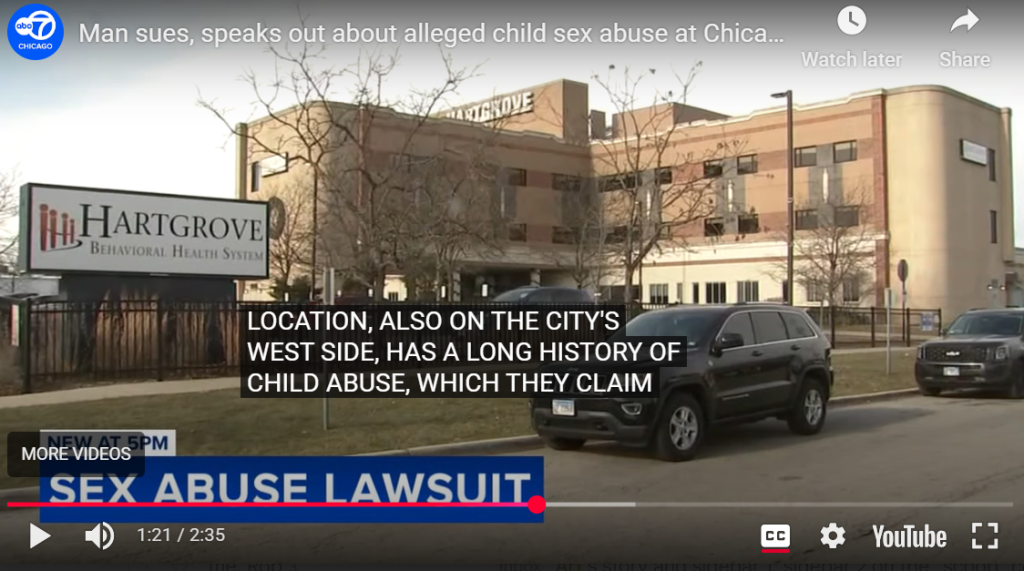
The arrest of Rivers and the lawsuits against Hartgrove come on top of a combined $895 million in damages awarded last year by civil juries against UHS for alleged child sexual abuse at two UHS facilities: Pavilion in Illinois and Cumberland in Virginia
UHS and its subsidiaries have consistently denied wrongdoing when facing allegations of abuse, neglect, and other issues stretching back more than a decade. In September, a Nevada jury ruled the company must pay more than $500 million in punitive damages to a rival health system for trying to poach doctors and patients.
Despite the numerous legal judgments – and a scathing 2024 report issued by the U.S. Senate Finance Committee – net income for UHS soared last year to $1.1 billion, with its behavioral health business generating the company's highest profit margins.
Gould represents more than a dozen clients who say they were abused by Rivers. His firm, Gould, Grieco & Hensley, has already filed eight lawsuits against Hartgrove alleging physical and sexual abuse of young patients. In August, another firm also sued Hartgove and UHS on behalf of a teenage girl who claims she was repeatedly sexually assaulted by staff members during three separate stays at the facility.
Lawyers for Hartgrove have disputed allegations of abuse. “The safety of all patients is of paramount importance to Hartgrove Hospital and we take these allegations seriously,” it said in a statement published by Fox 32 in Chicago about the 2024 case. “Based upon preliminary review of the lawsuit, Hartgrove denies the allegations against them and intend(s) to defend this case vigorously.”
Attorneys for Hartgrove, Pavilion, UHS and Cumberland, along with the corporate office of UHS, did not answer questions emailed to them by MindSite News in early December.
The allegations against Hartgrove include sexually assaulting former patients while they were sedated with unprescribed drugs like Thorazine and benzodiazepines, and forcing minors to have sex.
At a news conference last year, Gould introduced a former patient who had claimed that Rivers and others sexually assaulted him at the hospital in 2001, often in bogus therapy sessions. He was 11 years old at the time. Abuse of child patients at Hartgrove continued through July of 2024, according to Gould and dozens of police reports cited in his firm’s complaints.
Abuse of children 'beyond the pale'
The former patient, now in his mid-30s, spoke at the press conference from behind a screen in an altered voice and charged that Hartgrove staff members would force patients to perform sex acts on each other. "They (told) us that we have to listen or we’re not going to go home and we’re not going to be able to see our family,” he said.
“The nature of the abuse was beyond the pale,” Gould said at the press conference. “One staffer walked in and witnessed the sexual abuse of children, laughed, closed the door and never followed up,” he said.
In one of his lawsuits, Gould also cites a scathing 2011 investigation conducted by the psychiatry department of the University of Illinois in Chicago on behalf of the state’s child welfare agency. It found that Hartgrove subjected minor patients to “an unacceptable risk of harm,” citing more than 100 reports of physical and sexual assaults over approximately six months. He and his team have also collected numerous testimonies of sexual assaults at Hartgrove over the years from former patients whose reports had been ignored by the staff (see an excerpt from his John Doe 1 lawsuit below).
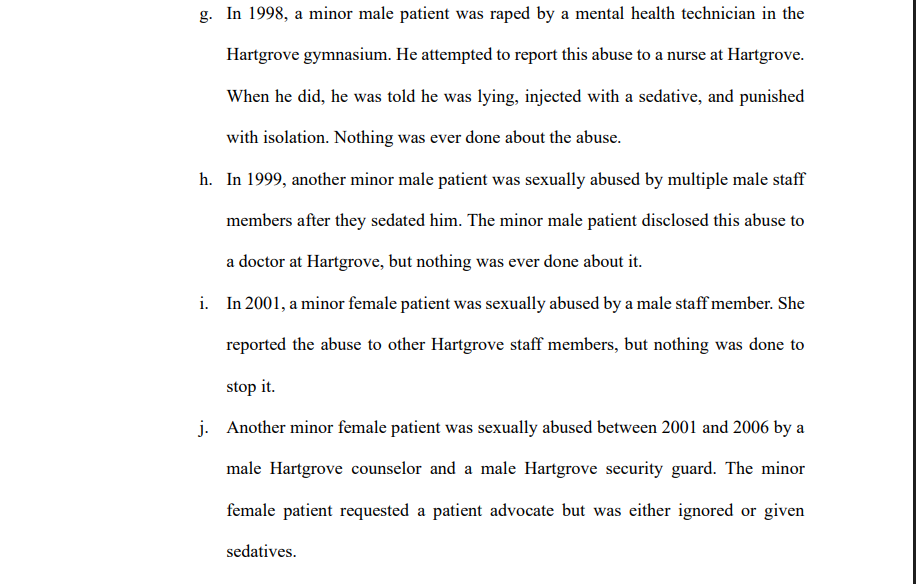
In addition, the probe found that staff fabricated paperwork and lied to university investigators – and that employees were threatened with firing by administrators if they spoke truthfully about conditions there. Even so, the Department of Children and Family Services continued “warehousing” children in Hartgrove and other locked psychiatric facilities long after children were cleared for release, according to lawsuits brought by former patients and reporting by ProPublica.
For UHS, damage awards piling up
River's arrest and the Hartgrove lawsuits add to the mounting legal problems facing UHS.
In March 2024, an Illinois jury awarded $535 million to the mother of a 13-year-old girl raped by a 16-year-old male patient on an adolescent psych unit of the UHS-owned Pavilion hospital in Champaign. The jury verdict was one of the largest institutional abuse awards in the state's history – until the trial judge lowered the jury award and the case was settled out of court for an undisclosed sum earlier this year.
Camera footage captured by the facility and shown to the jury demonstrated that the 16-year-old attacker and an accomplice, who were housed on a co-ed unit that included children aged 4 to 17, running amok in the hallways long after the nominal 9 p.m. curfew. Their actions were largely ignored by the skeleton staff on duty that night.
The verdict against Pavilion raised the financial stakes for UHS, and offered a rare inside look at how troubled teen facilities operate in practice.
“They essentially tossed an aggressive, sexually active, 16-year-old human hand-grenade into this unit and into a room next to my client and didn’t separate them,” plaintiff’s attorney Tim Cronin of the Simon Law firm told the jury.
Medical records and testimony show that hospital staff members were aware of the teen’s history of violence; he was even driven to the hospital in a police cruiser after punching staff and jumping out a second-story window at a previous facility.
In his opening statement, Cronin urged the jury to send a signal to the troubled teen industry by imposing a verdict large enough to deter other companies from turning a blind eye to behavior that harms the vulnerable patients they are charged with caring for. “The decisions you make in this courtroom can make a difference, not just for my client and upon this defendant, but upon our society," Cronin said.
In another case last year, jurors imposed a s $360 million negligence award against Cumberland Hospital, a UHS child and adolescent facility in Virginia, for a doctor’s alleged sexual assaults on teen patients.
“The system is failing, except the providers running these facilities, who have figured out exactly how to turn a profit off taxpayer-funded child abuse.”
—SENATOR RON WYDEN (D-OREGON) FROM 2024 SENATE REPORT
These legal verdicts against UHS accompanied the release of "Warehouses of Neglect," the Senate Finance Committee report on facilities for “troubled teens” that found UHS and three other poorly regulated major behavioral health chains were engaging in “taxpayer-funded child abuse.” (See MindSite News’ detailed look at the troubled teen industry here.)

On top of that, the Stop Institutional Child Abuse Act passed Congress and was signed into law in December 2024 after years of lobbying led by survivors of the industry, including Paris Hilton, the celebrity entrepreneur and Hilton Hotels heiress. Hilton says she suffered physical and sexual abuse as a teen in the 1990s at the controversial Provo Canyon in Utah, which was purchased by UHS in 2000 and has a decades-long history of of abuse allegations from its inception as a private boy’s school in 1971 to a large-scale riot reported at the school in 2023.
The law Hilton helped pass was considered by most advocates a crucial first step in reform: It requires federal agencies to regularly report on deaths and abuse in the industry, and to review best practices and regulatory failings with an eye towards improving treatment and government oversight.

Alongside the successful legal strategy, a powerful, parallel movement has arisen among survivors and family members who’ve lost loved ones at these facilities. These include Theresa Payne, who spoke before the 2024 Senate hearings at a press conference about the death of her 14-year-old daughter Monique in 2006 at a UHS-owned facility in Westwood, Massachusetts, due to alleged assault and medical neglect.
Facility staff admits 'losing control'
The Pavilion lawsuit demonstrated the impact of running a mental health program with too few, poorly trained staff members and of failing to maintain clear protocols for protecting vulnerable patients. It also highlighted the refusal of UHS and its affiliates to take responsibility for their failures.
Evidence presented in the case showed that on Dec. 5, 2020, a 16-year-old and his accomplice were able to squirt toothpaste on three cameras monitoring the hallway to obscure their views, steal the cell phone of one mental health tech and distract another by spilling water on the floor. It also showed that the older boy used the distractions to invite a 13-year-old girl, a virgin, to have “some fun” in his room and when she protested against having sex, he raped her.
When she left the boy’s room after about eight minutes, her pants were soaked in blood. One mental health tech – working in a position requiring no more than a high school diploma – spotted her bloody clothes and hands the night of the rape, but accepted the frightened girl’s explanation that she just had her period. The girl didn’t report the incident to the nursing staff for two more days and later testified that before the rape she had looked up to the attackers as “my big brothers.”
The staff members on duty on the floor that night took no action in response to the boys being in the hall after hours, and the cameras weren’t even cleaned until the next morning. One tech later admitted in a deposition that he was “losing control” of the situation but contended that he didn’t have the authority to force the boys back into their rooms.
Still experiencing nightmares four times a week
The Champaign-based News Gazette covered the lawsuit and described the victim's emotional testimony as she broke down on the stand: "The girl testified that she feels ‘very small’ when she thinks of the incident and now has nightmares four times a week. She has struggled with image issues, she said, and shaved her head at one point so boys would think she is less attractive.”
Her lawyers also presented testimony that the family had been told by Hartgrove officials that girls and boys would be housed separately at the facility. Instead, when she was admitted, she learned that the boys and girls were housed on the same wing.
“They didn’t seem to put any thought into where patients were housed," attorney Cronin told MindSite News. "On the night of the rape, there were two unoccupied rooms on the girl's wing that were open and our client and her roommate at the time, both could have been placed over there.”
In an effort to minimize Pavilion's culpability and the harm done to the girl, attorneys for Pavilion presented an expert witness, psychiatrist William Giakas, whose testimony appeared to anger the jury.
Giakas testified that he believed that "whatever emotional trauma occurred for (the girl) has subsided a long time ago," according to a summary of this testimony later given by Circuit Court Judge Jason Bohm, who presided over the case. Bohm noted that while Giakas thought "memories of that (night) are always going to bother her," he also said the distress lasted only a matter of months, and that "any stress...should have or has completely subsided."
"The trial record is devoid of any evidence that the Pavilion recognizes the gravity of its wrongdoing. No meaningful changes were made after the rape."
—JUDGE JASON BOHM
Bohm also dismissed as “disingenuous” an attempt by Dr. Giakas to do damage control when he tried to claim, during cross-examination, that his use of the word "minor“ during his original testimony referred to the girl's age rather than the impact on her of being raped.
Bohm noted that that Giakas had testified that "I think the event itself was actually — in the scheme of traumatic rape, it was actually quite minor. But it still had some impact…I just think it was a minor impact.’"
Bohm skewered Pavilion's case and the testimony of its key expert witness: “The trial record is devoid of any evidence that the Pavilion recognizes the gravity of its wrongdoing. No meaningful changes were made after the rape. If (these two people) were admitted today, the same horrible outcome seems likely. Yet, throughout this litigation, the Pavilion seems oblivious to its own failures.”
Lack of staff means no eyes on hallways, says attorney
In his October 2024 post-verdict ruling, Bohm reduced the damages imposed by the jury from $535 million to $180 million but rejected Pavilion's request for a new trial. He also noted that the girl was diagnosed with post-traumatic stress disorder by a psychologist and continues to experience nightmares in which she relives the assault – even though her assailant has since died, killed in a shooting in 2022.
"They are ‘vivid nightmares of him killing her’ by stabbing her or lighting her on fire," Bohm said. "She wakes from these nightmares short of breath and discovers she has wet the bed, causing her to wear a pull-up to bed every night. She suffers fear, agitation, paranoia, low self-esteem, mistrust – particularly of men – disassociation, and depression.”
Keeping costs low by saving money on staffing appears to be at the root of many of Pavilion’s deficiencies – a common feature of the troubled teen industry. The staff's failure to respond to one of the earliest red flags – the toothpaste-covered cameras – was largely due to the hospital’s policy of not requiring regular watching of the TV monitors.
Hospital administrators had once considered a policy of real-time monitor-watching but that would have required adding extra staff. As Cronin noted in his closing argument, “They want you to ignore the fact that they simply do not keep eyes on the hallways at all times, like they admit they're supposed to, and know they can’t because of having too few staff. (That’s) because they won’t (hire more) at $12 to $15 an hour.”
Cynthia Clark, a registered nurse working the day shift when the 13-year-old girl was first admitted, testified she had raised concerns about understaffing “many, many times” with upper management but was rebuffed. She was also told by staff members that the 16-year-old boy had a history of sexual violence and needed to be watched carefully – and kept away from female patients.
Two days after the rape, the victim told Clark, who also noticed the bruises on her body. She was then transported to a medical hospital. Clark testified she quit the facility three months after the rape because it was so unsafe that she thought she could lose her nursing license.
The attorney for Pavilion maintained in court that the only person at fault was the assailant and insisted – in the face of research and expert testimony to the contrary – that it's "industry standard to house boys and girls on the same unit.”
According to Cronin, Pavilion admitted in discovery that it had at least 12 documented sexual assaults at the facility from 2015 to 2020, “and an average of 400 to 500 physical assaults per year during that same time period on the youth unit.” (See a partial listing in a 2017 police log here.)
Company placed profits over patient safety, critics say
Critics say the evidence presented in the lawsuits against UHS’ Pavilion facility and its Cumberland youth hospital show the company continues to place profits over patient safety and quality care – as lawyers, investigative reporters and government watchdogs have been saying for decades. Although it has consistently denied wrongdoing over the years, the company conceded in response to last year's Senate report that there have been incidents at some facilities “where residents have suffered harm.”
Like many other lawsuits against teen treatment facilities, the Pavilion case was ultimately settled out of court for an undisclosed sum and the parties signed nondisclosure agreements keeping the details secret. Still, the large amount of the initial jury verdict, coupled with other large judgments, prompted a warning from IMA Financial Group, a leading insurance broker and investment advisor. An IMA report earlier this year cautioned investors about mounting risks in the behavioral treatment industry, noting that "operational failures can cascade into catastrophic losses."
In September 2024, a jury awarded $360 million to three teenage girls, who said they'd been sexually assaulted by the former medical director of the UHS facility in Cumberland, Virginia. In the course of the lawsuit, UHS was removed as a named defendant by the judge, and the total jury award was lowered to $323 million. If the verdict is upheld on appeal, the company and its insurers will still be liable for paying the jury award.
Dr. Daniel Davidow, the former medical director, was accused of engaging in digital vaginal penetration in his exams of the girls. He denied the charges and was acquitted in a criminal trial in April 2024 involving two of the accusers.
Pavilion admitted in discovery that it had at least 12 documented sexual assaults over a five-year period and an average of 400 to 500 physical assaults a year.
The jury decisions and ongoing lawsuits continue to pose financial risks for UHS. Although the Cumberland verdict is being appealed, and the Pavilion case was settled out of court, UHS noted in regulatory filings last year with the SEC that the cases could “materially adversely” impact the company. A spokesperson for UHS and attorneys for Pavilion and Cumberland hospitals declined to answer questions from MindSite News. While the two trials garnered relatively little national news coverage, the verdicts sent a message about the company's greed, said plaintiff’s attorney Cronin.
“The directive was to fill the beds, overfill the beds, cut the staff (and).... maximize profits to the fullest extent possible,” he told MindSite News. "That was the message from management on down; that was the business plan.”
After the verdict, Cronin says he got calls from executives at other facilities asking about Pavilion's practices so they can avoid doing the same. His key advice: “Have enough staff to actually watch these kids and house them safely.”
A Virginia case may become the costliest
The Cumberland case may prove to be the costliest to UHS. The original complaint, filed on behalf of 46 former patients, sought $930 million in damages. But a jury awarded $120 million each to the first three patients whose cases were heard in the first trial and who alleged that they'd been sexually assaulted by Davidow. Additional damage awards for the other 43 patients could lead to massive liability for UHS.

The Cumberland case is now under appeal and the Hartgrove cases haven’t yet gone to trial. But advocates say they are still a long way from bringing about fundamental reform in the troubled teen industry and that government oversight remains far too feeble – to the great detriment of young patients.
Elizabeth Jeglic, a psychology professor at the John Jay College on Criminal Justice and a co-developer of the data-driven Sexual Grooming Model used to prevent sexual abuse, says many companies have failed to keep up with evidence-based safety practices "so that kids going forward are not abused." At this point, she says, "There’s really no excuse for institutions not to have those things in place because this (child sexual abuse) is a known risk.”
Kayla Onder, a survivor of childhood sexual abuse who is now a partner in a law firm, Onder Law, and is a founder of Kayla’s Survivors, sees litigation as the only effective weapon to date against the greed and cruelty baked into the system.
When you run a facility that treats children like revenue and cuts care to the bone, suffering isn't a glitch. It's an intentional outcome.”
—ATTORNEY KAYLA ONDER
“These are for-profit companies, right? The only way to get them to change is to affect their bottom line and get their attention with these big verdicts," she told MindSite News. “When you run a facility that treats children, in my opinion, like revenue and cuts care to the bone, suffering isn't a glitch. It's an intentional outcome.”
She hopes for greater oversight and reforms, but in the meantime, she and lawyers around the country are headed back into court. Last month, she filed suit on behalf of nearly 30 alleged victims of sexual abuse at Pavilion.
Unfortunately, there’s little sign so far that UHS and the rest of the troubled teen industry are going to fundamentally change anytime soon. Indeed, reformers have long contended that most troubled children would be better served by community-based care – not residential treatment.
Senator Ron Wyden, who led the recent Senate investigation into the troubled teen industry and described it as “taxpayer-funded child abuse,” favors cutting off the supply of public funds to these institutions. To the children who have spent time in these facilities – and their families – it's an idea that is long overdue.
This article first appeared on MindSite News and is republished here under a Creative Commons Attribution-NoDerivatives 4.0 International License.
Built by peers, backed by the state: Inside North Carolina’s expanding peer support network
by Taylor Knopf, North Carolina Health News
January 8, 2026
By Taylor Knopf
Thanos first stepped into the peer cafe across from the bus station in downtown Raleigh looking for his friend — and the promise of a free coffee. What keeps him coming back months later is a community of people and group sessions that have supported his substance use recovery.
“Everybody in this room is recovering from something traumatic in their past,” he said, “and now we’re trying to navigate life with the mindset that we have now.”
Thanos, his preferred name, is 28 and has been in recovery from crystal methamphetamine use for four years. When he first started hanging out at the cafe, he was unemployed and without stable housing. The cafe, which has free activities throughout the day like meditation, book club and addiction recovery groups, is run by Promise Resource Network, a Charlotte-based nonprofit that is led by people who all have dealt with mental health challenges and/or substance use issues throughout their lives.
Thanos credits the peer support specialists — people with this kind of experience and professional training on how to support others — at the cafe with helping him break old patterns. They encouraged him to apply for the two retail jobs he now holds, and they helped him find an apartment.
“I could resonate with them, because you can tell when somebody's been through something, because they're more emotionally aware,” he said. “They’re authentic. You could tell that they love themselves, and they’re protecting their energy, and they’re in a certain space where I’m trying to get to.”
While the idea of getting help from people with similar past experiences is not new, peer support has become more and more professionalized and integrated into the mental health system in recent years. In North Carolina, a small number of programs similar to the peer cafe have existed for years on shoestring budgets, sustained largely by the determination of a few individuals.
Now, government funding is beginning to follow, and more programs are opening across the state.
Different kind of space
Walking down the stairs to the peer cafe in Raleigh, there are string lights over patio tables with purple umbrellas. By the door is a free vending machine filled with sterile injection supplies and naloxone, the opioid overdose reversal drug. Inside the cafe, there’s music playing and maybe a dozen people in a room outfitted with stylish velvet furniture, cool posters and exposed brick walls.

There’s a call for those interested in the “creative self” class where participants are learning to crochet. A few people head into the classroom where the leader demonstrates with some pink yarn and a hook.
“This is very therapeutic for me. It gets the world out of my head,” she told the group.
“I bet,” a participant responded, “Because this is all I can focus on right now.”
Outside the classroom, a peer support worker and a regular of the cafe are having a one-on-one peer support session. The next group session is SMART recovery, for those working through addiction recovery. One participant talks about how he’s learning to let go, trying not to control other people’s decisions. Another talks about how he’s gotten off hard drugs recently and is using THC products to cope.
Elliott Brooks manages the Raleigh peer cafe, which opened in the fall of 2025. Books said a lot of the people who come for the cafe’s classes, activities and community have engaged with the mental health system in the past and had negative — or even traumatizing — experiences. Now they want something different.
“They’re looking for a safe space where they can come and be themselves and get access to support that they’re not going to get anywhere else,” Brooks said. “They get classes that embrace them, embrace wellness holistically, that are not focusing on illness and pathologizing. They’re able to walk in and see this is a different space.”
A growing body of research over the past decade suggests that peer support programs can play a meaningful role in helping people manage mental health crises and reduce reliance on emergency services. Reviews of studies from the U.K., Australia and elsewhere have found that people who visit peer programs often report improved mental health, reduced isolation and a greater sense of control over their care. Researchers note that these spaces offer a nonclinical alternative to emergency rooms, which many people describe as intimidating or ill-suited for caring for someone who’s severely depressed or hearing voices or experiencing another form of mental health crisis.
Several studies documented declines in emergency department visits and calls to the police after people engaged with peer support programs, with some reporting reductions of more than 40 percent in three years.
Participants of peer programs find that peer workers are welcoming and foster trust, understanding and a sense of solidarity — all while modeling that mental health recovery is possible, according to a review of several studies published in the Community Mental Health Journal. While such outcomes are promising, the researchers said access to peer-run spaces across the globe is limited, and there is a need to further integrate peer support into the broader mental health system.
Slow, but steady progress
Peer support services have come a long way in North Carolina over the past decade or so. While peers have been hired to support patients alongside clinicians in medical settings for a while, it took much longer for funding to reach organizations that were independent of health systems. Some of the most successful programs are run entirely by peers.
Promise Resource Network, founded by Cherene Caraco in 2005, has led the state in the expansion of peer-run programs. With the support of state dollars, the organization opened two peer-run respite houses in Charlotte and Raleigh in the past five years and is in the process of opening a third in Cabarrus County.
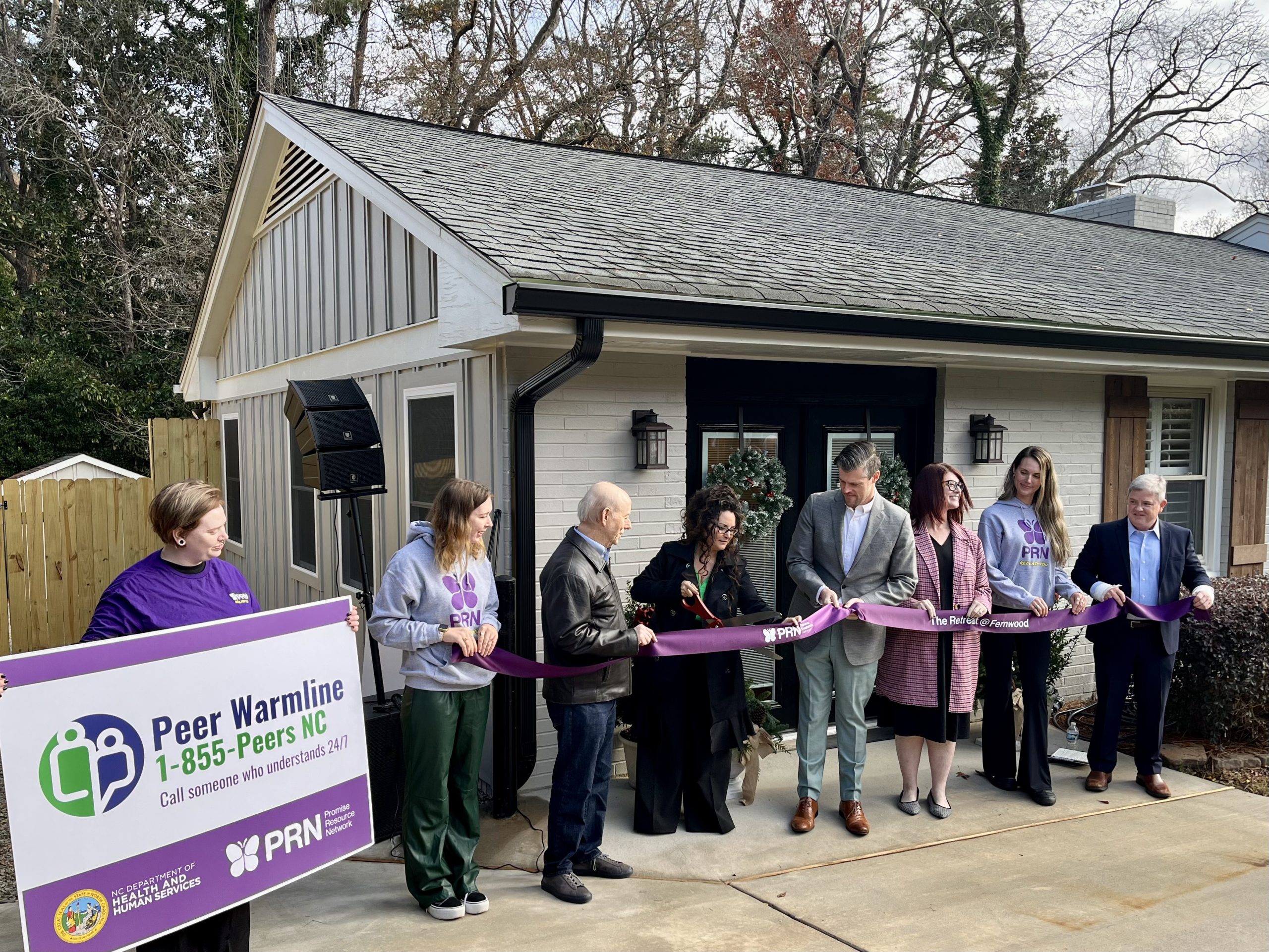
A respite is designed to be a voluntary alternative to hospitalization for people in mental health distress; it allows the person space and time to de-escalate their crisis outside of the traditional health care system. Completely staffed by peer support specialists, respites are peaceful, home-like settings where people can stay and get help from trained peers who are on their own recovery journeys.
In the midst of the coronavirus pandemic, Promise Resource Network also launched a peer “warm” line, a nonclinical support line answered by people in mental health recovery, to offer support to people who were more isolated than ever. At the time, the organization was only operating in Mecklenburg County and never meant for the line to serve the whole state, but the demand was there. Eventually, the state helped with funding, which allowed the Peer Warmline to be a permanent part of the state’s mental health infrastructure.
“Many didn’t recognize the impact of loneliness until COVID shined a light on it,” said Amanda Martin, executive director of GreenTree Peer Support Program in Winston-Salem. “In the substance use world, we’ve been saying for years that the opposite of addiction is connection. And it’s true for mental health too. I know that when I’m connected, that I don’t hear as many voices, and I don’t have as many challenges with emotional dysregulation.”
Previously employed at Promise Resource Network, Martin was recently hired to run the newly expanded programs at GreenTree, another trailblazer in North Carolina for peer-run support. Seeing peer-run programs grow in the state has been beautiful, like watching a baby grow, she said.
“For many of us in this work, we never really had a place anywhere, and it was because of our mental health, it was because of our trauma, it was because of our substance use that we were banished,” she said.
Place at the table
People who live with mental health and substance use issues have long wanted a place at the table where decisions about mental health services are made.
A saying heard frequently in this community is: “Nothing about us, without us.”
The way Martin sees it, instead of being invited to that decision-making table, peer leaders built their own and invited officials and health leaders. She credits a handful of dedicated peer leaders in North Carolina who started programs that delivered results and built relationships with state and local leaders.

GreenTree, founded by Laurie Coker in 2012, had been operating out of a church lobby for years. It recently moved into its permanent new home on West First Street just west of downtown Winston-Salem. The new space allowed the organization to expand its Refuge program, which provides 24-72 hours of lodging and peer support for people who don’t meet criteria for psychiatric hospitalization but need some kind of care before returning home or to a homeless shelter or wherever they are staying. Peer center programming is under the same roof, Monday through Friday, and the schedule is on GreenTree’s Facebook page.
The local hospital emergency department has worked closely with GreenTree through the years and referred patients leaving the ER there for support.
“For many years I was the advocate that wouldn’t go away,” Coker said during the ribbon cutting celebration in October for the new GreenTree space. “As part of my grieving process, I wanted to do something to make a difference — turn advocacy to action.” Coker’s son died as a result of his mental illness, and she made it her mission to create the kind of mental health support she believed was missing at the time.
“Across the state with our peer support movement, this is what our communities need,” Coker said. “As the hospital systems change and mental health and health care become more industrial, we’re the folks that keep it together. You need those people to help empower folks to navigate and find what they need.
“And we know how because we’ve been there,” she said.
State and local leaders buy in
Coker told the gathered crowd at the ribbon cutting that in all her time advocating for peer-led programs, she didn’t believe anyone at the very top really understood why peer support was so important to recovery — until now.
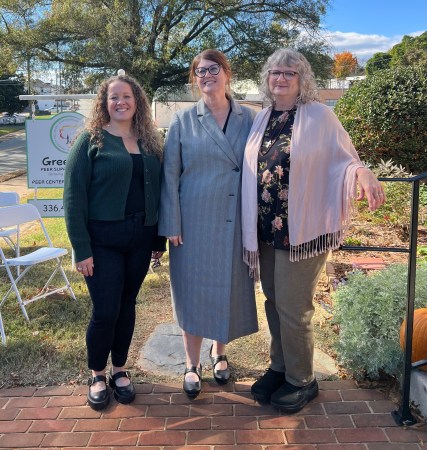
Peer leaders have openly praised Kelly Crosbie, director of the NCDHHS Division of Mental Health, Developmental Disabilities and Substance Use Services, for her understanding and support of peer services. Crosbie is a social worker by training and has been vocal about the role peers played in the lives of her family members with mental illness, including her father, a veteran who struggled with past trauma.
“For some people [clinical treatment is] absolutely life saving, but it’s a time and a place — and what happens to the rest of your life? That’s where communities come in. That’s where families come in. That’s where places like GreenTree come in,” Crosbie said at the ribbon-cutting event. “And we need them for acceptance, for reducing stigma, so people can live full and happy lives.”
“And we really need this in the system — a place where we have people who have navigated this complex world, not just an illness,” she said.
The state has been able to fund and open an array of peer support services and other mental health crisis supports over the past two years using a $835 million investment for behavioral health needs included in the 2023 state budget.
There has been local buy-in as well. Denise Price, deputy county manager and health and human services director for Forsyth County, said she credits people like Coker for helping shape her understanding around the need for peer support. Forsyth County has supported GreenTree and employed peer support specialists for some time, including a unique role: a peer support specialist based at the public library, who helps people navigate mental health services and other resources such as food and housing assistance.
Price told NC Health News that peer support delivers a great return on investment.

“At GreenTree, they allow an individual to define their crisis,” Price said. “What puts me in a crisis may be very different than what puts you in one, and oftentimes it doesn’t involve a formal support to remediate [...] and it doesn’t require therapy or an ED visit, but being able to deliver it within that space of GreenTree can certainly prevent a higher, unnecessary level of care.”
“It is very preventive, which is not a space that we traditionally fund,” she said. “We usually fund a service when you meet a need, you check mark these criteria. This is a way of preventing someone from getting to a space of needing that.
“So I think the outcomes speak for themselves.”
This article first appeared on North Carolina Health News and is republished here under a Creative Commons Attribution-NoDerivatives 4.0 International License.

Inside the Battle for the Future of Addiction Medicine
 Aneri Pattani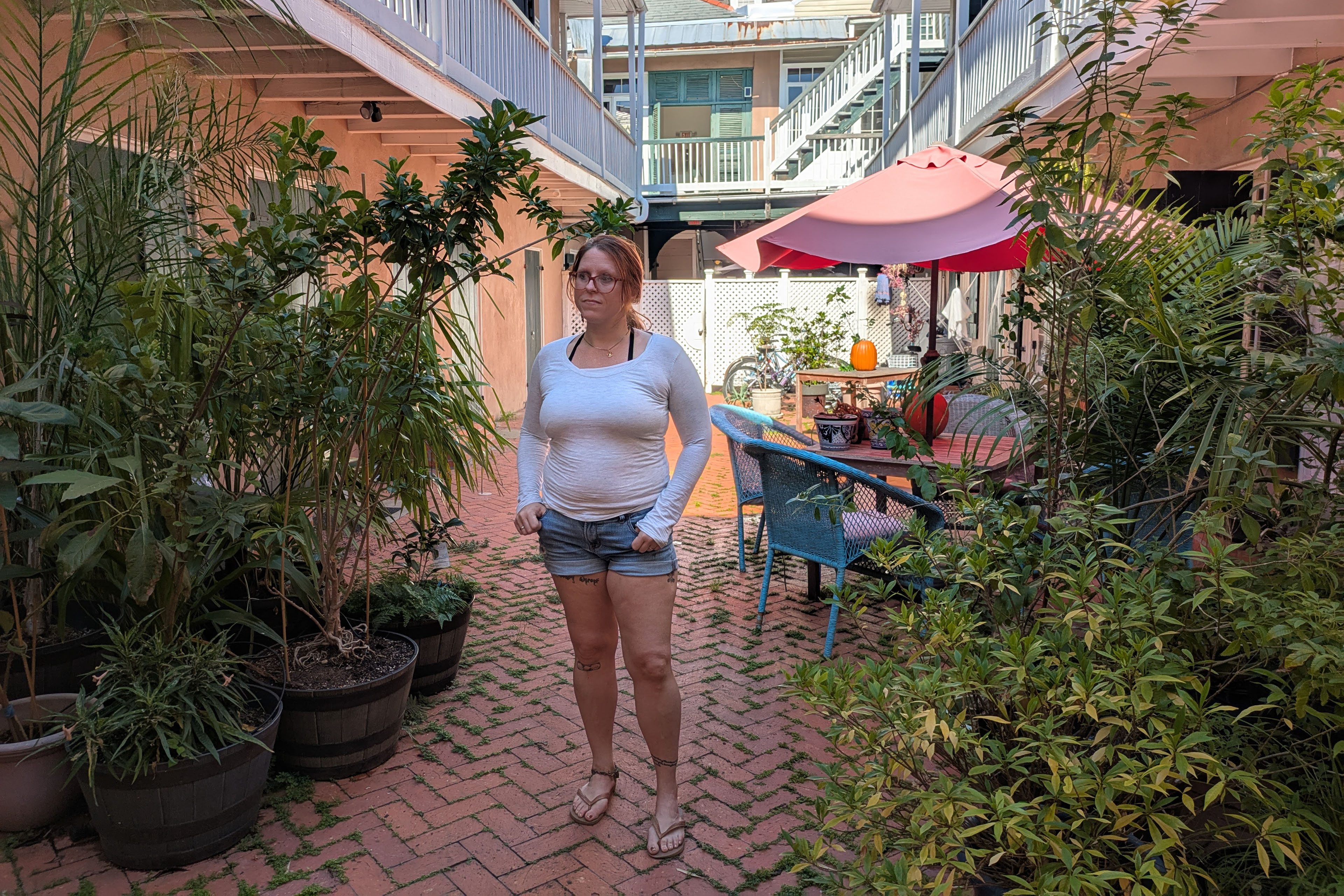
Aneri Pattani January 7, 2026
NEW ORLEANS — Elyse Stevens had a reputation for taking on complex medical cases. People who’d been battling addiction for decades. Chronic-pain patients on high doses of opioids. Sex workers and people living on the street.
“Many of my patients are messy, the ones that don’t know if they want to stop using drugs or not,” said Stevens, a primary care and addiction medicine doctor.
While other doctors avoided these patients, Stevens — who was familiar with the city from her time in medical school at Tulane University — sought them out. She regularly attended 6 a.m. breakfasts for homeless people, volunteered at a homeless shelter clinic on Saturdays, and, on Monday evenings, visited an abandoned Family Dollar store where advocates distributed supplies to people who use drugs.
One such evening about four years ago, Charmyra Harrell arrived there limping, her right leg swollen and covered in sores. Emergency room doctors had repeatedly dismissed her, so she eased the pain with street drugs, Harrell said.
Stevens cleaned her sores on Mondays for months until finally persuading Harrell to visit the clinic at University Medical Center New Orleans. There, Stevens discovered Harrell had diabetes and cancer.
She agreed to prescribe Harrell pain medication — an option many doctors would automatically dismiss for fear that a patient with a history of addiction would misuse it.
But Stevens was confident Harrell could hold up her end of the deal.
“She told me, ‘You cannot do drugs and do your pain meds,’” Harrell recounted on a Monday evening in October. So, “I’m no longer on cocaine.”
Stevens’ approach to patient care has won her awards and nominations in medicine, community service, and humanism. Instead of seeing patients in binaries — addicted or sober, with a positive or negative drug test — she measures progress on a spectrum. Are they showering daily, cooking with their families, using less fentanyl than the day before?
But not everyone agrees with this flexible approach that prioritizes working with patients on their goals, even if abstinence isn’t one of them. And it came to a head in the summer of 2024.
“The same things I was high-fived for thousands of times — suddenly that was bad,” Stevens said.
Flexible Care or Slippery Slope?
More than 80% of Americans who need substance use treatment don’t receive it, national data shows. Barriers abound: high costs, lack of transportation, clinic hours that are incompatible with jobs, fear of being mistreated.
Some doctors had been trying to ease the process for years. Covid-19 accelerated that trend. Telehealth appointments, fewer urine drug tests, and medication refills that last longer became the norm.
The result?
“Patients did OK and we actually reached more people,” said Brian Hurley, immediate past president of the American Society of Addiction Medicine. The organization supports continuing flexible practices, such as helping patients avoid withdrawal symptoms by prescribing higher-than-traditional doses of addiction medication and focusing on recovery goals other than abstinence.
But some doctors prefer traditional approaches that range from zero tolerance for patients using illegal drugs to setting stiff consequences for those who don’t meet their doctors’ expectations. For example, a patient who tests positive for street drugs while getting outpatient care would be discharged and told to go to residential rehab. Proponents of this method fear loosening restrictions could be a slippery slope that ultimately harms patients. They say continuing to prescribe painkillers, for example, to people using illicit substances long-term could normalize drug use and hamper the goal of getting people off illegal drugs.
Progress should be more than keeping patients in care, said Keith Humphreys, a Stanford psychologist, who has treated and researched addiction for decades and supports involuntary treatment.
“If you give addicted people lots of drugs, they like it, and they may come back,” he said. “But that doesn’t mean that that is promoting their health over time.”
Flexible practices also tend to align with harm reduction, a divisive approach that proponents say keeps people who use drugs safe and that critics — including the Trump administration — say enables illegal drug use.
The debate is not just philosophical. For Stevens and her patients, it came to bear on the streets of New Orleans.
‘Unconventional’ Prescribing
In the summer of 2024, supervisors started questioning Stevens’ approach.
In emails reviewed by KFF Health News, they expressed concerns about her prescribing too many pain pills, a mix of opioids and other controlled substances to the same patients, and high doses of buprenorphine, a medication considered the gold standard to treat opioid addiction.
Supervisors worried Stevens wasn’t doing enough urine drug tests and kept treating patients who used illicit drugs instead of referring them to higher levels of care.
“Her prescribing pattern appears unconventional compared to the local standard of care,” the hospital’s chief medical officer at the time wrote to Stevens’ supervisor, Benjamin Springgate. “Note that this is the only standard of care which would likely be considered should a legal concern arise.”
Springgate forwarded that email to Stevens and encouraged her to refer more patients to methadone clinics, intensive outpatient care, and inpatient rehab.
Stevens understood the general practice but couldn’t reconcile it with the reality her patients faced. How would someone living in a tent, fearful of losing their possessions, trek to a methadone clinic daily?
Stevens sent her supervisors dozens of research studies and national treatment guidelines backing her flexible approach. She explained that if she stopped prescribing the medications of concern, patients might leave the health system, but they wouldn’t disappear.
“They just wouldn’t be getting care and perhaps they’d be dead,” she said in an interview with KFF Health News.
Both University Medical Center and LSU Health New Orleans, which employs physicians at the hospital, declined repeated requests for interviews. They did not respond to detailed questions about addiction treatment or Stevens’ practices.
Instead, they provided a joint statement from Richard DiCarlo, dean of the LSU Health New Orleans School of Medicine, and Jeffrey Elder, chief medical officer of University Medical Center New Orleans.
“We are not at liberty to comment publicly on internal personnel issues,” they wrote.
“We recognize that addiction is a serious public health problem, and that addiction treatment is a challenge for the healthcare industry,” they said. “We remain dedicated to expanding access to treatment, while upholding the highest standard of care and safety for all patients.”
Not Black-and-White
KFF Health News shared the complaints against Stevens and the responses she’d written for supervisors with two addiction medicine doctors outside of Louisiana, who had no affiliation with Stevens. Both found her practices to be within the bounds of normal addiction care, especially for complex patients.
Stephen Loyd, an addiction medicine doctor and the president of Tennessee’s medical licensing board, said doctors running pill mills typically have sparse patient notes that list a chief complaint of pain. But Stevens’ notes detailed patients’ life circumstances and the intricate decisions she was making with them.
“To me, that’s the big difference,” Loyd said.
Some people think the “only good answer is no opioids,” such as oxycodone or hydrocodone, for any patients, said Cara Poland, an addiction medicine doctor and associate professor at Michigan State University. But patients may need them — sometimes for things like cancer pain — or require months to lower their doses safely, she said. “It’s not as black-and-white as people outside our field want it to be.”
Humphreys, the Stanford psychologist, had a different take. He did not review Stevens’ case but said, as a general practice, there are risks to prescribing painkillers long-term, especially for patients using today’s lethal street drugs too.
Overprescribing fueled the opioid crisis, he said. “It’s not going to go away if we do that again.”
‘The Thing That Kills People’
After months of tension, Stevens’ supervisors told her on March 10 to stop coming to work. The hospital was conducting a review of her practices, they said in an email viewed by KFF Health News.
Overnight, hundreds of her patients were moved to other providers.
Luka Bair had been seeing Stevens for three years and was stable on daily buprenorphine.
After Stevens’ departure, Bair was left without medication for three days. The withdrawal symptoms were severe — headache, nausea, muscle cramps.
“I was just in physical hell,” said Bair, who works for the National Harm Reduction Coalition and uses they/them pronouns.
Although Bair eventually got a refill, Springgate, Stevens’ supervisor, didn’t want to continue the regimen long-term. Instead, Springgate referred Bair to more intensive and residential programs, citing Bair’s intermittent use of other drugs, including benzodiazepines and cocaine, as markers of high risk. Bair “requires a higher level of care than our clinic reasonably can offer,” Springgate wrote in patient portal notes reviewed by KFF Health News.
But Bair said daily attendance at those programs was incompatible with their full-time job. They left the clinic, with 30 days to find a new doctor or run out of medication again.
“This is the thing that kills people,” said Bair, who eventually found another doctor willing to prescribe.
Springgate did not respond to repeated calls and emails requesting comment.
University Medical Center and LSU Health New Orleans did not answer questions about discharging Stevens’ patients.
‘Reckless Behavior’
About a month after Stevens was told to stay home, Haley Beavers Khoury, a medical student who worked with her, had collected nearly 100 letters from other students, doctors, patients, and homelessness service providers calling for Stevens’ return.
One student wrote, “Make no mistake — some of her patients will die without her.” A nun from the Daughters of Charity, which ran the hospital’s previous incarnation, called Stevens a “lifeline” for vulnerable patients.
Beavers Khoury said she sent the letters to about 10 people in hospital and medical school leadership. Most did not respond.
In May, the hospital’s review committee determined Stevens’ practices fell “outside of the acceptable community standards” and constituted “reckless behavior,” according to a letter sent to Stevens.
The hospital did not answer KFF Health News’ questions about how it reached this conclusion or if it identified any patient harm.
Meanwhile, Stevens had secured a job at another New Orleans hospital. But because her resignation came amid the ongoing investigation, University Medical Center said it was required to inform the state’s medical licensing board.
The medical board began its own investigation — a development that eventually cost Stevens the other job offer.
In presenting her side to the medical board, Stevens repeated many arguments she’d made before. Yes, she was prescribing powerful medications. No, she wasn’t making clinical decisions based on urine drug tests. But national addiction organizations supported such practices and promoted tailoring care to patients’ circumstances, she said. Her response included a 10-page bibliography with 98 citations.
Liability
The board’s investigation into Stevens is ongoing. Its website shows no action taken against her license as of late December.
The board declined to comment on both Stevens’ case and its definition of appropriate addiction treatment.
In October, Stevens moved to the Virgin Islands to work in internal medicine at a local hospital. She said she’s grateful for the welcoming locals and the financial stability to support herself and her parents.
But it hurts to think of her former patients in New Orleans.
Before leaving, Stevens packed away handwritten letters from several of them — one was 15 pages long, written in alternating green and purple marker — in which they shared childhood traumas and small successes they had while in treatment with her.
Stevens doesn’t know what happened to those patients after she left.
She believes the scrutiny of her practices centers on liability more than patient safety.
But, she said, “liability is in abandoning people too.”
KFF Health News is a national newsroom that produces in-depth journalism about health issues and is one of the core operating programs at KFF—an independent source of health policy research, polling, and journalism. Learn more about KFF.
Subscribe to KFF Health News' free Morning Briefing.
This article first appeared on KFF Health News and is republished here under a Creative Commons Attribution-NoDerivatives 4.0 International License.

‘Can’t do this alone’: An Appleton school prepares students for skilled trades. It’s not easy.
by Miranda Dunlap / Wisconsin Watch
December 30, 2025
- ATECH opened over a decade ago to create a pipeline of students interested in advanced manufacturing careers.
- Many students at the charter school like the hands-on classes, take advantage of paid apprenticeships and earn free college credits.
- But school leaders say they struggle to attract students, fight a stigma that surrounds technical education and afford equipment and tools.
A cacophony of humming, drilling, banging and buzzing fills Appleton Technical Academy’s cavernous lab.
In one corner, a student drills ventilation holes in a piece of metal that will eventually be a firepit ring. Another cuts through a thin piece of metal with clippers. Shrouded by red vinyl curtains, several students weld metal, sending blue sparks flying through the air.
As more schools embrace career and technical education, scenes like these are increasingly common in high schools nationwide: fewer students gripping pencils at desks; more wielding expensive tools and receiving hands-on training for their future career.
Part of that trend, Appleton Technical Academy (ATECH) opened a decade ago to ease the region’s shortage of advanced manufacturing workers. Today, many of the students love their hands-on classes, enroll in paid apprenticeships and collect free college credit before continuing on to trade school.

But it hasn’t been without difficulties. The school has struggled to attract students, combat a persistent stigma around technical education and afford the pricey equipment and tools it requires. Plus, it’s hard to determine if the school has met the original goal of producing local manufacturing employees.
What’s happening at ATECH shows how preparing Wisconsin teenagers to eventually fill workforce holes, especially amid the state's dearth of skilled trade workers, can be a tall task.
ATECH lead teacher Paul Endter spends his lunch breaks and free time trying to grow local support for the school and get more students interested.
“I continue to tell people we're the best-kept secret in the Fox Valley, and that's not by design,” Endter said. “I wish I had more people who wanted to get involved.”
Born from industry needs
In the early 2010s, Jared Bailin, CEO of Appleton-based Eagle Performance Plastics, was struggling to find enough advanced manufacturing workers. The plastic manufacturing leader thought introducing high schoolers to the jobs would help.
He took the idea to Greg Hartjes, who was principal of Appleton West High School at the time. Hartjes is now the school district’s superintendent and has always worried about students who don’t mesh with traditional high school education structure — students who, he says, “perhaps didn't want to sit in English class and read Shakespeare,” but rather wanted “their hands in the work that they were doing.”
Together, they built ATECH, a tuition-free charter school inside Appleton West that aims to prepare students for manufacturing jobs. They secured state grants to fund the launch, and Appleton voters approved a district referendum that put $2.4 million toward renovating labs and classroom spaces.
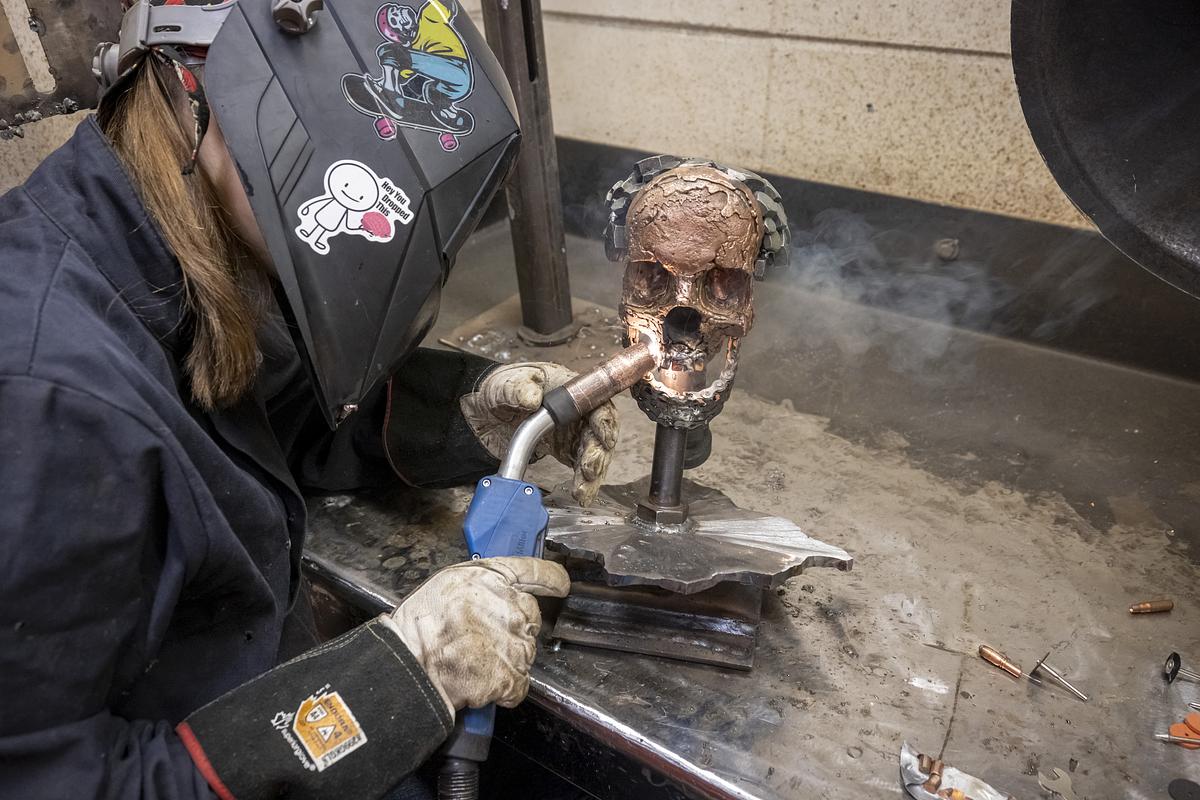
The school opened in the 2014-15 school year. Here’s how it works: Students can apply to the school at any point, but most enroll their freshman year. They choose to specialize in one of four growing industries: electronics and automated manufacturing, machining, mechanical design or welding.
At first, students take a small number of classes that introduce them to the basics of manufacturing alongside the traditional courses required of all high schoolers, such as language arts and math. Students gradually take on more courses aligned to their specialization, such as programming for electronics students or blueprint reading for machining students.
Beginning their junior year, students take free college classes that earn both high school and Fox Valley Technical College credit. The classes chip away at a certificate in their focus area, which can shave thousands off tuition for students who enroll in technical college after graduation. Some juniors and seniors can work for local employers as paid youth apprentices during part of the school day, earning money and gaining work experience.
“ATECH kids are kids that wanted to use their hands along with their brain in learning,” Hartjes said.
That’s the reason senior Izzy Chappell enrolled. On an early December morning, she dipped into one of the lab’s eight welding booths wearing a helmet to protect from the harsh UV rays and flying sparks. She put the finishing touches on a welded metal skull sculpture she entered in a regional SkillsUSA competition that night.
“Other classes are hard,” Chappell said. “This comes easy to me.”
Getting students excited a struggle
ATECH leaders hoped the school would be a magnet for students, but getting them interested has been a challenge.
The school debuted with 56 students. Enrollment has fluctuated a bit over the decade, never reaching the district’s goal of 120. In the 2024-25 school year — the most recent year with available state data — 68 students enrolled.
Leaders chalk the lower-than-desired enrollment up to several difficulties: The district doesn’t provide transportation to charter schools, meaning these students typically have to find their own way to school. A jump start toward a career simply doesn't resonate with many teenagers as young as 14, who Endter said are more motivated by sports or where their friends go to school.
And most of all, ATECH leaders find many families still see college degrees as the gold standard. Despite growing investment in career and technical education programs nationwide and the critical need for skilled workers in Wisconsin, they say a stigma still plagues technical education, leading many to believe it’s for students who don’t perform well in school.
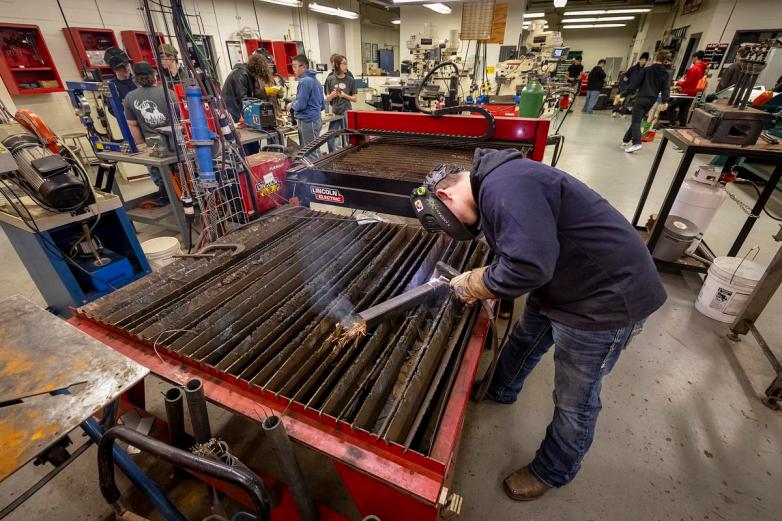
“I think a misconception often is that it's not rigorous, and it's not for students that have an aptitude or are intelligent,” Hartjes said. “That's not the case. We've given kids an opportunity to really learn using both their hands and their head.”
When ATECH was brand new, a state grant helped the school afford TV commercials and mailers. That money is long gone. Nowadays, Endter visits nearby middle schools to talk to students about career education. They organize tours and career fairs, where ATECH leaders try to entice students with the spacious labs and high-tech equipment.
“It's not for lack of trying, you know?” Endter said. “But again, as an incoming eighth grader, charter schools represent something different. For some kids, different is good. And for some kids, different is not. So many kids don't know what could or should be the best pathway for them.”
Meeting workforce needs?
Sophomore Noah Siong enrolled in ATECH because his brother graduated from the school and went on to open his own car repair shop.
“That kind of opened the gateway to me,” Siong said. “It was like, ‘Oh, this stuff is pretty cool.’”

Siong wants to pursue a career in metal fabrication after graduation. Hartjes estimates hundreds of students like Siong have learned “skills that have prepared them for careers” over the last decade. But it’s difficult to know exactly how many students have gotten jobs that use the skills they learned at ATECH.
Wisconsin, like many states, doesn’t have a system connecting education and employment data, according to a 2024 Education Commission of the States analysis. The evidence ATECH leaders collect is largely anecdotal, but Endter said it indicates the vast majority either continue to technical college to finish their programs or turn their youth apprenticeships into full-time jobs after graduation. Endter estimates about 10% pursue a four-year degree.
Bailin, the Eagle Performance Plastics CEO, said ATECH hasn’t produced as many local manufacturing employees as he hoped when he helped create the school.
“It didn't really come out the way I would have hoped,” Bailin said. Eagle has hired between one and three apprentices from ATECH each year. He estimates roughly half have moved into full-time jobs, but it hasn’t been enough to produce the pipeline of machining employees he wanted. The company is no longer closely tied to the school, Bailin said.
In a measure of its academic performance, ATECH’s state rating has averaged a score of 58, which the Department of Public Instruction (DPI) defines as “meets few expectations.” Hartjes said the hands-on skills students learn are not reflected in the state’s rating system. For example, the college classes students take, however advanced, don’t factor into the school’s rating.
“If they were … tested on their aptitude for mechanics, I guarantee you that they would outscore many other students across our state,” Hartjes said. “If they were being tested on those different things that we focused on, I guarantee you that their knowledge, their experience and their aptitude is going to shine through. But, you know, they don't.”
‘Just can't fund all of this’
“I’m going to teach you about different kinds of metal!” technology education teacher Carrie Giauque shouts so students hear her in the noisy lab. She pulls scraps out of a large trash barrel filled to the brim, identifying them to the students crowded around her: “Carbon! Steel! Aluminum! Galvanized steel! Copper!”
Behind them, sheets of metal are stacked floor to ceiling. The school goes through countless sheets teaching students the basics of welding and metal fabrication. It’s ATECH’s largest expense.
“It's a lot less costly to have 30 students sit in math class,” Hartjes said.
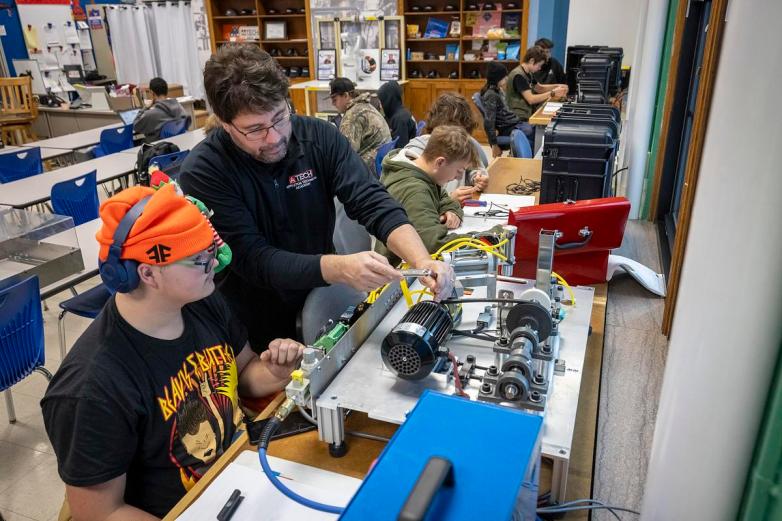
Despite needing costly materials, ATECH’s state funding is determined by the same formula as all other schools in the district, so it relies on grants and donations to make up the difference. To date, the school has received $266,000 in donations toward equipment and curriculum.
“A lot of the learning exhausts materials, exhausts some of our resources,” Hartjes said. “(We’re) having to get support from our local manufacturing community, from a financial aspect, because as a school district, we just can’t fund all of this.”
Endter said ATECH also badly needs mentoring from industry employees, who can teach students and teachers how to use the complicated technology they receive as donations. In one classroom, a large robot sits untouched in a locked box after a college donated it. ATECH employees don’t have enough experience with the programming language to teach students how to use it.
For their part, employers are often stretched too thin to offer up staff to mentor teachers and students. Eagle Performance Plastics used to send someone to ATECH to teach students about a pricey machine it helped buy, but there weren't enough interested students to make the trip worth it, Bailin said.

Inside ATECH, a “sponsor wall” is decorated with the logos of organizations and employers that have invested in the school. Two-thirds of the spaces are empty — a visual reminder of the school’s need for added support.
Endter jokes he wears “27 hats” trying to find it.
“Every hour that I am not teaching, including working through my lunch hour, is dedicated to phone calls, emails, site visits, networking, cold calls,” he said. “You name it. I am doing it.”
The work could soon pay off. Beginning in 2024, Appleton students between kindergarten and fifth grade began taking weekly STEM classes. Endter hopes that will spark interest in career and technical education.
“I'm on the precipice,” Endter said. “And I’m hoping that there's going to be this giant surge of students who are looking for opportunities."

The dilemma isn’t unique to ATECH. Many schools are eager to provide this kind of technical education, Karin Smith, a DPI education consultant, said. However, the equipment and tools are costly, and many schools are struggling to fund basic offerings. (Appleton expects a $13 million deficit this school year.)
Wisconsin is one of five states that don’t designate state funding for career and technical education programs, relying solely on federal funding. Many states allocate more funding to school districts specifically for these programs because the federal dollars alone cannot meet the costs, according to Advance CTE, a nonprofit representing state career and technical education leaders.
“In Wisconsin, we have used (the federal funds) to, generally speaking, keep the lights on,” said Sara Baird, DPI’s career and technical education director.
State Superintendent of Public Instruction Jill Underly requested the 2025-27 state budget include about $45 million in career and technical education grants to districts. Gov. Tony Evers suggested a pared-down version of $10 million, which was scrubbed by the Legislature’s Republican-controlled Joint Finance Committee and not included in the final bill.
“We’re seeing tremendous growth and tremendous interest in expanding CTE,” Smith said. Still, school district leaders are frustrated by the lack of funding for it. “They are feeling like their hands are tied behind their back,” she said.
“We can't do this alone … Every school has a tech ed teacher who is desperately trying to get kids excited about career pathways,” Endter said. “They need business support. They need donations. They need mentors in the classroom.”
Miranda Dunlap reports on pathways to success in northeast Wisconsin, working in partnership with Open Campus. Email her at mdunlap@wisconsinwatch.org.
This article first appeared on Wisconsin Watch and is republished here under a Creative Commons Attribution-NoDerivatives 4.0 International License.

Stuart Community Hospital opens for emergency and inpatient care
Patrick County had been without a hospital since 2017. Braden Health bought the property at auction in late 2024 and spent a year and $15 million renovating and refitting it.
by Emily Schabacker January 6, 2026
 Emily Schabacker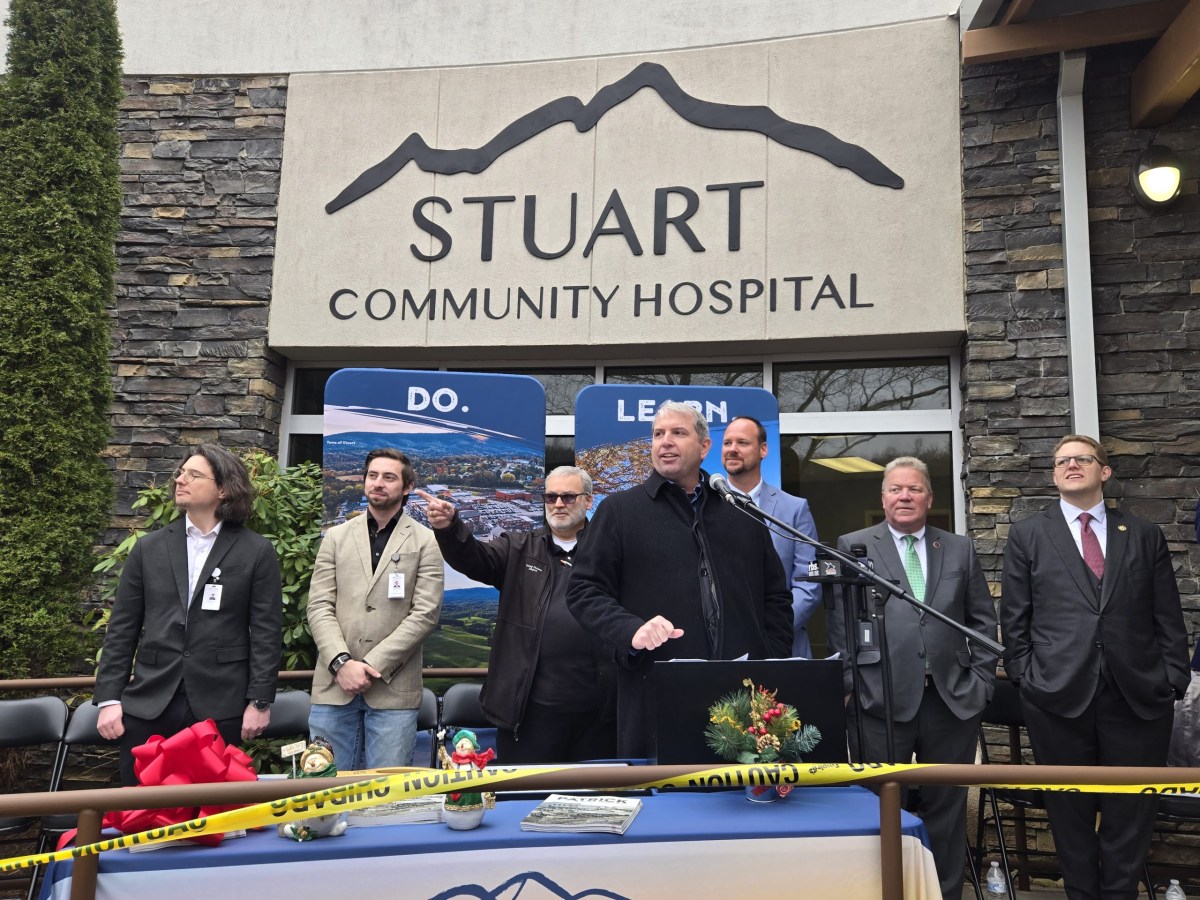
Spirits were high in Patrick County on Monday as Stuart Community Hospital officially reopened for emergency and inpatient care.
Dozens of community members gathered outside for a ribbon-cutting ceremony marking the hospital’s return after eight years. Hospital leaders, county officials, state legislators and U.S. Rep. Morgan Griffith shared remarks reflecting on the long road to reopening. Above them, the hospital’s name stretched across the building, framed by the ridgeline of a mountain.
Braden Health, a Tennessee-based for-profit health care company, purchased the property at auction in 2024. According to Kyle Kopec, the company’s co-founder and chief compliance officer, it took about a year and $15 million to renovate and reopen the facility.
The company specializes in reviving rural hospitals that are on the brink of closure or have already shut their doors.
Dr. Beau Braden, the company’s founder and CEO, attended the opening ceremony. An emergency department physician, Braden began acquiring and flipping rural hospitals in 2020 after years of consulting work in rural areas. His company has worked with about 180 hospitals, Kopec said in a November 2024 interview.
Braden Health now owns about seven critical access hospitals, most of them in Tennessee. Stuart Community Hospital is its first acquisition in Virginia.
“This project is a testament to what happens when faith, grit and community come together,” Braden said. “We didn’t arrive here by accident. We arrived here by providence, hard work, determination, perseverance. And make no mistake, it was a fight to get here, but here we are.”
Company leaders say Braden Health succeeds in fragile rural markets where hospitals face higher costs because they serve smaller populations, many of whom rely on Medicaid or Medicare. Rural emergency departments face even steeper costs because they require around-the-clock staffing.
Kopec said during an August interview that the company aggressively negotiates insurance contracts and prioritizes employee satisfaction to reduce turnover, so it can rely less on temporary workers than other rural hospitals. Updated equipment also helps keep overhead costs lower and employees satisfied, he said.
Larry Henson, site manager for the project and revenue cycle director for Braden Health, will now serve as the CEO of Stuart Community Hospital.
Once patient volumes increase at the 25-bed facility and finances stabilize, the company plans to upgrade equipment, Henson said Monday. Updates to the X-ray machines are planned, and leaders hope to add mammography services in the future.
The reopening has already brought jobs to the area. More than 150 people were hired to work at the hospital, many of them from Patrick County or nearby communities. Others returned to work in their hometown, Kopec said.
During his remarks, Braden thanked each new department director by name, acknowledged their families and shared a personal detail about each one.
Kristin Amos, the new director of radiology, said she worked at the hospital before it closed in 2017, when it was the Pioneer Community Hospital.
“It’s amazing to see this come full circle,” Amos said.
Since the closure, the property has been largely vacant. Several buyers considered reopening or repurposing the building, but all eventually backed out.
Sen. Bill Stanley, R-Franklin County, noted the toll the closure took on the community.
“It was devastating,” Stanley said. “What I do remember is, in 2018, we worked so very hard and members of this community came to the General Assembly and lobbied. They took time out of their schedule to make sure that those people in Richmond did not forget about us.”
In 2022, Del. Wren Williams, R-Patrick County, sponsored a bill at the General Assembly that preserved the hospital’s state license to operate as an acute care and critical access hospital for a future provider. The bill passed with bipartisan support.
“People see a shuttered hospital, but they don’t realize seconds matter. … Trying to get to the ER was the most important thing on my legislative to-do list,” Williams said at the event.
Weeks later, the hospital property was purchased by Chicago-based Foresight Health for about $2.1 million. After years of unfilled promises and shifting plans — and the indictment of Foresight’s CEO on unrelated federal fraud charges — the project eventually collapsed.
Braden Health bought the property in November 2024 for about $600,000.
At first, the community was skeptical. But construction crews arrived quickly, and residents were invited to walk through the hospital throughout the renovation process. Trust in the company grew.
After the ribbon-cutting, visitors toured the top floor of the two-story facility. Then, holding a radio, Williams made the first official call to emergency medical services.
“This is Stuart Community Hospital in Stuart, Virginia,” he said. “Effective immediately, Jan. 5, 2026, Stuart Community Hospital is fully open and operational. Emergency department and inpatient services restored. We are now accepting and receiving patients. Units may now begin transporting patients to this hospital. … Stuart Community Hospital all clear.”
The crowd cheered.
Arizona voters approved in-state tuition for undocumented students. The state left implementation to chance.
by Molly Bohannon, Arizona Center for Investigative Reporting
January 7, 2026
From the start of high school, Ignacio knew he wanted to go to college to become a nurse practitioner. But when he learned that being undocumented disqualified him from in-state tuition at Arizona’s three public universities, his plans unraveled.
“It was definitely a hard time navigating through high school knowing that I probably wasn't going to be able to afford college,” said Ignacio, who is being identified by his first name because of his immigration status. “I was like, ‘it’s unattainable, I’m not even going to try hard.’”
That shifted during his senior year, though, when he learned of Proposition 308. The 2022 ballot initiative promised in-state tuition to students who had graduated from an Arizona high school after attending for at least two years, regardless of their immigration status.
“Prop. 308 — it changed my perspective on things,” he said. “It motivated me just to keep going.”
The initiative narrowly passed that November, with 51.2% of the vote. The following spring, Ignacio enrolled at Estrella Mountain Community College. His career goal changed, and he eventually transferred to the University of Arizona, where he’s now pursuing a double major in law and political science.
Ignacio’s experience reflects what Prop. 308 was designed to do: Reopen college as a realistic option for undocumented students who had grown up in Arizona. But three years after the law took effect, it remains difficult to say how many students have actually benefited—and how many were left behind.
Though national experts estimated that more than 3,600 undocumented students a year could qualify for in-state tuition under the measure, Arizona put no centralized system in place to oversee its rollout, track participation or ensure consistent implementation across colleges and universities.
“There wasn't an effort from the governor or the Board of Regents, or any other effort to implement it,” José Patiño, vice president of education at Aliento, a nonprofit working with undocumented Arizonans, told AZCIR. “It was left basically to people who cared.”
As a result, students and advocates have shouldered much of the work required to benefit from the law, during a moment when political hostility toward immigrants has intensified nationally. Advocates suspect some students are still paying the higher, 150% tuition rate that applied to undocumented students at state universities before Prop. 308 passed, while others may be forgoing college entirely.
“I think at the end of the day, even though we want them to advocate for themselves, the students shouldn't have to carry that burden of having to go look for resources,” said Blanca Alcantara-Hershey, a coordinator in the University of Arizona’s AGAVE office, a student support center. “We could avoid all that by having a streamlined process.”
Arizona’s disjointed implementation has taken on new urgency as the Trump administration moves to challenge tuition equity laws in other states, creating confusion and fear among families weighing whether college is worth the risk. Taken together, the gaps suggest Arizona may have missed a narrow chance to make the promise of Prop. 308 real, and advocates say students are paying the price.
Along with Washington, D.C., Arizona was one of 22 states with a tuition equity law on the books as of September. Texas and California were the first to implement such measures in 2001.
These policies often draw bipartisan support, given their potential to reduce high school dropout rates, encourage undocumented students to pursue higher education and provide an economic boost. One 2022 analysis projected that students enrolling under Arizona’s Prop. 308 could strengthen the workforce and inject about $23 million into the state’s economy, while another found that any lost tuition revenue from in-state rates could be offset by increased enrollment.
In Arizona, three Republican lawmakers sponsored the bill to take the matter to voters, and it received overwhelming support from Democrats. The “Yes on Prop 308” committee was also chaired by a Republican, and groups like Aliento and ScholarshipsA-Z worked alongside the Greater Phoenix Chamber of Commerce and other business leaders to secure its passage.
Not all Republicans endorsed the measure, however. Some who had supported a 2006 initiative barring students without lawful status from receiving aid or in-state tuition urged voters to oppose Prop. 308, citing concerns about tuition costs and fairness.
After the initiative passed in 2022, the Arizona Board of Regents—which oversees Arizona State University, Northern Arizona University and the University of Arizona—held a meeting to revise its non-resident tuition policy. At the time, ABOR executive director John Arnold, now UA’s chief financial officer, acknowledged that only a small number of students would be affected immediately but said he hoped participation would “dramatically increase over the coming years.”
Arnold described the procedural policy change as “pretty straightforward,” and it passed unanimously. But multiple regents raised pointed questions about its implementation, including whether the three universities were prepared to enact the change the following semester and whether there was “any sort of communications plan to ensure that qualified students know about this.”
Arnold replied that the universities were excited to move the program forward, and that ABOR would rely on the schools to ensure eligible students were informed. Regent Larry Penley pushed back, arguing responsibility extended beyond the universities.
“When we offer these opportunities to students, promotion really is incumbent upon us,” said Penley, who did not respond to AZCIR’s recent request for comment. “And in many cases, I don't think we're taking as seriously as we need to the job to join with the three universities and really promote things like this to the public.”
Advocates working with undocumented students applying to college would likely agree with Penley’s assessment. Several told AZCIR that implementation lacked consistency because schools approached it differently, often requesting varying documents and information to prove eligibility. That led to confusion for students.
Carolina Silva, executive director of ScholarshipsA-Z, which assists undocumented students in southern Arizona, said one school asked for a driver’s license to prove residency—something those without legal status cannot obtain in Arizona. Her organization intervened, she said, helping the school identify alternative documents students could realistically provide.
“Some institutions created more hoops for students to jump through, not realizing, again, it would become another barrier,” Silva said. “It's continued to just be a battle every step of the way.”
AZCIR requested information from 22 universities and community colleges on how many students have received in-state tuition through Prop. 308 since it took effect. Just seven schools were able to provide a number. Fourteen said they did not track usage, which is not required under the law. Yavapai College did not answer repeated requests for information.
Across the seven schools with data, about 720 students had received in-state tuition through the initiative as of the fall 2025 semester: 432 at Arizona State University, nearly 200 at Pima Community College and fewer than 70 at UA. For comparison, there are an estimated 11,000 undocumented students enrolled in higher education in Arizona, with about 1,000 graduating from high school annually.
Asked about AZCIR’s findings, a spokesperson for Democratic Gov. Katie Hobbs said the language approved by voters did not designate a lead agency for Prop. 308’s implementation, leaving responsibility to the Arizona Board of Regents for the state’s public universities and the governing boards of the state’s community college districts.
ABOR spokesperson Megan Gilbertson insisted the board provided clear policies, supported the schools in interpreting the law and provided “systemwide coordination.” She repeatedly pointed to the board’s FAQ page for Prop. 308, which she said is updated as questions arise.
Gilbertson did not share specifics about how the board communicated with schools to ensure consistency, however, acknowledging that “each university’s student information system is uniquely configured.”
As with the universities, implementation at community colleges was left to individual campuses, according to David Borofsky, executive director of the Arizona Community College Coordinating Council. The nonprofit works to support and promote collaboration among community colleges.
Policy changes involving access for immigrant students often cause “confusion and errors at first,” requiring active monitoring to work as intended, according to Tanya Broder, senior counsel of health and economic justice policy at the National Immigration Law Center.
“You can't just declare victory and go home,” she said. “You really need to invest in making sure that these laws lead to good outcomes for the people.”
The FAQ document crafted and updated by the Board of Regents does not spell out how students can show they qualify for in-state tuition. It instead directs those with questions to contact the financial aid or residency classification office at their university.
What happens next largely depends on where a student enrolls.
Ignacio, who received in-state tuition at Estrella Mountain Community College before transferring to UA, said the process wasn’t particularly difficult at Estrella Mountain. At UA, finding the correct form to show he qualified “definitely took some digging.”
UA’s registrar site outlines the documentation requirements and links to a form for students seeking the “Arizona High School Graduate – Qualifying Non-Citizen tuition rate.” Students at Pima Community College likewise must submit a form and documentation, though a spokesperson said the “specific paperwork required can vary depending on each student’s situation.”
Jessica Martinez, a coordinator in UA’s AGAVE office, said students who learn of their eligibility through community organizations like ScholarshipsA-Z often know how to proceed. Those without that support may not know where to look.
Officials at ASU and Maricopa Community Colleges, the latter of which could not provide a count of students using Prop. 308, said applicants do not need to submit extra paperwork. Eligibility is determined using materials already included in applications, such as high school transcripts.
“We looked at making sure we weren't collecting unnecessary information that wasn't required under the law, just to make the barrier to enrollment that much easier for our students,” said Lindsey Wilson, a Maricopa Community Colleges spokesperson.
Lesli, an undocumented student being identified only by her first name, applied to ASU in the fall of 2022 before Prop. 308 took effect and was classified as an out-of-state resident after being accepted.
Her high school counselor called the university, explained Lesli’s status, and her residency classification and tuition rate were corrected. Without her counselor, though, Lesli—who saw college as too costly before Prop. 308—said she would have struggled to navigate the mixup.
“I would have been stuck, and I just wouldn't know where to start or where to go,” Lesli said.
Officials at NAU declined to explain how their students indicate they qualify and instead directed AZCIR to the university’s Prop. 308 website, which does not include instructions for demonstrating eligibility.
Silva, with ScholarshipsA-Z, said the qualification process can hinge on “who you know” within the admissions office at any given school. “It's kind of still like three times the amount of work and time and headache a regular student would do,” she said.
Those added hurdles come as an unprecedented, nationwide crackdown on immigrants has heightened the stakes for undocumented students and their families. Patiño, with Aliento, said uncertainty around on-campus immigration enforcement and post-graduation paths to employment is making some question whether higher education is worth pursuing at all.
“How do we speak to the community about Prop. 308 and college, given the climate that is going on at the federal level?” he asked.
In April, President Donald Trump signed an executive order directing federal agencies to stop the enforcement of local laws granting in-state higher education tuition to undocumented students, contending they favor “aliens over any groups of American citizens.”
As of Jan. 6, his administration had sued seven states—Illinois, California, Oklahoma, Minnesota, Kentucky, Texas and Virginia—over tuition equity laws and policies. Kentucky, Texas, Virginia and Oklahoma sought to comply with the federal directive and end their policies but are facing challenges in court. Florida voluntarily repealed its law in February.
So far, the administration has not challenged Arizona’s statute, and state Attorney General Kris Mayes issued an opinion affirming that Prop. 308 complies with relevant federal laws. Still, advocates say the national backdrop continues to shape how families weigh their options.
As Silva works to increase visibility around Prop. 308, she said she has seen a shift in attitude among some of the families her organization assists, noting they “are just really scared in this moment.”
Despite that fear, she emphasized that “there is more access in Arizona than there has been for the past 20 years”—if students know how to claim it.
This article first appeared on Arizona Center for Investigative Reporting and is republished here under a Creative Commons Attribution-NoDerivatives 4.0 International License.

-30-