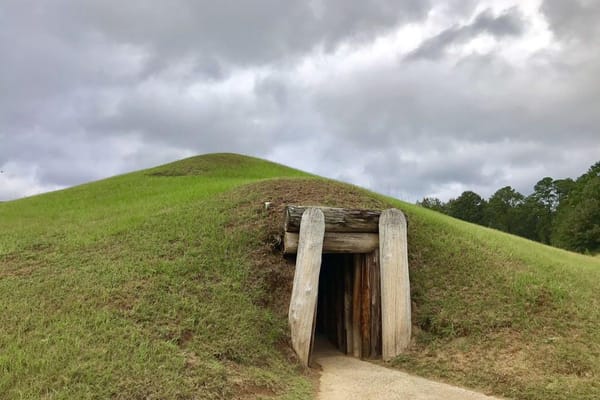
Feds target Crescent City for immigration raids
Asheville, N.C. hospital just out of immediate jeopardy could face Medicare termination


It's Friday, November 28, 2025 and in this morning's issue we're covering: U.S. government is targeting the New Orleans area for its latest round of immigration raids, Mission Hospital still faces potential Medicare termination, despite immediate jeopardy being lifted, Judges uphold NC congressional map redrawn by legislators in 2023. No word on challenge to change in 2025, ‘Toxic Soup’: PFAS and other contaminants surged in French Broad River after Helene, study finds, Rural family practices in NC wrestle with Medicaid cuts, Are Americans Worried About Crime? It Depends on How They Voted, A Montana Hospital is Training Future Rural Providers, How free out-of-school therapy for Memphis teens strengthens MSCS mental health services, A Hidden Health Crisis Following Natural Disasters: Mold Growth in Homes, Appleton’s Community Living Room offers an antidote to isolation.
Media outlets and others featured: Verite News, Asheville Watchdog, Carolina Public Press, North Carolina Health News, NC Newsline, The Marshall Project, The Daily Yonder, Chalkbeat, KFF Health News, Wisconsin Watch.
‘Schools are a safe place’: Local schools prepare for fallout from Border Patrol operation in New Orleans
by Safura Syed and Bobbi-Jeanne Misick, Verite News New Orleans
November 21, 2025
On the afternoon of Sept. 22, a text thread on Jennie Moctezuma’s phone started flooding with messages after federal immigration authorities appeared near KIPP East Community Primary School in New Orleans East, according to eye witnesses and school administrators.
The messages — sent between members of local immigrant-led civil rights group Unión Migrante — said U.S. Immigration and Customs Enforcement agents were spotted at the end of the street where cars lined up to collect children leaving the school during dismissal.
A former school administrator in New Orleans in the years following Hurricane Katrina, Moctezuma knew the impact of stressful situations — like a parent potentially being arrested and detained — on young minds.
“Children who are in trauma can't thrive when they're carrying around fear, even if they're little,” Moctezuma said in a phone interview in November. “They may not understand what's happening, but they can certainly feel it.”

When administrators at KIPP New Orleans Schools, the charter school network that runs KIPP East, found out about the agents, they sprang into action. They wanted to make sure that, whatever was happening, dismissal remained safe for children, guardians and school staff, according to the managing director of impact Ashley Daniels-Hall and director of school operations Maleka Williams.
Daniels-Hall said ICE agents were “cooperative” when school administrators asked them to move their vehicles that blocked the pickup line. In an email to other KIPP staff, Daniels-Hall said that ICE was in the neighborhood for “something separate.”
“Thankfully, they did not attempt to interfere with dismissal,” Williams said. The administrators were not aware of anyone connected to the school being arrested.
ICE spokesperson Linsday Williams wrote in an email to Verite News that their, “operations were not conducted at the school and had no impact on its activities.”
It was not the first time immigration officials were seen near a KIPP School. Williams said ICE agents showed up near KIPP Morial, also in New Orleans East, in March. According to Daniels-Hall, agents did not enter the school campus and appeared to be searching for a specific individual.
Since President Donald Trump took office in January, promising mass deportations, federal immigration authorities have increasingly been conducting raids and effecting arrests in or near locations once seen as off-limits.
In the first days of Trump’s second term, the U.S. The Department of Homeland Security — which oversees ICE and U.S. Border Patrol — removed Biden-era measures that placed restrictions on immigration enforcement actions in or near “sensitive locations,” including courthouses, churches, medical facilities and schools.
“ICE is NOT targeting schools or daycare centers,” read a September press release from ICE.
But in the past few months, there have been documented immigration arrests around a school outside of San Diego and in Oakland, California, both at times of day when parents would be present. And in the midst of stepped-up immigration actions in Chicago as part of operation “Midway Blitz,” immigration agents went inside a daycare center building to arrest a teacher. School attendance has dropped in Chicago since the immigration crackdown began, particularly in schools in areas that have been targeted.
Fear in New Orleans’ immigrant communities has lately intensified this week, after the Associated Press reported that 250 Border Patrol agents will come to New Orleans and surrounding areas to conduct immigration sweeps, similar to what has happened during Midway Blitz in Chicago and, over the past week, during operation “Charlotte’s Web” in Charlotte, North Carolina.
According to the AP, authorities plan to arrest as many as 5,000 people in Southeast Louisiana as part of operation “Swamp Sweep.”
‘The fears are there’
The day after agents were spotted near KIPP East, Moctezuma drove from her home near the Fairgrounds to meet other Unión Migrante members near the school to canvass the neighborhood. Volunteers circled several blocks surrounding the school and created Facebook Live reels declaring that streets were all clear. They offered to escort children to school, although, she said, no one was needed in that capacity.
While there have not been reports of immigration actions in or directly surrounding New Orleans area schools this year, federal agents have been seen conducting investigations and arrests within a few blocks of schools, according to sources who have spoken with Verite News.
Since the news about Border Patrol’s imminent arrival in New Orleans broke, InspireNOLA CEO Jamar McKneely said he’s received multiple emails from families concerned about what protections schools will offer to make sure students and their families don’t become targets.
“Our families can know how we're trying to protect them, that they just don't have to pull their kids out of school, that they don't have to be concerned,” McKneely said.

K-12 schools are required by federal law to educate students regardless of their immigration status. KIPP New Orleans and InspireNOLA, the largest charter networks in New Orleans, confirmed that they do not collect information regarding family status. That’s also true in Jefferson Parish schools, where 39% of students are Hispanic.
But fears about immigrant tracking laws and activity near schools persist. Clay Moise, a member of the Jefferson Parish School Board, said community members have reached out to him with their concerns.
“The fears are there,” Moise said. “Our response has been the same all along. We don't allow ICE into our schools as policy.”
NOLA Public Schools did not respond to requests for comment. Gabriela Biro, a board member on the Orleans Parish School Board, speaking in her personal capacity, said she encouraged residents to join groups like Unión Migrante.
Charter school administrators in Orleans Parish have been training staff to prevent potential ICE enforcement on campuses. While McKneely said that InspireNOLA is starting to work on its policies to protect students, Daniels-Hall said KIPP has a clearly outlined process to determine if ICE agents should be allowed on campus, which includes requiring a judicial warrant. Before an agent can come on the grounds, a staff member should work with their legal team to ensure that a warrant is viable, Daniels-Hall said, adding that these extra training measures for front office and operations staff are meant to “keep the school community safe.”
So far, those measures seem to have worked. There have been no appreciable drops in attendance among Hispanic students at KIPP, Moise and Daniels-Hall said. The Sept. 22 incident, Daniels-Hall said, didn’t impact attendance the following day.
But that could change if sweeps intensify due operation Swamp Sweep, which is reportedly set to begin in earnest after Thanksgiving. (While it might have been a coincidence, McKneely said some schools in his network saw a drop in attendance the day after news about Border Patrol coming to New Orleans broke.)
“Schools are a safe place for students and families,” Daniels-Hall said. “[We’re] really reinforcing that we’re doing any and every thing to keep the school community safe, that it's a safe place and it's supposed to be a joyful place for children to learn.”
This article first appeared on Verite News New Orleans and is republished here under a Creative Commons Attribution-NoDerivatives 4.0 International License.

Mission Hospital still faces potential Medicare termination, despite immediate jeopardy being lifted
The hospital has until Jan. 15 to fix deficiencies or lose access to Medicare and Medicaid funding, CMS letter says
by JACK EVANS November 26, 2025
 JACK EVANS
Mission Hospital remains out of compliance with federal health and safety regulations and will lose crucial Medicare and Medicaid reimbursements in January if it doesn’t fix the problems, according to a letter sent last week from the U.S. Centers for Medicare & Medicaid Services to Mission CEO Greg Lowe.
Mission had received an immediate jeopardy citation in October, meaning that CMS, acting on information from North Carolina Department of Health and Human Services surveyors, found that it posed an imminent threat to patients’ lives and safety. Though the surveyors found in a follow-up visit that the immediate danger had abated, they said the hospital still had deficiencies in patients’ rights, nursing services and emergency services — all of which were ultimately the responsibility of its governing body.
In two of the 32 cases the investigators reviewed, patients died. One was a cardiac patient who became disconnected from telemetry equipment, which off-site technicians use to monitor patients’ vital signs, for at least an hour. The other patient’s pulse oximetry, which measures blood oxygen levels, was not continuously monitored while they were transferred from the emergency department to another area of the hospital. Both of those cases were among the three that sparked the immediate jeopardy citation; according to surveyors’ follow-up report, they also revealed more systemic issues at Mission.
COMING NEXT: “While staff do their best to provide care, it was not always safe care”: Details from surveyors’ latest inspection of Mission Hospital
The letter, dated Nov. 21, was obtained Wednesday by Asheville Watchdog along with documents describing the findings of both the September and November investigations. The details they contain complicate Lowe’s announcement, in an email to hospital staff Friday, that the immediate jeopardy citation had been lifted, which was reported by several Asheville area-media outlets. The Watchdog has not independently reviewed Lowe’s letter.
Mission spokesperson Nancy Lindell could not immediately be reached for comment.
Mission has until Dec. 1 — next Monday — to issue a new plan of correction addressing those deficiencies, according to the letter. The state will then send surveyors back to Mission to determine if it’s achieved compliance. If the hospital fails to fix the problems, it will lose access to Medicare on Jan. 15.
The October immediate jeopardy citation was Mission’s second in two years and its third since 2021. Mission was placed in immediate jeopardy in 2024 after an NCDHHS inspection revealed 18 patients were harmed between 2022-2023, four of whom died, as a result of violations of federal standards of care related to the hospital’s emergency and oncology services. The sanction was lifted after Mission provided its plan of correction.
In 2021, Mission faced another immediate jeopardy sanction after a female patient was found dying on her hospital room floor, her IV disconnected, and saline flush syringes in her bed. NCDHHS inspectors found that “the hospital failed to maintain a safe environment for a medical/surgical patient with a history of substance abuse and prevent patient access to unsecured flushes, failed to follow a physician order for liquid pain medication, and failed to communicate and escalate patient care concerns for safety.”
Earlier this year, CMS also investigated an Emergency Medical Treatment and Labor Act violation at Mission after a patient died in an emergency department bathroom in February after calling for help for 29 minutes before staff responded. That investigation determined that Mission violated its responsibility to provide emergency services. But by the time CMS investigated, it determined that Mission had taken sufficient steps to remedy the problems that led to the death and the hospital avoided an immediate jeopardy finding.
Asheville Watchdog welcomes thoughtful reader comments on this story, which has been republished on our Facebook page. Please submit your comments there.
Asheville Watchdog is a nonprofit news team producing stories that matter to Asheville and Buncombe County. Jack Evans is an investigative reporter who previously worked at the Tampa Bay Times. You can reach him via email at jevans@avlwatchdog.org. The Watchdog’s reporting is made possible by donations from the community. To show your support for this vital public service go to avlwatchdog.org/support-our-publication/.
Judges uphold NC congressional map redrawn by legislators in 2023. No word on challenge to change in 2025.
by Sarah Michels, Carolina Public Press
November 21, 2025
North Carolina lawmakers did not intentionally discriminate against minority voters in the 2023 drawing of the state's congressional map, a federal district court ruled Thursday evening.
However, the judges’ decision does not apply to an ongoing challenge to 2025 redistricting.
A group of voters and several voting groups challenged various congressional and state Senate districts after Republican lawmakers redrew congressional maps in late 2023. They alleged that lawmakers intentionally diluted the voting power of minority voters in various areas of the state.
[Subscribe for FREE to Carolina Public Press’ daily, weekly and Election 2026 newsletters.]
The three-judge panel was not convinced. In their 181-page opinion, the judges wrote that plaintiffs had not proven any discriminatory intent, and in this case, the impact on minority voters wasn’t enough to strike down the maps.
While the First Congressional District was originally one of the challenged districts in the 2023 congressional map, it was not part of this order. Lawmakers again redrew that district in October to give Republicans the best shot at an additional seat in the U.S. House, according to the primary map drawer, Sen. Ralph Hise, R-Mitchell.
Plaintiffs addressed the development by adding onto their lawsuit with a new, First Amendment argument. The same panel of judges are currently considering that complaint on a preliminary basis to determine whether the 2025 congressional map can be used for the upcoming 2026 elections. Candidate filing begins Dec. 1, and maps have to be decided by then. The judges indicated that they would issue an order as soon as possible in that portion of the case during Wednesday’s hearing.
The partial order may be appealed to the U.S. Supreme Court, though no decision has been made yet, according to the Southern Coalition for Social Justice, which is representing some of the plaintiffs in the case.
“We are disappointed with the ruling and currently reviewing the decision to inform next steps,” SCSJ spokesperson Melissa Boughton said in a statement.
The challenge
Republican lawmakers redrew electoral maps in late 2023, after a newly Republican state Supreme Court pulled an about-face on the legality of partisan gerrymandering.
A group of voters and the North Carolina chapters of Common Cause and the NAACP challenged the new congressional map. While they could no longer sue over partisan gerrymandering, they alleged that lawmakers were still gerrymandering based on race.
Lawmakers used a pair of strategies to weaken the voting power of racial minorities in four congressional districts, they alleged.
First, plaintiffs argued that lawmakers used “cracking” to split up minority communities across multiple districts so that they would not have an opportunity to be competitive or elect their preferred candidate in any district.
This was the case, they argued, in northeast North Carolina’s First District. There, lawmakers moved whiter counties into the district and removed minority communities.
Plaintiffs contended that lawmakers also diluted minority voting power by cracking in the Sixth District. The 2023 congressional map reduced the district’s combined Black and Latino voting age population from 36% to 24% by splitting Guilford County across three congressional districts and the Piedmont Triad region — including High Point, Winston-Salem and Greensboro — across four congressional districts.
The combined population of the Triad could have been contained in one district.
Second, Republicans used another strategy, “packing,” to weaken minority voting power in the Twelfth and Fourteenth Districts, plaintiffs argued.
The Twelfth District, encompassing Charlotte and most of Mecklenburg County, already had a combined Black and Latino voting age population of about 44%, while the neighboring, western Fourteenth District had about 28% Black and Latino voting age population. While neither is a majority, minority voters could typically elect their candidate of choice in the Twelfth District and had the opportunity to do so in the Fourteenth District with enough crossover from majority white voters.
However, the 2023 congressional map moved minority communities from the Fourteenth District to the Twelfth District to make the former even more favorable for minority voters and the latter much less. Plaintiffs argued that the point was to “pack” minority voters into as tight a space as possible so that they could only reasonably win one district, not two.
Each of these changes made districts less compact, and sometimes resulted in weird shapes due to the inclusion and exclusion of certain communities.
It’s political
Republican defendants had a simple rebuttal: they didn’t use racial data at all while redistricting. It wasn’t even in the computer.
In fact, their goal was purely partisan; to benefit Republicans at the expense of Democrats, as was newly permissible under state and federal judicial precedent.
The three Republican-appointed judges — Richard Myers, Thomas Schroeder and Allison Rushing — found that argument more credible. Besides, they wrote in the majority opinion, it’s almost impossible to separate politics from race in North Carolina voting patterns.
“Nearly any map that moves Democrats in or out of a district will disproportionately affect black North Carolinians, but that does not prove that the legislature acted with discriminatory intent,” the opinion stated. “Correlation is not causation.”
In other words, Black voters tend to be Democratic voters. If partisan gerrymandering is legal, and racial gerrymandering is not, but lawmakers would essentially end up drawing the same congressional map under either motivation, then courts have to decide which motivation is predominant.
In this case, the judges decided that partisanship seemed like a more likely motivation than race.
What does this mean for 2026?
The ruling makes it less likely judges will side with plaintiffs on the 2025 congressional map challenge, but it doesn’t deem it impossible, Western Carolina University professor Chris Cooper said.
The 2025 redistricting had a more extreme racial impact than the 2023 congressional map, for one. And there’s an additional argument in that portion of the case that has nothing to do with race. Plaintiffs are arguing that mid-decade redistricting in and of itself should not be allowed without a legitimate reason, and that the 2025 map unconstitutionally punishes voters based on their choices at the ballot in violation of the First Amendment.
“There's still a chance,” Cooper said. “I think it's low, but it was low before, frankly.”
Kat Roblez, Forward Justice senior voting rights counsel, is involved in the 2025 portion of the lawsuit.
She said it’s hard to know what the judges will decide, but it means something that they waited to issue a separate ruling on the 2025 maps.
“They could have obviously issued an order about both, so it appears to me that they feel like that is a different situation,” she said.
This article first appeared on Carolina Public Press and is republished here under a Creative Commons Attribution-NoDerivatives 4.0 International License.

‘Toxic Soup’: PFAS and other contaminants surged in French Broad River after Helene, study finds
by Will Atwater, North Carolina Health News
November 24, 2025
By Will Atwater
Fifteen days after Tropical Storm Helene sent debris, runoff and a cocktail of toxins — including raw sewage and pharmaceuticals — pouring into the French Broad River in the fall of 2024, Shea Tuberty set out to investigate the damage.
The storm had carved an improbable path from the Florida Gulf Coast into the North Carolina mountains, taking lives and tearing apart communities. Days after it passed, Tuberty — a professor in Appalachian State University’s Department of Biology who’s known by friends as “the water guy”— said he was contacted by friends downstream in Tennessee who asked him to collect water samples to test for contaminants.
The disaster stirred painful memories for Tuberty,
“I’ve got PTSD from back in my 20s, when I lost my sister to a Middle Tennessee flood on Christmas Eve,” he said. “So this all had a personal, horrifying impact on me.”
Tuberty said his friends who live near the North Carolina border in the Cherokee National Forest didn’t trust what they were hearing from local or federal authorities as they were working to clean up Hot Springs, N.C., the closest community to their home. They peppered him with questions about the river.
“‘We’re working all day long in the sediment left behind by Hurricane Helene. What’s in the sediment and dust we’re breathing in? What’s in the water? Are we safe? Should we even be here?’” Tuberty said they asked him.
Seeking help
Before collecting water samples along a stretch of the river that flows from Asheville to Tennessee, Tuberty said he knew he’d need help analyzing them.
Earlier that week, while preparing to attend the North Carolina Society of Toxicology meeting at RTI International, he called colleagues to find out who might be able to conduct a general chemical analysis. But identifying every chemical individually would have been far too expensive and time-consuming — and he had no grant funding to support the work. A colleague told him to speak with Imari Walker-Franklin. Tuberty found her soon after she gave the keynote address at the conference, and they agreed to work together to provide information regarding the contaminants in the river.
Walker-Franklin, a research scientist at RTI, had the knowledge and technology to conduct the tests. She and her team used high-resolution mass spectrometry — a process that separates chemicals in the water and measures their molecular characteristics.

The technique can detect thousands of contaminants at extremely low levels, including ones scientists aren’t necessarily looking for. Walker-Franklin performed a non-targeted analysis of samples collected 15 days after the storm from five sites along an 80 kilometer (50-mile) stretch of the French Broad River.
“Site 4B was near where a wastewater ramp was impacted [by the storm],” Walker-Franklin said. “Which they could see was the obvious [source of] sewage input into the river.”
Toxic soup
The findings of the study, co-authored by Walker-Franklin, Tuberty and others, were published in October in the journal Toxics.
The analysis revealed that storm runoff created a toxic chemical soup in the river.
“It was literally everything stored in people’s garages,” Tuberty said. “Everything in their kitchens, everything in their basements, everything in their storerooms — all the businesses that line the rivers.”
According to the study, hurricanes can wash a wide range of contaminants into rivers — everything from sewage and roadway chemicals to industrial materials, pesticides, pharmaceuticals, and per- and polyfluoroalkyl substances known as PFAS. The French Broad River’s heavy recreational use, ecological value and history of flood damage make it especially vulnerable to this kind of chemical surge.
Among the chemicals detected were 11 types of PFAS, including PFOA and PFOS, which the study found at levels exceeding the Environmental Protection Agency’s maximum contaminant levels of 4 parts per trillion. PFAS are often called “forever chemicals” because they don’t break down easily in the environment. They have been linked to health risks including cancer, immune system suppression, thyroid disease, developmental harm and elevated cholesterol.
The analysis also detected four EPA “priority” contaminants: 4-nitrophenol, 2,4,6-trichlorophenol, pentachlorophenol and dibutyl phthalate.
The analysis traced the likely source to a stretch of the river identified as Site 4B, an area downstream from Asheville.

“The primary objective of this study was to inform disaster-response monitoring efforts by applying a hazard profiling framework,” according to the paper.
To better understand the risks from the contaminants identified in the samples, the research team used a method known as cheminformatics-based hazard screening. The EPA describes these tools as computer models that use chemical structure and existing data to predict which contaminants may pose health or ecological risks — even when they haven’t been widely tested.
Seeking higher ground
A year later, experts say the water quality in the river has improved.
“A lot of things that probably were present at the time have either settled or transformed, or have been uptaken in some capacity,” Walker-Franklin said. “I don’t think the water that we see today is probably what we saw post-storm.”
French Broad Riverkeeper Anna Alsobrook agrees.
“We did pretty extensive analysis after the storm,” Alsobrook said, “looking at all kinds of pollutants, from bacteria to diesel- and petroleum-based products and other types of chemicals [...] because folks were really concerned about getting into the flooded sediments to muck their businesses and homes down.”
She added, “Where we are now, it’s very similar to what we saw before the storm.”
Alsobrook noted that over time, some contaminants break down, get flushed downstream or settle into river-bottom sediment.
When considering the study’s broader implications, Walker-Franklin said the real lesson is vigilance: People should treat river water with caution after major storms. She said it’s important to understand that these types of analyses are a starting point for uncovering potential risks — not a reason for panic, but for better preparedness.
Tuberty said the findings should prompt a deeper conversation about how communities build near waterways.
“We need to have policies and laws put into place for guiding people away from likely loss-of-life situations, moving forward,” he said. “All of these compounds that ended up in the water could have been prevented if we didn’t have sewer plants, industry and storehouses with chemicals that are known to be toxic right on the banks of the river.
“There should be guidance created from either the state of North Carolina or EPA calling for a buffer between you and that river — not just distance, but also elevation.”
Correction: An earlier version of this article misstated the name of the host organization for the 2024 North Carolina Society of Toxicology meeting. It is RTI International, not Research Triangle International.
This article first appeared on North Carolina Health News and is republished here under a Creative Commons Attribution-NoDerivatives 4.0 International License.

‘We’re already struggling’: Rural family practices in NC wrestle with Medicaid cuts
by Lynn Bonner, NC Newsline
November 25, 2025
Dr. Deborah Ainsworth, owner of a pediatric practice in Beaufort County, has hard decisions to make about how to handle the financial dip that resulted from the state paying less for Medicaid health services.
About 85% of the children Washington Pediatrics treats are insured under Medicaid. Beaufort is a small, rural, economically disadvantaged county surrounded by others like it. Families travel far, sometimes up 90 minutes, to get to the office in Beaufort’s county seat, Ainsworth said.
“There’s nothing else around,” she said. “We’re kind of a catch-all.”
Independent primary care practices like Ainsworth’s are struggling to cope with the state’s 8% rate cuts for the care they provide to people who use Medicaid. Independent practices aren’t owned by large hospital systems that have more sources of income and are likely better able to absorb rate cuts.
Community Care of North Carolina, an organization that supports independent physicians and their practices, asked a group made up of mostly independent practices how they would respond to the rate cut. More than 60% said they would need to limit the Medicaid patients they see or stop taking on new ones, while 24% said they may need to stop treating Medicaid patients altogether. And 22% — one in five — said they may need to close.
More doctors closing their doors to Medicaid patients would mean additional hurdles to treatment for rural residents who already tend to travel farther to get to doctors and who are more likely to use Medicaid as their insurance than suburban or urban residents.
More than 39% of people who use Medicaid live in rural counties, according to a report from the NC Rural Center. Rural residents are about 35% of the state’s population.
According to the Sheps Center for Health Services Research at UNC, about 20 of the state’s 100 counties had no practicing pediatricians last year.
“These practices in rural areas — after a while, they may not be able to survive if this goes on,” said Gregory K. Griggs, NC Academy of Family Physicians CEO. “And once they’re gone, they’re not opening back up. It’s going to hit our areas of the state that already have access problems the worst, because those are the areas of the state that have higher percentages of Medicaid.”
Ainsworth said she will continue to welcome children who use Medicaid, but will likely cut expenses by “tightening our belt.” That means not replacing staff members who are leaving and ending plans to recruit a new doctor.
“We’ve always taken Medicaid,” said Ainsworth, a member of the CCNC board of directors. “I can’t stop taking Medicaid patients. I can’t drop them both financially or ethically. We’ll continue to see new patients. That’s just what we’re going to do.”
The Medicaid program needed to find a way to save $319 million over eight months, said DHHS Secretary Devdutta Sangvai.
DHHS imposed rate cuts from 3% to 10% for Medicaid services beginning Oct. 1, with Sangvai and Democratic Gov. Josh Stein saying the state legislature did not provide enough money for the Medicaid program to operate until June 30 of next year.
“There’s no way we did this with the idea that no one is going to get hurt,” Sangvai said. “We need to get this funded so that we can start reprocessing claims, making people whole, and focus on getting people healthy.”
The impact of the cuts differs depending on what services are provided, who is providing them, and where practices are located, Sangvai said.
There was no way to fine-tune rate cuts based on geography, he said.
Republican legislative leaders say the reductions are premature, and Medicaid has enough money to last into next year without cutting rates.
Dr. Mark McNeill, president of the NC Academy of Family Physicians, has met with both Stein and Republican legislative staff since rates were cut.
“I sincerely think all parties sincerely want to get a solution in some way shape or form,” he said.
McNeill said he wanted to emphasize in those meetings how lower rates will affect family practices, particularly independent practices.
Dr. Mark McNeill, president of the NC Academy of Family Physicians on Nov. 14, 2025. (Photo: Lynn Bonner/NC Newsline)
“We’re already struggling with access to primary care,” he said. “This is just making it so much worse.”
McNeill, whose office is in Asheville, has decided to stop accepting new Medicaid patients until the rate cuts are reversed. Between McNeill and the other doctor in the office, about 15% of the practice’s patients are on Medicaid.
The state must seek permission from the federal government for the rate cut. DHHS must have the request into the Centers for Medicare & Medicaid Services by Dec. 31.
If the funding controversy is resolved, the state must go back to CMS for permission to reverse the cuts.
McNeill wonders whether there’s a chance that CMS won’t allow the state to restore the rates. The Trump administration has been eager to reduce Medicaid spending. The “Big Beautiful Bill” Act on taxes and spending cuts about $1 trillion from Medicaid over 10 years.
Sangvai agrees there is a risk CMS will refuse to allow North Carolina to restore its Medicaid rates if funding increases, but he’s confident that won’t happen because the funding issue involves state money.
“I’m optimistic that CMS will allow us to take the corrective action in that second filing,” he said.
NC Newsline is part of States Newsroom, a nonprofit news network supported by grants and a coalition of donors as a 501c(3) public charity. NC Newsline maintains editorial independence. Contact Editor Laura Leslie for questions: info@ncnewsline.com.
Are Americans Worried About Crime? It Depends on How They Voted.
The sitting president can be a better predictor of how safe someone feels than what the crime data shows.
This article was first published by The Marshall Project, a nonprofit news organization covering the U.S. criminal justice system. Sign up for their newsletters, and follow them on Instagram, TikTok, Reddit and Facebook.
The United States is experiencing historic drops in crime across almost all categories, including murder, burglary and motor vehicle theft. But crime statistics don’t necessarily change how safe Americans feel or whether they support the latest public safety proposals, like President Donald Trump’s deployments of the National Guard into U.S. cities. Those beliefs are driven by political preferences.
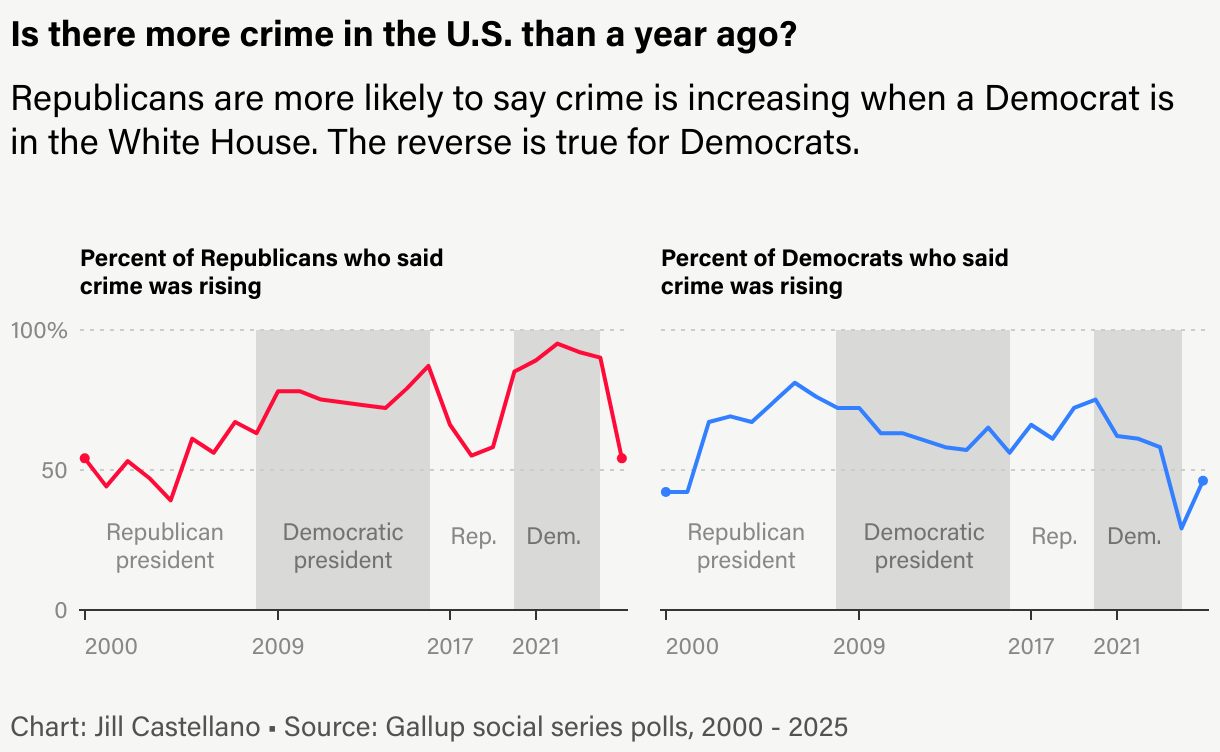
By many measures, Americans are more politically divided than ever, and this polarization colors people’s perceptions of the world around them. According to data from the research firm Gallup, which publishes an annual survey on crime perceptions, Republicans were more likely to believe crime was rising during the Barack Obama and Joe Biden presidencies than under George W. Bush or Donald Trump. The reverse was true for Democrats.
The partisan shift was especially dramatic in Gallup’s poll conducted this October, after Trump’s return to the White House. While 90% of Republicans surveyed in 2024 said national crime rates had risen over the past year, just over half believed the same was true in 2025. Meanwhile, Democrats were more likely to say crime was on the rise this year than they were in 2024, but their shift was smaller than Republicans’.
National murder rates began falling in 2023, well before Trump’s second term, and have continued to decline ever since. This year could result in the largest one-year drop in murder ever recorded, with data going as far back as the 1960s. Similar trends are taking place with other violent and property crimes.
On the surface, the latest polls reflect this safer reality. Less than 50% of people surveyed by Gallup this year said they believed crime was rising in the U.S., the lowest proportion since 2001. Yet the data also shows Republicans are driving the decline, following a decades-old pattern of party members shifting their views under new presidential administrations.
Long-term trends make it clear that partisanship is deeply embedded in Americans’ crime perceptions, even in their own communities. People report being less afraid of walking around at night and believing crime rates are lower in their neighborhood when their political party runs the Executive Branch, according to data from 25 years of Gallup surveys. This finding is especially true for Republicans.
“There is a political dimension to it, absolutely,” said John Roman, senior fellow at NORC, a research group at the University of Chicago. Roman said a growing number of Republicans and Democrats answer questions about crime and safety in a way that signals support for their party, even if it’s contrary to their personal experiences.
“It’s people being afraid of things that objectively they probably shouldn’t be that afraid of, or at least reporting it that way,” he added. “And other people defiantly saying, ‘I’m not afraid of these things,’ that maybe they should be a little more afraid of.”
In recent years, Republicans and Democrats have been more consistently voting for their party’s candidates in elections. Fewer Americans are willing to vote for the opposing party’s presidential nominee or down-ballot candidates.
As many as 43% of Americans now identify as independents, the highest proportion in more than three decades, while self-proclaimed Republicans and Democrats are dwindling. About as many independents “lean Democrat” as “lean Republican,” which helps explain why their survey responses and voting patterns appear to fall in between the two political parties.
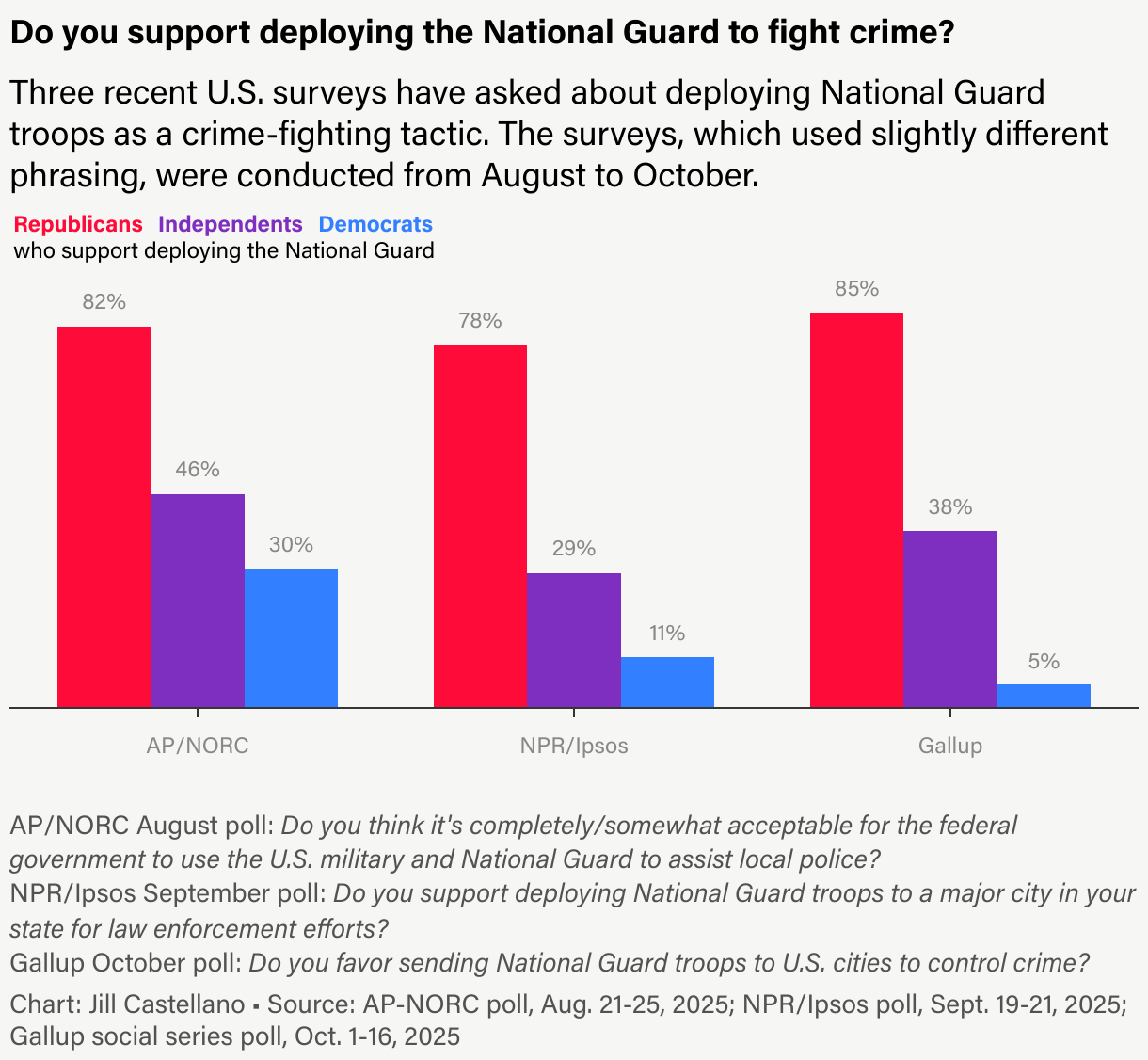
These polarization patterns are also reflected in what crime-reduction strategies people support. While the majority of Americans oppose Trump deploying the National Guard as a crime-fighting force in U.S. cities and his proposal to charge 14-year-olds as adults in Washington, D.C., his Republican base remains staunchly supportive.
Since August, at least three national surveys have tested public attitudes on National Guard deployments. Each found a stark partisan gap. The most recent poll showed around 80% of Republicans in favor, compared to only 5% of Democrats.
“It’s almost like a referendum on Trump,” said Lydia Saad, the director of U.S. social research at Gallup.
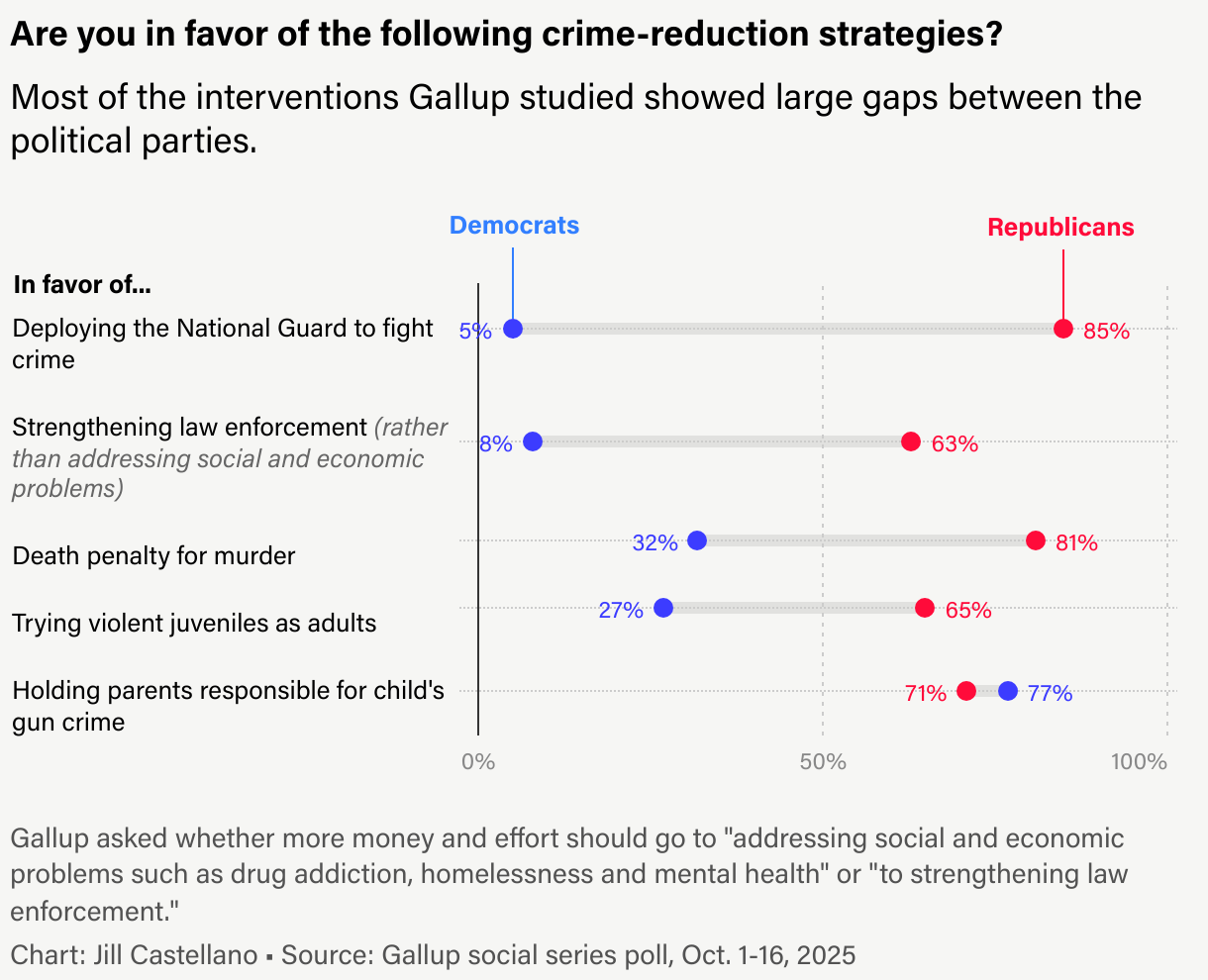
The October survey found that military deployment was the most polarizing of the five interventions studied. Researchers also asked about trying violent juvenile offenders as adults, boosting resources for police or social programs, and supporting the death penalty. All of them showed a political party divide. Only one intervention — whether to hold parents legally responsible for a child’s gun crime — lacked a substantial partisan gap.
Saad said the more an issue is discussed by political party leaders, the wider the party divergence. “The gaps correspond perfectly with how much these issues are in the news and who is associated with them,” she explained.
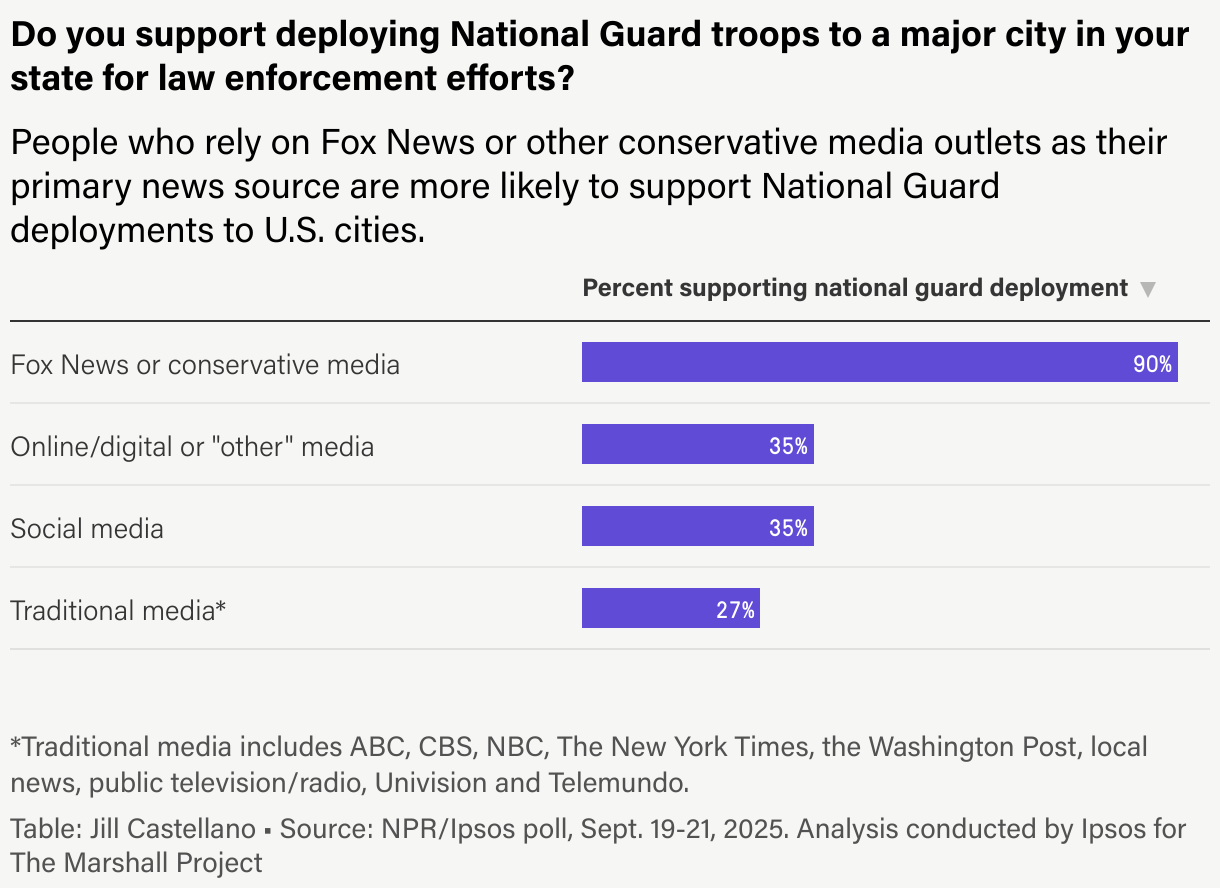
In a September NPR/Ipsos survey, Republicans whose main news source was Fox News or other conservative media outlets, like Breitbart or Newsmax, were almost universally supportive of deploying the National Guard, with 95% in favor, compared to 70% of Republicans who rely on other information sources.
“Our fractured media landscape and disparate sources of information is helping to exacerbate some of these political divides,” said Mallory Newall, a vice president at Ipsos.
Partisanship isn’t the only factor influencing crime perceptions. For example, women, people of color and people with lower household incomes are more likely than others to express fears of walking alone at night in their neighborhoods.
The NPR/Ipsos poll shows that Americans seem to be more concerned about partisanship than they are about crime itself. When asked to pinpoint their three “most worrying” issues, 43% of respondents listed political extremism and polarization, while only about one-quarter ranked crime or gun violence. Other studies have found that only around 5% of Americans currently consider crime and violence to be the single most important problem in the U.S.
At the same time, a slowly growing proportion of U.S. adults, primarily Democrats and independents, support criminal justice reforms.
Gallup found that more than two-thirds of Americans now say more money and effort should go toward addressing underlying causes of crime, such as drug addiction, homelessness and mental health issues, rather than toward strengthening law enforcement.
“This would be a really good moment to embrace the public’s preference for social policy as a solution to crime rather than law enforcement as a solution to crime,” said Roman at the University of Chicago.
“On most measures, if you are under 50 years old, this is the safest America you’ve ever lived in,” he added. “Our policies should reflect that.”
A Montana Hospital is Training Future Rural Providers
by Madeline de Figueiredo, The Daily Yonder
November 20, 2025
As rural areas across the country face worsening provider shortages and reductions in health care services, one community hospital in Billings, Montana, is celebrating the success of two new residency programs training the next generation of rural physicians.
Roughly 65% of rural counties face a shortage of primary care physicians, according to a Centers for Disease Control and Prevention (CDC) report. In some states, like Montana, the crisis is particularly acute. Research shows that a rural background is one of the strongest predictors of becoming a rural physician, yet the number of medical students from those communities has declined steadily over the past fifteen years. Today, fewer than 5% of U.S. medical students come from rural areas, contributing to a widening gap in access to basic health services.
But Billings Clinic has a different story to tell.
Since launching its internal medicine residency program in 2014, Billings Clinic has graduated 75 physicians, with half now practicing in rural communities. The program’s outcomes stand out amid national trends, where only 11% of physicians work in rural areas.
“I've never seen as much interest as I have over the past year in our residents remaining in the area,” said Dr. Steven Gerstner, program director of the Internal Medicine Residency Program at Billings Clinic. “The residency program has maintained the internal medicine department at Billings Clinic. Without the residency and the faculty we have attracted, we would be in very dire straits.”
That success sparked more growth. In 2023, Billings Clinic launched Montana’s first-ever psychiatry residency, welcoming its first cohort in 2024.
In the last 30 years, Montana has ranked in the top five states for suicide rates across all age groups. Youth alcohol use in the state significantly outpaced the national average, alcohol-related deaths have nearly doubled in the state in the past decade, and over half of Montanans live in communities that do not have adequate access to mental health providers.
“We have patients from eight hours away or six hours away who have to come [to Billings Clinic] because there are no other services for inpatient acute care in their communities,” said Dr. Mariela Herrera Rojas, the program director of the Billings Clinic Psychiatry Residency.
“There is a very high need to address mental health issues, but we are very under-resourced and there are a lot of shortages," Dr. Herrera Rojas said. “That's what we want to address through the residency program. What is it that we can do to address these shortages of addiction psychiatrists, child psychiatrists, and other providers?”
The psychiatry program was funded, in part, by The Leona M. and Harry B. Helmsley Charitable Trust, a global philanthropic organization, which has given over $23 million to the Billings Clinic, including funding the development of its residency programs.
“In Montana, the need for psychiatrists is huge,” said Walter Panzirer, a trustee for the Helmsley Trust. “One of the worst disparities across the United States is in Montana, and you look at all the behavioral health problems. It just seemed like a natural fit to further expand Billings Clinic’s residency program into psychiatrics.”

A Rural Health Success Story
Billings Clinic serves a large region that includes eastern Montana, the western edges of North Dakota and South Dakota, and northern Wyoming. Residents see patients from across rural communities both at Billings Clinic and in rural rotations they complete across Montana.
Every resident completes at least two rural rotations in communities such as Lewistown, Livingston, or Hardin, a structure designed to both expose them to rural practice and encourage them to stay in the region long term.
Ashley Dennis, Ph.D., director of Billings Clinic’s Office of Medical Education, said that this immersive experience prepares residents for the realities of rural practice.
“The more opportunities that residents have to get out into rural communities, the better for, ultimately, them practicing in those spaces,” Dennis said.
That firsthand exposure to rural medicine teaches residents to think differently about everyday procedures and logistics.
"We did a study recently talking to rural providers who had just transitioned into rural practice about their experiences. Through that, we heard lots of stories, and it's simple things, like realizing, ‘Hey, before I do this procedure, I need to call the blood bank and cross-check that they have enough blood,’” Dennis said. “That’s something you may not consider at all if you're in a place where there are ample resources and opportunities. So, having that contextual awareness changes how you practice as a physician."
Dr. Mette Strand graduated from the Billings Clinic residency program and now practices in Livingston, Montana, where there are only two internal medicine primary care providers. She said both the rural training rotations and the program’s teaching philosophy played a key role in preparing her for rural practice.
“I think it was very valuable for the Billings [Clinic] residency to emphasize rural health during our training,” Dr. Strand said. “They would always give us scenarios, asking what if you didn't have that consult service available? Or, what if you are on your own? They were always prompting us to think about how it would be to practice in a rural setting without the resources that we had.”
As a rural internist, Dr. Strand can care locally for patients that might otherwise have to travel far distances to see specialists. She now manages diabetes for patients who previously had to see endocrinologists, treats advanced chronic obstructive pulmonary disease (COPD) cases typically referred to pulmonologists, and cares for patients with liver disease once handled by gastroenterology. In some cases, she can manage these conditions locally right up to the point of transplant referral.
“The trip from Livingston to Bozeman or Billings can be hazardous, especially in the wintertime. And many of our elderly patients do not take that trip all winter. We also have patients struggling to afford gas or have help to go back and forth to those places,” Dr. Strand said. “By being able to offer internal medicine here in Livingston we are able to ensure better follow-up and treatment for these patients.”
Dr. Elizabeth Schiedermayer also graduated from the Billings Clinic internal medicine residency program and now practices in Anaconda, Montana.
Dr. Schiedermayer said that while she came into residency already committed to practicing outpatient care in a rural setting, the Billings Clinic residency program offered her the opportunity to anchor her career in rural primary care.
“They actually give you a primary care clinic. The rural rotation was really excellent, and they made space in our busy schedule to do that and value that,” Dr. Schiedermayer said.
“I really like blue collar, rural people, and I like taking care of them,” Dr. Schiedermayer said. “It's a privilege to take care of my neighbors.”
In a sea of stories about geographic disparities in medicine, Billings Clinic is forging a path to train and retain rural providers. Already, three of the upcoming Billings Clinic graduates have signed on to stay with Billings Clinic.
“Our hope in building residency programs is to keep people in the community,” Dennis said.
For Dr. Strand, that mission is coming full circle as she prepares to train future rural doctors.
“I have my first resident coming after the new year,” Dr. Strand said. “I’m really excited about that opportunity.”
This article first appeared on The Daily Yonder and is republished here under a Creative Commons Attribution-NoDerivatives 4.0 International License.

How free out-of-school therapy for Memphis teens strengthens MSCS mental health services
Bri Hatch, Chalkbeat
Oct 21, 2025 at 3:07pm EDT
Sign up for Chalkbeat Tennessee’s free newsletter to keep up with statewide education policy and Memphis-Shelby County Schools.
Peyton Golden said she knew she needed mental health support last spring when she started struggling to control her feelings.
“Sometimes I gather too many emotions at once, and I just start lashing out,” said Golden, 15, a sophomore at Power Center Academy High School in Memphis. “It was making me lose opportunities. It was making me look like a bad person, and I’m not a bad person.”
Golden said she was nervous to ask about starting therapy because it can be expensive. Then earlier this year, her mom found out about Youth Connect, a program run by the Shelby County Youth and Family Resource Center and local nonprofit The Braid Foundation that offers teens 12 free sessions with a Memphis-based therapist.
Golden started seeing hers in May. She and her therapist practice daily affirmations to boost self-confidence, Golden said, and work on developing skills to cope with overwhelming situations at school.
“I’m so proud of how far I’ve come,” Golden said. “Now, I can express my feelings, and I can say, ‘Wait, can we come back to this conversation when I calm down?’”
Youth Connect has provided free therapy outside of school to 345 young people in the Memphis area since it launched in May 2024. That is far fewer than Memphis-Shelby County Schools’ own mental health services, which serve over 6,000 students in group or individual therapy each year. But those who work in schools and with young people say Youth Connect is filling an important need, especially since a 2024 state law restricted certain kinds of mental health help schools can provide.
Youth Connect’s teenage clients, many of whom are MSCS students, say the program also offers more autonomy and privacy than in-school services.
Donna Goings, director of MSCS’ mental health centers, said the school system and Youth Connect work closely together. They often refer clients to each other, she said, and can share information about mutual clients if given permission from the student or their guardian.
“I know there’s a belief out there that a child shouldn’t have more than one therapist,” Goings said. “But we communicate with [Youth Connect] to ensure that we’re both on the same page, and helping that child to really be the best person that they can be.”
A program designed with teen choice in mind
Youth Connect started as a response to rising mental health needs during the COVID-19 pandemic. But it’s become more about addressing persistent issues in accessing youth mental health care locally and statewide.
Tennessee ranks as one of the worst states in the country for youth mental health, with high rates of mental health conditions and low access to care. In 2021, for example, more than half of 12-to-17-year-olds struggling with depression in Tennessee did not receive help. Nearly a quarter of Shelby County high schoolers reported seriously considering suicide that year.
To sign up for Youth Connect, teens and their families fill out an online form, and then choose a provider from a list of over 20 vetted therapists using their personalized video introductions.
“I am not a person that trusts off the bat,” Golden said. “But I felt very secure going into this,” she added, because she chose a therapist that best matched her experience and needs.
Right now, Youth Connect clients complete around six free therapy sessions on average, program leaders said. But some, like Golden, use all 12 free appointments and then continue working with their therapist.
Cathy Emerson, co-founder of the Braid Foundation and one of three Youth Connect leaders, said they designed the program with teen autonomy in mind. Before launching, Emerson said her team talked to over 300 young people about how they wanted free mental health support to look.
The responses were clear, she said: Young people want to choose their own therapists. And they want mental health care outside of school.
“In so many spaces, youth don’t have that autonomy of choice in their therapist,” Emerson said. “It’s either whoever’s assigned to their school, whoever their insurance covers, or whoever their parent or legal guardian is picking.”
With only a little over a year of service under their belt, Youth Connect leaders are already facing a funding deadline. The program is entirely reliant on federal pandemic aid, which is set to expire by the end of 2026. Emerson said they’re already looking for outside grants to replace that money.
The program takes about $350,000 to run per year, but Emerson says she’s seeking some $650,000 to expand their services, including to 18- to 24-year-olds.
“We absolutely hope our local leaders continue to invest in youth and community wellness,” she said. “At the same time, we know sustainability means diversifying funding.”
Youth Connect fills gaps in Memphis mental health care
In 2020, a group of nearly 80 Memphis-area nonprofits and practitioners started pushing the local government to fund targeted mental health support for young people. The Shelby County Commission responded in June 2021 by setting aside a little over $1 million in federal pandemic relief money for what would become Youth Connect.
Unlike some other free services, Youth Connect is also universal for teens ages 13-18, said Braid Foundation co-founder Shaneika Smith. That means families don’t need to prove their income level or insurance status to access it.
Smith said program leaders also insist on paying local therapists a sustainable wage, at close to $140 per session.
Brandi Rhoden, one of the Youth Connect therapists, said families used to turn down her help because they couldn’t afford therapy while reliant on Medicaid or without health insurance. Now, she can help them sign up for Youth Connect.
As an out-of-school option, Youth Connect is smaller but more flexible in some ways than in-school MSCS services. The program is also able to provide therapy to clients 16 and older, who can sign up without parent consent.
While Youth Connect leaders say very few teens sign up without parent permission, the option differs from school requirements for explicit parent consent on student mental health services. The 2024 Tennessee Families’ Rights and Responsibilities Act expanded that active permission requirement to school-wide assemblies on suicide prevention and bullying, following a nationwide push for more parent oversight in public education.
But the district currently has over 80 therapists and social workers on staff that can diagnose and treat students with mental health conditions on an individual or group therapy basis, she said, which not all school systems are equipped to do.
Most MSCS clinicians work in two schools, Goings said, and they can sometimes have waitlists for therapy services. That comes with the challenges of working in a time-constrained school environment, she added.
“We can’t take them out of a certain class, so we have to work around their academic schedule,” Goings said. “And we definitely try to include the parents in everything, because we are a school setting. We do not want to alienate parents.”
Emerson said Youth Connect leaders are still working to expand their own client numbers. This school year, she said, they started working with six local student volunteers to spread the word.
Dulce Ordonez is a 17-year-old student at Middle College High School. She said addressing stigma around mental health care, especially in Latino communities, is one of her main goals as a Youth Connect Ambassador.
“A lot of Latino people would often say that mental health is not important, or ‘you’re just crazy,’ or mental health is not real,” Ordonez said. “But some parents don’t really realize the importance of mental health within their families, their relationships, or their children.”
Clients like Golden offer valuable testimonies, too.
“People my age have our guard up with trust and everything, but it’s okay to let that wall down,” Golden said. “There’s a lot of suicide going on our generation. With the world that we live in, we need more trusted adults around us.”
Bri Hatch covers Memphis-Shelby County Schools for Chalkbeat Tennessee. Reach Bri at bhatch@chalkbeat.org.
Chalkbeat is a nonprofit news site covering educational change in public schools.
A Hidden Health Crisis Following Natural Disasters: Mold Growth in Homes
Jonathan R.M. Charles
November 19, 2025
TALLAHASSEE, Fla. — After returning from what felt like the best internship of her life, Danae Daniels was excited to unwind and settle into a new semester at Florida Agricultural and Mechanical University. But when she opened the door to her off-campus apartment, she was met with an overwhelming smell — and a devastating reality.
“There was mold in my bedroom, on my bed, mold in my expensive purse,” Daniels said. “Mold in my closet, my bathroom — literally everywhere.”
During her absence, a series of severe natural disasters had swept through the Tallahassee area, leaving widespread damage. According to the National Centers for Environmental Information, those storms in summer 2024 caused billions of dollars in destruction, displacing families and leaving businesses in ruin.
It caused more than just property damage. While the community worked to recover, mold took hold in homes and other buildings across the city, turning the natural disaster into a prolonged crisis with public health implications.
“If any part of a home is exposed to flooding or leaks and is not fully dried within 24 to 48 hours, mold growth is almost certain,” said Parham Azimi, a research associate at Harvard T.H. Chan School of Public Health, who studies the link between mold exposure and respiratory health, particularly in the wake of natural disasters. “After major storms, we often see spikes in respiratory illnesses, particularly in homes that were affected by flooding.”
A Foundation for Trouble
An estimated 47% of residential buildings in the United States contain mold or dampness. So even as the latest hurricane season winds down, the threat of mold-related health risks lingers.
And with 29% of the nation’s population living in flood-prone coastal counties, the risk of exposure to mold spores and allergens that can trigger respiratory illnesses is immense, leaving some 95 million people vulnerable when extreme weather strikes. That doesn’t count people in inland areas that flood, like in the North Carolina and Tennessee mountains that experienced massive flooding from Hurricane Helene last year — or those whose homes were drenched from the Hill Country flooding in Texas this summer.
The health consequences of mold exposure range from mild allergic reactions to severe respiratory conditions. Common symptoms include congestion, asthma flare-ups, and skin irritation, according to the Centers for Disease Control and Prevention. Prolonged exposure can lead to more serious complications, such as hypersensitivity pneumonitis — a rare lung inflammation — and mycotoxin-related illnesses, which can cause neurological damage, liver disease, and kidney dysfunction.
Now, a key federal program that helps repair housing after disasters and aid from the Federal Emergency Management Agency are in question amid President Donald Trump’s cutbacks and policy changes.
One of the greatest dangers of mold is that it often goes undetected for months or years, leaving people unknowingly exposed.
Lauren Lowenstein in Houston knows that all too well. “For five years, my family’s health kept declining, and we had no idea why,” she said.
After conducting an Environmental Relative Moldiness Index test, Lowenstein said, she discovered that toxic mold spores had been growing inside the walls of her home due to excessive condensation in the HVAC system. She, her husband, and their two children vacated immediately and had to start over again.
“The mold wasn’t visible, and we had no indication that it was growing,” Lowenstein said.
Even when mold is detected, removing it is an expensive challenge. On average, mold remediation costs between $1,223 and $3,751, according to the home service clearinghouse Angi, but in severe cases, the price can reach $30,000 or more. Even with home insurance coverage for mold, people may bear some cost.
Daniels, for example, was forced to leave her Tallahassee apartment and get a hotel for a month while waiting to be moved into a newly renovated unit. She had to replace all her belongings.
The cost of remediation remains out of reach for many households, Azimi said, and alternative yet affordable housing can be hard to find, which means continued mold exposure.
“For low-income and marginalized communities, the risks are even greater,” Azimi said.
For those seeking government assistance, the wait times can be extensive, according to the Rev. Mac Legerton, founder of the Robeson County Disaster Survival and Resiliency School in North Carolina. “In many cases, families are left to choose between living in unsafe conditions or homelessness.”
A 2019 review funded by the U.S. Department of Housing and Urban Development of 88 disaster grants found that its Community Development Block Grant Disaster Recovery program began distributing funds to applicants on average 20 months after the initial disaster, with disbursements taking two years or longer.
“When it comes to our disaster response system, mold remediation is one of the most neglected areas at the local, state, and national levels,” Legerton said.
Legerton’s organization runs a “mold busters” program, a hands-on training and education initiative that helps give people in Robeson County the tools and knowledge they need to safely remove mold from homes, churches, and businesses following natural disasters. The program also provides free mold remediation services to vulnerable communities. He said it was created in response to the lack of timely aid in the central North Carolina community.
Waiting Takes Its Toll
Tanya Locklear faced this reality after Hurricanes Matthew and Florence severely damaged her home in Pembroke, North Carolina, in 2016 and 2018, respectively, ultimately leaving it contaminated with mold.
She applied for assistance through North Carolina’s ReBuild NC governmental program in August 2021 but said she did not receive approval until November 2023. She said repairs finally began in February 2024 — more than two years after her application.
It was only after local advocacy efforts — including pressure from community leaders and Legerton’s organization — that her case moved forward, Locklear said.
However, she said, the initial delays had already taken a toll on her family’s health and well-being. While waiting for aid, Locklear and her children remained in the hazardous conditions of the moldy home. She said she and her family suffered health complications such as headaches, nose bleeds, and difficulty breathing.
Even today, Locklear said, she has various respiratory issues, showing the long-term risks of remaining in mold-infested homes.
Legerton, working with his group on the ground in North Carolina, believes that lawmakers and policymakers must focus on streamlining disaster relief programs to ensure effective and timely aid distribution for affected families and communities nationwide.
Government officials should also increase funding for mold remediation to help prevent displacement and long-term health consequences, and implement stronger building codes and flood-resistant housing designs to mitigate mold risk in disaster-prone areas, according to Legerton and public health experts. Without proactive policies, Azimi said, millions more will face prolonged exposure to unhealthy living conditions.
“As climate change intensifies, hurricanes and severe storms will become more frequent and destructive, increasing the risk of mold-related illnesses,” Azimi said.
KFF Health News is a national newsroom that produces in-depth journalism about health issues and is one of the core operating programs at KFF—an independent source of health policy research, polling, and journalism. Learn more about KFF.
Subscribe to KFF Health News' free Morning Briefing.
This article first appeared on KFF Health News and is republished here under a Creative Commons Attribution-NoDerivatives 4.0 International License.

Feeling lonely? Appleton’s Community Living Room offers an antidote to isolation
by Miranda Dunlap / Wisconsin Watch, Wisconsin Watch
November 12, 2025
Click here to read highlights from the story
- The founders of Ebb & Flow Connections Cooperative host emotional CPR training to community members and run a community living room in downtown Appleton.
- Lynn McLaughlin and Karen Iverson Riggers have trained more than 2,500 people in ECPR in roughly seven years.
- Their approach to teaching social connection has proved successful enough that groups in several other counties want to replicate it, and several state entities say the model is a method for building connection to prevent suicide.
- The effort is grant-funded, and the community living room requires space and volunteers.
Karen Iverson Riggers scrawls on a giant notepad as the 12 people around her call out rules they think should govern the next two days they’ll spend together: “It’s OK to cry.” “Authenticity over correctness.” “Judgement-free zone.” “Say it messy.”
The group — a mix of mental health professionals, children and family workers and curious residents — is kicking off an “emotional CPR,” or “ECPR,” workshop, a community public health training teaching how to assist someone in crisis or emotional distress.
Training leaders Iverson Riggers and Lynn McLaughlin have dedicated the last several years to encouraging northeast Wisconsinites to deeply connect with one another — and giving them a free community space to do so — in hopes they can combat the social isolation many feel today.
“This is not an individual problem. It's not like you are doing something wrong because you're lonely or feeling isolated,” Iverson Riggers said. “This is a community design issue … Lots of folks are being forced to work themselves to death without having any free time to engage in any kind of community or connection.”

The pair founded Ebb & Flow Connections Cooperative, which runs a Community Living Room in downtown Appleton. They describe it as an “unconditionally welcoming” space, where community members can socialize, play games, hang out or confide in certified ECPR practitioners.
“There's no requirement to belong,” McLaughlin explained. “You just do.”
Their approach to teaching social connection has proved successful enough that groups in several other Wisconsin counties are now trying to replicate the resources they offer. Plus, several state entities say their model is a method for building connection to prevent suicide.
With funding from the Medical College of Wisconsin, the pair spent two late-October days in Oshkosh training Winnebago County residents and workers.
Attendees practiced how to effectively listen to and assist people who are struggling, as a means to prevent self-harm and further distress. After the workshop, they’d be considered an ECPR "practitioner” and could go on to eventually work as a listener in a living room.
A place to ‘just be’
The pair’s idea for bringing more northeast Wisconsin residents together was born several years ago, when they were sitting in Iverson Riggers’ living room, discussing the unhelpful ways people typically respond to those struggling with mental health issues. They also lamented the general loss of “third spaces,” or places outside of home or work where people casually connect with their community without a cost barrier.
“So we said, ‘You know, what if there was a space where folks could go and could just be?’” Iverson Riggers said.
That question led them to devise the idea of the Community Living Room, where people could do just that.
In 2023, they received a grant from the Community Foundation for the Fox Valley Region, which they used to launch the concept as a pop-up event in different places — the local library, community gatherings, the children’s museum. There was always food and several ECPR-certified listeners in attendance.

Thanks to the relationships they built hosting pop-ups, a local developer gifted them space to open a permanent downtown Appleton location in October 2024. They pay just $1 in rent annually.
“It was created to break down all the barriers that people find to seeking support,” Iverson Riggers said. “There's no appointments and no forms. There's no requirement of a certain kind of identity or diagnosis. There's no requirement about how you engage.”
Inside the space, which resembles a large apartment, several cozy couches invite visitors to get comfortable. There are tables to sit at or partake in board games or puzzles. A small kitchen area with a fridge is stocked with fresh snacks. A poster on the wall permits people to take what they need — clothing, food, safe sex tools, hygiene supplies and even Narcan.
“It just says something about creating a space … where we can go and connect and feel welcome without having to buy anything, without having to be a certain way, without having to conform to whatever the rules of the space are,” Iverson Riggers said.

How people use the space varies. Some simply pop in for a snack or a drink or to use the bathroom. Two visitors regularly come in and practice playing the guitar. Others want to connect one-on-one with the “listeners” trained in ECPR — at least two people who have taken the training are paid $50 per hour to be present.
While the staff are trained to help people who are experiencing emotional crises and are more than ready to assist if needed, the living room aims to be a “prevention space,” they said. They believe that if people feel less lonely and isolated, or know they have somewhere where they can get support, they may not reach the point of crisis.
“You know, it's not just this joy-filled, ‘everything is peaceful’ (place),” McLaughlin said. “We're learning how to navigate conflict in community. We're learning how to support people in distress, in community.”
Since they started offering community ECPR workshops roughly seven years ago, they’ve helped train more than 2,500 people.
For years, they felt they were “pounding the pavement” to spread the word about their ideas for connecting neighbors. Now, they’ve turned a corner and have seen a steady increase in demand.
Community members across Wisconsin, including in Winnebago, Brown, Sauk and Sheboygan counties, have shown interest in replicating their approach. Prevent Suicide Wisconsin also shared Ebb & Flow’s approach in its 2025 Suicide Prevention Plan as a model for using peer support to reduce deaths by suicide.
Thanks to this, Iverson Riggers and McLaughlin expect they’ll soon be “overwhelmed” with interest. The increased attention has come with its own challenges — they had to cut back on meetings with people who want to replicate their approach in other counties. It’s also been hard to keep up with the demands of “chasing down funding” and keeping the downtown Appleton space in shape, Iverson Riggers said.

Lanise Pitts, a practitioner certified in ECPR, said she was drawn to the warmth of the cooperative and kept returning to events after she attended the training. The Community Living Room allows her to connect with people from different circles and different career paths that she would likely never meet otherwise, she said.
“When people just come in, it's just like being welcomed to somebody's house. Come in, find something to do, kick your feet up,” Pitts said while curled up on a couch in the living room. “When they leave, after we've done puzzles or colored or played card games or music games or had a 30-second dance party, it's just like the weight gets lifted. Like you might come in with a lot of baggage, but when you leave out, you're leaving some of that behind, and it just kind of dissipates.”
The Community Living Room currently has funding to be open two days a week. See a schedule here.
Miranda Dunlap reports on pathways to success in northeast Wisconsin, working in partnership with Open Campus. Email her at mdunlap@wisconsinwatch.org.
This article first appeared on Wisconsin Watch and is republished here under a Creative Commons Attribution-NoDerivatives 4.0 International License.