Gun violence dropped to its lowest level in decades
Virginia conservation group sues EPA over PFAS, Mamdani builds team in NYC, Faculty at NC colleges report anxiety over threats to academic freedom


It's Friday, January 2, 2026 and in this morning's issue we're covering: Gun violence has sharply declined. Trauma physicians have been pushing for that reduction for years, Conservation group sues EPA over PFAS contamination in Virginia waterways, Mamdani Builds Team with Fresh and Familiar Faces. Here’s Who’s On Board, An Old-fashioned Water Pump Is at the Heart of La Russell, Missouri, A Food-Growing Tradition Finds New Roots in the Mississippi Delta, How George Wallace and Bull Connor Set the Stage for Alabama’s Sky-High Electric Rates, Culture of fear in places of learning. Faculty at NC colleges report anxiety over threats to academic freedom, Louisiana public health worker and leadership program recruiting new cohort, Oklahoma’s ban on Chinese-owned farmland made an exception for Smithfield Foods, Three districts, one county: Some context on education in Lexington, Thomasville, and Davidson County.
Media outlets and others featured: Cronkite News, Virginia Mercury, The CITY, The Daily Yonder, Mississippi Today, Inside Climate News, Carolina Public Press, Verite News, Investigate Midwest, EdNC
Gun violence has sharply declined. Trauma physicians have been pushing for that reduction for years
by Abigail Beck, Cronkite News
December 1, 2025
PHOENIX – Doctors who treat gunshot victims rushed into emergency rooms have long stepped beyond their clinical roles, advocating publicly, working in schools, publishing research and speaking out about what they witness daily in trauma centers. And their public stance on gun violence intensified after a tweet from one of the nation’s most powerful lobbying groups.
Dr. Cedric Dark, an associate professor of emergency medicine at Baylor College of Medicine and physician who works in a Houston area ER describes the ER as “organized chaos” in a Cronkite News’ Pathways to Equity podcast episode.
“We have to cover the department 24/7/365, which obviously means not every person can do nine-to-five jobs,” he said. “ We are entering our holiday block between Thanksgiving, Christmas and New Years. Around those days you have to work one, you are guaranteed one off and who knows what happens on the third one.”
The catalyst for Dark’s activism began with a widely criticized National Rifle Association tweet in 2018 that told medical professionals to “stay in their lane.”
“And then it wasn’t me, but the doctors around the country within the next two weeks sent out 30,000 tweets with a hashtag saying, ‘This is our lane,’” Dark said.
The tweet came in as a response to a position paper from the American College of Physicians calling for stronger gun safety measures.
“The NRA tweet helped to galvanize the movement, recognizing that it is not enough to treat but prevent,” said Dr. Garen Wintemute, an emergency medicine physician at UC Davis.
Gun violence in the U.S. has dropped to its lowest level in decades, with hundreds of cities, both red and blue, showing steep declines over roughly the last four years, according to newly released data from the Gun Violence Data Hub, a year-old project of The Trace, a nonprofit news organization dedicated to covering gun violence in the United States.
The decline has occurred alongside major shifts in federal gun policy.
In recent years, the Biden administration expanded background checks and increased enforcement. This year, the Trump administration rolled back several gun safety measures: from legalizing forced reset triggers that allow semiautomatic rifles to fire like fully automatic weapons, to closing the Office of Gun Violence Prevention and revoking the surgeon general’s advisory that called gun violence a public health crisis.
“Everything we’ve seen indicates this steep drop hasn’t happened ever before. … The highest levels of gun violence ever recorded occurred in 2021, during the pandemic,” said George LeVines, the editor at the Gun Violence Data Hub, adding that the sharp pandemic-era rise contributed to the recent downward outcomes.
The Trace analyzed public reports of shootings from multiple sources, including city crime dashboards. The dataset reflects adjusted counts of people killed or injured by gunfire and excludes suicides involving firearms.
The findings show a significant drop in gun violence in roughly three-quarters of U.S. cities, with each following its own trajectory. Tucson, for example, has recently seen one of the sharpest declines in the Southwest.
Yet not all communities benefit from this trend.
“Racial disparities are limited to data from 2018-2023 and are often suppressed or marked 'unreliable' at the state level, for privacy or statistical reasons, respectively,” LeVines points out. “However, we can still see that gun death rates are consistently highest for Black people in each state, with only a few exceptions."
Dr. Christina Colosimo, assistant professor of surgery at the University of Arizona, said effective gun violence prevention often requires a multisystem approach. In Tucson, she said, the rate of violent crime is roughly twice the national average and communities of color are disproportionately affected.
“The population of Black Americans in Tucson is 4.8%, and (as) victims of gun violence are 22.7%. In terms of Hispanic or Latino, we have about 45.8% in the population, victims of gun violence are 47.5%,” she said.
The Gun Violence Data Hub reported that in 2023, Black people died by gun violence at a rate of 29 per 100,000 people, more than double the rate for white Americans, and more than triple the rate for people identifying as Hispanic or Latino.
“At the age where risk is highest – (during) teenage, young adult years – the rate for Black men is about 30 times higher than the rate for white, non-Hispanic men,” Wintemute said.

The Trace reports that youth gun violence in the Southwest is slightly higher than the national average, though LeVines said the picture is harder to assess because the most recent data ends in 2023. New Mexico stands out, he added, consistently ranking above the national average.
“Youth gun deaths in New Mexico outranked the U.S., including being the second leading cause of death in 2023,” LeVines said.
Dark, who is also a gun owner, believes that gun violence should be treated through a public health model built on primary, secondary and tertiary prevention – an approach he describes in his book, “Under the Gun: An ER Doctor’s Cure for America’s Gun Epidemic.”
“Primary meaning doing things for the entire community: Building walking trails so people could exercise. … The secondary prevention being screening: Checking people for breast cancer, colon cancer. Tertiary prevention is once somebody actually has a disease, what do you do to prevent it from recurring?”
This approach is applicable to firearms, Dark said, with primary prevention as doing “background checks to make sure someone that owns a gun from a community standpoint is safe.” Secondary, “so if you are a domestic abuser, maybe we should take your firearm away from you as opposed to just preventing you from buying another one. And tertiary prevention: Let’s say you’ve been shot, how do we prevent you from retaliating against the person that shot you or getting your friends or colleagues from retaliating?”
For Colosimo, a key to prevention is education. She goes into schools and talks with students: “We need to have better firearm curriculum — we need to be going into schools and talking about gun violence in elementary school, in middle school.”
Dark said mitigation requires breaking what he calls a “cycle of transmission.”
“The violence component is what’s being transmitted. That’s the disease agent that we have to deal with,” Dark said in the podcast.
For Dark, there are ways to manage gun violence case -by -case, and the focus should be on safe firearm use.
The physician-in-chief of Dartmouth Health Children’s, Dr. Keith J. Loud, echoed the sentiment.
“We need to keep firearms out of the hands of the wrong people – those who intentionally or incidentally want to hurt someone else or themselves, or are too young or otherwise unable to handle them properly,” Loud said. “Common sense approaches and policies can do that while still preserving constitutionally protected access for responsible gun owners.”
Andrew George, Grant Johnson and Mario Medina contributed to the story.
This article first appeared on Cronkite News and is republished here under a Creative Commons Attribution-NoDerivatives 4.0 International License.
Conservation group sues EPA over PFAS contamination in Virginia waterways
by Shannon Heckt, Virginia Mercury
December 24, 2025
The conservation group Wild Virginia has filed a lawsuit against the U.S. Environmental Protection Agency, alleging the agency failed to protect Virginia’s rivers and streams from PFAS, commonly known as “forever chemicals.”
Per- and polyfluoroalkyl substances are harmful chemicals linked to manufacturing runoff, fire fighting materials, and everyday consumer products such as water resistant clothing and nonstick cookware. Exposure to PFAS has been associated with serious health risks, including cancer and reduced fertility in women.
The lawsuit, filed in the U.S. Eastern District Court of Virginia, challenges the EPA’s approval of the state’s 2024 water quality report. Wild Virginia argues that the federal agency should have intervened after concluding that Virginia did not do enough to address contaminated waterways. State data shows that several rivers and streams are polluted with PFAS, including the Middle Chickahominy River, which has been under PFAS investigation since 2021.
The EPA has kept National Primary Drinking Water Regulations in place for several PFAS chemicals, establishing limits for what is considered safe in drinking water. However, there are thousands of different PFAS compounds, and regulations often lag behind emerging contamination, leaving many chemicals unregulated.
The complaint points to six years of PFAS data collected by the Virginia Department of Environmental Quality that identified multiple streams with elevated levels of the chemicals. Despite those findings, the lawsuit alleges, some waterways were not classified as “impaired” in the state’s water quality report.
In one case, PFAS levels were so high in the Chichahominy River and White Oak Swamp that DEQ issued a fish tissue consumption advisory in May 2025. The lawsuit claims that despite those warnings, the waters were not listed as impaired in the final report submitted to the EPA.
“There are many other waters around the state where they have data showing PFAS contamination in the surface waters themselves,” said David Sligh, the water quality program director for Wild Virginia. “They mentioned PFAs in their report, they really didn’t do any analysis as to what that means or how those are related to their own water quality standards.”
The EPA finalized its rule on PFAS exposure in drinking water in April 2024.
In its report, the Virginia DEQ wrote: “In December 2024, EPA published draft recommended water quality criteria protective of human health for PFOA, PFOS, and PFBS. These criteria are designed specifically to protect public water supplies and fish consumption and reflect a lifetime exposure duration of 70 years. These criteria will not be considered for adoption in Virginia’s water quality standards regulation until they are finalized by EPA. Once effective they would be used to assess waters in subsequent integrated reports.”
Sligh said that the EPA was “required to acknowledge, assess and designate waters that are impaired if their narrative water quality criteria are violated, those criteria say if there are pollutants that are causing toxic or harmful conditions for humans or wildlife, then they’re supposed to count those as standards violations. And so that hasn’t changed, and they didn’t need to wait on anything from the EPA.”
The EPA approved Virginia’s water quality report in July 2025. According to Wild Virginia, the agency acknowledged the state’s PFAS contamination but declined to take enforcement action.
The group argues in its lawsuit that the decision will delay required pollution controls while residents of the commonwealth will continue to be exposed to the chemicals.
The complaint further alleges that the EPA’s inaction violates the federal Clean Water Act. The lawsuit seeks a court order requiring the agency to identify the PFAS-impaired waters so that pollution reduction plans can be developed and implemented.
In 2024, the Virginia General Assembly passed a law intended to create a statewide plan to address elevated PFAS levels in waterways and identify pollution sources through self reporting requirements.
YOU MAKE OUR WORK POSSIBLE.SUPPORT
Virginia Mercury is part of States Newsroom, a nonprofit news network supported by grants and a coalition of donors as a 501c(3) public charity. Virginia Mercury maintains editorial independence. Contact Editor Samantha Willis for questions: info@virginiamercury.com.
Mamdani Builds Team with Fresh and Familiar Faces. Here’s Who’s On Board
THE CITY is tracking key administration leaders moving into City Hall as a new mayor takes charge.
by Katie Honan Dec. 29, 2025, 5:31 p.m.Updated Dec. 31, 2025, 3:41 p.m.

Zohran Mamdani will be sworn in as New York City’s next mayor on Jan. 1. In the weeks since his win, he’s been slowly building out his administration, although there are some key roles still not filled — including deputy mayor for operations, a schools chancellor, and the head of the Department of Transportation.
One appointee resigned a little more than 24 hours after she was announced after anti-semitic social media posts she wrote as a teenager surfaced.
Mamdani is also keeping some current commissioners and administration officials, including Dr. Mitchell Katz as president and CEO of Health and Hospitals, Dr. Jason Graham as chief medical examiner, Mir Bashar as chief administrative officer and Michael Garner as chief business diversity officer.
Here’s a running list of who will be part of the Mamdani administration, in order of appointment:
First Deputy Mayor Dean Fuleihan
Fuleihan spent years working in Albany as a policy analyst and then budget negotiator before joining former Mayor Bill de Blasio’s administration in 2013 as budget director and later in the job he’s returning to under Mamdani.
At 74, he offers the mayor — 40 years his junior — the experience many have criticized Mamdani for not having. Since he was announced, he’s attended picket line events and the incoming mayor’s 12-hour listening session at the Museum of the Moving Image, hearing from New Yorkers sound off about their biggest concerns.
Chief of Staff Elle Bisgaard-Church
Bisgaard-Church was announced alongside Fuleihan in early November and will serve in the same capacity she did for Mamdani during his tenure in the state Assembly. The usually press-shy staffer was described in a City & State profile as “calm” and “chic” and a “workhorse.” She also spent time meeting with New Yorkers about their citywide concerns, and is expected to be Mamdani’s most trusted advisor.
Police Commissioner Jessica Tisch
It was first reported in October that Mamdani wanted to keep the current police commissioner — Mayor Eric Adams’s fourth — in his administration. Nearly a month later, she announced she had accepted the mayor-elect’s offer.

Head of Intergovernmental Affairs Jahmila Edwards
A longtime leader of District Council 37,the city’s largest municipal union, Edwards will run Mamdani’s intergovernmental office, which works with local, state and federal officials to build support for the administration’s priorities. Most recently the union’s associate director, she previously worked at the city Department of Education.

Budget Director Sherif Soliman
Soliman was most recently the senior vice chancellor for budget and finance and chief financial officer at the City University of New York. He was tapped to lead the mayor’s Office of Management and Budget, an especially crucial position as the city faces budget deficits.
Soliman was a chief policy and delivery officer in the Office of Policy and Planning under Adams, and commissioner of the Department of Finance among other positions for de Blasio. He also served under former Mayor Michael Bloomberg.
Deputy Mayor for Housing and Planning Leila Bozorg
Bozorg is the current executive director for housing under Mayor Adams and has spent more than 15 years working in government, including at the Department of City Planning and Department of Housing Preservation and Development.
Her focus on creating more housing innovatively, by building on small lots, for example, will be pivotal in helping Mamdani achieve a critical goal. Bozorg also worked at the federal Department of Housing and Urban Development.

Deputy Mayor for Economic Justice Julie Su
Su worked for nearly two years as acting U.S. Secretary of Labor under former President Joe Biden. She also spent seven years as California’s labor secretary.
In her newly created role, she will oversee such agencies as the Department of Consumer and Worker Protection and the Taxi & Limousine Commission to ensure fair wages and other worker protections.
Department of Consumer and Worker Protection Commissioner Sam Levine
Levine is the former director of the Federal Trade Commission’s Bureau of Consumer Protection and previously worked under FTC chair Lina Khan, who is a co-chair of Mamdani’s transition team.
His focus will be on wage theft, labor abuse and other economic issues for workers, the incoming mayor’s team said.
Fire Commissioner Lillian Bonsignore
Bonsignore spent more than 30 years in the Fire Department and was chief of the department’s Emergency Medical Service operations during the pandemic, serving as the highest-ranking woman in the department.
Her appointment was praised by the unions representing EMS workers, who called it “historic” and a step towards ending inequity within the department.
Deputy Mayor for Health and Human Services Dr. Helen Arteaga
Arteaga, the chief executive officer of NYC Health + Hospitals/Elmhurst since 2021, was announced as deputy mayor at a press conference at the Queens hospital two days before Mamdani’s inauguration.
During her tenure, she secured necessary funding for major renovations at the hospital, including intensive care units and the labor and delivery suite.
At City Hall, she’ll work with multiple agencies including the Department of Health, Department of Social Services, and the department of Veterans Services.
Corporation Counsel Steven Banks
Banks will likely return to City Hall, where he previously served as commissioner of the Department of Social Services under former Mayor de Blasio, nominated as the city government’s top lawyer. The job requires City Council approval, which Mamdani said Tuesday was expected after he spoke with incoming Speaker Julie Menin.

Banks spent years at the Legal Aid Society as attorney-in-chief, and was pivotal to the landmark case to create the city’s right to shelter for families.
As corporation counsel, his focus will be on bringing on 200 attorneys to build back the city’s law department, Mamdani said, and ensuring pay parity across other city agencies.
Chief Counsel Ramzi Kassem
Kassem is currently a professor at the City University of New York School of Law, where he co-directs the Creating Law Enforcement Accountability & Responsibility (CLEAR) program, where he recently represented students detained by ICE.
Kassem was one of the lawyers who represented detained activist Mahmoud Khalil.
He also worked as a senior policy advisor under former President Joe Biden.
Schools Chancellor Kamar Samuels
Samuels is currently the superintendent of Manhattan’s District 3, and also worked in Brooklyn’s District 13. He has experience with school mergers and the move away from gifted and talented programs, which can be racially segregated.
The United Federation of Teachers, which represents the city’s teachers, praised the selection. "As a former teacher and life-long educator, Kamar Samuels has the experience and perspective necessary to help our school system thrive,” UFT President Mike Mulgrew said in a statement Wednesday. Read more about Mamdani’s new pick to lead the city’s nearly 1 million public school students at Chalkbeat.
Deputy Mayor of Operations Julia Kerson
Kerson is currently the deputy director of infrastructure for Gov. Kathy Hochul. As the person in charge of operations in Mamdani’s City Hall, she will oversee city agencies like the Department of Transportation and Department of Environmental Protection, in a role critical to the city’s infrastructure.
While working in the governor's office, she worked on the Hudson Tunnel Program to build a new rail tunnel between New York and New Jersey and helped implement federal investment through the Infrastructure Investment and Jobs Act, among other initiatives.
Department of Buildings Commissioner Ahmed Tigani
Tigani was most recently the acting commissioner of the Department of Housing Preservation and Development and returns to the buildings department, where he previously served as chief of staff.
Tigani was also a senior advisor focused on housing under former Mayor de Blasio and worked closely on neighborhood rezonings.
Executive Director of the Office of Child Care Emmy Liss
Liss has spent years working in early childhood education, working with the Department of Education on its universal pre-K rollout under de Blasio. She was also previously a consultant with MicKinsey & Company.
Chief Climate Officer Louise Yeung
Yeung was most recently the chief climate officer for former Comptroller Brad Lander, and also worked as the director of resiliency at the Department of Transportation.
In her role, she’ll lead the Mayor's Office of Climate and Environmental Justice, focused on resiliency efforts, flood protection, and the challenges of extreme weather.
An Old-fashioned Water Pump Is at the Heart of La Russell, Missouri
by Kaitlyn McConnell, The Daily Yonder
December 24, 2025
It's true in both literal and figurative ways. The metal, hand-operated relic divides a state highway near the feed store and post office, two of few remnants of the small southwest Missouri agricultural community of La Russell. Instead of water, a community spirit flows from it today – so much that every Thanksgiving, locals decorate it with Christmas lights and kick off the holiday season with pump lighting and parade. They gather in the street to yell, “Light that pump!” and see Santa flip the switch, as fireworks explode in the distance.
It’s a remarkable sight, especially in the rural space that’s home to about 134 people. It reminds us that traditions can start even now, and can be based on simply celebrating what we have.
“Every year or so, somebody that's new will come, and they'll say, ‘This is like being in a Hallmark movie,’” said Linda Heman, a La Russell local and one of the event’s leaders. She was part of its start some 15 years ago. Back then, her grandchildren were small, and her loved ones “kind of looked at each other like Grandma lost it” when the event idea came about.
But back then, as the community changed and its presence shrank, it seemed like the thing to do. Even then, the pump was a community symbol.
The water pump was installed in the early 1900s, and it was where locals got their water. In addition to its practical use, the pump was a symbol of community. It was hailed as a beacon of home by at least one soldier returning from World War II.
"Upon seeing the pump, my first thoughts were 'Thank God, thank God Almighty! I am back on solid ground!" the late A.E. (Noney) Graff wrote years ago. “What a feeling it was! The pump seemed to be sending a signal – 'This is La Russell!' For all practical purposes, it might as well have been the Statue of Liberty. It was a beacon in the night!"
The pump was so beloved that on one occasion, when it was hit by a car – remember, it’s in the literal middle of the highway – the Missouri Department of Transportation planned to remove it permanently. Locals weren’t having it. They protested and got it put back in place.
That affinity was what led to the idea for the pump lighting and parade.
“It’s created a bridge between generations,” said John Hacker, a local journalist who has covered the event for years.

Reflecting on Memories
The sun softly settled down on Thanksgiving Day in La Russell as I stood along Highway U with a growing crowd of people. As we waited for the parade to begin, attendees snapped photos with the celebrity-like pump that even has its own Facebook page.
“You come up here, and you just never know who you might see – someone you went to school with, or someone you grew up with,” said Carmen Campbell Wilke, who grew up around La Russell and whose father used to operate a long-shuttered service station. “When we were kids, what we would do for fun is we would play hide-and-go-seek, and the city limits would be the boundaries, and the pump would be ‘base.'”
Dana Potts, Wilke’s sister, has made her first trip to the pump lighting after moving away from home 25 years ago. “It’s a really cool thing for this little town,” she said, then shared memories of what once was: A restaurant, a grocery store, a laundromat, and even a domino parlor.
Those things are gone, but the future rolls down the street on a hay wagon full of family.
“They really enjoy it,” Denae Anderson said of her kids, the next generation in the Campbell family, who participate in the parade. “They feel really special to be able to wave at people.”
It’s not a long parade, although it’s grown significantly since the event’s start. It includes what one might expect at such an affair: hayride wagons pulled by antique tractors, laden with families; a tanker truck from the local livestock-feed company; candy being tossed from a firetruck to the kids along the curb, who run to grab the morsels like hungry trout after bits of bait.
“I think people say, ‘Parade!’ and think there’s going to be a lot of big, fancy floats,” one attendee quipped. “We don’t care (about that). It’s just about participating.”
One more unexpected element is the Humdingers, a kazoo band that makes a once-a-year appearance at the parade.
Like the event itself, the kazoo band was born out of a can-do attitude when local marching bands were unavailable on Thanksgiving. The Humdingers wear matching costumes that change from year to year. One time, they were stars. This year, they were magicians. It was fitting, after all, since the theme was “The Magic Moment,” and the co-grand marshals were a couple who got engaged at the pump lighting the previous year.

“It was one of the first things we did together as a family,” said Zac Babcock, who proposed to his now-wife Madeline at the parade in 2024, and said he was taken by the small-town, friendly environment.
The small parade moves down the street, and awards are given before they gather up for a group photo taken by Hacker, the local reporter whose coverage of the event earned him the parade’s grand marshal post in 2020.
“I hope it continues for a long time,” he told me. “I hope it continues drawing these crowds to this tiny eastern Jasper County village. It really is a bridge between La Russell’s future and its past.”
What Does All This Mean?
Hacker told me about the event years ago. I went once, and was hooked – bringing my own family and making new friends in the years since. When I tell people about La Russell and its pump, I’m often met with curiosity and quizzical looks. A water pump? In the street? With fireworks and Santa?

Those details are unique, but to me, the greatest part of this story is the decision to start. This unexpected idea has resulted in an enduring tradition and paints a new picture of the community to kids who never knew the town without it.
"It kind of connects me to the past," Heman said. "There were so many people in the beginning, a lot of older men who had lived here forever, and they just were thrilled to death with it. It meant so much to them to have had this going on every year."
And, now others do, too — such as Heman's grandkids. "It's just a tradition for them every year. Some of them who were babies don't remember before we did it. My grandkids — they all think it's the greatest thing ever."
It reminds us that community traditions aren’t necessarily only of the past. There is always time to build new ones.
As people leave La Russell and things change, it may feel like the opportunity has closed up, like that old service station. But sometimes we just have to look a little harder to see what's special about where we are, something taken for granted for far too long. It could be around a corner, on top of a roof, in a backyard. It might be out there in the middle of the street.
This article first appeared on The Daily Yonder and is republished here under a Creative Commons Attribution-NoDerivatives 4.0 International License.

A Food-Growing Tradition Finds New Roots in the Mississippi Delta
by Elizabeth Hewitt. Freelance Journalist, Mississippi Today
July 18, 2025
This story from Reasons to be Cheerful is one in a series about the confluence of capitalism, conservation and cultural identity in the Mississippi River Basin. It is part of Waterline and is sponsored by the Walton Family Foundation.
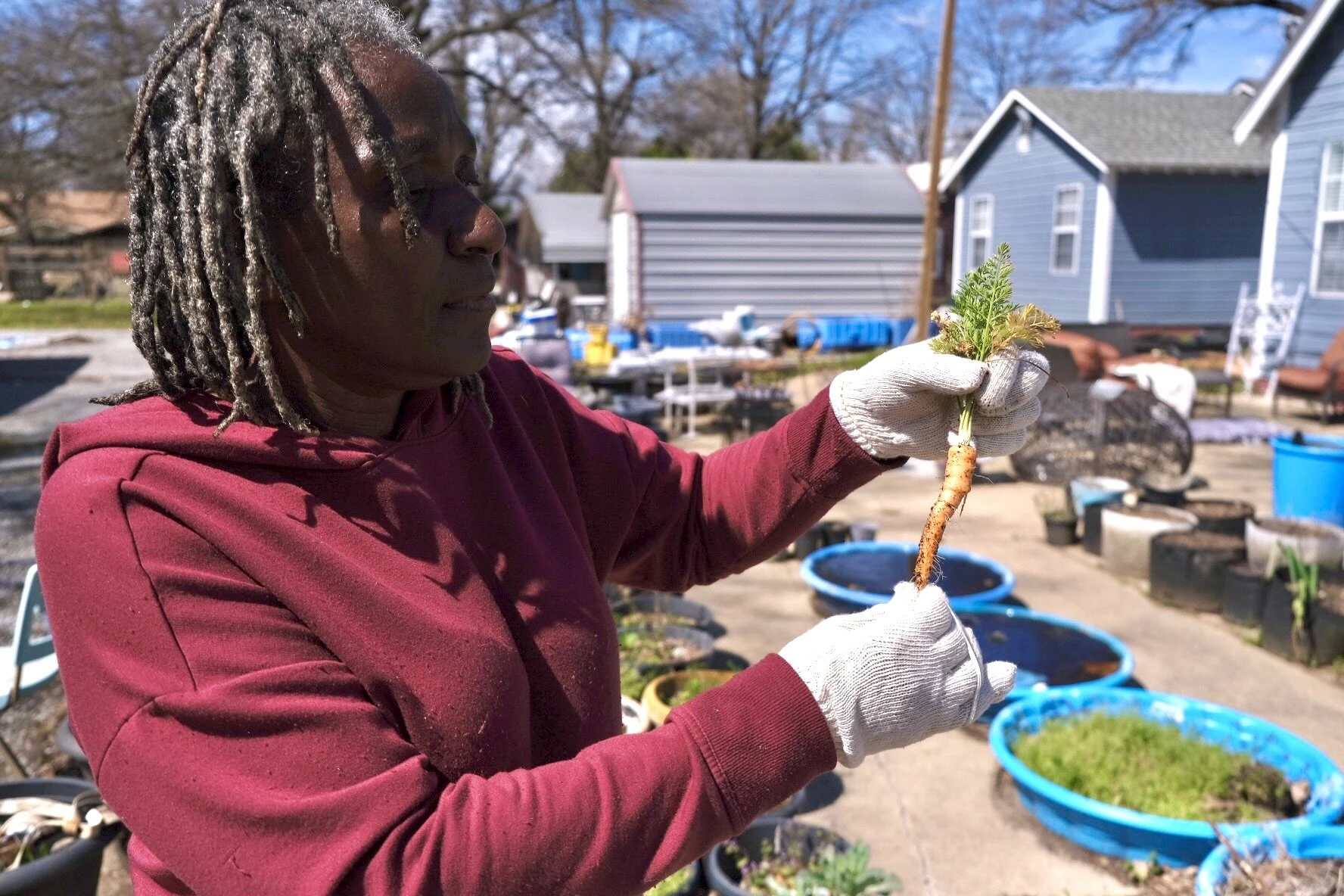
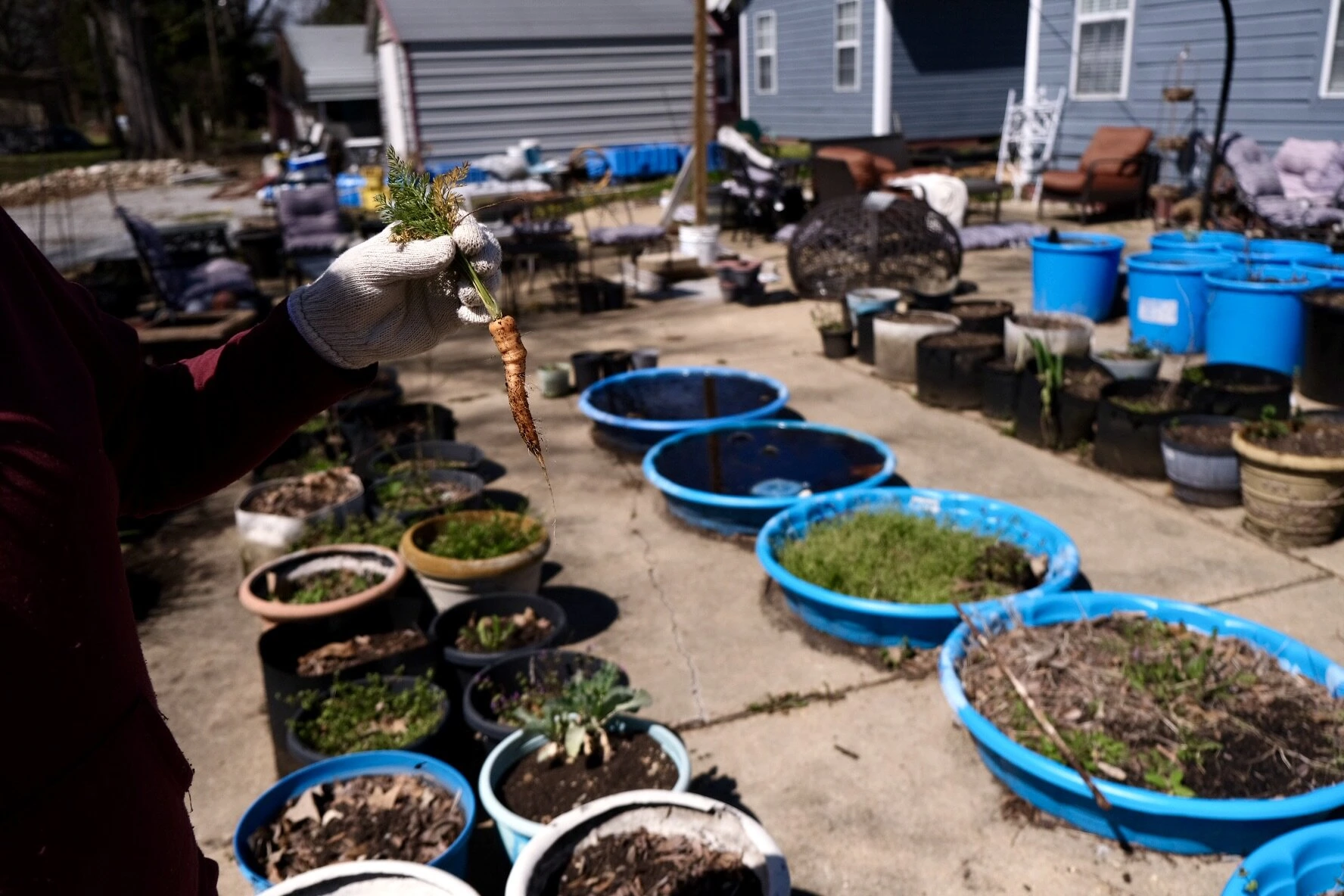
Dorothy Grady pulled at a tuft of green fronds sprouting from one of an array of soil-filled buckets sitting in the driveway of her house. A plump carrot, five inches long and brilliant orange, popped out.
Nearby, a sage shrub grew from another bucket, and scallions crowded a squat grow bag. In about three weeks, Grady would kick off the spring growing season on the land she cultivates around Shelby, Mississippi, including two plots at the now-closed middle school across the street, a small grove of peach and pear trees up the road, and five acres outside of town. She was ready to start planting eggplants, melons, tomatoes and a cornucopia of other produce that would soon end up in the homes of 127 nearby residents.
Shelby, a few miles east of the Mississippi River, is surrounded by flat, fertile farmland. But Grady’s vegetables and fruit are some of the only crops around that make it to local plates. The vast majority of Mississippi Delta farms are devoted to commodity crops like soy and corn.
Grady is one of almost a dozen local growers supplying produce to Delta GREENS, a collaborative research project that is delivering fresh ingredients to residents of Bolivar, Sunflower and Washington counties with diabetes and monitoring the health impacts. This “food is medicine” project is one of a number of initiatives that are supporting farmers and expanding the market for locally grown produce in this western Mississippi region. The benefits run in both directions: At the same time that community members are getting access to these nutritious ingredients, the small-scale farmers who grow them are getting a leg up.
“What we’re trying to do is build cooperative development amongst the farms,” says Julian Miller, founding director for the Reuben V. Anderson Institute for Social Justice in Jackson, a co-principal investigator for Delta GREENS, and a long-time local food advocate in the Delta region. “Ultimately, we want to be able to give them the capacity to scale and capture the broader market.”
The 200-mile-long Delta region, on the fertile floodplain sandwiched between the Mississippi and Yazoo rivers, has a rich agricultural history. Once known for growing cotton, today the area is dominated by ridged fields growing commodities that will be processed into animal feed or ethanol.
In the past, many Delta residents cultivated fruits and vegetables, says Miller, yet over time, pressures like farming mechanization and loss of land eroded the practice. Miller, a fifth-generation Delta resident who grew up a few miles away from Shelby, never saw anyone with a vegetable garden. “That tradition was lost, as far as growing your food,” he says.
Today, despite the abundance of fertile land, very little of it is dedicated to edible crops. About 90 percent of the food people eat in this region is grown elsewhere and imported. “That’s the irony,” Miller says.
And even imported fresh food can be hard to access. As of 2021, 63 of Mississippi’s 82 counties were classified as food deserts, meaning there is no grocery store or option to buy fresh ingredients in the immediate area.
Significant health and economic inequities overlay this region. In Bolivar, Sunflower and Washington counties — where the Delta GREENS study is focused — almost a third of residents live at or below the poverty level. Meanwhile, the rate of diabetes is twice the national average.
This confluence of public health disparities, economic inequity and lack of food sovereignty has fueled an effort to reestablish food-growing traditions, led by growers like Grady. A child of sharecroppers, Grady recalls her family always kept a garden when she was growing up, exchanging veggies and fruits with neighbors.
She has been involved with growing the local food movement in the Delta since the 1990s, when she first started working on farm-to-school garden projects.
In addition to helping establish hundreds of community gardens at schools and churches around the region, she’s also expanded her own growing operation, now supplying her harvests to residents in and around Bolivar County. Last year, the peach and pear trees she keeps yielded about 30 bushels of fruit, which went to local schools and was distributed through produce boxes for participants in the Delta GREENS study.
These weekly produce boxes are helping to address one of the structural challenges of developing the local food system in the Delta, explains Miller: the lack of a consistent market. While many residents are interested in eating more local produce, growers don’t have a reliable pathway to sell to the public. But nutrition- and food-security projects that source produce from local farmers are helping those agricultural businesses scale up.
About 40 miles northeast of Shelby, Robbie Pollard is busy planting and tending to more than 10 acres of fruit and vegetable plants.
Pollard grew up around farming — his grandfather grew commodity crops. But he says he didn’t know anything about cultivating food until he tried growing his own in his backyard. It turned out to be a calling, he says, and he soon left his job in IT to pursue it full time.
Farming fruits and vegetables is more complex than commodity crops, explains Pollard. For one, it’s more labor intensive — weeding, tending and harvesting by hand. Unlike commodity farmers, who deliver their crops directly to local co-ops, distribution is harder for fruits and vegetables, Pollard says: “We have to find our own markets.”
Pollard has found a range of ways to distribute his produce through his farm, Start 2 Finish, and his associated healthy foods initiative Happy Foods Project. Today, he is one of the main growers supplying for Delta GREENS, as well as similar projects that provide households with regular local food boxes, including another food prescription project, Northern Mississippi FoodRx, in conjunction with the University of Mississippi. This summer, he’ll also be distributing through a mobile market, and he recently started selling through a grocery store with a focus on local products that opened in the city of Clarksdale in May.
Produce prescription boxes have given him a way to steadily expand his farm by reinvesting each year in incremental upgrades. He’s progressed from doing all his work by hand, to having a tiller, then a small tractor. He’s now leasing 46 acres of cropland. Last year, he grew four acres. This season, he put in more than 10, with plans in the works to expand hydroponic and aquaponic capacity. Soon, he hopes to work with other local growers to try a range of different techniques across the acreage.
Tyler Yarbrough, Mississippi Delta project manager for the nationwide organization Partnership for a Healthier America, has worked alongside Pollard on a range of projects building out the region’s local food movement, including some that provide households with produce for a limited amount of time — like Good Food at Home, which has supplied about 500,000 servings of produce to local families through weekly boxes, each household eligible for 12 weeks at a time. Through these shorter-term projects, growers are able to take steps to become more stable, while building a demand for local produce among consumers.
“You can leverage it to bring on the consistency, and to further bring those markets into your orbit,” Yarbrough says.
While produce box models have yielded success, they have the most impact for farmers when they’re paired with other initiatives, according to Yarbrough. What’s key is to give growers flexibility with funding so they can build up over time.
“It can’t just be one thing,” Yarbrough says. “It needs to be coupled with funds for these farmers to actually build their capacity on their farm. It needs to be coupled with connecting all the dots with the market. It has to be a holistic approach.”
Within the Delta region, the local food movement still faces many barriers, according to Natalie Minton, a University of Mississippi researcher who is working with Pollard to study the local food market, and on North Mississippi Food Rx. Growers struggle to find — and afford — workers. And without a reliable market, growing their business is very difficult.
There are also environmental factors. Beyond extreme weather, like drought and severe storms, growers face challenges related to the dominant commodity cropland. Pesticides and chemicals routinely used on commodity crops drift, harming food crops.
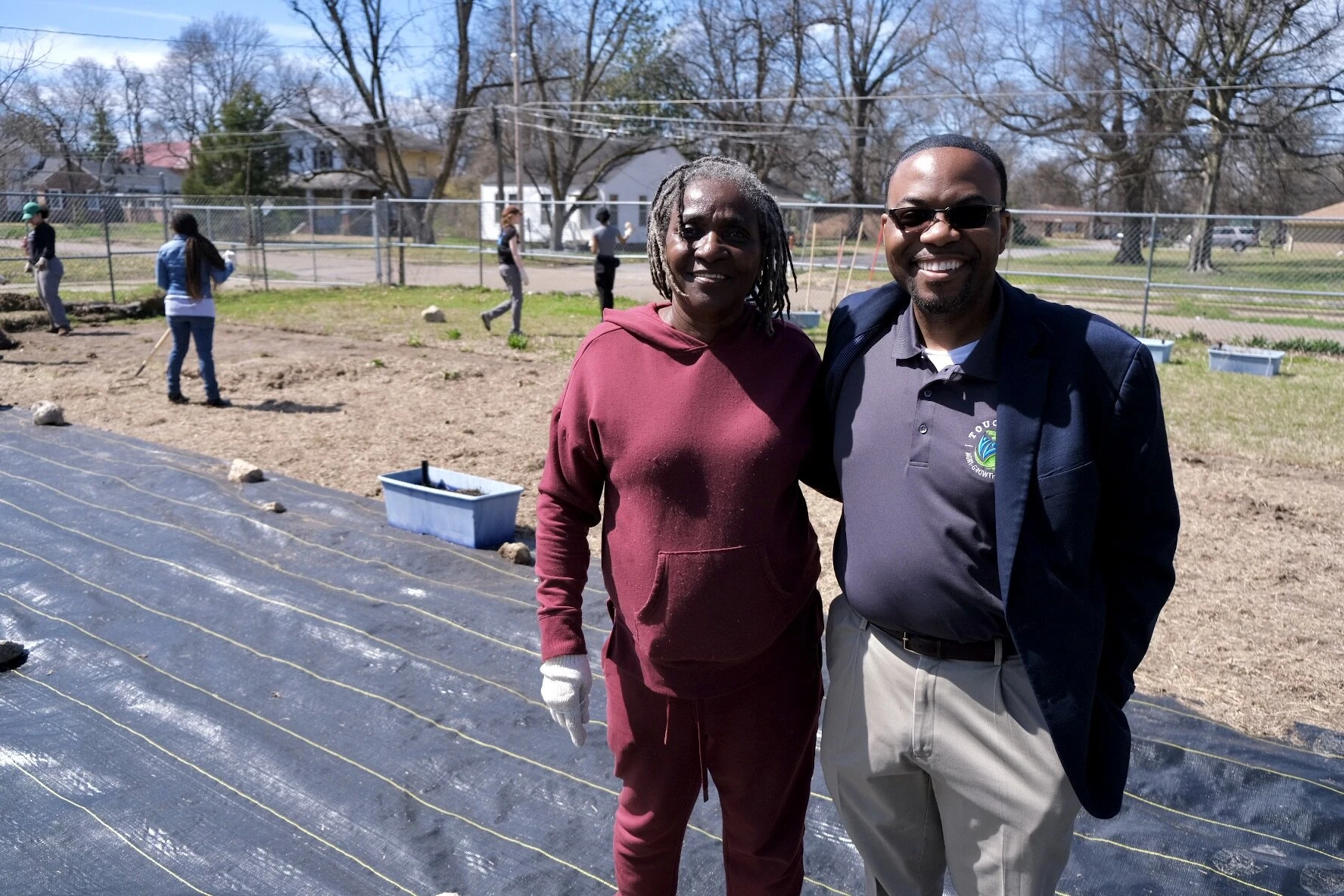
Yet, Minton says the roots of change in the local food system are taking hold. The success of farmers like Pollard is showing how specialty farming can be a viable career.
For projects that rely on grants and outside funding like Mississippi Fresh, another major challenge is working with federal programs, according to Miller. Trump administration cuts, including to subsidies that support buying from local producers, are straining local food systems. Delta GREENS is funded through the National Institutes of Health, and Miller says there is uncertainty around whether support will continue.
Despite the uncertainty, the local food movement in the Mississippi Delta is notable because it is so locally driven, says Marlene Manzo, of HEAL Food Alliance, a food justice coalition that works with groups across the country, including Mississippi Fresh. Manzo says that the growth of the local food supply within the Mississippi Delta shows the power of working at a small scale to make changes that really respond to the community.
“What we do know is building collective power within our communities and in regional systems can really make a large, lasting impact,” she says.
Grady sees a shift happening in the community. She knows more people, including her family members, who are starting to grow some of their own food. One former student is now a chef in a nearby school district. He’s keeping a garden and using the ingredients in the school kitchen.
“The interest of other people wanting to do this kind of work was the greatest reward of it all,” she says.
Elizabeth Hewitt is a freelance journalist based in the Netherlands. She's interested in how policy-making impacts lives, and likes to write about local solutions to big problems.
This article first appeared on Mississippi Today and is republished here under a Creative Commons Attribution-NoDerivatives 4.0 International License.

How George Wallace and Bull Connor Set the Stage for Alabama’s Sky-High Electric Rates
After his notorious stand in the schoolhouse door, Wallace needed a new target. He found it in Alabama Power.
By Dennis Pillion
December 26, 2025
This article originally appeared on Inside Climate News, a nonprofit, non-partisan news organization that covers climate, energy and the environment. Sign up for their newsletter here.
Wired for Profit: Second in a series about Alabama Power’s influence over electric rates, renewable energy, pollution and politics in the Yellowhammer State.
MONTGOMERY, Ala.—There’s a curious sight on the far-left wall of the Alabama Public Service Commission’s main hearing room.
Framed 8-by-10-inch photos of the previous commissioners dating back to 1881 line the wall. The photos are black and white. The commissioners are just white, but that’s not the strange part.
The strange part is that in the bottom left quadrant of the photo wall, directly above the most recent former commissioner, Twinkle Andress Cavanaugh, hangs the smiling mug of one of the most notorious faces in Alabama history.
Eugene “Bull” Connor, the former Birmingham police commissioner whose brutal suppression of civil rights demonstrations with police dogs and firehoses drew worldwide condemnation, stares back at the observer with his slicked-back white hair, horn-rimmed glasses and the slight vestige of a smile.
Connor, after his presence became an untenable black eye for the city of Birmingham, was shuffled off to Montgomery and the Alabama Public Service Commission, where he served as PSC president from 1965-1973.
Alabama’s civil rights history is inescapable, even in places most people wouldn’t expect. Their electric bills, for example.
George Wallace, the four-term governor who famously stood in the schoolhouse door in an attempt to prevent Black students from enrolling at the University of Alabama, was never on the commission, but may be as responsible as any single political figure for the state of Alabama’s electric regulation today.
That’s because throughout the 1970s, when crying “segregation forever” was no longer a viable political strategy, Wallace needed a new target for his brand of populist demagoguery. He found it in Alabama Power.
Wallace railed against what he called Alabama Power’s “exorbitant rates” for years, attempting to thwart or delay nearly every rate increase or construction project the company proposed. That campaign turned the state’s regulatory environment into a circus, pushed the state’s largest utility to the verge of bankruptcy and provoked a backlash that still clouds the ratemaking process
David Rountree worked at the PSC for 12 years in the 1990s, 2000s and 2010s, including stints as chief of staff or principal advisor for three different commissioners. Rountree said Wallace’s actions still reverberated through the PSC building decades later. Years before joining the PSC staff, Rountree had actually covered some of the hearings as a reporter for the Montgomery Advertiser newspaper.
“Those rate hearings were just a nightmare,” Rountree told Inside Climate News. “Nobody wanted to get sent over to have to cover a PSC rate hearing. It was like, ‘Can you just pull my fingernails out?’ And they would last for months on end.”
After years of Wallace’s chaotic attacks on the system, the PSC snapped back hard in the other direction. The commissioners attempted to create a system that would take political chaos out of utility ratemaking and prevent another George Wallace from hijacking the regulatory process. Rate increases were put on “autopilot,” Rountree said, going up automatically whenever Alabama Power’s earnings fell below a certain percentage.
The commission voted to approve the new system, called rate stabilization and equalization, or RSE, in 1982. That was the last time Alabama Power held a formal rate case that nearly all other states require. The RSE process did its job of averting contentious and costly rate cases, but there were serious side effects. One, according to environmentalists and public interest lawyers, has been a lack of transparency and almost any meaningful public participation.
The public rate cases that had become so toxic under Wallace had been eliminated, but those hearings served as the best method for the public to gain insight into how their power bills were calculated, and which utility decisions they were paying for. Now the public and advocate groups have to fight and claw for information that is public and easily accessible in other jurisdictions.
In a 2013 white paper titled “Public Utility Regulation without the Public,” the Institute for Energy Economics and Financial Analysis writes that Alabama’s RSE process “allows Alabama Power to adjust its charges each year without any public evidentiary hearings and, indeed, without any participation by ratepaying consumers whatsoever other than off-the-record and after-the-fact comments at an informal hearing that completely lacks public transparency.”
The paper states that only Louisiana and Mississippi have similar processes for utility regulation, but notes that those states have more “meaningful opportunities for public involvement.”
A spokesperson for Alabama Power told Inside Climate News that the RSE process still ensures oversight over the company, even if it differs from other states.
“Alabama’s Rate RSE framework provides continuous, formula-based oversight with monthly filings, annual PSC review, and automatic refunds or adjustments when earnings fall outside the approved range,” Alabama Power said. “Different structure does not equal lack of regulation.”
The Alabama Public Service Commission is in the process of completing its required review of Rate RSE that takes place every six years. It is not clear when the findings of that review will be made public.
“Following the review process engaged in by staff with representatives from Alabama Power and the Alabama Attorney General’s office, staff will consult with the Commission and provide an assessment of the effectiveness of Rate RSE and discuss any potential modifications deemed necessary,” a PSC spokesman said in an email. “The Commission will determine whether any further course or courses of action are necessary based on those consultations with staff. Any determination regarding the need for outside input will not be made until the Commission has made an assessment of the findings compiled by staff.”
Alabama Power went from the precipice of bankruptcy to being one of the most stable and profitable utilities in the country. But its customers shouldered the highest total electric bills in the country last year, according to an Inside Climate News analysis, and pay the highest electric rates in the Southeast.
Advocates who have criticized Alabama Power’s high returns point to the RSE process as a key reason that the company’s profits are so high.
Here’s how it happened.
George Wallace vs. the Power Company
To say Wallace was popular in Alabama through the 1960s and ‘70s is an enormous understatement. He was elected governor of Alabama four times from 1962 to 1982, bouncing in and out of the governorship as term limits allowed. He didn’t leave the governor’s office for good until 1987.
In 1966, the Alabama constitution did not allow governors to serve consecutive terms, blocking Wallace from seeking reelection. So Wallace’s wife, Lurleen Wallace, ran for governor in his stead, explicitly stating that her husband would stay in control. Her name appeared on the ballot as “Mrs. George C. Wallace,” and she won handily, winning the primary without a runoff and garnering 63 percent of the general election vote. Alabama would not elect another female governor until 2018.
Lurleen Wallace died of cancer 16 months into her term, casting the Wallaces temporarily out of the governor’s office. Doctors reportedly told Wallace of his wife’s cancer as early as 1961, but he insisted she not be told, delaying any possible treatment for years. She remained unaware of her condition until 1965, when a different doctor told her directly. Despite her condition, she handled a rigorous campaign schedule throughout 1966, but her health began to deteriorate shortly after taking office.
Lurleen Wallace died in 1968. That same year, Alabama voters approved a constitutional amendment to allow governors to serve two consecutive terms, setting the stage for George Wallace to run and win in 1970, 1974 and 1982.
In 1970, as Wallace campaigned to retake the governor’s office after his first interregnum, he campaigned against “banks and utilities and the rich on Wall Street who don’t pay their taxes,” former Newsweek columnist Stewart Alsop wrote at the time.
Alsop added that Wallace’s “attacks on the big newspapers, the banks, and the utilities account for that electric current in his shirt-sleeved crowds at least as much as the race issue.”
After his reelection, Wallace hired well-known attorney Maurice Bishop to formally intervene in the rate cases at the PSC. A handful of commissioners elected in the next several years had close ties to Wallace or at least shared his views on Alabama Power’s rates.
Meanwhile, Wallace held rallies and gave televised speeches criticizing the power company and called multiple special sessions of the legislature in unsuccessful attempts to give the governor’s office and/or the Alabama Supreme Court the power to directly overrule the PSC on electricity rates. Wallace was unwilling to compromise on any of those issues, which never advanced past the state Senate. He blamed Alabama Power for wielding “undue influence” over senators who balked at his proposals. Some of the senators pushed back.
“George Wallace had made a career out of raising emotional issues and demagoging his way into office,” state Sen. Joe Fine said, according to the Montgomery Advertiser. “First he used the race issue, black against white, but [now] that’s run out.”
In June 1976, the PSC rejected a rate increase request from Alabama Power, which the company’s president Joseph Farley called “shocking and dismaying.” The company appealed the PSC’s decision to the Montgomery County Circuit Court, which ordered the PSC to grant at least a partial increase. Alabama Power appealed that decision to the state Supreme Court.
The pattern would continue for several years, with rate cases bouncing between the PSC and the courts, and with Alabama Power repeatedly filing emergency rate cases before the courts had ruled on its previous rate increases.
People angry over their electric bills were bussed to PSC meetings from across the state. PSC hearings were moved to larger venues to accommodate the crowds.
Financial firm Standard and Poor’s dropped Alabama Power’s credit rating from A- to BBB. The company was forced to rely on high interest, short-term loans to stay afloat due to the long lag between rate increase decisions.
1977: “The Terrible Year”
In the book “Developed for the Service of Alabama,” a company history published by Alabama Power in 2006, historian Leah Rawls Atkins calls 1977 “the terrible year,” though 1978 and 1979 may have even been worse.
Skyrocketing prices caused by inflation and the oil embargo were creating huge costs for the company, and the clashes in Montgomery put the company on its most perilous financial footing since its early days of existence.
In January, an emergency rate case hearing was relocated to Montgomery’s Garrett Coliseum, where huge crowds packed the arena for what was, by most accounts, a circus.
Media reports at the time estimated the crowd ranging from 800 to 2,000 people, more or less evenly split between those who supported Alabama Power’s rate increases—power company employees, steelworkers, construction workers, economic development officials—and those who opposed the increases.
More than 50 witnesses testified, ranging from Alabama Power executives and expert witnesses to everyday Alabamians worried about their ability to pay higher bills in times of economic downturn and inflation.
Stewart B. Clifford, a senior vice president at Citibank, testified as a representative of a nine-bank syndicate that had granted Alabama Power $350 million in short-term loans over two years.
“None of them are willing, under present conditions, to extend any additional credit to Alabama Power,” Clifford said, according to The Birmingham News.
Meanwhile, numerous residents, many elderly, testified that they would not be able to pay their power bills if the increase were approved. So did construction workers who said they would be laid off if Alabama Power were not allowed to build the infrastructure it was planning.
One of the commissioners stated he believed the rate increase to be illegal because a previous rate increase was still awaiting judgment in the Alabama Supreme Court.
At one point in the two-day hearing, officials resorted to playing Simon and Garfunkel’s “Bridge Over Troubled Water” over the PA system to ease the tensions.
In the end, the PSC approved a smaller increase than the company asked for, but the struggles continued for the next two years.
In 1978, after Alabama Power reported a dramatic drop in earnings due to the newly constructed Joseph M. Farley nuclear power plant, the PSC approved an emergency rate increase to steady the ship in November, after that year’s elections. Wallace appealed and got a court to issue an injunction blocking the rate increase.
In December, the company filed a request for an emergency $288.8 million rate increase, saying its return on equity had fallen to a “disastrous” 4.5 percent.
According to Rawls’ book, Alabama Power responded by freezing officer salaries, cutting back construction projects and paying its bills only on an as-needed basis. The company sold five of its buildings with agreements to rent the spaces instead, freeing up cash, but losing out in the long run.
In January 1979, the Alabama Supreme Court denied Alabama Power’s motion to lift the injunction blocking its rate increase. The court found the PSC’s rate increases null and void and dismissed all appeals.
Rawls’ book quotes Alabama Power comptroller Jack Minor as saying the company had $45 million in unpaid bills and was unable to borrow money or sell stocks or bonds to cover them. He reported stacked invoices on his desk, not to be paid “until someone demands payment.”
The company put word out that it would remember which vendors were forgiving of its struggles, and which were not. Rawls says that there were some major suppliers that showed a “lack of support during this critical time,” and that Alabama Power “never did business with them again.”
Alan Martin, who held many executive positions in Alabama Power, including senior vice president, said executives in the company who experienced those times came out stronger for it.
“The enduring effect was positive,” Martin said in Rawls’ book. “Those who lived through those years were like the World War II generation. We were tougher. Our leadership has been real conservative, but when the company is criticized, we are quick to jump like a tiger to defend it.”
A Solution Emerges
By 1982, it was clear that the situation was untenable. Even Wallace and those in his administration conceded that something had to change.
Billy Joe Camp, Wallace’s former advisor and spokesman, had been elected PSC president, and he and the other commissioners implemented the rate stabilization and equalization system.
The goal of the system was to put utility ratemaking on autopilot, removing the possibility of messy rate case battles and political grandstanding that dominated the previous decade.
“At times the rate structure was used as a political football,” Camp said, according to the Associated Press. “I was part of that irresponsibility sometimes. We had to get to a new environment.”
An approved rate of return range was set for Alabama Power at 13 to 14.5 percent of the value of its common equity. Every December, if the company’s earnings for the coming year were projected to fall below that range, rates would go up automatically in January. If the company earned more in the course of the year than its allowed range, some of that money would be refunded to customers the next year.
The new system did not require a vote by the commission to increase rates, nor were there any public rate hearings or formal testimony from the utility on its revenue. In trying to stop political manipulation of the rate system, the PSC nearly removed the public from the process altogether, limiting the opportunities for public engagement or even understanding of the ratemaking process.
Instead, the PSC hosts informal hearings each year in December. The company presents its latest revenue figures for the year in progress and projections for the coming year, as well details about its environmental compliance plans for the next five years.
Company representatives answer questions from PSC staff, the attorney general’s office or members of the public, but they are not under oath as they would be in a formal rate case. The commissioners, if they attend, sit in the audience with everyone else. Proceedings are not streamed online, as regular PSC meetings are.
Christina Tidwell, a senior attorney for the Southern Environmental Law Center, attends the informal sessions on behalf of SELC clients, asking questions about Alabama Power’s profits, or issues like renewable energy adoption, coal ash cleanup plans, energy efficiency or electric vehicle charging programs offered by the company.
The one-day hearing typically lasts about four hours.
“The informal meetings held in December are the only opportunity for the public to ask Alabama Power questions about its environmental compliance costs or its profits,” Tidwell said in an email. “They are limited in scope—there is no discovery or opportunity to offer expert testimony and Alabama Power’s witnesses are not under oath. There is also no transcript of the meeting.
“It’s unclear to me what role these hearings play in overall utility regulation.”
High Interest Rates Preserved for Decades
One criticism of the RSE process is that utility return rates were locked in at 1982 rates for more than 40 years. And the early 1980s featured the highest interest rates since at least the 1950s thanks to inflation control measures taken by the Federal Reserve.
As Alabama Power demonstrated during its turbulent times in the 1970s, a utility company needs to earn returns higher than benchmark interest rates in order to attract investors to fund its operations and construction projects. If investors can get similar returns on government bonds, there’s little incentive to wade into the slightly riskier waters of utility companies, where politicians could scuttle or delay needed rate increases.
In 1981, the U.S. average interest rate spiked to 16.38 percent, dropping to 12.26 percent in 1982. But after 1982, interest rates dropped sharply for decades. This year, it is 4.21 percent after spending much of the past 20 years at near-zero levels in the wake of the 2008 economic crash and the COVID pandemic.
Utilities in other jurisdictions had to appear before state regulators periodically to justify their return rates, which dropped as well in many cases. Yet Alabama Power kept earning the same margins.
The only major change to the system occurred in 2013, when the PSC switched from using the industry-standard return on equity metric to evaluate Alabama Power’s profit margins to a novel weighted retail return metric developed for Alabama. The new metric gives Alabama Power additional incentives for having a higher percentage of equity as opposed to debt, a good thing when measuring financial health of the utility, but also made it harder to compare Alabama Power’s returns to other utilities.
By then, the 13 to 14.5 percent returns guaranteed by RSE were among the highest in the nation. After the adoption of the weighted return, Alabama Power’s return on equity remained around 13 percent through 2020, but has since dropped to around 11 percent.
Rountree, the former PSC employee who served as chief of staff to then-Commissioner Terry Dunn when the switch was made in 2013, said the change seemed mostly cosmetic, to deflect criticism over the high allowed returns.
By that time, Rountree said Dunn was being boxed out by the other commissioners, having advocated strongly for formal rate hearings that the other commissioners opposed.
“I crunched a lot of numbers back in the day when they were doing that, because I wanted to make sure that I understood it, and Commissioner Dunn wanted to make sure that we knew what they were doing,” Rountree said. “It looked to me like basically what they were trying to do was refashion the presentation of the numbers so that they look more benign.”
Dunn was the lone PSC commissioner to oppose the change to weighted returns, as he had been the only commissioner criticizing Alabama Power’s high return rates. Dunn lost the Republican primary the next year, after what he called a “smear campaign” linking him to national environmental groups and criticism from other Republicans.
Alabama Power’s return on equity, based on figures included in its federal Securities and Exchange Commission filings, remained above 13 percent through 2020, falling to around 11 percent after that. It is on track to earn about 11.1 percent this year, per filings with the PSC.
Last year’s nationwide average return on equity for an electric utility approved by state regulators was 9.74 percent, according to S&P Global.
Those handful of percentage points can add up. The Energy and Policy Institute, a nonprofit advocacy group, calculated in 2020 that from 2014 through 2018, Alabama Power earned over $1 billion more in profit than it would have if it earned industry-average returns.
The group found that Alabama Power’s profits over those five years totaled $4.26 billion at around a 13 percent return on equity. The group estimates that at industry average rates of return 9.75 percent, Alabama Power would have earned $3.24 billion.
Alabama Power is projected to earn $1.56 billion in profit this year, according to its filings.
The utility agreed to a two-year rate freeze this year with the PSC, intended to avoid increases through 2027, as concerns mount about high rates and the potential need for new generation to accommodate hyperscale data center projects that are currently being planned in Alabama.
U.S. Sen. Katie Britt has, on multiple occasions, said that Alabama Power has the “highest rates in the Southeast,” and called the situation “unacceptable.”
Alabama Power and the PSC have said that any data center customers will pay the “full and fair costs” of their operations, including any new infrastructure that is required. Specific details of those contracts however will likely not be made publicly available.
Rountree said he believes it is vital that utilities be allowed to earn a fair return on their investments.
“In utility regulation, you’re trying to have your public utilities do the job they’re supposed to do as best they can, and as efficiently as they can,” Rountree said. “It’s very important to make sure that you don’t starve them to death, that they have the wherewithal to do it well.”
Rountree credits Alabama Power for being a “first-rate utility” and for helping recruit major industries like Mercedes-Benz and Hyundai to build facilities in Alabama. But he also believes the returns are too much.
“Perhaps in the earlier years, giving Alabama Power that extra boost of return to build itself into a well-operating, good utility, maybe there was some wisdom there,” Rountree said. “But by God, I think it’s unfair, and I think it should be less than it is, the allowed rate of return.”
Culture of fear in places of learning. Faculty at NC colleges report anxiety over threats to academic freedom.
by Kate Denning, Carolina Public Press
December 19, 2025
At a recent Faculty Assembly meeting, a body of delegates from each of the 17 UNC System institutions, Wade Maki, chair of the assembly and UNC-Greensboro professor, asked its members to raise their hand if they had colleagues who were afraid of losing their job because of something they said in the classroom. Every delegate raised their hand, acknowledging concerns about academic freedom.
He asked them again to raise their hand if they had colleagues who were afraid of losing their job because of something they posted on their private social media accounts. Again, every delegate raised their hand.
[Subscribe for FREE to Carolina Public Press’ Daily, Weekend and Election 2026 newsletters.]
“I can’t think of anything that better expresses the climate that we are in,” Maki said.
North Carolina has narrowly avoided being in the spotlight alongside the slew of universities to fire faculty over speech both in and out of the classroom. But just because it hasn’t happened yet doesn’t mean that academics feel entirely safe from the national phenomenon. Some say the anticipation is creating a culture of fear and self-censorship among faculty in the classroom and when interacting with the media.
'Aggression' toward academic freedom
Todd Berliner is the president of the recently revived American Association of University Professors UNC-Wilmington chapter. He and the eight others on the executive committee resurrected the chapter because of the “unprecedented aggression toward faculty and toward academic freedom that has erupted” in the last year, though it’s really been happening for nearly a decade, he told Carolina Public Press.
What were once commonly shared values in academia like shared governance and academic freedom have become politicized and challenged, Berliner said.
Several high-profile firings occurred this year due to professors speaking on issues related to gender identity — one at Texas A&M after a gender and sexuality lesson in a literature class and another at the University of Oklahoma after a psychology professor gave a student a failing grade on an assignment that cited the Bible to disagree with the notion that there are more than two genders. Both raised concerns about the state of academic freedom in higher education.
In September, an associate professor — a rank that typically indicates academics have obtained tenure at their institutions — at a small private North Carolina college declined an interview request from CPP because the person did “not feel it is safe to even report on academic/scientific expertise, as that is now often attacked, and professors are now being reprimanded/fired for taking such a stance.”
Instances like these indicate a newly aggressive climate toward the mission of academia and the open exchange of ideas, Berliner said.
“When faculty feel threatened and when this kind of aggression is directed toward faculty, we can’t do our best work, and we need to be able to think freely and expose ourselves and our students to whatever ideas are pertinent to the issues of the day and to history in order to gain understanding,” he said.
Aside from disagreements over course material, public statements on current events and other outside political activity have also resulted in retribution for academics. As many as 40 faculty members were fired this year over comments related to the assassination of firebrand conservative activist Charlie Kirk, the national branch of the American Association of University Professors told The Guardian in October.
North Carolina had just one documented firing of a part-time instructor at Guilford Technical Community College who was fired for statements she made in class on Kirk’s death, though multiple K-12 teachers were placed on leave and fired for similar social media posts.
UNC-Chapel Hill placed Asian and Middle Eastern Studies professor Dwayne Dixon on administrative leave in October to investigate his former involvement with an “anti-racist, anti-fascist, community defense formation” known as Redneck Revolt after Fox News published an article linking Dixon to the group, though the organization dissolved in 2019. The university reinstated Dixon after it conducted a “thorough threat assessment” and the ACLU of North Carolina published a letter stating it would pursue legal action on Dixon’s behalf.
Berliner has observed self-censorship happening among his colleagues at UNCW, particularly untenured professors and professors who are not naturalized U.S. citizens, meaning those that are in the country legally but are not citizens. He said while he and others of course comply with the directives they receive from their institutions and the government, self-censorship is a form of overcompliance that should be avoided.
“They are very worried, and they are being exceedingly careful, more careful than they should be, in order not to antagonize or present knowledge that is contrary to government-approved knowledge,” he said.
“This is how authoritarian control of education thrives, because it’s very hard to censor people. For a government to censor people, it takes a huge apparatus. But if the strategy is the threat that you will be censored and the threat that you would lose your job or not get tenure or be deported, then the government doesn’t have to do the dirty work of censorship anymore, because the faculty are doing that work for the government.”
Limiting free speech
Some universities, including private colleges, are beginning to say the quiet part out loud.
Duke University sent an email in August to its Sanford School of Public Policy faculty directing them to route any media inquiries regarding “overarching issues confronting the University” to Vice President for Communications, Marketing and Public Affairs Frank Tramble, but encouraged them to continue speaking with the news media about matters pertaining to their research, as reported by Duke’s student newspaper, The Chronicle, last month.

Aside from the email to Sanford faculty, “Faculty in a few other departments received similar encouragements to route communications to central channels,” The Chronicle reported.
Even if universities openly encourage their faculty to exercise academic freedom in sharing their research but caution against responding to news media inquiries on issues facing higher education at-large, that can create a culture of fear that results in self-censorship, said Dominic Coletti of the Foundation for Individual Rights and Expression.
“If a person of authority is saying you should think twice about talking about this topic or that topic, that’s going to make it more difficult and make it less likely that anyone is going to talk about this topic or that topic, even if the person in authority says, ‘Look, we’re not trying to censor you. We’re not going to punish you for it,’” he said.
“The thought that you may face disapproval, you may face some kind of backlash from somebody who has power over you, even if that’s not explicitly threatened, is going to make you second guess whether or not you should say something, regardless of how valuable your opinion or your additional context might be to the discourse surrounding a particular situation.”
It also suggests that not all speech is good speech and speaking on broader issues like DEI practices in higher education, for example, could bring scrutiny to your own university and constrain its academic freedom.
“Because you are going to think about what is the government saying, what are the people who have power over me saying and how could the things that I’m saying lead to consequences, not just for me, but for the institution or for other people that I work with,” he said.
“Once you start thinking that way, that really does lead to an increase in self-censorship.”
Some academic areas are also more likely to be impacted by such restrictions, Coletti said, as is exhibited by Duke’s message being sent primarily to its public policy faculty.

“While the university said you can continue to talk about your research, what is a political science professor who talks about the ways that government shapes academia supposed to do?” Coletti said.
“Obviously that person is going to be an expert on the exact sort of thing that is affecting Duke University right now. It creates a culture of fear for professors to talk about their research, but it also creates an environment where you’re less likely to have open and honest conversations about the reality that you’re living in.”
“Duke has sound principles on academic freedom that are developed and overseen by our faculty, and we will always protect and support their ability to speak on behalf of their work,” a Duke spokesperson told CPP.
Maki and Berliner both made the distinction that Duke’s directive seemed to restrain faculty’s freedom of speech while still trying to protect their academic freedom, but Coletti said they are two sides of the same coin that is the broader freedom of expression.
The question of what is the difference between the two is one that Maki and other UNC System faculty are confronting by attempting to define what exactly “academic freedom” means to the System. There’s currently no definition in the policy manual aside from assertions that academic freedom is a bedrock value and faculty have it so long as they are using it responsibly — a key word to note, Maki said — and that they won’t be subject to unreasonable restrictions.
“Lawyers love both of those words, because they’re very flexible,” he said. “And of course, in the absence of clarity, it is the people in positions of power that have the advantage.”
The Faculty Assembly passed a resolution in October that seeks to create a standard definition which will not only draw clearer guidelines for where faculty are protected in their speech but also where they are not. The Board of Governors could consider the proposal as early as January.
“Fear is real,” Maki said. “The fear is real. Faculty all over the country are very cautious about what they say because of the potential of drawing — whether it’s state or federal or just a general local public — heat on the institution. And that’s not just in what they say, that includes research.”
“That's not helpful for anyone, right? And that’s why academic freedom work is so important. We have to be able to say, as experts following the policies and laws, we need the protection to be able to do that. Otherwise, the students aren’t getting the classroom instruction at the level they should, and the public isn’t getting the benefits of research that faculty produce.”
This article first appeared on Carolina Public Press and is republished here under a Creative Commons Attribution-NoDerivatives 4.0 International License.

Louisiana public health worker and leadership program recruiting new cohort
by Madhri Yehiya, Verite News New Orleans
December 24, 2025
Victoria Coy believes anti-abortion advocates would be “appalled” if they knew the state of maternal health care in Louisiana.
“Legal attacks on women's health care have resulted in a world where you can't get pre-natal visits, you can't get basic OB-GYN care, and I think that the voters in Louisiana don't want that,” she said.
After Louisiana’s near-total abortion ban passed in August 2022, hospitals, obstetricians and gynecologists increasingly delayed providing critical prenatal care until the twelfth week of pregnancy — after which miscarriage is less common — and have hesitated to diagnose miscarriages for fear of investigation by the Louisiana Department of Health or state law enforcement agencies.
As executive director of the Louisiana Coalition for Reproductive Freedom, Coy launched a program called Legacy Trust in 2024 and is now recruiting for the second cohort of “future reproductive justice leaders.” Topics will include digital security, community organizing and — new this year — reproductive health care.
Coy said the program will bring together 20 to 30 participants for six months of training followed by a two-year service commitment on the board of organizations LCRF is partnered with, such as the American Civil Liberties Union of Louisiana and the Louisiana Public Health Institute. Graduates also have the option to start their own organization or continue serving on a board if they were already part of one.
Coy, a native of St. Tammany Parish, told Verite News she has 20 years of experience in progressive movements across the South, including gun violence prevention and criminal justice reform, and that her grandmother worked for Planned Parenthood in the 1970s.
The program was named in honor of the legacy of the work done by previous generations of reproductive rights activists in Louisiana, she said. She added that it felt especially important to do so after the 2022 overturning of Roe v. Wade caused a loss of morale to the movement.
She is incorporating public health training this year in part because of the worsening state of reproductive health care in the state. Participants will be instructed on basic prenatal care, blood pressure testing and common breast cancer and STI symptoms. Legacy Trust graduates won’t perform clinical care as they are not licensed medical professionals, but they will be armed with public health information that can be shared within communities for people to better understand their own health.
“We will be training these folks to go back into their communities to be able to provide basic health care that is missing right now, because well over a third of Louisiana parishes have no OB-GYN of any kind,” she said.
Coy said it was important to note that Legacy Trust graduates will not be performing physical exams, but rather serving as educators on common maternal and reproductive health issues.
Louisiana consistently has one of the highest rates of maternal and infant mortality in the country, according to March of Dimes. A number of rural hospitals in the state are at risk of closing as a result of federal budget cuts made earlier this year. The closure of Louisiana’s Planned Parenthood’s health clinics — which also ran a community health ambassador program — in September marked another blow to the state’s health care services.
“Planned Parenthood was so much a heart and soul of the movement that we're really feeling the loss to the morale,” Coy said. “We recognize that that loss just leaves a huge hole that no one person or organization can fill.”
Former Planned Parenthood clinicians opened up The Clinic NOLA in New Orleans last month in order to help fill the gap in reproductive healthcare left by Planned Parenthood’s closure. Coy said she is thrilled that former Planned Parenthood staff are staying in the community to continue their work.
Coy added that if the state prioritized providing quality women’s healthcare, Legacy Trust would not be necessary.
“This program shouldn’t exist,” she said. “We shouldn't be having to take it upon community members to be teaching folks. … But it is the only solution in a state that has otherwise abandoned health care and just let those folks in rural communities fall to the bottom.”
A unique support system
Victoria Williams, a maternal health advocate and retired doula, participated in the pilot program last year. She said she left with a clearer view of the state of women’s health care across the state.
“That training actually created this statewide lens of understanding of where other people were and understanding their challenges across the state,” she said.
Williams continued her work as a member and owner of the Birthmark Doula Collective following graduation from the program. She said one memorable training covered “impromptu speaking” for when faced with unexpected dialogue on reproductive rights.
“You never know when there’s going to be a camera somewhere,” she said. “Being able to make sure that you have your elevator pitch, make sure that you are saying things that you believe in and not allowing other people to coerce your words — it was just such a wealth of information.”
Sadi Summerlin, founder of ProChoice With Heart - Gulf Coast, also participated in last year’s program. She said Legacy Trust gave her a community of reproductive health advocates to lean on that she did not have previously.
“Having almost like a support system of people within the movement that I know that I can turn to … to ask for help, or even just to say, ‘I'm having a really hard time right now,’ and be heard. That's huge,” she said.
Summerlin said the program also gave her the skills to expand work within her own advocacy work.
“I have four committees that have at least two people seated on those committees and a handful of volunteers. I have a regular book club that meets every two weeks that is focused on reproductive justice as a whole picture,” she said. “None of that would have been possible without having the incredible education that I received through Legacy Trust.”
Applications for the next Legacy Trust cohort close on Jan. 31, 2026. Applicants will be selected in early February and the program’s first in-person meeting will be on Feb. 20. Coy said although the program cannot fully make up for the loss of Planned Parenthood or the severe lack of reproductive and sexual health care across the state, Legacy Trust can do its best to help fill in the gap.
“It's hurting women, it's hurting moms. It's hurting rural communities even more,” she said. “It's not perfect. We would prefer to have doctors straight up, but we don't, and we're not going to for a while.”
This article first appeared on Verite News New Orleans and is republished here under a Creative Commons Attribution-NoDerivatives 4.0 International License.

Oklahoma’s ban on Chinese-owned farmland made an exception for Smithfield Foods
by Juan Vassallo, Investigate Midwest
December 8, 2025
This story was produced in partnership with ArtDesk, published by the Kirkpatrick Foundation. The Kirkpatrick Foundation is also a donor to Investigate Midwest.
Oklahoma lawmakers have passed measures limiting foreign ownership of farmland in response to concerns about Chinese nationals and companies buying agricultural land in the state.
While approximately 4.3% of Oklahoma farmland is foreign-owned, according to the USDA’s most recent filings, most of that is held by Canadian and European companies for renewable energy projects. Less than 1% of that share is Chinese.
Still, anti-China rhetoric has largely driven legislation, and a recent poll shows Republicans nationwide are concerned about Chinese ownership of U.S. farmland. Despite that concern, this new state legislation includes exemptions for Chinese-owned food supply companies.
The carve-outs specifically exempt Smithfield Foods, the only Chinese-owned company with farmland in Oklahoma. Smithfield Foods, owned by China’s WH Group, is not affected by the restrictions and continues to raise hogs on roughly 2,575 acres in northwest Oklahoma.
Oklahoma’s restrictions mirror a broader national movement in mostly Republican states to curb foreign farmland ownership, driven by security concerns over countries the government deems “hostile.” Yet, unlike states such as Arkansas, Oklahoma lawmakers have shown little interest in forcing Chinese-owned companies already operating in the state to divest or limit their ability to expand.
In 2023, Arkansas Attorney General Tim Griffin ordered the agri-chemical firm Syngenta, owned by the Chinese conglomerate ChemChina, to sell its 160-acre research site and fined the company $280,000. The move followed a new state law restricting foreign investments from certain countries.

Arkansas Gov. Sarah Huckabee Sanders touted the decision during a press conference announcing the Trump Administration’s National Farm Security Action Plan, a twelve-page outline aimed at “addressing the imperative for agriculture security in America.”
“I’m so proud of the fact that Arkansas was the first state in the country to kick a Chinese-owned company off of our farmland and out of our state,” Sanders said at the press conference in July. “And we made them pay for it. Very Trump-esque.”
During the same press conference, Trump trade adviser Peter Navarro brought up Smithfield Foods, noting that after its purchase by the WH Group, it “now basically controls an eighth of the world’s pork supply.” Counties where Smithfield operates in Oklahoma — Beaver, Harper, and Ellis — are even highlighted on a map included in Trump’s plan. Neither the plan nor those involved in its rollout specified any steps they might take to force Smithfield to divest.

Help us do more reporting like this.
You’re reading an investigation that traces how political rhetoric about China diverges from the facts on the ground, and how lobbying and selective enforcement shape who is targeted and who retains control of Oklahoma farmland.
Your NewsMatch donation helps us continue reporting that gives communities the information they need to stay informed and prepared.
The Smithfield exception
Oklahoma Senate Bill 212 expanded existing restrictions on foreign ownership of farmland.
The law, which took effect in November 2023 — around the same time Arkansas ordered Syngenta to divest — could have impacted Smithfield Foods’ operations in Oklahoma. But the following year, lawmakers added an exception: landownership restrictions do not apply to foreign companies that have an agreement with the Committee on Foreign Investment in the U.S. (CFIUS).
CFIUS is an interagency committee that reviews foreign investments in American companies and real estate to see if they pose national security risks. It can approve, block, or require changes to deals to protect U.S. interests.

WH Group’s 2013 acquisition of Smithfield was cleared by CFIUS, effectively shielding it from Oklahoma’s foreign ownership restrictions.
“We’re honoring the Constitution by those international corporations being vetted by the federal government,” says Oklahoma State Sen. Brent Howard, a Republican from Altus who introduced the legislation that shielded Smithfield.
Smithfield Foods has repeatedly rejected claims of “infiltration” of the U.S. pork industry by the Chinese Communist Party, emphasizing that it is managed by American executives. “We currently own approximately 85,000 acres of farmland [in the U.S.], and that number has declined considerably since the 2013 WH Group acquisition,” says Ray Atkinson, a senior director at Smithfield Foods. “The farmland we own does not present a national security risk and represents less than 1/100th of one percent of all American farmland.”
Enforcement remains selective
During a September hearing at the Oklahoma State Capitol, a handful of lawmakers and state officials convened to discuss the perceived threat of the Chinese Communist Party in the state. Guest speakers at the hearing included Jan Jekielek, a journalist and editor for the far-right media outlet The Epoch Times, and Tom Rawlings, policy director of State Shield — both outspoken anti-China organizations.
Although the guest speakers provided no concrete examples of Chinese interference in state politics, they advocated for a state-level Foreign Agents Registration Act, which would require anyone acting on behalf of foreign governments to disclose their ties.
During his presentation, Brad Clark, general counsel with the Oklahoma attorney general’s office, turned the discussion to farmland. Clark explained how the new laws can bolster the state’s crackdown on illegal marijuana operations, some of which are run by Chinese individuals.

After Oklahoma legalized medical marijuana in 2018, the industry has drawn an influx of out-of-state growers. Alongside that growth, there have been reports of labor exploitation and illegally operated farms, including some linked to Chinese organized crime.
Clark says the attorney general’s office currently has 150 pending cases involving illegal marijuana farms. But in an interview with Investigate Midwest, he did not specify if any of those cases involve Chinese nationals or illegally owned farmland, citing the ongoing nature of the investigations.
The office says it has no closed cases related to illicit land use.
Absent from the discussion was Smithfield Foods, the only Chinese-owned company that has lobbied state officials nationwide while also owning farmland in Oklahoma.
In 2024 and 2025, Smithfield spent at least $1.58 million on lobbying and more than $90,000 in political contributions during the 2024 election cycle. The company is represented on the board of the Oklahoma Pork Council, a trade group with registered lobbyists.
During the hearing, Howard asked Clark whether SB 212 has forced any foreign companies in Oklahoma to divest.
“We received questions early on from corporations on mergers and acquisitions as they were going through those processes and came to the realization that SB 212 was taking effect soon,” Clark said, in response. “[They] needed to restructure that merger, that acquisition, so it’s highly likely that [divestment] has been involved.”
The attorney general’s office declined to answer Investigate Midwest’s questions about which corporations altered or abandoned their merger or acquisition plans, or answer specific questions about Smithfield Foods and potential divestment.
“The attorney general is against and will fight any individual or entity that exploits Oklahoma jobs to foreign nationalists or others who are not Oklahomans,” Clark says. “And that would certainly include foreign adversaries like China.”
Clark also noted that no one from the Trump administration has yet reached out to the attorney general’s office to work on the National Farm Security Action Plan, the administration’s report that highlights the counties where Smithfield Foods operates in the state.
Oklahoma Gov. Kevin Stitt and other Republican members of the state’s congressional delegation have been vocal about what they see as the threat from China and the need to restrict foreign ownership of farmland. Last year, Stitt issued an executive order aimed at reducing Oklahoma’s exposure to the Chinese Communist Party.

On the federal level, Sen. James Lankford of Oklahoma introduced the bipartisan Security and Oversight of International Landholdings (SOIL) Act of 2025, calling for mandatory CFIUS review of foreign agricultural land purchases. Oklahoma U.S. Rep. Frank Lucas introduced the Agricultural Risk Review Act of 2025, which would make the secretary of agriculture a permanent member of CFIUS.
Stitt’s executive order, which directs the state’s retirement system to divest from foreign adversary countries like China, makes no mention of Smithfield Foods and potential divestment, and the bills introduced by Lankford and Lucas earlier this year are pending in Congress.
Stitt, Lankford, and Lucas did not respond to requests for comment.
Although Trump’s National Farm Security Action Plan emphasizes protecting the country’s farmland, it also calls for efforts to “strengthen domestic agricultural productivity.”
Smithfield Foods controls an estimated 23% of the U.S. pork market, while JBS, a Brazilian conglomerate, holds a similar share of the U.S. beef supply—a fact that was pointed out by Kansas senator Roger Marshall during the plan’s launch.

Both JBS and Smithfield went public this year, a move that could help them expand operations and further solidify their presence in the U.S. food system.
Despite introducing legislation across the country to restrict foreign ownership of farmland, lawmakers do not appear motivated to target companies like JBS or Smithfield, or to bring more of the food supply chain under domestic control.
A study from Michigan State University analyzed 143 bills aimed at restricting foreign ownership of agricultural land, introduced across 34 states, along with the actions of more than 6,700 state legislators. Despite China’s nominal makeup of total farmland in the state and across the country, the researchers found that fear and skepticism about Chinese influence in the US is what continues to drive the legislation.
“Of all the farmland that’s owned by foreigners, Chinese entities have a stake in less than 1% of that,” says Dr. David Ortega, a professor of food economics and policy at Michigan State University and one of the study’s authors. “We are targeting interests from specific countries that can lead to rises in xenophobia and discrimination.”
This article first appeared on Investigate Midwest and is republished here under a Creative Commons Attribution-NoDerivatives 4.0 International License.

Three districts, one county: Some context on education in Lexington, Thomasville, and Davidson County
by Brent Ducharme, EdNC.org | November 13, 2015
Recently, EdNC posted two articles celebrating the effort that local educators and elected officials are making in Lexington City Schools and Davidson County Schools. While those articles focused on the important work that is being done in two school districts, any discussion of education in Davidson County should begin with some important context; specifically, that the county’s student population of approximately 25,000 is divided among three racially and socio-economically disparate school districts.
In North Carolina, just four counties maintain a system of three separate school districts. Although multiple districts in a single county could theoretically sustain diverse schools and efficient and equitable educational resources, this is too often not the case. As the UNC Center for Civil Rights noted in its 2014 report, The State of Exclusion: Davidson County, NC, Davidson County’s three separate school districts are unfortunately marked by significant racial segregation and disparities in academic achievement.
In 2013, researchers from Duke University found that Davidson County was home to the second most segregated schools in the state, behind only Halifax, another county with three racially segregated school districts.1 As that same study concluded, “counties with multiple districts are particularly susceptible to imbalance, because racially disparate districts make some racial imbalance impossible to avoid.”2 During the 2014-2015 school year, there were 25,153 students attending the three districts across Davidson County. Lexington City Schools served just 3,044 of these students. Lexington City’s student population was 33.2 percent Latino, 30.1 percent African American, and 25.6 percent white. Thomasville City Schools served an even smaller student population, at just 2,392. Again, a majority of students in the district were non-white—30.4 percent Latino, 37.8 percent African American, and 24.4 percent white. In staggering contrast, Davidson County Schools served 19,717 students in 2014-2015, 85.3 percent of them white, 3.4 percent African American, and 7.6 percent Latino.
Taken together, Lexington City Schools and Thomasville City Schools served just 21.6 percent of all public school students in Davidson County last year. However, 73 percent of the county’s African American students and 53.8 percent of its Latino students attended these two city school districts.
This racial segregation is exacerbated by the fact that the Lexington and Thomasville city school district boundaries do not match up with municipal boundaries. In some areas of south Lexington, where the African-American population is smaller than in the city’s center, schoolchildren attend Davidson County Schools rather than Lexington City Schools.
Meanwhile, the city school district extends to serve some communities with higher non-white populations outside the city limits, to the north and west of Lexington. In Thomasville, the city school district is significantly smaller than the town itself. Thomasville City Schools serves the town center, where African-American and Latino populations are higher, but does not extend to areas in the northern and southern portions of the town where residents are predominantly white. While this is partially attributable to the fact that the school district has not expanded along with the town itself, the school district lines have also been altered to increase racial segregation. In 1955, the North Carolina General Assembly voted to allow Davidson County Schools to transfer two majority African American schools to the Thomasville city district,3 further entrenching the racial segregation that exists to this day.
The racial segregation of schools in Davidson County is accompanied by economic isolation as well. During the 2013-2014 school year, 88.2 percent of Lexington City students and 91.9 percent of Thomasville City students were eligible for free and reduced lunch (FRL). In 2014- 2015, all schools in the Thomasville City district took part in the U.S. Department of Agriculture’s Community Eligibility Provision, a program that grants school-level FRL eligibility to schools serving high-poverty attendance zones, in lieu of individual students filing FRL applications. In both of the past two school years, only 48 percent of students in the Davidson County Schools system have been FRL eligible.
The stark racial segregation and economic isolation of students in Davidson County’s three school districts is matched by deep academic achievement disparities. During the 2014- 2015 school year, Davidson County Schools saw 58.7 percent of its students pass their End-of-Grade (EOG) exams, outpacing the statewide average of 56.3 percent. The city school districts did not fare as well. 48.3 percent of students passed their EOGs in Lexington City Schools, while just 44 percent passed in Thomasville City Schools. As students struggle in the city school districts, many teachers are leaving. Data from 2014-2015 shows that Lexington City Schools had the seventh highest teacher turnover rate in the state, at 24.7 percent, while Thomasville City Schools had the eleventh highest, at 21.4 percent. The 9.3 percent teacher turnover rate in Davidson County Schools was twelfth lowest in the state.
Racial segregation and uneven academic achievement persist in schools across Davidson County, even as the Lexington City and Thomasville City districts continue to spend significant funds on education. While Davidson County Schools had the lowest per-pupil expenditure in the state during the 2013-2014 school year, Lexington City Schools’ per-pupil expenditure of $9,628.13 was 34th in the state. Thomasville City Schools had an even higher per-pupil expenditure of $9,960.30 (good for 27th in the state). It is critical however, to disaggregate these numbers. Both city school districts were near the middle of the pack in state and local funding, but were among the top fifteen in the state in federal education allocations. Thomasville City Schools was behind only Halifax County Public Schools and Washington County Schools in the amount of federal dollars received per pupil, a direct reflection of the concentrations of low-wealth students these districts serve.
As the U.S. Department of Education observed in its Guidance on the Voluntary Use of Race to Achieve Diversity and Avoid Racial Isolation in Elementary and Secondary Schools, “[r]acially diverse schools provide incalculable educational and civic benefits.” When schools become as racially isolated as they are in Davidson County, however, “they may fail to provide the full panoply of benefits that K-12 schools can offer. The academic achievement of students at racially isolated schools often lags behind that of their peers. . . . Racially isolated schools often have fewer effective teachers, higher teacher turnover rates, less rigorous curricular resources, and inferior facilities and other educational resources.” And perhaps most significantly, “[r]educing racial isolation in schools is also important because students who are not exposed to racial diversity in school often lack other opportunities to interact with students from different racial backgrounds.”
None of this is to take away from the significant efforts being made within these districts to improve student outcomes. However, those efforts will necessarily be limited by the social and fiscal realities of the multi-district delivery system that divides students by race, ethnicity, and class.
- CHARLES T. CLOTFELTER ET AL., RACIAL AND ECONOMIC DIVERSITY IN NORTH CAROLINA’S SCHOOLS: AN UPDATE (EXECUTIVE SUMMARY) 7 (Duke Sanford School of Public Policy 2013). ↩
- Id. at 14. ↩
- 1955 N.C. Sess. Laws 685–86. ↩
This article first appeared on EdNC and is republished here under a Creative Commons Attribution-NoDerivatives 4.0 International License.