Mississippi school district is addressing its educator shortage
After a Decade of Missteps, a Texas City Careens Toward a Water-Shortage Catastrophe; Only 13 of the nearly 100 known lynching sites in Virginia have historic markers. A new state program seeks to change that


It's Friday, March 20, 2026 and in this morning's issue we're covering: To address its teacher shortage, one Mississippi Delta school district is growing its own, Charges dismissed for 2 of ‘Broadview 6’ ICE facility protesters, After a Decade of Missteps, a Texas City Careens Toward a Water-Shortage Catastrophe, Only 13 of the nearly 100 known lynching sites in Virginia have historic markers. A new state program seeks to change that, Disability Advocates Challenge Research Claiming Access to Disability Services Is Better in Rural Communities, Debate over Buncombe’s Craggy Dam. Value, cost, benefit and future in doubt, Missouri and Kansas legislation looks to expand the reach of the alternative medicine doctors.
Media outlets and others featured: Mississippi Today, Capitol News Illinois, Inside Climate News, Cardinal News, The Daily Yonder, Carolina Public Press, The Beacon.
To address its teacher shortage, one Mississippi Delta school district is growing its own
by Leonardo Bevilacqua, Mississippi Today
March 13, 2026
CLARKSDALE — Clarksdale had the second highest teacher shortage in Mississippi last year — 40 posted vacancies in July.
For district administrators, that staffing challenge hits particularly hard each year in late summer when they try to fill vacancies before the new school year begins. The problem affects students, too, when they're taught by substitute teachers for weeks at a time.
Clarksdale schools leaders have also tried a solution that researchers and think tanks suggest: Identifying potential teachers early — before they even graduate high school. This approach also increases diversity in local teacher workforces, according to the National Council on Teacher Quality.
Nearly half of Mississippi public school students are Black, but about a quarter of their teachers are, according to the council's data. The gap has only shrunk by roughly one and a half points in the last 10 years.
“We cannot continue to work in the education arena like it’s a factory putting out the next product,” said Adrienne Hudson, who runs Clarksdale-based nonprofit organization RISE, which assists aspiring educators with licensure requirements. “As we can see in the numbers, we don’t have enough products. The supply and demand are not matching.”
“We have to do better at cultivating the educators in our schools and communities.”
Cultivating educators in the community would also address disparities between the demographics of teachers and their students.
A way ‘to change kids’ lives’
One way the district is trying to cultivate educators is through a vocational educator preparation class Candace Barron teaches at Clarksdale Municipal School District’s Carl Keen Career and Technical Education center.
Triccia Hudson, the center’s director, had the goal of widening the pipeline for future educators in Clarksdale. She first recruited Barron to teach the course during the 2021-2022 school year.
“You don’t see as many families of educators any more,” Hudson said. “It was clear to me that aspiring teachers needed more mentorship.”
More than a dozen Clarksdale students are getting a feel for a career well known to them: teaching. In a classroom once devoted to a cosmetology course, students are learning how to plan lessons, manage classrooms and about the different roles in a school district.

In Barron’s course, students start their first semester learning about the origins of public education. The introductory lectures fascinate students.
It was interesting to learn that it’s always been about helping people by “spreading information,” Clarksdale High School sophomore Khloe Reed said.
Beyond having the opportunity to join a profession that predates the country’s founding, students in Barron’s class say they are drawn to education because of their lived experiences in their community.
Barron has observed that high school-aged students understand the obstacles facing their fellow students and are in a good position to learn skills teachers employ to educate and inspire developing minds.
For sophomore Leah Myles, helping kids with learning disabilities inspired her to take the course. She saw how her brother struggled with his reading lessons, and she was moved “to learn how to help students like him.”
Sophomore Jamarick Davis said education has the power to “change kids’ lives.” He remembers his assistant teachers fondly and saw the impact a good teacher can have on a student who struggles in the classroom and at home — and might act out in class for attention.
Davis’ favorite teacher never seems to be in a bad mood despite challenges that educators face outside and inside the classroom.
Some students come from teacher families, while others admire alumni who entered the profession. All were aware that a teacher’s role involves more than what is in the textbook.
As Reed put it, teachers are a positive role model in a young person’s life. Myles said teachers help students by challenging them, and demonstrating how they care.
“Teachers play a very important role in our community because without them, we wouldn't really know anything,” said Reed. “It wouldn't be a very lively life if you didn't know anything at all.
22 years in the classroom
Candace Barron has taught elementary school for 18 years and high school for four, but she still lights up with admiration when a student grasps a new concept or demonstrates eloquence.
The Clarksdale native has taught hundreds of students and seen her corner of the world regress and progress from under the fluorescent bulbs in Clarksdale’s city classrooms.
When she graduated college, Barron followed in her parents’ steps when she became a teacher. She realized how important empathy was to a teacher whose classroom has students from various households and skill levels.
“I do have bad days, but I try not to bring it to work,” Barron said. “I don't know what (students) have been through at home and I don't want to add to that by coming in and bringing my problems. So I come in, I have my game face on, I'm going to do what we have to do.”
That dedication matters as the teacher shortage has gotten worse in Clarksdale and other cities and counties across Mississippi in the past year.
“We really have lost a lot of the efforts that were put in place to combat the teacher storage crisis, " Adrienne Hudson said. “Many of the scholarship incentives that used to be prevalent and professional development opportunities no longer exist.”

Barron said she believes the program can ignite students’ interest in an education career. The lessons give students the confidence and skillset to pursue careers where communication and project management are components — even those who don’t end up pursuing education, Barron said.
One student told Barron the class helped her with a speech impediment. The student felt more confident delivering presentations, and began to imagine careers that she felt discouraged from pursuing previously.
“At this age, they're still trying to decide what they want to do. So the more you expose them to every different area, it'll help them decide,” Barron said.
Outside of the state-approved curriculum and textbook, students learn the art of crafting classroom bulletin boards. Fewer craft projects conjure as much nostalgia and appreciation. Some teachers spend hours with a ruler and yards of colored construction paper decorating their classroom in late July before school starts.
Creativity is the key to a successful poster board, Barron said. One student was inspired to construct a data wall with construction paper made to look like wood, while another put together a yellow bulletin board with crayons bearing the name of students.
“I really hope that by the end of the program that they feel like they can make an impact on somebody's life by becoming a teacher or getting into the education field,” said Barron. “That is my hope. So all of the negatives that they hear, I hope that I can dismiss some of them.
“Students tell me at the end of (the course), they want to be successful like teachers.”
This article first appeared on Mississippi Today and is republished here under a Creative Commons Attribution-NoDerivatives 4.0 International License.

Charges dismissed for 2 of ‘Broadview 6’ ICE facility protesters
by Hannah Meisel, Capitol News Illinois
March 16, 2026
Article Summary
- A federal judge on Friday granted prosecutors’ motion to dismiss charges against two of the “Broadview Six” who were charged with conspiracy stemming from a September protest outside a U.S. Immigration and Customs Enforcement facility near Chicago.
- Since their October indictment, the defendants — including Democratic congressional candidate Katherine “Kat” Abughazaleh — have maintained they were targeted because of their positions as liberal candidates or elected officials.
- Attorneys for the remaining four defendants on Friday demanded the U.S. Department of Justice turn over records that might show “improper influence” from the Trump administration that led the DOJ to charge just six of the dozens visible in video footage of the protest.
This summary was written by the reporters and editors who worked on this story.
CHICAGO — A federal judge on Friday granted prosecutors’ motion to dismiss charges against two of six Democratic officeholders, candidates and activists indicted last fall after protesting outside a U.S. Immigration and Customs Enforcement facility near Chicago.
The “Broadview Six,” named for the small suburb in which the ICE facility became a hotbed for protest action in September, have maintained since their October indictments that they were selectively charged among dozens of protesters for political reasons.
Within minutes of the feds making the charges public, Democratic congressional candidate Katherine “Kat” Abughazaleh posted a video on social media calling the indictment “a political prosecution and a gross attempt to silence dissent” by “weaponizing the federal justice system.”
Read more: ‘Broadview Six’ plead not guilty to charges of ‘impeding’ agents outside ICE facility | Democratic candidates, officeholders indicted for ‘impeding’ agent outside ICE facility
Charges dropped
Charges were officially dropped Friday against Cook County Board candidate Catherine “Cat” Sharp, who dropped out of the race in January citing the “emotional and financial” costs of fighting the case. Joselyn Walsh, who does not work in politics but performed songs during protests at Broadview, also had charges dropped. During the same Sept. 26 demonstration at issue in the case, federal agents shot a rubber bullet through Walsh’s guitar.
In a statement Thursday, Walsh expressed relief that her charges were dismissed but that it “does not change the disruption it caused in my life for the past six months.”
“It also does not change that I was a victim of ICE violence when they shot my guitar and that many continue to experience violence at the hands of federal agents in Chicago and across the country,” she said.
Sharp predicted vindication for “all six of us.”
“This motion to dismiss proves what we have always known — that the indictment in this case was flawed from the outset,” Sharp said in a statement.
Indictment narrowed
The feds’ motion to dismiss those charges came two weeks after prosecutors agreed to narrow the scope of the indictment.
Remaining defendants include Abughazaleh and her deputy campaign manager Andre Martin, along with Chicago 45th Ward Democratic Committeeman Michael Rabbitt, a former candidate for the Illinois House, and Oak Park Village Trustee Brian Straw.
The group was charged with felony conspiracy, with prosecutors alleging they conspired to “interrupt, hinder, and impede” a federal immigration agent from the “discharge of his official duties.” They also face charges for misdemeanor simple assault of a federal officer, which does not require physical contact.
The charges stem from a late September demonstration at the height of protests outside the ICE facility, a few weeks into the Trump administration’s Chicago-area immigration enforcement surge campaign dubbed “Operation Midway Blitz.”
Of the 50 to 100 protesters present at the Sept. 26 demonstration, more than a dozen were captured on video — including footage posted to Abughazaleh’s social media accounts — surrounding a vehicle driven by a federal agent into the ICE facility’s property, banging on its hood and windows while the agent drove slowly through the crowd.
To prove a conspiracy charge, which carries a maximum of six years in prison and a $250,000 fine, prosecutors have to prove intent that a group of people agreed to act in concert. And while the burden of proof for the charge is not a particularly high bar, government lawyers haven’t routinely hit protesters with conspiracy charges in modern history.
‘Improper influence’ from White House
And in a new filing, lawyers for the remaining four defendants asked U.S. District Judge April Perry to force the Department of Justice to turn over records — including Trump administration communications — that they believe would show “improper influence” from the White House to the Department of Justice to bring the charges.
In a 26-page motion Friday, attorneys alleged the public record is “replete with public admissions” from members of the Trump administration that it is actively weaponizing the Department of Justice and federal courts “to retaliate against perceived political enemies.”
Lawyers pointed out multiple instances in which White House or Department of Homeland Security officials responded to Abughazaleh’s social media and appearances on cable news.
For example, in early October, a spokesperson for now-ousted DHS Secretary Kristi Noem responded to one Abughazaleh appearance on MSNBC with her own on Fox News. In the interview, lawyers wrote in Friday’s filing that Tricia McLaughlin “personally attacked” Abughazaleh as “dishonest, desperate and demonizing law enforcement to try to get 5 minutes on MSNBC and some fundraising cash.”
Attorneys also bolstered their arguments that the indictment was politically motivated, as “the one commonality among these four defendants is that via social media platforms and public statements they were all outspoken critics of the Trump Administration,” the filing said.
“Put simply, the defendants, the Court, and the public deserve an answer as to whether this prosecution was brought for unconstitutional retaliatory and/or selective reasons,” the lawyers wrote.
The case is set for trial beginning May 26.
Capitol News Illinois is a nonprofit, nonpartisan news service that distributes state government coverage to hundreds of news outlets statewide. It is funded primarily by the Illinois Press Foundation and the Robert R. McCormick Foundation.
This article first appeared on Capitol News Illinois and is republished here under a Creative Commons Attribution-NoDerivatives 4.0 International License.

After a Decade of Missteps, a Texas City Careens Toward a Water-Shortage Catastrophe
Officials in Corpus Christi expect a “water emergency” within months and to fully run out of water next year. That would halt jet fuel supplies to Texas airports, trigger a surge in gasoline prices and result in an “economic disaster” without precedent, former officials said.
By Dylan Baddour
March 8, 2026
This article originally appeared on Inside Climate News, a nonprofit, non-partisan news organization that covers climate, energy and the environment. Sign up for their newsletter here.
CORPUS CHRISTI, Texas—The imminent depletion of water supplies in Corpus Christi threatens to cut off the flow of jet fuel to Texas airports and other oil exports from one of the nation’s largest petroleum ports, triggering potential shockwaves through energy markets in Texas and beyond.
Without significant rainfall, Corpus Christi is headed for a “water emergency” within months and will reach a point next year where city supply can no longer meet demand, according to the city’s website. At that critical point, the city would be unable to deliver water to its customers—a potential catastrophe for Corpus Christi and beyond, experts and people knowledgable about the city’s water system say.
“The impacts are going to be felt tremendously through the state, if not internationally,” said Sean Strawbridge, former CEO of the Port of Corpus Christi Authority, the nation’s top port for crude oil exports, in a 40-minute interview Thursday. “This should be no surprise to anybody. We were talking about this over a decade ago.”
Other current and former officials, alarmed at what they call a lack of preparations, have suggested the potential for an economic crisis involving mass layoffs, disruption of fuel supplies and billions of dollars in emergency spending to avoid an evacuation of the city.
Strawbridge, who now lives in Houston, laid the blame on city leaders, citing “their lack of experience, their lack of knowledge, their lack of recognizing the risks” in a bumbling, decade-long endeavor to build a large seawater desalination plant that would veer the region off its clear course towards calamity.
“They’ve found themselves in quite a dire predicament as a result of those poor decisions,” Strawbridge said. “Time is up.”
A spokesperson for Corpus Christi Mayor Paulette Guajardo declined interview requests, citing “prior commitments,” and did not respond to follow-up questions. City manager Peter Zanoni also did not respond to questions. Instead, Corpus Christi public information manager Robert Gonzales provided an emailed statement.
“The water shortage in the Coastal Bend is the result of a historic five-year drought,” it said. “Currently, the City of Corpus Christi has $1 billion in City Council-approved and funded water projects underway to address our water needs. The City remains committed to ensuring water security for the more than 500,000 residents and our commercial and industrial customers.”
In an emailed statement on Monday, Gonzales called the story “an incomplete and alarmist narrative.”
Depletion of this region’s reservoirs would lead to “controlled depression” for the local economy, “mass unemployment” and “industrial total shutdown,” according to a two-page report by Don Roach, former assistant general manager of the San Patricio Municipal Water District, which supplies many of the region’s large industrial water users.
That includes refineries operated by Flint Hills Resources, Valero and Citgo that provide jet fuel to Texas airports and meet much of the state’s daily demand for gasoline.
“This waiting disaster is under the radar for the rest of the state,” said Roach, who worked 20 years at the water district and retired in 2014. “We hear nothing from the Texas politicians about the seriousness of the situation or any state plan to mitigate it.”
He no longer had access to current water data and contracts, he stressed, but produced the report based on his own knowledge. It said the costs of trucking in emergency water “would bankrupt many local small businesses and low-income households” while state emergency managers would need billions of dollars to “build emergency temporary pipelines or subsidize desalination barge rentals to prevent a total evacuation of the city.”
Strawbridge, a former director of the Port of Long Beach, said Roach’s assessment was “spot on.”
Kara Rivas, a spokesperson for Flint Hills Resources, which delivers jet fuel via pipeline from its Corpus Christi refinery to airports in Dallas and Austin, said, “We are doing everything we can to minimize our water use and diversify our water resources to avoid disrupting our operations.”
Flint Hills is developing a project to use treated effluent from a wastewater treatment plant to meet up to 15 percent of its water demand. The refinery consumes about 0.55 barrels of water per barrel of crude oil, Rivas said, a 29 percent reduction since 2010.
“We are focused on working with local authorities on finding ways to meet the region’s immediate and long-term water needs,” she said. “This is a challenge that requires leadership.”
“No Time to Panic”
Zanoni, the city manager who has overseen Corpus Christi’s descent toward water depletion since 2019 and receives a $400,000 salary, rejected notions of imminent disaster during a press conference Thursday, when Lake Corpus Christi, one of the city’s main reservoirs, dropped below 10 percent. The press conference took place three days after Inside Climate News asked the city for comment about the impending water crisis.
“I think we are going to get through this,” he told TV cameras as he stood before the dwindling remnants of the lake. “We have confidence in what we’re doing. This is no time to panic.”
Zanoni, who holds a master’s of public administration from Florida State University, said the city had “worked tirelessly over the past months to bring everything that we humanly and possibly could to forego what could be this supply and demand issue.”
“Now we’re going to focus, with the City Council and the region, on being prepared in case supply doesn’t meet demand,” he said.
“The best-case scenario, that assumes some level of rain, has this lake here going to about the early fall,” said Zanoni, who indicated that the summer months would give the city enough time to boot up its portfolio of new groundwater water projects.”
James Dodson, a former director of Corpus Christi’s water department who retired this year as a private consultant and was involved in several of those projects, disagreed. He said residents and officials “are crazy not to be panicking.”
“It’s the very worst scenario that I’ve ever seen,” said Dodson, who oversaw a historic expansion of Corpus Christi’s water supply in the 1990s. “It’s going to be an economic disaster.”
For years, he said, the city dismissed repeated opportunities to develop groundwater import projects as it maintained a singular and fruitless focus on desalination. That includes projects that the city only recently scrambled to get started. Dodson doubted any will materialize in time.
“They’ve been kicking the can down the road for a long time and they’ve finally run out of road,” said a current regional water official who requested anonymity to preserve a working relationship with the city. “They’re looking at projects to do that they should have done five, six, seven years ago.”
The last hope to avert disaster, the official said, was a 20- to 30-inch rainfall.
“It would basically have to be a hurricane,” he said.
A spokesperson for Texas Gov. Greg Abbott, Andrew Mahaleris, didn’t address specific comments about an impending water catastrophe or disruption of the state economy. In an emailed statement, he said: “Corpus Christi is an important economic driver not only for Texas but also the nation. The State of Texas has made significant investments into ensuring the Corpus Christi area has the water resources it needs to serve citizens and industry alike.”
He added that the governor “will continue working with the legislature to ensure Texans have a safe, reliable water supply for the next fifty years.”
“I Wouldn’t Say That It’s a Disaster”
Mere months remain, according to Corpus Christi’s online water dashboard, until the city enters a “Level 1 Emergency,” which begins 180 days from projected depletion of water supplies. Functional failure of the water system, or “dead pool,” will occur before total depletion.
In a level one water emergency, the city’s plans call for an immediate 25 percent curtailment of water consumption. But city planners are only beginning to discuss what that would even look like and still haven’t determined how they would implement it.
“We can’t close and open everyone’s valves,” said Nick Winkelmann, interim chief operating officer of Corpus Christi Water, in an interview at City Hall last week. “One way to enact water restrictions is through pricing.”
The region’s largest industrial users, which collectively consume the majority of the region’s water, remain exempt from emergency curtailment. These multi-billion-dollar refineries, petrochemical plants and liquified natural gas facilities are built to run at a steady rate and can’t simply throttle down production in accordance with water availability. They consume large volumes of water primarily in cooling towers to prevent excessive heating and explosions.
The city also may enact across-the-board, pro-rata curtailment at will, said Winkelmann, who assumed his role last September when the city’s former water director, Drew Molly, resigned days before the City Council pulled the plug on its long-running desalination project. “That will have an effect on all our customers.”
For years, local business leaders insisted desalination was Corpus Christi’s key to overcoming the water limitations that had historically plagued it on this semi-arid coastline. Massive desalination plants, the first of their kind in Texas, were supposed to kick off an era of abundant water, financial prosperity and limitless economic expansion.
Instead, the plan drove this region to the precipice of ruin.
“It has not gone as smoothly as it should have,” said Bob Paulison, the director of the Coastal Bend Industries Association and an architect of the desalination project. “There are a lot of reasons for why that happened.”
He said he worked on desalination for 12 years, but the projects got bogged down by political fights, administrative processes, the COVID pandemic and “a tug of war which has resulted in very slow progress.”
“I wouldn’t say that it’s a disaster,” he said of the current situation, expressing faith that the city would complete new water projects before supplies run out. It was “too early” to assess when that could happen, he said.
Presented with Roach’s report, Paulison expressed a longstanding respect for the veteran water manager, but said, “It looks like it’s very dire, more dire than we’ve been looking at.”
“We’re relying on the model that the city has put together,” Paulison said.
Regarding a potential shutdown of the entire refining and petrochemical complex, he said, “that could certainly shut down at some point, but we don’t see that happening in the early stages.”
Asked about plans to develop alternative jet fuel supplies for Texas airports in the case of a shutdown, Paulison said, “I’m sure that someone somewhere is working on that.”
Charles McConnell, a former assistant energy secretary with the Obama administration, wondered why concrete plans hadn’t been prepared.
“Did it take them all the way to yesterday to figure out they’re going to run out by the end of the year?” he said. “That’s pretty pathetic.”
McConnell, who now teaches at the University of Houston, doubted that a shut down of Corpus Christi’s industrial sector would have acute or long-lasting impacts beyond Texas. New producers would fill the gap, while new pipelines and supply chains would bypass the city.
“It’s a surprise to me that none of those refineries and industries down there have their own desal plants,” said McConnell, who worked 31 years for the chemical manufacturer Praxair in Houston. “They’re using municipal water, for Christ’s sake!”
Rapid Expansion Followed the Shale Boom
The roots of this situation stretch back more than a decade, to the period of rapid downstream industrial expansion that followed the shale revolution in the oilfields of Texas. Strawbridge joined the Port of Corpus Christi Authority in 2015, as a surge of major industrial projects sought to build in the area. Even then, Strawbridge said, everyone knew Corpus Christi needed more water.
In January 2016, Abbott traveled to Israel, where he toured the world’s largest seawater desalination plant and met with Israeli officials to discuss desalination.
Later that year, an industry group called H2O4Texas, with sponsors including Dow, Chevron and Marathon Oil, hosted an event in Corpus Christi.
“They were basically saying because of the growth in the Coastal Bend, we were gonna need desalination,” said Isabel Araiza, then a professor at Texas A&M University-Corpus Christi, who attended the event.
That was the first that Araiza, a Corpus Christi native with a Ph.D. from Boston University, had heard of desalination. She said she was at the meeting for a different reason, finding it strange how many business and political leaders were there.
The oil and gas industry wanted to build enormous projects in the region, processing oil and gas from Texas’ shale fields into myriad fuels, chemicals and plastics before loading them onto tankers for export.
In March 2017, then-city manager Margie Rose sent a letter to ExxonMobil, the world’s largest private oil company, that said, “because the City aggressively protects water resources for the future by implementing a matrix of supply strategies, we feel that we have sufficient water supplies to meet your needs.”
Six days later the city requested funding from the Texas Water Development Board to study feasibility and do preliminary design of a seawater desalination plant.
Around that time, Strawbridge said, “it became very clear to the port authority that there was a difference of opinions as to how much water was available and how much would be needed to continue to attract large industrial investors.”
“The city felt that it had enough water to last, based on its forecast, until 2040,” Strawbridge said. “We, the port authority, had a very different view of what that demand curve looked like.”
That’s when the port began developing plans for its own desalination plant, he said.
In 2018, a new, interim city manager, Keith Selman, promised another large volume of water to Steel Dynamics, which then built a steel mill in the area.
The Emerging Solution: Four Desalination Plants
That same year, Corpus Christi created a program exempting the region’s largest industrial water users from water curtailment restrictions during drought for a fee of $0.25 per 1,000 gallons. The city said it would use the money to fund the development of a new water source. The city’s water reservoirs were two thirds full at the time.
Gonzales, the city public information officer, said the industrial water users are subject to mandatory State 1, 2, and 3 restrictions of the city’s Drought Contingency Plan, but described the Drought Surcharge Exemption Fee as “a payment structure, not a regulatory waiver.”
“To claim they are ‘exempt’ from curtailment is a fundamental misinterpretation of the city code,” he said.
In 2019, the city’s staff presented the City Council with a plan to build a seawater desalination facility. Exxon had taken up the city’s offer for water and planned to build a massive plastics plant called Gulf Coast Growth Ventures in partnership with Saudi Arabia’s national oil company. It would be the largest water user in the region, consuming as much as all city residents combined.
“Large increases in water demand are projected to occur in 2022,” said a presentation authored by Paulison and given to the City Council by then-Assistant City Manager Mark Van Vleck. “To meet expected water demand, we need to move forward with the procurement of a seawater desalination plant now.”
The plant would produce 10 million gallons per day, cost $140 million and take two years to build, the presentation said. It needed to begin supplying water by the start of 2023. The City Council voted unanimously to move forward.
By 2020 the size of the proposed plant had doubled. “We were recognizing that we’re going to need more water,” said Roland Barrera, a city council member who has served since 2018. “If we want to expand our economy, then we have to recognize that’s the way to go.”
As the scale of the situation came into focus, the city proposed a second desalination plant, and the port also proposed two.
Sounding the Alarm
That’s when Encarnacion Serna, a retired chemical plant operations manager, found out about plans for one of those plants just up the shore from his waterfront home on Corpus Christi Bay.
Serna, an engineer who had worked on reverse osmosis water systems for Valero and Occidental Chemical, reviewed the project’s application. What he saw, he said, astounded him: flimsy assumptions, unrealistic estimates and missing information.
A facility of that scale, he knew, would require railcars full of pretreatment chemicals, create a mountain of sludge waste every day and consume a tremendous amount of electricity. But he didn’t see serious plans for any of that, he said.
He dug deeper into the desalination boom and quickly saw what was going on: Politicians and businessmen had oversold their water supply, he said, and were scrambling for more as shortages approached. But none of them had any idea what they were doing, Serna remembered thinking as he reviewed the applications.
“I’ve been trying since 2020 to let them know how catastrophic this is going to be,” he said in an interview at his home. “They’ve acted with a profound ignorance.”
Serna, a father of four who worked his whole life at chemical plants in Texas, didn’t think any of the proposals would produce as much freshwater as projected, come online as quickly as expected or cost as little as any of the applications stated. These were not going to solve the crisis that officials had teed up, he believed.
In calls, emails and public comments to city and port officials, Serna raised the alarm at what he saw unfolding. He felt brushed off and soon stopped receiving responses.
Serna knew that chemical plants and refineries can’t just throttle down water consumption at will. The multi-billion-dollar facilities are meant to operate consistently at a steady state with a set inflow of water. Changing that balance raised risks of explosions. The whole region was skidding toward catastrophe, Serna thought at the time, with no realistic solution in sight.
In 2022, Gulf Coast Growth Ventures, the Exxon-Saudi partnership, began to draw water while the desalination facility meant to supply it still didn’t even exist on paper.
Strawbridge, then CEO of the Port of Corpus Christi Authority, insisted a private desalination operator should build and run a large facility that could sell its water to the city. But the city wanted to operate its own. Strawbridge considered the location of the city’s project unsuitable. Both sides said the other took steps to undermine the project.
Meanwhile, veteran local scientists rejected environmental studies from developers claiming the massive discharge of brine from the plants wouldn’t turn the coastal bays and estuaries into hypersaline wastelands.
“I’ve read the engineering studies,” said Paul Montagna, an endowed chair at the Harte Institute for Gulf of Mexico Studies at Texas A&M University in Corpus Christi, in a 2022 interview with Inside Climate News. “And I just don’t get it.”
Environmentalists organized against the plants. Araiza, the college professor who attended the first desalination meeting, had become a leader among groups that were fighting desalination as a means to resist the onslaught of petrochemical projects in their area, which they saw as wealthy, outside interests swooping in to hijack their resources, institutions and environment.
“They really thought it was just going to be a yes,” she said from her office at Del Mar College, beneath a poster of Che Guevara. “I think we helped slow things down.”
Barrera, the City Council member, started to feel uneasy as controversy and constant turnover on the council seemed to leave them unable to push the project forward.
“I’ve been accused of being a fearmonger,” he said in an interview at his office in downtown Corpus Christi. “Now everybody’s scared.”
It All Falls Apart
Strawbridge took an entourage of about 30 Texas lawmakers, businessmen and lobbyists to Israel in November 2022 to visit desalination facilities “to see that it is possible to solve for our water issues,” he said.
Strawbridge encouraged the lawmakers to support the port’s development of a private desalination plant, which he said was urgently needed to cover for the failures of the city. But he drew public outrage from city officials when he applied for state funding for a facility that struck them as a competitor to theirs.
Strawbridge said the trip to Israel ultimately led the Texas lawmakers to pass legislation in 2023 that created the state’s $1 billion water fund.
But the trip, not disclosed to the public at the time, ultimately ignited a scandal that led to Strawbridge’s resignation when an investigation by KRIS 6 revealed that the Port, which is not a taxing entity, spent more than $200,000 taking the crew to Israel. The station described “a pattern of lavish spending” on that trip and in prior port activities.
Strawbridge earned $750,000 in the prior year and had expensed an average of $10,000 per month on food and alcohol, including parties. One day later, Strawbridge resigned, but maintained that all expenses were incurred properly through his work representing the Port.
In an interview, he characterized the report and scandal as “a hit job” by political opponents and “an effort to hasten my departure from the Port.”
“They used the expenses from the Israel trip as a basis for smearing my good name, although the trip ultimately proved fortuitous for the state and its water funding,” Strawbridge said. “Ultimately an independent audit of the previous five years of my expenses found absolutely no irregularities or departures from policy. But of course that wasn’t covered by KRIS 6.”
That year, 2023, was the hottest on record in Texas. Water levels in Corpus Christi reservoirs continued to plummet as the drought intensified. Desalination had moved to the center of Corpus Christi’s public conversation. Local politicians spoke for or against it while activists flocked to city council meetings and permit hearings.
“Blessed be the environmentalists,” said Serna, the retired engineer. “But 90 percent of them don’t know what the hell they’re talking about.”
In January 2024, Corpus Christi City Council produced a new cost estimate for its proposed desalination plant of about $550 million to produce 30 million gallons of freshwater per day.
“These numbers are ridiculously low, fraudulent and deceitful,” wrote Serna in an email to city officials.
By that time, Serna was angry. The subject line of his email read: “The Legacy of the Imbeciles.”
Where was the city even getting this cost estimate from, he asked, if it “does not have engineering and construction drawings.”
“All the city has at this time are deficits and bills incurred by lunatics in the millions of dollars already spent in the pursuit of this Scam project with nothing tangible on hand yet,” Serna wrote.
Later that year, a new cost estimate put the project at nearly $760 million. Another estimate, in July 2025, said $1.2 billion.
Two months later, Corpus Christi City Council, dominated by newly elected members and unable to stomach the cost, voted to cancel the project after a rancorous 12-hour public meeting that broke repeatedly into yelling from the audience. By then, the Port of Corpus Christi Authority also handed off one of its desalination projects to the nearby Nueces River Authority and mothballed another.
Corpus Christi city leaders expressed optimism over plans to quickly pipe in groundwater from the Evangeline Aquifer about 20 miles away. But when users of that water, like the small city of Sinton, requested in February 2026 that an administrative law judge review Corpus Christi’s groundwater permits, hope faded for a timely solution, other than hurricane-scale rainfall.
“Let the shit hit the fan,” said Serna. “Let dog eat dog.”
What does he think will happen to Corpus Christi? In time, he said, the refineries and chemical plants will probably build their own water projects, somehow, and possibly restart their facilities that they will have to mothball in the meantime.
For residents, he said, life might be like it used to be for him, 70 years ago, as a boy in the Rio Grande Valley, when he would hang plastic jugs on mesquite branches and carry them on his shoulder to ask nearby companies for water.
“This is the legacy of the imbeciles,” he said.
In an emailed statement following publication of this report, Gonzales listed the projects the city is pursuing to produce more water and alleviate the crisis.
He said that the city is drilling emergency water wells along the Nueces River. Experts interviewed don’t expect those wells to produce significant volumes before the city projects it may run out of water by early fall.
Gonzales also said the city was pursuing its Evangeline Groundwater program. Dodson, who was involved with that project, said the city repeatedly dismissed it for years until 2025 when the situation became dire. A challenge to that project’s permits was filed in February by the city of Sinton, which said “the transport and production of groundwater representing more than four times the total current production of all groundwater users in San Patricio County, is likely to result in unreasonable water level declines.”
Gonzales also said that the Corpus Christi City Council, in February, approved plans for a seawater desalination plant that the city projects will begin producing potable water in two years.
CORRECTION: A previous version of this article incorrectly said that Bob Paulison, director of the Coastal Bend Industries Association, was a member of the Texas Chemistry Council. The article also described him as the architect of Corpus Christi’s desalination project, when it should have said that he was an architect of the project.
Only 13 of the nearly 100 known lynching sites in Virginia have historic markers. A new state program seeks to change that.
The General Assembly allocated $76,008 to the Virginia Department of Historic Resources to cover the costs of 15 new markers at or near the sites of lynchings.
by Emily Hemphill March 13, 2026
 Emily Hemphill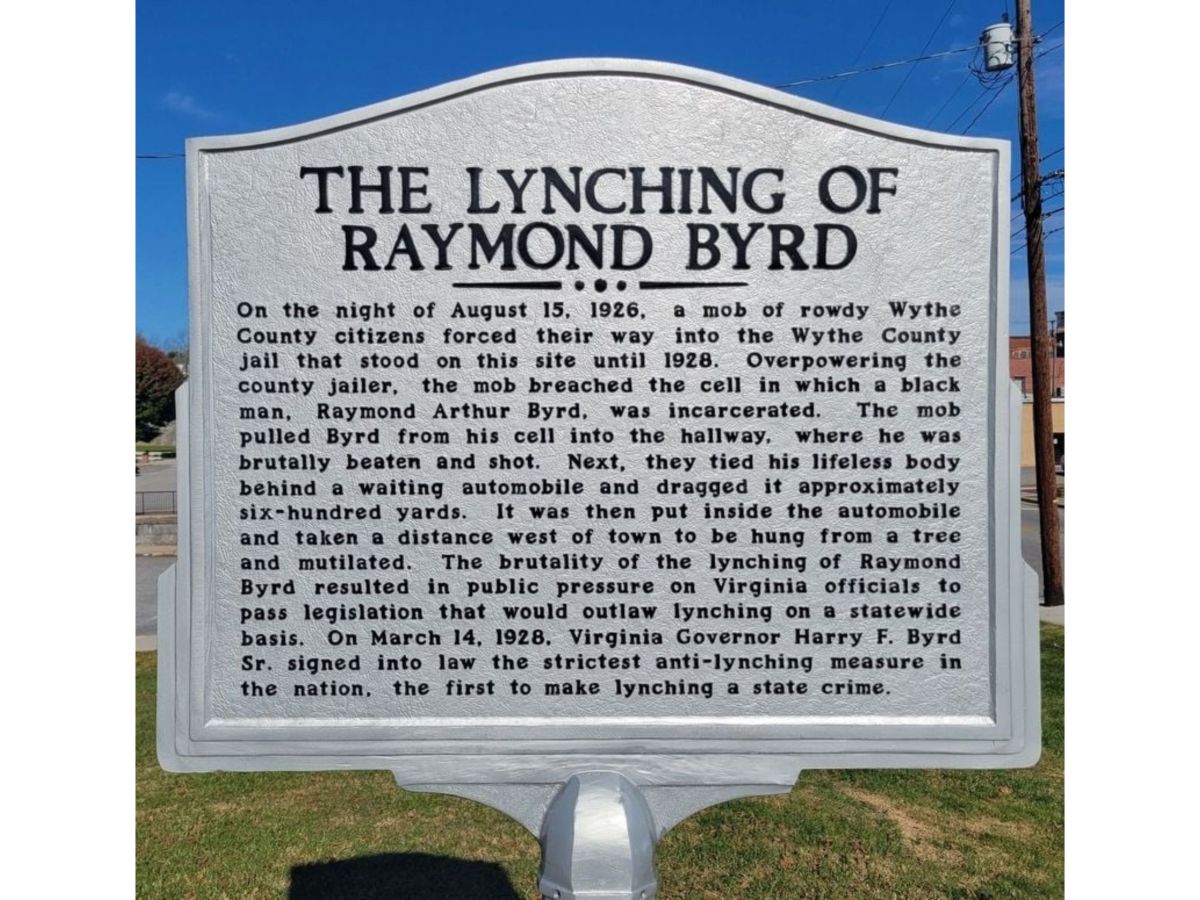
This August marks 100 years since the lynching of Raymond Byrd, a 31-year-old Black farmer accused of sexually assaulting a young white girl in Wytheville.
A mob of 50 masked men broke into the cell, beat Byrd within an inch of death before they shot him, tied his body to the back of a car and drove to the site of the alleged crime, where they hung his battered corpse from a tree.
The attack became one of the most notorious lynchings in Virginia, where approximately 100 lynchings have been documented.
A recently launched program through the Virginia Department of Historic Resources seeks to rectify the fact that this history has gone unrecognized for so long.
In the 2025-2026 budget, the General Assembly allocated $76,008 to the agency to cover the administrative and production costs of 15 new historical highway markers at or near the sites of lynchings, which occurred across the commonwealth mostly from 1880 to 1927. The budget item was sponsored by Del. David Reid, D-Loudoun County.
“Lynching not only claimed lives but also left a long-lasting legacy of racial trauma and social division,” Reid said in an email. “The lack of accountability and justice for these crimes fostered a climate of fear and oppression. Acknowledging these events through historical markers can serve as a step toward healing and reconciliation.”
Currently, only 13 of the state’s identified lynching sites hold markers detailing the crimes that taint the soil. Some state lawmakers, historians and community leaders view the new DHR program as a chance to acknowledge this oft-overlooked piece of history.
“It’s really important, in particular this time right now where we’re trying to erase history. These kinds of programs really are very important to make sure that this history is not forgotten, and that actually people are aware of it,” said Gianluca De Fazio, a professor of justice studies at James Madison University. “It’s something that really can make a difference in terms of how we think about our public space — how we think, in terms of our collective memory, of who gets remembered, who gets forgotten.”
Working with a handful of his senior students to comb through historical newspapers, court records and oral histories in 2017, De Fazio assembled a database to detail and map out all known lynchings in Virginia. According to his “Racial Terror: Lynching in Virginia” website, 95 Black men and one woman were lynched in Virginia. The comprehensive database is the recommended starting point for any potential applicants to the DHR program.
Nomination forms are open on the department’s website and will be considered on a rolling basis by the Board of Historic Resources, which convenes quarterly to review new proposals for historic sites and markers. Applications will require extensive documentation from primary and secondary sources and should demonstrate support from local governments and community groups. Additionally, the program criteria encourage applicants to identify and include any known descendants of lynching victims in the process.
With funding for only 15 signs, the DHR will only consider one nomination per locality in order to “promote the distribution of these markers across Virginia’s various regions,” according to the nomination form. Historical highway markers typically cost around $3,000.
Some localities saw multiple lynchings, such as Clifton Forge with four documented lynchings or Tazewell County with nine, the most of any county in the state.
Highway marker program manager Jennifer Loux said her department will consider, on a case-by-case basis, whether signs would include mention of other nearby lynchings.
“It would be possible, but not mandatory, for other lynchings that took place in a locality to be mentioned on a marker that focuses on one of them,” said Loux in an email. “A limiting factor will be the space available on the marker.”
Historical highway markers are limited to 700 characters, or approximately 150 words. The DHR has already approved highway historical markers for seven lynching sites:
- Joseph Holmes, May 3, 1869, Charlotte County
- Charlotte Harris, March 6, 1878, Harrisonburg
- Isaac Brandon, April 6, 1892, Charles City County
- Thomas Washington, March 23, 1896, Essex County
- Charles Craven, July 31, 1902, Leesburg
- James Horace Carter, October 12, 1923, King and Queen County
- Leonard Woods, November 30, 1927, Wise County
Five other lynching locations are memorialized through the efforts of the Equal Justice Initiative, the national, nonprofit legal group founded by civil rights attorney Bryan Stevenson:
- Robert Clark, June 13, 1891, Bristol
- Thomas Smith, Sept. 21, 1893, Roanoke
- John Henry James, July 12, 1898, Albemarle County
- Wiley Gynn, June 5, 1902, Wise County
- Dave Hurst, November 14, 1920, Wise County
Additionally, in 2020, the town of Wytheville collaborated with local historian John Johnson to fundraise and erect its own marker for Raymond Byrd.
This leaves more than 80 known lynching sites unmarked. De Fazio says this figure is “a vast undercount of the real number,” given the lack of historical documentation of most crimes against Black victims.
Lynchings in Southwest Virginia
Due to its mountainous terrain, Southwest Virginia was not supportive of the large-scale tobacco plantations found in the eastern part of the state, which kept the region’s Black population low for a time.
“Southwest Virginia is a really odd case, because that will be an area where historians and scientists would not expect a high number of lynchings, because lynchings are very often a legacy of slavery and a plantation economy,” said De Fazio.
Yet, more than half of the state’s total known lynchings took place in its Southwest and Southside regions.
Nine lynchings have been documented in Tazewell County; four took place in Alleghany County; Wythe, Russell, Halifax and Wise counties each had three lynchings; Scott, Smyth, Bland, Henry, Pittsylvania, Roanoke and Campbell counties each had at least one documented lynching, as did the cities of Bristol, Danville, Lexington and Roanoke.
The lynching of Thomas Smith in the city of Roanoke led to the city’s race riot in 1893. Smith was imprisoned after being accused of assault and robbery of a wealthy, white woman when a mob of 4,000 formed around the city jail. The local militia was summoned and eventually fired into the crowd as people attempted to break into the jailhouse and capture Smith. Nine white residents were killed and 34 more wounded, making it one of the few lynchings where more whites than Blacks were killed.
With a handful of exceptions, nearly all of these took place towards the end of the 1800s, spilling into the first couple of decades of the 1900s.
So, how did this seemingly bucolic, majority-white area become embroiled in such racial violence? Industrialization sparked the dormant, yet ever-present, fuse of racism.
The opening of Pocahontas Mine No. 1 in Tazewell County in 1882 ushered in the boom of Virginia’s coal industry. Thousands of job seekers, including African Americans, flooded the region. This economic growth, along with the expansion of three major railroads in the 1890s, led to massive population increases across Southwest Virginia.
“You have an influx of immigrants and African American workers coming and that creates the kind of labor conflict that makes lynching more likely to happen,” De Fazio said.
He also pointed out that preexisting racial tensions were exacerbated by Jim Crow laws, the economic downturn of 1893 and theories of scientific racism — a pseudoscience trending in the U.S. around the mid-19th century that asserted a biological hierarchy of humanity, an order that established white Euro-Americans at the top and non-white races as inferior.
When all of these factors intersected in localities, it only took a small infraction from the Black community — or, more often, a false accusation — to push “the white men to take action outside of the law and go ahead and execute sentence,” said Tom Costa, a retired history professor at the University of Virginia’s College at Wise.
Practically every lynching victim in Virginia was already in the custody of law enforcement when they were captured, tortured and killed by white residents.
“That really tells you how lynching is not a matter of getting rid of Black criminals, but really it’s a means to implement racial terror,” De Fazio said. “You’re sending a message to the larger society, saying, ‘Regardless of what the law says, we’re going to make sure that everybody that we think is a potential threat can be eliminated at our will, knowing full well, there’s going to be no consequences for the lynchers.’ Almost every single person, every single lynching, had no legal consequences for the lyncher.”
Take the events of winter 1893 in Tazewell County. Within the span of three days, five Black men were hunted down and lynched, accused of murdering two white men.
Alexander Ratcliff and Benjamin Shortridge were white merchants from nearby Buchanan County who made their way to the town of Richlands in Tazewell County on Jan. 30, 1893. Having conducted their business, the pair visited a saloon before their departure, “whence they were followed by four negroes,” according to the Clinch Valley News.
“In a very short space of time the two men were found lying upon the railroad track, their heads beaten almost to a jelly by club and hatchet,” reads the article. “The scene presented resembled a slaughter place. The banks of the cut to the top and the road bed torn up and covered with blood.”
The bloodbath had only just begun. Jerry Brown, a Black man “having a bad reputation,” was arrested and interrogated by law enforcement. Whether under duress or of his own will, Brown confessed to the murders and implicated three accomplices: Spencer Branch, John Johnson and Sam Ellerson. Branch and Johnson soon joined Brown behind bars, but Ellerson managed to escape custody, albeit temporarily.
That evening, Jan. 31, Brown was the first to meet his fate. “An angry mob of about three hundred people collected around the jail and finally overpowered the authorities and took Jerry Brown from them,” reported the Clinch Valley News. He was taken to the river that forks through the town and lynched, his body left hanging from an oak tree.
The mob returned to the jail for Branch and Johnson to find that the prisoners had been sent to the neighboring town of Cedar Bluff for their protection. Such a precaution was uncommon for white authorities to take on behalf of African Americans in a time when “very often, the jailers would just give them out to these lynch mobs,” De Fazio said. It only briefly delayed the inevitable.
Having received word that Ellerson was hiding out a few miles south of Richlands, a faction of the vigilante horde went to capture him while hundreds of others boarded the train to Cedar Bluff, where they tracked down the remaining two. All three were taken back to the riverbank where a crowd of 500 men, women and children watched as they were hanged alongside Brown from the oak tree.
“The lynching took place between the hours of one and two p.m. and was very orderly, there being no shooting or fighting, and not one of the crowd wore masks,” according to a Roanoke Times article.
Before he was killed, Johnson confessed to another unsolved crime: the murder of James Hunt, a white man, in September 1891. And he pointed the finger at four other men, two of whom were Black. By the following day, Sam Blow was also taken from the county jail and “was hanged to an apple tree near the mouth of Indian creek,” while unconfirmed accounts reported that Sam Burns was also lynched.
No harm befell the white accomplices, nor the scores of white assailants and witnesses to the lynchings.
Remembrance
No markers currently stand in Tazewell County as a physical testament of this violence.
A third-generation Tazewell native, Susie Green, recalls stories passed down in her family, ones infused with a sense of fear and trauma hailing from that era of racial terror. Green’s mother, Thedia Harris, died in June 2025 at the age of 101. She was born in 1923, one of eight siblings. While Harris wasn’t alive to witness the county’s last lynching in 1900 or the killing spree of 1893, she long believed that her mother did.
“[My mother] would say that when she was young, her mom would always call them in early and she would be upset if they didn’t come when she called them after dark,” said Green. “Her mom would get so upset that she thinks that she may have witnessed some hangings and she always feared that would come to [her children].”
Virginia’s last recorded lynching victim was 35-year-old Leonard Woods, who was hanged, shot and burned by a mob of 400 in Pound Gap in Wise County on Nov. 30, 1927. A few months later, Gov. Harry Byrd signed the Virginia Anti-Lynching Law of 1928, the first of its kind in the U.S. to declare lynching as a “specific state offense.” Violators of this law would be prosecuted by the state attorney general, and municipalities where the crime occurred would be subject to paying a $2,500 settlement to the victim’s family.
Some historians consider the measure an “empty-letter law,” given that no white perpetrator was ever prosecuted under the statute. Costa, however, says he tries to look on the positive side — “what little bit of positivity there is” — as the law seemed to have put an end to the “public spectacle lynchings” where white spectators and mobs felt immune from repercussions.
In Tazewell County, Green has played a critical role in remembering this era. She assisted in the creation of a mural depicting influential Black Tazewell residents in 2022. And, the year prior, she was largely responsible for the restoration of Maple Hill Cemetery, securing a DHR highway marker for the final resting place of approximately 300 African Americans.
Initially, Green said she had no plans to apply for the DHR program, but added, “I relish the idea of younger people getting involved; this is an excellent time for them.” After learning that the financial burden of the endeavor would be covered by the state, she began to change her mind.
“I’m passionate about it, and now that you don’t have to fund them … just a matter of getting the information together and submitting it,” she said. “I’m considering it. I can do it, I know I can do it. Maybe that is something I can do and work with somebody on or get a committee together.”
She said she planned to get a group together to discuss the idea in the coming weeks.
_______________
Correction, 11 a.m. March 13: The 1893 lynching of Thomas Smith in Roanoke is noted with a marker through the Equal Justice Initiative. This site was omitted from an earlier version of this story.
Disability Advocates Challenge Research Claiming Access to Disability Services Is Better in Rural Communities
by Liz Carey, The Daily Yonder
March 16, 2026
Access to disability services is better in rural communities than in urban ones, according to a new report from the University of Minnesota’s Rural Health Research Center.
Urban residents are more likely to report barriers to accessing health care than rural residents, the report explains. The research team looked at 11 barriers to care among rural residents without disabilities, rural residents with disabilities, urban residents without disabilities, and urban residents with disabilities.
Although adults with disabilities, regardless of location, reported difficulties accessing care because of nine of the barriers, some urban residents – both with and without disabilities – reported having trouble overcoming many of those barriers.
“We found more differences by disability status than we did across rural and urban areas,” Alexis Swendener, the lead author of the study, said in an interview with the Daily Yonder. “There were some actual urban disparities, with folks in urban areas having less access compared to folks in rural areas.”
While the analysis is still preliminary, Swendener said there were similarities that were striking just in people with disabilities delaying care because of those barriers.
“People with disabilities and without disabilities were likely to delay care due to appointment availability,” she said. “I think that really just speaks to our struggles across location, but even in urban areas, of not necessarily having access to healthcare facilities or services during times that work for them.”
Urban residents with disabilities were more likely to cite delaying medical care due to the hours clinics were open (9.7%), a provider's insurance acceptance (7.7%), and appointment availability (15.5%), according to the analysis. Those residents were also more likely to report financial difficulty paying for mental health services and dental health services than their rural counterparts, although both groups reported similar rates of delaying medical care due to cost, and not being able to afford prescriptions.
Rural residents with disabilities, however, often face different barriers to accessing healthcare, including long travel distances, limited access to transportation, lack of access to specialized providers, and inadequate or inaccessible housing, according to the Rural Health Information Hub.
“These, combined with higher rates of poverty and underinsurance, create ‘service deserts’ in many rural areas,” information on the RHIHub said.
Urban residents without disabilities were the most likely to report delaying care because of appointment availability (13.1%), the Rural Health Research Center analysis found. More than one-tenth of rural residents without disabilities (10.6%) also reported delaying care because of appointment availability. However, residents with disabilities in both urban (10.1%) and rural (7.9%) were less likely to report that as a barrier.
Rural and urban residents with disabilities were more likely to delay medical care due to a lack of transportation (15.8% and 14.0%, respectively) compared to rural and urban residents without disabilities (4.8% and 4.9%, respectively). But residents with disabilities were less likely to report having a usual place to go to for medical care, with only 6.4% of urban residents and 3.0% of rural residents, compared to 11.7% of urban individuals without disabilities and 8.3% of rural residents without disabilities.
“Transportation is an issue for rural people (without disabilities), but it's also an issue for both rural and urban people with disabilities just being able to find transportation,” Swendener said. “Whether you're in a big city or you're in a small town, those locations are going to (impact) what that transportation is going to look like, but it's still a problem.”
But Sandy Hanebrink, a disability advocate in upstate South Carolina and the executive director of Touch the Future, an organization that helps disabled individuals with assistive technology, said she felt the analysis was too limited to draw any broad conclusions from.
In her view, the sample sizes and the definition of disability impacted the outcomes.
The economic differences between rural residents with disabilities and urban residents with disabilities could explain some of the results, Hanebrink said.
“More people with disabilities in urban areas have access to more opportunities (like) education, employment, recreation, public transportation… which can make schedules busier,” she said in an interview with the Daily Yonder. “I think access to preventative, timely, and effective healthcare in rural communities is problematic, as there are higher rates of disability per capita. I believe significant barriers to equal and equitable healthcare for disabled Americans is a huge problem, no matter where you live.”
While Hanebrink is an occupational therapist who also advocates for disability laws, she is also a patient with disabilities. When she was a student athlete at the University of Florida, she was in a car accident. During treatment, she had an allergic reaction to an antibiotic that resulted in transverse myelitis and left her a quadriplegic. So she understands first-hand the challenges that rural residents with disabilities face.
Although she lives in Anderson County, South Carolina, which has more than 200,000 residents, she helps clients in more rural areas of the state. Healthcare access for those with disabilities is limited, she said.
“In Anderson County, most disability services are provided by nonprofits, especially if you do not have Medicaid. The only medical provider I have in my county is a dentist,” she said. “All my other healthcare needs are at least 45 minutes away (two providers) to two-to-five hours away (five providers), including from out of state (three providers),” Hanebrink explained.
“It actually scares me to think about if I end up in an emergency situation at a local hospital, will they make things worse as, historically, this has happened to me. They don't have the training or facilities to support my complex care needs… As I age, we have had discussions on whether we need to consider moving, but doing so is cost-prohibitive.”
Swendener’s research team acknowledged the limitations in the data set in terms of undercounting people with less severe disabilities. Still, the analysis highlights issues faced by Americans with disabilities, whether they live in urban or rural areas, Swendener said.
“I think this speaks to larger issues, concerning access and availability,” she said. “There’s a lot of work to be done. It's important to look at these (barriers) across locations, but there are some shared barriers, and a lot of times we don't necessarily think about the wider barriers among people with disabilities for various reasons related to structural inequalities and drivers of health.”
This article first appeared on The Daily Yonder and is republished here under a Creative Commons Attribution-NoDerivatives 4.0 International License.

Debate over Buncombe’s Craggy Dam. Value, cost, benefit and future in doubt.
by Jack Igelman, Carolina Public Press
March 17, 2026
How do you put a price on a 122-year-old mass of concrete sitting in the middle of a river? The value of Craggy Dam on the French Broad River in Buncombe County is now at the center of a debate over river restoration, flood mitigation, power generation and the future of aging dams across the region.
Built in 1904, the dam in Woodfin supplies a portion of the energy used by its owner, the Buncombe County Metropolitan Sewerage District, to power a portion of its wastewater treatment facility.
In 2022, a group of environmental organizations known as the Craggy Coalition approached the MSD to discuss the removal of the dam, which is 13-feet-high and nearly two football fields long.
[Subscribe for FREE to Carolina Public Press’ Daily, Weekend and Election 2026 newsletters.]
The public utility lead staff member, however, remains lukewarm about the possibility. MSD General Manager Tom Hartye told Carolina Public Press that operating the dam “reduces our carbon footprint by 45% and saves the ratepayers energy costs for the treatment of wastewater,” he said, adding that until there’s a viable plan for its removal, razing the dam is off the table.
The Craggy Coalition is proposing a third-party purchase the structure at a fair market value, remove it and ultimately transfer the restored site to public ownership.
A viable plan may ultimately hinge on a single question: what’s it worth?
Craggy Dam questions
Craggy Dam is one in an expansive effort to target and remove obsolete and aging dams in Western North Carolina and throughout the country. According to American River’s Southeast Conservation Director Erin McCombs, roughly 27,000 dams throughout North Carolina, many of which are no longer serving a purpose. American Rivers is a leader in the movement to remove dams and has a lofty goal to raze 30,000 dams by 2050. In 2024, 108 dams were removed nationwide.
The nonprofit Mountain Valleys Resource Conservation and Development is pursuing the removal of the next dam downstream on the French Broad River, the Capitola Dam near Marshall in Madison County. They are working on a feasibility study in cooperation with the French Broad Electric Membership Corporation. Altogether, three dams are in place on the river in North Carolina.
“Removing a dam is the fastest way to bring a river back to life” by allowing sediment to spread normally and allowing insects, invertebrates, fish and other aquatic animals to flourish, McCombs said.
A free-flowing French Broad River could also eliminate safety hazards associated with dams, and boost the local recreation economy by opening 3.5 miles of whitewater and expanding opportunities for river access, tourism and riverfront activity.
River advocate and former City of Asheville vice mayor Marc Hunt said the most compelling benefit of removing the Craggy Dam is reduced flood impact.
“This is the most important thing we might do in our lifetimes to support the health of the French Broad and what the river means to our community,” Hunt said. “It’s time to move on and adapt to the new reality that our rivers should flow freely.”
But removing a dam is technically complex and costly. American Rivers commissioned a study by the consulting firm Stantec to determine whether removal of Craggy Dam is environmentally and economically viable. The report estimated that fully removing Craggy Dam and its associated hydropower facilities could cost between $6.3 and $8.7 million.
In addition to steep costs, its removal requires cooperation by the dam’s owner, the MSD.
The Hatch report
The MSD is a nonprofit, publicly-owned utility created in 1962 by the North Carolina State Stream Sanitation Committee in order to operate facilities to treat and dispose of raw sewage and industrial wastewaters. Its governing board includes 14 members appointed by Buncombe County and municipalities served by the utility.
In 1963, the MSD purchased Craggy Dam, originally built to power a textile mill. MSD discontinued electrical operations until 1984, when the utility invested in improvements allowing the dam to again generate hydroelectricity.
Aging infrastructure and recent operational outages prompted MSD to consider capital repairs to extend the dam’s life. Last year, MSD hired Hatch Ltd., an international engineering consultancy, to develop a capital improvement plan known as the “Hatch report” which included projections of major maintenance and investment costs.
At the Feb. 18, 2026, MSD board meeting, Hartye and MSD Director of Engineering Hunter Carson presented a summary of the Hatch report and detailed their concerns with American Rivers' commissioned study of the dam removal.
The presentation on Craggy Dam was preceded by public comments from members of the coalition, including McCombs.
Hartye and Carson stressed the physical complications of dam removal, its impact on the MSD’s existing infrastructure, the environmental impact of relying on the energy grid and costs to ratepayers. The presentation included an estimate from Greensboro-based demolition contractor D.H. Griffin Companies, projecting a cost of $20 million to remove the structure, more than double the Craggy Coalition’s estimate.
McCombs questioned D.H. Griffin’s experience with dam removals.
“In our experience, dam removal requires specific knowledge and expertise,” she said. “The more uncertainty or lack of information in a construction project typically inflates the cost to account for increased risk.”
Stantec, which has experience with complex dam removal projects, provided the cost estimate to American Rivers and is included on their pre-qualified list of dam removal contractors.
A slide during the presentation outlined the dam's future estimated net cash flow. The Hatch report calculated a net cash flow of $17.1 million dollars based on 30 years of future cash flow less the expenses of operating and improving the dam. The calculation included major maintenance and facilities costs, labor, equipment and materials to operate the Craggy Dam facility.
A decision to retire assets such as Craggy Dam is guided by the MSD’s bond obligations in order to protect ratepayers and bondholders, Hartye said. Currently the MSD is investing $771 million in capital wastewater improvements, mostly bond-funded, to provide cleaner water and better service.
Among Hartye’s recommendations to the MSD board was to gather sufficient information and to hire a consultant to determine a fair value of the dam before there is public engagement about the structure’s future.
MSD board member Gwen Whistler said the Craggy Coalitions’s and MSD’s numbers are “pretty far apart” and added that she would want any consultant chosen to be approved by both parties.
Hartye told CPP that he will ask the board to approve a proposal from Raftelis Inc. to provide a dam valuation study at the next meeting. He also criticized American Rivers, saying they’ve ignored MSD’s concerns with portions of the Stantec study, instead choosing to “engage politicians and the press.”
Discounting net value of Craggy Dam
A dam’s value isn’t just the concrete and steel; it’s a complicated mix of potential revenue, costs, risks and public interest. For instance, measuring the ecological benefits of a dam are difficult to pinpoint. That’s why buyers and utilities often spend months or years trying to agree on a fair price.
McCombs said a commissioned valuation must be independent, technically credible, widely trusted and commissioned jointly by the MSD and the Craggy Coalition.
In the meantime, the Craggy Coalition asked energy economist Stratford Douglas, a retired West Virginia University faculty member, to analyze the Hatch report’s estimated future net cash flow.
Douglas said $17.1 million is overstated because it doesn’t properly “discount” the values to account for the uncertainty and timing of future cash flows around Craggy Dam.
Discounting future cash flows using standard financial techniques converts distant costs and benefits into their present-day equivalents for comparison. The greater the risk associated with future values, the lower the present-day value.
“There's a lot of uncertainty with future cash flows," Douglas said. "There could be massive repairs caused by large weather events and there are reasons to think that the future output will not be what it has been in the past."
For example, the hydro power facility is not able to run at 100% capacity when the French Broad is at low levels, thus more persistent droughts caused by a warming climate, for example, could impact future revenue. The cost estimates in the Hatch report were prepared to accuracies of -30% to +50%.
Douglas estimated the value of the dam’s future net cash flow at $3 million to $6 million using a range of discount rates to portray different levels of future risk. Douglas explained that an asset’s value is usually determined from the net benefits that it’s projected to deliver, adjusted for risk and uncertainty.
“I'm not suggesting any kind of incompetence or malfeasance on the part of Hatch or the MSD. Like most entities, they would like to continue operating in a way that they're familiar with. That's totally understandable.” he said. “All I did was discount their numbers.”
Hartye told CPP in an email that the Hatch report is not an estimate of the value of Craggy Dam: “This is primarily an engineering report that assesses future capital and maintenance needs for the next 30 years.” He also pointed out that the Hatch report included an expected cash flow analysis based on the annual operating expenses and revenues from its hydroelectric function calculating a new present value of $2.05 million discounted at 6%.
Transparent and independent
While dams seldom change owners, there’s precedent. In 2019, Duke Energy sold five dams located in the Carolinas to Northbrook Energy for $4.75 million. Among them was the Ela Dam on the Oconaluftee River in Swain County. Northbrook Energy has since sold the dam for $1 to Mainspring Conservation Trust to facilitate its removal.
McCombs hopes that whatever the future of the dam, the process leading to a decision is transparent and independent.
“It seems like the MSD is only viewing the French Broad River as a source of power for them,” she said. “At the end of the day we’re focused on getting to a fair sale price to be able to realize the benefits of removal. Rate payers will be made whole and MSD won't have to operate this dam anymore.”
McCombs requested a place on the agenda of the MSD’s next governing board meeting on Wednesday, March 18. She plans to advocate that the MSD explore the possibility of removal; freeze capital expenditures on the hydro facility until a decision is made; and establish a transparent evaluation process to understand the full range of public benefits and tradeoffs of removal.
CPP reached out to several members of the governing board including Asheville resident Chris Pelly. “I support removal of the dam although, as an MSD board member, I have to consider its interests too,” he said. “I believe we’ll eventually get there, but need for the process to play out.”
Convincing Hartye may, however, be a high hurdle.
“What is incredible is how hydropower is dismissed now that there’s going to be a new kayak park (in the stream),” he wrote to CPP.
Hunt is a driving force of Taylor’s Wave, which will be owned and operated by the Town of Woodfin once construction is complete. Eliminating Craggy Dam, he said, means MSD must rely on power from the electricity grid.
“We are looking at about 2.3 times the amount of greenhouse gas production. Hydroelectric aligns with city and county goals to meet 100% renewable by 2030,” Hartye said. “Maintaining the hydro certainly aligns with those goals. Reliance on additional grid power does not.”
This article first appeared on Carolina Public Press and is republished here under a Creative Commons Attribution-NoDerivatives 4.0 International License.

Missouri and Kansas legislation looks to expand the reach of the alternative medicine doctors
by Suzanne King, Beacon: Kansas City
March 13, 2026
During the depths of the COVID pandemic, Audrey Canaday’s health spiraled.
Takeaways
- Proposed legislation in Missouri to license naturopathic doctors hasn’t yet been scheduled for a hearing. A bill in Kansas, which would have expanded the scope of practice of that state’s naturopathic doctors, failed to pass the House.
- Traditional medical associations oppose giving naturopathic providers the authority to serve as primary care providers, although they already do in several states.
- Some tenets of naturopathic medicine have similarities with the pro-Trump Make America Healthy Again movement. But naturopathic medicine does not similarly shun the use of vaccines.
The Lenexa mom started having gastrointestinal issues almost overnight in May 2020. Her body stopped tolerating many foods and in less than two months her weight dropped to 77 pounds. Canaday’s 5-foot-6-inch frame could barely function.
Two stints in the hospital didn’t help and Canaday was left waiting weeks for an appointment with a gastroenterologist. Things got so bad, she had to move in with her parents, leaving her husband and three children — then 7 years, 4 years and 18 months old — behind.
“I was in a severe state,” said Canaday, now 42.
That’s when she decided to see a naturopathic doctor. Her insurance wouldn’t cover the cost, but Canaday believed in the alternative approach to health care, which promotes helping the body heal itself through diet, lifestyle and natural treatments.
“I was willing to try anything that my husband and I felt like we could afford,” she said.
Canaday’s story is not unusual. Increasingly, naturopathic doctors are seen as a legitimate alternative to traditional or osteopathic physicians and, for some, a welcome change from the long waits, short appointments and complicated financial side of traditional health care.
Naturopathic doctors, who are already licensed as primary care providers in some states, argue that doctors trained in accredited, four-year naturopathic colleges are more than capable of taking on patients as fully licensed providers. And some policy makers are on board, too.
Legislation introduced this year in Missouri and Kansas would effectively put naturopathic providers on par with primary care doctors, allowing them to perform exams, order screening tests and write certain prescriptions.
But the medical establishment has pushed back. Naturopathic doctors, they warn, don’t have the same training as medical doctors and rely on methods that sometimes veer outside the lines of evidence-based science. They contend naturopathic providers shouldn’t be treated as if they are traditional doctors.
“Patients deserve care led by physicians — the most highly educated, trained and skilled health care professionals,” the American Medical Association writes in a statement on its website. “Through research, advocacy and education, the AMA vigorously defends the practice of medicine against scope of practice expansions that threaten patient safety.”
Meanwhile, patients like Canaday are caught in the middle.
Back in 2020 when she was fighting for her health, Canaday eventually saw a gastroenterologist who diagnosed her with ulcerative colitis, an inflammatory bowel disease. She followed that doctor’s treatment plan, including certain medications. But Canaday believes it was her naturopathic doctor’s alternative approach, overhauling her diet and recommending supplements to help her body heal, that made her better.
“That is what turned my situation around,” she said.
Missouri and Kansas legislation
Naturopathic medicine is not opposed to traditional medicine or treatment. Naturopathic doctors who attend accredited schools are trained to prescribe pharmaceutical drugs. But the practice places a higher priority on less invasive natural treatments, some of which have been criticized as pseudoscience.
While pharmaceutical drugs may be prescribed “to halt progressive pathology,” whenever possible naturopathic care turns to “safe, effective, natural substances that do not add toxicity or additionally burden the already distressed body,” according to the American Association of Naturopathic Physicians.
But the meaning of naturopathic medicine varies depending on where you live. In states like Missouri where naturopathic doctors aren’t licensed, anyone with an internet certificate could claim the title. But no one in the state, not even those with four-year degrees, has a legal right to call themselves doctors.
In states like Kansas, where they have been licensed since 2003, naturopathic doctors can see patients, but they aren’t allowed to prescribe most prescription medications and face other limitations, which providers argue shackle their ability to provide care. According to the state, only 51 naturopathic providers are currently licensed in Kansas, including 28 who practice there.
But in states like Oregon, where naturopathic doctors have been licensed since 1919, they are recognized as primary care providers, they accept Medicaid and some private insurance and can prescribe medications, order labs and other diagnostic testing.
Currently 23 states and three territories license naturopathic doctors at varying levels. And the profession is actively working to expand its reach.
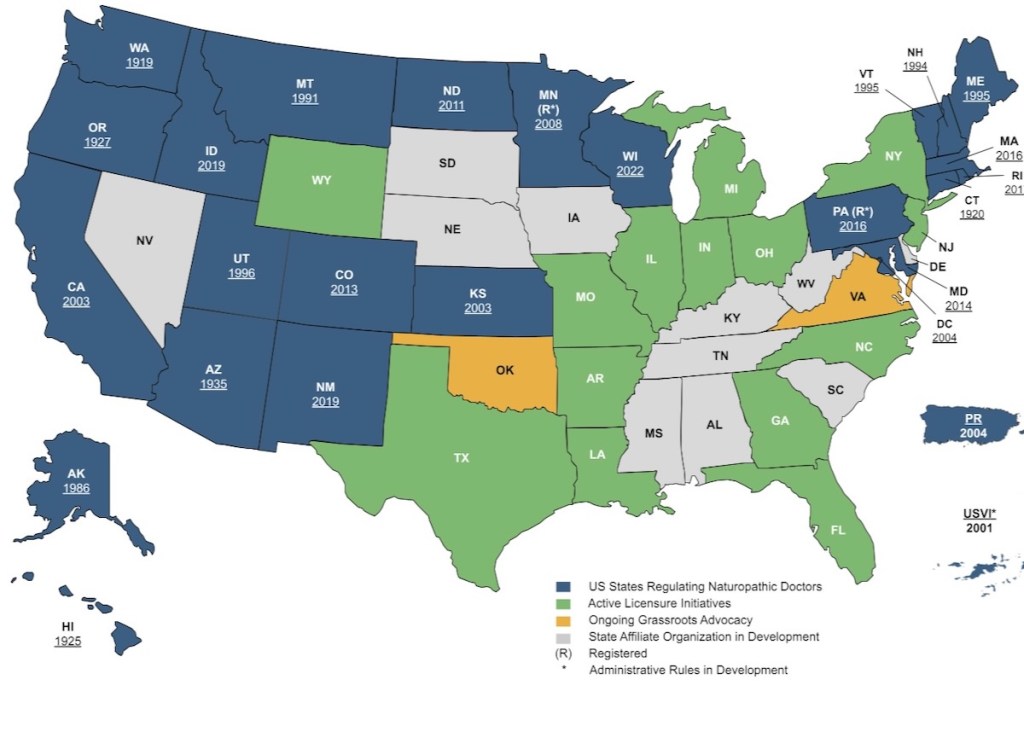
This year legislation was filed in six states, including Missouri, to begin licensing naturopathic doctors. And another six states, including Kansas, have seen legislation that would expand their scope of practice.
The Kansas bill, which would have given naturopathic doctors in the state expanded professional capabilities, like prescribing many medications, passed out of a state House committee, but failed in a 58-58 floor vote last month.
The Missouri bill would license naturopathic doctors in the state for the first time and allow them to perform many duties similar to a primary care doctor, including prescribing basic medications. To date, that bill hasn’t been scheduled for a hearing and it is unclear if it will be heard this session.
Rep. Mark Meirath, an Excelsior Springs Republican who cosponsored the bill, said he sees the legislation as a way to help expand the pool of available providers in the state, which is facing doctor shortages across rural communities.
“It just makes sense that we should give the people another safe option for their health care needs,” Meirath said.
Medical establishment has concerns
But the medical establishment has long fought back against allowing naturopathic doctors to act like traditional physicians, calling into question naturopaths’ training and approach.
Testifying in January against the Kansas legislation, Rachelle Colombo, executive director of the Kansas Medical Society, told the state House Health and Human Services Committee that expanding the scope of practice of naturopathic doctors in the state would be “contrary to the best interest of patients.”
Under the bill, she said, naturopathic doctors “would be able to do traditional, conventional medical treatment, although they are nontraditional, alternative” medical providers.
Naturopathic providers have also faced criticism for recommending and sometimes selling dietary supplements and vitamins that don’t face Food and Drug Administration scrutiny for safety or effectiveness. And they have been criticized for recommending homeopathic products, which federal drug regulators have in the past warned consumers against using.
Beyond those concerns, other criticism about naturopathic care has been far more pointed.
In testimony two years ago against a Missouri bill to license naturopathic doctors, which was passed out of committee before it stalled, a Kansas City doctor testified that she had seen an infant near death after being under the care of a naturopathic provider.
In written testimony before the House Professional Registration and Licensing Committee, Dr. Joanne Loethen, representing the Missouri State Medical Association, described a severely malnourished 12-month-old child who came to her practice weighing the same as a 4-month-old.
After testing the baby for food allergies, Loethen testified, the naturopathic doctor advised the parents to “strictly avoid countless foods and formulas.” But the baby’s weight became stagnant and her development lagged.
“Rather than refer to a physician who specializes in growth failure and delays, or even to a board certified allergist if it was truly felt her food allergies were that severe,” Loethen said in the testimony, “the family was instead told to continue alternative remedies and avoid various foods.”
No regulation may be part of the problem
Supporters of states licensing naturopathic doctors contend that situations like the one Loethen described are precisely why states should be regulating the practice.
“In states like Missouri where there is no regulation at all,” said Laura Farr, executive director of the American Association of Naturopathic Physicians, “anybody can call themselves a naturopathic doctor. As a patient you wouldn’t know if someone has graduated from a four-year medical school, or if it’s somebody who has gotten a five-week correspondence certificate.”
On the other hand, states that do license naturopathic doctors can require certain levels of education and training and establish other standards that protect patients.
Missouri’s proposed bill establishes a board of naturopathic medicine that would determine the quality of education a licensee must have. The board would administer exams and establish continuing education requirements. And it would discipline providers for misconduct.
Emily Hudson, board president of the Missouri Society of Naturopathic Physicians, said many people who oppose the Missouri bill simply don’t understand the level of education naturopathic doctors receive.
“We are trained in evidence-informed medicine,” she said. “We want to provide good, safe, quality care. And keep patients safe.”
Under current law, Hudson and other naturopathic providers working in the state can only serve as something like health coaches to the patients they work with.
”We don’t act as physicians,” said Hudson, who lives in St. Louis. “We don’t diagnose. We don’t treat. I don’t do any physical exam. I don’t touch any of my patients. Basically, it’s generally health advice — speaking to people about the diagnoses they’ve already been given and how I can support them.”
Even in that limited capacity, Hudson said, her practice is full. She often works with medical doctors who refer patients to her for nutrition advice and other support. Patients who want to find a more holistic approach to their health also find her on their own.
“Many people are seeking naturopathic care,” she said. “They want more time for appointments, a more preventative approach. And more support for managing chronic conditions."
All of those are at the heart of the naturopathic approach to health care, providers said. The practice emphasizes finding and treating the root causes of disease, and that often involves spending lots of time with patients, learning about their lives, including every part that could be affecting their health.
“We want to have 20 to 45 minutes, if not an hour, with our patients,” said Dr. Laura Rues, a naturopathic doctor in Johnson County.
The approach, she said, pays off in healthier patients who require less expensive care.

Similarities to MAHA
Naturopathic providers still face steep resistance in states like Missouri and Kansas.
But they have expressed hope that they might have allies in President Donald Trump and Health Secretary Robert F. Kennedy Jr. Kennedy’s rhetoric in favor of healthy eating and exercise and against highly processed foods match naturopathic principles.
And Casey Means, the doctor turned wellness influencer whom Trump nominated to be his surgeon general, has embraced functional medicine, which has similarities to the naturopathic approach.
Like the Make America Healthy Again movement, Kennedy’s political calling card, they both focus on healthy eating and lifestyle, including promoting vitamins and supplements marketed to support the body’s self-healing processes.
In fact, last year, soon after Trump took office, Farr sent a letter on behalf of the American Association of Naturopathic Physicians noting the similarities and urging federal policy changes that would promote naturopathic practices.
“For over a century,” the letter said, “naturopathic medicine has offered a distinct approach to health care, prioritizing disease prevention, health promotion and patient-center care.”
The letter went on to say that naturopathic doctors employ “a range of evidence-based, cost-effective therapies that resonate deeply with the MAHA platform’s vision.”
To be sure, not everything matches up. For example, accredited naturopathic medical schools follow evidence-based science, including related to vaccines, Farr said. But many in the Make America Healthy Again movement, including Kennedy, shun them.
“Vaccines are taught in all of our schools,” Farr said. “There is a heavy emphasis on having a doctor-patient conversation … related to vaccines, but that’s about informed consent, part of any doctor-patient relationship. We are not getting involved in the vaccine political controversy.”
Farr also did not mention the Trump administration’s moves to cut funding for healthy food programs, food assistance, Medicaid and health insurance subsidies.
While emphasizing that her organization was not endorsing MAHA or any other political movement, Farr said she sent the letter to point out that parts of the new administration’s proposed policies closely align with what naturopathic medicine promotes.
Her letter asked the administration to:
- Direct the Centers for Medicare and Medicaid Services to require states to credential licensed naturopathic physicians. Currently only some states’ Medicaid programs cover the alternative doctors.
- Allow the Veterans Health Administration to hire naturopathic doctors.
- Protect patient access to compounded medications "including those utilizing natural substances and botanical ingredients.”
- Promote “Food as Medicine” programs and appoint naturopathic doctors to boards and task forces that oversee those programs.
As for her assessment of what the MAHA movement has accomplished so far?
“It’s a mixed bag,” Farr said.
On one hand, the administration invited a naturopathic medical school representative to participate in a recent meeting about how nutrition is taught in medical schools, an important step in medical education, Farr said. On the other hand, Trump recently issued an executive order that promotes the use of glyphosate, a chemical used in weed killer and widely implicated as causing cancer.
But, still, Farr said, any new dialogue about nutrition, lifestyle medicine and food as medicine is “a breath of fresh air.”
“It’s something naturopathic doctors have been talking about for decades,” Farr said. “It finally feels like the rest of the world has caught up.”
This article first appeared on Beacon: Kansas City and is republished here under a Creative Commons Attribution-NoDerivatives 4.0 International License.