Somali men in ICE custody say a ‘refueling’ stop became weeks at Guantánamo Bay


It's Friday September 18, 2026 and in this morning's issue we're covering: Somali men in ICE custody say a ‘refueling’ stop became weeks at Guantánamo Bay, Effectiveness of NC certificate-of-need law meant as healthcare guardrail in doubt, Less work, fewer tips for hospitality workers during “brutal” summer slump in New Orleans, Arizona promised secure treatment for its sickest psychiatric patients. Seven years later, it still doesn’t exist,
Media outlets and others featured: Sahan Journal, Carolina Public Press, North Carolina Health News, Verite News, Arizona Center for Investigative Reporting,
Three Minnesota men are among a group of eight Somalis who have been held at the U.S. military facility since late August.
By Mohamud Farah (Sahan Journal) Published: September 15, 2026
As many as 12 Somali deportees have passed through the U.S. detention facilities at Guantánamo Bay, Cuba, in recent weeks and eight remain, according to two Minnesota men still held there.
One of the men, St. Paul resident Abdullahi Adam Mohamed, said he was told by Immigration and Customs Enforcement (ICE) agents that he was being deported from Louisiana to Somalia with a refueling stop in Cuba. He’s now been at Guantánamo for three weeks.
Seven of the Somali detainees are currently located at Camp 6, a military detention center known for housing high-risk inmates, and the eighth is in isolation, Adam said.
The two Minnesotans, and a third man interviewed by Sahan Journal, say they had active asylum cases and work permits, but were targeted for removal as the Trump administration stepped up deportations. They all describe punishing conditions at Guantánamo, aggressive shackling of prisoners, constant cold air and round-the-clock surveillance.
Adam, 31, said he was detained on Dec. 12 at the beginning of Operation Metro Surge. “They pulled me over and asked me for my work permit,” he told Sahan Journal in a 10-minute phone interview from Camp 6. “I asked them if they had a warrant, and the reason they pulled me over.”
“‘We are immigration officials. We know you’re Adam Abdullahi, and we don’t need a warrant.’ That’s what they told me,” he said.
Adam said he doesn’t know why he was targeted. He has two misdemeanor snow emergency parking citations, but no other records in the state court database.
In a statement for this story, the Department of Homeland Security said the Somalis held at Guantánamo Bay, who all arrived on the same flight, posed a threat.
“This flight of illegal aliens to Guantánamo Bay included some of the worst of the worst with criminal histories including aggravated assaults, weapons offenses, robbery, multiple larcenies, police obstruction, possession of burglary tools, receiving stolen property, trespassing, unauthorized use of a vehicle, multiple drug charges and DUIs,” the statement said.
DHS did not answer any other questions regarding the detainees.
Building a new life in St. Paul
Adam arrived in the U.S. as an asylum seeker in March 2023, obtaining a work permit and Social Security number. He quickly established his own mechanic business and worked for Amazon, where he traveled to different states to repair vehicles.
When Adam was detained by ICE, his family was heartbroken, his cousin Naima Ali said. They believed his Social Security number, work permit, clean record and consistent appointment attendance would allow him to continue his asylum case, especially since he had an upcoming appointment that could lead to approval.
Over the past nine months, Adam has been transferred from the Freeborn County Jail in Albert Lea, to a detention center in Covington, Kentucky, and then to Louisiana. An immigration judge ordered his removal on May 14, and Adam has no pending appeals.
“They say we will go to Somalia from Miami, but first we will stop in Cuba for refueling and then go to other countries before reaching Somalia,” Adam said.
Initially, he and the other Somali detainees were told they would be deported to Somalia, but instead found themselves in Guantánamo, where he and his fellow detainees have been held for nearly 20 days.
Adam reached out to the Somali Embassy in Washington, D.C., and learned that ICE had reported his deportation to Somalia on Aug. 12. “I am here in Guantánamo,” he said.
“I came to the U.S. to be safe,” Adam said. “I used to work and support my mother who died while I was in a detention center in Covington.”
He described life in Guantánamo as challenging, citing the constant air conditioning that leaves the environment frigid, along with cold food and water. “When we come together for food, we’re all coughing all the time,” he said, “as if we’re in a coughing competition.”
Turned back at the Canadian border
Hassan Abdi Abtidoon, 31, is another Somali asylum seeker from Minnesota now detained at Guantánamo Bay.
He came to the U.S. as an asylum seeker on Jan. 3, 2023, and moved to Minnesota, where he worked as a driver for Uber and Lyft, and held various factory jobs.
As he watched the increase in anti-Somali rhetoric, fueled by social media comments by President Donald Trump, and then fatal shootings of Renee Good and Alex Pretti by immigration agents during Operation Metro Surge, Hassan became concerned about the outcome of his asylum application.
His lawyer was overwhelmed with cases and had stopped responding to his calls, he said.
When Hassan received a removal order from the Executive Office for Immigration Review (EOIR) on April 6, he decided his best option was to seek asylum in Canada.
On May 19, Hassan attempted to claim asylum at a border crossing but was stopped by Canadian authorities. They subsequently handed him over to U.S officials, who transferred him to Kandiyohi County jail in Willmar, which has an agreement with ICE to hold prisoners.
Hassan’s family members expressed deep concern for his well-being following his detention at Guantánamo Bay.
Abdiaziz Abdullahi, Abtidoon’s cousin, cited the facility’s troubling reputation and history. “It’s shocking and frightening that Hassan is being held in Guantánamo.”
Hassan is described as an industrious, law-abiding individual with no criminal history. “He is a social person,” Abdiaziz said, “a talented poet, and is beloved by his friends and family for his generosity and capability.”

Pulled over by a state trooper
Sakariye Abdi Mohamed, 22, is another Somali asylum seeker detained in Guantanamo Bay.
He arrived in the U.S. in January 2023, and obtained a Social Security number, a work permit, and a commercial driver’s license. On Oct. 28, 2025, while driving a truck in Alabama, he was pulled over by a state trooper, who asked if he was a U.S. citizen or held a green card. Sakariye had neither.
“The trooper was very aggressive to me and called ICE agents, who took me to a detention center in Alabama,” he said. “After eight days, they transferred me to another detention center in Louisiana, where I spent 11 months.”
He said he was informed that he would be deported to Somalia with a stop in Florida. However, he was instead transferred to Guantanamo Bay, arriving on Aug. 26.
“When we asked the officials about our prolonged detention at Camp 6,” he said. They said it was a federal decision from Washington, D.C., and offered no further explanation.”
A third Minnesota man, who Sahan Journal could not reach, is also being held at Guantánamo, the three others said.
Concerns about legal access, due process
Shortly after Trump began his second term in 2025, he issued an executive order to expand the Migrant Operation Center at Guantánamo Bay to accommodate up to 30,000 people.
Since then, ICE detainee counts at Guantánamo Bay have fluctuated from a high of 255 in February 2025, to three in August that year, according to the Deportation Data Project.
In June, the last month for which data is available, nine deportees were held at Guantánamo.
The American Civil Liberties Union and other groups have challenged the legality of holding immigrants facing civil charges in a military prison where they have limited access to family members or legal counsel.
“There is no legal authority for migrants to be detained at Guantánamo, especially in Camp 6,” said Yumna Rizvi, of the Center for Victims of Torture.
The language of the current administration mirrors that of the post-9/11 Bush administration, she said. “They are framing individuals held in Camp 6 as ‘high-priority criminal aliens.'”
“The tactics, rhetoric, and narrative used at Guantanamo, originally designed for counterterrorism, are now being repurposed for immigration enforcement,” Rivzi said. “This raises significant concerns about due process and access to legal counsel, which appear to be systematic violations by design.”
Marc Prokosch, who represents Adam, said he’s been able to track the cases of six of the eight Somali detainees currently held at Guantanamo Bay. Four were recent asylum-seekers, he said, but two had been in the U.S. for decades.
All had final orders of deportation, he said, but no other additional charges.
Hassan said the U.S. immigration authorities obtained a to-go-home letter from the Somali Embassy and said they’re deporting him to Somalia. He spent one night in a Louisiana detention center and found himself in Guantánamo.
Sahan Journal contacted the Somali ambassador to the U.S. in Washington, D.C., to inquire about the distribution of “to-go-home” letters aimed at facilitating the deportation of asylum seekers. Ambassador Dahir Abdi said the process has changed, with U.S. immigration agents now coordinating directly with Mogadishu, the capital of Somalia. “The system is centralized now and we don’t do it here anymore,” he said.
“I never expected to be arrested in a prison established for the terrorists who I fled from,” Hassan said. He called the prison a “terrible place.”
In addition to restrictions on phone calls, Hassan said there were limited opportunities for exercise. However, he mentioned that detainees can interact with one another. “During the day, we have a few hours together,” he said.
He and Adam both expressed concern about the surveillance cameras installed in the bathrooms at Guantánamo Bay. The cameras continuously record, leaving no room for privacy.
When asked about his impending deportation to Somalia, Hassan said he would face additional challenges because of his time at the U.S. military prison.
“People believe that those who are detained in Guantánamo are terrorists and bad people,” he said. He said his name would become synonymous with Guantánamo.
“Life in Somalia would be difficult under any circumstances, but this new stigma makes it even worse.”
Sahan data reporter Cynthia Tu contributed to this story.
The post Somali men in ICE custody say a ‘refueling’ stop became weeks at Guantánamo Bay appeared first on Sahan Journal.
This story is being shared with permission by the Sahan Journal, a local newsroom in St. Paul, MN. To learn more, please visit https://sahanjournal.com/.
Effectiveness of NC certificate-of-need law meant as healthcare guardrail in doubt
by Lucas Thomae, Carolina Public Press
September 15, 2026
In 1971, North Carolina passed its first certificate-of-need law. Copying a model which started in 1960s New York, the program would require medical providers to seek permission from the government before expanding or developing new services.
The idea behind the policy was that it would prevent unnecessary spending by hospitals, which had been rapidly growing in the economic boomtime following World War II. Under a more centralized system, state health agencies aimed to reduce costs and ensure access for all patients.
But just a couple years after the law’s passage, the North Carolina Supreme Court struck down the state’s certificate-of-need program.
[Subscribe for FREE to Carolina Public Press’ Daily, Weekend and Election 2026 newsletters.]
Aston Park, a 50-bed nonprofit hospital in Asheville, had sued after the state denied its application to replace its aging facility with a new 200-bed hospital.
Fearing that there weren’t enough physicians in Asheville to staff a new hospital of that size, North Carolina’s Medical Care Commission wrote in its decision that the proposed facility "would be an unnecessary and weakening duplication of services.”
Aston Park argued to the Supreme Court that the certificate-of-need process violated the state Constitution’s anti-monopoly clause. The court agreed, ruling that the law granted “exclusive privileges" and the power of monopoly to existing hospitals.
The law was struck down, but the certificate-of-need program wasn’t dead — just dormant. In 1974, Congress passed legislation incentivizing states to implement certificate-of-need programs of their own. With the blessing of the federal government, North Carolina revived its law four years later, including language about legislative findings in order to get around the court’s earlier objections.
North Carolina remains the only state in which a legal challenge to its certificate-of-need law succeeded, even if that victory was short-lived.
Aston Park never ended up building the 200-bed hospital at the center of the lawsuit. In 1975, it transferred its acute care beds to Memorial Mission Hospital and transitioned into a senior nursing facility.
To this day, Mission Hospital — now under the control of Tennessee-based, for-profit HCA — enjoys a de facto monopoly in the region, thanks in large part to the current certificate-of-need law.
This is the second installment in Battling for Beds, an investigative series by Carolina Public Press about how certificate-of-need disputes between competing health systems have hampered the state’s ability to meet healthcare needs in its fastest-growing communities.
This article interrogates the effectiveness of certificate-of-need laws and examines how the process has been exploited to protect existing hospitals.
The previous article investigated the extent to which legal delays have stalled the development of new hospital beds and undermined the state’s healthcare planning process. The final article explores proposals for reforming North Carolina’s certificate-of-need process and laws or abandoning them altogether.
Certificate-of-need law: Guardrails or outdated relic?
Nearly every US state adopted some form of a certificate-of-need program in the 1970s after Congress made it a requirement to receive funding for certain public health initiatives.
However, reception to the policy was divided. In 1986, Congress repealed the law. Some states subsequently ended their certificate-of-need programs, but North Carolina is one of 35 states that has kept its law in place.
There have been several attempts to get rid of the state’s certificate-of-need program since it was revived in 1978, both through legal challenges and legislative means, but so far none have stuck.
North Carolina’s program remains among the most restrictive in the country, as it requires certificates of need for 23 different healthcare services. Only three states — Hawaii, Vermont and Kentucky — restrict more services.
But do certificate of need laws actually keep healthcare costs down, as they were originally intended to do?
Critics of them say that, in fact, they do the opposite. One of those critics is Donald Bryson, CEO of the John Locke Foundation, a libertarian think tank based in North Carolina.
“Certificate-of-need artificially restricts supply, which just means that prices are artificially inflated over time,” Bryson told CPP.
But others disagree.
Josh Dobson, the CEO of the North Carolina Healthcare Association — the lobbying arm of the state’s hospital industry — told CPP he “fundamentally disagrees” with the idea that repealing certificate of need laws will lower costs.
Instead, Dobson said getting rid of the laws would only serve to destabilize the finances of hospitals that are already operating under tight margins.
The certificate-of-need program offers hospitals some protection from what they call “cream skimming.” That is when a non-hospital, like an outpatient surgery center, selectively chooses patients based on their profitability or insurance status.
Hospitals, which are required to provide charity care and often lose money to low Medicaid reimbursements, don’t have the luxury of turning down unprofitable patients.
“These other providers, if you will, can cherry pick who they want to see and who they do not want to see,” Dobson said.
“They are able to flip the lights off at 5 o'clock. They are not required to be open 24 hours a day, seven days a week, and they don't have to provide free care for 20 to 30% of the people that walk in the door through charity care.
“So it's not fair to say that it's a free market issue, when the playing field is not level.”
What research says about CON programs’ impact
According to Wake Forest Law professor Mark Hall, the effectiveness of certificates of need is a more nuanced topic than advocates on either side of the issue would like to admit. One thing however, is clear: they haven’t protected patients from soaring healthcare prices.
“The laws haven't succeeded in controlling costs as much as we'd like,” Hall said.
Even with certificate-of-need laws in place, hospital costs have far outpaced normal inflation for years. If more health systems were allowed to build competing facilities, Hall said, it could push them to lower prices.
However, transforming the state’s hospital landscape into a purely free market could have adverse consequences. For example, relaxing certificate-of-need laws could be a nail in the coffin for many rural hospitals that are already struggling financially from low patient volume and recent cuts to the federal Medicaid program.
“If there weren't those questions asked and constraints put on uncontrolled expansion, you could expect the larger hospitals in cities to invade those (rural) territories … just build a better hospital and drive the rural hospitals out of business,” Hall said.
Many academics have attempted to quantify the impact of certificate-of-need laws, both by comparing states with and without them, and also by studying what happens when a state repeals its certificate-of-need requirements.
One of those researchers is economist Stephen Slivinski of the Cato Institute, a libertarian think tank based in Washington, D.C. In August, he co-authored a report which included a literature review of existing research on the impacts of certificate-of-need laws and what happens after they are repealed.
Slivinski’s takeaway: the worst-case scenarios which the hospital industry warned about haven’t seemed to take place in states that ditched their certificate-of-need laws.
“The academic research on this is fairly strongly in favor of the proposition that the sky won't fall if you liberalize or get rid of CON laws, and in fact, the opposite often occurs,” Slivinski said.
Most studies found that certificate-of-need programs were associated with negative impacts to prices, access and quality of care. A majority of those studies also found that those conditions tended to improve in states that repealed or reformed their certificate-of-need programs.
“CON laws are typically associated with worse outcomes in terms of health outcomes, in terms of cost, in terms of access, even things as simple as the amount of time it takes to drive to a hospital from where someone might live in a rural area,” Slivinski said.
The Cato Institute report also found that states without certificate-of-need laws tended to have greater access to providers who offered services like obstetric care and neonatal ICU beds. North Carolina has struggled with maternity care deserts, a problem which research suggests could be made worse by the state’s certificate-of-need law.
In the end, Slivinski said, these programs don’t do much other than insulate incumbent hospitals from potential competition.
“There's no argument for health or safety or access that holds up,” he said. “So the only argument that really holds up is, well, maybe this is just cartel protection.”
Stopping the clock on CON awards
While hospital systems often go head-to-head in competitions over beds and medical equipment, they are generally unified by their support for certificate-of-need laws through the North Carolina Healthcare Association.
The association has argued for decades that these laws are essential to financial stability and access for all patients by keeping service providers “right sized.”
A more critical perspective is that certificate-of-need programs allow powerful hospitals to maintain control over their turf, like HCA in Asheville and Duke Health in Durham. Through costly litigation, these systems can make it difficult for potential competitors to break in, even if they do manage to win DHHS’ approval. It may also ward off potential competitors from even applying in the first place.
In cases where the state decides to allocate beds or medical equipment to a new competitor, the spurned incumbent will often argue in an appeal that the decision should be reversed on technical grounds.
Such was the case in Buncombe County, where HCA argued that AdventHealth’s proposal for a new hospital in Weaverville didn’t properly follow application guidelines and therefore shouldn’t have been approved in the first place.
The courts ultimately ruled against HCA, but the legal battle still managed to delay the issuance of AdventHealth’s certificate of need by three years.

DHHS has a generally streamlined process for most parts of the certificate of need process, but what it can’t control is how long it takes once an objector to an approved project elevates an appeal up through the court system.
In the case of AdventHealth Weaverville in Buncombe County, the timeline went like this:
- Jan. 1, 2022: The State Medical Facilities Plan determined that Buncombe County needed 67 new acute care beds.
- June 15, 2022: AdventHealth, Mission Health (HCA) and Novant Health submitted competing applications for the beds.
- Nov. 22, 2022: DHHS approved AdventHealth’s application for a new hospital in Weaverville, allocating them all 67 beds. Mission’s and Novant’s applications were denied.
- Dec. 21, 2022: Novant and Mission filed appeals contesting AdventHealth’s approved application, pausing the issuance of the certificate of need.
- December 2025: Three years later, the North Carolina Supreme Court ends Mission’s bid to overturn DHHS’ decision, allowing AdventHealth to receive its certificate of need and begin building the Weaverville hospital.
Once a new competitor manages to get its foot in the door, like AdventHealth in Buncombe County, it doesn’t necessarily solve the issue of continuous delayed projects. Counties like Wake and Mecklenburg with multiple established systems still experience logjams as those competitors jockey in court over a limited quantity of hospital beds.
The introduction of an alternate hospital may increase access and patient choice, but it hasn’t led to new beds or medical equipment being deployed any quicker. In fact, competition surrounding certificates of need incentivizes health systems to contest their rivals’ approved projects for as long as possible.
These legal delays are in direct conflict with the state’s goal of creating enough hospital capacity to meet demand. But what’s preferable for public health isn’t necessarily the best option for health systems’ balance sheets.
“It tells you that the financial stakes are really high,” Hall said.
“It’d be one thing if all the competitors just put in their proposals and accepted what (DHHS) had to say… let’s move on and let bygones be bygones because we need some hospital built and this affects people’s welfare.
“But each hospital is looking at their individual position and saying, ‘We think we have a legal case to make, and we are willing to go to court to state that case.’”

Why appeals keep happening, even if they don’t win
North Carolina’s general statutes do require appellants of certificate-of-need decisions to pay a bond, between $5,000 and $50,000, which may be paid to the winner of the CON if a judge finds that the appeal was frivolous or intended to cause an unnecessary delay.
In the case of hospital projects that cost hundreds of millions of dollars, a winning system facing appeal may petition the judge to increase the bond to a maximum of $300,000.
However, proving that an appeal was purely a delay tactic set up a high legal bar to overcome. The threat of financial penalty hasn’t deterred health systems from increasingly launching legal challenges to their competitors’ approved projects. That’s the case even though appeals are rarely successful.
The more likely outcome is that health systems stuck fighting over a certificate of need may enter into a legal settlement with each other and DHHS. In the case of acute care beds, the parties may agree to split the available beds and each walk away with their own certificate of need.
That is precisely what happened during the 2024 application cycle in Mecklenburg County, when Novant Health appealed DHHS’ decision to award 89 new hospital beds to Atrium Health for an expansion of its Carolinas Medical Center.
In a settlement agreement, DHHS agreed to issue 45 beds to Atrium, while Novant walked away with 44 for its Presbyterian Medical Center.
UNC Health and Duke Health entered a similar agreement after Duke spent four years contesting DHHS’ decision to allow UNC to build a new hospital in southern Durham County. Eventually, the parties agreed that UNC could build a new 102-bed near Research Triangle Park, while Duke was awarded 44 beds that it was originally denied in previous cycles.

These success stories seem to have signaled to health systems that contesting their competitors’ projects is worth the risk of having to pay a bond. In 2025, 12 out of 14 acute care bed projects approved by DHHS statewide were appealed, which is a much higher rate than in previous years.
So far in 2026, six of eight approved acute care projects have been appealed. That totals out to 454 beds waiting in legal limbo. And that number will only get larger — DHHS hasn’t yet ruled on another 22 applications for a total of 1,473 requested beds this cycle.
Putting those beds into service before hospital overcrowding becomes a serious issue might be DHHS’ greatest challenge yet.
This article first appeared on Carolina Public Press and is republished here under a Creative Commons Attribution-NoDerivatives 4.0 International License.

Veterans find purpose on the farm
by Will Atwater, North Carolina Health News
September 10, 2026
Key Takeaways:
- The Veteran’s Farm teaches agricultural skills while offering former military members structure, community and a path into civilian life.
- A state grant will help the nonprofit expand programs and support veterans in crisis as they wait for VA benefits.
- The program connects veterans interested in farming with an industry seeking its next generation
After serving five years in the Marine Corps and another 10 as a Department of Defense contractor, Robert Elliott found the transition away from military life difficult. The jobs he took did not last, he said, and neither did his first attempt at college.
Elliott was at a low point.
“I started going down to a really dark place in my mind,” he said. “A lot of folks that get out of the military in the first year, statistically speaking, wind up having really hard transitional issues.”
Missing the camaraderie and structure of military life, Elliott said he returned to something familiar: farming. He was raised on a family farm in Louisburg, North Carolina, where he helped tend tobacco, corn and cattle, and he drew on that experience and the discipline he developed in the Marine Corps to give agriculture another shot.
Farming restored Elliott’s sense of purpose, he said, and he began to wonder whether it could offer other veterans a route into civilian life. In 2015, he founded The Veteran’s Farm of North Carolina, a nonprofit that provides veterans with agricultural training and support as they pursue farm careers.
A way to ease into civilian life
The Veteran’s Farm of North Carolina trains military veterans in agriculture, with the goal of helping them build careers and find community after service. The nonprofit aims to address two challenges: helping veterans navigate civilian life and preparing a new generation to enter an aging farm workforce.
Before founding The Veteran’s Farm in 2015, Elliott helped create Soldiers to Agriculture, a five-week training program now offered through N.C. Cooperative Extension in Cumberland County. The program introduces veterans, military spouses and active-duty service members preparing to leave the military to agricultural careers through classroom and hands-on instruction.
The General Assembly provided new support for The Veteran’s Farm in its 2026 state budget; the nonprofit is slated to receive a $250,000 nonrecurring directed grant. Elliott, now 47, said the money will help the organization expand.
The grant comes as North Carolina’s agricultural sector looks to bring new farmers into the industry.
The average U.S. farm producer was 58.1 years old in 2022, according to the U.S. Department of Agriculture’s Census of Agriculture. That aging workforce is a concern in North Carolina, where agriculture and agribusiness had an estimated $111.1 billion economic impact in 2022, according to a 2024 analysis of USDA data by NC State University economist Mike Walden.
“Encouraging the next generation of farmers and ensuring they are prepared is important to the long-term success of agriculture in North Carolina,” North Carolina Agriculture Commissioner Steve Troxler shared in an emailed statement. “The Veteran’s Farm program works with military members who are interested in farming after their service ends, providing a solid educational foundation and mentors to help them prepare for a career in farming.”
Retired Army Lt. Col. Andrew Scruggs served 21 years before retiring in 2025. The Cumberland County resident said he and his wife became interested in homesteading during the COVID-19 pandemic, when he began to see “how fragile our economy can be, and also our food supply and supply chain.”
The couple began considering a land purchase and looking for ways to become more self-sufficient by growing food, Scruggs said. His wife learned about The Veteran’s Farm of North Carolina, and he decided to enroll after attending one of the nonprofit’s open houses.
Scruggs began the training program in January and finished in May.
Scruggs says one of the key points about the program is how it prepares veterans to enter agriculture without overextending themselves.
“[Elliott] gives you a baseline understanding of what it means to be a small production farmer and helps you start in a smart, controlled way that fits your capabilities, instead of slinging out $200,000 on equipment and going down the wrong path,” Scruggs said.
Classroom and hands on training
The Veteran’s Farm offers several training options for veterans and service members interested in exploring agricultural production, volunteer staff member Robin Tutor said. Its flagship program, the Veterans Agricultural Training and Education Program, is a five-month course that combines classroom instruction, labs and farm tours with hands-on farm experience.
After the first two months, which cover core agricultural skills, veterans move into a more individualized phase of the program. That portion includes a farm project, a business plan and more work experience, Tutor said.
For active-duty service members preparing to leave the military, the organization offers the Farm Military Agriculture Program. The two-month course uses the same classes, labs and tours as the five-month course but is designed as a military-transition and career-exploration opportunity. Participants typically stay on active-duty pay while enrolled, Tutor said.
The Veteran’s Farm also offers Basic Agricultural Training, a five-day course available by request for people seeking an introduction to farming. For participants who want to continue beyond VATEP and Farm MAP, the organization offers or connects them with apprenticeships and additional hands-on work experience through partnerships with workforce development, apprenticeship, university and community college programs.
Building more than farm skills
Elliott said some veterans enter The Veteran’s Farm’s training programs seeking more than the skills needed to pursue agriculture as a career. He recalled one participant who was dealing with a traumatic brain injury and a knee injury from military service.
“One day he came to me and he was like, ‘Hey, listen, if it’s OK with you, can I just go sit with the cows today?’” Elliott said. “That’s what he wanted to do for the remainder of the time that he was here. I’m like, that’s absolutely fine with me.”
Elliott said he knew the participant was unlikely to graduate from the program and become, as he put it, a “rock star farmer.” But the farm could offer time and space to adjust to life outside the military.
“What the farm is doing is giving them time to decompress while they’re trying to get out of the Army,” Elliott said. “It kind of brings them down out of the tempo of the military.”
Elliott said that one of the obstacles that former military personnel face when they leave the service is the lack of routine. “There's no structure,” he said. “In the military, everything you need is pretty much taken care of for you, or by somebody on your left and right.”
Suicide prevention
The loss of structure combined with other challenges can have devastating effects.
Suicide is a serious concern for veterans. In 2023, 6,398 veterans died by suicide nationwide, according to the Department of Veterans Affairs. The agency reported that 61 percent of those people had not received VA health care in the last year of their lives.
“We've lost six of my guys to suicide,” Elliott said, speaking about people he served with.
He and Tutor are developing a suicide-prevention model with the University of Arkansas that draws on what he sees as overlapping pressures facing veterans and farmers.
“The same issues that veterans face that are leading to the suicide statistics in the veteran community are the same exact things, just in a little bit of a different format, that farmers are facing now,” Elliott said.
Farmers and others in farming, fishing and forestry are among occupational groups with elevated suicide rates, according to the Centers for Disease Control and Prevention. In 2021, the rate among men in that occupational group was 49.9 deaths per 100,000 male workers, compared with a rate of 32 deaths per 100,000 males in the general population.
Elliott said The Veteran’s Farm works with a mental health expert who spends time getting to know the students, and teaches coping mechanisms to deal with stress. One goal is to make sure that veterans are signed up to receive health care through Veterans Affairs because the process can take a while, he said.
“If they're not enrolled in it already, they're looking at eight to nine months before they get to see the first therapist, and you know that's usually just a basic intake,” Elliott said. “If we're talking about [roughly] a year between getting someone who is having a life crisis to the point where they can actually get in front of somebody with the benefits they have, there's a lot that can go wrong in that year.”
To help address this, Elliott said the organization plans to use part of their new state funding to pay for veterans experiencing crisis to receive treatment from local providers while waiting for their VA benefits to become active.
But Elliott and others involved with The Veteran’s Farm say that, for some veterans, farming can offer a way to carry forward the purpose they found in military life.
“In farming, there is a sense of continuation of service,” said Scott Marlow, a former board member. “For people in the military, it’s very much about [that], and farming is a way to continue serv[ing] other people by growing food. And that’s not a small issue.”
For more information about The Veteran’s Farm and their courses, visit their website or call 919-721-2039.
This article first appeared on North Carolina Health News and is republished here under a Creative Commons Attribution-NoDerivatives 4.0 International License.

Less work, fewer tips for hospitality workers during “brutal” summer slump in New Orleans
by Jasmine Robinson, Verite News New Orleans
September 14, 2026
The start of the summer was the beginning of the end of Amara Sylvester’s time working at a fine dining restaurant in the French Quarter. As a server, she relied on tips to make money at work. But instead of waiting on tables, she was often sent home early because business was slow.
With 12 years of experience working in hospitality in New Orleans, she knows slowdowns in the summertime will happen. But this summer felt different. When she took home an $87 paycheck for a week of work. At another point, her water got shut off at home because she couldn’t afford the bill.
“Me and my family are going to be on the street if I continue to work here,” she recalled thinking at the time.
She got a second job at another French Quarter restaurant earning an hourly wage working in the kitchen. Things weren’t better there. She could only get weekend shifts because business was slow. Her weekly paychecks never reached $400, she said.
“I was going through a real hard time, especially when I was working both, and I still wasn’t even able to pay my bills because that’s how slow it was,” Sylvester said.
It’s a reality that countless hospitality workers endure every year during a period known as the “summer slump.” This is when tourism slows — generally attributed to sweltering heat and a decrease in conferences, conventions and other special events that are foundational to the local tourism economy.
As tourism drops off, so does business at the city’s restaurants and bars. Each year from June through September, hospitality workers in New Orleans have to cope with less tips, fewer shifts or even layoffs as their employer tries to keep the business afloat. According to some who spoke with Verite News, this summer was harder than usual to weather financially.

In the third quarter of 2025 (July through September), food and beverage workers in Orleans Parish earned an average of $580 weekly, the lowest of all four quarters, according to the U.S. Bureau of Labor Statistics. Wages peaked in the fourth quarter, when workers earned an average of $650. Third quarter data is not yet published for 2026.
Walter Leger, president and CEO of tourism marketing agency New Orleans & Company, said the summer slump has posed a challenge in New Orleans for more than 40 years.
“I think the sophisticated nature of the workers in this field is that they recognize some of these months are not as ideal as others. For them to have to plan accordingly is something that I think they've grown accustomed to,” Leger said.
Despite New Orleans’ hospitality scene being a major draw for tourism, it’s among the lowest paying industries in the region. The New Orleans metro area’s 50,000 food prep and serving-related workers — which includes all food and beverage workers — earned an annual median wage of $26,000 in 2025, according to the BLS. This includes tips.
For Kamari Stevens, a bartender at a Mid-City bar, prepping for this summer meant picking up extra shifts in April and May. When he talked to Verite News in early September, he was working three days a week at the bar with shifts ranging from eight to 12 hours. He said he knows bartenders in the Central Business District and French Quarter whose jobs only schedule them one day a week this time of year because business is so slow.
“You just learn. I've heard my elder New Orleanians be like, ‘Alright, the summer's going to be slow. So prepare, tighten your belts,’” Stevens said.
But Stevens said his paychecks aren’t going as far as they used to due to economic inflation. According to the BLS Consumer Price Index, the cost of consumer goods rose 3.4% during the 12 month period ending in August 2026, led by a surge in energy costs. Uncertainty around tariffs has also troubled the industry since the Trump administration first enacted new tariffs in April 2025.
“As the cost of things start to rise, it’s hard because you don’t want to pass those costs along to your customers, but you also do want to give your employees raises because you know that their cost of living is increasing,” said Mara Baumgarten Force, a professor of finance at Tulane University and a member of the city’s revenue estimating committee. Force is also a member of the Verite News Board of Advisers.
Due to a lag in when tourism data is published, it’s unclear if data aligns with anecdotal accounts from hospitality workers who say this summer is the worst they’ve worked through.
June hotel occupancy hovered around 55%, as presented by the New Orleans Convention Center at its August board of commissions meeting. That’s slightly higher but nearly on par with June 2025.
New Orleans & Company shared data with Verite News showing that “out of market” visitation to downtown from June through August of 2026 increased by 5.4% year-over-year. The data was pulled from Placer, an AI-powered tool that analyzes foot traffic.
“Anecdotally, I spoke to some folks just last week who were so pleased with how strong July was for them this year,” Leger said in an August interview with Verite News. “But I also hear anecdotally from people who are saying this is the most challenging year they've had.”
In the summertime, New Orleans has historically enjoyed a boost in international tourism. But workers say there’s a noticeable drop in international guests they’ve served this year.
Recent data from the Louis Armstrong New Orleans International Airport seems to match this. In its May 2026 report, the most recent at the time of publication, the airport reported that about 6,100 passengers got off of international flights at Armstrong. That’s a 44.9% decrease from May 2025, when about 11,100 passengers got off of planes coming to New Orleans from out of the country. This data also includes U.S. citizens returning to the country.

Aaron Knecht is a bar manager in the French Quarter. The veteran bartender said he’s worked in more than 40 bars in his career, and that French Quarter establishments are the hardest hit during the summer slump.
“Right now, it's almost like every business and every bartender in the general area is behind on a poker machine they're really sure is going to pay out,” Knecht said.
For tipped workers like bartenders, foot traffic is critical to earning sufficient wages. But the reality, he said, is that some workers don’t make a living during the summer.
“It's really, really hard for morale when somebody comes in and works an eight hour shift and barely makes enough to cover the Uber back and forth because it was slow,” he said.
A new, unanticipated factor made an already challenging summer "infinitely worse,” he said. The bar was one of dozens of businesses on upper Decatur Street where construction fencing for a Sewerage & Water Board project has blocked roads for a year. Fencing in front of the bar was removed in mid August, though some obstructions still remain on nearby blocks.
Regarding the officials in charge of construction and those organizing relief to businesses, Knecht said they’ve shown “blatant disrespect” for service industry workers by not being more considerate of the year-long financial hardship it has caused them.

WORKERS CAUGHT IN THE MIDDLE
JD Eubanks has worked in the restaurant industry for 30 years and his recent jobs have been as an executive chef at fine dining restaurants in the French Quarter. He called this summer “brutal,” and said he’s observed employers “aggressively” reducing labor costs in order to turn a profit.
Businesses drastically cutting workers’ hours — or laying off staff only to refill those positions in the fall — is common, he said. He sees these business practices every summer in New Orleans, especially in the French Quarter.
When it comes to cuts and layoffs, hourly staff like cooks are vulnerable because they’re more expensive to retain than staff making a tipped wage, like servers. The minimum wage for tipped employees in Louisiana is $2.13.
“The quality of guest experience goes down, the quality of food goes down because they're still wanting the same results with less people,” Eubanks said.

For restaurants, labor management also includes delegating tables to servers — directly impacting how much in tips a server will make. Restaurant workers have told Verite News that toxic workplace politics can result in problematic decision making by managers. Eubanks said this can bleed into selecting staff for shift cuts and layoffs, too.
What a business might see as a short-term solution to save on costs during the summer can have life altering effects on a worker.
“Saving money causes [workers] mental health issues and it also is costing people broken hearts, broken homes, lost assets, lost income,” Eubanks said.
For Sylvester, working two jobs didn’t provide her the stability she needed to take care of her family. There were times she was sent home early from her serving job due to a lack of patrons. And at her kitchen job, she said the $17.50 hourly pay wasn’t high enough given her responsibilities as a fry cook.
Her wife works in restaurants too, which doubled the uncertainty that they’d be able to support their two kids and dog.
“I feel like I can't perform my job if I'm under so much stress. I still go to work but I don't feel like I give my best,” Sylvester said.
She left both jobs for what she hopes are greener pastures as the summer winds down, working as a server assistant at a French Quarter restaurant hotel.

Robert LeBlanc is the founder and CEO of the LeBLANC+SMITH hospitality group made up of bars, restaurants and hotels. LeBlanc said last summer was tougher financially than this summer on his businesses.
He gave credit to New Orleans & Company for promoting programs like COOLinary and Tales of the Cocktail to drive business. But he still has to strategize for the summer. He said that at his restaurants, some employees’ schedules get reduced from a 40 hour week down to 32 or 33 at worst, and he doesn’t do summer layoffs or temporarily close his businesses, a common practice for New Orleans restaurants.
“These people are important to us and we would rather incur a bit more labor cost when it's really slow to reinvest in the people who allow us to do really well when it's busy,” LeBlanc said.
It’s the type of people-focused approach that Eubanks wants to see more of in New Orleans restaurants.
“We have to be fiscally responsible, but we also have to be physically responsible for human beings. I think that's the piece that's really missing in the city,” Eubanks said.
This article first appeared on Verite News New Orleans and is republished here under a Creative Commons Attribution-NoDerivatives 4.0 International License.

Arizona promised secure treatment for its sickest psychiatric patients. Seven years later, it still doesn’t exist.
by Jasmine Demers, Arizona Center for Investigative Reporting
August 13, 2026
This article is published as part of the Mental Health Parity Collaborative, a national partnership between AZCIR, The Carter Center and other newsrooms throughout the U.S.
Larry Bootsma was 23 years old when he experienced psychosis for the first time.
His parents still remember the phone call from his apartment. He was panicking, saying bugs were crawling out of the vents. He was later diagnosed with schizophrenia.
Larry exhausted nearly every level of Arizona’s behavioral health system over the next 25 years, including its most intensive public services for people with serious mental illness, or SMI. He was ordered by a judge to receive treatment, assigned to work with a specialized team of psychiatrists, nurses and case managers, and eventually given a court-appointed public guardian.
Despite those interventions, Larry never found lasting stability. He lived on the streets and cycled in and out of hospitals and treatment centers, occasionally landing in jail as his illness worsened. And then, on the morning of Sept. 24, 2025, the 47-year-old, known to his family as “Larry Bear,” was found dead at a bus stop in Phoenix, just outside of the mental health clinic where he received treatment.
The medical examiner said he died of a drug overdose.
“All this didn't have to end like this. That's the hard part for me,” said Helen Bootsma, Larry’s mom. “He could have gotten better.”
The cycle of failed treatment that preceded Larry’s death reflects a gap that Arizona has recognized for years: The state has no appropriate treatment options for people with mental illnesses too severe to be managed in the community but who don’t qualify for long-term hospitalization.
Advocates estimate that up to 3% of the roughly 63,000 Arizonans with serious mental illness—nearly 2,000 people—could fall into that gap.
Lawmakers tried to address the problem in 2019 when they authorized secure behavioral health residential facilities, small group homes where patients could receive longer-term, court-ordered treatment in a secure setting.
AZCIR found that in the seven years that followed, the effort repeatedly faltered amid contractor failures, funding gaps, legal complications and provider challenges.
It wasn't until April 2026 that the Arizona Health Care Cost Containment System, the state's Medicaid agency, began seeking providers to operate the long-promised facilities. Even then, it could not say when they would be up and running.
In the meantime, some of Arizona’s sickest psychiatric patients are left rotating through costly, short-term interventions that experts say repeatedly fail to produce meaningful recovery.
Two days before Larry died, Helen received a message from his treatment team at Terros Health. Larry had picked up his medications and was compliant with his court order.
By the state's own standards, the system was doing what it was designed to do.
But the team also mentioned that Larry was mixing methamphetamine with fentanyl and following it with alcohol. His daily use had increased substantially since his detox a week earlier.
The message ended with an explanation that his parents had gotten countless times before: “Terros policy is to meet the client where they are. We will continue to encourage Larry to seek assistance for his substance use when and if he is ready. Of course, substance use is never a reason to psychiatrically hospitalize someone, so Larry’s increased use is not a legitimate reason to amend his (court-ordered treatment).”
His treatment team could encourage care, monitor his condition and respond when he was in crisis. But unless his illness put him in immediate danger or left him unable to care for himself, they had few options to keep him in treatment.
Most of Arizona’s behavioral health system is built around this kind of voluntary model. And a lot of the time, it works.
But Larry, like many people with the most severe forms of SMI, had anosognosia, a neurological condition that left him unable to recognize he was ill. It is a primary reason people with schizophrenia or bipolar disorder refuse medication, walk out of treatment and experience repeated relapses. One in four adults with serious mental illness also has a substance use disorder, which can worsen the symptoms of mental illness and make long-term recovery that much harder.
For people who can’t voluntarily engage in treatment, a few days or weeks of care is rarely enough to stabilize them, said Josh Mozell, a mental health attorney and president of the Association for the Chronically Mentally Ill.
"They cycle through things like (group homes) and homelessness and crisis centers and interactions with police and fire. All the while getting sicker and sicker and sicker—and almost irredeemable."
josh mozell
"They cycle through things like (group homes) and homelessness and crisis centers and interactions with police and fire,” Mozell said. “All the while getting sicker and sicker and sicker—and almost irredeemable."
That cycle defined Larry’s adult life.
In the five years before he died, Larry was hospitalized at least 26 times for a total of 280 days, according to a timeline compiled by his parents. Between hospitalizations, he was placed in behavioral health residential facilities at least 10 times.
The group homes provide around-the-clock care but patients can leave whenever they want. Each of Larry’s stays was followed by another crisis and another hospitalization.
“What a waste for him to be admitted in each one of these situations and then not have a positive outcome,” said Helen, who is also an advocate with Arizona Mad Moms, an organization that supports families of people with serious mental illness. “Each one of these would have been—could have been—an opportunity for wellness.”
According to an AHCCCS report, nearly half of the roughly 8,000 people with serious mental illness discharged from unlocked residential facilities in fiscal year 2025 were hospitalized within a year.
In the same report to the governor, the agency acknowledged that conditions such as anosognosia mean some patients are "unable to engage voluntarily in interventions, including antipsychotic medication and community support," and that court-ordered treatment "may be necessary for stabilization."
That’s why lawmakers authorized secure residential treatment seven years ago.
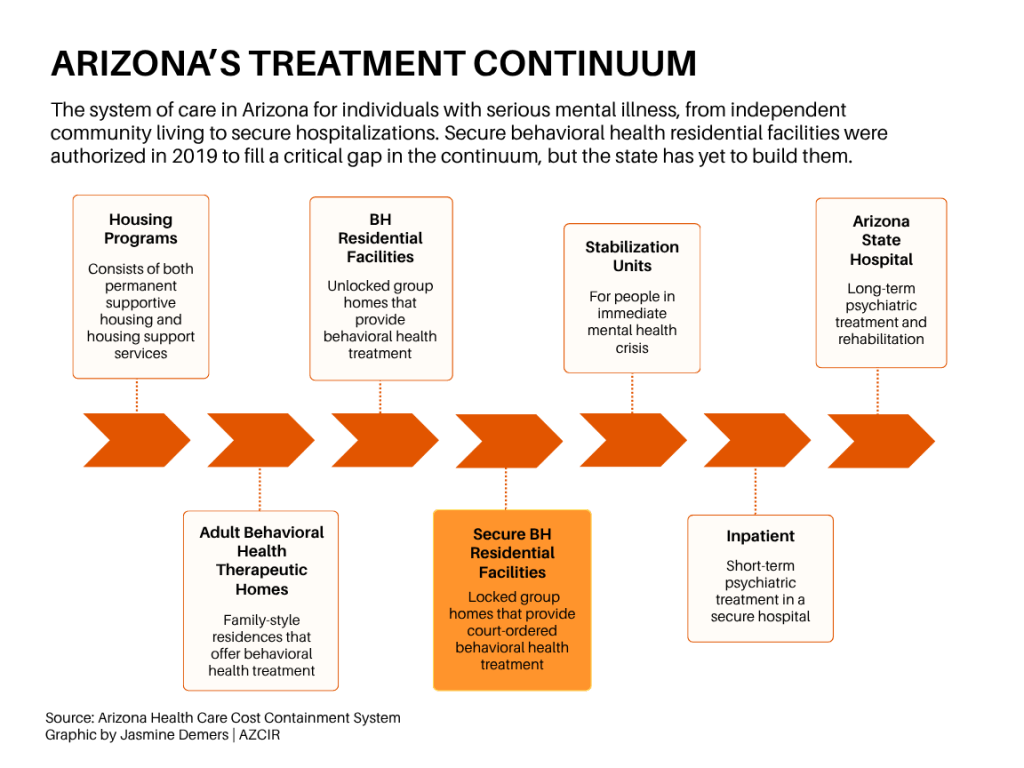
Unlike traditional residential facilities, patients could not simply walk out, giving them time to stabilize on medication, gain insight into their illness and ideally transition to a less restrictive setting. The homes, each capped at 16 beds, are meant for individuals under court-ordered treatment whose repeated hospitalizations, homelessness or arrests show they have been unsuccessful in less restrictive settings. Judges could authorize placements ranging from three to 12 months.
Under those criteria, Larry would have qualified for a placement. And his parents believe it could have made all the difference.
“In a secure environment and taking his meds,” Helen said, Larry “was a different boy.”
His parents saw that version of him one last time in the weeks before he died. During his final hospital stay at Aurora Behavioral Health, he was on clozapine, an antipsychotic medication primarily used for treatment-resistant schizophrenia. Larry was like his old self, they said—cracking jokes and discussing football, Carl’s Jr. and music.

"We talked about things that a normal couple of guys would talk about," his dad, Elvern, said.
A week later, he was gone.
Public records and interviews show Arizona’s effort to build secure facilities stalled after a series of setbacks.
AHCCCS awarded grant funding to a provider in 2020, but the project ran into delays finding properties, rising construction costs and budget constraints. After the provider failed to meet the terms of its agreement, AHCCCS halted the project and ended the contract in 2022.
Lawmakers approved $25 million for the construction of five secure facilities that same year, but the funding was pulled from the state budget after AHCCCS was unable to move the project forward. Attempts to restore that funding failed two years in a row. Instead, lawmakers approved a $5 million appropriation in 2025 for AHCCCS to restart the effort.
"We thought we could pass the law, and the agencies would get the rest done," Mozell said. "That's just not the truth. If you're going to get something done that actually builds a level of care in the system … you have to hold these agencies' hands."
The project hit another roadblock after county attorneys identified a pathway in the law that allowed people charged with a dangerous crime—and found mentally unfit to stand trial—to be placed in secure facilities alongside civil psychiatric patients. Mozell said providers were unwilling to participate until lawmakers passed a measure separating the two populations in 2025—a fix that cost the project another year.
Disability rights and civil liberties organizations have also long raised concerns that expanding secure or involuntary treatment could come at the expense of patients’ rights and due process.
"People with disabilities have the right to receive services in the least restrictive setting that's appropriate for their needs," said Asim Dietrich, a supervisory attorney at Disability Rights Arizona.
Citing shortages of community treatment teams and overburdened case managers, he contended that "if more resources were focused on home and community-based services, we likely wouldn't need the (secure facilities)."
Supporters of secure treatment say the due process concerns, while valid, mischaracterize how the facilities would actually work. By the time someone qualifies for placement, a judge has already determined that less restrictive options have failed and the legal standard for involuntary care has been met.
"More than any other place in the behavioral health system, there's going to be due process," Mozell said during a 2019 legislative hearing, as lawmakers considered creating the facilities.
Leslie Carpenter of the national Treatment Advocacy Center, which has long advocated for expanding involuntary treatment options for people with severe mental illness, thinks the debate has become too polarized. Both sides agree that community-based services need strengthening, she said, but for the sickest patients, secure treatment fills a gap that community care alone cannot close.
"A secure setting does not automatically have to be a bad setting," said Carpenter, the center’s senior legislative advocacy manager. “I would propose that the number of people we’re seeing in our prisons, in our jails, homeless and untreated, and in our graveyards—that’s much more carceral … than to be in a state facility that is meant to meet their needs."

Without secure residential facilities available, many of Arizona’s sickest mental health patients are trapped in a loop of emergency room visits, psychiatric hospitalizations and crisis care—a pattern that comes at a steep cost to the state.
Last year alone, AHCCCS spent more than $1.2 billion on behavioral health services for members with serious mental illness: about $20,000 per member, on average. A 2024 paper authored by Mozell and other mental health experts said those who would qualify for secure treatment visit emergency rooms five times more often than the general population and, when hospitalized, stay four times as long.
They said “it would be less costly, more therapeutic, and more humane for the person to spend this time in a secure, home-like setting.”
Experts say secure residential facilities could also help relieve a longstanding bottleneck at the Arizona State Hospital, the state’s highest level of long-term psychiatric treatment.
"There are people at … that highest, most secure level of treatment, that are ready for discharge if there was a place to put them,” said Will Humble, executive director of the Arizona Public Health Association.
Patients at the Arizona State Hospital stay an average of more than four years. In just the first month of the current fiscal year, discharge delays kept beds occupied for a combined 482 days by patients who no longer needed to be there. Those delays are especially significant in Arizona, which had the lowest rate of state-operated psychiatric beds for civilly committed patients in the nation as of 2023.
In April, seven years after Arizona authorized secure behavioral health facilities for people with serious mental illness, AHCCCS formally began its search for providers to build and operate them. But the agency still could not say when the facilities would open. AHCCCS told AZCIR that providers have to be selected and facilities must be developed, licensed and staffed before services can begin.
The progress came too late for Larry. He died before Arizona established the kind of care his family believes could have helped him.
His parents hold onto the memory of the son they knew—affectionate, fiercely competitive and always reaching for a guitar. Their “Larry Bear.”
On June 26, what would have been Larry’s 48th birthday, Helen brushed aside blades of grass from his headstone before laying a single red rose across the top. She rested her hand there for a moment, then reached up to take her husband’s.
"He's safe now," Elvern told her. "He's OK."
This article is published as part of the Mental Health Parity Collaborative, a national partnership between AZCIR and The Carter Center’s Rosalynn Carter Fellowships for Mental Health Journalism and other newsrooms throughout the U.S.
This article first appeared on Arizona Center for Investigative Reporting and is republished here under a Creative Commons Attribution-NoDerivatives 4.0 International License.