
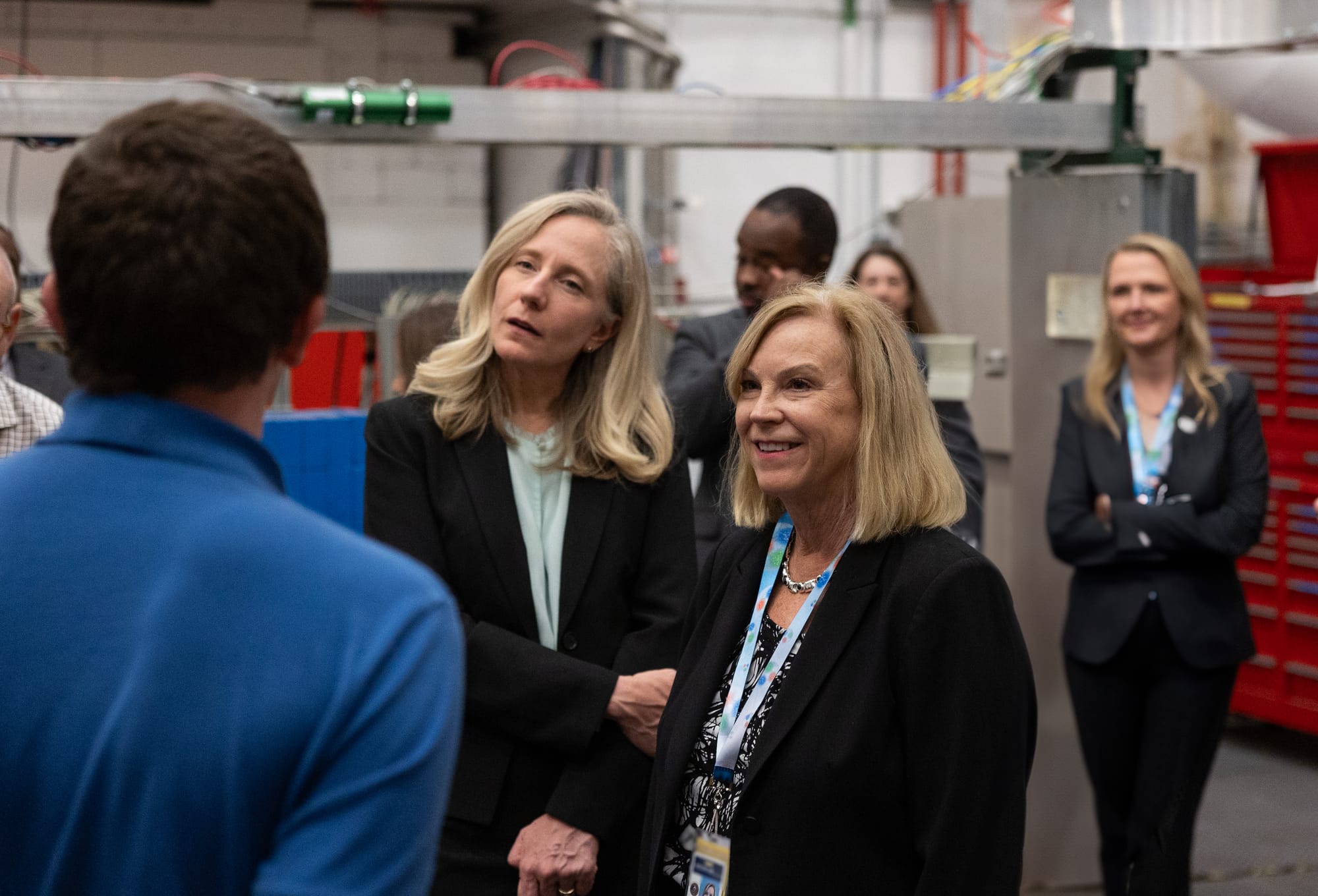
Spanberger to become Virginia’s first woman governor
Many across the country still awaiting SNAP benefits

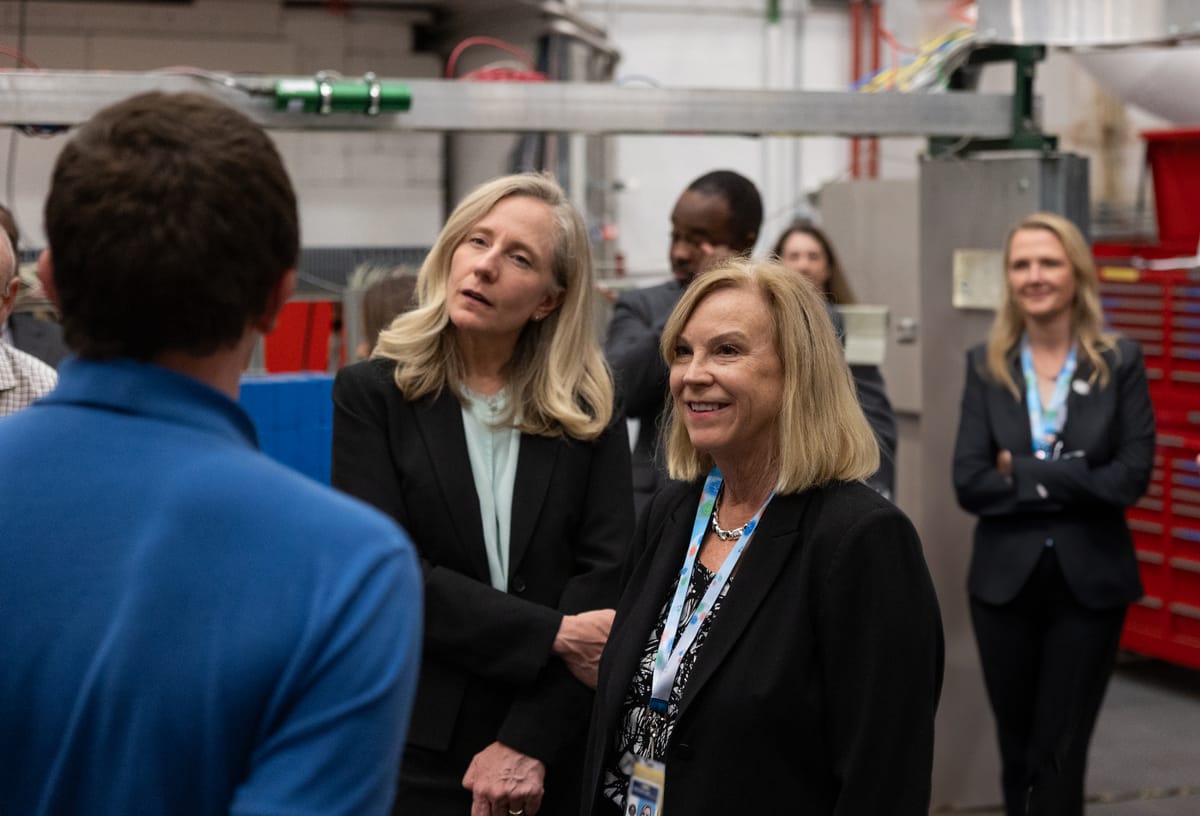
It's Friday, November 7, 2025 and in this morning's issue we're covering: Virginia House of Delegates Speaker Scott: Democrats plan to legislate with ‘restraint’ after decisive victoryHigh turnout for NC municipal elections as voters make themselves heard, “We don’t know what we’re going to eat”: Texans are still waiting for November SNAP benefits, Gavin Newsom’s Proposition 50 just passed. Here’s what happens next, SC congressional delegation donating, pausing paychecks amid government shutdown, Moore defends redistricting as effort to ensure fairness; Republicans prepare to go to court, The human cost of the Yuma’s vegetable empire, With SNAP Benefits Delayed, Fountain House Clubhouses Scramble to Feed Hungry Members, Republican Barbour and Democrat Thompson both praise legacy of former VP Cheney, Generous community support not nearly enough to fill gap in SNAP funding, food advocates say, As SNAP benefits are slashed, renovated Sandhills food bank braces for surge in need.
Media outlets and others featured: Cardinal News, Carolina Public Press, The Texas Tribune, CalMatters, South Carolina Daily Gazette, Maryland Matters, Cronkite News, MindSite News, Mississippi Today, Asheville Watchdog, North Carolina Health News.
Speaker Scott: Democrats plan to legislate with ‘restraint’ after decisive victory
Del. Don Scott said the Democratic caucus plans to legislate responsibly to avoid government “overreach” after this week’s election saw the party grow its majority by 13 seats in the chamber. Also, Gov.-elect Abigail Spanberger names her transition team.
by Elizabeth Beyer November 6, 2025
Democrats in Virginia’s House of Delegates grew their majority by a margin not seen in nearly 40 years after Tuesday’s election. Regardless, the caucus leader, House Speaker Don Scott, vowed during a press conference Wednesday morning that the party would wield its legislative power “responsibly.”
The Democratic majority in the House of Delegates now stands at what Scott, of Portsmouth, called a “historic, unbelievable” 64 seats. Democratic candidates ran in all 100 House districts and picked up five districts that were won by President Donald Trump in 2024, he added.
“This is what a mandate looks like,” Scott said. “We’re going to keep focused and we’re going to remain disciplined. The word of the day now is ‘restraint.’ We can’t overreach. We have to be restrained, we have to be wise with the gift that the voters have given us, to govern.”
He pointed out that voters are interested in kitchen-table issues and protecting democracy.
“We’re going to listen to the voters — they already told us what our priorities should be,” Scott said.
Those priorities include lowering the cost of housing, health care, making schools safe and protecting public safety, among others, he added.
Del. Dan Helmer, D-Fairfax County, chair of the campaigns committee in the House Democratic caucus, said the party approached the 2025 election like a military campaign. From recruiting and training candidates to collecting a “dragon’s hoard” of resources, the caucus was able to raise over $30 million, nearly tripling what was raised in 2021, he said. Republicans were outspent in the television and online ad space two to one in the final weeks of the campaign, he added.
“We ran the biggest battleground campaign in modern history, the biggest field campaign in modern history,” Helmer said.
Youngkin vows to support Spanberger as he prepares to leave office
Outgoing Republican Gov. Glenn Youngkin congratulated Democratic Gov.-elect Abigail Spanberger and vowed to support her as she builds her transition team and prepares to take office, during another press conference that took place earlier Wednesday.
“We will support her in that process, so that she and her team can hit the ground running,” Youngkin said. “She will step into a Virginia that is stronger than it’s ever been.”
The governor-elect on Wednesday announced her transition team, which includes former Democratic Congressman Rick Boucher of Abingdon, who represented Virginia’s 9th Congressional District from 1983 to 2011, as an honorary co-chair.
Youngkin stopped short of calling the outcome of Tuesday’s election a referendum on the Trump administration, but he did say that the ongoing federal government shutdown was a “big, big challenge” that may have influenced voters in a state that has a large population of federal workers.
Virginia’s off-year statewide elections are often considered a bellwether for how the midterm elections may go, as well as a referendum on the current presidential administration.
Youngkin said, when asked by a reporter, that he did not believe the outcome of the statewide election was a referendum on his own administration.
“I believe that Virginians thoroughly support what we’ve been doing. I mean, at the end of the day when people say ‘Is the state heading in the right direction?’ people say ‘Yes,’” he said.
Youngkin’s job approval rating hovered around 50% between August and October, according to a poll released by Roanoke College on Oct. 30. That same poll saw the governor’s disapproval rating decline by 7 percentage points.
Spanberger, a former congresswoman, defeated Republican Lt. Gov. Winsome Earle-Sears in a decisive 15-percentage-point victory.
Term limits for Virginia’s executive office are bound by the commonwealth’s constitution: A governor may not serve two consecutive terms.
 Elizabeth Beyer
OPINION: 13 reasons why Spanberger and the Democrats won so big. Trump is just one of them.
High turnout for NC municipal elections as voters make themselves heard
by Sarah Michels, Carolina Public Press
November 5, 2025
Diana Medoff passed out pamphlets to Durham voters Tuesday afternoon at Cole Mill Road Church of Christ, her third stop of the day. Medoff, a candidate for Durham City Council Ward III, used to teach third grade, when students learn about their city. She taught them about Durham’s development, and how it wasn’t always done well — for example, when the city’s construction of the Durham Freeway displaced Black communities and businesses in the 1970s.
Today, Durham is once again facing growth. This time, Medoff thinks the city could handle it differently. It can shape inevitable population growth in a smarter way, she said.
[Subscribe for FREE to Carolina Public Press’ alerts and weekend roundup newsletters]
“There were promises that just weren't kept about rebuilding homes and businesses, and so there's a lot of people here that fear growth and change, because they're thinking, ‘We're going to get kicked out,’” she said.
Medoff echoed the concerns of many North Carolina voters who traveled to the polls for Tuesday’s municipal elections. How to address population growth was on the minds of nearly every voter, from Greensboro to Apex, who spoke to Carolina Public Press.
North Carolina voters in 447 municipalities and 88 counties elected mayors, city councils, boards of education, boards of commissioners and voted on a few ballot referendums. According to an analysis from Western Carolina University political science professor Chris Cooper, about 39% of North Carolina voters were eligible to vote.
Each municipality’s election was defined by its own local issues, candidates and drama. At stake is who will lead those communities for the next two, three or four years. Election winners will guide tax policy, development and growth, education policy and budgetary decisions.
Many of North Carolina’s municipal elections are nonpartisan — although that doesn’t stop electioneers from each political party outside the polls passing out sample ballots with their recommended candidates.
“Off-year elections historically predict the policy issues, partisan enthusiasm and voter turnout statistics for the upcoming midterm elections,” Common Cause President Virginia Kase Solomón told CPP.
Turnout strong for off-year
Not all municipalities in North Carolina conduct elections at the same time, or in the same years, so turnout is not quite an apples-to-apples comparison.
Nonetheless, turnout was up from previous municipal elections Tuesday. That’s not saying much. From 2015 to 2023, municipal turnout ranged from 14% to 17% of registered voters.
Tuesday, more than 19% of registered voters turned out.
Early voting and absentee mail-in voting numbers were strong. As of Monday afternoon, nearly 222,000 ballots had been accepted by county boards of elections, according to State Board of Elections spokesperson Colin Loftin.
Since fewer voters generally show up in off-year elections, close races are much likelier.
Since voters who forget their photo ID or have some other issue that prevents them from casting an official ballot are allowed to cast provisional ballots and fix the issue before the county canvass, all Election Night tallies are unofficial. Provisional voters have until Friday at noon to fix any issues, and county boards of elections will meet Nov. 14 to certify the official results at their canvass meeting.
Durham council and mayor races
Diana Medoff didn’t win. Current councilmember Chelsea Cook defeated her by 49 percentage points. Neither did Anjanee Bell, who challenged current Durham Mayor Leo Wiliams along the same lines as Medoff — smarter, slower development that includes more affordable housing and input from Durham’s Black community. She lost by about 15 percentage points.
Even so, Durham residents will see change in their council makeup as incumbent councilmembers DeDreana Freeman and Mark-Anthony Middleton lost to their challengers, Matt Kopac and Shanetta Burris.
Williams, Middleton and fellow councilmember Carl Rist have almost always approved pro-development zoning changes, according to analysis by the Durham Dispatch. Freeman, Cook and Councilmember Nate Baker have voted in favor of them only about two-thirds of the time.
Kopac and Burris appear poised to join Cook and Baker in development discussions, which may create a more evenly divided council.
One Durham woman who talked with CPP at the polls on Tuesday said her priority was affordable housing and “not selling out to developers.”
Another voter, Chris Williams also cited affordable housing as a top issue, but had another concern: Immigrations and Customs Enforcement.
Two weeks ago, Durham Food Hall shut down for several days after an ICE recruitment ad appeared on one of its screens, according to News & Observer reporting. Durham is home to many immigrants, and the national uptick in immigration enforcement is a tense subject.
“Our local governments are the ones that fight — the last line of defense between us and the presidential administration,” Williams said.
Greensboro council and mayor contests
Greensboro elected a new mayor on Tuesday. Current mayor Nancy Vaughan did not run for reelection, so voters had a blank slate.
They chose Marikay Abuzuaiter, the current mayor pro tem, over Robbie Perkins, former Greensboro mayor and current commercial brokerage businessman.
Voters also chose five members of the Greensboro City Council. Several incumbent city council members lost to challengers, signaling a desire for change.

In District 1, Crystal Black defeated incumbent Sharon Hightower. In District 3, April Parker bested current councilmember Zack Matheny. Incumbents did not run in Districts 2 and 4, where Cecile Crawford and Adam Marshall were elected, respectively.
The only Greensboro City Council seat that remains the same is District 5, where Tammi Thurm won reelection with 68% of the vote.
Tuesday, voters said property taxes, affordable housing and bringing business to Greensboro were top issues.
Voters Morgan and Christopher Drazek told CPP on Tuesday that they wanted their vote to balance out national politics.
“Seeing more of a liberal government at a local level, considering the broader scope of the United States right now, is something that is important,” Morgan Drazek said.
Apex council voting
While Apex Mayor Jacques Gilbert was not on the ballot Tuesday, a lot of newcomers were competing in the Town Council race.
A pair of councilmembers, Brett Gantt and Audra Killingsworth, told IndyWeek they were not running for reelection partly due to difficulties working with Mayor Gilbert, particularly on zoning, development and appointment issues. They were especially concerned about one Town Council candidate, T.J. Evans, Gilbert’s daughter’s partner.
They need not worry any longer. Evans did not place in the top three vote-getters Tuesday. Sue Mu, Shane Reese and incumbent Ed Gray all earned 22% of the vote, beating out the other five candidates.
Apex voters who talked with CPP didn’t specifically mention the tension between the mayor and the Town Council, but they shared concerns over development and growth.
One Apex couple who has lived there for 17 years said they had seen a lot in their time in the once-small Wake County town. They feel a loss of community as the town has grown. People don’t feel as connected as they used to be, they said.
“It’s hard to have that sense of community, I think, when you’re getting so large,” the wife said.
She added that growth is inevitable and could boost the town’s tax base, but wants the town council to stop letting just anyone come in and build a six-story apartment.
“They need to find a balance,” she said.
Voter Kevin Fitzgerald agreed. He hopes his vote helps stop a data center from locating in Apex.
“Things have been changing,” he said. “The growth has gotten disproportionate, and data centers seem to be all over the place now. So, it's time to take a stand.”
Charlotte tax passes
In Charlotte, 52% of voters approved a 1-cent sales tax increase to pay for transit improvements.
The rate hike would amount to a $240 annual tax increase for the average Charlotte household. It would raise about $20 billion over the next three decades to be used to improve rail and bus services, roads, sidewalks and bike lanes.
Charlotteans have disagreed over whether the transit board that will decide how to use this money will spend it in the most equitable way, or include the people who rely on public transit the most.
Also in Charlotte, Democrats predictably swept the mayoral and city council elections, with the exception of unchallenged Republican Ed Driggs, who will keep his District 7 seat. In Charlotte, the primary election tends to decide the overall winners. The only competitive race was in District 6, where Democrat Kimberly Owens defeated Republican Krista Bokhari, the wife of a former councilmember who went to work for the Trump administration.
Fayetteville sticks with incumbents
In Fayetteville, there were few surprises.
Mayor Mitch Colvin handily won reelection against challenger Kathy Keefe Johnson.
Incumbent councilmembers Malik Davis, DJ Haire, Lynne Greene, Derrick Thompson, Brenda McNair and Dono Hondros won in Districts 2, 4, 5, 6, 7 and 9, respectively.
In districts with no incumbents running, Stephon Ferguson, Antonio Jones and Shaun McMillan beat their opponents.
Wilmington council election amid allegations
In the week before Election Day, an alleged scandal broke in Wilmington.
The North Carolina Republican Party claimed to have evidence of a vote-buying scheme involving three Democratic City Council candidates. The North Carolina State Board of Elections is aware of the allegation, according to WUNC.
While Republican City Council candidates Luke Waddell and Richard Collier outraised their opponents by tens of thousands of dollars, per a WHQR and WECT analysis, Democrats JC Lyle, Cassidy Santaguida and Chakema Clinto-Quintana took the top three spots in the election.
None were incumbents. Waddell and another incumbent candidate, Clifford Barnett, were pushed out of their seats.
However, one incumbent did win — Wilmington Mayor Bill Saffo. Saffo earned nearly 50% of the vote against two opponents.
To check results for these races, or any of the other hundreds of races, visit the State Board of Elections website.
Correction: This article has been updated to show that Durham City Council members Freeman, Cook and Baker have voted in favor of development issues about 2/3 of the time according to Durham Dispatch analysis. An earlier version of the article described this analysis inaccurately.
This article first appeared on Carolina Public Press and is republished here under a Creative Commons Attribution-NoDerivatives 4.0 International License.

“We don’t know what we’re going to eat”: Texans are still waiting for November SNAP benefits
by Colleen DeGuzman and Jess Huff, The Texas Tribune
November 5, 2025
AJ Wark, a third-year maritime studies student at Texas A&M University at Galveston, started the fall semester on food stamps. In May, her parents kicked her out of their home after she came out as a member of the LGBTQ+ community, taking away her car and money that helped pay for textbooks and other essentials.
But now that her food stamp account sits empty, the 21-year-old has yet another expense to worry about — how to pay for her next meal.
“There are these social safety nets that are supposed to be in place to help stay stable, but now we’re seeing them taken away,” Wark said. “I never thought this would happen.”
Wark is among 3.5 million Texans — including 1.7 million children — on the Supplemental Nutrition and Assistance Program, also known as SNAP, who have become political collateral as the country’s leaders waffle over how to fund benefits for the month of November.
On Friday, two federal judges ordered the Trump administration to fund SNAP after states were notified last month that the USDA wouldn’t be able to pay out benefits because the federal government is shut down. Although the president suggested on social media Tuesday that SNAP wouldn’t be funded until the government reopens, USDA has said it will pay at most half of what people would typically receive for the month.
As of Wednesday, Texans still haven’t seen any November SNAP benefits, which could take days to roll out.
“It's not just numbers,” Wark said. “It's actual people with lives, people with mouths... it's people who have jobs…who have children, and I think that really gets lost on politicians."

In SNAP’s 60-year history, recipients — 40 million of them today — have never gone without a monthly payment. Lawmakers in Congress have been locked in a stalemate since Oct. 1, causing the longest government shutdown on record. Democrats are demanding that Congress address expiring health insurance subsidies and Republicans are refusing to negotiate until the government reopens.
SNAP offers critical federal food assistance to the nation’s poorest citizens, and although many have been bracing for the program’s pause, Democrats in the state Legislature warned Gov. Greg Abbott of the long-term effects on the state: “Suspending federal benefits could intensify an already critical demand for food assistance across Texas,” senators wrote in a letter to Abbott last week, urging him to allocate state funds to support SNAP recipients.
Without the safety net designed to help the country’s poorest put food on the table, many Texans, whose situations range from single parents trying to make ends meet to college students like Wark, were starting to ration food and preparing to skip meals.
A petition on Change.org demanding that Congress pause lawmakers’ salaries and benefits throughout the shutdown has received more than 150,000 signatures. The petition says that “Government shutdowns are not just political games — they disrupt lives, harm communities, and erode public trust.”
“I'm not the only student on campus who's going to be impacted”
Wark usually gets her SNAP payments on the second day of the month, and as of Tuesday, her Lone Star Card was empty. On top of stressing about exams and homework, Wark is now worried about how she’s going to pay for food.
When Wark first learned that SNAP was being paused, “the first thing that I started doing was crunching numbers in my head to try to figure out how I would make it work, where I could go for food, what I could hold off on,” she said.
Wark is a financial aid adviser for students on campus, but working just 20 hours a week for $10 an hour isn’t enough to cover everything — especially now that her parents no longer financially support her. Wark, who grew up in Grandbury, southwest of Fort Worth, said SNAP helped her maintain a balanced diet during her transition to being independent.
“SNAP has been the difference between canned chicken, instant rice and Pop Tarts, to things like vegetables and actual meats,” she said.
Wark loves mushrooms and tries to put them on any dish she can. “I'll put mushrooms in anything, tacos, mushrooms, you name it,” she said. But canned foods are cheaper, so until SNAP resumes, she’s planning to rely mostly on canned meats and vegetables.
She’s also planning to visit her campus’ food pantry more often, which she’s noticed has been lower on food than before.
“I'm also kind of worried, specifically for the food pantry because I'm sure that I'm not the only student on campus who's going to be impacted by this,” said Wark.
To make up for the food stamps she’s not getting this month, she’s planning to cut out some of the hygiene products she usually purchases, like shaving products. Since she’s moved out of her house, she’s been needing household items such as clothing hangers — but she said those things can wait.
“It's just kind of whatever I can take, you know,” Wark said. “Whatever I can put in my mouth, pretty much at this point.”
“We’re families who are just trying to feed our kids”
Sarah Jones is a 44-year-old mother of two teenagers in Liberty County. A seamstress by trade, she has struggled to make ends meet for more than a decade since Hurricane Ike hampered her small business in 2008. She has relied on food stamps to feed her family in a local economy with few jobs that fit her skills. She has been staring down a month of hunger while news reports go back and forth on when or how she will get her benefits.
“We’re not bums sitting around getting handouts,” Jones said. “We’re families who are just trying to feed our kids and they’re making it extraordinarily hard.”
Jones has been out of the traditional work force for more than a decade. She has filled out applications for any local job that would take someone with limited experience, but even being a janitor or Walmart shopper have been out of reach. Recently, she began running deliveries for a local florist, which helps a little.
Her story isn’t unique.
Liberty County, which had about 108,000 residents in 2023, sits between Houston and Beaumont. More than half of Liberty County’s households are either impoverished or considered working poor, according to the United for ALICE.
For most of Liberty County’s existence, the primary industry has been agriculture, according to County Judge Jay Knight. But that has been changing, and he’s trying to bring new jobs into his county, but that work is slow.
“Most of our people who live in Liberty County go out of county to work,” Knight said. “They go to the Houston market or to the refineries and oil companies down south of our county.”
Jones can’t do that. Her 2004 Mazda that shakes when she drives faster than 60 mph wouldn’t make it far from home. Plus, the jobs she could get to wouldn’t pay enough to warrant burning gas. To move out of Liberty County would mean to leave her village and her rent controlled housing and it wouldn’t guarantee employment.
It is difficult to stock up on food with a 15-year-old and a 16-year-old. So when the SNAP payment didn’t arrive on Saturday, Jones and thousands of her neighbors turned to each other for help. She had been working out a meal sharing program with her neighbors and they have discussed ride-sharing to food banks.
Jones built a career making costumes, clothes and quilts. But in 2008, life hit hard and fast. She was dealing with a tough pregnancy with complications when Hurricane Ike wrecked many East Texas communities — and took her customer base and business with it.
Seeking SNAP benefits was supposed to be a short term solution.
“I was so determined. I wasn't going to abandon [my business], I was not going to drop it,” Jones said. “But the economy just suddenly got worse, especially for things that people don't necessarily need, those luxury items.”
Jones then became the primary caregiver for her mother and took custody of her niece. To save money, she kept the kids home from day care. But that meant she had to stay home, too. She took whatever odd sewing or crafting jobs that came her way.
When COVID-19 struck, it culled the number of people willing to pay for handmade goods. Jones began submitting job applications wherever she could. There were 3.4 million other jobseekers at that time.
Little has improved since. The family of three still lives month to month, saving what they can because they know good months won’t last.
Jones has kept her expenses minimal. She developed a personal relationship with her landlord, built on trust that has kept her rent low. She tracks utility usage and only pays for streaming services on good months, when she brings in more than $1,200 from her crafts. But those months are not regular. She runs her household on less than $2,000 a month, including $700 a month in SNAP benefits, which barely meets the needs of her growing children.
“It's gonna affect a lot of people”
When Edinburg resident Navitidad Noriega learned that she wasn’t going to get food stamps this month, her first thought was about how grateful she was that this was happening during the school year — at least she knows that her two eldest kids will be getting breakfast and lunch.
Noriega is a mother of four, her oldest is 7 and her youngest is just a year old. Since her husband became incarcerated last year, SNAP helped her put food on the table. She usually gets around $1,200 for groceries every 11th day of the month.
Noriega said she’s going to be relying on her local food bank more than before, but she’s worried it’s not going to be enough.
“I’m not sure how I’m going to do it, maybe I’ll get a job but then everything would mostly go toward daycare,” Noriega, 29, said.
Edinburg is a city in the Rio Grande Valley, where the percentage of residents who receive SNAP benefits is the highest in the state. Around 28% of households in Hidalgo County, which includes Edinburg, are SNAP recipients.
The Rio Grande Valley is a heavily Latino community, and in Texas, 1 in 4 Latinos are experiencing food insecurity, according to Feeding Texas. The overall food insecurity rate for Latinos in Texas is 24%.
“It's gonna affect a lot of people also, not only me,” she said. “There's a lot of single mothers, people that have disabilities.”
To reserve money just for the essentials, she will forgo the items that typically put a smile on her kids’ faces — cookies, juices and treats.
She’s planning to make her kids sopa de fideo, a low-cost Mexican noodle soup, more often than before. “Whenever I'm having a hard time or whatever, that's what I make,” Noriega said.
“We would always go without food to feed our son”
Amber Harrington doesn’t know what she’s going to feed her 7-year-old son, Xavier, this week. He is autistic with high needs that will likely last his whole life. Because of his disability, Xavier has an extremely sensitive palate and can only eat certain foods.
“Even when he tries different foods, he gags on it because of the different textures,” Harrington said.
To accommodate that, she and her husband have often gone hungry to make sure the pantry is stocked with foods Xavier can eat. When they were finally accepted on to SNAP last year, after years of applying, it gave them a moment of relief. They appreciated their bellies being full for the first time in years.
Harrington’s husband is a full-time custodian at the high school in Onalaska, a town of 3,300 about 85 miles north of Houston. Amber is a part time cashier at the local pizzaria, Simple Simons. She works part time because it allows her to care for Xavier after school.
Harrington struggles with what she has seen online when people criticize the way SNAP benefits are used. She does believe people need to eat healthier and she does her best. But, the small family also spends some of their benefits on cheesy balls and Goldfish crackers because those are some of the only things Xavier will eat.
Now, Harrington worries all three of them will go hungry.
“We would always go without food to feed our son,” Harrington said. “Our son's the only one that eats sometimes. It was hard, but when we got the food stamps it helped out greatly. My husband and I got a chance to eat. Now that they're cutting it off, we don't know what we're going to eat.”
Without considering groceries, the couple’s monthly spending sits around $1,500 a month. They rent a house for $850 a month, pay about $140 a month for electricity and another $250 a month for car insurance. They normally receive about $300 a month in SNAP benefits, and they make it stretch.
“We sometimes have to wait till my husband gets paid on the 15th, because that's when he gets a good check and we have to buy food on that check,” Harrington said. “If we don't get that check, we don't have food.”
The Harringtons will go hungry again if benefits don’t resume. They tried to make a plan and save for the shutdown, but then the truck loan payment came due and it had to be paid. They can’t access community food banks because they’re only open when one of them is at work. And they can’t ask family for help, because many of their family members are in the same boat.
They splurged and bought a small turkey breast for $12 last week to put in the freezer for Thanksgiving.
When she checked on Monday, Harrington’s SNAP deposit was still listed as “delayed.”
Disclosure: Feeding Texas has been a financial supporter of The Texas Tribune, a nonprofit, nonpartisan news organization that is funded in part by donations from members, foundations and corporate sponsors. Financial supporters play no role in the Tribune's journalism. Find a complete list of them here.
This article first appeared on The Texas Tribune.

Gavin Newsom’s Proposition 50 just passed. Here’s what happens next
By Maya C. Miller, CalMatters

This story was originally published by CalMatters. Sign up for their newsletters.
Three months ago, conventional wisdom suggested that Gov. Gavin Newsom’s redistricting plan faced a brutal uphill battle amid an impromptu 10-week campaign sprint.
But within minutes after polls closed at 8 p.m. Tuesday, The Associated Press and national news networks had already proclaimed that Proposition 50 would pass handily, with voters agreeing to temporarily suspend California’s independently drawn maps and adopt ones gerrymandered in favor of Democrats.
Prop. 50’s landslide victory proved that Newsom and his allies bet correctly on pitching the measure as a countermaneuver to gerrymanders by Republican states such as Texas and an act of resistance against President Donald Trump.
It also spells the beginning of the end for several of California’s Republican House members, who now must make the unpleasant calculation of whether to run in their current district, switch to a new seat or drop out entirely — questions they could previously dodge under the guise of “Prop. 50 won’t pass.”
But it’s not yet clear how widely Prop. 50’s influence will stretch outside of California. The five-seat gain for Democrats could offset at least some redistricting efforts in Republican states, although Republicans stand to gain more seats from an all-out redistricting arms race.
Then there’s the looming possibility that the U.S. Supreme Court will outlaw the use of race in the redistricting process, which could give Republicans a major advantage in Southern states.
Opponents also haven’t given up, despite losing at the ballot box.
Just over 12 hours after polls closed, California Republicans announced a lawsuit challenging Prop. 50 in a Fresno-based federal court on the grounds that it violates the 14th and 15th Amendments by drawing districts that favor Latino voters at the expense of other ethnic and racial groups.
All the while, incumbents and challengers on both sides of the aisle are scrambling to mark their turf in whichever newly drawn district they think will give them the best chance of winning, which could lead to some tense and expensive intra-party matchups.
As all eyes turn to 2026, here are five key takeaways from Prop. 50’s success and what comes next:
Democrats leveraged Trump and national politics
Newsom repeatedly told Californians that a vote for Prop. 50 was a vote against Trump.
It worked.
Droves of Democratic voters who were hungry to “do something” meaningful to fight back against what they perceived as an out-of-control Trump administration weighed in on a single-issue ballot measure. With thousands of outstanding ballots still to count, the measure was leading by a 64% to 36% margin Wednesday. Secretary of State Shirley Weber said there was “huge turnout” in person Tuesday night, with long lines wrapping around buildings at many polling sites.
The nationalization of the campaign, which harnessed many Californians’ palpable fear of and disgust with the actions coming out of Washington, drowned out the good governance case that Prop. 50 opponents tried to push.
Absent the “Trump effect,” an argument against gerrymandering likely would have played well in California, a state that just 15 years ago voted to take map-drawing powers away from politicians and give them to citizens.
The opposition lacked money and a clear message
While the Yes campaign focused on antagonizing Trump, the opposition steered clear of the president and settled instead on a California-focused good governance message that avoided national politics altogether.
To Cathy Abernathy, a Bakersfield-based Republican political operative and longtime mentor of former Speaker Kevin McCarthy, that was a big mistake.
“The word was, ‘Well, don’t make it about Trump,’” Abernathy said. “Why in the world aren’t we making it all about Trump?” she added. “Trump didn’t even campaign here for president and got 40% of the vote.”

Abernathy also criticized the state Republican Party for its sloppy get out the vote mailing blitz, which wasted precious money by failing to target only voters who hadn’t yet returned their ballots, sending mailers to thousands of people who had already voted. She placed the blame on consultants who cared more about making money than winning elections.
“I just don't think there's respect for the money donated to the party by the people that are spending the money,” she said.
Let the musical chairs begin
Now that voters have approved Prop. 50, a major shuffle is underway as some incumbents scramble to preserve their careers in newly redistricted seats while challengers jockey for the chance to unseat them.
Five congressional Republicans in California, Reps. Doug LaMalfa, Kevin Kiley, David Valadao, Ken Calvert and Darrell Issa, face much steeper challenges to retaining their seats. And on the defensive side, five incumbent Democrats — Reps. Adam Gray, Josh Harder, Dave Min, Derek Tran and George Whitesides — have seen their seats grow safer.
Among the incumbents switching districts is Calvert, who for more than 30 years has represented a Riverside County district that was redrawn eastward into Los Angeles County. He announced Wednesday that he would instead run for reelection in the neighboring 40th District, setting up an intraparty showdown with fellow incumbent Republican Rep. Young Kim. Kim upped the stakes Wednesday by announcing that her campaign has already placed a $3.25 million ad buy in advance of the June primary election.
On the Democratic side, Rep. Ami Bera announced he would challenge Kiley in the newly gerrymandered 3rd District, which encompasses Sacramento suburbs. That in turn prompted Dr. Richard Pan, a former state senator and a pediatrician who had already declared his candidacy, to relocate to the newly drawn 6th District to avoid a tough primary battle with a well-known incumbent.
Legal challenges could change the maps again
California Republicans on Wednesday sued to block the Prop. 50 map, as they previously did twice, unsuccessfully, when the proposal was still on its way to the ballot.
The suit, funded primarily by the National Republican Congressional Committee, claims the map causes “stigmatic and representational injury” by placing certain candidates, such as Republican Assemblymember David Tangipa of Fresno, who is Polynesian, into districts drawn with a specific racial or ethnic minority group in mind.
“The map is designed to favor one race of California voters over others,” said Mike Columbo, an attorney for the Dhillon Law Group, the firm founded by Harmeet Dhillon, assistant attorney general for civil rights in Trump’s Justice Department.
Dhillon’s firm, along with the California Republican Party and Tangipa, is suing Newsom and Weber, asking a three-judge panel for a temporary restraining order before Dec. 19, the date when candidates can start collecting signatures to get their names on the 2026 primary ballot.
Legal scholars say the case faces long odds. The plaintiffs would have to prove that the primary intent of the map drawers – and California voters who approved Prop. 50 — was to racially gerrymander without proper evidence of racially polarized voting.
“It would be a very hard case to win,” said Emily Rong Zhang, an assistant professor of law at the University of California at Berkeley School of Law. “But if the Supreme Court changes the law, then the likelihood of success here might be higher.”
The justices are weighing Louisiana v. Callais, on whether to strike down the part of the Voting Rights Act that requires creating districts in which racial and ethnic minorities have a chance to elect their preferred candidate. That could render both the Prop. 50 maps and those drawn by the independent redistricting commission unconstitutional.
Supporters of Prop. 50 have repeatedly said their maps will hold up to legal scrutiny. Paul Mitchell, the data consultant whose firm drew the lines, said the group in many cases hewed closely to configurations proposed by the citizens redistricting commission. An analysis by the nonpartisan Public Policy Institute found the new maps largely kept communities together.
Regardless of how SCOTUS rules, other states are still deciding whether to weigh in on the redistricting wars. Republicans in Kansas recently dropped an attempt to redraw their district lines, citing a lack of support. Maryland Gov. Wes Moore, a Democrat, announced Wednesday that he was forming a committee to propose new congressional maps to eliminate the state’s one safe Republican seat, held by Rep. Andy Harris, who leads the ultra-conservative House Freedom Caucus.
This article was originally published on CalMatters and was republished under the Creative Commons Attribution-NonCommercial-NoDerivatives license.
SC congressional delegation donating, pausing paychecks amid government shutdown
by Jessica Holdman, SC Daily Gazette
November 4, 2025
At least five GOP members of South Carolina’s congressional delegation have asked to have their salaries withheld until the ongoing federal government shutdown finally comes to an end.
Two more congressmen — Sen. Lindsey Graham and Rep. Ralph Norman — opted to forgo their pay entirely, instead donating it to charity. And two others did not respond to calls or emails from the SC Daily Gazette.
Under federal law, the president, Congress and federal judges all receive regular paychecks during shutdowns, unlike the 2 million civilian government employees and thousands of congressional staffers.
Members of Congress have the option to receive their pay as normal, donate it to charity, give the money back to the Treasury to buy down the federal debt, or have their checks withheld. They will get backpay when the shutdown ends, like other federal workers who don’t get an option.
Congress members’ base salary is $174,000 annually, or $14,500 a month.
Pay withheld
In separate statements to the SC Daily Gazette, five of South Carolina’s Republicans on Capitol Hill said Congress should not get paid while federal employees and families across the country go without because of the ongoing stalemate, but they will collect when it’s over. Those statements came from U.S. Reps. Sheri Biggs, Russell Fry, Nancy Mace, William Timmons and Joe Wilson on Tuesday, 12 days after federal workers missed their first full paycheck since the shutdown began Oct. 1.
“I’ve refused my paycheck during the shutdown because if our troops, border agents, and essential workers aren’t getting paid, I shouldn’t either,” said Biggs, whose conservative 3rd Congressional District spans 11 counties from Edgefield County on the Georgia border to the state’s northwest corner.
“Public service means putting others first, and I’ll always stand with the hardworking Americans who keep this country running,” she added in a statement.
GET THE MORNING HEADLINES.SUBSCRIBE
Wilson pointed to his pledge on social media at the onset of the shutdown.
“A government shutdown is irresponsible,” he posted Oct. 1, noting he voted with Republicans on the stopgap spending bill that cleared the House. “In solidarity with those Americans who feel the financial hardships of this ill-advised vote, I will not accept my own government salary until this government shutdown is over.”
The 2nd District congressman said he’s followed through with that pledge.
Democrats and Republicans have pointed fingers, each blaming the other for prolonging the shutdown.
Republicans in the House passed a stopgap spending bill Sept. 19 that would have kept government running at then-current levels through Nov. 21. Republicans in the Senate can’t pass that on their own because their narrow majority can’t reach the chamber’s required 60-vote threshold. The measure failed in the Senate for a 14th time Tuesday on a 54-44 vote. Graham and Sen. Tim Scott were again among the “yes” votes.
Democrats are holding out for a permanent extension of enhanced federal tax credits that buy down the cost of health insurance in the online marketplace created by the Affordable Care Act, commonly known as Obamacare. Initially approved during the pandemic, those enhancements that make private health insurance affordable are set to expire Dec. 31. Republicans contend the government must open before those negotiations begin.
“While Senate Democrats play politics and hold the government hostage, Congresswoman Mace refuses to collect a dime until our troops and federal workers get the pay they’ve earned,” according to a statement from the coastal 1st District representative’s office. “She voted to keep the government open and won’t take her salary until theirs is restored.”
Active-duty military actually have continued to receive a paycheck. President Donald Trump ordered the U.S. Department of Defense to repurpose money to keep those dollars flowing — at least for now.
To make the troops’ most recent payday, the defense agency pulled $2.5 billion from a military housing fund included in Republican’s “One Big Beautiful” spending package passed earlier this year. In addition, $1.4 billion came from military research funds and another $1.4 billion came from an account that pays for the building of U.S. Navy ships.
A constitutional push
Graham and Norman, both Republicans, have each introduced a constitutional amendment in their chamber that would do away with congressional pay in any future shutdown. There would be no back pay to members of Congress. Instead, their pay would automatically go to the Treasury.
Fourth District Rep. Timmons, of Greenville; and 7th District Rep. Fry, of Horry County, also voiced support for the idea.
Congress has voted several times over the years to officially withhold members’ salaries during a shutdown, but none of the proposals passed.
A measure to change the Constitution likely stands even less of a chance. The process requires two-thirds majority approval in each chamber, then approval by three-fourths of the states for ratification.
But in the meantime, both have pledged to donate their pay to charity.
When the shutdown started, Graham announced he will donate his salary to the Upstate Warrior Solution, which helps veterans and their families with needs such as housing and jobs.
Norman said he will make donations to the Children’s Attention Home, which helps foster children and homeless youth, and the Westminster Presbyterian Church Fund.
“If members of Congress had to forfeit their pay during government shutdowns, there would be fewer shutdowns and they would end quicker,” Graham said in a statement. “Not only should members of Congress not get paid during shutdowns, but the forfeited salaries should be used to pay down the federal debt.”
Norman, who is among five Republicans running for governor in 2026, called it “unconscionable” for politicians to get backpay during a shutdown.
“While hardworking Americans are tightening their belts, Congress shouldn’t be insulated from the very consequences it helped create,” the 5th District congressman from Rock Hill said in a statement.
The church and the veterans’ charity declined to comment on how they would put the donations to use. The SC Daily Gazette was unable to reach the Children’s Attention Home for comment.
Scott and 6th District Rep. Jim Clyburn, the state’s lone Democrat in Congress, did not respond to requests for comment.
YOU MAKE OUR WORK POSSIBLE.SUPPORT
SC Daily Gazette is part of States Newsroom, a nonprofit news network supported by grants and a coalition of donors as a 501c(3) public charity. SC Daily Gazette maintains editorial independence. Contact Editor Seanna Adcox for questions: info@scdailygazette.com.
Moore defends redistricting as effort to ensure fairness; Republicans prepare to go to court
by Bryan P. Sears, Maryland Matters
November 5, 2025
A Republican lawmaker who successfully challenged redrawn congressional districts three years ago said she is preparing to go back to court if Gov. Wes Moore and other Democrats produce a new set of districts aimed at eliminating the state’s only Republican-held seat.
“This just seems like Kabuki theater,” Del. Kathy Szeliga (R-Baltimore County) said of the governor’s claims that he wants fair congressional districts. “It’s very theatrical, big on theatrics and short on substantial, genuine efforts to serve the citizens of the state of Maryland.”
Moore Tuesday announced the formation of a five-member redistricting advisory commission, chaired by Sen. Angela Alsobrooks (D-Md.), to recommend “fair and representative” congressional district maps. Even as he was insisting to reporters that the effort is about ensuring fair districts, however, Moore acknowledged that the push is part of a larger effort to counter mid-cycle hyper-partisan redistricting in Republican-controlled states.
Moore’s redistricting panel is expected to lead to an anticipated special session — perhaps before the end of the year. Maryland is expected to join a national scrum over which party controls the House of Representatives after the 2026 midterm elections.
Del. Kathy Szeliga (R-Baltimore County). (File photo by Danielle E. Gaines/Maryland Matters)
The state’s eight current congressional districts were passed after Szeliga successfully filed suit against a legislative redistricting plan in 2022.
Senior Judge Lynne A. Battaglia struck the legislative plan down, calling it “extreme partisan gerrymandering.” Her ruling linked partisan map-making to potential violations of Maryland’s Declaration of Rights.
Democratic lawmakers soon after that ruling crafted the current maps.
‘Do we have fair maps?’
The governor said Tuesday that he is concerned that the maps are not fair.
“I would argue that if you’re looking at the maps that we have right now, that were put together in days, that cut through neighborhoods, that cut through jurisdictions, that I would argue that I’m not sure if these maps actually reflect that,” Moore said. “And so, by going through that process of simply saying, ‘Do we have fair maps?’ I think that’s democracy, and I think that’s fair.”
Those maps are as old as Moore’s nearly three-year career as an elected official. He did not explicitly explain when he became concerned about the fairness of maps the super-majority Democratic legislature drew in place of those offered by then Gov. Larry Hogan (R).
But in comments to reporters Tuesday, Moore himself linked Maryland redistricting to a national skirmish in which states controlled by Republicans and Democrats are trying to slip congressional seats into the hands of their own party using mid-decade redistricting.
Moore said President Donald Trump “cannot just sit there and call certain Republican states and say, ‘Hey, I want you all to find me a congressman here, and find me a congressman there,’ and then expect other states to just simply sit on their hands,” Moore said.
He said that even though states like Maryland redistricted recently, they cannot stand pat “when we are watching this type of attack on our democracy.”
“When we are watching the president of the United States rip up the rules because he knows the only way he can win elections is by actually changing the rules, because you’re not going to win elections on your policies. Your policies are deeply unpopular. So, what do you do? You change the rules,” Moore said of Trump. “And so, the only point that I have, and I have long felt this, and I’m not moving on, is if you have other states that are deciding whether or not they have fair maps, then so will Maryland.”
Moore and other Maryland Democratic leaders face heightened pressure from their own party at the national level.
U.S. Rep. Hakeem Jeffries, House Democratic leader, flanked by Reps. Katherine Clark and Pete Aguilar. (File photo by Jennifer Shutt/States Newsroom)
House Minority Leader Hakeem Jeffries (D-N.Y.) has called Moore to discuss the issue. Moore declined to characterize the discussions, calling them private conversations. But Jeffries, in public statements, has urged Maryland to answer the party’s call to redistrict.
Szeliga and other Republicans criticized Moore’s definition of fairness.
“You need a new dictionary to define fair,” Szeliga said.
In Maryland, registered Democrats outnumber Republicans about 2-1. The number of unaffiliated voters is nearly that of Republicans.
Despite that, the state’s eight congressional districts have shifted from an even four-four split 23 years ago to Democrats controlling seven of eight seats today.
Senate Minority Leader Stephen S. Hershey Jr. (R-Upper Shore) said Moore’s committee aims to “wipe out the Republican Party” in the state.
“Instead of restoring integrity to the process, Governor Moore has chosen to rig the system,” Hershey said in a statement. “This is a partisan power grab disguised as reform, designed to silence dissent and cement one-party rule in Maryland.”
Moore dismissed those like Hershey who believe a fair map might include two or potentially three districts where Republicans could win a seat.
“Part of the reason that I pulled together this bipartisan commission is because I want this bipartisan group of leaders to be able to have conversations with people of our state to determine whether or not we have fair maps within the state of Maryland,” Moore said. “So, for anyone who said they would have a problem with going to the people to determine whether it’s a fair map, I guess my only answer is, ‘What’s your issue with democracy?'”
Advisory panel all but set
Alsobrooks will lead the five-member panel that includes former Attorney General Brian Frosh and Cumberland Mayor Ray Morriss, all appointed by Moore. The panel will also include the House speaker and Senate president, or their designees.
House Minority Leader Jason C. Buckel (R-Allegany) said Morriss, whose city is in Buckel’s district, is in a politically difficult position.
“The lone nominal Republican, after a fruitless search by the Moore Administration to persuade others to participate in this farce, must seriously consider his involvement and recognize that he will obviously be asked to either aid and abet the political crime of stealing representation from Republican citizens, or be a meaningless ‘nay’ vote with little to no real input,” Buckel said in a joint statement with House Minority Whip Del. Jesse T. Pippy (R-Frederick).
Moore pushes for congressional redistricting, sets up confrontation with Senate
“We urged other Republicans and fair-minded leaders not to participate in this charade,” the pair said in the statement. “As it stands, the commission allegedly seeking ‘fair’ congressional districts is made up of four elected Democrats from the Baltimore/DC area, including a sitting US Senator beholden to protecting her party, the most nakedly partisan Attorney General Maryland has perhaps ever seen, and legislative representatives of the Democratic Party who have alternatively already pledged their support for raw gerrymandering for political advantage from the House and conversely committed not to do so in the Senate.”
House Speaker Adrienne Jones (D-Baltimore County) named Del. C.T. Wilson (D-Charles) to the panel Tuesday. Wilson is chair of the House Economic Matters Committee.
“I know Chairman Wilson will listen to all perspectives as the Commission hosts public hearings around the State to ensure fair congressional maps,” Jones said in a statement. “Given his representation of a growing region in Charles County, he understands the importance of fair representation and the need to get it right.”
Senate President Bill Ferguson has yet to announce if he will sit on the panel or assign another senator. In a letter last week, Ferguso said that he and the majority of the 34-member Democratic Caucus oppose mid-cycle redistricting. A mid-cycle redistricting bill sent to the Senate is seen as a nonstarter.
Moore and Ferguson’s office confirmed the pair are scheduled to meet over dinner later this week.
“I respect his opinion,” Moore said of Ferguson. “We have a very fundamental disagreement on this. I think this moment requires urgency, and I think this moment requires us to really think critically and make sure that the people’s voices can be heard in a very practical and legal way.”
Ferguson did not meet with reporters Tuesday. A spokesperson, when asked about Moore’s comments earlier in the day, referred a reporter to a statement issued by Ferguson that same morning. In it, Ferguson called for public meetings in all eight districts, among other things.
“Marylanders’ voices remain central to this process, and these public meetings will provide an opportunity for voters to hear about the unique legal barriers in Maryland – barriers that could unintentionally give Donald Trump another one or two of Maryland’s congressional seats should this effort backfire in our courts,” Ferguson said.
“The Senate Democratic Caucus understands that this is an unbalanced risk reward calculation. It is why there is overwhelming concern about Maryland joining the mid-cycle redistricting wars rather than focusing on tangible, immediate policies to protect our State from this lawless Trump Administration,” his statement said.
‘We’ve got it teed up’
A schedule for meetings of the commission has not been announced. But Moore told reporters “the commission’s work has already commenced.”
He said he expected the panel would use technology to “hear the voice of the people in public ways” leaving open the door to virtual meetings or some sort of hybrid approach combined with in-person testimony.
Expectations among lawmakers in the House and Senate is that Moore’s panel could lead to a special session before the end of the year. Many are looking to the first week of December.
The governor on Tuesday would not commit to a special session nor rule it out.
“There is no state that has been more exposed to the cruelty of the Trump administration than the state of Maryland,” Moore said. “I will use any and all tools at my disposal to make sure that my people are protected all across the state of Maryland, and that includes I will never take the option of calling a special session, which is my right as the governor, I will never take that option off the table.”
Meanwhile, Szeliga said she is preparing for the possibility of new maps. She and U.S. Rep. Andy Harris (R-1st) have already talked to the legal team that represented her in 2022.
“We haven’t signed any papers, but we’ve got it teed up to go right back to the Supreme Court” of Maryland, she said.
Maryland Matters is part of States Newsroom, a nonprofit news network supported by grants and a coalition of donors as a 501c(3) public charity. Maryland Matters maintains editorial independence. Contact Editor Steve Crane for questions: editor@marylandmatters.org.
The human cost of the Yuma’s vegetable empire
by Oliver Boye, Cronkite News
November 5, 2025
YUMA – As night falls over the 121-square-mile stretch of land at the corner of California, Arizona and Mexico – land almost twice the size of Washington, D.C. – crop planes and helicopters boot up.
Under the cover of darkness, pilots drop thousands of pounds of pesticides over fields in one of the nation’s most productive agricultural regions growing lettuce, wheat, melons, lemons and dozens of other crops.
A few hours later, legions of farmworkers head to these same fields to plant, irrigate, pick, cut, bag and run machinery.
The scale is massive: the region’s industry generated over $4.4 billion in the Arizona economy in 2022, according to a study by the Department of Agricultural & Resource Economics and the University of Arizona Cooperative Extension.
Farms in Yuma have shifted from mass-produced field crops, such as alfalfa and cotton, to high-value specialty crops, including lettuce, which sell at higher prices and require more labor. This makes vegetable farming employment in the Yuma area 58 times higher than the national average.
That means more money, more labor, more pesticides and, according to a growing body of research, more adverse health effects among farmworkers.
Yuma County employs more than 80% of the state’s agricultural workforce. The county has more than 65,000 farmworkers, including about 16,000 migrant workers and roughly 50,000 seasonal workers.
Researchers and advocates have long raised concerns about the adverse short- and long-term effects of pesticides. These range from headache and nausea to cancer, Parkinson's disease, diabetes and stillbirths.
“In rural agricultural areas where people are working on farms, there are higher incidences of diabetes, obesity, pulmonary issues, endocrine disruption, cancer …” said Sara Grantham, the advocacy manager at Beyond Pesticides, a D.C.-based nonprofit that advocates for non-chemical alternatives in agriculture.
Multiple reports link these conditions to environmental toxins farmworkers are exposed to. Many of them also examine a potential link between pesticides and chronic health effects.
“We do believe any synthetic pesticides or fertilizers are going into our environment, they're going into our bodies, and they're poisoning us,” Grantham said. “This science isn't new”.
The science is nearly 60 years old; however, the impact of these pesticides remains alarmingly current, with comprehensive studies conducted over the past 20 years.
From 2013 to 2016, diabetes rates among Southwest farmworkers were almost twice the national average. Researchers and healthcare professionals noted the heightened risk among Latino communities and said pesticide exposure may compound that risk by interfering with hormone regulation.
“Some pesticides and herbicides that we're using affect different hormone imbalances in the body. Many of the chemicals we use are endocrine disruptors,” said Dr. Luc Lanteigne, a physician in Yuma’s largest medical center, Onvida Health.
However, tracking the health effects of pesticide exposure in Yuma is difficult, in part because the region’s farm labor force is uniquely mobile.
According to a 2024 estimate of Yuma’s farmworker population, cross-border labor is a core part of the region’s agricultural workforce.
“We have people who come across every single day,” said Katherine Ellingson, an epidemiologist and co-author of the report.
In recent years, growers have increasingly relied on H-2A visas, which allow the hiring of foreign nationals for temporary farm work when domestic labor is unavailable.
The number of H-2A workers has grown sixfold nationwide since the early 2000s, with more than 10,000 visas certified in Arizona in 2023.
The reliance on short-term and cross-border labor, often hired by contractors that work with growers, makes it difficult to track health outcomes.
“Growers in Yuma might have 20 to 30 full-time employees that get health benefits and vacation days and they're really proud of taking care of them,” Ellington said. “But most of the actual labor, at least with certain crops like lettuce, melons … is done by the temporary workforce they don't even have on payroll.”
Workers may return to Mexico or move on to other states, meaning effects of pesticide exposure – especially long-term – often go unreported.
The Environmental Protection Agency sets the national standards for protecting agricultural workers from pesticide exposure, but Grantham said these guidelines are inadequate as the EPA does not include independent scientific data when registering or re-registering pesticides and “only consults the industry-provided data.”
“They (EPA does) not currently study any of the active ingredients that go into pesticide products sufficiently,” Grantham said. “They don’t look at cumulative effects. They don’t look at synergistic effects.”
Cronkite News reached out to the EPA for comment, but the agency did not make anyone available for an interview.
Some national voices argue that systemic factors deepen the challenges. “Farm workers are in one of the least empowered positions in our economy,” said Alexis Guild, the vice president of strategy and programs at Farmworker Justice, a national nonprofit that advocates for better working conditions and safety in agriculture. “If they speak up about unsafe conditions — whether that’s pesticides, heat or breaks — they risk retaliation or losing their jobs. That imbalance makes enforcement incredibly difficult”.
This does not mean there’s no progress. Farmworker Justice is a part of the EPA’s Pesticide Program Dialog Committee, which worked to pass the 2022 Pesticide Registration Improvement Act (PRIA-5). This law, among other things, mandates pesticide labels to be in English and Spanish.
Advocates say that farmwork is essential and skilled and protecting workers’ health is a matter of basic dignity.
“If you talk to farm workers, they're extremely proud of the work that they do, and they are extremely proud of their contributions to their communities, to the economy, to the country,” Guild said. “I think that this narrative often gets lost.”
This article first appeared on Cronkite News and is republished here under a Creative Commons Attribution-NoDerivatives 4.0 International License.
With SNAP Benefits Delayed, Fountain House Clubhouses Scramble to Feed Hungry Members
by Rob Waters, MindSite News
November 4, 2025
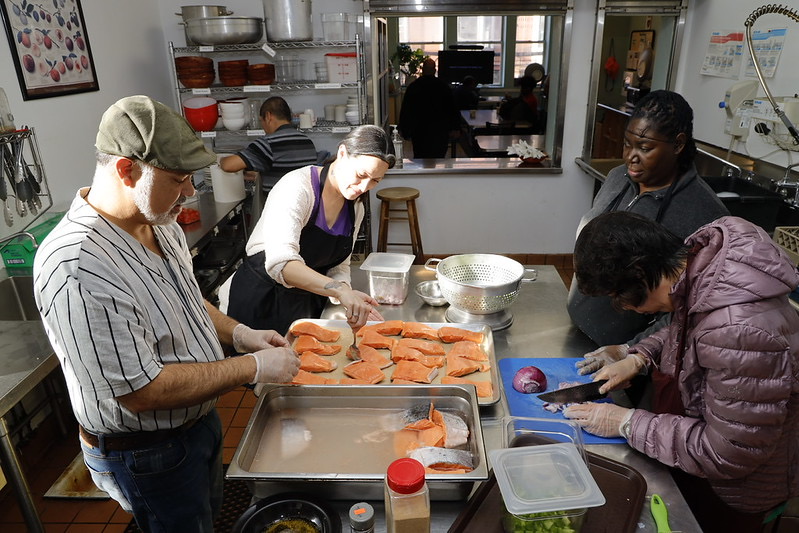
A MindSite News interview with Fountain House members and staffers
This story has been updated with links where donations can be made to support the efforts of Fountain House and affiliated clubhouses to feed their members.
Starting this week, some 42 million Americans were faced with an existential dilemma: How would they feed themselves and their families while the federal SNAP benefits they use to buy groceries are cut off by the Trump administration?
As of Monday afternoon, the White House, in response to court orders that SNAP benefits be reinstated, said people should expect to receive only partial benefits this month and that those payments would be significantly delayed.
The problem is particularly grave for the estimated 20% of SNAP beneficiaries who are grappling with mental illness. For this group of people – already struggling to cope with uncertainty and stress – losing the ability to pay for food adds another huge stressor to their lives.
One group stepping up to help is the members and staff of Fountain House, an organization founded 77 years ago to provide a place where people with serious mental illness gather together at a "clubhouse" and provide mutual support to each other.
That mutual support is now being focused on a critical task: ensuring that all members get the food they need. Members from the original Fountain House, in Manhattan's Hell's Kitchen neighborhood, and those in Harlem, the South Bronx and the Hollywood neighborhood of Los Angeles – along with affiliated clubhouses in other states – are stepping up their efforts to provide meals and food to members who need it.
Fountain House is accepting donations at this link to help it feed its members, and also released a directory of affiliated clubhouses around the country that are seeking support for their food programs.
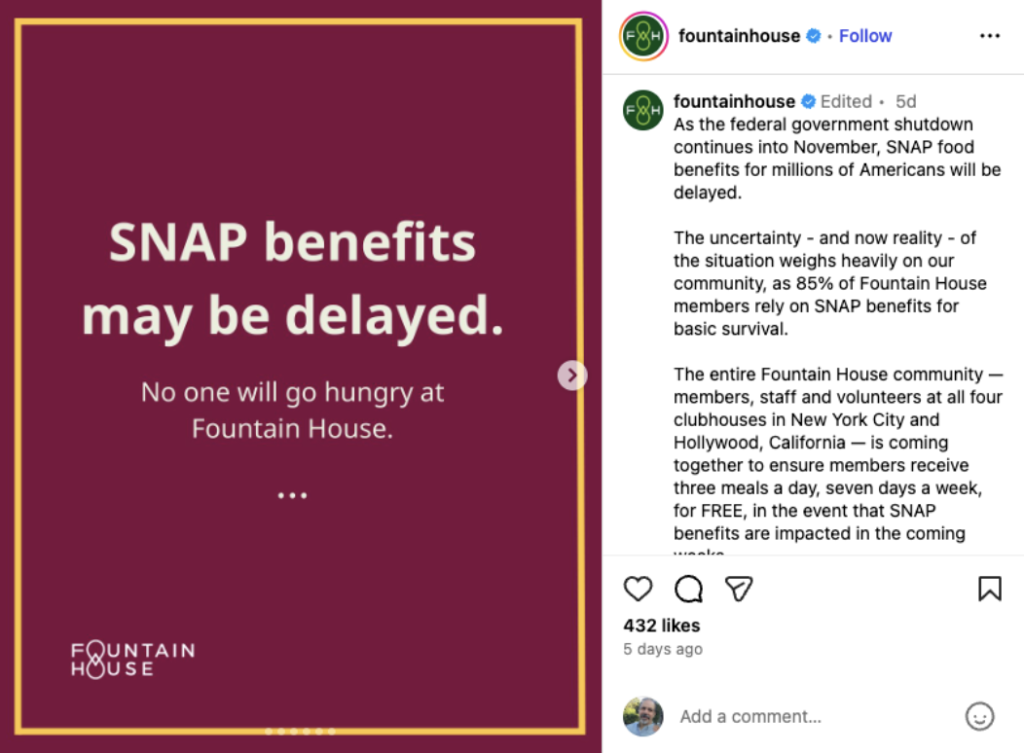
MindSite News Editor Rob Waters spoke with members and staff of Fountain House programs and affiliates to learn more about how they are caring for each other. As member Shawn Guffey said: “Once it became clear that SNAP benefits were going to be cut off, the question was never will we make sure that the members of our community have food to eat. It was, how will we?”
“Fountain House has been around since 1948,” he added, “and we've been through wars and pandemics and terrorist attacks and there's never been a question that we are not going to take care of one another.”
Here are edited excerpts from that conversation.
https://vimeo.com/1133587854Safi Chaudry, from video interview.
Safi Chaudry, communications team member:
I came to Fountain House six months ago. I was very hesitant at first to join – my therapist had recommended that I take a hard look at it – and it took me a year to go through those green doors. And then I finally did, and it's been mind-blowing – the change in my mood, the change in my health, the positive effects it's had.
I find community, I find belonging. I find a sense of cohesiveness which was lacking before, and being able to see other people struggle and still make through their day is inspiring.
https://vimeo.com/1133586074?share=copy&fl=sv&fe=ciShawn Guffey, from video interview.
Shawn Guffey, member, education employment unit and community programming and facilities team, responsible for direct services in the clubhouse and programming.
I was a high school teacher in the Bronx, and then I did an all-but-dissertation PhD program in developmental psychology. But as I was getting worse and going into the hospital more and more, I was never able to finish. And then I spent about seven years basically completely alone, never leaving the house except to walk my dog and going in and out of the hospital.
I came directly from an inpatient psychiatric unit – that's one of our biggest referrers, along with post-incarceration programs and housing programs for people who were unhoused. The requirement is that you have a serious mental illness and not be a danger to the community. So I came from an inpatient program. I used to say that I spent my summers at Columbia Presbyterian.
As I had gotten older, my illness had gotten worse and worse. I've had over 200 electroconvulsive therapy treatments. At one point, I was having a treatment every month, because nothing worked for my illness. At one point I thought my life was – that I would never have any kind of meaningful role in society, and that has changed as a result of Fountain House. I found a sense of belonging, a sense of purpose. I'm one of 12 people who work together to run the place. And this is four club houses with 1600 members. That's a lot of work.
So tell me about how your SNAP benefits. How much have you been getting? How far does it go — and what's going to happen now?
Shawn Guffey: I get around $180 a month in SNAP benefits, which is not a lot when you think about the cost of groceries. Our best guess is about 80% of our members receive SNAP benefits. Many of our members get the majority of their meals from the clubhouse, and now many of them will be getting all of their meals at the clubhouse.
Safi Chaudry: I get around $177 per month, which isn't much, but it does help bolster my budget throughout the month. I've just been trying to figure out where I can make cuts, or where I could dip into my savings, or what the next steps look like.
Shawn Guffey: People are going to have to make choices between, you know, buying food and paying the utilities or paying a copay on a medication or paying for a metro card, right? If you can't afford a metro card, you can't get to the clubhouse, which means you can't eat the meal that's being provided by the clubhouse.
Once it became clear that SNAP benefits were going to be cut off, the question was never will we make sure that the members of our community have food to eat. It was, how will we? How can we ramp up? How can we order the food?
Every single day, the members make lunch for one another and make breakfast for one another, and some days we make dinner for one another. All of this is being done by members, from ordering the food to serving the meals to cooking the meals to serving the meals to cleaning up afterwards.
One thing I've been impressed by when I've visited Fountain House is the diversity of people that are there – where you are and what you've done in life, as well as racial and ethnic diversity. How do all those different kinds of diversity sort of bring themselves together at Fountain House?
Safi Chaudry: It's like a tapestry in a way – everyone is threaded together from these different backgrounds, these different beliefs, different races, different educational levels. I mean, I've met people that haven't finished high school, and then I've met people with three PhDs, all in the same room trying to figure out what's next, trying to find community. That cohesiveness is very much on display every day in Fountain House.
Shawn Guffey: I don't think there is a more diverse place on Earth – you name it, we've got it, and they are a part of the community. Human beings need community. They need to be needed. They need to be with one another. When you're together in community, that's more important than your differences, it's more important than your diagnosis, and that's how we hold one another together.
Turning back to SNAP, when did the members and leadership team start to think about how you would address this problem, and what have members been saying in terms of their fears about losing this life-saving benefit that they depend on?
Shawn Guffey: I think our members have been very afraid, but also confident, knowing that we would take care of one another. I don't think anyone was afraid that they were just going to be left hanging with no assistance whatsoever. Fountain House has been around since 1948 and we've been through wars and pandemics and terrorist attacks and there's never been a question that we are not going to take care of one another.
Tell me about the planning and fundraising and logistics of increasing the amount of meal preparation that you all are doing.
Shawn Guffey: We found out early last week that this was definitely going to happen. We knew this was a possibility from the beginning of the year, when the current administration came in, so we knew essentially what elements needed to be put in place: We've got to find ways to store more food. We've got to find ways to raise more money. We are reaching very deeply into our operating funds right now and hoping our supporters will come through to assist us. There's talk that the SNAP benefits will begin again soon, but money talks; we'll wait and see.
We have a SNAP delay contingency plan. There's one for every clubhouse. And so every meal will be free in Hell's Kitchen – breakfast, lunch and dinner will be served Monday through Friday. For the weekends, people will get a weekend pack, which is groceries, in a box, like subscription services that send you food. It's a box of food that's fruits and vegetables, healthy and hearty. It also has instructions and recipes.
For people who can't leave their home, they will be delivered. If a member can't come in during the day, they can pick up in the evening. They can pick up meals for the next day. Every day of the week, we have vans going out to deliver meals.
Thanksgiving is our big holiday at Fountain House. It's a huge tradition – we have a gigantic Thanksgiving dinner. During the pandemic, we had Thanksgiving dinner delivered to every single member of Fountain House, and everybody ate their Thanksgiving dinner looking at the screen. So we have some experience scrambling to deal with emergencies. Our members are tremendously resilient. They are tough. They have been through a lot, and they can survive through a lot, especially together. There's a line from an early member of Fountain House, Michael Obaleski, who says, "All we have is one another, and that's more than enough." We just buckle down and get it done.
Safi Chaudry: I've been talking to a lot of folks in the clubhouse, and they are frustrated and anxious. There's a general sense of worry about how long the delay will last, and members are talking about how it's affecting their ability to stay healthy and focused. At the same time, there's also a feeling of support, since everyone understands what others are going through.

Paige Huff, director of Alliance House in Salt Lake City, Utah: Alliance house has 370 active members, but I would say 90% of those are going to be impacted by this, because those that don't utilize snap or don't receive SNAP, are utilizing the food banks. In Utah, a lot of people utilize the food banks, and as of last weekend, the food banks are turning people away because they no longer have food.
We have committed to do a food drive. Members can come and get a box, and then they can take that with them. One thing that we're struggling with is that a lot of our members are unhoused, and therefore having a large box of food is not going to be conducive for them, whereas on the SNAP benefits, they could just go get food for that day. So we're trying to coordinate for people to come in daily, rather than getting a box, because they don't have anywhere to take that box. Those are kind of the nuances that we're trying to figure out. But I'm also here with my colleague, Trudy, and I will let her speak to her perspective.
Trudy Moser, Alliance House member: I've been a member of Alliance House for almost eight years. I'm trying to come to the clubhouse every two days a week at least. I help in the cooking, I help in the graphics, I help in the food behind us. I'm affected because I have $70 that I usually get on the 11th and not getting it is just stressful. It adds to my anxiety and depression, makes me worry, but Alliance House – having their help right now makes me feel like I can breathe a little more. It makes me happy. A lot of the people around here are shocked and confused and don't know what to do, but we're working our way through it.
Jillian Santoro, clubhouse director of Fountain House Hollywood:
We're providing 21 meals a week to each of 140 members. We serve breakfast and lunch Monday through Friday. For the month of November, breakfast and lunch will be free for members who come into the clubhouse, and then every day, they'll be able to take a bag home with a meal. For example, tonight they can take home a bag with spaghetti and sauce and a can of mushrooms that they can cook at home if they have a kitchen. But if they don't have a kitchen, they have nowhere to cook. And so many of our unhoused members don't have access to cooking or even a microwave, so we're doing that. On the weekends, we're providing three meals on Saturday and three meals on Sunday, because the clubhouse isn't open.
We also have Thanksgiving this month, and that's kind of a big deal. If our members don't have their SNAP, their Thanksgiving dinner is not going to exist. We do have Thanksgiving in the clubhouse, and we offer that. It usually costs the members a couple dollars, but we're going to have Thanksgiving be free for our members this year. But you this is coming out of our emergency fund, and that's going to affect our programming in the future and down the line. I spent $2,000 on groceries this week to give food to our members, and I can't do that forever. I'm going to run out of money. And so that's something we haven't even brought up, that I'm sure Paige is also nervous about – we're taking money from other places, other bucket items in our budget, to try and make sure that our members can eat.
This article first appeared on MindSite News and is republished here under a Creative Commons Attribution-NoDerivatives 4.0 International License.
Republican Barbour and Democrat Thompson both praise legacy of former VP Cheney
by Geoff Pender and Emily Wagster Pettus November 4, 2025
Wake up informed. Sign up for our free daily newsletter and join over 35,000 Mississippians who start their day with Mississippi Today.
After Hurricane Katrina walloped south Mississippi in 2005, then-Vice President Dick Cheney was among the national leaders who traveled to the area to assess damage, and he was instrumental in helping the state secure federal money for recovery, Republican former Gov. Haley Barbour said Tuesday.
Cheney died Monday night of complications of pneumonia and cardiac and vascular disease, his family said. He was 84.
Barbour and Democratic U.S. Rep. Bennie Thompson are among the Mississippi political figures who say they appreciate the legacy of Cheney, who is widely considered one of the most powerful vice presidents in U.S. history.
Barbour was governor from 2004 to 2012, overlapping with most of the Bush-Cheney terms from 2001 to 2009.
“He wasn’t loud, but he was strong … and he was a very nice man,” said Barbour, who was chairman of the Republican National Committee in the mid-1990s and served on the first Bush-Cheney national campaign committee in 2000.
Cheney has been a polarizing figure in Republican politics. Once a hero to the right, he fell out with the GOP in recent years as he criticized President Donald Trump.
After a heart transplant in 2012, Cheney remained politically active and was a frequent critic of President Barack Obama’s administration. But after initially endorsing Trump in 2016, Cheney had sharp words for the Trump administration and supported his own daughter, Republican U.S. Rep. Liz Cheney of Wyoming, as she became a leading “never Trump” Republican. Dick Cheney later published a statement saying he would vote for the Democratic nominee, Kamala Harris, in the 2024 presidential election.
Cheney spent decades in government and politics, including as White House chief of staff for President Gerald Ford, congressman from Wyoming, secretary of defense and vice president. He was influential in Bush’s tax policies and rolling back environmental protections opposed by big businesses. He was a main architect of Bush’s “War on Terror” and invasion of Iraq after the terrorist attacks on Sept. 11, 2001.
Thompson, Mississippi’s lone Democrat in Congress, is a former chairman of the House Homeland Security Committee. As chairman of the House select committee that investigated the Jan. 6, 2021, attack on the U.S. Capitol, Thompson appointed Liz Cheney as vice chair.
“When I met Vice President Cheney, he personally thanked me for that decision and for the integrity with which the committee conducted its work, even at a time when many in his party chose not to participate in the one-year commemoration of January 6th,” Thompson said in a statement Tuesday. “Vice President Cheney’s legacy in shaping America’s national security will be remembered, and I extend my prayers to the Cheney family during this difficult time.”
Thompson said he worked with Cheney during creation of the Department of Homeland Security after 9/11.
“His leadership and support were invaluable as we brought together 22 federal agencies to form the Department of Homeland Security and strengthen our nation’s security,” Thompson said of Cheney.
Thompson also said Cheney’s death “saddens me deeply.”
Paul Hurst, an attorney who was Barbour’s gubernatorial chief of staff, said Tuesday that Cheney was “a great friend of Mississippi, and I was honored to work with him a few times.”
“He supported all of our recovery efforts after Katrina and advocated for others in DC to do the same,” Hurst said.
Barbour first worked for Ronald Reagan’s unsuccessful presidential campaign in 1976. After Ford fended off a challenge from Reagan at the Republican National Convention, Ford hired Barbour to run his campaign in seven Southern states.
“Cheney was very bright, but he was quiet,” Barbour told Mississippi Today in a call from his Washington office Tuesday. “He wasn’t loud. He spoke in short sentences. He was always very nice to me.
“When he got picked for vice president, I was on the George Bush national campaign committee,” Barbour said. “Cheney had for a while gotten out of politics at that time.”
Barbour said he remembers a letter he wrote after Bush and Cheney were elected that could have gotten him into hot water with the vice president.
“I wrote Cheney a letter about how we always said the Democrats, the Clinton administration, had kowtowed to the environmentalists, and that he and Bush and other Republicans said they were not going to do that any more,” Barbour said. “… I said, ‘Mr. Vice President, you have said this, and we want to see you back it up. Environmentalists are pushing bad policy that doesn’t do any good and just makes everything more expensive, so we are watching to see how you do.'”
A reporter “somehow got hold of the letter,” Barbour said, and he faced questions from his lobbying client, Southern Company, and apparently Cheney didn’t initially find the letter amusing.
“But Cheney thought the letter was funny after a while,” Barbour said. “He and I stayed friends long after that, and I have always had great admiration for him.”
Barbour said Bush, Cheney, their administration and Congress were a great help to Mississippi after Katrina.
“We were blessed to have President Bush the younger, Dick Cheney, (U.S. Sen.) Thad Cochran at that time,” Barbour said. “We had a very supportive Congress, and Cheney was part of that. They bent over backwards to help Mississippi and other states.”
Generous community support not nearly enough to fill gap in SNAP funding, food advocates say
As shutdown stretches into sixth week, program’s recipients grow more desperate
by DAN DeWITT November 6, 2025
 DAN DeWITT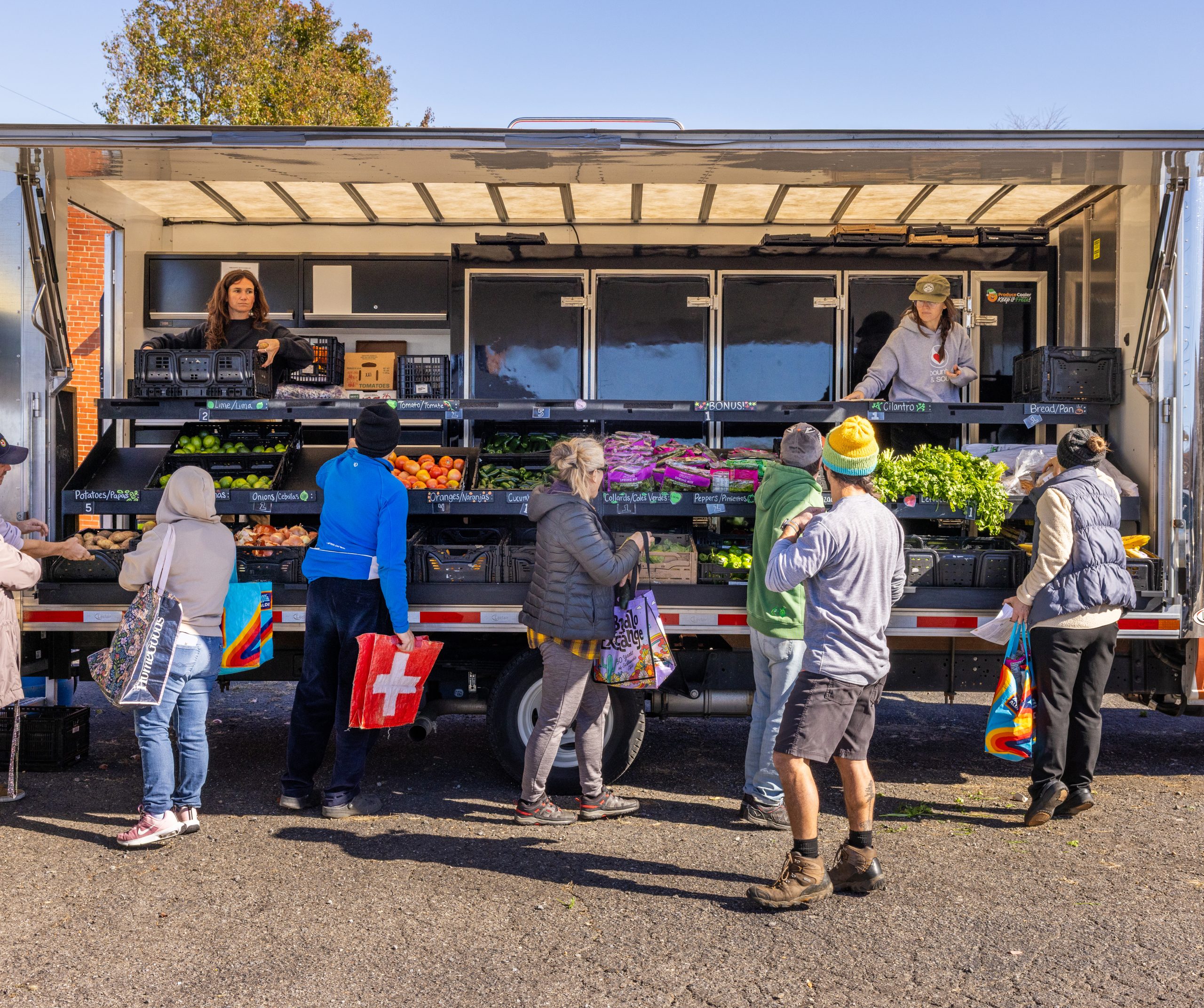
Brittany Ebert thinks federal lawmakers might reopen the government and resume food stamp funding if they knew what it was like to feed three children on a tight budget.
Ebert, who filled a bag with free produce Monday at the nonprofit Bounty & Soul’s market in Swannanoa, is a part-time substitute teacher. Her husband is an Ingles Markets Inc. warehouse employee who lost two months of work after the chain’s distribution center near Black Mountain was flooded by Tropical Storm Helene.
They are rearing children ages six, seven and eight, whose appetites seem to be growing every day, she said, and feeding two neighborhood kids who regularly stop by for meals.
“It’s hard to tell somebody about something if they’ve never been through it,” Ebert, 32, said of federal legislators whose 36-day standoff is jeopardizing $8.3 billion in monthly funding for food stamps, the informal name for the Supplemental Nutrition Assistance Program (SNAP). “If they were in our shoes, and saw hungry kids, they’d be in a different position.”
Without the monthly $490 SNAP payments that make up about 15 percent of her family’s total budget, Ebert will likely go to more food distribution events like the one Monday, she said.
Thousands of other food-insecure residents will likely do the same, pressing Bounty & Soul and other already strained food nonprofits into a role they aren’t equipped to fill – the primary food providers for Buncombe County’s nearly 30,000 SNAP recipients, their leaders say.
Even if the Trump administration complies with the court-ordered release of $4.65 billion in reserve SNAP funding – and the president said at one point Tuesday it would not – the money would cover only about half the cost of the program and only for one month, said Bounty & Soul Deputy Director Paula Sellars.
The NC General Assembly has no immediate plans to fill the remaining gap, said state Sen. Julie Mayfield, D-Buncombe, and the $18 million in food aid announced by Gov. Josh Stein’s office last week is a small fraction of the more than $230 million in SNAP benefits paid across the state monthly.
And none of the much-appreciated local efforts – the ramped up operations at food organizations, the fundraisers, the food drives launched by local businesses, the city of Asheville and Buncombe County – can fill the yawning void left by the SNAP cuts, said Joe Beckler, chief development officer of MANNA FoodBank, which serves more than 220 food pantries in western North Carolina.
In a typical month, the program pays for nine times as many meals as MANNA provides, Beckler said.
“We’re going to do our level best and lean in and help people make it through this holiday season,” he said. But making up the deficit from SNAP “is just not scalable. There’s no way we can do that.”
“If this doesn’t get resolved very soon,” Sellars said. “We’ll see hunger at a scale we have never seen before.”
Elected leaders cast blame
Both Sellars and Beckler said that filling the gap left by SNAP cuts comes on top of challenges to their organizations described to Asheville Watchdog in August.
Demand at Black Mountain-based Bounty & Soul tripled after the onset of the COVID-19 pandemic, and doubled again after Tropical Storm Helene, Sellars said at the time.
MANNA’s Swannanoa warehouse and all its contents were destroyed by Helene, and the organization was completing its move to its new Mills River location earlier this year when it learned of deep cuts to two major federal food initiatives – The Emergency Food Assistance Program (TEFAP) and Local Food Purchase Assistance (LFPA).
MANNA received only 160,000 pounds of food from TEFAP in August compared to 386,000 pounds the same month last year, Beckler said, and the LFPA cuts are expected to take $1.3 million from the food bank’s $10.4 million annual food budget.
In August, the organization expected demand to double with the shifting of $420 million in SNAP payments to the state starting in January 2027, a measure included in July’s “One Big Beautiful Bill” budget reconciliation.
But that was a partial funding shortfall, months in the future, Beckler said. The current cuts are immediate, and depending on the level of funding from the White House, the shutdown will eliminate all the program’s allocations in the state, which totaled more than $2.8 billion in 2024.
“What we’re talking about effective Nov. 1 is no SNAP benefits,” Beckler said.
As welcome as the food drives are, the non-perishable and often processed groceries they collect are not a healthy long-term substitute for fresh meals families can prepare with SNAP benefits, Sellars said.
“The longer SNAP is lapsed and access to fresh food is low, the more risk to people’s personal health and the greater risk that the healthcare system will take a population-wide hit,” she said via email.
There is also SNAP’s irreplaceable economic impact, Beckler said, forwarding a statement from the National Grocers Association trade organization.
SNAP supports “over 389,000 American jobs” according to the release. “The disruption to program funding may lead to reduced employee hours, perishable food losses, and declining sales for many community grocers across our nation.”
Elected leaders cast blame
The Trump administration announced Monday it would release some funds after a federal judge in Rhode Island ruled last week it must spend the available reserves.
Late Tuesday, the White House affirmed its intention to comply with the court order. But that was hours after Trump said otherwise in a post on Truth Social. Under “crooked Joe Biden” the program had been expanded to give handouts to “anyone for the asking,” he wrote, before pledging that payments would resume “only when the Radical Left Democrats open up government, which they can easily do, and not before!”
U.S. Rep. Chuck Edwards, R-Hendersonville, blamed “Democrats in the Senate who have failed to vote to fund the government,” in a statement this week on his website that also listed organizations providing food aid.
Mayfield said responsibility for providing emergency funding for SNAP lies with the General Assembly’s Republican leaders, Senate President Pro Tem Phil Berger and Speaker of the House Destin Hall, neither of whom returned emails to their offices from The Watchdog.
State lawmakers, Mayfield said, are just as deadlocked over budget issues as their federal counterparts.
They still haven’t passed the biennial budget that was scheduled for approval before July 1. Republican leadership has failed to close the gap in the state’s contribution to Medicaid, she said. And when lawmakers met last month, she said, the priority was redrawing maps of congressional districts, not addressing SNAP funding.
“I have no confidence that they would fund whatever this would cost, even on a temporary basis,” she said.
Locals doing what they can
Asheville and Buncombe, local restaurants and other businesses are attempting to fill this breach left by the federal and state government.
In an Oct. 31 news release, Buncombe urged residents to drop off canned goods and other non-perishable items at, among other locations, the 12 branches of the county’s Public Library.
The drive is scheduled to continue through Nov. 25, county spokesperson Lillian Govus wrote in an email. “As we head into the holiday season and with continued instability in Washington, we want to ensure that MANNA FoodBank, Bounty & Soul … and all our other community partners have supplies on hand to help address food insecurity.”
Residents can also bring food to four of Asheville’s community centers, the city wrote in a statement.
The Chai Pani restaurant in Asheville was scheduled to host a Give Back Night on Wednesday, pledging that 10 percent of the proceeds of its dinner service would go to MANNA. The Sand Hill Kitchen on Sardis Road is providing free bagged lunches, primarily for school children, but also adults, server Sarah Hill said Wednesday.
“It’s ‘no questions asked.’ It’s like, if you need it, you need it,” Hill said, adding that customers had donated about $7,000 to support the effort.
BMAZ – The Adventure Zone in Whittier, about an hour west of Asheville, is offering discounts to customers who donate food and contributing 10 percent of its proceeds in November to MANNA and an area food pantry, Rose Johnson, the gaming center’s creative director, wrote in an email.
Increased demand at MANNA has been met with a flood of monetary donations to its virtual food drive and groceries delivered in person, including by a teenaged girl who bought supplies from money earned babysitting, Beckler said.
“She poured all of it into buying food so she could deliver food to help out,” he said. “We’ve become just acutely aware of how much the community cares.”
Confronting a ‘disaster‘
At this point, local sources of food – accessible through MANNA’s food finder interactive map – are the only option for many of the estimated 100,000 food SNAP recipients in MANNA’s coverage area, which includes 16 counties and the Qualla Boundary.
Emily Hernandez, a 34-year old single mother of three, said she hasn’t worked regularly as a food server since the restaurant that employed her was flooded by Helene.
Without the roughly $620 she receives from SNAP, she said, she will depend on Bounty & Soul and food distribution events hosted by churches and other organizations.
“I guess food banks and the community coming together,” she said of her options.
Freida Fisher has been living in a donated camper in Transylvania County since her apartment in Rosman was flooded by Helene.
She was recently notified that she will have to move the camper to make way for homes that Transylvania Habitat for Humanity plans to build on its current site. She has been unable to work at her long-time job as a restaurant server since a June surgery on her wrist to repair carpal tunnel syndrome and remove a cyst.
Though she has applied for disability benefits from the Social Security Administration, she has not begun receiving them. And though she is due for a widow’s benefit from the agency, payments won’t kick in until after she turns 60 in January.
Until then, she will live on her deceased husband’s $89-per-month pension and whatever remains of her $298 in SNAP benefits.
The loss of food stamps is “more than a chunk out” of her income, she said Friday. “That’s what I live on right now.”
Like Hernandez, she will depend on food organizations such as Sharing House, a Brevard organization that offers a range of services for struggling residents including a food pantry that receives about 30 percent of its groceries from MANNA.
Sharing House has seen an outpouring of donations of money and food since news of the looming cuts to SNAP began to spread, said Executive Director Shelly Webb. But the number of new residents accessing its programs increased 200 percent in October compared to the month before, and in her 12 years with the organization, she said, “we’ve never seen a disaster like this.”
Without cash reserves to weather such dramatic cuts, Sharing House’s neighbors are foregoing medical treatment and skipping rent payments to cover the cost of food, said Jackie Curtis, the group’s crisis assistance director.
“Everybody’s coming in saying, ‘I’m scared. I don’t know what to do,” she said, “because they don’t have any way to plan for what’s coming.”
When one neighbor recently told her of such concerns, “my response was, call your representatives,” Curtis said. “Tell them your story. Tell them what is going on and how this directly affects you, and get as many other people you know who this affects to call as well.”
Asheville Watchdog welcomes thoughtful reader comments on this story, which has been republished on our Facebook page. Please submit your comments there.
Asheville Watchdog is a nonprofit news team producing stories that matter to Asheville and Buncombe County. Dan DeWitt is The Watchdog’s deputy managing editor/senior reporter. Email: ddewitt@avlwatchdog.org. The Watchdog’s local reporting is made possible by donations from the community. To show your support for this vital public service go to avlwatchdog.org/support-our-publication/.
As SNAP benefits are slashed, renovated Sandhills food bank braces for surge in need
by Jaymie Baxley, North Carolina Health News
November 5, 2025
By Jaymie Baxley
When the Food Bank of Central and Eastern North Carolina began renovating its Sandhills branch in 2023, the nonprofit did not expect the project’s completion to coincide with the threat of a national hunger crisis.
The $1 million overhaul of the Moore County facility, which also serves Lee, Richmond and Scotland counties, was originally meant to address an uptick in food insecurity across the largely rural region.
“We were prepared for the increase in demand for food assistance due to economic factors like the rising cost of living and the fact that wages in the region are not keeping up with that cost,” said Jason Kanawati Stephany, vice president of communications and public policy for Food Bank of Central and Eastern North Carolina. “We were not ready for the largest cut in the history of SNAP grocery support.”
Yet that is the reality Food Bank officials faced as they celebrated the re-opening of the branch — which boasts new offices, an expanded warehouse freezer and other upgrades — with a ribbon cutting on Monday.

The event happened just hours after the Trump administration announced that people participating in the Supplemental Nutrition Assistance Program would receive only half their normal benefits amid the ongoing federal government shutdown.
About 40,000 residents depend on SNAP in the four-county area served by the Sandhills branch. The slashing of their benefits, which were already delayed and may not be issued for several weeks still, means more local families will need help putting food on the table, just as the holidays arrive.
“We know that our community needs us, and so we have to be positioned to support the work that needs to be done,” said Mariah Murrell, chief community impact officer for Food Bank of Central and Eastern North Carolina.
The branch's work, she added, "matters more than ever — not just as a response, but as a lifeline.”
A well-timed facelift
While the disruption in SNAP will be felt across the Food Bank’s regional network of six branches covering 34 counties, the staff at the Sandhills site are at least better equipped to handle a surge in demand than they were two years ago.

The renovation is the first major update the branch has received since 2003, when it was relocated from its former home in nearby Aberdeen to the end of a gravel path off Sandy Avenue in Southern Pines.
Now, a fully paved road leads to a proper parking lot in front of the facility. Inside, the outdated equipment and cramped cubicles that workers made do with for decades have been replaced with modern hardware and actual offices.
“This is my first time having an office with a door,” said Jessica Ledbetter, a network engagement manager who has been with the branch since 2009. “I used to have to try to find a private space if I needed to take a call that needed to be confidential.”

The “most exciting” addition, Ledbetter said, is a larger conference room that can host representatives from the many local organizations that assist the branch with food distribution.
“We had wanted more space to invite our partner agencies for meetings and to have trainings,” she said. “Before, we had to either rent a space or look for an external space to use.”
Another significant upgrade can be found in the facility’s warehouse, where a walk-in cooler has been expanded to hold more meats and produce. About half of all food distributed by the branch is perishable.

Amy Beros, president and CEO of Food Bank of Central and Eastern North Carolina, called the renovation a “significant investment.”
“The timing is fortunate for us to be able to have this extra capacity to meet the continuing increased demand,” she said.
No substitute for SNAP
Still, Beros said, the upgrades don't mean the branch can completely fill the gap created by the current shortfall in SNAP.
“For every one meal we provide, SNAP provides nine,” she said. “There’s no way to charity-food-system our way out of those gaps. We can’t fill those gaps, and we were never meant to replace the federal safety net.”
More than 486,420 people are enrolled in SNAP across the Food Bank’s larger network across eastern North Carolina. Those beneficiaries account for nearly 35 percent of the state’s total enrollment in the program.
“We would need to basically more than double the size of our food bank to fill that gap,” Beros said. “It’s just not possible for us. It’s not possible for our partners.”

Stephany, the vice president of communications, said SNAP is the nation’s “first line of defense against hunger” because it “puts money directly into families’ pockets to buy food” — a service the food bank can’t replace.
“Our network is moving mountains to keep food on folks’ tables,” he said. “But even with the incredible community generosity that we benefit from, we can’t make up for these cuts through community support alone.”
Cuts after cuts
The limitations have been compounded by an additional loss of federal dollars that arrived just as demand for food assistance began to grow.
Much of the funding that helped food banks keep pace with rising demand during and after the COVID-19 pandemic has been eliminated. For example, this spring, the Trump administration sunsetted a pandemic-era program that enabled food banks to buy food from local farmers.
“Over the last nine months, we have lost millions of dollars in federal funding to purchase food,” Stephany said. “The resources that we use to meet the rising need have been cut at a time when that need is increasing significantly.”
Stephany, who said he grew up in a food-insecure household and used food stamps to feed himself as a college student, anticipates that SNAP-dependent families will be leaning on his organization for support in the coming weeks.
“We just want to make sure that folks know that food is available right now to all who need it,” he said. “And if you are fortunate enough to be in a position to get involved, whether that’s as a donor or a volunteer, there has never been a more important time to do so.”
People can also help, he said, by reaching out to lawmakers.
“They need to hear from us and know that we can’t afford to let these cuts stand.”
This article first appeared on North Carolina Health News and is republished here under a Creative Commons Attribution-NoDerivatives 4.0 International License.