
Unrest continues in Minnesota; Former inmate buys N.C. prison; UNC Charlotte faces racial discrimination claim
Helena Moreno sworn in as the Crescent City's second woman mayor


Editor's note: The events in Minnesota continue to be a developing story. While there is coverage today about it, here are links to three sources in the state providing their own coverage:
 Ana Radelat
 Katelyn Vue
Minnesota Reformer also provides its own statewide news coverage.
It's Friday, January 16, 2026 and in this morning's issue we're covering: Former inmate buys NC prison to help others who have served time, UNC-Charlotte faces racial discrimination claim in fired employee’s lawsuit, Gov. Moore honors County Police autism unit, After second ICE shooting in a week, Minneapolis residents raise alarm on community safety, How Twin Cities mental health advocates are responding to trauma – again, The Emotional Toll of the current U.S. president's Immigration Policies on Asian Children and Families, The Army Corps of Engineers Wants to Dredge the Cape Fear River. Environmentalists Tally the Costs, Black lawmakers warn constituents that proposed funding formula changes could hurt Mississippi’s HBCUs, Helena Moreno sworn in as New Orleans mayor under storm clouds of budget deficit, layoffs.
Media outlets and others featured: NC Newsline, Carolina Public Press, Montgomery Community Media, Sahan Journal, MinnPost, MindSite News, Inside Climate News, Mississippi Today, Verite News.
Former inmate buys NC prison to help others who have served time
by Greg Childress, NC Newsline
January 6, 2026
With the recent purchase of the former Wayne Correctional Center in Goldsboro, Kerwin Pittman is laying claim to an unusual title — he says he’s the first formerly incarcerated person in the U.S. to purchase a prison.
Pittman, the founder and executive director of Recidivism Reduction Educational Program Services, Inc. (RREPS), was sent to prison at age 18 and served 11 years and six months for conspiracy to commit murder. January 26 will mark eight years since his release and return to the Southeast Raleigh community in which he was reared.
“I started a nonprofit when I came home and began advocating for individuals coming out of the [incarceration] system but I also put in programming to try to help them reintegrate into society with a little more ease,” Pittman said.
His experience behind bars gave him insight into what other formerly incarcerated individuals needed after they left prison.
“I had family support, so I had housing. but a lot of my friends didn’t have any place to go. Or if they did, there was a time limit on how long they could stay,” Pittman said.
Pittman’s purchase of the abandoned, 400-bed prison is an extension of the work he started soon after he left prison. He plans to create re-entry housing and a workforce campus where formerly incarcerated people can attain job skills or industry certifications.
“The campus would be like a stabilization phase for guys coming out of jail or prison, to give them a six-month pause so they can get their life back on track,” Pittman said.
Pittman estimates it will take up to two years to get the former prison ready for as many as 300 residents who would live on the campus until they completed the six months-long program. Another class of up to 300 would replace the previous residents each six months, he said.
He envisions residents studying and training to become electricians, plumbers, HVAC technicians, construction workers and other trades that are in high demand.
“Right now, not only in the United States, but particularly North Carolina and particularly rural North Carolina, they are experiencing a decline [in people] seeking trade jobs,” Pittman said.
Other residents might choose a track to earn industry certifications or a Commercial Driver’s License, he said.
The program will be open to previously incarcerated individuals from across the state, Pittman said.
“We’ll take referrals, we’ll have a case management team that go inside the jails and prison … and then we’ll go and see if the candidate is the best fit for our program,” Pittman said.
Pittman said it would make sense to locate such a facility in Goldsboro even if the former prison wasn’t available.
“Goldsboro is suffering right now with the plague of not only violence, but also poverty,” Pittman said. “It only made sense when this institution came up for sale to purchase it because of all of the other things that are going on in Eastern North Carolina, but also in that area.”
Pittman said he bought the former prison for under a million dollars and projects it will take about $2 million to refurbish it, while taking care to ensure it no longer looks like a prison. Pittman will rely heavily on private donations to fund the enterprise but has not ruled out pursuing local, state or federal funding.
The prison closed in 2013 as North Carolina sought to save money by reducing prison capacity after inmate populations declined.
Wayne County Commissioner Bevan Foster had not heard about the project but was excited after a reporter shared the news.
“If he’s able to do what he said he’s gonna do, it’d be great,” Foster said. “It’s the kind of program we need.”
Foster noted the irony of the prison being repurposed to help formerly incarcerated individuals.
“They’re using it for some good,” Foster said. “It would be a great thing.”
Wayne County Commissioner Antonio Williams also had not heard about Pittman’s proposal but said it would be a “wonderful opportunity” for people leaving prison.
“You can look around and see a lot of people who have been rehabilitated, but they come home and it’s challenging for them to even have housing, it’s challenging for them to find a job,” Williams said.
Many formerly incarcerated individuals return home to find that relatives or other loved ones have died or they’ve just lost those relationships while they were away and don’t have any place to go, Williams said.
“Pittman’s proposal, he said, “would definitely give them a chance to rejoin life and get the basic steps in order such as finding jobs, housing and health care, all of those things that are valuable and have meaning.”
As NC Newsline previously reported, a year ago, Pittman launched the state’s first mobile reentry service center to bring resources and support to people reentering society from prison. He followed up with a second mobile center six months later.
The centers provide previously incarcerated people with case management and other services such as job placement, housing assistance, mental health support and help obtaining important documents such as identification.
Pittman said the time he spent behind bars fuels his passion to help others.
“Me going into the system young, getting in trouble and being able to come out on the other side of that — and to be honest, just following my spirit and God leading the way — it made me want to be able to help other people,” Pittman said.
NC Newsline is part of States Newsroom, a nonprofit news network supported by grants and a coalition of donors as a 501c(3) public charity. NC Newsline maintains editorial independence. Contact Editor Laura Leslie for questions: info@ncnewsline.com.
UNC-Charlotte faces racial discrimination claim in fired employee’s lawsuit
by Kate Denning, Carolina Public Press
January 13, 2026
A former UNC-Charlotte employee, Janique Sanders, is suing the university for racial discrimination and two administrators for a First Amendment rights violation. The university fired Sanders in May 2025 after undercover individuals recorded videos that showed Sanders alluding to continued diversity practices at the university despite the widespread dismantling of DEI in the UNC System.
Sanders was employed by the university’s Office of Identity, Equity and Engagement until it was shut down in 2024, as well as two other offices with a similar purpose, after the UNC System repealed its diversity policies across its 17 institutions. At the time of her termination, she was an assistant director in the Office of Leadership and Community Engagement.
An announcement of the closures from UNC-Charlotte in August 2024 stated full-time staff from the affected offices were “provided employment opportunities elsewhere on campus.” The lawsuit claims Sanders’ former office was “reorganized” and some diversity work “remained intact,” though it’s unclear in what capacity.
[Subscribe for FREE to Carolina Public Press’ Daily, Weekend and Election 2026 newsletters.]
More than a year after the UNC System repealed the policy, videos began to circulate of staff at a number of schools in the system, each stating that the universities where they worked were continuing to incorporate diversity initiatives despite the policy change.
Undercover reporters working for a group called Accuracy in Media filmed Sanders and others discussing these details unknowingly. The covert tactic is sometimes described by critics as “gotcha journalism,” an interviewing method intended to elicit statements that could be damaging to the interviewee’s image, though AIM president Adam Guillette rejected the term in an interview with CPP in June.
In the video, Sanders tells the individuals, who appear to be inquiring about getting involved with DEI initiatives happening on the UNC-Charlotte campus, “If you’re looking for, like, a(n) outward DEI position — not going to happen. But if you are interested in doing work that is covert, there are opportunities.”
The lawsuit states the video was filmed in the fall of 2024, months after the System repealed the policies. The video wasn’t posted online until May 28, 2025. Just one day later, UNC-Charlotte announced Sanders was no longer employed by the university following an internal review. The statement said her comments were inaccurate and she had no policymaking authority or role in compliance with UNC System policies.
The lawsuit questions the validity of the internal investigation on the basis that Sanders was not questioned by a university investigator or provided with specific grounds for her termination.
“While (UNC-Charlotte’s) spokesperson alluded to an internal review that preceded Sanders’ firing, the ‘review’ lacks any hallmarks of genuine investigation,” the lawsuit states.
“Sanders was not interviewed or asked to provide a defense or rationale for her taped comments. Upon information and beliefs, (UNC-Charlotte) did not seek and has never obtained the entire footage of AIM’s recording of Sanders.”
Guillette told CPP in June the multiple North Carolina universities that were featured in AIM’s undercover reporting did not ask for the unedited footage, though he said that indicated the universities were not interested in addressing noncompliance.
“When we actually released the video, at no point did any of them follow up with me,” Guillette said.
“At no point did any of them request the video. And in many instances, if we’re dealing with honest brokers, we are more than happy to have shared the full unedited videos of these scenarios, so the fact that they never responded to us is proof that hidden camera tactics are needed and proof that these people are clearly engaged in deception.”
Sanders’ attorney and former U.S. Congressman Artur Davis also criticized UNC-Charlotte's lack of inquiry into the full footage for what he sees as a failure to obtain both sides of the story.
“Even if there’s a world where they say, ‘Well, this is a third party over whom we have no control, so therefore we can’t expect that we’re going to get their video tape.’ Why not simply ask her, what’d you say, and what didn’t you say, and what did you tell them?” Davis said.
“That’s the core level of fairness here. So there is a problem, in my view, both legal and moral, that UNC-Charlotte did not take the time to hear Janique Sanders’ side of the story.”
A UNCC representative told CPP the university does not comment on pending litigation.
Prior to filing the lawsuit, Sanders filed a charge with the Equal Employment Opportunity Commission, the EEOC, alleging race discrimination as a motivating factor in her termination. The EEOC granted Sanders a right-to-sue letter in September, leading her to file a Title VII claim against the university.
The motivating factor element of the claim is important, Davis said, because while it is possible in discrimination lawsuits like Sanders’ that other legitimate reasons for termination exist, it still bars race or other aspects of identity from being a factor at all.
“We do expect that there is probably going to be an argument from UNC-Charlotte that Ms. Sanders was not authorized to talk about internal campus policies, that she was not authorized to talk to people outside of the school about the DEI changes that have been enacted within the institution,” Davis said.
“They may very well say that. Now, we contend that there is no written policy that she violated and she was never told she violated a policy, but let’s assume that they say she violated policy she was never told about and that was not publicized. She would still be able to argue that the decision that they made somewhere along the way, in effect, gave weight to racism or gave weight to racial bias.”
The lawsuit lays out the claim of racial discrimination by stating there is no evidence that UNCC attempted to verify whether “other non-black officials in Sanders’ department have made comments similar to Sanders’ viewpoint or determine the forum in which any similar comments were made; or that UNCC analyzed whether AIM’s conduct itself reflects a racially biased agenda.”
“Race was at least a motivating factor in UNCC’s termination of Sanders, in that the university ratified or condoned AIM’s actions that are at least partially ringed by racially biased assumptions,” the lawsuit states.
The way in which Sanders was terminated is not how UNC-Charlotte typically handles such scenarios, also indicating racial bias was a factor, Davis said. Sanders’ legal team will be analyzing how the university engages with and has responded to employees that have shared their personal viewpoints on hot topics in the past.
“The evidence in this case is going to show that there have been numerous other instances when individuals who were not Black and who were not female raised concerns, articulated viewpoints on a range of controversial issues, and they didn’t lose their jobs because of it,” Davis said.
Sanders’ case also includes two allegations of violations to her First Amendment rights which are aimed at the two administrators who fired her, Executive Director of the Division of Student Affairs Frank Fleming, who has since retired, and Associate Vice Chancellor of Student Affairs Karen Shaffer.
The lawsuit states Fleming and Shaffer failed to convey the rule Sanders violated or how she breached the Board of Governors’ anti-DEI directives, which “indicate that UNCC’s legitimate interests in efficient administration did not outweigh Plaintiff’s constitutional interest in free speech.”
AIM’s series of videos at North Carolina universities also included staff members from Western Carolina University, UNC-Asheville and UNC-Wilmington. WCU and UNCA both announced the individuals were no longer employed after the release of the videos. UNCW said it was looking into the actions of the two individuals in AIM’s video, though both are still employed according to university records.
Davis does not know of any other lawsuits filed by those terminated in the aftermath of AIM’s undercover operation, but he expects Sanders won’t be the only one to take action on what he sees as a First Amendment violation in addition to discrimination, in Sanders’ case.
Sanders is seeking lost wages due to her subsequent unemployment since being terminated and compensatory damages for emotional distress. She also seeks punitive damages, which go beyond monetary and other tangible losses addressed by compensatory damages, in regard to the claims against Fleming and Shaffer.
Her team is also requesting a trial by jury as is customary in employment discrimination and other civil rights cases. UNCC has yet to respond to the lawsuit in court.
This article first appeared on Carolina Public Press and is republished here under a Creative Commons Attribution-NoDerivatives 4.0 International License.

 Sophia Hernandez-Pina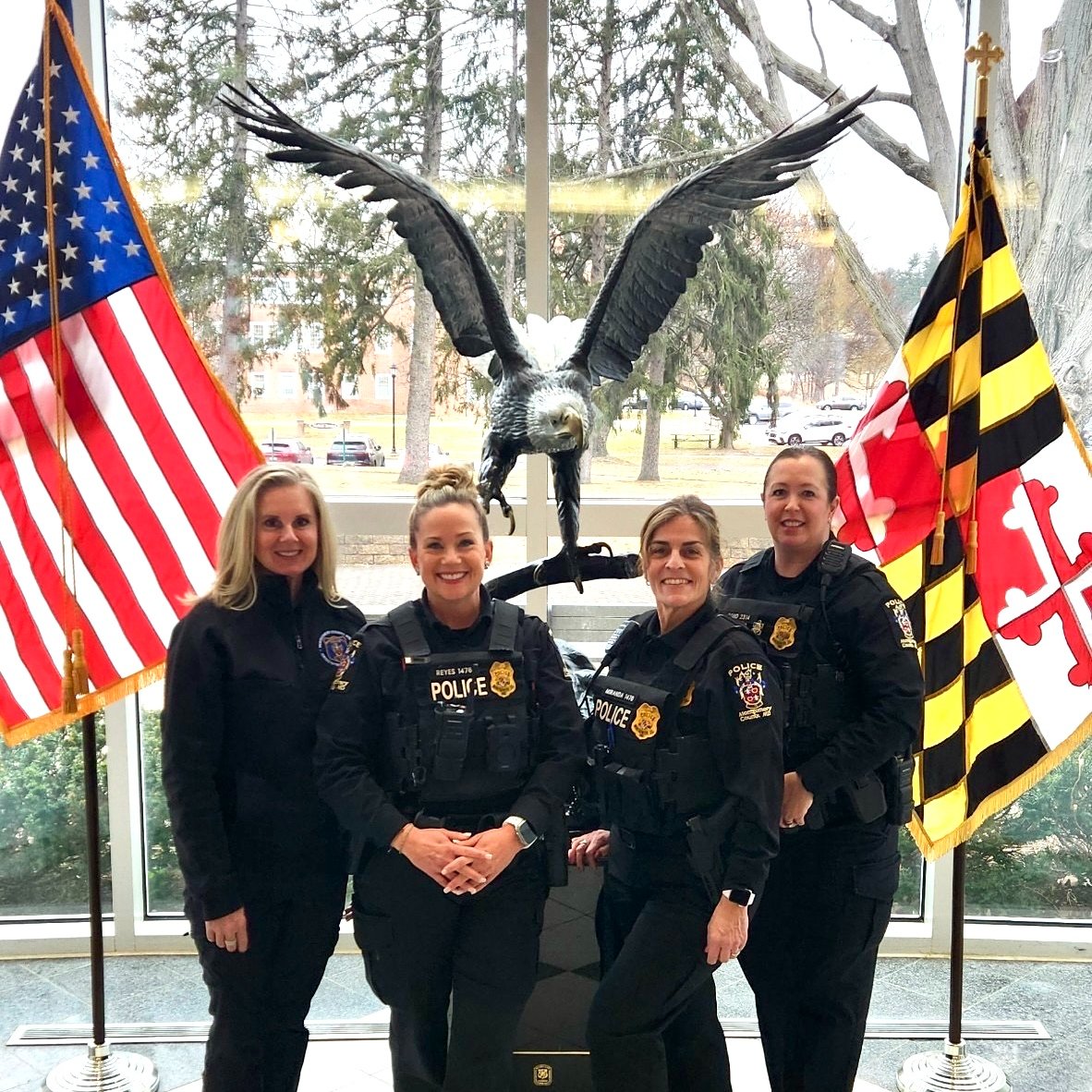
Feature Police/Crime/Fire January 14, 2026 Sophia Hernandez-Pina
Gov. Moore honors County Police autism unit
Gov. Wes Moore recognized the Montgomery County Police Department’s autism and disability-focused unit Monday with the Ethan Saylor Alliance Award honoring two decades of work to improve interactions between law enforcement and individuals with developmental disabilities.
The county’s Autism, Intellectual and Developmental Disabilities, Alzheimer’s and Dementia Outreach Program began in 2005 in response to a rise in police calls for missing persons with these types of disabilities. Since then, the program has trained officers on communication tactics, crisis response and de-escalation strategies tailored to protecting this population of residents. The unit also works directly with caregivers and individuals on safety planning and communication skills.
The award is named in memory of Ethan Saylor, a 26-year-old man with Down syndrome from Frederick County who was killed in 2013 when an off-duty sheriff’s deputy working as a mall security guard attempted to remove him from a movie theater using excessive force. His health prompted state and national calls for change and led to the creation of the Ethan Saylor Alliance, which trains law enforcement and first responders on the best practices for interacting with people with developmental disabilities.
At the ceremony, Moore highlighted Montgomery County’s role as an early adopter of specialized disabilities-related training.
“Initiatives like this build bridges between law enforcement and the disability community,” Moore said in a statement. “This unit set a standard for what compassionate public safety can look like.”
The symbol can be added through a myMVA account or in person at Motor Vehicle Administration offices at no cost if no other changes are made. The designation is voluntary and does not require documentation.
The law is named for Eric Carpenter-Grantham, a Montgomery County resident with high-functioning autism whose family advocated for legislative action following concerns about police encounters. Supporters say the butterfly symbol promotes understanding during traffic stops and emergencies and complements ongoing police training initiatives.
Together, the Saylor Alliance award, Montgomery County’s autism/IDD unit and Eric’s ID Law reflect a broader statewide push to improve communication and safety between law enforcement and people with hidden disabilities.
 Katelyn Vue, Nicolas Scibelli, Shubhanjana Das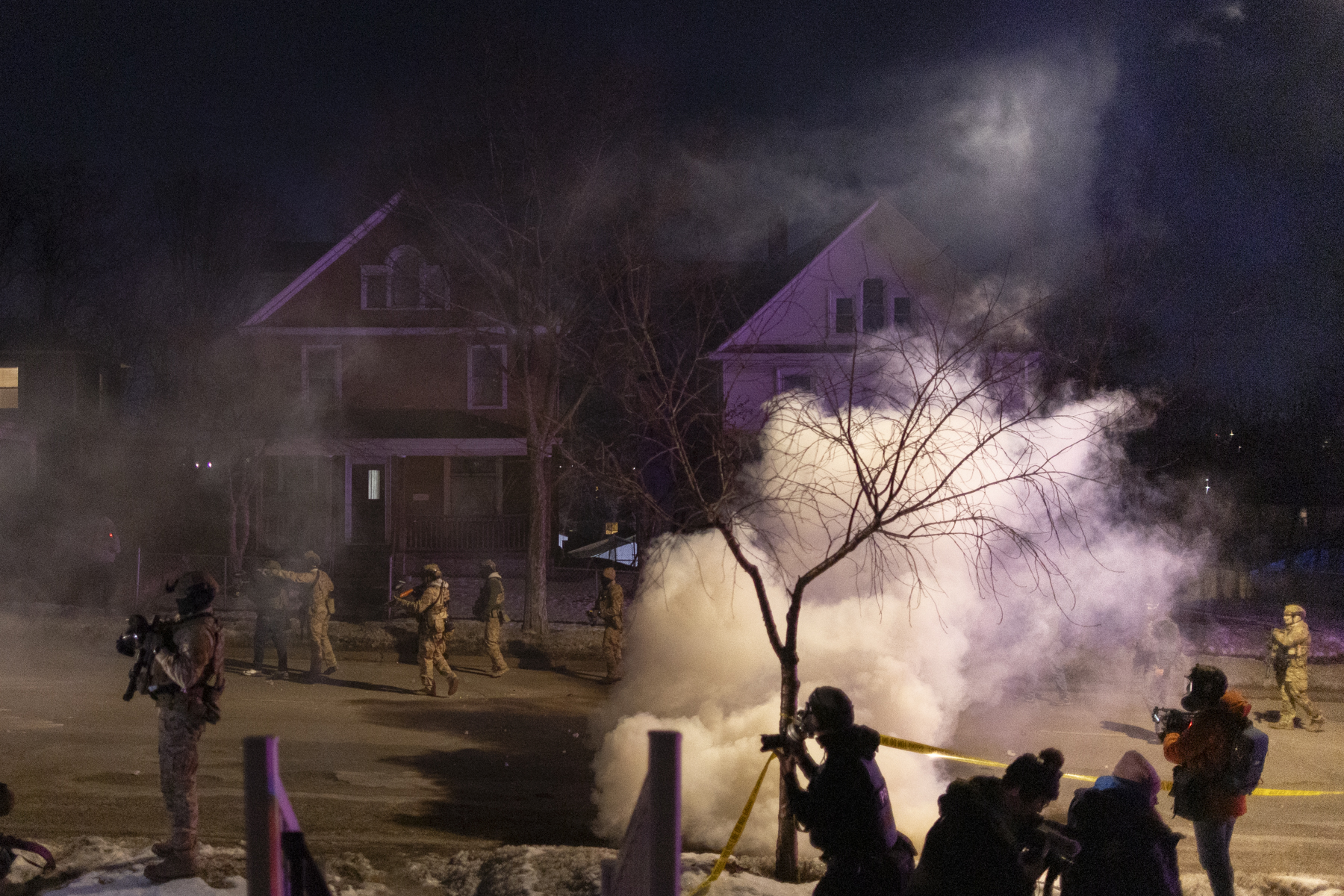
After second ICE shooting in a week, Minneapolis residents raise alarm on community safety
Minnesota politicians and residents are demanding accountability of ICE for its excessive force and violent behavior in the state.
by Katelyn Vue, Nicolas Scibelli and Shubhanjana Das
A day after Julio Cesar Sosa Celis was shot in the leg by a federal agent while fleeing a traffic stop in north Minneapolis, state and local officials scrambled to respond to a threat by President Donald Trump to invoke the Insurrection Act to deploy troops against protesters in Minneapolis.
The shooting came a week after Immigration and Customs Enforcement (ICE) agent Jonathan Ross fatally shot Renee Nicole Macklin Good in south Minneapolis.
On Thursday, both the American Civil Liberties Union filed a class action lawsuit in federal court seeking an emergency order to prevent ICE from stopping and questioning people based on their ethnicity and to prevent them from arresting people wrongfully.
Minnesota Attorney General Keith Ellison, who sued the federal government on Monday to try to end the ICE enforcement surge, said he’s ready to go to court again if the president invokes the Insurrection Act to justify sending in the military as well.
The back-to-back shootings left many community leaders and residents reeling and demanding accountability for the actions of the thousands of federal agents who have flooded the Twin Cities in the last month.
“ICE shot a Latino on the leg in Minneapolis today,” Minneapolis Council Member Jason Chavez posted Wednesday night. “It’s despicable. Being Latino is not a crime. The color of your skin is not a crime. Being in this country is not a crime. Our entire community is in complete and utter pain.”
Clashes with protesters on Wednesday night led federal agents to deploy round after round of flashbangs, smoke bombs, tear gas and other chemical irritants. Those lingered in the air Thursday, affecting the whole neighborhood, DFL Sen. Bobby Joe Champion said in a statement.
“They’re not just harming our residents by shooting us, they’re gassing us right now and sowing chaos throughout our city and especially in the Northside,” Council Member Elliot Payne posted on social media Wednesday night.
Emilia Gonzalez Avalos, executive director of Unidos Minnesota, said the immigrant rights group’s phones were flooded Wednesday night with calls from neighbors concerned about their safety with ICE in the neighborhood.
“That’s, you know the new reality of Minnesota right now, it’s unsafe,” she told Sahan Journal. “People don’t feel safe in their communities. It’s violent, and we need this to stop.”
Neighbors clean up
Uptown resident Matt Dawson was one of several people who responded to a social media post asking for help cleaning up the neighborhood Thursday morning.
Wearing a bright orange vest, he used a little machine claw to pick up trash on the corner of Lyndale Avenue and 24th Street N.
“I haven’t been able to do any of the ICE watch trainings, and I don’t want to show up to that stuff unprepared, so I’m looking for ways to chip in and support,” Dawson said. “We’re going to save ourselves, it’s us saving us right now.”
He was near the duplex where a confrontation allegedly occurred with federal agents Wednesday night. The door to the house was boarded up and a second-story window was smashed out Thursday.
“Right now it’s good vibes, just people out here trying to look out for each other and look out for the community,” Dawson said.
People gather at site of Good’s shooting
On Thursday, a handful of visitors stopped at the south Minneapolis site of where Good was killed last week. The memorial at the site where her car crashed has continued to grow, with flowers, handwritten letters and toys covering the snow.
“Renee was just the tip of the iceberg,” said Kadee Ruhland, an Eagan resident visiting the vigil site of the shooting Thursday afternoon. Ruhland, 61, is a retired school teacher who came to the vigil site with her close friend of more than four decades, Darcy Brommer.
Ruhland and Brommer said they both live in the suburbs and expressed feeling “heartbroken” and “helpless.” But seeing the vigil in-person has brought back more interest to help others affected by ICE.
“I think even being here now inspires that even more,” Ruhland said.
Brommer said the second shooting last night felt “inevitable” and more violence will likely break out if Trump invokes the Insurrection Act in Minnesota.
“And until they stop occupying our city, it will continue,” she said.
“Every day I want to get more and more involved,” said Dalton Thibodo, a recent visitor at the vigil site. “Every headline that comes up, I just want to get out there and get into it.”
St. Paul resident Jessica Ramstad said she felt “devastation” when she heard about the Wednesday night shooting. The memorial site is a “beautiful” but also an “awful” reminder of what Minnesotans are facing in the midst of heavy federal enforcement activity.
Three friends of Minneapolis, Heather Pahl, Jessica Stevens and Liz Beam, visited the memorial site Thursday afternoon. They expressed frustration, hopelessness and sadness over Good’s death and Wednesday’s shooting.
“My house is over in the neighborhood where that shooting happened last night and so it’s just getting too close to home and this is not what should be happening in our community,” Stevens said. “Nobody deserves this.”
Volunteers helping deliver food, tow truck companies offering to return vehicles for free and elected officials denouncing ICE in the state have shown that Minnesota is not backing down, Beam said.
“In 2020 with George Floyd’s murder, we showed everyone in the national news that you can stand up to stuff like this, and you can have small victories in the face of terror,” she said.
Early morning protest at Whipple
At the Bishop Henry Whipple Federal Building early Thursday, about 10 protesters had gathered. One protester had a brief encounter with Immigration and Customs Enforcement (ICE) agents pointing a gun at him after he drove his vehicle too close to a convoy of unmarked vehicles.
“None of us should be shocked by what is happening,” legal observer Delta Larkey said. “The United States, the very foundation is [built] on white supremacy and this is what it looks like.”
“What’s so hard and what maybe other people are feeling maybe is the cognitive dissonance. My friend and I are out here, then we have to go to work, then I have to bring my kid to a dentist appointment. Meanwhile, people are being abducted off the street. So how do I take care of myself, how do we take care of each other, when we’re living in occupied cities?”
“There’s nothing normal about this anymore,” said bus stop supervisor Cindy Boldenow.
“No one should be shot for being protective of other people,” she said, referring to Good. “This is getting out of hand and I can’t stand here and watch my neighbors getting kidnapped. My heart is broken.”
She said she planned to attend another protest tonight and is delivering food to neighbors, making whistles with her 3-D printer and doing what she could to keep her friends and neighbors safe.
This is a developing story. Check back for updates.
How Twin Cities mental health advocates are responding to trauma – again
by Deanna Pistono, MinnPost
January 13, 2026
Refugees and asylum seekers who had graduated from needing mental health services called Sara Nelson last week.
The program manager at the Center for Victims of Torture, which supports people who have survived torture, said those calling wanted to restart services following ramped up Immigration and Customs Enforcement (ICE) action in the Twin Cities that included the shooting death of Renee Good by an ICE agent. Other clients, out of fear for their own safety, changed their appointments from in-person to virtual.
Advocates say the shooting and ICE enforcement action is yet another traumatic event affecting the community, leading to feelings of anger, hopelessness and fear.
Therapist Shonda Craft, Ph.D., said her clients last week “need(ed) to expel the fact that they’d been thinking about” these violent acts, even while addressing previous concerns around their mental health.
Even people in the Twin Cities who have stayed home watching the events unfold on social media are experiencing a traumatic event, Craft said, defining it as “any event or incident that radically shakes” someone’s sense of wellbeing.
Craft, owner of a private mental health practice, is among many responding to clients’ growing needs. Larger organizations, such as M Health Fairview, responded by offering two free psychological first aid trainings this week.
Related: What is psychological first aid?
Marlee James, the CEO and owner of the Black mental health practice Reviving Roots,said programming such as a “Black in America” support group is going ahead as planned. Reviving Roots, which James explained was founded in response to the “historical trauma caused by white supremacy,” has and will continue to host educational events for clients, including the “Peace and Power” community safety series that includes deescalation and self-defense training.
The violence of this week, while traumatic, is, James said, “something we’ve experienced and continue to experience.”
“It almost feels like George Floyd times,” she added.
At the Center for Victims of Torture, measures instituted last year to support clients in response to fears around immigration enforcement are continuing, said Nelson. These include food deliveries to clients afraid to leave their homes and accompanying clients to appointments with ICE or to court.
Related: How the Center for Victims of Torture is supporting immigrants’ mental health amid fear and hostility
Though providers cited fear, anger and hopelessness among the reactions of their clients, they urged clients to be in community with each other in whatever way they can, whether in-person or virtually.
“It is important to check in on your friends and your colleagues,” Craft said, “especially if they are teachers and health care providers.” Craft added that it is also important to check in with your community in totality – not just your peers in identity-based communities, but with the people close to you geographically, who live nearby or shop at the same stores.
“Being in isolation,” James said, “is not the move right now.”
This article first appeared on MinnPost and is republished here under a Creative Commons Attribution-NoDerivatives 4.0 International License.

Collateral Damage: The Emotional Toll of Trump’s Immigration Policies on Asian Children and Families
by Simran Sethi, MindSite News
January 8, 2026

On an unseasonably warm afternoon in mid-September, high school senior Kirat Virk got in his car, picked up a friend, and headed to Carroll High School for the second football game of the season. The team was poised to make it to the state semifinals; the bleachers were full and the crowd raucous. “Everyone was so loud,” Kirat recalled. “And, for the first twenty minutes, I was having so much fun.” Then, reality came rushing back. “I got a terrible feeling. I felt guilty that my mom was home alone. I felt guilty that my dad wasn’t going to be there, either. I didn’t want my dad to think that I didn’t care that he’s in there and I’m out here having fun.”
"In there" means in detention. For months, Kirat’s father—a 48-year-old business owner who has lived in the United States since he was a teenager—was one of roughly 66,000 people (a record high) held in U.S. Immigrations and Customs Enforcement (ICE) custody, according to federal data obtained by CBS News. Then, in late 2025, he became one of the more than 605,000 people the U.S. government said it has deported since the start of Trump's second term.
Headlines on immigration are dominated by heart-wrenching coverage of children being violently separated from their parents on street corners and in front of schools. A less-visible version of immigration enforcement—what The Lancet called “the silent trauma”—is equally devastating and holds the potential for lasting harm. Nova Institute Media Fellow Simran Sethi spent three months speaking with families facing these challenges. Some names have been changed to ensure safety and privacy.
Kirat is one of thousands of children carrying an invisible weight: anxiety for his parent’s well-being and the fear that they may not come home. These sons and daughters of immigrant, mixed-citizen, and noncitizen families—some of whom were born on U.S. soil, others who arrived as children—are being harmed by increasingly punitive immigration enforcement efforts. Psychiatrists say this campaign is causing an epidemic of fear and trauma which not only impacts children’s physical and emotional well-being today but has grave implications for their future.

Trauma that burrows into the brain and body
Latino families have borne the devastating brunt of ICE detainment and deportation—and the research reflects it. But the children of Asian immigrants are increasingly, and acutely, affected. Asians are the only ethnoracial group in the United States that is majority foreign-born. Seventy-five percent of Asians ages 14-24 were born outside of the country or have a parent who was born abroad, versus 49% of Latinx people and 23% of the general U.S. population.
Asians are heavily represented across the continuum of immigration status—from refugees, temporary visa holders, and permanent residents to naturalized citizens—and are the nation’s fastest-growing unauthorized population, according to a report by Asian Americans Advancing Justice. The report also notes that one in three noncitizen Asian Americans is undocumented, and that some 800,000 Asian American children live with at least one undocumented parent.

“Given the data and what’s going on, it's quite important to highlight Asian Americans in relation to immigration policy," said Dr. Austin Nguy, a third-year psychiatry resident at UC Riverside. “We know sweeping immigration policy supportive of ICE detention causes harm to all children.”
As the Trump administration implements its executive order to “protect the American people under invasion,” children have become collateral damage. Parental separation is the most damaging and potentially enduring trauma, triggering hardships that were previously unimaginable. Separation not only disrupts parent-child relationships, it acts as a “toxic stressor,” triggering strong and prolonged activation of the body's stress response.
Toxic stressors change how the body manages stress over time and disrupt cognitive processes and emotional regulation. Research shows children and adolescents who experience this kind of separation can face higher rates of anxiety, depression, post-traumatic stress disorder, and severe psychological distress. IQ scores tend to be lower and immune systems are more likely to be compromised.
In a comprehensive study published in JAMA Pediatrics of more than 500 Latino middle-schoolers—the majority of whom have U.S. citizenship—researchers found that adolescents with a detained or deported family member were more than twice as likely to have suicidal thoughts and about three times as likely to use alcohol. They were also more likely to show problematic behaviors, including aggression and skipping school.
The impacts of these policies do not disappear. The trauma burrows in the brain and body and can reverberate into adulthood. “Evidence for serious risks during the early and middle adolescent years has implications for dropping out of school, criminal activity, and suicidality occurring later in life,” researchers concluded in the JAMA Pediatrics study. Adverse early experiences have also been linked with elevated rates of cancer, heart disease, and lung disease, and a host of mental health challenges including anxiety, depression, and eating disorders.
“We get a little bit of hope and it’s all crushed”
The last time Kirat saw his father, Paramjit Singh, was at Chicago’s O’Hare airport. Paramjit handed him the fanny pack that held his credit cards and papers and placed his rings and kara—the steel bangle that reflected his commitment to his Sikh faith–into his cupped hands. He pulled his son into an embrace and told him to stay safe and take care of his mom.
Paramjit and Kirat were returning from India to their home in Northeastern Indiana. They had spent the last few weeks visiting relatives—drinking chai, sitting with the aunties, doing the things Indians visiting loved ones typically do. It was the first time they had traveled without the rest of the family, a father and son on their first adventure. “We didn’t even watch movies, really,” Kirat said. “We just talked and talked and laughed.”
Paramjit, a green card holder, immigrated from India to Indiana at age 17, the same age his son is now. On their return, he got pulled aside for additional screening. That wasn’t unusual. He had a decades-old conviction for using a payphone without payment, a charge his lawyer calls a "minor infraction" that, in 2023, was reduced to a misdemeanor.
Paramjit and Kirat, a U.S. citizen, were escorted to a nondescript room in the corner of the airport. "My dad had been through this so many times," Kirat said. "I thought everything was normal."

But this was their first trip since Trump resumed office. As one hour became two, Kirat felt the weight of the conversations they'd had before leaving, when news of ICE's expanding enforcement began to spread. "I was stressed out even before we left for India," he said, "and told my dad, 'It's dangerous, let's not go.'"
Kirat’s fear—known as "anticipatory anxiety"—are concerns about situations that could arise, commonly focused on situations that someone can’t fully predict or control. It is a kind of pre-traumatic stress, a fear that has become pervasive in immigrant communities and increasingly common in mixed-status families that include family members who have citizenship and those who do not.
“Despite being citizens, (children) are deeply affected by the precarious legal status and systemic exclusion faced by their caregivers,” Dr. Nguy and his colleagues wrote in a Special Report on U.S. Immigration Policy and the Mental Health of Children and Families published in Psychiatry Online. And, he added in an interview, “the threats or the anticipation of something happening is experienced (in the body) at almost the same level as the separation itself.” A 2024 study found these fears lead to school absenteeism, academic disengagement and heightened emotional distress.
Children and teenagers are particularly vulnerable because the coping mechanisms that could help them manage those potential events are not fully developed. Stress and anxiety have increased, Texas-based school psychologist Dr. Asha Unni explained, not only through direct exposure to raids and detentions but through shattering accounts from peers and social media.
“They’re holding this feeling of, ‘When is it going to be the day that my family is directly affected? When am I going to hear about my friend? When am I going to hear about my relative?’” she said in an interview.
After a seven-hour wait, officers told Kirat that his father would be detained overnight. They did not ask the teenager traveling alone, who had been awake for close to 18 hours, if he had a safe place to stay. They simply told him to collect the family’s suitcases and call his ride.
While in custody, Paramjit was taken by ICE to a hospital emergency room for a health crisis—one his family only learned of weeks later when they received a hospital bill. After the ER visit, Paramjit was moved back to airport detention and, eventually, to a northern Kentucky jail. It is one of many jails and prisons contracted to detain people on behalf of ICE, blurring the distinction between detainee and inmate, detention and incarceration. The facility is paid $88 a day per ICE detainee, roughly 2 ½ times the amount it receives to house an inmate.
“If ICE catches people who have done super-bad crimes, obviously they are deportable,” Kirat says. “But there are a lot of people who have small cases from 10-, 15-plus years ago. My dad was young. He made a stupid mistake. He's been here for 30 years. He has a nice home, two kids, over 300 employees in his gas stations. They are bending the rules to kick people out of the country. It’s not fair.”
Evolving immigration policy including the Laken Riley Act (the first piece of legislation Trump signed upon re-entering office) has expanded the definition of "conviction,” which can have significant consequences for green card holders. “Many old offenses that don’t count as convictions in criminal court do count as convictions in immigration court," the National Immigration Law Center explains in its guide.
Paramjit has a heart condition and is recovering from a pituitary adenoma, a brain tumor linked to partial blindness. The medical assessment he was supposed to have in October was cancelled and repeated requests for humanitarian parole on medical grounds have been denied. “His sight is worsening again,” Kirat says. “And we don't know if it's growing back. He is a really strong guy, but I’m not sure he’s safe. That keeps me worried all the time.”

Aside from school and the one truncated football game, Kirat rarely leaves the house, living what he describes as “the same day every day. I wake up, shower, do morning prayers, go to school, and come home. I sit for an hour—doing whatever to pass the time—and then go to the basement, work out, shower, do chores, eat, sit with my mom, do my homework, and go to bed.”
But sleep does not come easily; all he is thinking about is his dad. The few times where he dreams that they were reunited are even more difficult: “I wake up and realize he’s not here; it’s hard to get out of bed or do anything.”
Kirat used to get rest before virtual court hearings but, over five months, that has changed. “The lawyer tells us something positive and we get excited that he's gonna be out,” he says. “But then the judges keep pushing everything back. They don't understand that they're splitting up families. We get a little bit of hope and then it's all crushed.”
In adolescence, our sense of identity, agency, and personal boundaries are still forming; we are people still becoming, shaped by life circumstances and the people we love. More than his friends or other family, Kirat’s constant companion was his dad, and that paternal support is what he now longs for. “I feel like a father is the only man in the world that wants you to be better than himself," he says. "But that man, for me, is locked up right now. I don't have the only support that I really want. I am fighting every single day to just get through the day.”
“The kids had to walk a little tightrope …”
Arun Chauhan was sitting in his statistics lecture at the University of Central Florida when his phone lit up. "UCF Police," the caller ID said. His heart began to pound.
Two months earlier, during what was supposed to be a routine check-in, ICE detained his father, Harpinder. They sent him first to Krome North Processing Center in Miami—a facility one detainee described as "hell on Earth"—then, due to overcrowding, on to FDC Miami federal prison, and finally to Broward Transitional Center (BTC) in Pompano Beach, forcing the family into an unprecedented emotional, legal and financial tailspin. The university had recently contracted with ICE, resulting in abrupt terminations of student visas and rising fears of detention. For Arun, a scholarship student under his parents’ work visas, no public space felt safe.
When Arun returned the call, the officer told him to come to his vehicle. "There's something wrong," the officer said. Arun called his mother, Rani, who had been reluctant to let her teenage son drive alone since her husband’s detention. "Police just asked me to come see them at the car," he said. "I think, this is it."
Rani told him to hang up and call the lawyer. She had already been preparing him, he would later recall. If it happens, surrender. Don't fight. Don't end up in detention. Go back to England.
Arun called the lawyer's office. "Stay on the phone with me," he said. "I think it's happening right now." For months, his mother had been quizzing him randomly on the lawyer's number, just so they'd have it ready. He had watched the YouTube videos, the public service announcements about what to do when ICE comes for you. Don't say anything. Ask to speak to your attorney.
The five-minute walk felt interminable. Since his father’s detention, he'd learned to live in a constant state of readiness. His phone was always on. His mind never fully focused on schoolwork, trying to support his mom at work and keep his father’s spirits lifted from afar. There was no time for extracurriculars or friends. Just a steady focus on getting through the day.
He saw the UCF police pickup truck and, next to his vehicle, a fellow student in tears. She had been backing into a parking spot and hit the car. A fender bender. Arun felt relief so profound he didn't check for damage. "Everything's fine,” he told her. “Don't worry about it.”
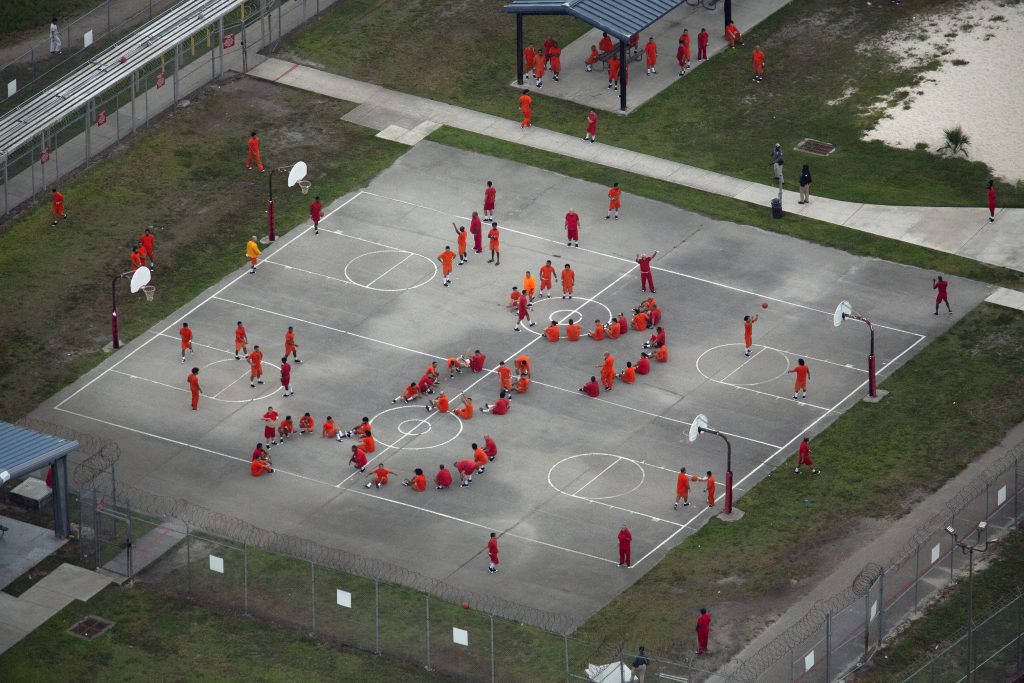
But everything was not fine. The emotional toll of living under rapidly evolving and expanding immigration policies has had a profound impact. The Urban Institute report "Facing Our Future: Children in the Aftermath of Immigration Enforcement" found that most children and adolescents experienced at least four adverse behavioral changes in the six months following a raid or arrest, including increased crying and fear, changes in eating or sleeping habits, and heightened anxiety, withdrawal, or aggression compared to the previous six months.
Although Arun experienced a false alarm, his response was not irrational. It was grounded in his lived reality: His father remained in detention, the family's future remained uncertain. They were on guard because history had shown they had to be.
On Easter Sunday, Arun, his sister, Jasbir, and their mother finally allowed themselves to sleep in. Then came a text from a relative of his father’s cellmate. Harpinder had left the BTC detention in an ambulance.
The siblings grabbed their phones. BTC refused to tell them where their father had been taken, so they called every hospital in the vicinity. Intervening on their dad’s behalf was something they had been doing for years, a role reversal that mental health professionals call "parentification.” It is a compression of childhood that occurs "when youth are forced to assume developmentally inappropriate parent- or adult-like roles and responsibilities," a research team reported. Parentified children and adolescents “are expected to become pseudo-parents and pseudo-adults long before they are cognitively and physiologically equipped for these roles," researchers added.
"The kids have gone through so much,” Harpinder later said from England. “They had to walk a little tightrope: keeping their mother sane and keeping me sane. Arun went from being quite childlike to being more adult than anyone within just a few months."
Dr. Razia Kosi, a Maryland-based child psychologist working with South Asian communities, explains that the phenomenon varies by generation. "Depending on whether they're first, second, or third generation, we see different layers of engagement,” she says. The depth of parentification also depends on what she describes as “parents' sense of belonging: where they feel they land in the whole process of acculturation.” These factors inform both how many adult responsibilities children take on and the extent to which they feel the need to navigate both Asian and American cultures and intervene on their parents’ behalf. While parentification has been shown to increase self-reliance, improve coping skills and foster growth, it has also been correlated with increased rates of depression, anxiety, addiction and poor physical outcomes.
The children did not know their father had collapsed in ICE detention showing signs of cardiac arrest after being deprived of insulin for nearly a week.
"Do detainees from Broward Transitional come to you guys?" Arun asked the first hospital he called. The response: "I have no idea." The siblings kept searching. They did not yet know their father had collapsed in the dinner line at BTC, showing signs of cardiac arrest after being deprived of insulin for nearly a week (part of a larger, horrific pattern of neglect and abuse their father had experienced in ICE detention).
The next morning, Arun’s sister and mom headed to work. They had no choice. They had to keep the shipping store—their only source of income—running, shrugging off customers like the one who sneered, "How's Trump's America treating you?" A 2020 survey of 125 long-term resident households in Pima County, Arizona determined immigration arrests cost a household, on average, more than $24,000. Deportation of an immediate family member resulted in an average annual income decline of more than $19,000 for noncitizen and mixed-status households alike.
Arun was meant to be studying but instead made repeated calls to every hospital near BTC, plus the sheriff’s department and detention facility itself. “I was going crazy,” he says.
"Children are so attuned to risks facing their parents or family structure," Dr. Nguy explains. "They pick up on anxieties and financial insecurity, and that gets reflected in their own internalized struggles."
Later that day, a nurse confirmed Harpinder was there, in the very first facility they had contacted the day before. But he was listed under a pseudonym, his real name in brackets.
"The only time we will alert you," the official said, "is if your father dies."
Shortly after, Arun called back and asked for his father under the assumed name. The nurse immediately hung up. He called again. A hospital supervisor told Arun he could not share information because the patient was in ICE custody: “Information is confidential.” He called BTC in hopes of getting some word that his dad was okay. “The only time we will alert you,” the official told him, “is if your father dies.”
For nearly three days, the family was anxious and fearful, barely eating or sleeping, not knowing that Harpinder had stabilized but was still under observation. Only when the online ICE locator showed that Harpinder was back in detention did they think he was okay. A cell, they reasoned, was better than a hospital. Relief washed over them.
But that same day, Arun—the family’s liaison to their attorney—received an update. “Please see the attachment,” the lawyer emailed just before the end of the workday, “and call me tomorrow to discuss.” Arun was the first to learn a motion to reconsider in his father’s case had been denied and he would be deported. Arun had to break the news to the rest of his family, including his dad.
"The ICEman took him"
Last May, Jaswinder Singh and his wife Ruby, a U.S.-born citizen, brought all six of their children to what should have been a celebratory meeting: Jaswinder's interview with U.S. Customs and Immigration Services for his permanent residency ("green") card. Theirs was a modern-day love affair. The couple met as neighbors and Jaswinder fell in love with not only Ruby but her four children from previous relationships. The couple eventually got married and went on to have two more children together. All, Ruby says with affection, are “deeply loved.”
As they passed through the metal detectors, a police officer yelled "ICE is here." Ruby felt her chest tighten. She turned to her husband—nicknamed Lucky—and said, "ICE is here." He squeezed her hand reassuringly. "Don't worry. I've been through this before. It's going to be okay."
After waiting for her husband for what “seemed like forever,” an officer appeared and asked if he could take Ruby, alone, into a back room. She refused to leave their children, so he led all of them down a long, narrow hallway. “I kept looking and looking for him, with each room that we passed. I didn’t see him,” she said. “And I felt so lost.”
Finally, the officer told her that her husband had been detained.

The Department of Homeland Security claims 70% of ICE arrests have been of “criminal illegal aliens,” but the evidence collected by Syracuse University’s Transactional Records Access Clearinghouse does not support it. The number of non-criminal detainees arrested by ICE has surged by 2,000% under Trump. According to recent reporting,73% of those detained have no criminal convictions; only 5% have violent convictions. Jaswinder says he has never even had a speeding ticket.
“We aren’t a fake family, and he isn’t a criminal,” Ruby said to the officer. “I know,” he replied. “I am so sorry.”
Outside the office, Ruby’s thoughts turned to the children. Tara, Trevor, and Karan—all in their late teens—understood what had happened. But she hoped the younger kids would be spared. She took them to Target, hoping the toys would distract 5-year-old Will. "But something clicked,” she says, “and he figured it out.” So, she piled everyone back into the car and drove to Chick-fil-A, her 10-year-old son Neel's favorite. But there in the back seat, he dissolved into tears. "He mentally broke down and said, "I don't understand why they took Lucky. He is not a bad person. I miss him so much." A month later when Ruby took Trevor, nearly 16, to get ice cream, he also succumbed to tears. “I just want him to come home,” he told her.

Separating a child from their parent is “an incredibly severe trauma,” Dr. Martin Teicher, associate professor of psychiatry at Harvard Medical School, explained in a recent interview with me. He has spent decades studying the ways adverse childhood experiences, including immigration trauma, reshape developing brains.
Trauma, he said, disrupts the brain development of all children. It presents most strongly in the amygdala, an almond-shaped cluster of cells nestled in the mid-brain that serves as the brain’s alarm system, interpreting sensory information and initiating fear responses. But the way trauma impacts the amygdala differs dramatically according to age. For older children, the amygdala can become hyperreactive to threat, priming them for fight-or-flight responses. In younger children who do not have the ability to fight or flee, the response gets derailed. Their developing brains adapt by treating harmless everyday occurrences as dangers while simultaneously failing to recognize genuine threats.
Trauma can also weaken the connection between the amygdala and prefrontal cortex, brain structures that work together to detect threats, manage emotions, and guide decision-making. Children with disrupted circuitry between these regions struggle to regulate their anger, control their impulses and maintain the kind of mental flexibility that allows them to hold information or sustain attention.
Will, who recently started kindergarten, is "a lost soul,” Ruby says. “When people ask him where his daddy is, he says, 'the ICEman took him.’"

The sadness and disassociation Ruby has witnessed isn’t just momentary emotional distress. At 5 years old, he is in a developmental window when specific brain regions are most vulnerable to the effects of trauma.
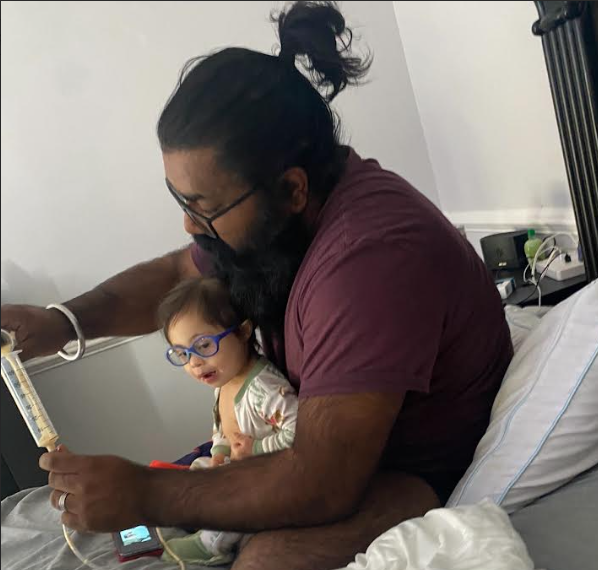
Yet it's Jasdeep—their youngest—whose situation highlights the particular cruelty of this separation. Born with a trisomy (a genetic condition in which a person is born with an extra chromosome), pulmonary hypertension, and a hole in his heart, Jasdeep can't eat or drink by mouth—everything goes through a feeding tube directly into his stomach. This year, he was also diagnosed with autism. Jaswinder had been to every medical appointment, knew every doctor, and handled the complicated feeding routine, Ruby said. "The doctors would always say, 'Oh, he's a great dad. He helps with everything.'"
At a recent appointment, the pulmonologist asked why Jaswinder was not there. When Ruby explained, the doctor started to cry. "The kids are sitting here saying, 'Please give him back to us' and this doctor's literally sitting there crying," Ruby said. "And I just don't understand how any of this is okay."
These days, when Ruby asks Will what's wrong, he just shrugs and says he misses his dad. But when she asks if he wants to go get his dad, he says he doesn’t know. “He wonders," she says, "‘are you gonna actually give him back to us, or are you gonna just take him again?’" This tracks with what researchers describe as "ambiguous loss.”
The absence, detailed in a 2024 study, puts children in emotional limbo. Unlike death or traditional incarceration, immigration detention offers no timeline, no endpoint. The uncertainty exacerbates anxiety, leaving children with unresolved grief.
The separation heightens their vulnerability to depression and poast-traumatic stress and compromises their ability to self-soothe, trust others and establish a foundation for healthy relationships.
While the children navigate neurological and psychological upheaval, Ruby faces her own impossible challenge. As the caregiver left behind, managing six children on her own, she bears what Columbia University sociologist Yao Lu and her colleagues describe as "the social and emotional costs of family reorganization.” The increased physical and psychological burdens on sole caregivers can increase stress, reduce the amount of time they can devote to their kids, and may contribute to children’s distress.
“Under these challenges,” the researchers write, “remaining caregivers may show lower levels of warmth and support and may be more punitive in their interactions.” At the same time, they add, “Young children are likely to interpret separation from parents as a complete loss of (the absent parent’s) love and protection.”
Will used to proudly wear the traditional Sikh head coverings his grandfather sent from India, but now he refuses. When his older brother tried to hype him up—"It's so cool, you wanna wear it?"—the 5-year-old said he was too scared. That fear reflects a threat-detection system working overtime and is not unfounded. A 2017 report, “Living in an Immigrant Family in America: How Fear and Toxic Stress are Affecting Daily Life, Well-Being, & Health” from the health policy organization KFF revealed a significant increase in discrimination, racism and bullying of children of immigrants during Trump’s first term. A 2020 study of 179 children in the 6th and 9th grades found that while all participants thought bullying was wrong, non-immigrant adolescents objected less when the victim of bullying was an immigrant. Will’s older brother Neel now asks, "Mom, are they gonna come get us because we're brown?"
Jaswinder has missed Will's first day of kindergarten and his birthday. He missed Father’s Day, Neel’s birthday, and Halloween. He missed Jasdeep's birthday—his “Santa baby” born on Christmas Day. And he'll miss Tara and Karan's graduations. Both kids graduated early. They had wanted their adoptive father to be there.
"The impact of forced separation by the Trump administration will not end when children and parents are reunited," Dr. Teicher wrote in a 2018 commentary. "Many will live in fear that this will happen again.” And the consequences, he says, will still be playing out “20 years from now."
After six months in detention, Jaswinder was deported. He describes himself as feeling as devastated and lost as his children, unsure when he will see his family again, or how things will be when he does.
MindSite News contributor Simran Sethi is a media fellow at the Nova Institute for Health, which provided financial support for this series. If you or your loved ones are impacted by current immigration policies, these guides on family preparedness and ICE encounters may help.
This story is reported and produced by MindSite News and co-published by The Xylom, a nonprofit news outlet covering global health and environmental disparities. Subscribe to their newsletter here.
This article first appeared on MindSite News and is republished here under a Creative Commons Attribution-NoDerivatives 4.0 International License.
The Army Corps of Engineers Wants to Dredge the Cape Fear River. Environmentalists Tally the Costs.
On a ferry trip across the Cape Fear, they pass beaches and bird habitats that could be endangered by PFAS deposits. The Trump administration has already proposed rolling back PFAS limits for drinking water from the river.
By Lisa Sorg
January 11, 2026
This article originally appeared on Inside Climate News, a nonprofit, non-partisan news organization that covers climate, energy and the environment. Sign up for their newsletter here.
Forever War, Part 3: This story is the third in a series of stories about the PFAS crisis in North Carolina.
FORT FISHER, N.C.—On a sunny, brisk afternoon in mid-December, Kerri Allen peers from the deck of a ferry, crossing the Cape Fear River from Fort Fisher, on a coastal barrier island, to Southport, a small town on the mainland, near where the river meets the sea.
Allen has lived near the water all of her 30-plus years. She competes in outrigger canoe races and calls herself an “East Coast mermaid.” She knows how to read a river, and at times her life has depended on that skill. She has paddled this rugged stretch of the Cape Fear River when winds were wailing and whitecaps were walloping her boat. She now works as coastal management program director for the N.C. Coastal Federation.
On this day, from the port side of the ferry, the river looks as deep and dark as midnight. A light southwest wind pushes serrated waves against the hull.
“There is a lot going on under the water,” Allen says, as she scans the horizon. “Tidal currents, river currents, basin currents.”
Allen is taking the 35-minute ride with her fellow environmental advocates: Lindsay Addison, a coastal biologist with the Audubon Society, and Kemp Burdette, the Cape Fear Riverkeeper. They’re showing me the potential impacts of a proposed federal dredging project: Shorelines and beach spits that are buffeted by wakes of enormous container ships, and vulnerable bird habitats on barrier islands that could be coated with PFAS-contaminated silt.
And, of course, the Cape Fear River itself. It’s a repository for industrial chemicals and fertilizers that have drained from farms and lawns, and microplastics that have invaded every aspect of human existence, even our brains.
The advocates have spent the last year fending off myriad environmental assaults under the Trump administration, including the loss of wetlands protections, the weakening of the Endangered Species Act and the rollback of PFAS regulations in drinking water.
These threats—and many others—are now weighing on the advocates’ minds as they fight a different battle, the billion-dollar, six-year dredging project proposed by the U.S. Army Corps of Engineers.
To accommodate larger ships heading up the Cape Fear River to the Port of Wilmington, the Corps would dredge 28 miles of the river up from its mouth near Bald Head Island, north along the Fort Fisher ferry route and upstream to the port. The dredging would deepen the shipping channel to 47 feet, from its current depth of 42 feet, federal records show, and widen some segments by as much as 500 feet—equivalent to one and a half football fields.
By the time the Corps is finished, 35 million cubic yards of silt and sand, plus the creatures that live in it, would be scraped and slurped from the riverbed.
The Corps would dispose of roughly half the material at a permitted ocean disposal site; the rest—sand and silt likely contaminated with PFAS—would be slathered on hundreds of acres of public beaches, bird-nesting islands and imperiled wetlands.
From the ferry deck, the Military Ocean Terminal Sunny Point comes into view across the vast river expanse. Operated by the U.S. Army, it is the world’s largest military terminal. It stores and ships explosives, artillery shells, Howitzers, grenades and other ammunition. If the United States is embroiled in a conflict—or assisting with one—the weapons likely ship from Sunny Point.

Parts of the terminal are contaminated with toxic PFAS found in firefighting foam, military testing has shown. Studies have also found contaminants from terminal seeping from the groundwater into tributaries of the Cape Fear.
University scientists and state environmental regulators have also found the forever chemicals in river water, fish, birds and alligators, as well as in sediment north of the port.
Despite the likelihood of contamination, the Corps doesn’t intend to test the dredging material for PFAS, according to a Draft Environmental Impact Statement released in September. In fact, the 260-page document doesn’t mention PFAS at all.
Even if the Corps did find PFAS in the dredging material, it’s unclear if they would be prohibited from disposing of it. There are currently no federal standards or regulations to guide decisions related to PFAS contamination in sediment, a Corps spokesman said.
Because sediment tests have a limited shelf life, the spokesman said, samples collected now would be outdated by the time the Corps would begin dredging the river in five to 10 years.
If the dredging project comes to fruition, the spokesman said, the Corps would test the sediment in the engineering and design phase “to meet all applicable requirements” and guide decisions about where to place the material.
Gulls soar overhead. A cormorant perches on a channel marker and spreads its wings. As the ferry lumbers downriver, the issue takes on an urgency that’s tinged with exasperation.
Burdette has battled for PFAS regulations since the compounds were detected in the Cape Fear River in 2017. He’s from Wilmington and unknowingly drank contaminated water much of his life. His two children, now in their teens, drank it. His father drank it and died of kidney cancer, which research has linked to exposure to GenX, a PFAS compound.
Burdette has wrestled alligators so scientists could take their blood. His organization, Cape Fear River Watch, sued the state and Chemours, the chemical manufacturer responsible for discharging GenX and other forever chemicals into the Cape Fear. The state and Chemours agreed to a consent order that required the company to stop its contaminated discharges into the waterway.
Last fall, Burdette paddled an aluminum rowboat to Chemour Fayetteville Works on the river to test whether a PFAS compound called TFA was in water outfalls from the plant. He found disturbingly high levels of the ultra-short chain compounds.
Now Burdette is again fighting for the river he knows so well, and on behalf of the people who depend on it.
A Gritty, Loud, Noxious Port
The ferry turns gently toward the west as the advocates aboard rattle off additional probable harms from the dredging: The increased wake and wave action from the enormous ships would erode shorelines and drown bird eggs and chicks in their nests. Roughly 1,000 acres of wetlands would be permanently lost. Endangered Atlantic Sturgeon, which live on the river bed, would be dismembered by the ships’ sharp keels.
Allen is concerned that there is no monitoring plan for the environmental impacts. The Cape Fear River is so impaired, she says, that crabbers describe the river as dead.
Allen, in her mid-30s, is blond and athletic with a wide smile. She was born in Raleigh, but moved to Wilmington as a teenager. She originally planned to become an artist, and her creative streak manifests in her Coastal Federation office at Wrightsville Beach.
Not only does she have a graceful array of seashells, but also a collection of sand: Black sand, white sand, sand from Hawaii, sand from San Francisco, sand from Costa Rica, sand with large grains, sand with small grains, even sea glass, all housed in 100 small antique bottles with cork stoppers.
Had it not been for a high school oceanography class, Allen could be painting ocean scenes. But as part of the class, she visited a marsh where she retrieved the shell of a tulip mollusk, a type of large sea snail. She was hooked. Now she’s a coastal geologist.
Allen and her fellow advocates have scrutinized the economics of the proposal. Federal documents show the financial benefits of the $1.2 billion proposed project are few and barely meet the Corps’ benefit-cost threshold for reasonableness. The state legislature would have to appropriate $339 million to cover a quarter of the costs.
The total cargo volume flowing through the port is expected to remain steady with or without a harbor improvement project, according to the Corps’ analysis. Yet, the Corps, and before it, the State Ports Authority, justified deepening the shipping channel to accommodate larger vessels. Otherwise, ships would have to “light load”—carry less weight to the port, which could entail more river traffic.
In other words, fewer trips, but bigger ships.
The 284-acre Port of Wilmington lies just two miles south of downtown. Unlike the city’s waterfront promenade, restaurants and tourist shops, the port is gritty, loud and noxious.
Along Burnette Boulevard, Kinder Morgan, the Houston-based pipeline company, operates a chemical, petroleum and asphalt storage terminal. EcoLab injects shipping containers with the neurotoxin methyl bromide to fumigate logs. In the backyards of Sunset Park residents looms Enviva’s dome of wood pellets, sourced from North Carolina forests and bound for Europe to be burned as fuel.
The port is crucial to Wilmington’s economy, but receives just 1.3 percent of the nation’s marine shipping traffic. It handled about 7 million tons of cargo in 2022, most of it container shipments, according to State Port Authority figures.
In February 2020, the State Port Authority released a feasibility study about improving the shipping channel, which, unsurprisingly, found it would benefit the port.
The findings have since prompted accusations of self-dealing, especially in light of an eviscerating federal review. After the state submitted it to the assistant secretary of the Army for Civil Works, that office identified more than two dozen major weaknesses and unresolved issues.
The state Department of Transportation, which oversees the port, did not respond to emails from Inside Climate News seeking comment.
The Port Authority underestimated the project’s impact on river flooding associated with sea-level rise, failed to account for the effects of climate change, and claimed, without evidence, that unless the shipping channel was deepened and widened, the port would close.
“As written, the planning objectives are unclear and could potentially lead to the pre-selection of an alternative plan,” Corps documents read. “In many cases, the report uses qualifying words, such as may, potentially, and just, to lessen the description of project impacts.”
Nonetheless, Congress authorized more than $839 million for the project, but with a caveat: The study’s shortcomings had to be fixed before lawmakers would consider releasing the funding.
In 2022, the task fell to the Corps.
PFAS in the Fish
The ferry docks at the Southport terminal after crossing the river in about 35 minutes, and the trio of environmental advocates heads for the fishing pier. It’s nearly empty in December, but during high season, the pier is jammed with anglers eager to catch a red drum or Atlantic croaker for dinner.
Those fish are among seven saltwater species that contained PFAS in their tissues, according to sampling conducted by the state Department of Environmental Quality.
In 2023 and 2024, DEQ tested 77 fish caught between Wilmington and Southport—the same stretch of the river that the Corps would deepen and widen—for the compounds. DEQ presented preliminary data to the state Secretaries’ Science Advisory Board last October that showed PFAS were present in all seven saltwater species sampled, as well as in river water.
The agency found 13 types of PFAS disbursed among the fish. PFOS, which the chemical industry phased out in 2002, was detected in all of the samples.
Two compounds found in several fish, PFMOAA and PFO5DA, can be traced back to Chemours, 100 miles upstream.
The saltwater fish findings build on previous DEQ sampling that detected high levels of PFOS in eight species of freshwater fish commonly caught in the river segment upstream of Wilmington, between Chemours and the Bluffs on the Cape Fear.
The results compelled state health officials in 2023 to issue a fish consumption advisory for those species, recommending that pregnant women eat none and that others limit their intake to no more than seven meals in a year.
The state health department is evaluating options for future fish advisories, including consideration of guidelines proposed last September by the Great Lakes Consortium for Fish Advisories.
Research on PFAS and Birds
Addison is in her 40s and, in the winter, wears flannel and a knit toboggan to protect against the wind. She has been a coastal biologist with the Audubon Society in Wilmington for 15 years and grew up in Florida, surrounded by nature and books. Her father was a biologist, and she spent her childhood playing outside, roaming the woods behind her elementary school while she waited for her mother, a teacher, to finish working.
“Outside, you might go to the same place over and over,” she says, “but you don’t know what you’re going to see or what’s going to happen. It’s never the same.”
Even her hobbies dovetail with her professional life. Like the protagonists in the British mysteries she reads, Addison observes the natural world, what belongs and what seems out of place.
Addison loves birds. She has a figurine of a killdeer in her office—but if she had to name a favorite shorebird, it would be the American oystercatcher. (The Carolina wren, a yardbird, is second, Addison says. “They’re pert.”)
“Birds are a thing that everyone can get behind,” she says. “They are a great uniter.”
American oystercatchers live on coastal salt marshes, mudflats, and islands. They are sociable introverts who are loyal to their mates and will return to the same spot to nest every year. If an island were a parking lot, Addison says, an American oystercatcher would return not just to the same lot, but “to the same parking space.”
American oystercatchers, as their name suggests, eat oysters. And scientists have found oysters contaminated with the compounds along the Southeast Atlantic Coast.
Some birds living along the Cape Fear River have also been contaminated with PFAS. In 2017, Addison, EPA scientists and University of Rhode Island researchers tested chicks that had died of natural causes from three locations: Massachusetts Bay, Narragansett Bay in Rhode Island, and the Cape Fear River Estuary in North Carolina.
They found 16 types of PFAS in the livers of royal terns, sandwich terns, laughing gulls and brown pelicans from the Cape Fear River Estuary. These included PFOS and two compounds associated with Chemours.
Chicks from the Cape Fear Estuary contained significantly greater concentrations and numbers of PFAS than juveniles from Massachusetts Bay or Narragansett Bay, researchers found. A royal tern chick from the estuary had the highest total of PFAS of all the birds tested: 390 parts per trillion.
Over the past two years, Addison, along with the U.S. Geological Survey and the University of North Carolina, Wilmington, conducted a second study. They took blood samples from living brown pelican chicks to see if their immune systems have been affected by exposure to PFAS. The results are pending.
If the Corps places contaminated dredge material on the bird nesting islands, that could further expose them to compounds. The “likely presence of PFAS is a major concern” for DEQ, according to an agency spokesperson.
“We need to find out before we do it,” Addison says. “You can’t un-ring the bell.”
Back Before the House
Emily Donovan, co-founder of the environmental group Clean Cape Fear, couldn’t make the ferry trip. Instead, she prepared to testify before the U.S. House Environment Subcommittee.
Donovan routinely speaks in public; sometimes it seems like she’s on tour. Seven years ago, she first appeared before the House Environment Subcommittee, where she pleaded with federal lawmakers to authorize and fund a comprehensive, nationwide PFAS Human Exposure Study and to regulate all of the compounds, not piecemeal, but as a class.
Last May, she addressed 100 people from the pulpit of Ocean View United Methodist Church in Oak Island, North Carolina, to unveil findings about PFAS in sea foam along the state’s beaches. Coincidentally, that was the day EPA Administrator Lee Zeldin announced he would roll back drinking water regulations for GenX and four other PFAS chemicals—regulations Donovan and other North Carolina environmentalists had fought for more than a decade.
This time, though, Donovan felt nervous. She had little time to finesse her remarks. House Democrats had contacted her on short notice to appear before the committee about proposed PFAS exemptions under the Superfund law, which governs hundreds of sites nationwide that are contaminated by hazardous waste.
The hearing at the Rayburn Building in Washington, D.C., was on the 18th of December: A week before Christmas, in the middle of Hanukkah and on the final day of Congress in 2025. She wondered if anyone was listening or even cared.
Clad in a black turtleneck sweater, Donovan sat at a hearing table with three other witnesses, all of whom represented industries that favored the Superfund exemption.
The Trump administration had kept the hazardous materials designation for PFOA and PFOS, enacted under President Biden. That classification places those compounds under the purview of the Superfund program, which allows the EPA to force polluters to pay for cleanups, rather than taxpayers.
Now, Congress was weighing a legal exemption for “passive receivers,” entities that didn’t produce the compounds but had unknowingly accepted contaminated material: farmers, wastewater treatment plants, even seaside beach towns.
Initially, the proponents’ arguments seemed reasonable. But as the hearing wore on, observers learned the EPA already absolves passive receivers from governmental liability. However, proponents say that without the exemption, they are still vulnerable to third-party lawsuits.
Those claims are disingenuous, Donovan told the committee, whose Democratic members agreed. The passive receiver exemption could shield polluters from accountability, she said. For example, in North Carolina, the state regulates water and wastewater utilities. In turn, the utilities often end up processing discharges of toxic chemicals from industries like plastics manufacturers and textile companies.
This gives polluting industries cover: the utility is on the hook to DEQ, not them, Donovan said.
“Our beaches are coated in an atrocious amount of PFAS in sea foam.”— Emily Donovan, Clean Cape Fear
“Yet here we are debating whether to weaken accountability for two types of PFAs that haven’t been in commercial use for over a decade,” she said.
Donovan was part of a research team that found PFAS-contaminated sea foam along several Brunswick County beaches in southern North Carolina. Of the 12 sea foam samples, Caswell Beach and nearby Oak Island had some of the highest levels. These are the same places where the Corps could soon place 2 million cubic yards of dredge material from the Cape Fear River.
“Our beaches are coated in an atrocious amount of PFAS in sea foam, the highest ever recorded in literature to date,” she told the committee. “The discovery of these toxic levels of PFAS contaminating our local beaches is yet another public health threat lawmakers and regulators have no idea how to address.”
Seaside Towns Divided on Dredging
Sand is existential for coastal communities. Without a steady replenishment, the sand is carried to sea by storms—some of them supercharged by climate change—and the constant barrage of wakes and waves. Without sand, there are no tourists. And without tourists, the coastal economy folds like a beach chair.
Beach renourishment can cost seaside towns tens of millions of dollars. This is why the prospect of the Corps delivering free sand from the dredging project is nearly irresistible.
The Corps is required under federal law to evaluate whether to test dredge material for contaminants of concern, such as pesticides, metals and PCBs. If the material is in an area with a history of spills or known contamination, the Corps is required to test it for a list of chemicals before disposing of it either inland or at a designated ocean site. PFAS are not on that list.
In the Draft Environmental Impact Statement, the Corps bases its conclusions that sediment contains “acceptable concentrations” of toxic contaminants on tests conducted from 2013 to 2016. Those tests did not include PFAS; not until 2017 did the public know PFAS had contaminated the Cape Fear River.
Scientists have already shown that PFAS can settle in sediment in rivers and lakes worldwide, from Michigan to China. Ralph Mead, a scientist at UNC Wilmington, found the compounds in sediment samples in the Cape Fear River at the dam 39 miles north of Wilmington. Eleven PFAS were found in estuarine sediments in Charleston, S.C.
Erin Carey is the deputy director and conservation policy lead for the North Carolina chapter of the Sierra Club. She lives in Wilmington with her husband and stepson, and grew up in rural Vermont, where, as a child, she became an environmental advocate.
In third grade, she started a petition to bring a rock, about the size of a loaf of bread, into the classroom where she could store it at her desk. All of her classmates signed the petition, which did not sway the teacher. “Not only did it not work,” she says. “But I didn’t get the rock and I had to stay in for recess.”
In sixth grade, she started a boycott to advocate for dolphin-safe tuna. Carey wanted to “save the world” and become a marine biologist. She moved to Wilmington, where she earned two degrees in environmental and marine science.
But “there weren’t a lot of ‘save the world jobs’ out there,” Carey says, so she took whatever science job she could.
She worked at the microbiology lab at Wilmington’s Sweeney water treatment plant years before scientists discovered PFAS entering and leaving the facility. In Carteret County, she inspected small wastewater treatment plants, where her job entailed peering into vats of raw sewage. At DEQ’s shellfish sanitation program, she pureed oysters to test them for E. coli bacteria.
Finally, one day when she was surfing in Costa Rica, she got the call that she’d been hired at the Sierra Club in North Carolina. Since then, she’s seen some environmental victories—state rules on emissions of methyl bromide, a neurotoxin—and losses. Under Trump, millions of acres of wetlands, including thousands in North Carolina, are losing protection. “The wetlands fight will be, [and] is, the most daunting and most terrifying change we’ve seen come out of the Trump administration.”
Polling shows that the environment falls below the economy in importance, she says. “It may, but I don’t think that that’s a full picture of how emotionally connected people are to the environment. Despite the body blows that we take, the energy from the public, love for the environment and for nature, the need to protect it, that seems intrinsic to being human. That makes it worth it.”
Carey says environmental groups have spoken with the Corps about their PFAS concerns, but “they’re taking the stance that it’s not regulated and we don’t have to do anything about it.”
“No, you don’t have to,” Carey says of the Corps, “but you could do your job and protect people.”
“Despite the body blows that we take, the energy from the public, love for the environment and for nature, the need to protect it, that seems intrinsic to being human.”— Erin Carey, Sierra Club
Caswell Beach Mayor George Kassler said he is unaware “that anyone is concerned with PFAS from material placed on the beach.” He said the town is relying on the “Corps’ assurance” that chemical testing of the material would occur as outlined in the Draft Environmental Impact Statement.
In Oak Island, elected officials haven’t taken a public stand on whether it would accept sand from the dredging project. The Town Council “has not yet had the chance to discuss this topic in an open meeting,” a town spokesman said.
Other municipalities, though, have either opposed the project or asked for concessions similar to those made when the Georgia Ports Authority expanded the Savannah Harbor.
The Southport Board of Alderman passed a resolution earlier this month that urged state and federal policymakers to require a “comprehensive, long-term, and fully-funded environmental mitigation and adaptive management plan.”
This would require the State Port Authority to deposit $500 million in an escrow account to fund future mitigation projects to address as-yet-unknown environmental harms caused by the dredging.
Kure Beach officials passed a similar resolution. They also urged the relevant agencies to protect Battery Island and the surrounding Cape Fear River islands “as irreplaceable ecological assets,” ensuring that mitigation measures “fully safeguard the habitats supporting nearly a third of North Carolina’s coastal shorebird population.”
The Village of Bald Head Island, a wealthy enclave in and near a maritime forest four miles from the mainland, would receive 1.6 million cubic yards of dredged sand. But that offer isn’t enticing enough to counter the potential environmental and property damages; in mid-December, village officials voted unanimously to oppose the project.
Bill Cary, an attorney with the powerful law firm Brooks Pierce, which is representing Bald Head Island, wrote to the Corps that the village is still recovering 25 years after the previous dredging project. It has spent more than $2.8 million a year addressing the damages, including shoreline erosion.
Brooks Pierce also hired ports and shipping expert Asaf Ashar, a University of New Orleans research professor emeritus, who, in 40 pages of analysis, concluded that the Corps’ economic projections are incorrectly calculated and unsupported.
“Considering the size of the projected expenditures, the environmental impacts, the prior criticisms and the time and expense of the new analysis,” Cary wrote, “one would expect the 2025 economic considerations to be thorough, well-documented, supported by available data, and based on sound, consistent analytical principles. It is none of those things.”
What’s Next
A motorboat passes by the Southport pier. Its wake travels beneath the pilings and thwacks the stone rip-rap that protects the waterfront from flooding. Multiply the power of that wake by 1,000, even 10,000, from ships traveling the river, and the force of the water can annihilate a shoreline.
Addison points out Battery Island, which lies about a half mile across the river from the Southport pier. At 100 acres, it is one of the largest wading-bird areas in the state, as well as a sanctuary for chicks because no mammals, other than the occasional unfortunate deer, can swim there.
Many of the birds “read” the island for the high tide line and build their nests above it, she says. But sometimes the incoming water, whether from gusty winds or big boats, tops the line and drowns birds in their nests.
When ferries and ships pass the island, they create a tsunami effect: Water is sucked from the shore, but then slams back and gradually sloughs off the shoreline. The birds are running out of higher ground. Thirty-year-old cedars are falling into the sea.
“It’s one of the islands we’re most concerned about,” Addison says. “There’s a pretty wicked current. It’s striking how far a boat wake can travel.”
The state Wildlife Resources Commission owns many islands near the river, which the Audubon Society manages. The commission is also concerned about the damage wakes could inflict on birding islands from large ships, especially on Battery Island.
“There was no information on wave heights and how far wakes would progress onshore,” the WRC wrote in its public comments to the Corps. “A single overwash causes a nest to be lost. This permanent loss of nesting and roosting habitats along with potential site abandonment by birds should be considered and mitigated appropriately.”
The project would alter 1,000 acres of wetlands from freshwater to saltwater, which supports entirely different ecosystems. The Corps would be required to mitigate those impacts at other locations within the river subbasin, but the harm—including inundation of some wetlands and wake erosion of others—would be extensive and permanent.
“This project will increase salinity up the river,” said Carey of the Sierra Club. “It will change the nature of ecosystems and forests. The idea of killing off wetlands and then just assuming that they will become just a different kind of wetland—eventually—there’s no analysis behind that. It’s just an assumption.”
Carey likens the project to a scene in the film Jurassic Park: “Jeff Goldblum says, ‘your scientists were so focused on whether they could do something, they didn’t think about whether they should.’”
An Uncertain Fate
On the pier, Burdette scrolls on his phone, searching for photos of Atlantic sturgeon. They are endangered in North Carolina and, because they live on the river bottom, can be mowed down by the sharp keels of ships.
He points to the shoreline where the boat’s wake just dissipated. “This one I found right over there,” he says, having found the photo of a sturgeon on his phone. “And this one—is missing part of himself.”
Cars and trucks line up to load onto the ferry back to Fort Fisher. It is mid-afternoon but already the sun is nodding toward the horizon. Burdette glances at his watch, 30 minutes until high tide. The ferry heads up and then back across the river to Fort Fisher. Even though the advocates know the area by heart, there is always something beautiful to see.
“Wow, look at that boat,” Allen says, pointing ahead.
The long fingers of the sun have bathed the vessel in hues of butter.
The conversation turns to what could happen next. Under state law, DEQ must conduct a consistency review for federal projects that could affect the coastal zone. The agency’s Division of Coastal Management analyzes the project to evaluate whether it complies with the state’s approved coastal management program, including the dredge and fill law.
Coastal Management officials are expected to complete the review by Jan. 20.
The division has three choices: It could issue a letter of “concurrence,” which allows the project to continue. A letter of “conditional concurrence,” requires changes to the project for it to proceed. An “objection” cancels the project unless the Corps appeals to federal court or enters into mediation with the state.
The Corps could issue its Final Environmental Impact Statement as early as next spring. Even if the project clears the regulatory hurdles, it’s unclear if Congress and the state legislature will appropriate the funds—and when.
The ferry heads north and east. From the starboard side, Burdette points to a dredging barge, slouched in the water, laden with dirt. The barge is headed south, and likely out to sea, to dump it.
Out here on the water, I feel small, humble, inconsequential. “Ecosystems, the ocean, the tides, hurricanes, these are not things you can negotiate with,” Addison says. “We can, we can observe them and appreciate their beauty, but we do not control them. The forces are big and impersonal, and that, to me, is comforting instead of intimidating.”
Ten minutes after sunset at Kure Beach, just north of Fort Fisher, the skies have turned from indigo to lilac. The sand is damp and cold. A half dozen hardy tourists take selfies against the backdrop of ocean waves breaking on the shore.
Those forces require beaches to be routinely smoothed and mended. Behind the orange snow fence, slumps a backhoe and a heap of sand.
This story has been updated to give Erin Carey’s full title and corrected to reflect the process by which the Corps could appeal a state objection to the dredging project; that appeal is to federal court, rather than a federal agency.
Black lawmakers warn constituents that proposed funding formula changes could hurt Mississippi’s HBCUs
by Candice Wilder, Mississippi Today
January 14, 2026
Proposed changes to how the state funds its eight public universities could harm historically Black institutions, some lawmakers said.
The funding formula updates, which legislators discussed with higher education officials in December, would tie state money to post-graduation student success such as the number of Mississippians attaining jobs and completing some form of education beyond high school.
A delegation of Black lawmakers said that factoring graduation rates, post-graduation employment and degrees awarded by universities into their allotted funding would unfairly penalize historically Black colleges and universities for challenges tied to decades of underfunding.
Black lawmakers spoke about the funding formula to a standing-room-only crowd of more than 160 alumni and supporters at Mt. Nebo Baptist Church in Jackson on Monday. The goal of the event, organized by Jackson Democrats Sen. Sollie Norwood and Rep. Grace Butler Washington was to educate and warn HBCU stakeholders about proposals the state Legislature is considering this session.
It was also a rally to encourage supporters to stay engaged.
“We need to be cautious as we proceed forward,” said Rep. Bryant Clark, a Democrat from Pickens and a 1998 graduate of Mississippi Valley State.
The Board of Trustees for the Institutions of Higher Learning, which oversee the state’s public universities, uses a formula that equally distributes funding across the eight universities without factoring in performance or enrollment.
HBCUs serve many students who lack resources and face more barriers to completing higher education. More than three quarters of the undergraduate student body at Mississippi's three public HBCUs rely on Pell Grants — federal student aid provided to students who demonstrate exceptional financial need — to attend. By comparison, Pell Grant recipients make up about half of the student enrollment at only two of the state’s predominantly white institutions — Mississippi University for Women (56%) and University of Southern Mississippi (52%).
Mississippi settled a lawsuit over funding disparities at its public universities in 2002 — the $500 million Ayers settlement — but chronic underfunding of higher education by the state means these funds have not caught HBCUs up to their PWI counterparts.

The proposed funding formula success metrics could lead to closing Mississippi Valley State, Clark said.
Valley State’s average six-year graduation rate is 27%, the lowest of Mississippi’s public institutions, according to IHL data. MVSU awarded 242 degrees in the 2023-24 academic year, the lowest among the state’s public universities, even similarly sized ones. Of almost 2,200 students enrolled at MVSU in fall of 2023, 985 received Pell Grants, federal financial aid awarded to students from low income households, according to the National Center for Education Statistics.
Students who attend Mississippi Valley State have more barriers to get to the rural campus, including transportation, cost and affordability, Clark said. It is unfair for the Legislature and IHL to consider a funding formula that doesn’t take into account the disproportionate challenges to graduation that the students enrolled face, he said.
Mississippi Valley State is also an “economic engine” for the Delta region, Clark said. The university contributes $75 million to the the state’s economy and produces more than 980 jobs, according to a 2024 HBCU Impact report from the United Negro College Fund.
Instead of focusing on closing them, the Legislature and IHL should view the state’s HBCUs as a model of efficiency, doing more with fewer resources, Clark said. “We continue to educate our students at just a fraction of the cost.”
Alcorn State University and Mississippi Valley State alumni tend to remain Mississippi residents and enter the state’s workforce after graduation, said Rep. Greg Holloway, a Democrat from Hazlehurst. For predominantly white institutions such as the University of Mississippi or Mississippi State University, he said, “you can’t say the same thing.”
“They don’t talk about us and our impact,” Holloway said to thunderous applause. “This new formula is about a money grab. Displacing resources from one place to another. We should be talking about how to provide quality education for our HBCU students. We deserve more.”
Students should pay attention to the threat of closing one of Mississippi’s HBCUs, said Camrynn Wimberly, a senior studying political science at Jackson State. Wimberly rallied a few of her classmates to attend the town hall. She shares policy issues and information on her social media.
“Our schools, we’re more than just football, partying and pledging fraternities and sororities,” Wimberly said. “We’re history.”
At the end of the event, Rep. Zakiya Summers, a Democrat from Jackson, encouraged HBCU alumni to send emails, call and pressure lawmakers to pay attention to their concerns. Summers also led a call and response chant, and participating lawmakers and audience members locked arms.
“When we fight,” Summers shouted into the microphone. The audience shouted back, “We win!”
This article first appeared on Mississippi Today and is republished here under a Creative Commons Attribution-NoDerivatives 4.0 International License.

Helena Moreno sworn in as New Orleans mayor under storm clouds of budget deficit, layoffs
by Katie Jane Fernelius, Verite News New Orleans
January 12, 2026
Helena Moreno was sworn in as New Orleans’ 63rd mayor on Monday (Jan. 12), taking the oath of office under the artificial starry skies and amidst the pastiche neoclassical interiors of the Saenger Theatre — officially kicking off her first term as mayor of New Orleans.
Moreno is the second woman — after outgoing Mayor LaToya Cantrell — and the first Hispanic mayor to lead the city.
Moreno was joined by former Vice President Kamala Harris, who administered the oath of office to the mayor after giving a short speech, where she described Moreno as “talented but tough.”
“She believes in fairness and in the simple yet fundamental principle that elected leaders must be accountable to the people they serve,” Harris said. “Helena, I know you will be a mayor who will lead with integrity, with courage and with the people of New Orleans always at the center of your work.”
In her inaugural address, Moreno lauded the virtues of faith, hope and love in her work to serve and lead the city.

“This is our time to build that functional city that we all deserve together,” Moreno said. “We will build a New Orleans that is safe, where we can drive down the street without busting up the car, where there is no limit to realizing a dream, and where our children have endless opportunities for success, where our seniors live not in fear or uncertainty, but in dignity and insecurity. We want a New Orleans that works for everyone.”
The seven members of the New City Council — which will be led by two Black at-large councilmembers for the first time in the city's history — were also sworn in at the ceremony, which featured music by The Soul Rebels and Trombone Shorty, among others, and included appearances by beloved local chef Emeril Lagasse and local philanthropist and New Orleans Saints and Pelicans owner Gayle Benson, as well as a host of local, state and federal politicians, including Cantrell.
The inauguration ceremony caps off a weekend of celebrations, which included a festival at Lafayette Square and a mass at St. Louis Cathedral. The Crescent City Connection bridge and the Superdome were also adorned in blue and gold lights — Moreno’s campaign colors — over the weekend. Moreno’s transition team will lead a day of service on Martin Luther King Jr. Day, after weather concerns delayed an initial plan to do it on Jan. 10.
Monday’s ceremony seemed designed to showcase her diverse political coalition and breadth of relationships by including prominent Republicans such as U.S. House Majority Leader Steve Scalise and Louisiana state Senate President Cameron Henry alongside local Democratic heavyweights such U.S. House Rep. Troy Carter and state Sen. Jimmy Harris in the ceremony.
“Let's face it, these are complicated and troubling times; conflict and division are all around us,” Moreno said. “Some will continue to try to divide us, but we must choose to come together for our future. Today, you've seen local, state and federal leaders on all sides of politics come together to support the future of our exceptional city. We have more in common than divides us.”
Despite the optimism on display at Monday’s ceremony, Moreno will assume office under stormy conditions.
The city faces a projected $220 million deficit this year. To cover the deficit, Moreno, along with outgoing District A councilmember and incoming Chief Administrative Officer Joe Giarrusso, have clawed back $14.7 million in American Rescue Plan Act dollars, called for the furloughing of approximately 700 city employees and handed out pink slips to dozens of employees.
The latest round of layoffs, which included cuts to the Office of Resilience and Sustainability, caused a stir last week. Employees say they had previously been told they would still have a job in the Moreno administration by aides close to the mayor, according to recently fired employees who spoke to Verite News. A Moreno spokesperson did not immediately respond to a request for comment on the firings.
Many of the other cuts came from subdepartments of the Mayor’s Office, including the Office of Youth and Families and the Office of Criminal Justice Coordination, which were both shuttered altogether.
Those employees were “unclassified” political appointees, meaning they are not covered by the city’s civil service system. Many such appointees enjoy higher salaries and quicker hiring processes than classified civil service workers. But unlike civil service workers, they are “at-will” employees who serve at the pleasure of the mayor and can be fired without cause or an appeals process.
On Monday morning, shortly after the inauguration concluded, the Office of Youth and Families sent out an email thanking the people of New Orleans for their support of the office as it closes.
“As our dedicated staff steps away from this work, we do so with pride in what we have built together,” the email read. “While we will no longer be here, our commitment to the wellbeing of children, youth, and families continues through the City of New Orleans Health Department, where this work will carry forward.”

Amanda Fallis, the president of the city workers’ union AFSCME Local 2349, said that the union has been in talks with Moreno and Giarrusso about furloughs and layoffs — and that union officials would meet with Moreno again tomorrow (Jan. 13) on her second day in office.
“AFSCME Local 2349 has greatly appreciated Mayor Moreno and CAO Giarrusso and their teams’ willingness to meet with us, even before officially being sworn into office,” Fallis said. “We look forward to partnering with them to follow the terms of our collective bargaining agreement regarding 45 days notice from City administration regarding any layoffs of classified employees, probationary or not.”
Despite the slew of challenges facing Moreno, she sounded a hopeful note in her inaugural address.
“We know that things are not exactly where we want them to be today, and we know that it's not going to be easy to fix these things, but just because things are hard does not mean that they're impossible,” she said. “We stand here on a turning point as we face challenging times, and we must be clear that failure is not an option. Not anymore. There’s just too much at stake.”
This article first appeared on Verite News New Orleans and is republished here under a Creative Commons Attribution-NoDerivatives 4.0 International License.