Va. Sen. Louise Lucas, one of the Old Dominion's most powerful Democrats, was one of six indicted in federal corruption case
512 Flock cameras boost Coastal Georgia’s growing surveillance network, The Brutal Commute of New Yorkers Priced Out to the Poconos, Medi-Cal cuts could push seniors and people with disabilities off of coverage


It's Friday October 23, 2026 and in this morning's issue we're covering: Va. Sen. Louise Lucas, six others indicted in federal cannabis corruption case, Clearing of Durham’s homeless encampments tests NC community’s resolve, 512 Flock cameras boost Coastal Georgia’s growing surveillance network, The Brutal Commute of New Yorkers Priced Out to the Poconos, West Bank can’t afford to lose another high school, analysis finds. But school changes are certain in other parts of NOLA, Medi-Cal cuts could push seniors and people with disabilities off of coverage.
Media outlets and others featured: Virginia Mercury, NC Newsline , NC Local, The Current (Ga.), The City Reporter, Verite News, CalMatters.
Va. Sen. Louise Lucas, six others indicted in federal cannabis corruption case
By Markus Schmidt (Virginia Mercury) Published: October 22, 2026
State Sen. Louise Lucas of Portsmouth, one of Virginia’s most powerful Democrats, was indicted on federal racketeering, marijuana distribution and money laundering conspiracy charges, with prosecutors alleging she used her legislative influence to protect and enrich a cannabis business she co-owns.
Lucas, 82, surrendered to authorities, U.S. Attorney General Todd Blanche said during a news conference in Norfolk Thursday. Six others, including family members and close associates, were also in custody in connection with the alleged scheme.
The eight-count indictment, unsealed Thursday morning, charges Lucas with racketeering conspiracy, conspiracy to distribute and possess with intent to distribute marijuana, money laundering conspiracy, conspiracy to commit honest services fraud and maintaining drug-involved premises.
The indictment also includes firearms and wire fraud charges against other defendants.
Lucas struck a defiant tone in a statement posted on X following her indictment, accusing federal authorities of trying to silence her.
“I grew up under Jim Crow. I’ve seen what happens when people in power try to silence those who stand up to them,” she wrote. “I spent my life fighting back, and I’m not stopping now. I will not be intimidated. I will not be bullied. And I will not back down.”
The unsealing of the charges against the longtime senator and outspoken critic of President Donald Trump comes 12 days before the midterm elections.
The investigation predates the Trump administration, but the timing is unusual because federal authorities have typically avoided overt investigative steps involving political figures so close to an election.
Lucas is not on the ballot this year but has ties to prominent Democrats who are.
“We’re here today because of facts and evidence, which led to this investigation to begin many years ago, and facts and evidence that led to the grand jury to indict Senator Lucas and her alleged co-conspirators,” Blanche said.
Prosecutors allege Lucas directed an organization they called the “Lucas Enterprise,” arranging the acquisition and distribution of at least 100 kilograms of marijuana and supervising the laundering of proceeds.
FBI Director Kash Patel said prosecutors believe Lucas and her associates accumulated nearly $5 million in proceeds from the alleged criminal enterprise over almost five years.
“The purpose of her enterprise included trafficking large quantities of illegal marijuana, creating generational wealth for members and associates of her criminal enterprise,” FBI Director Kash Patel said during the news conference.
Prosecutors also allege Lucas used her position as chair of the Senate Finance and Appropriations Committee to shield the operation from criminal scrutiny and influence legislation benefiting it.
Marijuana is legal to use recreationally in Virginia but not to sell. Earlier this year, lawmakers passed a legislative framework creating a recreational weed marketplace that is set to launch next summer.
Blanche on Thursday accused Lucas of betraying the public’s trust.
“Her first duty should have been looking out for her constituents before herself,” he said. “But the charges listed in the indictment reflect the alleged behavior of a public servant who put her own financial interests before the people she was elected to serve.”
Prosecutors outline business dealings
According to Blanche, Lucas’ associates included her daughters, Lisa Lucas-Burke and Theresa Lucas-Lamb, and her grandson, Ryan Eichelberger, as well as Carlton Upton Jr, Prince Albert William Hudson III and Tamika Johnson.
Lucas and Lucas-Burke opened The Cannabis Outlet in Portsmouth in 2021. Prosecutors allege Lucas-Lamb and Eichelberger acquired marijuana, supervised its distribution and managed the store for the enterprise.
Upton was Lucas’ business partner in VA Freedom Life, an umbrella for The CBD Shoppe and The Cannabis Outlet beginning in 2019, according to the indictment.
Upton managed The CBD Shoppe and allegedly worked with Lucas to obtain a recreational marijuana license benefiting the enterprise.
Prosecutors also allege Upton made materially false statements on an April 2020 application for an Economic Injury Disaster Loan for Virginia Freedom Life. The loan was funded for $11,800.
Another allegation centers on a $750,000 payment Lucas allegedly made in August 2022 for full ownership of a business serving as a shell holding company for a co-conspirator’s expected Virginia recreational marijuana license.
Prosecutors allege Lucas failed to reveal that interest on required financial disclosure forms. They say she met with the co-conspirator at her Capitol complex office to receive a partial repayment and discussed the person’s qualification for a marijuana license with officials, including legislators, depending on her receipt of a bribery payment.
“Yes, we can make a lot of money but, before we start down that road again; how about we begin with you sending at least a good faith payment of the money you owe me with arrangements for the balance. Then we can talk about future business plans,” she wrote in a text message to the unnamed co-conspirator in November of last year.
Lucas had identified herself as president and CEO of VA Freedom Life on a February 2022 Statement of Economic Interests, according to the release.
Patel said the alleged operation also involved “recycling drug proceeds to expand the operation that she launched and created, and steering marijuana licenses to entities in which members held financial interest.”
The case became public May 6, when federal agents searched Lucas’ Portsmouth legislative office and cannabis businesses. The Justice Department said agents recovered marijuana and firearms at The Cannabis Outlet and The CBD Shoppe.
At the scene, FBI spokeswoman Cassandra Temple told the Mercury: “We are conducting court-authorized law enforcement activity today.” She declined to answer additional questions.
Fox News, which first reported the operation, said staffers were ordered out of Lucas’ office while agents searched. Witnesses saw agents carrying boxes from the building. The network also reported that armed SWAT officers ordered people out of the adjacent Cannabis Outlet and that at least three people were handcuffed.
Lucas arrived after the operation began and told a reporter she did not know what it concerned.
Lucas has called investigation intimidation
After the May searches, Lucas characterized the federal action as political intimidation, saying it was “about far more than one state senator” and reflected “a clear pattern from this administration.”
In a statement on X at the time, she linked the raid to the redistricting referendum voters approved in April, saying Virginians had voted to “stop Trump’s scheme to manipulate the 2026 midterm elections.” The Supreme Court of Virginia later overturned the referendum.
“I am not backing down, and I will keep fighting for the people of Portsmouth and the commonwealth of Virginia,” she said.
Lucas has served in the Senate since 1992 and as president pro tempore since 2020. Her finance committee chairmanship gives her considerable influence over the state budget, taxes and spending.
Earlier this year, she pushed to end or scale back sales and use tax exemptions for data centers, arguing the incentives had become too costly and strained Virginia’s electric grid and infrastructure. Resistance from House Democrats and Gov. Abigail Spanberger contributed to a monthslong intraparty budget impasse.
What the indictment means for Lucas’ role in the Senate and the upcoming legislative session remained unclear as of Thursday morning.
Senate Majority Leader Scott Surovell, D-Fairfax, urged restraint in responding to the charges against his Democratic colleague.
“The federal indictment unsealed this week contains serious allegations, and Senator Lucas is entitled to the same presumption of innocence that every American receives,” Surovell said in a statement.
“She is innocent until proven guilty in a court of law. I will not comment on the evidence in this case, and I urge others to show the same restraint.”
Lucas’ cannabis business had drawn scrutiny years before the federal searches. Lucas co-sponsored legislation legalizing simple marijuana possession in 2021, but that change did not establish a regulated recreational retail marketplace.
A 2022 Mercury investigation found labeling discrepancies and quantities of delta-9 THC that made two tested products from The Cannabis Outlet illegal to sell under Virginia law at the time.
One cereal bar contained substantially less total THC than its packaging advertised. The reporting examined broader concerns about unregulated cannabis products following legalization of possession.
This is a breaking news story that will be updated as more information becomes available.
SUPPORT: YOU MAKE OUR WORK POSSIBLE

Clearing of Durham’s homeless encampments tests NC community’s resolve
By Greg Childress (North Carolina Newsline) Published: October 16, 2026
Tito Husband began his first week as store manager of the Food Lion on the corner of Fayetteville and Pilot streets about a week after Durham police launched “Operation Safe Passage” to remove a nearby homeless encampment, which allegedly doubled as an open-air drug market.
Husband told NC Newsline that he was already aware of the encampment and its resulting chaos before his arrival. Residents who live near the store had begun to shop at the Lakewood Shopping Center Food Lion, where he worked before his new assignment, to avoid aggressive panhandling at the Fayetteville Street store, he said.
Since Husband has become store manager at the Fayetteville Street store, customers have told him that the panhandling has eased since police cleared the encampment that was along the city’s popular American Tobacco Trail.
“There’s still a little bit of panhandling in the area, but I’m trying to deal with it as best as I can,” Husband told NC Newsline last week. “As soon as customers let me know that panhandlers are in the area, we try to get police involved so we can make a better experience for our customers.
The former encampment — and others still intact across Durham — have tested a city long known as a welcoming haven for people struggling with homelessness, addiction, or other social challenges.
“We’ve been hearing a lot from people who are unhappy about the way we’ve approached encampments — both directions, right?” Durham City Councilwoman Chelsea Cook said during a recent work session. “Some folks are unhappy that we have cleared encampments and not others. They feel that because there is no policy that we’re sort of applying things and they don’t see the reason behind them.”
Even socially conscious residents who live in neighborhoods where encampments have sprung up have grown weary of the criminal activity, debasement of property and life and violence they say sometimes accompany such encampments.
“I can speak for thousands and thousands of African Americans who live in this city — we are tired of the crap,” Victoria Petersen, a longtime Durham activist, said during the work session. “We’re tired of these tents all over the place and talk about we’ve got to find someplace for all of these homeless people.”
Petersen said the encampment near Fayetteville and Pilot streets was rife with drugs, prostitution and gang activity. Its location near Fayetteville Street Elementary School, “where children can see,” made its presence in the neighborhood worse, she said.
Police made several arrests and confiscated drugs and weapons during Operation Safe Passage. It cleared the homeless encampment and erected a chain link fence to prevent people from returning to the area. City officials have told area media that police have responded to more than 700 calls for service in the area. Those calls included two for homicides and one for a sexual assault.
Former Durham city councilwoman Jackie Wagstaff told NC Newsline that the encampment was “truly out of control.”
“The bus shelter became an extension of their tents. They would go sit in there all day,” Wagstaff said. “You could drive by anytime and see somebody sitting in there with no shirt on, high as a kite. That is what we had to deal with.”
Wagstaff said the encampment also created a harrowing experience for residents who used the trail for biking or walking.
“The people who bike on that trail, when they got to the encampment, they literally had to part the Red Sea to get through there,” Wagstaff said.
At the work session, Wagstaff complained that it took multiple calls to the city to get police to address the encampment problem. Similar calls from more affluent areas are addressed more quickly, she said.
“This is bigger than one block,” Wagstaff said. “It is about whether Durham will treat residents fairly no matter their zip code, income level or political influence, and whether unhoused people will be met with real solutions instead of inconsistent crisis management.”
Others who spoke at the council work session were critical of the police clearing the encampment.
“It was a reprehensible targeting and vilification of the most vulnerable people in our city, and also cruelly orchestrated to dehumanize its victims and be celebrated as if it were a victory,” said Rayna Rusenko, a sociologist of homelessness and public policy. “These actions do not bring safety.”
Ellie Nobblitt, a member of the National Union of the Homeless in Durham, said sweeps of homeless encampments are violence against poor and homeless people who have nowhere else to go.
“There is no alternative shelter right now for folks,” said Nobblitt. “The shelter is not safe.”
But Councilwoman Shanetta Burris said critics who insist homeless encampments are being targeted by police are displaying a “level of irresponsibility.”
“To my knowledge, that’s not what’s happening in the city or the community,” Burris said.
She said the encampments police raided were drug hubs where she saw “able-bodied people posted in the tent selling poison to their own people.”
“I want to know what’s dignified about people who look like me who are sleeping in tents on the ground, who have nowhere to bathe, who have nowhere to use a restroom,” Burris said.
City Councilman Nate Baker has proposed a new encampment policy that would, among other things, prohibit clearing encampments unless a shelter alternative is available for residents. The policy would also require the city to protect unhoused residents’ personal belongings by storing them for a “period of time.”
“There are also some detailed and stringent provisions, in cases of emergency, where the city does need to move quickly to protect health and safety,” Baker said. “And of course, none of this impacts the other laws that we implement. If there’s a fire, you put out the fire. If there’s lawbreaking, you can address that.”
Baker also noted House Bill 437, which bans unauthorized public camping, establishes penalties for drug offenses near homeless shelters and allows local governments to designate temporary public locations for people experiencing homelessness. HB 437 has been vetoed by Gov. Josh Stein, a Democrat, but the Republican-led General Assembly is expected to pursue a veto override after the November election.
“If the veto is overridden, I don’t think that would render this null and void,” Baker said. “We would have to change some of the language in order to be more in compliance with that.”
North Carolina advocacy groups speak out against homeless ban bill
Ryan Smith, director of the Durham Community Safety Department, said that there are approximately 1,000 people in Durham experiencing unsheltered homelessness and another 1,000 experiencing other forms of homelessness.
“We currently have a waitlist of nearly 200 people to get into our main shelter for single adults, and another 50 families on a waitlist for our family shelter,” Smith said in an email response to questions.
He pointed to the city’s new “Strategic Framework to Make Homelessness Rare and Brief” by quickly moving more people into housing through a process known as Housing Sprints.
“Through this process, Durham has housed 104 people, including 50 children,” Smith said. “Thirty-eight people were housed through two August sprints alone, including 25 members of nine families.”
The city’s goal is to “build a system that is both robust enough and nimble enough to house anybody experiencing homelessness in Durham within 30 days,” Smith said.
“That goal is still at least five years away, but successes over these past six months give us confidence that it is a horizon we can reach,” he said.
SNAP: Food assistance changes by Congress and General Assembly put pressure on N.C. counties
by Ryan Oehrli, NC Local
October 15, 2026
Editor's note: This story is the first in a series about changes to the Supplemental Nutrition Assistance Program, or SNAP, sometimes called food stamps.
County governments across North Carolina are bearing the brunt of changes to funding for federal food assistance — SNAP, the Supplemental Nutrition Assistance Program.
Soon, local governments will face even more costs tied to the program.
This month, under changes in the “One Big Beautiful Bill Act,” North Carolina counties went from paying for 50% of SNAP’s administrative costs to 75%. The federal government’s contribution shrank from 50%to 25%.
The pressure comes amid reports of increased demand from food banks and nonprofits across the state.
New work requirements and other changes for SNAP, or food stamps, recipients started rolling out last December after Congress passed the far-reaching tax and spending bill.
Data from the North Carolina Department of Health and Human Services (N.C. DHHS) showed the number of SNAP participants in the state dropped consistently over the last 13 months. Still, more than 1.2 million people in the state used food stamps as of August, and the number of people trying to access the program has held steady.
“Applications for SNAP in North Carolina have not decreased. The state received about the same number of applications in the first eight months of 2026 as in the same months of 2025,” state Department of Health and Human Services spokesperson Sean Doyle told NC Local via email.
Costs move to counties
The shift to make counties pay three-quarters of the administrative burden adds about $52 million in new costs collectively.
Starting in October 2027, states will also pay when their payment error rates — a measure of incidents when benefits are given out incorrectly — go above 6%. North Carolina’s 2025 fiscal year rate was 7.36%, according to the federal government.
The state’s new budget includes a provision that shifts the cost of errors to counties.
Under the provision, every county will pay a flat fee: 0.75% of its sales tax revenue. Counties with errors will pay even more based on a formula that includes how much of the state’s error rate they account for and how much sales tax revenue they generate.
County commissioners have criticized the move.
“I don’t care if you’re Mecklenburg County or if you’re the poorest county in the state,” North Carolina Association of County Commissioners Government Relations Manager Andrew Blackburn told NC Local. “Whatever your share of that error rate is going to be, that’s squeezing a budget that’s already constrained because it’s getting more expensive to run government.”
In addition to the added expense, the changes increase the workload for county social services offices that manage the day-to-day application and distribution process for SNAP benefit recipients.
Social services staff are already stretched thin, according to the N.C. DHHS. Along with SNAP, they are responsible for veterans benefits, foster care, disability assistance and much more.
Blackburn said staff are taking their responsibility to lower the payment error rates in their counties seriously.
Big and small counties both affected
Stantavia Wright, who supervises food and nutrition services for Wake County Social Services, said her county is juggling support for recipients while working to lower its 7.2% payment error rate. That has required some reorganizing.
A larger team than usual is combing through “high risk” cases that might require more review, such as when more than five people live in a home, or when someone’s situation may be more complex because they are self-employed, she said.
“As soon as we got the word that there was penalties attached and this bill was coming down, we started migrating people over to that side of the house to help,” she said, adding that more training on error cases has been given to staff as well.
Even in a small county with zero flagged errors, staffers are under new duress knowing that small mistakes could have an outsized cost on the county, Clay County Department of Social Services Director Todd Goins said.
The administrative costs will have a big effect too, he said.
“It’s hard to put all of this on a county, especially a small county,” he said. “Our revenue is so small anyway.”
This article first appeared on NCLocal and is republished here under a Creative Commons Attribution-NonCommercial 4.0 International License.

512 Flock cameras boost Coastal Georgia’s growing surveillance network
by Adithi Vimalanathan, The Current
October 19, 2026
Driving from Savannah’s airport along US 80 to the end of Tybee Island, a vehicle will pass at least 18 Flock Safety license plate readers. Visiting downtown Savannah from Rincon along GA 21 means passing at least six Flock Safety cameras. Strolling through Forsyth Farmer’s Market means pedestrians are tracked by the rotating camera atop a telephone pole near the famous fountain.
The constellation of more than 500 surveillance cameras is part of a network of Flock cameras operated by 18 law enforcement agencies across the seven counties of Coastal Georgia, according to an investigation by The Current GA.
The Georgia-based company, is one of the most popular makers of automatic license plate readers, so-called ALPRs, and is synonymous with the growing scrutiny and worry among voters and politicians about the powerful nature of surveillance and potential for abuse. These tools can scan and store license plates, the make and model of cars, and track people. The information is kept in a database operated by Flock accessible by the law enforcement agency that runs the camera as well as thousands of other Flock clients.
Savannah Police Department fired six employees over alleged Flock database misuse in August, with offenses ranging from one officer looking up his own vehicle within the system to another sharing her password so that her husband, an Immigrations and Customs Enforcement officer, could monitor hundreds of vehicles.
As part of a two-month investigation, The Current GA mapped the locations of Flock cameras using publicly available data confirmed with 18 area law enforcement agencies.
Any commute, many cameras
Flock cameras log each driver multiple times on routes in Chatham county linking places like Tybee and the airport on U.S. Route 80, the airport and Savannah on State Route 21, or Savannah and suburbs like Richmond Hill on U.S. Route 17, according to camera locations provided by law enforcement agencies.
But data is missing in major jurisdictions like like Savannah, Pooler and Port Wentworth, which declined to give the locations of the 203 cameras in their cities.
Local law enforcement agencies using digital license plate readers, from Tybee Island Police Department to Glynn County Police Department, confirmed that they share data with hundreds of municipalities also connected to the Flock system, both in Georgia and out of state, as well as on the federal level.
Among these agencies, Savannah police operate the most Flock cameras, with at least 50 of its 124 cameras installed through a grant from the Savannah College of Art and Design. As of August 2026, SPD has spent more than $1 million for its Flock Safety network, public records show.
Glynn County police, meanwhile, operate 85 cameras. Effingham County Sheriff’s Office has 49, and Chatham County Police Department has 41 cameras.
These Flock systems are only a fraction of the digital surveillance tools used by area law enforcement. The Current asked the agencies for a list of all ALPR cameras, including those from Flock competitors such as Axon Enterprise, Inc. and Vigilant by Motorola Solutions, Inc. After six weeks of reporting involving more than 60 public records requests, law enforcement agencies would only confirm the number of Flock cameras, which include ALPRs and other live feed systems. It is unclear how many cameras owned by other surveillance companies are in place in Coastal Georgia.
Information abuse
Public concern about digital surveillance tools and a perceived lack of transparency about how they are used has become a major talking point ahead of the November elections, especially in light of the abuse in Savannah.
In August, Amber Harpe, a Savannah Police officer was fired after an internal review found that she had shared her Flock login credentials with her husband, an ICE officer. Her husband, Tyler Harpe, used the software to run nearly 1,000 searches related to his federal immigration work over several months, including 788 searches on South Carolina cars that were largely registered to Hispanic owners, according to reporting by WJCL.
The internal departmental investigation concluded that Harpe did not violate state laws, but the department determined that by sharing her login details, she had violated departmental policy and created concerns over data security and public trust, according to WJCL.
Georgia gubernatorial candidates Keisha Lance Bottoms and Rick Jackson agree on the need to protect privacy, but disagree on what measures should be taken. Bottoms said she would not oppose a moratorium on new cameras. Jackson said restrictions needed to be tightened but that the technology was useful in curbing crime.
Meanwhile, digital surveillance tools have been questioned in federal court. In the U.S. Northern District of Oklahoma, a federal judge referred to ALPR systems as “a type of indiscriminate mass surveillance.” The police officer in the case used digital surveillance to access 50 vehicle sightings in multiple states without probable cause.
In Coastal Georgia local law enforcement have adopted wildly divergent policies about acceptable use of Flock.
Like other ALPR makers, Flock contracts with individual agencies, meaning each department sets its own internal policies for acceptable use, audits and sharing settings.
Municipalities can vary widely when it comes to internal policies that govern authorized use and controls, according to Johnny Nhan, professor of criminology at Texas Christian University and reserve officer at the Fort Worth Police Department.
“There are some robust policies that have everything from access control, and only a handful of officers or sworn officers can access this type of information,” he said. “For other departments, anybody in the department can have access to it.”
Patchwork policies
According to The Current’s investigation, local law enforcement policies overseeing Flock systems range from a single page to 26 pages. The agencies also differ over the search protocols and procedures, and prohibited uses.
The lack of a standardized policy or best practices is something that U.S. Sen. Raphael Warnock, the Democrat from Savannah, says could foster abuse. He advocates for federal guardrails and monitoring of police surveillance technology.
“This can’t be a patchwork system,” he said on a September press call with reporters. “People [are] addressing this state by state, municipality by municipality. The DOJ has a unique set of tools and I’m calling on them to use those tools to bring some sanity to this system.”
In Coastal Georgia, the Bryan and McIntosh County Sheriff’s Offices have revised their policies in response to Flock misuse stories.
“We started immediately when we started seeing some of the other things that were going on in other jurisdictions,” McIntosh County Chief Deputy Gary Taylor said. “Naturally we started looking at ourselves.”
Taylor noted that the process of revision involved speaking with community members, Darien City Council and McIntosh County commissioners. McIntosh County has 20 Flock cameras, five of which are ALPRs.
Now, his office has a new transparency portal provided by Flock and added guardrails, including an automatic flag for suspicious searches.
For McIntosh County, which has a population of almost 12,000, Flock helps provide investigative details when eyewitnesses are not readily available, he said.
“We don't have a heavy population, so we don't have the eyewitnesses and stuff of that nature that you do when other crimes are committed in other communities,” Taylor said. “This is a tool that helps us with that.”
Savannah Police misuse
Among Coastal Georgia law enforcement agencies, neither Richmond Hill Police Department nor Savannah Police Department have an ALPR-specific policy.
Savannah police, which installed its first Flock camera in 2020, has a growing reliance on Flock over the last six years.
In an email to The Current, Open Records Supervisor J. Brian Dale said that SPD’s Flock administrators estimate that this year they have averaged “2 million lines of search results per month.” The department did not respond to questions about what those searches entailed.
Unlike smaller agencies in the region, SPD does not have a specific policy for Flock use. Instead, it uses a 23-page document called the General Order for Information Management.
The document obtained in a public record request does not address specific surveillance policing tools, and instead includes guidelines for access to criminal justice information.
SPD’s public information office told The Current that all employees must sign a statement certifying their awareness of the issue as mandated by the Georgia Crime Information Center.
SPD appears to have tried earlier this year to strengthen its ALPR protocols.
Between June and July an SPD working group met for five weeks to draft a Flock policy, according to emails obtained in a public record request. The group disbanded on July 22, according to one email addressed to officials from the department’s internal regional intelligence center, community response team and violent crimes task force.
On July 27, SPD launched an internal investigation about the alleged abuse of Flock by four officers and two civilian employees, according to an SPD press release.
The six employees were subsequently fired, but five have appealed their terminations to the Civil Service Board, Savannah’s board that hears appeals from city employees. Four of those cases have moved forward to the city manager.
As part of the appeal, some officers are citing the fact that SPD does not provide users with Flock training protocols.
According to SPD disciplinary records obtained by The Current, the department has investigated abuse of the surveillance network as far back as 2024. In one case from that year, a police officer used Flock to stalk two of his fellow police officers. He was later terminated and arrested.
One of the stalked police officers also admitted to using Flock to search her partner’s license plates. SPD recommended a “written reprimand” given her lack of disciplinary history and immediate admission of wrongdoing.
Earlier this year, a community service specialist was accused of using Flock Safety to search for his own vehicle while he was out of town. The issue was initially flagged by Flock Safety’s audit system. SPD fired the officer, who had no previous disciplinary history. He appealed, saying he was never trained on what was the appropriate policy, but his appeal was denied.
SPD’s public information office told The Current that it is currently working on a policy, which they will release alongside a Flock Transparency Portal. As of publication, the department has yet to release an updated policy for ALPR use.
As of Oct. 14, SPD told The Current it has no open files related to Flock misuse, and declined an interview.
Privacy concerns
Despite the well-publicized cases of abuse, many law enforcement officials who spoke to The Current said Flock and other digital surveillance tools are key to public safety.
Officials from six agencies responded to The Current’s request for comment: Chatham County Police Department, McIntosh County Sheriff’s Office, Tybee Island Police Department, Bryan County Sheriff’s Office, Richmond Hill Police Department and the Springfield Police Department. They said Flock was a useful investigative tool, and said they were committed to public trust, transparency and privacy protections. 12 other agencies declined to respond or did not respond to a request for comment.
McIntosh County’s Flock Transparency Portal notes that the ability to track location history proved an important investigative detail in a missing person’s case. By inputting the individual’s license plate into Flock Safety, the Sheriff’s Office found that they had traveled to the West Coast.
“Deputies were able to help locate the individual and provide his family with confirmation that their loved one was safe,” according to the agency’s website.
Such benefits do not outweigh the risks of abuse, according to Ethan Watters of Flock Out Sav.
Watters, the head of the local anti-Flock advocacy group, said that the surveillance restricts individual freedom of movement, and violates Constitutional rights.
“It’s too much power for the government to have,” he said. “The best way I’ve heard of it is [to] think of your worst enemy, would you want them to have this power? The answer is no.”
“This has been proven across the country, that it’s not right in any hands,” he added.
Chatham County Police Chief Jeff Hadley stands by Flock as a valuable tool and believes his department’s auditing policies are robust enough to flag wrongdoers.
Chatham County audits every 30 days and requires officers to enter a police report or a computer automated number and a reason every time they run a search.
“Are we going to be able to prevent every single human being that may have access to it? We're dealing with human beings. We're dealing with human behavior. But I believe our protocols are strong. We've had a policy in place since 2020,” Hadley said.
Watters, however, is not satisfied. There’s not enough information, he says, to understand the full extent of surveillance.
“We don’t have a full accounting of every single search that’s been performed since 2020,” he said. “I think we’ll have a lot more reports of abuse if we had all that data.”
Map methodology:
Most camera locations are approximate: somewhere at the closest intersection, parking lot or recreation center. Most police agencies gave camera locations as a description, such as "Hwy 80 @ Old Hwy 80 WB." We mapped these by dropping a pin in mapping software at that location to extract a latitude and longitude. Several cameras come in pairs, pointing different directions at the same intersection.
This map omits 15 cameras that are mobile or that have a location too ambiguous to map, such as "Johnny Mercer Blvd NB"
This article first appeared on The Current and is republished here under a Creative Commons Attribution-NoDerivatives 4.0 International License.

Welcome to Hotel RAV4: The Brutal Commute of New Yorkers Priced Out to the Poconos
The quest for an affordable home and a little peace and quiet has taken thousands of New Yorkers to eastern Pennsylvania, even as they keep their jobs in the Big Apple. Welcome to the three-state commute.
By Claudia Irizarry Aponte, The City Reporter
Oct 20 5:03am EDT

After a twelve-hour shift, most people would undergo a bleary-eyed commute home, enjoy whatever show they’re currently binging, and go to bed before doing it all over again the next day.
But not Alex Gomez.
Gomez, a 31-year veteran of the city’s Emergency Medical Services, lives in East Stroudsburg, Pennsylvania, a longtime landing strip for New Yorkers looking to buy a home that would otherwise be out of reach in an increasingly expensive city.
At the end of each work day, Gomez punches out of his station at Harlem Hospital and heads towards the parking lot to his SUV, lays the driver’s seat all the way down, cracks open the window and tucks in for the night. He has done some version of this routine three to four days a week since 1997, when he bought the Poconos home where he lives with his wife and raised their two children.
“Everybody at work jokes around,” says Gomez, a supervisor. “They call it ‘Hotel RAV4.’”
Westward Ho!
He is one of an untold number of workers who’ve chosen to make their lives two states away in the Pocono Mountains, where New York salaries stretch farther, and they’re surrounded by nature, peace, quiet and space for their children to roam.
In the approximately five decades since the migration began with the completion of Interstate 80 connecting New York to eastern Pennsylvania, these New Yorkers have transformed a cluster of towns, making them among the most diverse in that region.
In his election night victory speech last year, Mayor Zohran Mamdani invoked the Poconos commuter, describing an 1199SEIU member named Wesley as “a New Yorker who lives elsewhere, who commutes two hours each way from Pennsylvania because rent is too expensive in this city.” (Wesley, through his union, declined to speak with The City Reporter.)
The Poconos-to-New York commuter comes in many forms.
There’s the white-collar worker taking advantage of the work-from-home revolution to try exurban living. There’s the yawning immigrant day laborer arriving at the George Washington Bridge before dawn to start looking for a gig. And there’s the blue-collar worker — the civil servant, the medic, the union porter or electrician or laborer — who, priced out of the five boroughs and their immediate suburbs, is forced to venture westward for their slice of the American Dream.
A recently renovated 1,383 square-foot three-bed, two-bath ranch-style home on an acre of land in East Stroudsburg is currently listed for $315,000; a comparatively sized ranch on Staten Island — the borough with the largest concentration of civil servants — is going for more than twice as much, at $760,000.

Yes, there is the peace and quiet and bucolic scenery and the space. But for many former New Yorkers the decision boils down to economics: their New York City salaries stretch much farther two hours away.
It’s a dynamic that has long vexed New York’s labor leaders. New York City has residency requirements for most civil servant jobs, though they vary by job title, status and agency. Workers in some jobs designated as “hard-to-recruit,” like those in the Emergency Medical Services, are not required to live in the city.
Anthony Almojera, vice-president of Local 3621, which represents EMS officers, was unable to provide specifics, only that a considerable share of his members live in Pennsylvania — and even as far as Delaware.
“What kind of society are we that the people who are specifically here to help us in our time of need, cannot afford to live in New York City, the city that they work for?” he said. “The sacrifice that is made by these people is tremendous. The only place to afford to live as a New York City FDNY EMT is Pennsylvania? That’s crazy.”
Real estate companies make direct appeals to home buyers from New York and New Jersey. There have been talks for decades of reopening an abandoned passenger rail line connecting Scranton to New York City via East Stroudsburg. There is a cottage industry of bus and van companies connecting Poconos commuters via the George Washington Bridge bus terminal.
A Taste of the Old Neighborhood
Some former New Yorkers who moved to Monroe County in recent years say that, in some respects, it feels like they never left. One construction worker notes that all of his neighbors are New Yorkers — Puerto Rican, Dominican and Haitian families from The Bronx and Brooklyn; one is a cabbie. Gomez often meets with two fellow members of his union, Local 3621 of the Uniformed EMS Officers Union, to kill time at a local shooting range.
Today, nearly 40% of East Stroudsburg’s population is Black or Latino, according to the Census. The town’s share of Black residents (20%) is nearly identical to that of New York (21.9%). Over the decades, the schools went from being “90% white, to now they’re about 50/50,” according to Kelly Lewis, the town’s borough manager. Lewis, a Republican former state lawmaker and 12th-generation Stroudsburger, takes pride in his hometown’s transformation. “We have a very diverse population now.”
Despite the region’s growing diversity, several former New Yorkers shared shared stories depicting a mixed reception.
Dorothy Leconte, a yellow cab driver, recalled an incident 15 years ago at a Home Depot parking lot near her East Stroudsburg home. She went to the store to pick up a few things and when she returned to her parked cab, she found a handwritten note that read “Get your ass back to New York. There’s no place for you here.” Leconte, who is from Haiti, said her son also experienced racist bullying as a child in East Stroudsburg’s elementary schools in the early 2000s.
'I Wanted to Cut My Wrists'
The commute to and from the Poconos has consistently ranked among the worst in the country — made worse, as was the case last year, when a series of massive sinkholes opened in sections located in Morris County, NJ, stretching commute times on I-80 by an hour in both directions for months as repairs were underway.
One worker at a NYC social services agency described the ensuing five-hour roundtrip traffic: “I wanted to cut my wrists and bleed out.”
But The City Reporter spoke to more than a dozen people who feel having peace, quiet and a home they can afford is still worth the long commute.

Gomez, the EMS lieutenant, grew up in Throggs Neck. He and his wife, a fellow Bronxite, tried buying a home in the borough in the mid 1990s but the newlyweds discovered they were priced out — not just from The Bronx, but from Long Island and Westchester, too. They bought their two-level East Stroudsburg home in 1997 for a fraction of an equivalent home in the New York metro area. He’s lived in Pennsylvania for nearly his entire three-decade career in New York City’s emergency medical services.
Gomez is just one of many New York EMS technicians and paramedics, who receive the lowest pay among the city’s first responders, to have made a home in Pennsylvania.
Winslow Luna Jr., a paramedic, moved to East Stroudsburg in 2019 following in the footsteps of his own parents, who made the jump a few years prior and still work in New York.
A New Life
Luna, 35, grew up in the Woodside Houses in Queens and said he wanted more for his young family.
“There was a bullet that missed my head when I was sleeping there, like about eight years old, and the hole was still on the wall when I left that apartment,” he said.

He married his high school sweetheart, a fellow FDNY paramedic, and they closed on their 2,700 square-foot two-story house in October 2019 for $198,000, he said.
“I remember I used to get jumped like every two weeks,” he said. “It wasn't easy growing up over there. I didn't want that for my daughter.”
New Yorkers arrived in the Poconos in three major waves. There was the COVID bump at the beginning of this decade, and a post-9/11 wave exacerbated by what became the subprime mortgage crisis. But the first New Yorkers arrived in the mid- to late-1970s, after the completion of Interstate 80, a period that coincided with the city’s near-bankruptcy and an exodus of white New Yorkers to the suburbs.
Lewis, the East Stroudsburg borough manager, remembers the sudden arrival of new kids around 1977, when he was in middle school. These kids spoke differently, wore trendier clothes and talked nonstop about basketball, while the town kids worshipped football.

“They started showing up in our seventh or eighth grade classes,” said Lewis. “They said they came from New York, but they definitely just dressed differently, brought the trends with them.” The accents and the last names — at the time, predominantly Italian — were another giveaway, he recalled.
The population exploded, such that there are now two public high schools — though football is still king, as it was in Lewis' boyhood. The East Stroudsburg South Cavaliers were the division champs in 2024 and are hoping to come back this year after a disappointing 2025 season.
In the late 1990s and early 2000s, another crop of first-time home buyers — many of them Black and Latino — from New York looked to the Poconos to settle their roots. (Anecdotally, some locals and real-estate professionals say the 2001 attacks on the World Trade Center aided this second wave.) Flocks of New York City civil servants and blue-collar workers were duped into buying spacious houses for a bargain compared to city prices — only to later learn their home’s value had been wildly inflated, making them victims of a vast fraud described in a 2003 City Limits article as a “real-estate–scam hell.”
The result was devastating: Even before the national real estate bubble burst in 2008, one in five homes in Monroe County, at the heart of the Poconos, were in foreclosure, according to a 2004 study commissioned by two Pennsylvania state agencies.
“It was a desperate time,” said Lewis.
'Everything's Cheaper'
Slowly the region began to rebuild. Today, East Stroudsburg property values for the first time surpassed pre-2007 levels, according to Lewis. There is a flurry of new construction for the first time in decades: Pocono Township approved plans to build hundreds of new townhomes earlier this year, and East Stroudsburg has conversion proposals for 40 homes. Amid all the development, the biggest controversy is a plan to dot the region with data centers, including two 125,000 sq-ft facilities in East Stroudsburg.
East Stroudsburg’s main downtown strip is dotted with pubs, boutiques, brunchy cafés, and Dominican and Jamaican lunch counters. (On a recent afternoon, Gomez’s wife, a self-described foodie, regaled visitors with local restaurant recommendations and served Argentine alfajores and other cookies from a nearby bakery.)
COVID brought on another wave of home-buyers, says local realtor Cindy Lecht, and the region’s low inventory has caused home prices to surge. According to Redfin, the real estate firm, the median home price in Monroe County this summer rose 11.9% compared to last year, to $346,000.
Lecht, a second-generation realtor in the Poconos, has said that New Jerseyans and New Yorkers have long provided reliable clientele in the area.
“I think people come out here looking for the same things: everything’s cheaper, taxes-wise, car insurance is cheaper, and they are able to get a large home for a very reasonable price without having to think too much in terms of school or property tax,” says Lecht.

“We’re literally an hour and a half from Manhattan, so we’re not that bad of a drive,” she adds. “For people who have a family that is growing, I can imagine these are all reasons why they come to our area.”
A proposed Amtrak extension that would restore passenger rail service between East Stroudsburg and New York City has been a political hot potato for decades. The administration of Pennsylvania Gov. Josh Shapiro, a Democrat, is in the early stages of determining the proposal’s feasibility after receiving millions in federal funds for rail expansion across the state in 2023.
In the meantime, commuters find creative ways to get to and from their jobs in the city. There’s Gomez, who sleeps in his car. Luna drives a motorcycle to his three to four weekly shifts to save on tolls on the George Washington Bridge and Manhattan’s congestion pricing.
Leconte obtained her taxi medallion in 1989 and lived in Queens Village until 2004, when she closed on her house in an East Stroudsburg gated community after seeing a real estate ad in the Daily News.
Whatever skepticism Leconte felt about moving two states away evaporated when she toured the neighborhood.
“I just fell in love: it’s quiet, the house was so big, there was a lake. I had space for my car,” she said. “There was no crime; there were no drugs. And I thought to myself, ‘Well, 90 minutes from New York is not that bad.’”
For years Leconte, a single mom, would make the roundtrip to New York up to seven days a week – rising at 3:30 in the morning — but now she stays with relatives in Hicksville, Long Island, a few days a week.
Escape From Old Bed-Stuy
Derrick Jones, a mason tender with Laborers Local 79 for 17 years, drove from his home in Henryville five days a week, rising at 3:15 in the morning to start his commute. One morning three years ago, he endured a bad accident about 40 minutes from the city. There was heavy rain and low visibility, he said, and he struck the median on Route 280 in New Jersey, totaling his car. Now he stays with his sisters in Brooklyn a few nights a week to save on trips.
The traffic, they all admit, is awful, especially in the evening rush. But to hear people like Jones and Gomez describe it, the trade-off makes sense: After all that driving, they arrive home, sit on their porches overlooking spacious, forested land and enjoy that one amenity that is hard to find anywhere in New York: Some peace and quiet.
“Besides,” Jones offers, “with traffic, it takes two hours to get to Long Island, too.”
Jones, 54, grew up in Bedford-Stuyvesant, Brooklyn, and took an anywhere-but-New York approach to his home search. He couldn’t afford to stay in the city, and at the end of the day he said he wanted more for his young son, who is now 15.
He picked Henryville, a Monroe County village of 3,500, because of the quality of its school district. As much as he loves his home borough, he has zero regrets about his decision to move to Pennsylvania in 2019, where he owns a newly-built home with nearly an acre of land.
“I wanted a better life, I didn’t have the money and I wanted to get out of the environment that I came from,” he says. “If my son’s happy then I’m happy. I want him to have things that I never grew up with myself.”
'New York Was My First Choice'
Ashley Alejo, an EMS lieutenant who came up in the service alongside Gomez, lived in Morristown, New Jersey, early in his career where rent was cheaper than in Astoria, where he grew up. But when was ready to buy a house, he found that he was priced out of North Jersey, too.
After years of diligent saving, and working punishing overtime shifts, the search left him feeling dispirited: “New York was my first choice.”
Gomez and others convinced him to take a look at the Poconos. The commute, they assured him, wasn’t so bad. He closed on his Long Pond, Pa. home, about 30 minutes west of East Stroudsburg, for around $200,000 in 2005.
Naturally, after working for 60 hours a week, and dedicating at least 25 more to drive to and fro, there is little time for rest and leisure. Life in Monroe County is quiet, and that’s just fine for the long-haul commuters. The taxes are low. After the busy summer settles and the weekenders go away, they’re left with the beauty of the Delaware Water Gap all to themselves.
Still, with so many ex-New Yorkers around, one wonders where they hang out. Is there a Knicks bar where they all saw the team's miracle playoff run? Do the guys from the local ever get together for poker, or a family barbecue?
“No, but that’s actually not a bad idea,” offers Alejo. “Maybe I should start that up.”
West Bank can’t afford to lose another high school, analysis finds. But school changes are certain in other parts of town
By Safura Syed, Verite News New Orleans
October 19, 2026
L.B. Landry High School, one of only three high schools in Algiers, faces potential closure by the end of the 2026-2027 school year. But a new analysis finds that even as the city’s K-12 enrollment continues to shrink, the city’s West Bank is the one area that can’t afford to lose a single school.
In September, L.B. Landry’s charter operator, Algiers Charter Schools, voted not to renew the school’s contract with the NOLA Public Schools district, which oversees almost all of the public charter schools in the city. The move appeared to anticipate district regulatory action. Landry has earned a D letter grade for the past four years, running afoul of new academic standards and would have likely faced closure when the district votes on renewal decision in December.
Under the new academic standards, which were implemented this July, schools with consistent D and F grades can be subject to charter revocation, even if the school isn’t up for renewal. In the two months since the new accountability system went into effect, three schools — Landry, Fannie C. Williams Charter School and Dr. Martin Luther King Charter School for Sci Tech, the sole remaining school in the Lower 9th Ward — have already become eligible for closure.
At a recent public meeting, alumni demanded that the district keep Landry open because it is integral to the culture and communal fabric of Algiers.
A new analysis of school population trends by New Schools for New Orleans (NSNO), an influential education nonprofit that has advised the public school district since Hurricane Katrina, could bolster their argument. The analysis, which was shared with Verite News, found that there isn’t room at the West Bank’s two other high schools — Edna Karr High School and the New Orleans Military & Maritime Academy (NOMMA) — to accommodate all the students that would leave Landry if it closed.
Citywide, public school enrollment shrank about 6% — from about 47,200 to about 44,500 — between 2017 and 2025, according to the NSNO analysis. While high school enrollment over that period increased slightly, K-8 enrollment saw reductions of nearly 12%, which will lead to a steep decline in older students over the next several years. The group projects that by the 2029-2030 school year, New Orleans public school enrollment will be just above 40,000.
Alongside declining enrollment, the state’s per-pupil funding remains lower than the national average and hasn’t seen major increases in years. Funding re-allocations for teacher stipends and voucher programs also decrease public school funding, leading to less financial security amidst enrollment declines.
That will likely mean that there are some difficult choices ahead as public school officials try to “right-size” the district, said NSNO President Dana Peterson in a written statement.
“Every one of these decisions will disappoint someone,” Peterson wrote. “What the district owes families is to do its homework, look at both the citywide numbers and patterns for particular neighborhoods, and listen to the community before it decides."
NSNO’s analysis splits New Orleans into three geographic chunks: the West Bank, New Orleans East and the central East Bank, which includes Uptown, Lakeview, Central City, Downtown, Mid-City and Gentilly, among other areas. (The Lower 9th Ward is also lumped into the central East Bank area in the analysis.)
According to NSNO, most of the city’s empty seats come from its East Bank center, which has almost 2,000 empty K-8 seats and 561 empty high school seats. In New Orleans East, there are an estimated 776 empty K-8 seats and 26 empty high school seats. That means at most two K-8 schools and one high school in the city center and one K-8 school in the East can close at the end of the 2026-2027 school year and still give students options to attend high-performing schools, NSNO estimates.
The NOLA Public Schools district has fewer options on the West Bank unless it wants to force hundreds of students into long commutes over the Mississippi River. About half of the city’s students living on the West Bank currently cross the river to go to school, according to the NSNO analysis.
According to the analysis, there are around 400 and 230 available seats in Algiers’ high-performing K-8 and high schools, respectively, which isn’t enough to accommodate even one school closure in the area.
The West Bank’s high schools, Karr and NOMMA, are both rated A for academic performance, and are the two most in-demand schools for incoming freshmen in the city, according to NOLA Public Schools admissions data. Neither has any room for additional enrollees, according to the NSNO analysis. (Though NOMMA is overseen by the state Board of Elementary and Secondary Education rather than the NOLA Public Schools district, the district reports the data for all public schools in New Orleans.)
“Closing a high school on the Westbank would likely leave all the students at that school with no alternative Westbank option,” the analysis reads.
As of this week, it is not clear what will become of Landry. During the September community meeting at Landry, NOLA Public Schools Superintendent Fateama Fulmore suggested that the district isn’t eager to convert it to a district-run school to keep it open, as many community members have asked. The only district-run school in the city, the Leah Chase School, has faced persistent underenrollment and budget shortfalls and was considered for closure during the 2025-2026 school year.
“I’m direct-running a school now that people don’t send their children to,” Fulmore said in September, responding to a suggestion that Landry be run by the district.
And it's unclear whether another charter operator would take Landry on given its academic and enrollment issues. The school’s building, which opened in 2010 with room for over 900 students, has fewer than 500 this year.
Jamar McKneely, the CEO of InspireNOLA, one of the city’s largest charter networks and Karr’s operator, said last week that the group hasn’t had any discussions regarding taking over Landry.
What about the Lower 9th Ward’s only public school?
While Landry’s charter board voluntarily sought to stop running the school in the face of low scores, the Dr. Martin Luther King Charter School for Sci Tech is fighting back in advance of a potential closure decision in December. The school has to present an improvement plan to the district and participate in a data review public hearing on Nov. 5.
Earlier this month, the district placed King under a “triggered revocation review,” an analysis of a school’s performance before its charter is up for renewal. It can lead to increased district oversight, corrective actions, campus relocations, charter modifications or charter revocation and closure.
The school’s governing charter board, Friends of King, had its K-8 charter renewed in 2024 for three years, though its high school closed at the end of the 2024-2025 school year. Despite not meeting basic renewal standards in 2024, Fulmore cited academic growth, stable enrollment, a popular early learning program and geographic importance as reasons for the K-8 renewal.
The overwhelming majority of students from the Lower 9th Ward attend a K-8 and high school outside of the neighborhood — 75% and 85%, respectively, according to district data from 2024. More than half of the students attending MLK live in the Lower 9th Ward.
The school’s charter board attorney, Willie Zanders, said in a charter board meeting and an interview with Verite News that the community of the Lower 9th Ward needs the school. After Hurricane Katrina, the loss of neighborhood schools — and the jobs and economic mobility they proffered — was devastating for communities across the city, especially in the Lower 9th Ward.
“The Lower 9 is the Lower 9, and those K-8 students shouldn’t have to travel an hour early on a bus,” Zanders said. “Neighborhood schools are important, community schools are important.”
At last week’s Friends of King board meeting, Zanders played a recording of the Orleans Parish School Board’s 2024 renewal decision. The board asked the district to make good on the contract that is supposed to keep the school open until 2028.
But since then, a new state law went into effect that makes it easier for school districts to close charter schools before their contracts expire.
And Zanders pointed out that the metric the district is using to close the school — its performance score — might not represent the true K-8 outcomes at the school. Every performance score that the school has received from the state so far has used combined performance data for both the high school and the elementary school, according to Louisiana Department of Education spokesperson Ted Beasley.
The existing K-8 school should be judged on its own merit, without the high school’s performance weighing it down, Zanders said. And the K-8 portion of the school should have time to prove itself before being subjected to decisions like closure, Zanders said. The school will receive its first solely K-8 letter grade from the state next month.
“That is not fair because the elementary school is totally separate from the high school,” Zanders said. “Don’t evaluate us on three years of school letter grades when two of those involve the high school.”
Last week, the charter school’s board passed a resolution to request more information about their performance score from the district. Zanders said the school’s finances are “in good order,” and has had fairly steady enrollment. (The school saw an almost 300 student loss after the high school closed, according to district data). He hinted at “potential litigation” should the district move forward with closure, but declined to elaborate.
Zanders said he’s concerned about the lack of community involvement in discussions about closures and consolidations.
“The public has been taken out of public education,” Zanders said. “There is not enough transparency.”
Community wants in on decision-making that affects their children
Zanders’ sentiments were echoed by parents of children currently attending Fannie C. Williams Charter School, a K-8 school in New Orleans East. The school also received notice of a triggered revocation review earlier this month. It has earned a D letter grade for the past three years.
At a meeting held by the district last Thursday, parents found out for the first time that the school would likely be closing at the end of the school year.
“What we’re tired of is decisions being made by a few in the dark and it being presented to us as if we have options,” Fannie C. Williams parent Gentry Allen said during a public comment period.
During the meeting, Tanya Bryant — the CEO of ReNEW schools — presented families with a plan that had been hammered out with the leaders at Fannie C. Williams over the past “couple months,” mostly behind closed doors.
Under the proposed plan — which first has to be approved by both the ReNEW charter board and the Fannie C Williams board, and then by the Orleans Parish School Board — ReNEW would take over the Fannie C. Williams campus, moving students from ReNEW Schaumburg Elementary School into the building, which will be called Renew Schaumburg at Fannie C. Williams. Current Fannie C. Williams students, meanwhile, would be encouraged to go to ReNEW Moton Lakefront, a bit more than four miles away. Moton earned a C rating last year and currently has a little over 500 students enrolled. All of Fannie C. Williams’ nearly 500 students would have a guaranteed spot at the school.
“We also wanted to give families two options,” Bryant said. “If you want to stay together as a community, Fannie C. community, you are guaranteed at Moton. However, if you want to stay in this building, in this space, at this Fannie C. building, then you have an opportunity to stay here as well.”
The building, which was rebuilt after Hurricane Katrina and opened in Fall 2012, has the capacity for only about 700 students. ReNEW Schaumburg already has about 650 students, leaving little room for any Fannie C. Williams students who want to remain in the building. Students who want to stay in the building would have to apply to Schaumburg through the district’s common app portal, but it's unclear whether or not they would be preferred among other applicants.
“There would not be enough room,” Bryant said.
Although the plan hasn’t yet been finalized, parents and community members expressed frustration with the proposal, saying that it stripped them of their choice and would force them to go to a school they did not prefer, in this case, Moton.
Allen, the father of a third grader, told Verite News that it seemed as if leaders had already made up their minds at the expense of students and families.
“Pick your poison: Either we close the school down and leave it vacant or you take this option over here without any care for what’s best for the kids, the parents, or anything,” Allen said. “I’m tired of this.”
During the meeting, Fulmore said she supported the plans presented by the two charter boards, but was accepting community feedback. Like she did at L.B. Landry, Fulmore took notes as parents took to the mic and expressed their concerns and frustrations with the plan and how it had been implemented. But it's unclear if the plans would change because of their response. Ultimately, decisions to shape the future of the school largely rest in the hands of unelected private charter school boards, with elected OPSB choosing later whether to vote their approval.
Allen said he would probably move out of the parish if the plans were finalized. He said he doesn’t want to risk going through the district’s complicated application process and worries about putting his daughter in another school that might close.
“My daughter’s thriving over here,” Allen said. “But now you’re gonna basically take that, and then turn it over to someone else, and then who knows what they’re gonna do to survive? Because basically they’re playing a game of whack-a-mole right now.”
This article first appeared on Verite News New Orleans and is republished here under a Creative Commons Attribution-NoDerivatives 4.0 International License.

Medi-Cal cuts could push seniors and people with disabilities off of coverage
By Kristen Hwang, CalMatters

This story was originally published by CalMatters. Sign up for their newsletters.
Julia Feinberg feels like she’s living in a sinister version of Groundhog Day. For the second year in a row California lawmakers have made it tougher for seniors and people with disabilities to qualify for state-funded health benefits.
Feinberg, 37, who has a degenerative neuromuscular disorder, said without Medi-Cal she would be confined to a nursing home rather than living and working as a therapist in Oakland.
“We keep having to have the same fight over and over and over again,” Feinberg said. She requires a power wheelchair and about 19 hours of caregiving each day, which Medi-Cal covers.
California is cutting Medi-Cal after a decade of expansion, part of sweeping federal and state cuts that experts estimate will kick more than 2.2 million Californians off coverage in the next four years, doubling the state’s uninsured rate.
The latest cut came in June, when state leaders approved a budget that will lower the asset limit for low-income seniors and people with disabilities to $21,000 to qualify for Medi-Cal, starting in July 2027. Feinberg, who has built up emergency savings, will have to spend about $10,000 to get under the cap.
Medi-Cal: The Cut
Federal and state health care cuts will strip coverage from millions of Californians. CalMatters is tracking and reporting on these changes as they roll out.
- Learn how to prepare for these changes and share your story with us
- Watch our documentary in collaboration with Evident
In 2024, the state eliminated longstanding Medi-Cal asset limits, but since then lawmakers have chipped away at that policy. At the beginning of this year, state leaders reinstated an asset limit of $130,000, and the June budget lowered it further.
A primary residence and one vehicle are exempt from the new limit, but people 65 and older as well as those with disabilities cannot own a second home or car, and they can’t have more than $21,000 in savings accounts, certain retirement accounts, life insurance policies or even burial plots. They must still meet Medi-Cal income eligibility limits of about $1,800 a month for a single person.
Advocates say the rules unfairly target older people and those with disabilities.
“It’s really expensive to be disabled,” said Elizabette Guéçamburu, 44, who like Feinberg has spinal muscular atrophy and requires a power wheelchair as well as daily caregiving.
Guéçamburu said she’s saving up for a used wheelchair-accessible van, which costs about $75,000. Home modifications such as adding ramps and making bathrooms accessible also cost tens of thousands of dollars, none of which are covered by Medi-Cal. Guéçamburu said those expenses would be impossible to afford if she couldn’t save.
Guéçamburu lives on her family’s farm in Patterson where they grow walnuts, almonds and alfalfa. She works part time as the farm’s bookkeeper. In 2024, doctors diagnosed Guéçamburu’s father with prostate cancer, and he could no longer act as her caregiver. The same year, California eliminated asset limits for people with disabilities and seniors — Guéçamburu cried, able to qualify for Medi-Cal for the first time.
“The timing was a godsend,” she said.
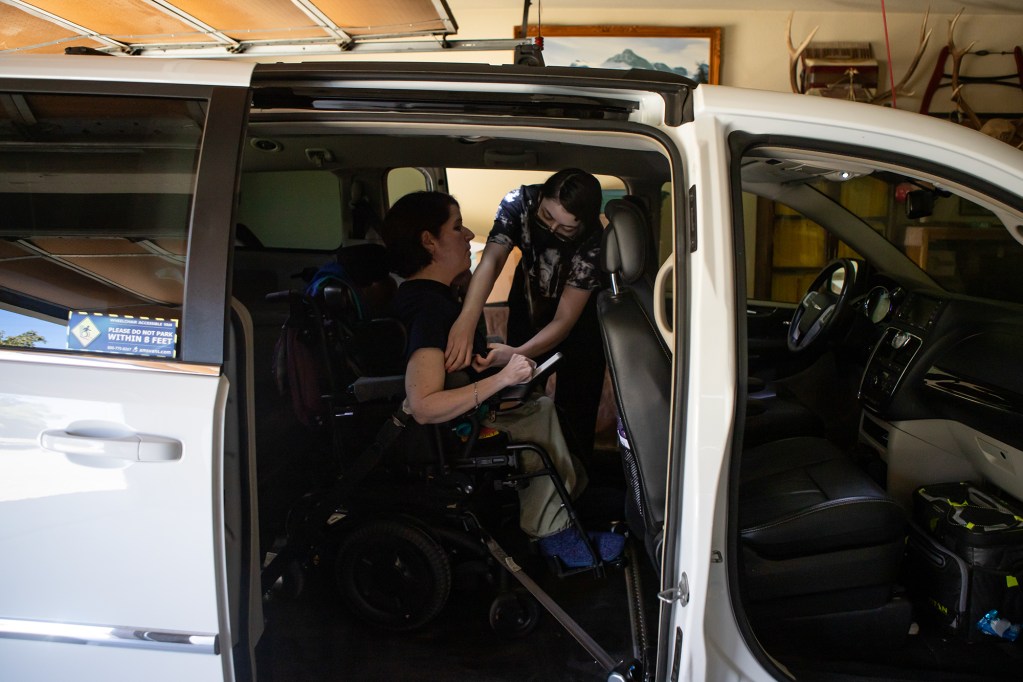
Now, her aging father is unable to take care of her should she lose Medi-Cal, and Guéçamburu is struggling to figure out what to do with money left to her by her grandmother. She’ll likely have to put it into a special needs trust controlled by a family member and give up financial independence. She also had her family strike her from inheriting any portion of their 100-year-old farm. Private home care costs thousands of dollars a month, making it hard for lower- and middle-income people to pay for it out-of-pocket.
“I have to surrender our legacy just to have medical security and have the ability to live my life,” Guéçamburu said.
Asset limit flip-flop
Gov. Gavin Newsom eliminated Medi-Cal asset requirements in 2024 after a yearslong campaign by senior and disability rights advocates. In a statement before the elimination, Newsom said he was proud of the “bold investments” his administration was making to “protect life savings and homes.”
But two years later, faced with a $12 billion budget shortfall, Newsom proposed reinstating the former $2,000 limit, arguing that more than twice as many people enrolled as previously estimated. The Legislature opposed that proposal and compromised at the current higher limit of $130,000, lowering it again to $21,000 starting next July.
Lindsay Imai Hong, California director for Hand In Hand, an advocacy group supporting families that need caregiving, said organizers are looking to the next governor for change.
“We would love to see the asset test permanently taken off of the chopping block,” Imai Hong said.
Republican gubernatorial candidate Steve Hilton said in a statement to CalMatters that he opposes asset limits. He criticized the state for extending other Medi-Cal benefits beyond what it could afford, including coverage for immigrants without legal status.
“Seniors and people with disabilities shouldn’t lose their coverage because they’ve managed to save some money. They’ve done the responsible thing. Why punish them for it?” he said.

Democratic gubernatorial candidate and front-runner Xavier Becerra did not answer specific questions about the asset limit policy, but a campaign spokesperson blamed the Trump administration’s federal cuts for “squeezing” California’s Medi-Cal program.
Becerra will be “focused on protecting access to care and demand savings that are real, measurable and sustainable,” spokesperson Johnathan Underland said. On the campaign trail, Becerra has called himself California’s next “healthcare governor” and has previously floated raising taxes to reverse Medi-Cal cuts, but has not released detailed health policy plans.
Camille Nguyen, an attorney with the Legal Aid Society of San Mateo County, said most people who struggle to stay under the limit have little financial security.
“They have all of their life savings in cash savings instead of a house. That's their retirement. That is the amount they are expecting to live off of for the rest of their life,” Nguyen said.
State data shows about 600 people lost Medi-Cal when California reinstated the $130,000 limit. Advocates expect many more to lose Medi-Cal at the lower limit, but the state never released budget estimates before lawmakers approved the $21,000 limit. If the state reinstated the much lower $2,000 limit, the Department of Finance estimated 62,000 seniors and people with disabilities would lose Medi-Cal over two years.
Limit fuels anxiety, anger among people with disabilities
Feinberg said the prospect of losing Medi-Cal is especially scary because she would also lose access to a special disability program that pays for extra caregiving hours and has a multiyear waitlist. Caregivers help Feinberg get in and out of bed, dress and prepare her meals.
Before the limit was erased in 2024, Feinberg said she checked her bank account every day to make sure the balance was low. At the time, Feinberg was a graduate student and did not earn very much money. Now, as a licensed therapist Feinberg has been able to squirrel away some money.
“I don’t want to spend down that money. I want to save that for retirement, maybe buying a house in the future,” Feinberg said. “The prospect of not being able to have a nest egg is very unsettling.”
Guéçamburu said she’s angry and frustrated that the state views services for people with disabilities as expendable.
“It’s exhausting to have to justify your existence every legislative cycle,” she said.
Supported by the California Health Care Foundation (CHCF), which works to ensure that people have access to the care they need, when they need it, at a price they can afford. Visit www.chcf.org to learn more.
This article was originally published on CalMatters and was republished under the Creative Commons Attribution-NonCommercial-NoDerivatives license.