Vast produce supply chain complicates tracking food safety in the Midwest
Texas Catholic churches unite residents over ICE detention center, water concerns; How one man’s Olympic moment brought new life to Jackson, Miss. rugby


It's Friday July 31, 2026 and in this morning's issue we're covering: Vast produce supply chain complicates tracking cyclospora in Missouri and Kansas, Affordable housing often costs more to build than market-rate housing – Colorado is closing the gap, Homeless New Orleanians swelter amid scorching heat wave, Socorro Catholic churches unite residents over ICE detention center, water concerns, How one man’s Olympic moment brought new life to Jackson rugby, A Tale of Two Behavioral Health Systems, or How the State Border Determines Who Gets Access to Mental Healthcare.
Media outlets and others featured: Missouri Independent, The Conversation, Verite News, El Paso Matters, Mississippi Today, The Daily Yonder.
Vast produce supply chain complicates tracking cyclospora in Missouri and Kansas
By Meg Cunningham (Missouri Independent) Published: July 30, 2026
The same food supply chain that lets restaurants serve nearly identical produce in Missouri, Michigan or California can also make it remarkably difficult to figure out where contamination began when Americans get sick.
As cyclospora cases climb across Missouri and Kansas, public health investigators are working backward through a supply chain that can stretch thousands of miles and cross international borders before fresh produce ever reaches our table.
Every confirmed case of cyclospora, which is famously afflicting patients with “explosive diarrhea,” triggers an interview that can last up to an hour as public health investigators and epidemiologists ask patients to recall meals from days, or even weeks, earlier.
The summer months typically bring a small uptick in cyclospora, which is considered a parasitic infection that spreads through food or the use of contaminated water. But the scope seen across the country this year stands out as the country’s largest outbreak in recent history, sending local, state and federal investigators searching for a common source.
And the painstaking process of finding the source of the illness in just one person in Kansas or Missouri highlights a larger challenge: Produce can move through the hands of dozens of farms, packing facilities, grocery stores or restaurants in days. When contamination occurs, tracing it back through that system can take weeks.
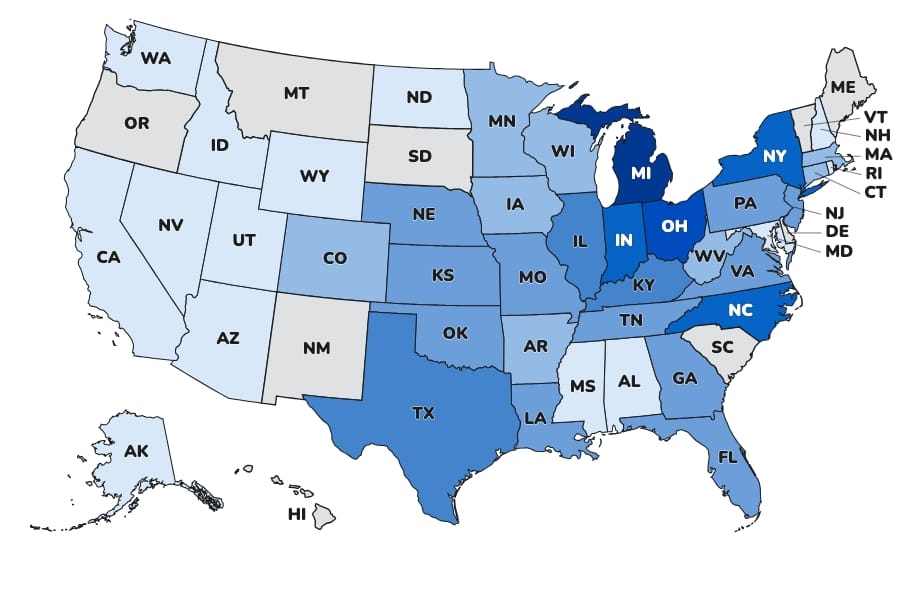
How investigators track cyclospora cases in Missouri and Kansas
Missouri has reported nearly 600 cyclospora cases as of July 27, while Kansas has reported 289. In a typical year, officials in Jackson County see between three and seven cases, which can often be connected to international travel.
Nationwide, at least 41 states have reported cases. More than 4,000 cases have been confirmed by testing, with another 7,400 cases that were not confirmed by lab testing. Overall, the country has seen 308 hospitalizations related to the infection so far. In 2025, the country recorded about 2,700 cases total.
Cyclospora Cases
The Centers for Disease Control and Prevention said it factors in a six-week reporting lag between the onset of an illness and when cases are actually reported to the CDC, and it anticipates cases continuing to rise.
This summer, officials say emergency departments across the region have also seen an uptick in patients arriving at the hospital with diarrhea and other gastrointestinal symptoms.
In Boone County, Missouri, where health officials are investigating cases in dozens of patients, each interview can take up to an hour.
“It is becoming quite a time-consuming endeavor to single in on a common theme,” said Austin Krohn, the public information specialist for Columbia and Boone County Public Health.
And the process is made longer by conflicting information from federal officials and major distributors as to the cause of the outbreak.
Federal officials initially pointed to Taylor Farms, a major lettuce farmer and distributor, as the cause of much of the contaminated lettuce moving throughout the country.
Major food retailers like Taco Bell voluntarily pulled shredded lettuce from their menus, but the Food and Drug Administration later backtracked, saying testing resulted in a false positive result.
For health officials trying to find the cause of illness, the uncertainty at the federal level made the process all the more difficult.
“The false positive thing that’s been going on with the FDA maybe lengthened the process here,” Krohn said.
Investigators must ask where people ate, where they shopped and what symptoms they experienced. Plus, the infection can take up to two weeks to show symptoms, making tracking even more complex.
“It’s incredibly complicated with this one because there is a gestation period that can potentially last up to two weeks,” Krohn said. “You have to recall all these things because symptoms can potentially start appearing much later.”
Because many people can recover at home without ever going to the doctor, the number of cases is almost certainly higher than what is being reported, Krohn said.
“Numbers are most assuredly going to go up in an official capacity and in a nonofficial capacity,” he said.
Local cyclospora cases feed the national picture
Investigations don’t stop at the county level. They get elevated to state officials, who then compile data and share it with the federal government.
Officials in Jackson County are working diligently to identify potential sources of contamination.
“The distribution network as it pertains to our food is very, very complex in this country,” said Ray Dlugolecki, the assistant health director at Jackson County Public Health. “Without a centralized entity looking at the data from a large, 70,000-foot perspective, it can take some time to identify sources.”
Missouri’s Department of Health and Senior Services is participating in weekly calls with all 50 states and the CDC to coordinate with public health officials across the country, said Nathan Koffarnus, a Missouri state epidemiologist.
“When we get enough really good data from all the questionnaires and the interviews,” Koffarnus said, “the CDC compiles that and does a big data study on it. That’s when they can really identify these clusters of illness that maybe all come from a common source.”
The complexity of tracking cases is a byproduct of a nationwide food system tailored to convenience and consistency, regardless of season or geography.
How market consolidation can lead to a lack of transparency in the food supply chain
Restaurants and grocery chains depend on consistency, said Darin Detwiler, a food safety and supply chain expert at Northeastern University. Customers expect the same quality whether they’re eating in Missouri and Kansas or on the coasts.
Demand from large restaurant chains and grocery retailers prioritizes consistency year-round, Detwiler said, despite the fact that most produce is limited to certain seasons in the majority of North America.
That can lead to consolidation and large distributors owning major parts of the market.
Detwiler pointed to changes in enforcement rules for the Food Safety Modernization Act, which was passed by Congress in 2010. One part of the law asked producers to test water and water treatment beginning in 2016, but industry lobbyists pushed back on the rule, arguing it was too expensive to do.
“All of the sudden, boom, we are hit in 2017, 2018, 2019 with all of these leafy green, romaine lettuce outbreaks and recalls,” Detwiler said.
And as the cyclospora outbreak continues across the country, changes in federal rules are a topic of conversation. The FDA’s new food traceability rule was set to take effect in January of this year, with the goal of requiring more standard recordkeeping for certain high-risk foods. But enforcement of the rule was delayed until July 2028.
The CDC has also reduced the number of pathogens it tracks — including cyclospora — in its FoodNet program, the primary foodborne illness disease surveillance effort. Although illnesses are still reportable through other systems, the changes no longer require producers to collect the same level of data.
“Here we are, and this past weekend has been quite eye-opening for the American consumer,” Detwiler said.
“It’s not about access and sustainability as much as it is also that trust and confidence in the safety of the product,” Detwiler said.
Even with some digitization improving traceability efforts across the supply chain, a lack of transparency in how food reaches the American consumer is creating uncertainty, Detwiler said.
“It’s the transparency that is causing what I’ll classify as a certainty gap — you have to understand whether to trust them or not,” he added.
The case for shorter supply chains
Some advocates for more regionalized food systems say outbreaks like this expose another consequence of market consolidation.
Katie Nixon is a Missouri farmer and the food systems director at Nevada, Missouri-based nonprofit New Growth, which is in part working to strengthen local and regional food systems. Nixon said shorter supply chains aren’t immune to foodborne illness or contamination problems, but she argues problems are often easier to trace and the system provides more transparency to consumers.
“Over the years, we’ve lost many of our medium-sized farms. Small farms are kind of stuck in small-farmness, and medium farms get bought up by the big guys. Then the big guys get bought up by the mega guys,” Nixon said.
“It seems like in this system, it’s just so massive that it’s kind of been lost track of,” she said.
Regional food systems can create greater accountability and trust, Nixon said, because produce moves through fewer hands before reaching customers.
“When you have regional food systems, it can only go so far,” Nixon said. “You can’t make the entire country sick from one packing facility because that packing facility wouldn’t have the capacity to service the entire country.”
In shorter food supply chains, growers, distributors and buyers are more likely to know one another and their customers, Nixon said.
“A lot of times accountability is a lot stronger because the people know each other,” Nixon said.
Still, she acknowledged that regional food systems are often too small and seasonally dependent to serve the needs of many consumers.
For investigators, every outbreak begins with the same questions. What did you eat, and when?
But for Nixon and others, this summer’s cyclospora outbreak poses a question of what sort of food supply people want.
“We’re the backstop,” Nixon said. “You want those customers to be steady customers, not just emergency customers.”
This article first appeared on Beacon: Kansas City and is republished here under a Creative Commons Attribution-NoDerivatives 4.0 International License.
Affordable housing often costs more to build than market-rate housing – Colorado is closing the gap
Lower land costs and new statewide housing reforms have made Colorado an outlier.
By Solomon Greene, University of Denver, The Conversation Published: July 28, 2026


By Solomon Greene, University of Denver
In much of the United States, developers spend more to build an affordable apartment for a low-income family than a market-rate one just down the street – sometimes far more. It is one of the central paradoxes of the nation’s housing crisis: The affordable homes that lower-income renters need most tend to be the costliest to build.
Colorado is an exception. In a recent study of more than 140 housing developments in California, Colorado and Texas, researchers at RAND, a nonpartisan research organization, found that affordable apartments in Colorado cost about $50 less per square foot to build than market-rate units. Colorado was the only one of the three states where affordable developments cost less to build than market-rate ones.
I’ve spent nearly three decades trying to understand why affordable housing costs so much to build – and how to bring those costs down. I now direct the Center for Housing Research and Innovative Solutions at the University of Denver, where we study how to expand housing supply and affordability in Colorado and across the Rocky Mountain West. Earlier, I led the research office at the U.S. Department of Housing and Urban Development that studies housing markets, affordability and federal housing programs.
Throughout my career, I keep running into the same paradox: The tools designed to make housing affordable are also a big part of what makes it expensive to build.
When rent can’t cover the bill
At the core of the housing paradox, the numbers just don’t add up.
Affordable housing programs typically serve households earning well below their area’s median income, the midpoint where half of local households earn more and half earn less. Their capped rents fall below what it costs to build a new apartment, especially where land, labor and materials are expensive.
To close that gap, developers assemble multiple layers of public and private subsidies. The cornerstone is the federal Low-Income Housing Tax Credit, which gives investors a tax break in return for financing apartments that must stay affordable for decades. Typically, those units are rented only to households earning at or below 60% of area median income, at capped rents, for at least 30 years. Because the credit rarely covers the whole gap, developers usually combine it with other sources of public money: state credits such as Colorado’s own affordable housing tax credit, local housing funds and federal grants.
Each funding source has its own application, deadlines and income rules, and assembling this financing takes lawyers, accountants, consultants and staff time – the so-called soft costs that sit on top of the hard costs, such as concrete, steel and labor.
Studies that compare affordable and market-rate buildings find that soft costs are where a large share of the cost difference originates. Affordable projects tend to have significantly higher soft costs, even when the buildings themselves are similar. In other words, much of what makes an affordable apartment expensive isn’t the building – it’s the financial and regulatory machinery wrapped around it.
Affordable housing is built largely with public dollars, yet the full cost picture is surprisingly hard to see. A 2023 Government Accountability Office report found that no federal agency has clear authority to collect and compare development-cost data nationwide. The HUD office I led was also responsible for maintaining the government’s data on federally assisted housing, and my team routinely struggled with inconsistent and incomplete cost information. Policymakers are making billion-dollar decisions with only a partial view of where the money actually goes.
How Colorado breaks the pattern
So why does affordable housing cost less to build in Colorado? The RAND study points to where and how it gets built. Unlike their counterparts in California and Texas, Colorado’s affordable developers built for less, per square foot, than the state’s own market-rate builders.
In Colorado, a key distinguishing factor is land: Developers paid just $1.50 per square foot, against about $23 for market‑rate builders, often on public land offered at little or no cost. That cheaper land, along with lower-cost building sites, more than offsets the higher soft costs that affordable projects still carry everywhere, Colorado included.
What actually lowers costs
In recent years, Colorado has passed a series of laws aimed at easing the frictions that inflate housing costs, especially for subsidized projects, making the state a real-time test of what works. Research already points to several promising levers, none of which requires weakening the protections that keep homes affordable.
The most powerful lever is land. Cities and states across the country are increasingly offering public land at little or no cost, reducing one of development’s biggest expenses.
Colorado’s 2026 HOME Act authorizes school districts, universities, transit agencies, housing authorities and qualifying nonprofits to build homes on land they already own, through a streamlined approval process that limits how restrictive local zoning can be. It lowers two costs at once: the price of the land and the months spent winning approval.
Colorado is also reducing the paperwork that inflates soft costs. In 2022, voters approved Proposition 123, which requires communities that want state housing dollars to act on affordable-housing applications within 90 days. More than 100 jurisdictions, Denver among them, have adopted such fast-track reviews.
The state has also launched a common application that lets developers apply once for money from the state, its housing finance agency and the city of Denver, instead of submitting separately to each. In a recent state survey, developers called this their top priority for reducing soft costs.
Parking rules are another hidden driver. Requiring builders to include parking forces them to construct expensive structures – sometimes $50,000 per space – and give up land that could hold homes. A study by two of my University of Denver colleagues estimated that ending Denver’s parking mandates would boost housing construction by about 12.5%, or roughly 460 additional homes a year. Denver dropped its parking minimums in 2025, following a 2024 state law that lifted them near transit.
On construction, Colorado is easing its building and inspection rules to make factory-built housing simpler to permit. Affordable developers are using modular and panelized construction to narrow the gap with market-rate building. These homes, which are assembled in a factory, can cost less and get built faster. While leading research at HUD, I toured affordable developments built this way, including one in Detroit that cost roughly 30% less than comparable homes nearby. The savings matter most in rural and mountain areas, where labor is scarce and the building season is short.
The country still struggles to measure what actually drives housing costs. Building stronger regional data, and the partnerships among agencies, lenders, universities and developers to use it, can show where rules add value and where they instead add delay and cost.
Affordable housing’s impact
Stable, affordable housing is linked to better health, stronger school performance and higher lifetime earnings for children. In one national study, each additional year that a child spent living in assisted housing as a teenager raised their adult earnings by 3% to 6%. So every dollar lost to unnecessary cost – the delay and duplication that make housing no better – is a home that never gets built for a family who needs one.
Affordable housing will always require some subsidies: When the rents that low-income households can pay fall short of what building costs, public or philanthropic dollars must close the gap. But those costs are not fixed. Colorado’s experiment is a reminder that the gap between affordable and market-rate housing can be narrowed, but only by treating the financial plumbing as seriously as the bricks and mortar.
Read more of our stories about Colorado.
This article is republished from The Conversation, a nonprofit, independent news organization bringing you facts and trustworthy analysis to help you make sense of our complex world. It was written by: Solomon Greene, University of Denver
Read more:
- A rare bipartisan housing bill just became law – but Americans will still struggle with affordability
- ‘Affordable’ Pittsburgh doesn’t have enough affordable housing – here’s why
- A successful USDA program that has supported more than 533,000 affordable rental homes in rural America is getting phased out
Solomon Greene is affiliated with the National Housing Law Project (Vice President of Board of Directors).
Homeless New Orleanians swelter amid scorching heat wave
by Diego Perdomo, Verite News New Orleans
July 27, 2026
For people experiencing unsheltered homelessness like Victor Tate, shade is sometimes the only available relief from summer heat.
Living in a makeshift shelter under the Pontchartrain Expressway, Tate told Verite News that he lost his shelter during 2025 Super Bowl sweeps, had his phone stolen and felt disrespected often by people passing by during the last 10 years that he’s been unsheltered on and off. With the heat index expected to reach as high as 115 degrees Fahrenheit (46 degrees Celsius) this week, full shelters and worsening climate conditions, Tate is bracing for the additional stress brought on by rising temperatures.
“If it gets hot, you’ve got to stay up under here or go to the shelter at night,” he said. ”The cars going back and forth — that’s what makes it cool. Then when it rains, the wind blows.”
About 1,563 people experience homelessness across Orleans and Jefferson parishes, according to recent data from the U.S. Department of Housing and Urban Development. While the point-in-time counts estimate just over a quarter of unhoused people are unsheltered, people can often fall in and out of the gaps of New Orleans’ safety net.

Like the rest of the nation, Orleans Parish has seen warmer maximum morning temperatures — meaning those who remain outside have less recovery time from the heat, according to research from the Southern Climate Impacts Planning Program (SCIPP), a partnership between Louisiana State University and University of Oklahoma. Barry Keim, an environmental health professor at LSU who is a former state climatologist, called humidity a “killer” as it interrupts people’s natural ability to cool off.
“When you perspire, you're still not getting a whole lot of evaporation off of your skin because the air is so humid to begin with,” Keim said. “It limits the amount of evaporation that can take place. And as a result, your body just continues to get hotter and hotter.”
According to research from the Louisiana Department of Health, parishes in southeast Louisiana experienced 98 heat-related deaths since 2023, which is just over half of the statewide total. This year, people from those same parishes made up over a third of all statewide hospitalizations for heat-related injury.
Seniors and people with disabilities are particularly vulnerable to heat, according to Joe Heeren-Mueller, a coordinator for the Louisiana Advocacy Coalition on Homelessness. Over the past six years, seniors — aged 65 and older — are the fastest growing unhoused population with a 78% uptick in homelessness, according to a recent study from Unity of Greater New Orleans.

According to the National Weather Service’s Baton Rouge/New Orleans office in Slidell, this year is currently the 16th hottest summer season since 1946. NWS meteorologist Danielle Manning recommends people outdoors stay in shaded areas, avoid physical activity and hydrate with water instead of coffee, soda or alcohol.
While unhoused New Orleanians are supported by shelters and heat relief initiatives in Orleans and Jefferson parishes, shelters are just one step in eliminating homelessness, according to Heeren-Mueller. He added that because demand for shelters is higher than their capacity, specialized solutions are needed to help people find relief.
“That doesn't simply mean that we need to just build more shelters because...what works is creating flow,” Heeren-Mueller said. “You need sufficient shelters, and those who go into shelters need somewhere to go afterwards where they can maintain stable housing.”
At the start of next year, public sleeping will be illegal statewide because of a new law, Act 788. The law doesn’t explicitly mention the termination of services and programs that help people who are unhoused, but housing advocates are concerned at its potential to weaken trust with unhoused people and push them away from lifesaving services.
“Over 350 cities have passed anti-camping bills in the past two years,” said Jesse Rabinowitz, the communications director for the National Homelessness Law Center. “None of them have solved homelessness because laws that make it a crime to be homeless will never actually solve homelessness. They'll only make homelessness worse.”

During extreme hot and cold weather, New Orleans activates cooling and warming centers in its libraries and recreation facilities. When overnight shelters for unsheltered people are at capacity, cooling centers can house about 100 people at each center.
City outreach teams from the Office of Homeless Services & Strategy and the Public Health Emergencies & Environmental Health Unit also coordinate bottled water distribution near the Claiborne Corridor and French Quarter. During colder weather, the same outreach teams will attempt to get unsheltered people into warming centers and shelters.
Elainna Williams, an Office of Homeless Services’ team member, said she learned how important rapport was the first time she did winter street outreach.
“They would not come off the street, and it was mind blowing. But then I went to the warming center the next day, and [saw] some of the same people that told me ‘no’ the night before,” Williams said. “Sometimes it takes time, and sometimes it could be a level of trust.”
To reduce the citywide heat index, the Office of Sustainability is planning to plant 40,000 trees by 2030 as part of the New Orleans forestation plan. After Katrina, New Orleans lost 200,000 trees, decreasing available shade and its tree canopy coverage to half of the shade of other southern cities. The Heat Action Plan is currently being drafted and is expected to be adopted by the city later this year, outlining different cooling strategies.
As the public sleeping ban goes into effect before winter’s coldest days, some advocates worry criminalization could perpetuate homelessness. A city spokesperson said warming and cooling efforts would not be affected by the public sleeping ban.
Outside of municipal operations, local grassroots efforts aid those living outside of shelters. During summer months, Below Sea Level Aid dispatches street teams to hand out cold drinks, ice packs, battery-powered fans and other cooling supplies. The weekly trips are part of the nonprofit’s harm reduction and public health mission.
“New Orleans is not built to handle extreme heat. Our infrastructure actually makes it even worse,” said Below Sea Level Aid founder Jack Waguespack-Slooijer. “I really try and focus on our people who are under the overpasses and directly on concrete or the street, [as] opposed to being in a park or somewhere green.”
Christiana Botic contributed to this report.
This article first appeared on Verite News New Orleans and is republished here under a Creative Commons Attribution-NoDerivatives 4.0 International License.

Socorro Catholic churches unite residents over ICE detention center, water concerns
by Robert Moore, El Paso Matters
July 27, 2026
SOCORRO, Texas – In the 1980s, Maria Estella Padilla went door to door after Mass, organizing house meetings to bring running water and sewerage services to hundreds of thousands of homes along the Texas-Mexico border.
Today, at 82, she’s back to organizing her neighbors and fellow parishioners at La Purisima Catholic Church in an effort aimed both at stopping a planned immigrant detention center and protecting the access to water that she and others fought so hard to win decades ago.
“We did it back then when we didn't have the internet, when we didn't have social media, but now they communicate quickly. It would be easier in a way to do it now than it was back then when we had to go door to door and take signups after Mass,” she said of her latest fight.
Earlier this year, the U.S. Department of Homeland Security, then headed by Secretary Kristi Noem, announced a $38 billion plan to buy and retrofit 11 warehouses across the country to convert them into sprawling detention facilities to serve the administration’s mass deportation program for undocumented immigrants.
That included three warehouses on the edge of Socorro, about 15 miles southeast of the El Paso city limits, that had been built to hold nuts harvested from nearby pecan groves. The property, sold to DHS for $123 million by a Kansas City area developer, included three reinforced concrete warehouses of about 296,000 square feet each, with an adjacent plot of land available for expansion.
DHS initially said the Socorro facility would hold up to 8,500 immigrants awaiting deportation, which would have made it one of the largest immigrant detention centers in the country.

After Oklahoma Sen. Markwayne Mullin replaced Noem in March, DHS said it was canceling plans to convert at least seven of the 11 warehouses – though not the Socorro site. In June, the acting director of Immigration and Customs Enforcement told El Paso leaders that the privately run detention facility would be smaller than previously announced, but didn’t provide details.
But local leaders and residents, many organized by local parishes, remain outspoken about their concerns, citing environmental, as well as moral reasons.
Socorro has transformed over the past 50 years from a mostly agricultural area with no running water or sewer service into an El Paso suburb of almost 40,000 people. Pecans, cotton and other crops are still produced in the area, but much of the historic farmland has been sold for housing developments.
Socorro opposition to the detention center began to grow in April, when the El Paso Interreligious Sponsoring Organization began meetings with parish leaders in the town's three Catholic churches to discuss what the planned detention center might mean.
EPISO is part of the Industrial Areas Foundation, a national network that works with local religious congregations around the country – primarily but not exclusively Catholic – to organize communities around issues that local residents identify as most important.
In El Paso and throughout Texas, the most consistent issue for IAF affiliates over the past 50 years has been water. In El Paso County alone in the 1980s, more than 80,000 residents lived in homes without water or sewerage services. Hundreds of thousands of other residents along the Texas-Mexico border lived in so-called colonias, illegal subdivisions built without basic infrastructure.
Organizing by IAF organizations led to hundreds of millions of dollars in state investments starting in the late 1980s that brought basic water and sewerage infrastructure to most – but not all – of the state’s colonias.

EPISO began focusing on the proposed Socorro immigrant detention center in April, based largely on Catholic social teaching on the treatment of immigrants. Organizers put together what they call “house meetings” at each of the town’s three Catholic churches.
“And when people learned what was happening, then the water issues started to surface,” said Surya Kalra, EPISO’s lead organizer. Officials with El Paso Water and the Lower Valley Water District said hundreds of thousands of gallons of water a day would be needed for a large detention facility.
House meeting participants started talking about water issues they were seeing at their own homes, especially with water pressure.
“People started to realize that they weren't isolated in their own issues on water pressure and water backup and all that stuff,” Kalra said. “That's what house meetings do when you have people get together and they start to share their stories, they realize that what they thought might be their own personal failing is actually a systemwide difficulty.”
On May 28, more than 40 people organized by EPISO went to a meeting of the Lower Valley Water District board. The agenda didn’t include any items about the detention center or water pressure issues, but several residents addressed the board in English and Spanish during the public comment portion of the meeting.
“I’m completely opposed to detention centers on so many levels, on a human level, ethical, moral, our faith, we just don't believe in that. The way we're treating them, it's just abhorrent,” Padilla said at the meeting. “But on a practical level, we don't have water, and we have several issues at our house. The most common one is the pressure.”

“We are many generations of families, and I would hate for us to be known as the city that is holding this many people that don't deserve to be treated the way they're going to be treated,” said Grace Herrera, who attended the meeting with her daughter and granddaughter.
Several residents focused on a disruption of service on May 18, when the area’s water pressure dropped dramatically. Lower Valley Water District officials didn’t respond to El Paso Matters’ questions on the water pressure issues raised by residents.
A Socorro dialysis center had to shut down for the day, said Alicia Mossman, whose nephew works at the facility.
“They were trying to disperse these people to other dialysis centers. Many of the people that show up for dialysis are dropped off and have no way to get them elsewhere, so they had to do without dialysis that day,” she told the water board.
Herrera’s granddaughter, Eleina Gibbs, started to tell the water board about what happened at her middle school the day the water pressure dropped, but she was too soft-spoken for the board and audience to hear. So her mother, Gracie Ortiz, read her letter for her.
“No one could go to the restroom or drink water. This continued from 8:30 in the morning to the end of the day,” Gibbs’ statement said.
Her letter said that by the end of the school day at 3:30 p.m., she rushed home to use the restroom, only to find it occupied by her grandmother. “I desperately waited for her to get out. When she was done, I rushed to get in.”

The girl’s statement said her parents weren’t told that students didn’t have access that day to the restroom or drinking water, a claim disputed by the Socorro Independent School District.
“Parent messages were sent by the campus, and water was made available for restrooms and consumption,” district spokesperson Daniel Escobar said. “The campus did consolidate to use specific restrooms on campus. Drinking water also was offered for students and staff.”
Rosalinda Vigil, the water district board chair, was clearly moved by Gibbs’ statement.
“I'm a resident, and I, too, have complained about pressure and certain issues, and I pray and promise that we hopefully won't have to go through this again,” Vigil said. “We're going to address these issues, and we're going to talk about them, so that no one should ever have to go through this again.”
EPISO and the parishes continue efforts to inform residents about the detention center and ongoing water concerns, and meet regularly with local government officials. Democratic U.S. Rep. Veronica Escobar of El Paso met with EPISO representatives shortly after a June 12 meeting where Acting ICE Director David Venturella told her the administration had adjusted its plans for the Socorro warehouse facility.
“The Department of Homeland Security is going to proceed with using those warehouses, but there will not be 8,500 people held there,” Escobar said during a news conference after her meeting with Venturella. “They said that they’ve changed the plans a little bit. It will be a training facility. It will be a campus, essentially, for ICE, with offices and conference rooms, but yes, there will be privately run detention.”

Escobar and other El Paso area officials said even a scaled-down detention facility would stress water and public safety infrastructure in the Socorro area.
DHS officials didn’t respond to a request for comment from El Paso Matters about its plans for the Socorro warehouses.
Kalra said EPISO will remain vigilant in its efforts to stop the detention center, and to advocate for improved water services for Socorro’s residents.
She said the Catholic parishes will play a key role in those efforts because they serve as a place of trust for many residents.
“If you're doing this outside of the structure of an institution or a church, it's catch as catch can. But churches have deep networks of relationships of trust that help people understand and interpret what's going on and start to get organized quickly,” Kalra said.
Padilla, who was part of the fight to bring water to the colonias in the 1980s, said she believes that it's possible to organize the community again around the detention center and water issues.
“I believe we can, but it does take involvement by organizations that are already organized, like churches, and that's why I am so happy to see that our church is behind this effort, and that San Felipe (another Socorro Catholic church) is behind it, and others. But that's what it takes, and I do believe we can do it,” she said.
This article was produced as a collaboration between El Paso Matters and Religion News Service as part of the Atlas of American Belonging project, supported by the Henry Luce Foundation.
This article first appeared on El Paso Matters and is republished here under a Creative Commons Attribution-NoDerivatives 4.0 International License.

How one man’s Olympic moment brought new life to Jackson rugby
by Aaron Lampley, Mississippi Today
July 27, 2026
Mitchell McGinnis owns two music academies and teaches vocal lessons in his spare time. He goes regularly to the gym, but that was as far as his athletic prowess and interest in sports went – until he found himself in Paris, at Stade de France during the 2024 Olympics, watching a sport he knew almost nothing about.
The game looked vaguely familiar: players chasing an oval-shaped ball and piling atop one another. But this was not American football. This was rugby.
While still in the stands, he picked up his cell phone and began searching for anything he could learn about the sport.
McGinnis did not know it yet, but his curiosity would help revive one of Mississippi’s oldest rugby clubs, attracting new players to an organization that nearly died out during the COVID-19 pandemic.
“I remember sitting there Googling rules and trying to understand what was happening on the field,” he said. “It happened so fast.”
His introduction to rugby came by chance. A friend who won a lottery to attend the Olympics invited McGinnis to Paris.

He started searching for local rugby leagues near his Jackson home. Facebook led McGinnis to the Jackson Rugby Football Club. He began sending messages to the club back home. Within minutes, a practice was scheduled for that August.
Excitement built. But that initial practice fell through. So did another. That’s when McGinnis decided to grab the ball himself and run with it.
He began recruiting players and scouting a field to play on. He would eventually get Jackson Public Schools’ permission to use Murrah High School’s practice field. Nearly three months after McGinnis first reached out to Jackson Rugby, they were finally going to meet.
He showed up at the high school dressed in a T-shirt and shorts. He kept slipping on the wet grass in his tennis shoes.
“My friends joke a lot of times that a toxic trait of mine is thinking that I can do anything,” McGinnis said.
While rugby continues to grow in popularity in the U.S., it is hardly a staple of televised sports – dominated by football, basketball and baseball.
Nevertheless, rugby has found homes in some American communities. One of the early Mississippi adopters was Jackson Rugby.
In rugby, two teams compete to advance an elongated ball to score a try — or a goal — by kicking, running and passing the ball backward. Its origins extend to the early 19th century in England and spread to the United States, mostly on college campuses. USA Rugby, the country's governing body for the sport, counts 11,000 active players.
An English sport makes it way to America
In a state dominated by college football, the English sport found its footing in Mississippi’s capital city in 1974. Back in 2010, team members even purchased and created their own makeshift facility with practice fields near Highway 49.
“We get to have a good time. We get to run around together, laugh at each other, make a joke, have something to look forward to at the end of the week,” said Chris Mendonca, the team’s coach. “This is what I live for.”

Mendonca’s rugby journey started in 1999 during his Air Force deployment to Trier, Germany. Fresh from military training, Mendonca felt he was lacking a community and outlet outside of work. He would run across a local rugby league and instantly fell in love with the sport.
Rugby became an outlet for Mendonca during his deployments in South Korea, Florida and Japan. Wherever he went, the sport gave him an anchor.
“I don’t know where I would be if I didn’t have this,” Mendonca said.
When he returned to civilian life, Mendonca went to work for Raytheon, a defense and aerospace company, that transferred him to Brandon in 2018.
He already knew he would join Jackson Rugby prior to his move. He had played against the team in 2005 when he played for a club in Okaloosa, Florida.
But it was not the same Jackson rugby team he remembered.
The team was not nearly as active as it once was. Players left as they began families and started new careers. The last few active members attempted to host practices amid busy schedules. There were talks of merging the Jackson team with the one in Biloxi, but those discussions stalled when the COVID-19 pandemic hit.
Things continued to fizzle until McGinnis gave the team the push it needed.
The goal: ‘play, have fun, challenge ourselves’
Mendonca was one of the two experienced players available when McGinnis organized the resurgent team’s first practice in October.
Mendonca arrived early and walked around the school parking lot filling a garbage bag with trash as he waited for other players to show up.
McGinnis arrived next. He approached Mendonca, wondering if he was a worker with the school. Mendonca said picking up trash was just something he could do while waiting. The team now makes a habit to clean the parking lot after every practice.
Nearly two years have passed since the team’s revival on that muggy evening. Now Jackson Rugby regularly has over a dozen players at practice, with new people showing up to try the sport.

On most Sundays at 3 p.m., you can find the team at Murrah High School preparing for its next game. They sprint up and down the field, practice passing the ball and slam into foam pads to perfect their tackles. In between drills, they gather under a bright blue tent that gleams in the sun as they cool off with fresh watermelon and a misting fan.
“If you’re interested in playing, just come out and try for a practice or two,” McGinnis said. “We like to have a good time. It doesn't matter if you're a guy or girl. Come out and learn the game with us and have a good time.”
Caroline Swindool joined the group in early February after coming across a yard sign with the team’s information. At first she was intimidated by the predominantly male team. Her love for fitness and trying new things pushed her to join, and Swindool was welcomed with open arms.
“It’s really just a hodgepodge of a bunch of different people that you wouldn't put together in a group normally, but everybody comes out and has the same common goal,” Swindool said. “We just want to play, have fun, challenge ourselves and get better.”
The club’s newfound popularity hasn’t gone unnoticed. McGinnis said several people approached the team’s tent at the Mobile Battleship Rugby Tournament earlier this month. Some asked about hosting games in Jackson later this year.
James Lawson has been a team member for two decades and has seen the team through hard times. He said the team is exactly where it needs to be.
“I think we got the right combination of people on the team right now,” he said, “and a lot of younger people on the team now to help grow rugby in this area.”


This article first appeared on Mississippi Today and is republished here under a Creative Commons Attribution-NoDerivatives 4.0 International License.

A Tale of Two Behavioral Health Systems, or How the State Border Determines Who Gets Access to Mental Healthcare
by Astra Lincoln, The Daily Yonder
July 22, 2026
In July 2025, the One Big Beautiful Bill Act (OBBBA) mandated significant health care funding cuts and policy changes related to low-income health insurance programs like Medicaid and the Children’s Health Insurance Program (CHIP) administration.
As of April 2026, 1.59 million Americans had lost their Medicaid insurance because of OBBBA-related cuts. Because of the bill, an estimated 13 million more people will lose their insurance over the next three years. Between direct funding cuts and a massive loss of clients, health care providers around the country were understandably left on edge.
And then the no-cause termination letters started to arrive.
Becky Wolery, the founder of the Oregon/Idaho-based mental health clinic, Insight Matters, first got the news in December 2025: her clinic was losing its Oregon Medicaid eligibility. Going forward, Wolery’s Ontario, Oregon-based clinic could no longer accept any new Medicaid patients.
“It was basically a close-down notice,” Wolery said. At the Ontario office, 90% of patients are insured through Medicaid. Even existing patients need to renew their prior authorization every six months. Once their existing authorizations had expired, these patients’ coverage would be denied.
Wolery panicked. Ontario, population 11,645 — the largest of any in eastern Oregon’s expansive Malheur County — was already in a health care desert, despite having the highest rate of Medicaid enrollment of any county in the state.
For years, Wolery had only practiced in Idaho, where she lives. When her clinic had outgrown its first building in Payette, she decided to analyze her patients' demographic data so she could find a new space that best fit her clientele, only to realize that a huge portion of the patients were paying with Oregon Medicaid, crossing the border from Ontario or elsewhere in Malheur County in order to seek out counseling or substance use treatment. She decided to open a second location in Ontario. In less than a year, they had outgrown the first building and had to relocate into a new, larger space. Since then, her practice has been booming.
Now, a total closure was on the horizon. All this, before Medicaid enrollment had really begun to unwind.

Which Side Are You On?
One year after its passage, the implementation of the many fiscal changes mandated by OBBBA — which have been largely managed by individual states — has had vastly different impacts for communities depending on which side of a state border they find themselves on.
For residents of the Oregon-Idaho boundary area, access to care largely depends on which side of the Snake River a person happens to live on. On the eastern, Idahoan side of the border, 4% of state residents were cut from Medicaid in September 2025. Some behavioral health programs — including some that provide funding for peer support and crisis response teams — were cut, but subsequently refunded. Otherwise, business has continued more or less as usual. Although behavioral health providers are anticipating new restrictions to arrive this July, Idaho has yet to experience any seismic shifts to its health care landscape.
This is largely because Idaho had such limited state-sponsored health care services to begin with; the state’s 19% enrollment rate is well below the national average. And in the rural communities along the Idaho-Oregon border, behavioral health care access has always been limited.
In Weiser, Idaho, across the water from Ontario, there were no mental health care providers practicing in town until the town’s hospital opened a small clinic three years ago. Since then, more clinics have followed — but mostly have sprung up to serve the population being sentenced to court-mandated rehabilitation following drug and alcohol charges. For everyone else, the closest in-patient facility is over an hour away.
“For a small city like us, we have nowhere to take our people that need help,” said Weiser City Clerk Natasha McDaniel. “We just put them in jail. And when they come out, they have a criminal record, and it’s harder to get a job. It’s just a vicious cycle.”
So business may be carrying on in Idaho — but it’s bad business to begin with.
For Oregonians living on the other side of the Snake River, it’s a different story.
In recent years, the Oregon Health Plan, which administers Medicaid for state residents, has significantly expanded Medicaid eligibility. Whereas most states only allow coverage for able-bodied adults below the Federal Poverty Line (FPL) — which is $15,960 for a single person — Oregon enrolls anyone earning less than double the FPL. There have been additional expansions for pregnant people and immigrants.
Because of this, Oregon stands to have the most significant drop in Medicaid enrollment of any state in the nation. In Oregon’s rural areas alone, OBBBA will lead to a $4 billion reduction in Medicaid funding through direct cuts and cuts to Medicaid-covered health care services — though most of these changes won’t begin to be implemented until late 2027, and some won’t take full effect until 2034.
In June 2026, the Oregon Health Authority announced new Medicaid eligibility rules. Beginning in 2027, Medicaid participants will need to renew their coverage every six months (currently, the renewal period is two years). And, beginning in October 2028, copays will be required for many health care services, though emergency care, mental health care, prenatal care, and substance use treatments will be excluded — which will likely reduce access to care even among people who retain Medicaid eligibility. Already, 20% of rural Oregonians delay or skip necessary care due to cost.
And in Malheur County — Oregon’s second largest, and one of its most rural — Medicaid enrollment is disproportionately high, relative to other parts of the state: 50% of residents are currently enrolled in Medicaid or Medicare. Among those enrolled in Medicaid (which provides free insurance to low-income people), the vast majority (almost 80%) are children. Nearly 25% have a disability, nearly 50% are Hispanic or Latino, and more than 25% speak Spanish as their primary language. And for residents living outside of Ontario, where all of Malheur County’s behavioral health clinics are located, patients may have to drive more than three hours to access a clinic.

Inadequate Response
The federal government has taken some steps to offset these impacts — though economists and health care researchers suggest that the measures made to date will almost certainly be inadequate.
In addition to sweeping Medicaid cuts, the OBBBA established the Rural Health Transformation Program (RHTP), which sought to distribute special funding to rural areas, like Malheur County, to offset the disproportionately high impacts that other portions of the bill would cause in regions already facing worse health outcomes. Oregon's rural residents have been shown to “experience higher rates of chronic disease, including heart disease, diabetes and cancer,” said Clare Pierce-Wrobel, Oregon Health Authority (OHA) Director of Health Policy and Analytics, in an interview for KEZI earlier this year. The state was awarded $200 million in RHTP funding.
Across the country, the RHTP has allocated $50 billion to rural hospitals over five years — though the Kaiser Family Foundation, a national nonprofit focused on health policy, wrote in a study published in July 2025 that “Federal Medicaid spending in rural areas is estimated to decline by $137 billion, more than the $50 billion appropriated for the rural health fund.” Because of this, an estimated 338 rural hospitals are expected to close, including three in Idaho and four in Oregon — as well as additional closures among private and specialty clinics located outside of hospitals. By the end of 2025, Oregon had already lost an acute care hospital, an inpatient care center, a birth center, six occupational health centers, and four occupational medicine clinics.
In April, the first $21.7 million in RHTP funds was awarded to 12 Oregon-based programs — but none went to projects located in Malheur County. Because so many clinics — like Insight Matters — are funded almost entirely through Medicaid payments, it has been predicted that many rural hospitals and clinics will close despite the patchwork funding provided by the RHTP.
Bad News
In Malheur County, four of the five behavioral health clinics, including Insight Matters, received no-cause termination notices in December. For now, the Insight Matters’ Ontario clinic has been able to stay open — in part because of the additional programming they offer, via a grant-funded contract with the Department of Health and Welfare, in schools, domestic violence shelters, and nursing homes. The grant will fund these programs through next year, at which point the viability of the Ontario location will depend on fickle grant funding. Whether or not the clinic closes entirely will depend on whether such grants are renewed.
In the meantime, the clinic's 350 patients, 90% of whom rely on Medicaid, are faced with a choice: terminate care, or cross the river to receive out-of-pocket treatment in Idaho.
"People in these rural areas are used to driving into main areas for services," said April Browne, a Licensed Clinical Social Worker at Family Services Treatment in Weiser, Idaho — a community that got its first mental health care provider just three years ago.
"They're getting on the freeway anyway to go to work. So maybe they're going to attend a group or see a counselor at that time [after work]." Even before the clinics in Ontario began to close, Browne already had several Oregon-based, self-pay clients. But a health care landscape that only offers substantive options to people who can afford to pay out-of-pocket will mean that already stark poverty-related health outcomes will continue to intensify.
This is bad news for a state that has historically had the highest rates of mental health challenges in America. Despite hundreds of millions of dollars in state investments, Oregon has been ranked the worst state in the nation for mental health for several years — more than 30% of the state’s adults live with some form of mental illness. With new funding, the state’s ability to provide care has improved — in 2025, Oregon was ranked seventh in the country for mental health care access — but wellbeing indexes have yet to follow. Part of the problem is that health care is managed at the county level, and so standards and implementation can be inconsistent at best.
Only one behavioral health clinic in Malheur County, Lifeways, remains to serve the entire population of a county that has a larger area than the state of Maryland — and will need to find a way to provide care to the 800 patients who had previously received treatment at the newly out-of-network clinics.
Lifeways did not respond to multiple requests for comments. But several clinicians working in the region reported that many patients pursuing behavioral health care are hesitant to pursue care there. The clinic has developed a bad reputation because of huge staff turnovers (among its leadership and clinicians), as well as long wait times, and bad personality fits — which research has shown is one of the largest determinants in the success of behavioral health treatment. For patients who don’t find a good fit at Lifeways, no other options exist.
Cooked Books?
Which clinics are in-network in Oregon is determined by the different regional coordinated care organizations, or CCOs, that administer the state's health care plans. In the more densely populated parts of the state, several CCOs are available for Medicaid clients to enrol in, based on which providers they want access to.
But for the entire eastern half of the state, only one CCO exists. All mental health dollars distributed through the Eastern Oregon Coordinated Care Organization are managed through Greater Oregon Behavioral Health Inc. (GOBHI).
When the OBBBA was passed, OHA directed the state's CCOs to implement cost-cutting measures, prompting GOBHI to terminate Medicaid eligibility for the three Malheur County-based clinics, according to the termination letters GOBHI distributed. (GOBHI also terminated contracts with several clinics in Harney and Baker counties, also in Eastern Oregon.)
Wolery requested a meeting with the GOBHI CEO to ask why Lifeways was selected to maintain its contract, while other clinics were not. At the meeting, the CEO explained that they had analyzed “network capacity,” and found that Lifeways had adequate capacity to meet behavioral health needs, according to Wolery. But when Wolery reviewed the numbers, she found that they were only using Lifeways existing patients in their calculations — and not the 800 patients receiving care at the other clinics.
“I think they’re doing false reporting,” Wolery said. Earlier this year, Wolery joined four other local agencies to file for an investigation against GOBHI with the CMS, citing multiple NQTL violations of the Mental Health Parity Act. GOBHI did not respond to interview requests from the Daily Yonder.
Wolery also suspects that the need for these cuts might have more to do with general fiscal mismanagement than any immediate OBBBA-related funding gaps. In recent months, GOBHI has been faced with fines and repayment requests related to financial and administrative errors.
It might also have something to do with the who’s-who of Eastern Oregon health care. The current Lifeways CEO is the treasurer for the GOBHI board tasked with GOBHI’s fiscal decision-making, including how to implement the coming Medicaid funding cuts.
Oregon’s Radical Plan Years in the Making
What are residents of these rural regions of Idaho and Oregon to do, in the face of dwindling insurance options and closing clinics and hospitals? In Idaho, social worker April Browne said, “There will just be people that fall through the gaps. We all have community connection. But that’s the only thing here that can close those gaps.”
In Oregon, there might be another option: the state is currently considering a universal health care plan. Since 2023, a governance board has been developing a policy proposal that could fully fund and implement a single-payer health care option that would cover every resident in the state. It’s the first serious effort to establish a single-payer health care system since 2002, when voters overwhelmingly rejected a plan proposed via ballot measure.
For Oregon’s rural clinics, which have historically been less likely to withstand unstable funding environments, the plan could have a “stabilizing effect,” said the advocacy nonprofit Health Care for All Oregon (HCAO) President Valdez Bravo, who works in health care administration. “The Baker City Birthing Center closed a few years ago, right on the eastern edge of the state. That wouldn’t have happened if we had a universal health care system providing stability and predictability to funding,” Bravo thinks.
One of the Universal Health Plan Governance Board’s (UHPGB) nine members, Chunhuei Chi, helped design Taiwan’s first universal health plan in 1995. He’s been working on health care finance ever since, and has been involved in Oregon’s efforts to implement a universal health plan ever since the last ballot initiative in 2002. In an interview for Willamette Week in May 2026, Chi said the current UHPGB effort is “the closest [to success]. This is probably the closest ever.”
If enacted, the plan put forward by the UHPGB could resolve many of the health care funding gaps created by OBBBA. While the draft plan is not set to be released until September 2026, early summary documents released by the UHPGB suggest that the final version will include provisions to provide full insurance coverage to every resident, regardless of income, for all medically necessary services. There would be no premiums, no co-pays, no out-of-network providers, and no Coordinated Care Organizations.
According to a 19-page summary of preliminary recommendations released in April 2026, the plan would cover all necessary physical and behavioral health services, as well as routine vision and dental care and some fertility services, with minimal to zero cost-sharing for patients at the point of service. For patients, there would be no insurance premiums, no deductibles, and no co-pays. And insurance would no longer be tied to a person’s job — which could have a huge impact for the 40% of Oregonians who currently do not have coverage through their employer.
The plan would be funded through a combination of federal funding, business contributions, and a progressive income tax. (The income tax would only be on income over 200% of the FPL, or $31,500,) Preliminary analysis shows most Oregon residents would pay less for their care under the proposed plan, and most businesses would pay less in health care costs for their employees.
The UHPGB is due to submit its final recommendations to the state legislature in September of 2026. But whether or not the legislature acts on the plan depends on whether or not it is written into a bill that is then introduced to the 2027 legislative session. In July, a petition circulated by HCAO and the Portland chapter of the Democratic Socialists of America encouraging legislatures to do so had collected more than 4,000 signatures.
If the UHPGB’s plan is brought to the session, the legislature could then either vote to pass the recommendations into law as-is — though the HCAO leadership team does not expect that it will — or refer the plan to a ballot measure, which could go before voters in 2028.
If a bill or ballot measure is eventually passed, the new plan would not fully cure Oregon’s health care landscape overnight. “There will still be challenges for rural communities that lack services,” said Colin Stackhouse, who serves as HCAO’s Communications Coordinator and also volunteers on the UHPGB Community Engagement and Communications Committee.
“Rural clinics are closing. This plan won’t directly address that,” Stackhouse said. “But it will solve the problem for the people in these rural communities who can’t see available providers because their local providers don’t take coverage. It would solve the insurance coverage access question.”
Bravo is optimistic about the plan’s potential trickle-down effects. “Right now, we’re heading in a direction where there’s just not going to be any care offered [to rural residents]. We’re going to be like five hours away from what you need.” But if more robust insurance infrastructure existed, Bravo is confident that “it will promulgate more care being offered out there in Eastern Oregon.”
This article first appeared on The Daily Yonder and is republished here under a Creative Commons Attribution-NoDerivatives 4.0 International License.