Affordability a larger issue for Georgia voters
NC families with disabled children press lawmakers to maintain funding as federal Medicaid cuts loom; Ex-residents of Chicago apartment building targeted in massive immigration raid seek millions in damages

It's Friday, May 22, 2026 and in this morning's issue we're covering: Affordability is more than a political buzzword for many Georgia voters, Mississippi Democrats fear big losses in Legislature from redistricting, vow to organize, A Utility Mega-Merger Is All About Data Centers, NC families with disabled children press lawmakers to maintain funding as federal Medicaid cuts loom, Florida entrepreneur’s job promises for NC mountains looking like a mirage, Can you trust that post about Tom Steyer? How paid influencers are flooding into the California governor’s race, Ex-residents of Chicago apartment building targeted in massive immigration raid seek millions in damages, Louisiana parish president sparks free speech fight after shutting down ‘Cancer Alley’ film screening, Fundraising effort saves patch of state-managed forest in western WA from logging.
Media outlets and others featured: Georgia Recorder, Mississippi Today, Inside Climate News, North Carolina Health News, Carolina Public Press, CalMatters, Capitol News Illinois, Verite News, Washington State Standard.
Affordability is more than a political buzzword for many Georgia voters
By Ross Williams, Maya Homan, Alander Rocha (Georgia Recorder)
Published: May 18, 2026
Everything is more expensive these days, and Georgia voters across the state say the cost of living is shaping how they vote.
According to the Bureau of Labor Statistics, grocery prices in April had climbed 2.9% since the same time last year. A pound of ground beef that would have cost you $6 a year ago would set you back $6.92 today, and that same pound of chuck would only cost $4.34 in April 2020.
Overall, the Consumer Price Index, a measure for the cost of consumer goods, has increased nearly 30% since April 2020.
The cost crunch has been compounded in recent months by a spike in fuel costs. The average Georgia motorist today is paying $60.24 to fill up their 15-gallon gas tank with regular gas, up from $43.98 this time last year, according to data from the American Automobile Association. And higher gas prices means higher prices for all other goods.
Voters feeling the squeeze
Gwinnett County resident Hunter Harsh, a recent college graduate, said that he hasn’t been able to buy a car after having to dip into his savings to afford housing and food.
“I’m starting my first job next week, and I won’t have a car to go there. So I’m going to have to ride a bike to work every day, as I can save up money,” Harsh said. “Thankfully, it’s not too far so for my situation kind of works out, but like a lot of people, if I ended up having to work somewhere further away, I would be in a tough situation.”
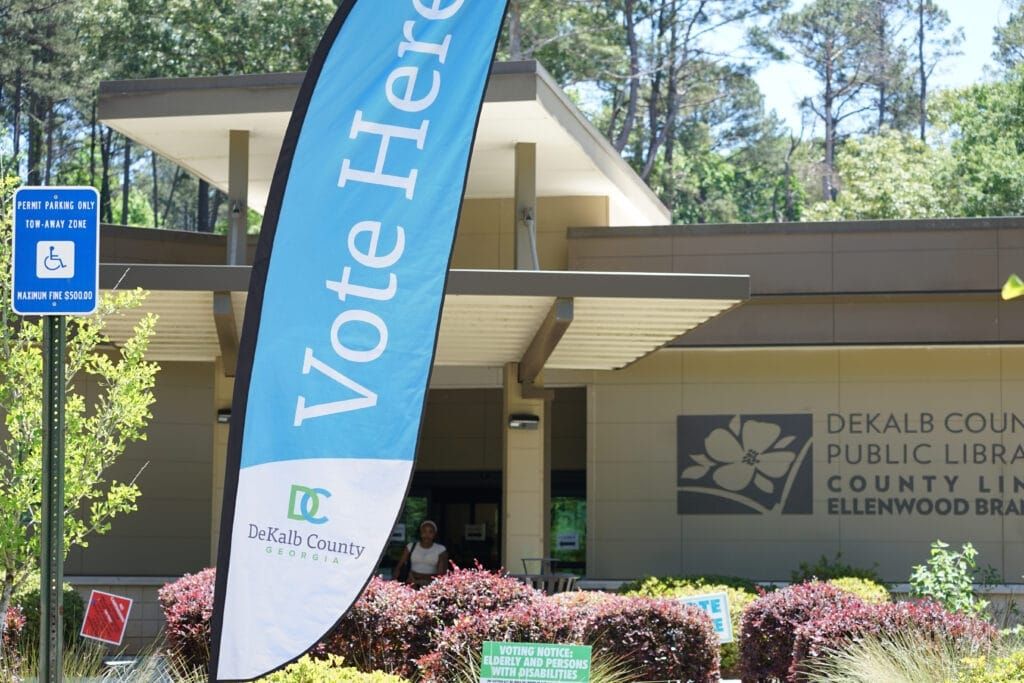
Voters like Harsh have been casting ballots during early voting ahead of the May 19 primary election, where Democratic and Republican nominees are selected to face off in November. At stake will be positions ranging from one of Georgia’s two U.S. Senate seats and governorship down to every seat in the state House of Representatives and local offices.
SUBSCRIBE: GET THE MORNING HEADLINES DELIVERED TO YOUR INBOX.
Many indicated that for them, “affordability” was more than a buzzword. Voters reported having to readjust their shopping habits to either only buying essentials or opting for less healthy foods, as well as having to pick between necessities.
“You have to check on your medicine, you have to say, ‘well I can get this, or I can get gas.’ You have to eliminate places you can go because you don’t have the money to fuel up. You can’t really buy the stuff you really want. The healthy foods you want cost so much more now, so you really have to demand it on just the cheap foods to survive,” said Rockdale County resident Debbie Mitchell.
Other voters indicated they’re cutting back on groceries as well as on non-essentials, like going out to eat in restaurants and traveling.
“As far as going out to the movies, eating out, that’s not an option because that’s just too expensive right about now,” said another Rockdale County voter, Raquel McDaniel.
For many, frustration over high prices is showing up at the ballot box. A recent Atlanta Journal-Constitution poll found economic concerns among the top issues voters say Georgia is facing today. The poll found 31% of Democratic primary voters listed inflation and cost of living as their top issue, with 17% of Republican primary voters agreeing.
“Everything has tripled in prices,” said Michelle Hayes, a resident of Stephens County in northeast Georgia who cast her ballot in Toccoa. “They may say they’re doing it for the long run, but people got to survive through it to get to that point, and it’s not feasible. So I do not vote the way that I did a couple of years ago.”
Hayes described herself as a “very strong” Republican voter, but she said she drew a Democratic ballot for the first time in this month’s primary election largely because of the cost of living, but also after seeing images of violent immigration raids.
“People are getting kicked out and beat on and jerked out of their cars, and the violence is just chaotic, and I don’t agree with all the violence I’m seeing and the way people are being treated,” she said.
Yvonne Chrimes, a 75-year-old retired university administrator who lives in Fulton County, said she’s doing all right financially, but worries about having to make repairs on her house with tariffs driving up the cost of lumber and other supplies.
“I’ve got some savings, but in the long run, I worry more about what would happen if our country continues on the path that’s going on under the current administration,” she said. She said she also worries about the cost of healthcare for those with less financial security than she has.
Though she used to vote for candidates of both parties, “in the last couple of years, there’s no way I’m going to vote for a Republican,” she said. “The current administration lost my vote several years ago.”
Georgia’s economic pain is not evenly distributed, said Sherrell Byrd, founder and executive director of SOWEGA Rising, a nonprofit aimed at revitalizing southwest Georgia.
“We’re already in a community that’s economically depressed,” she said. “We’re in a community that’s already two or three times higher than the national average when it comes to poverty rates. We don’t have a lot of jobs here that pay living in wages and we’ve had a lot of major corporations and manufacturers that have left the area, so people are already feeling the weight of not having enough money to pay their bills, but it’s even more compounded now that gas is higher, food costs and groceries are higher, rents are increasing.”
Byrd said there’s a vicious cycle where people leave the area in search of jobs, decreasing tax revenue and pressuring municipalities to institute new taxes to help pay for services like police and fire protection. Byrd said a Dougherty County ballot initiative for a Floating Local Option Sales Tax, or FLOST, a 1% sales tax to take pressure off local property taxes, is likely to draw more voters to the polls this month.
Byrd said when SOWEGA activists approach voters about the FLOST, they often hear people’s opinions about prices and the federal government.
“People are very aware of what is happening with this current administration,” she said. “I know that there’s a lot of correlation that we’re hearing from voters between the current war and how that’s impacting the price of gas, and things like tariffs. We’re hearing voters talk about these things at the doors and how that’s having a trickle down effect to all of the reasons why everything else is so expensive right now and so unaffordable.”
Some loyal Republicans urge patience
Many Georgia voters placed the blame for high prices on Republicans in power, and specifically on President Donald Trump, citing the war in Iran and the tariff policy favored by the president.
But Republican voters interviewed during early voting predicted the current pain at the pump would ultimately be just a blip.
Hugh Holley, a 79-year-old retiree, said he is trusting the plan, even as he is cutting back on luxuries.
Holley, who cast his ballot in Alpharetta for Derek Dooley in the GOP primary for the U.S. Senate race and Chris Carr for governor, said he’s concerned about rising costs, but he sees the spike in oil prices as a necessary step in order to prevent Iran from building a nuclear weapon.
“To me, it’s a short term thing we have to live with,” he said.
Holley and his wife have been choosing to save money by cutting back on travel and splitting an entree at restaurants rather than ordering two dishes.
“We haven’t given it up,” he said. “But in our case we split meals, so you reduce the total cost of the eating out by doing that.”
Lauren Shera, a retired radiologic technologist from Martin, a small town in northeast Georgia, voted in the Republican primary and cast her ballot for Mike Collins in the U.S. Senate race and Rick Jackson for governor earlier this month.
For her, the most important issues were combating child trafficking, securing the U.S.-Mexico border and promoting oil independence. The cost of living was further down her list of concerns.
“It’s a factor, but I’m a wait-and-see sort of person,” she said. “As soon as all this crap is over in Iran, I think we’re going to level out and it’s going to be better than what it was before. Now that everybody’s griping about the gas prices going up, well, I’ll take a little bit higher gas prices for a couple more months opposed to Iran nuking us, you know what I’m saying? I like my safety more than paying a couple bucks extra for gas for right now.”
Roger Goodwin, a retiree from Homer, which is about 75 miles northeast of Atlanta, voted for Derek Dooley and Jackson. He said he’s as perturbed at the pump as anyone.
“I’m on Social Security, so I’m on a fixed income,” he said. “I don’t like paying $4 and some odd cents for gas. I won’t say it’s a total hindrance, but it’s definitely a concern and it makes things a little bit tighter.”
But Goodwin said he’s also confident in the economy long-term.
“I think what we’re seeing now is a result of when the strait (of Hormuz) was completely closed, and this is kind of the after effect, and I’m suspecting that prices for gas, for example, will come down,” he said.
SUPPORT: YOU MAKE OUR WORK POSSIBLE
Mississippi Democrats fear big losses in Legislature from redistricting, vow to organize
by Michael Goldberg, Mississippi Today
May 19, 2026
One estimate shows Democrats could lose as many as 24 seats in the Mississippi Legislature from GOP-led gerrymandering, the state party chairman said Tuesday.
At a news conference in Jackson, Rep. Cheikh Taylor, Democratic Party chairman, said he has reviewed maps Republicans might adopt in the wake of the U.S. Supreme Court's Louisiana v. Callais ruling, which gutted part of the Voting Rights Act.
Taylor said he fears Democrats could lose as many as 17 seats in the House and 7 seats in the Senate. He also cited a report published last fall in anticipation of the Callais decision by voting rights organizations Fair Fight Action and Black Voters Matter. The report said nearly half of the state’s Black-majority districts, 29, could be eliminated if Republicans adopt an aggressive redistricting strategy encouraged by some in the majority party.
The impact of the Supreme Court decision is almost certain to trickle down to the state and local level, as the decision significantly narrows how courts can require states to account for race in redistricting. And in Mississippi and across the Deep South, race and party affiliation are intertwined.
The majority-white, Republican-dominated Mississippi Legislature has already formed special committees in both chambers to consider redistricting ahead of the 2027 legislative session.
Taylor's remarks came a day after the U.S. Supreme Court reversed a lower federal court’s ruling that determined Mississippi lawmakers unlawfully diluted Black voting strength when it redrew the state’s legislative districts in 2022.

Republicans already hold near supermajorities in both chambers of the Legislature, but several state officials have urged the Legislature to draw maps to cement even stronger majorities. Many Republicans in Mississippi have also said the state should redraw its congressional maps to oust U.S. Rep. Bennie Thompson, the lone Democrat and lone Black member of the state's delegation.
Republican Gov. Tate Reeves called off a special session he initially ordered to redraw state Supreme Court districts in light of the Callais decision. But in a radio interview, Reeves said it was only a matter of time before Republicans moved to target Thompson.
“The tenure of Congressman Bennie Thompson reigning terror on the 2nd Congressional District is over,” Reeves said. “It’s not a question of if. It’s a question of when.”
On Tuesday, Taylor condemned Reeves' remarks as "dog whistles," and said Republicans were poised to target Black representation across Mississippi's political system. He also said moves by Mississippi Republicans to redraw maps would likely be met with litigation.
"When people say race no longer matters, while simultaneously redrawing districts, weakening protections and targeting Black voting power, we must call it what it is: hypocrisy, moral decay and political cowardice disguised as constitutional principle," Taylor said. "The same forces framing America as suddenly colorblind are the same forces that continue manipulating systems to dilute Black voices and Black communities working together to make sure that their issues are heard."
Taylor also vowed Democrats would mobilize to counter Republicans' "power grab." On Wednesday, voting rights advocates are set to host a rally at the Jackson Convention Center in response to the U.S. Supreme Court's recent rulings and subsequent calls to redraw Mississippi's electoral maps. Attendees scheduled to appear include Thompson, NAACP President Derrick Johnson, Democratic nominee for U.S. Senate Scott Colom and the daughter of the late Medgar Evers, Reena Evers-Everette.
"We will continue organizing, we will continue educating, mobilizing and building leadership in every corner of Mississippi, from the Delta to the Coast, from Jackson to the smallest rural community. Every church house and every college campus," Taylor said. "Our fight is not over, and in many ways it's just the beginning."
This article first appeared on Mississippi Today and is republished here under a Creative Commons Attribution-NoDerivatives 4.0 International License.

A Utility Mega-Merger Is All About Data Centers
NextEra’s blockbuster deal with Dominion means the largest electricity company stands to benefit even more from AI growth. But what does it mean for ratepayers?
By Dan Gearino, Amy Green, Charles Paullin
May 18, 2026
This article originally appeared on Inside Climate News, a nonprofit, non-partisan news organization that covers climate, energy and the environment. Sign up for their newsletter here.
A proposed merger of the largest utility in the country by market value, NextEra Energy, with the sixth-largest, Dominion, would create a megacompany at a time when data centers and rapid increases in electricity demand are reshaping the industry.
The proposal, announced Monday morning and contingent on state and federal regulatory approval, would result in a company that leads in nearly every aspect of the U.S. power and utility industry, including overall electricity generation, natural gas generation and renewables.
The $67 billion deal combines NextEra’s size and reach with Dominion’s positioning as the local utility for the world’s largest concentration of data centers in northern Virginia. But the results are likely bad for consumers and the environment, creating a company with enormous financial and political strength that will be difficult to effectively regulate, according to consumer advocates and analysts.
For perspective, only Exxon Mobil and Chevron would be larger based on market value among U.S.-based energy companies.
“Mergers are not about consumers; they’re about shareholders,” said Ari Peskoe, director of the Electricity Law Initiative at Harvard Law School. “For the Dominion shareholders, they are selling their shares at a premium. The executives are getting massive payouts for facilitating this, assuming it all goes through, and obviously NextEra believes the transaction is going to add value to the company. Ratepayers are all an afterthought.”
The deal makes financial sense for both companies, said Andrew Bischof, an equity analyst for Morningstar.
“We view the transaction as allowing NextEra to accelerate its data center ambitions, which had trailed those of its regulated peers, by using Dominion’s expertise and relationships to expedite NextEra’s data center hub plans,” he said in a note to clients.

NextEra, based in Juno Beach, Florida, includes Florida Power & Light, the largest regulated electricity utility in the state, and NextEra Energy Resources, a wholesale electricity supplier that owns power plants across the nation. Dominion, based in Richmond, Virginia, includes regulated utilities serving much of Virginia, parts of North Carolina and South Carolina and other assets across the country.
The company would be called NextEra Energy and NextEra CEO John W. Ketchum would serve in the same role after the deal closes. Robert M. Blue, Dominion’s CEO, would be the CEO for regulated utilities for the merged company. The parties said they expect regulatory approvals to take 12 to 18 months.
NextEra shareholders would own 74.5 percent and Dominion shareholders would own 25.5 percent, respectively, of the combined company in the all-stock transaction.
“We are bringing NextEra Energy and Dominion Energy together because scale matters more than ever— not for the sake of size, but because scale translates into capital and operating efficiencies,” Ketchum said in a statement.
“Adding to the Pollution Problem”
The post-merger NextEra would be the leader in so many categories in the U.S. utility sector that it’s easier to list the ones where it wouldn’t be on top. It would rank second in nuclear power generating capacity and in the number of regulated utility customers, trailing Exelon Corp. of Chicago in both.
NextEra and Dominion both have substantial carbon emissions, but neither was among the top five utility companies in the country in 2024, according to the most recent edition of the Benchmarking Air Emissions report from the Natural Resources Defense Council. NextEra ranked sixth and Dominion ranked 11th, and their sum was less than that of each of the leaders, Vistra Energy and Duke Energy.
But those are still massive emissions from a company that stands to gain more clout because of its size.
“If we continue to add dangerous climate pollution into the mix, then people who are already suffering and are typically hurt first and worst will suffer even more,” said Susan Glickman, vice president of policy and partnerships at the CLEO Institute, a Florida-based nonprofit dedicated to climate education and advocacy. She noted that those with the fewest resources often are the most affected by disasters like hurricanes, which are intensifying as fossil fuel emissions warm the global climate.
“They’re going to continue to be at the short end of the stick, while these companies build more methane gas plants to provide additional power for data centers, and adding to the problem of pollution that is warming our climate.”
Consumers Stand to Lose
In a conference call Monday morning, company officials said the agreement will lead to economies of scale, providing savings that will benefit ratepayers. The deal includes $2.25 billion in bill credits for Dominion customers, spread over two years.
But utility mergers do not have a track record of delivering long-term benefits to consumers, said Marissa Paslick Gillett, who served as chair of the Connecticut Public Utilities Commission from 2019 to 2025. She resigned following clashes with utilities in the state and now is a senior fellow at the American Economic Liberties Project, a think tank that works to limit the concentration of corporate power.
“I continue to be sort of flabbergasted by the tone deafness,” she said. “I’m not sure that any of us could point to a major utility merger acquisition that’s happened in the past decade … where that merger acquisition has definitively provided the synergies that they told their commissions were going to come out.”
Gillett’s experience includes work as a staff member at the Maryland Public Service Commission during the 2012 merger of Exelon with Maryland-based Constellation Energy, which was one of the largest U.S. utility mergers ever.
One of the main problems that arises from a utility merger is that it creates a company that is difficult to regulate because of its complexity, she said.
“We know how this goes, and the real, tangible problems of having to regulate a behemoth like this,” she said.
Stephen Smith, executive director of the Southern Alliance for Clean Energy, said the merger could be a good thing if NextEra is responsible to customers and continues to expand its renewable energy portfolio. He noted NextEra’s status as the largest renewable energy developer in the country, but he also had concerns about the growing weight of the utility’s political influence, especially in Florida.
”You’re making a very large utility that has a tremendous amount of financial resources, a tremendous amount of political power, and that does not always bode well for ratepayers,” he said. “The more political power that a utility has, the more probable it is that they will use that power to the disadvantage of ratepayers.”
Smith cautioned that the merger should not be viewed as a done deal. NextEra has attempted to acquire other utilities in the past and failed, including aborted talks with Duke Energy in 2020.
“Their track record in acquisitions is not really that great,” he said.
Virginia’s Laws Would Still Apply
Despite those worries, Dominion and its out-of-state parent company would still need to follow Virginia’s laws and regulations, said William Shobe, a research professor emeritus of public policy at the University of Virginia.
“The regulations don’t mention Dominion, they mention the utility that covers Dominion’s footprint, whatever its name is,” he said.
Those laws include the Virginia Clean Economy Act, the state’s 2020 law seeking to decarbonize its grid by 2050, and the recently passed legislation increasing Dominion’s battery storage development targets.
If anything, NextEra’s track record as a leader in solar and wind power could “bleed” into the Dominion culture that “has not been super aggressive about adding non-emitting technology,” Shobe said.
Acquiring Dominion is appealing to NextEra Energy, he said, because Virginia has a friendly policy environment to build grid infrastructure, a strong profit margin and a booming data center market. NextEra said the merger creates a pipeline of 130 gigawatts worth of demand from data centers, which critics say are speculative, and a chance to more than double generation capacity to 225 gigawatts by 2032.
Florida regulators in November approved a $7 billion rate hike for Florida Power & Light. Consumer groups characterized the rate hike, which faces a legal challenge in state court, as the largest in U.S. history.
Bradley Marshall, a senior attorney at Earthjustice, said the rate hike positioned NextEra financially to pursue the merger.
“In the past, when we see utilities become even more powerful, we’ve seen bills go up even further,” he said. “Consumers need to be informed about what’s happening and ensure that keeping bills from going up is a priority.”
NC families with disabled children press lawmakers to maintain funding as federal Medicaid cuts loom
by Rose Hoban, North Carolina Health News
May 18, 2026
By Rose Hoban
Finley Thomas is an 11-year-old girl who’s got a morning makeup and skin care routine. She loves Halloween, dressing up, her older brothers and cheering with her squad.
She also uses a wheelchair, has a tracheostomy tube that gets hooked up to a ventilator at night, receives tube feedings for much of her nutrition, and has multiple therapy sessions each week—all the result of a neurological condition she was born with that has recently required a couple of surgeries.

Just don’t tell Finley that any of those things are going to slow her down. When asked what she wants to be when she grows up, she quickly responds “a princess.” Or a makeup artist. Or a hairdresser.
Her mom, Jennifer Thomas, says Finley is her “social butterfly.” In a N.C. Legislative Building atrium in Raleigh on May 12, Finley was surrounded by a cortége of admirers. She chatted and laughed with the adults in her circle.
“Her personality is huge,” Jennifer said. “She does cheerleading, you know, she has friends. We go on adventures. We take her places, parks, play dates, you know, just making sure she's getting out into the community.”
All this activity is possible through the state’s Medicaid Community Alternatives Program for Children, or CAP/C. The home- and community-based services program provides the Thomas family with round-the-clock nursing care to help with all of Finley’s needs.
The Thomases took part in an advocacy day at the legislature to give lawmakers a better understanding of the kinds of services and personal care that more than 58,000 people receive in various community-based programs that help them stay in their homes with their families.
These services can be expensive. An in-home nurse costs the state’s CAP-C program about $123,965 a year on average. While that number might seem eye-popping, it could cost closer to $200,000 a year for a child like Finley to live in a skilled nursing facility. Then take into account the psychological toll that living in an institution would have on such a gregarious, bubbly little girl. For people with greater needs, the facility costs, on average, could be closer to $311,000 annually.
“Obviously a facility would not be an option for us,” Jennifer said. “She’s so social.”
But the One Big Beautiful Bill Act, (also known as H.R. 1), the federal budget plan passed by Congress last year, contains close to a trillion dollars in cuts to Medicaid over the coming decade.
Passage of the bill sent a chill through families like Finley’s. Their fear is that you can’t slice that kind of money out of the nation’s Medicaid system and expect kids like Finley not to be affected. And while many of those cuts are aimed at ostensibly so-called able-bodied adults who receive benefits on the program, families like the Thomases know that in a challenging budget environment, a cut’s a cut and the services keeping their families intact are at risk.
Wages not keeping up
About 58,000 people in the state rely on Medicaid for nursing or home health aide services that allow them to remain in the community with their families.
One of the challenges, for the Thomases and other families, is that the wages paid through Medicaid to professionals in vital, physically demanding and often emotionally challenging caregiving jobs have not kept up with the wider employment market. Home care aides, the least-skilled care providers, earn, on average, $15.30 an hour. Working at an Amazon warehouse pays about $23 an hour.
“You know, you can work in retail, making more money and less stress,” said Lee Dobson, one of the leaders of BAYADA Hearts for Home Care, an advocacy group that supports families who need care at home.
Home care agencies have more needs than their current workforce can meet. About 20 percent of home care aide positions go unfilled at any given time. “And then the turnover, just churn,” Dobson added, runs between 50 percent and 80 percent. “You're just always trying to recruit staff.”
Those people who provide Medicaid-reimbursed personal care services received a bump in pay near the end of the pandemic. That helped retention, but advocates are afraid that those dollars could go away as North Carolina’s Medicaid budget will be under increased pressure this budget cycle.
Dobson said several bills have been introduced that would fund all these services, plus supply $120 million to increase salaries for personal care service providers. None of those bills have moved past the introductory stage.
There’s an additional request from advocates to bump up the private duty nursing rate; that would require a $20 million investment. Nonetheless, that wouldn’t get nurses who provide this care up to the pay level that hospitals offer. And it still would be much less than what home care nurses earn in surrounding states.
“I think, fundamentally, what we want this year is we want to make sure that Medicaid gets funded,” Dobson said. She said they want to maintain services, even though they will cost more than they did last year.
“The industry cannot go back to what happened in October,” Dobson said, referring to cuts made to the Medicaid budget last fall when the legislature had not completely funded all of Medicaid’s annual needs.
Despite the steep price tags, Dobson argues that these home-based services save taxpayer dollars. The1991 Americans with Disabilities Act and the subsequent 1999 Supreme Court Olmstead decision affirm the right for people with disabilities to be integrated into the community, but home-based Medicaid services are still optional under federal law.
Dobson said the home care industry estimates that North Carolina will need 186,000 aides by 2028, but will likely be about 22,000 people shy of that number.
It could be even more difficult to keep nurses interested in working in community-based care programs. There’s already a projected shortage of as many as 12,500 nurses by the end of the decade. As demand for their services grows in other parts of the health care system, which traditionally have offered higher pay, the prospect of nurses making $25 to $27 an hour could be a long-term deterrent.
NC Medicaid programs for medically fragile and disabled people
- Community Alternatives Program for Children (CAP/C): available to people younger than 21, provides in-home services for medically fragile children as an alternative to hospital or institutional-based care. Recipients go through a needs assessment and annual updates. 4,125 current recipients.
- Community Alternatives Program for Disabled Adults (CAP/DA): available to adults 18 and older, also provides in-home services for people who are medically fragile and at risk of being institutionalized for their care. The program is intended to supplement, rather than replace paid and family-provided services available in the community (for example, family supports). 9,033 current recipients.
- Community Alternatives Program - Choice (CAP-Choice): Allows the disabled person or their caregiver to act as the "employer of record," giving them direct control over who provides care and how services are scheduled. The person or their caregiver is responsible for hiring, training, scheduling and supervising their care assistants. 3,566 current recipients.
- Innovations Waiver: The Innovations Waiver allows for enhanced community services, such as job coaching, crisis services, services for caregivers, home modifications and assistive devices, without taking into account family income or other typical Medicaid eligibility requirements. Currently, 11,695 people receive Innovations services, while 20,893 are on a waiting list for the program. The wait time for receiving a slot in the program is as much as 20 years.
- Personal Care Services: Helps people with daily tasks like eating, getting dressed, taking a bath, using the bathroom, etc. Recipients must have a medical condition, disability or cognitive impairment to qualify and be able to demonstrate unmet needs. Currently, 42,059 recipients.
Lifelong needs
Not all recipients of the Community Alternatives Programs are children. Kids with disabilities age, and they become adults with disabilities for whom much of the care continues to fall on their parents.
That’s the story for Janet Schmitt, whose son Kevin is 30 and is profoundly disabled as a result of daily seizures — sometimes more than one.
“He has the mental capacity of an 8-year-old,” Schmitt said. She also said Kevin is on the autism spectrum and has had brain injuries from frequent seizure-related falls.
“We have severe cognitive decline, functioning,” Schmitt said at the advocacy day. “He's had two brain surgeries. We attempted three others that were not successful.”
“I have gone way above and beyond even some not-so-conventional methods to keep him with us,” Schmitt added. “That's why we're here, because he thrives in the home environment. If he were to be taken out of that environment — just like anytime we're hospitalized with his medication regimen, it's always mixed up, confused in the hospital. It takes us about three months to rebound from that. Then seizures are manifest even more frequent because it's a different environment.”
Because Kevin has qualified for Medicaid’s Innovations Waiver, Medicaid pays Schmitt an hourly rate to be Kevin’s caregiver. Medicaid also pays for help from an outside caregiver two days a week. That’s when Schmitt crams in errands like shopping and all of her medical appointments — she was diagnosed with leukemia several years ago.
Part of Schmitt’s “above and beyond” included returning to school when she was 42 to become a nurse so she could better care for Kevin and navigate the health care system. Twenty years later, she’s retired from nursing work and is hoping her husband can retire later this year to help with Kevin’s care.
She’s worried about what happens “after,” especially since her diagnosis and a medical crisis a couple years ago when she was told she had only weeks to live.
“I do honestly think Kevin will outlive me,” she said. “In the event that that does happen, you know the care is gonna fall on my husband, and for one person, you know, it's a lot, without the assistance and being able to, you know, even have the break.”
No one expects these disabilities
Jennifer Thomas said right now, they’re feeling lucky with the people who care for Finley.
“We've had the same nurses for a while. Our night nurse we've had for 10 years; she works Friday, Saturday, Sunday, Monday nights,” Jennifer said.

“Then our other night nurse, he's been with us for seven years, and Sandra's been with us for four years,” she said, gesturing to the nurse standing in the group surrounding Finley.
That wasn’t easy, though. Jennifer estimated the family cycled through 50 nurses during Finley’s first decade. Even once they found reliable, skillful help, there are still holes.
“Nurses do take vacations. We had times where we'd go a week without having overnight nursing care,” she said. “It was really hard on our older children, you know, it was really hard on us. It was hard on our marriage, it was just hard on any relationships that we have when you're not sleeping.”
Although some who are unfamiliar with what these families go through still consider home-based care optional, the advocates at the General Assembly hope to persuade legislators that it’s not only necessary, but a cost-saver over institutional care. Medicaid reductions from H.R. 1 will start hitting state budgets in the coming year, compelling lawmakers to make decisions about what to cut.
Thomas and the other advocates believe they have a strong case to make, but other states — Nebraska, Idaho, Colorado and Missouri — are contemplating cutting services, even to those families with profoundly disabled members. Maryland has already decided to move ahead with them.
Thomas and her husband run a small business that employs 20 people, they’ve been able to grow it, even as they’ve had to cope with their family’s medical challenges. Her husband is the business lead, Jennifer is the administrator.
Cutting their Medicaid would affect their ability to be contributing members of society, something she and her husband don’t want to have happen.
“I don't think anybody expects to have a medical crisis or have a child with disabilities,” she said. “But it happens, and it's important to have support out there.
This article first appeared on North Carolina Health News and is republished here under a Creative Commons Attribution-NoDerivatives 4.0 International License.

Florida entrepreneur’s job promises for NC mountains looking like a mirage
by Lucas Thomae, Carolina Public Press
May 18, 2026
In February of 2025, just months after Tropical Storm Helene devastated the North Carolina mountains and destroyed entire livelihoods, Chris McKendree stood in front of a congregation at the Burnsville Town Center and made a promise to “put jobs in the community” and “money in the banks,” with his latest business venture, Paradigm Energy and Storage.
Wearing khaki shorts and a University of Florida football hoodie, McKendree presented himself as a down-to-Earth businessman from Fernandina Beach, Fla. — a son of a shrimper and an entrepreneur interested in clean energy that would “change the world.” In 2024, prior to Helene, he came to the Yancey County Board of Commissioners with a proposition to build a headquarters and manufacturing facility in Burnsville for Florida-based Paradigm.
McKendree said the project would involve a $175 million investment and create 150 good-paying jobs by the end of 2027 in one of North Carolina’s most remote mountain counties. County commissioners were convinced by the proposal, and in turn they agreed to give McKendree a 84.5-acre parcel of land to build on, valued at $2.6 million, for free.
[Subscribe for FREE to Carolina Public Press’ Daily, Weekend and Election 2026 newsletters.]
A bevy of regional media reports and press releases celebrated the deal as a major economic victory for the rural county.
More than a year later, no construction has been done and no jobs have been created. Paradigm Energy and Storage appears to exist only on paper, and it isn’t clear that McKendree ever had the resources, or even the intention, to follow through on the project.
Paradigm doesn’t have any online presence or legitimate contact information. Its listed addresses are a private residence in Fernandina Beach and a private mailbox at a UPS Store in Burnsville.
Not only has the company defaulted on its agreement with Yancey County, but it also owes more than $16,800 in unpaid property taxes and is more than a month late on filing the annual report required to keep the company active in North Carolina. McKendree even appears to have changed his personal phone number through which Carolina Public Press attempted to contact him for this story.
Adding a further complication to the matter, Paradigm sold a small portion of the land deeded to it by the county in September to a third party, seemingly without the legal authority to do so.
While residents are left to wonder what happened, multiple stakeholders involved in bringing Paradigm to Burnsville have said very little, if anything, publicly about where the project stands now.
Yancey County officials did not respond to CPP’s multiple phone calls and email inquiries asking whether the county was still in active communication with Paradigm or McKendree, or whether it intended to pursue legal action to recoup the land and unpaid property taxes.
The Economic Development Partnership of North Carolina, a public-private nonprofit which recruits new businesses to the state, and which played a role in connecting Paradigm to Yancey County, also declined to answer a CPP inquiry for an update on the project.
“We don't have any comment for this one,” EDPNC spokesperson Evan Hoopfer said.
‘A lot of promises’ for Paradigm
On Feb. 5 of last year, Yancey announced its agreement with Paradigm to a sizable audience at an event center in Burnsville.
It wasn’t just a local crowd. Staffers from the offices of U.S. Senator Thom Tillis and Congressman Chuck Edwards were among the attendees. Yancey County Manager Lynn Austin also thanked representatives from EDPNC, the Town of Burnsville and Mayland Community College for their roles in bringing the project together.
Austin had previously hinted that a major economic development announcement was in the works at a Dec. 30 special meeting of the county commissioners, but she said she couldn't divulge the identity of the interested company because of a nondisclosure agreement. So instead, the county referred to it as “Project Gator.”
Project Gator, which was later revealed to be Paradigm Energy and Storage, wanted to build on a parcel of land that the county purchased in 2022 using federal funds from the American Rescue Plan Act, better known as ARPA.
Yancey County bought that land with the intention of turning it into an industrial park, and, with the help of the state, had it certified as a shovel-ready industrial site. The county jumped on the opportunity when McKendree approached them about developing it, and they were relieved, Austin said, when he doubled down on his interest after Helene.
With an agreement between the two parties reached, McKendree had the opportunity at that February meeting to introduce himself and sell the community on his vision for Paradigm. However, the introductory speech he gave, captured in a YouTube video, lacked specifics and concerned several Yancey residents who spoke with CPP.
McKendree emphasized his Christian faith and humble upbringing, as well as his desire to bring prosperity to Yancey County in the aftermath of Helene. However, he said little about what Paradigm would actually do at the planned $175 million facility, instead painting an ambitious picture that bordered on hyperbole.

“Paradigm is going to become a global corporation,” McKendree said.
“We're going to be building energy systems all over the world. We're going to teach our children the robotics that move the energy. We're going to teach our children how to manufacture solar modules. We're going to teach them how to build everything and anything that's energy that makes sense and there's a market for.”
When asked by Commission Chairman Jeff Whitson to explain to the audience the products that Paradigm would manufacture, McKendree described nonflammable, transportable batteries which could provide power to facilities like schools and hospitals during power outages.
Landon Beaver, a community activist and chair of the Democratic Party in heavily Republican Yancey County, attended that meeting and said he was skeptical of the project almost immediately.
“It was a lot of promises,” Beaver said. “In a lot of ways it felt more like church for a few minutes there, with a prayer and everything, and (McKendree) was not very professional looking either.”
Yancey resident and small business owner Tal Galton was equally suspicious of Paradigm after Google searches turned up very little information about the company or its operations.
“From the get-go I was like, this can't be real,” Galton said, “and it's baffling to me that our county government had the wool pulled over their eyes somehow.”
Paradigm documents littered with red flags
CPP discovered multiple false and misleading information on Paradigm’s North Carolina business registration, which was filed 10 days after the announcement in Burnsville.
First, McKendree listed a Florida attorney’s cellphone number as Paradigm’s principal office number.
When contacted by CPP, that attorney said he had done legal work for McKendree in the past but was not associated with Paradigm. The same attorney provided CPP with what he believed to be McKendree’s personal cell number, which turned out to have been deactivated.
Further, the registered agent listed on Paradigm’s business registration is a Burke County woman who died in December. The address listed as her office is a Linville Falls restaurant, owned and operated by that woman’s relatives, who denied any association with Paradigm and called the information in the document “fraudulent.”
Paradigm’s 11-page development plan, which was attached to its contract with the county, also had multiple instances of contradicting statements and vague descriptions of the company’s operations.
In the first paragraph, it described Paradigm as an “upcoming unlaunched business” but also claimed to have 75 employees. CPP found no credible sources to suggest that Paradigm had any employees other than McKendree.
That same document claimed Paradigm’s “core offerings” were smart-grid technology, battery storage systems, demand response programs and peak-load management strategies, but did not explain what those were or how it fit into the company’s operations.
During his speech, McKendree also said Paradigm would manufacture solar panels, even announcing a partnership with Mayland Community College that would train students for that task, but Paradigm’s development plan didn’t mention solar manufacturing or the training program at all.
John Boyd, who leads Mayland Community College’s business partnerships, was present at the February 2025 announcement but did not speak about the proposed training program. Boyd did not respond to CPP’s requests for comment about the current status of that program.
An uncertain future for industrial site
It wasn’t until more than a year after the initial announcement that Yancey County gave a public update about the Paradigm project.
At the end of a March 9 county commissioners meeting, Whitson addressed the project after a group of citizens voiced their concerns about the legitimacy of the operation and the lack of work being done at the industrial site.

Whitson said Paradigm had been declared in default of its agreement with the county in December, and that the 84.5 acres deeded to them would return to the county as a result.
Whitson and Lynn further discussed the future of the industrial site in a Facebook video posted on March 13. In that video, Whitson referred to the situation as a “touchy subject” and said he wanted to put the topic “to rest,” emphasizing again that the county maintains control of the land given to Paradigm.
Public land records from the register of deeds and county GIS data do not, as of the publication of this story, corroborate that claim. Both indicate that Paradigm still owns that parcel of land, except for a 0.44-acre section that the company sold for $10 to the owner of a local trucking company in September.
The man who bought that portion of the industrial site declined to speak with CPP for this story.
County officials did not respond to CPP’s request for them to clarify the status of the default agreement with Paradigm, nor did they respond to questions about what might happen with the land the company sold.
Despite everything, Whitson’s video statement alluded to the possibility that Paradigm still might proceed with the project, although he added that the county is interested in recruiting other businesses to the site.
“The business that is looking at it right now, Paradigm ... is still able to come,” he said. “It’s up to them on how we move forward.”
Beaver said there’s still hope that the county can find a different suitor for the industrial site and bring a needed boost to its economy, but he was dismayed at the time lost by dealing with Paradigm.
“We do need good paying jobs, and that's kind of what was promised with this project,” he said.
“Beyond jobs, they were going to partner with Mayland Community College to provide education with it, so there’s a lot of let down with what was promised with this project versus what we got.”
This article first appeared on Carolina Public Press and is republished here under a Creative Commons Attribution-NoDerivatives 4.0 International License.

Can you trust that post about Tom Steyer? How paid influencers are flooding into the governor’s race
By Jeanne Kuang, Yue Stella Yu and Maya C. Miller, CalMatters

This story was originally published by CalMatters. Sign up for their newsletters.
Jaz Roche, also known to nearly 11,000 Tiktok followers as @spo0kymom, hawks facial cleansing bars, baby wagons and AI tools in short social media videos.
On a website where clients can pay her to post videos about their products, she says she’s based in Pennsylvania. Yet the content creator has taken an interest in the California governor’s race lately.
Tiktok and Instagram accounts linked to Roche have posted 34 times in the past 10 days to boost the campaign of billionaire Tom Steyer or to criticize his main Democratic opponent, Xavier Becerra.
“Hear me out, I have something to admit,” she says in the first video, posted May 8, on an account where she describes herself as a “so-cal girlypop.” “I did not expect the most progressive governor candidate to be a billionaire. But look at the policies, you guys.”
What she didn’t say was that Steyer’s campaign is paying her to say it.
Steyer, who has poured nearly $200 million into the most expensive primary campaign in state history, is under scrutiny for using paid social media influencers to post favorable things about him.
Is that legal?
Gov. Gavin Newsom three years ago signed a law meant to bring transparency to the increasingly intertwined world of politics and content creators, enacting a law requiring influencers to be upfront in their posts about being paid by a political campaign. In one of the first tests of the law, regulators have opened an investigation into one of the Steyer influencer videos.
But experts and transparency advocates aren’t optimistic: The law was intentionally designed with no real penalties, and the agency responsible for enforcing it sometimes takes years to resolve investigations.
“This is where the ‘Wild West’ analogy becomes useful,” said Dan Schnur, a political science professor and former chair of the state’s Fair Political Practices Commission.
‘Inundate the internet’
Campaign finance filings from January through April 18 show Steyer has paid over $123,400 to at least eight influencers. The New York Times reported that includes $100,000 to Texas-based Latino mega-influencer Carlos Eduardo Espina, whose 14.3 million Tiktok followers are a coveted target for Democrats and who has endorsed Steyer.
The campaign is also paying over $870,000 to a digital media agency, Group Project Digital, that solicits creators to post daily videos about Steyer. The listing initially offered $10 per video; it was amended last week to offer $1,000 a month and now includes a sentence telling creators they need to disclose the payments.
The state investigation covers just one of the influencer videos, in which content creator Isaiah Washington (known as @zaydante) did not disclose that Steyer’s campaign paid him $10,000 for a now-deleted video. It was sparked by a complaint from a pair of political social media influencers who post frequently in support of Becerra. On Tuesday, they filed another complaint alleging numerous additional paid, undisclosed posts, including from accounts in other countries.
“What he’s done is inundate the Internet in every way, shape and form to try and create an echo chamber,” said Beatrice Gomberg, one of the complainants.
Among the accounts they’ve recently highlighted: @foosgonewild, which has posted memes, content about Southern California street culture and, on May 5, an interview with Steyer talking about his opposition to ICE. The account has 3.3 million followers on Instagram and 1 million on Tiktok.
The Tiktok video has no disclosures. On Instagram, at the bottom of the video description, the account notes it’s a partner with California-based social video firm Flighthouse. Neither the content creator nor Flighthouse responded to requests for comment. The Steyer campaign would not disclose how much it paid the firm.
Steyer has defended soliciting influencers, saying they deserve to be paid for their work.
Spokesperson Kevin Liao called Gomberg’s first complaint “baseless” and said the campaign specified in its contracts with all third-party content firms that they needed to include payment disclosures, satisfying the campaign’s legal obligations under the state transparency law. The campaign doesn’t review posts in advance, he said.
Asked why the campaign had paid some creators who don’t live in California, he said, “I don’t see why that’s an issue.”
“Content creators, wherever they’re based, have followers in California,” he said.
‘Politics is all content now’
The blowback reveals the rising power and profitability of content creators in politics. One in five Americans regularly gets news on TikTok, rising to more than two in five for those under age 30. With traditional television hemorrhaging viewership and Americans hooked on the infinite scroll, campaigns are increasingly chasing posts.
They regularly hold events to court paid and unpaid influencers and sit for video interviews, aided by a new crop of talent agencies and digital media firms that represent influencers and solicit their content.
The relationship has contributed to at least one politician’s downfall: After attending a creator meeting for then-gubernatorial hopeful Eric Swalwell last fall, political influencer Arielle Fodor (aka @mrs.frazzled) received a flurry of messages warning her to stay away from him. It prompted her to post videos discussing rumors of his sexual misconduct, she has said. He quit the race after reporters covered several allegations of harassment and assault.
“Politics is all content now,” said Alex Stack, a Democratic consultant and former communications staffer for Gov. Gavin Newsom. “Candidates need to be content creators and they need a little online army behind them to get traction.”
Roche’s videos about Steyer — some featuring her talking, some simply showing text praising Steyer over mundane videos of her life — have gotten no more than 1,100 views each. They’re posted on accounts with fewer than two dozen followers, a far cry from the millions of Californians Steyer’s TV ad spending blitz is reaching.
But they provide something critical for the billionaire candidate who’s funding his own campaign: the impression of grassroots support.
In a briefing memo for creators obtained by CalMatters, the campaign’s digital firm tells Tiktokers and Instagrammers that the “title of billionaire is his biggest sticking point,” and that the campaign wants to reach California women, Latinos and African Americans. The Sacramento Bee first reported on the memo.
Organic content?
Advertisers covet creators regardless of audience size for their ability to portray a product endorsement as an organic recommendation from a friend. Candidates courting voters are no different.
For example, an organization representing California lawyers is paying influencers to promote a ballot measure targeting Uber's responsibility for sexual assaults by its drivers. Matt Mahan’s campaign for governor has also paid influencers and meme accounts for content boosting him. Instagram users see disclosures on those videos’ descriptions.
In the Los Angeles mayor’s race, Karen Bass’ challenger Spencer Pratt is offering money on social media gig platforms to make videos featuring viral-friendly soundbites of him.
“Whether or not they believe in Tom Steyer, they’re going to post those videos.” content creator Serabeth Mullaney
Serabeth Mullaney, a part-time San Francisco content creator promoting cat treats and AI tools, turned down an offer to make videos boosting Steyer’s campaign because of her opposition to billionaires in politics. The 29-year-old said she gets most of her news from social media so she’s concerned about the seep of paid political ads into influencer content.
“Anyone desperate to make that (money), they’re going to do the campaign,” she said. “Whether or not they believe in Tom Steyer, they’re going to post those videos.”
The concern mirrors the state Fair Political Practices Commission’s rationale for proposing the 2024 transparency law. Before that, campaigns only needed to disclose payment for ads they posted directly; paid content on third-party platforms was largely unregulated.
But the agency primarily relies on complaints to launch investigations, and violations of the law come with few consequences — no fines or criminal charges for creators or campaigns. The only thing the agency can do is ask a court to force an influencer to disclose payments, but experts say that's an expensive and time-consuming effort for a fleeting video.
Sen. Tom Umberg, a Santa Ana Democrat who authored the law, said paid influencers in politics are more prevalent than three years ago and lawmakers should make the requirements more enforceable.
“Transparency is like whack-a-mole,” Umberg said. “Every year there’s a new modality, and so there’s a new way to get around stuff.”
Becerra's online army
Now the gubernatorial candidates and their supporters are engaged in a mass scrutiny of all the posts boosting each others’ campaigns.
Critics have also questioned the relationship between Becerra and numerous creators who have boosted his campaign since Swalwell dropped out. The Becerra campaign has insisted it has never paid any content creator for a post.

The campaign seeks relationships with creators who are willing to post for free as a blend of campaign volunteer and reporter, said digital strategist Alf Lamont.
“Paid influencer campaigns don’t carry the kind of punch that organizing does,” Lamont said. “We want to make sure we’re getting folks who truly believe in it so we don’t face the second-guesses and the ‘paid by’ and the feeling you’re looking at something that’s insincere.”
Jordan “Jay” Gonzalez’s posts included lifestyle content, Latino advocacy and even salmon DNA facials before he started creating pro-Becerra videos on multiple platforms in March, a month before the campaign hired him as a full-time social media strategist. Gonzalez has recently been amending his posts with disclosures that he is paid by the campaign, “out of extreme caution so as not to seem disingenuous to my audience.”
Opponents point out Gonzalez and another creator who has posted numerous times in Becerra’s favor, Maggie Reed or @mermaidmamamaggie, have previously charged for content. Antonio Villaraigosa’s campaign solicited unpaid videos from both of them in the spring, and received quotes from each influencer’s agent of $7,000 to $16,500, emails shared with CalMatters show. The Villaraigosa campaign confirmed the exchanges.
On Tuesday, Steyer’s campaign filed a complaint alleging both influencers’ videos were paid for by Becerra’s campaign with no disclosure.
Becerra’s campaign has not reported any payments to Reed in campaign finance filings, and Lamont denied paying either creator for content. Gonzalez, in an email, said that he had previously declined a paid offer from the Villaraigosa campaign. Reed did not respond to a request for comment.
‘A SoCal girl’
Gomberg and Kaitlyn Hennessy, friends who met at a Becerra rally, have both posted frequently in favor of his campaign — for free, they say.
The pair began sleuthing online in early May, eventually filing a complaint with the Fair Political Practices Commission last week alleging Steyer’s campaign hired Roche, Washington and several other content creators to post on his behalf without disclosing it.
Posing as another, unnamed campaign, they emailed creators offering paid political content work to prompt them to talk about posting for Steyer’s campaign.
One account, @isabel.speakss, purported to belong to a “so cal girl sharing her thoughts” named Isabel Mendoza and has exclusively posted about Steyer since May 9. The woman in the videos appears identical to Jade Johnson, a Florida-based influencer.
Another account, @jess.votes, is linked to another Florida content creator.
Since the complaint was filed, Roche and the other creators have included disclaimers in their posts. None of them responded to inquiries from CalMatters asking if they knew about the campaign disclosure law. After a CalMatters reporter asked Johnson whether she was asked to pose as a California voter, the @isabel.speakss account on Monday afternoon removed the “so cal” description from its profile.
None of those creators are listed in Steyer’s latest campaign finance filings as subcontractors of any digital strategy firm. Steyer spokesperson Liao said they will appear in the next filing.
CalMatters reached out to all the creators listed in the filings; none agreed to an interview. They include lifestyle influencers, comedians and musicians whom Steyer paid between $1,500 and $10,000, mostly through another firm, to post video interviews with Steyer or talk about his platform. One of them labeled her video a “paid partnership;” others did not disclose campaign payments or have since deleted their videos.
This article was originally published on CalMatters and was republished under the Creative Commons Attribution-NonCommercial-NoDerivatives license.
Ex-residents of apartment building targeted in massive immigration raid seek millions in damages
by Hannah Meisel, Capitol News Illinois
May 15, 2026
Article Summary
- Immigrant rights groups have filed federal tort claims against the U.S. Department of Homeland Security over the Sept. 30, 2025, immigration raid on an apartment complex in Chicago’s South Shore neighborhood.
- Roughly 300 immigration agents stormed the building in a middle-of-the-night raid in the early weeks of “Operation Midway Blitz” this past fall, ultimately arresting 37 people allegedly without warrants.
- The 18 former residents who filed claims this week are seeking $5 million each in damages for agents’ alleged actions, including marching them outside in various states of undress and restraining them with zip ties. Those zip-tied outside the building for hours included undocumented immigrants and U.S. citizens alike — allegedly including children, though DHS denies that.
- After the raid, the building’s already-poor condition deteriorated further, leaving residents essentially homeless when a Cook County judge deemed the apartment complex uninhabitable in November.
This summary was written by the reporters and editors who worked on this story.
CHICAGO — In a series of federal tort claims filed this week, immigrant rights groups took the first step in suing the Trump administration on behalf of 18 former residents of a Chicago apartment building that became the site of a surreal middle-of-the-night military-style immigration raid in September.
The raid, which began after midnight on Sept. 30, 2025, unfolded in dramatic fashion as immigration agents rappelled down from a Black Hawk helicopter onto the building’s roof in Chicago’s South Shore neighborhood. Some of the roughly 300 total agents who orchestrated the raid deployed flashbang grenades and broke down doors without warrants, allegedly holding residents at gunpoint or using other types of force to march them outside in their pajamas or various states of undress.
By dawn, dozens of residents — children and adults, undocumented immigrants and U.S. citizens alike — shivered in the parking lot, their wrists and, in some cases, ankles restrained with zip ties. The Department of Homeland Security denies children were “handcuffed or restrained” during the raid but acknowledged some juveniles were taken into custody “for their own safety” to ensure they “were not being trafficked, abused, or otherwise exploited.”
The former residents, which include two U.S. citizens, are seeking millions of dollars in damages for federal agents’ actions during the raid. The legal filings, made public on Wednesday, describe residents’ screams in both fear and pain — including one man who suffered multiple dog bites from a K9 agent. The filings also detailed residents’ embarrassment at being filmed by a professional camera crew despite not being fully dressed. The footage would ultimately become highly produced promotional video for DHS used on social media.
“The U.S. government has no right to inflict this level of emotional distress and property damage and then just walk away — seeking compensatory damages is a necessary step toward righting the wrong these members of our communities, including families with young children, experienced that night,” said Allena Martin, senior litigation attorney at the Chicago-based National Immigrant Justice Center.
Read more: The real story behind the midnight immigration raid on a Chicago apartment building | ‘I lost everything’: Venezuelans were rounded up in a dramatic midnight raid but never charged with a crime
The chaotic night, just a few weeks into “Operation Midway Blitz,” marked a major flashpoint in the mass deportation campaign. Top White House immigration policy advisor Stephen Miller justified the raid claiming the building was a “Tren de Aragua complex filled with TdA terrorists,” referring to the violent Venezuelan gang.
But not one of the 37 residents arrested in the raid has been charged with a crime, despite the Trump administration’s claims that two of the arrestees were “confirmed” members of Tren de Aragua.
Instead, the 18 residents who filed claims this week — one of whom was detained outside the building a week prior to the raid — claim they and their neighbors were “targeted based on race and ethnicity.”
In the aftermath, many of the 37 people arrested remained in immigration detention for weeks or months. A number of them have been deported or have asked for voluntary departure.
In response to a request for comment, DHS sent the same statement it’s issued for months, saying the raid “was performed in full compliance of the law,” and touting the arrests of immigrants with criminal records. Two of those arrested, including a U.S. citizen, allegedly had active warrants out for them.
In addition to the NIJC, three other major immigrant rights groups are behind the effort, including the Mexican American Legal Defense and Educational Fund, the University of Chicago Immigrants’ Rights Clinic and the Chicago-based MacArthur Justice Center.
“We should not live in a country where the federal government can use violations of the Constitution as propaganda and get away with it,” Jonathan Manes, senior counsel at MacArthur Justice Center, said. “This raid was a nightmare turned into reality. It put federal agents’ abuse of power on full display while leaving the Chicago community traumatized.”
A traumatic night
Though civilians can sue state and local law enforcement officers for alleged civil rights violations, federal law enforcement officers are exempt. Instead, those who believe they were harmed by federal agents or other employees can file complaints under the Federal Tort Claims Act, which allows for compensation for death, injury, property damage or emotional distress.
The 18 former residents are seeking $5 million each, plus property damages.
The federal government has six months to respond or settle a claim within six months. If an agency does neither — or denies a tort claim — filers can then sue in federal court, where individual officers can be deposed and internal government records subpoenaed.
The claims name DHS and subsidiary agencies U.S. Immigration and Customs Enforcement, or ICE, U.S. Customs and Border Protection and U.S. Border Patrol. It also names the FBI and the Bureau of Alcohol, Tobacco, and Firearms, both of which fall under the U.S. Department of Justice.
The legal filings paint a picture of how agents stormed the 130-unit building shortly before 1 a.m. on Tuesday, Sept. 30. The account of one man, Johandry José Andrades Jiménez, describes how his wife woke him up after hearing helicopters outside and other noises from within the building. Within minutes, agents were outside their unit, yelling for them to “Open the door! Get out! Get out!” according to the filing.
When Andrades Jiménez did not open the door, agents allegedly hit it forcefully enough for them to breach the apartment. Four “heavily armed” agents entered and “pointed their weapons” at him.
“The agents ... ordered Mr. Andrades Jiménez to get on the floor ‘or I’ll kill you,’” the filing states. “Agents struck Mr. Andrades Jiménez in the head with a rifle and threw him to the floor. They did this in front of his wife and children, who were crying.”
He was then zip-tied and asked whether he was a member of Tren de Aragua, which he denied.
Still shirtless, he was eventually forced into a van with 15 other male residents who’d been arrested and taken to the ICE processing facility in Chicago's near-western suburb of Broadview. There, he was allegedly held in crowded conditions and “deprived of adequate basic necessities, including water.”
Read more: Judge orders ICE to clean up conditions in Broadview facility that’s ‘become a prison’ | Judge calls alleged conditions at Broadview ICE facility ‘unnecessarily cruel’ after day of testimony
Over the next two months, he was transferred to several ICE facilities in multiple states and eventually deported in December, according to reporting from ProPublica, separating him from his wife and three daughters, the youngest of whom was six months old at the time of the raid.
Other claimants’ filings, the majority of which are for members of three separate families, described children’s reactions to the raid. In one family’s account, the father feared agents would break down their door and hurt their four children, so instead he opened the door. When he did, he saw “agents pointing guns into his apartment” right at his family. The couple “huddled with their children as the children screamed and cried in terror,” according to the filing.
Agents restrained the father with zip ties and then yelled at the family in English, pushing all six of them out of their apartment in their pajamas, with the father and mother held at gunpoint, according to the filing. As they walked through the hall, “the family saw agents break down their neighbors' doors. children became increasingly distressed and started crying even harder than they already were.”
Once outside, agents lined up the family with dozens of other residents and took pictures of each person in line. When agents separated the father, their children became even more upset.
“Her children were crying and screaming, except for D.J.D.L., who was having a panic attack — he could not speak or move,” according to the mother’s claim, referring to her 9-year-old son by his initials.
Landlord coordination
In January, the Illinois Department of Human Rights opened an investigation into the building’s former landlords, who coordinated with DHS prior to the raid claiming the complex was becoming overrun by Tren de Aragua. According to February legal filings that cite two arrest records from the raid, agents attested to having received “owner/manager’s verbal and written consent.”
Arrest records also stated the raid was planned “based on intelligence that there were illegal aliens unlawfully occupying apartments.” The Department of Human Rights’ official housing discrimination charge alleges building management “unlawfully discriminated against their tenants” both by neglecting maintenance requests and then tipping off DHS.
Read more: State investigating landlord of Chicago apartments raided by immigration agents
In addition to many longtime residents, most of whom were Black U.S. citizens, the building was home to many Venezuelan migrants who arrived in Chicago in the latter half of the Biden administration. Republican governors sent thousands of migrants in busses from states like Texas to “sanctuary” cities run by Democrats, including Chicago.
Some living in the complex were squatters, and reporting by ProPublica found there had been drug dealing and prostitution in the building. In June, one Venezuelan resident allegedly executed his neighbor, another Venezuelan national, after he and two others forced their way into the victim’s apartment.
A recently published report by a state commission charged with memorializing alleged abuses during Operation Midway Blitz cited an internal CBP report on the raid that pointed to federal law enforcement intelligence as the basis for the operation. According to the report, the feds had intelligence “indicating that TdA (Tren de Aragua) members and other suspected criminals had ‘seized control of approximately 30 vacant apartments’ in the building and that ATF had conducted several undercover operations to purchase illicit firearms in the apartment complex.”
Read more: Accountability Commission refers federal agents for investigation, possible prosecution for conduct last fall | State commission finds agent abuses were ‘greenlit by Washington’ for Operation Midway Blitz
The building, which had been deteriorating for years according to reporting by the Chicago Tribune and Block Club Chicago, was left in shambles after the raid. In November, remaining residents were forced out of the building after a Cook County judge deemed it uninhabitable and ordered the property vacated for safety reasons.
The state Department of Human Rights’ January filing alleges building management “blamed Venezuelan tenants for their own (management's) failure to provide needed locks and security service, as well as other needed maintenance and repairs, and perpetuated stereotypes” so that all Venezuelan nationals living in the building would be associated with Tren de Aragua.
Capitol News Illinois is a nonprofit, nonpartisan news service that distributes state government coverage to hundreds of news outlets statewide. It is funded primarily by the Illinois Press Foundation and the Robert R. McCormick Foundation.
This article first appeared on Capitol News Illinois and is republished here under a Creative Commons Attribution-NoDerivatives 4.0 International License.

Louisiana parish president sparks free speech fight after shutting down ‘Cancer Alley’ film screening
by Tristan Baurick, Verite News New Orleans
May 14, 2026
Update: On Friday, May 15, St. John the Baptist Parish President Jaclyn Hotard emailed Verite News to deny that she was responsible for cancelling the screening of “The Big Sea.” In a phone call, she indicated that the St. John Threatre manager Amy Wombles and theatre board president Judge Sterling Snowdy “should set the record straight” and had put the parish in “potential liability.”
Verite has contacted Wombles and Snowdy to inform them about Hotard’s claim and request a response.
A documentary centered on a small Mississippi River parish had been racking up awards, earning prizes at film festivals in San Francisco, London and Milan.
But when residents of St. John the Baptist Parish tried to screen “The Big Sea” at a publicly owned theater during Black History Month, Parish President Jaclyn Hotard intervened, shutting down the event without explanation.
Organizers and legal experts say the cancellation in late February was discriminatory and appeared intended to silence viewpoints critical of St. John’s large petrochemical industry.
Produced by British filmmakers, the documentary explores the link between the global surfing industry and air pollution in Reserve, a mostly poor, Black community in St. John. Until its closure last year, the Denka chemical plant between Reserve and LaPlace was the nation’s only producer of chloroprene, a key ingredient used to make neoprene for wetsuits worn by surfers worldwide.
“The Big Sea” takes aim at Denka, a company that federal regulators said posed a substantial cancer risk to St. John residents, and the wider industrial corridor between New Orleans and Baton Rouge — an area known as Cancer Alley.
“This is important stuff for us to get to the public,” said Robert Taylor, president of Concerned Citizens of St. John, a community group that organized the screening at the St. John Theatre, a parish-owned theater in Reserve. “But the power of the petrochemical industry runs deep in Louisiana.”
Hotard has previously tussled with community groups over industrial projects. In 2024, court filings revealed she had used violent language against activists opposing a now-defunct grain terminal project. Evidence shown in federal court also showed her family stood to make money from a land deal related to the project, which would have been built atop the graves of enslaved people. Last year, a jury cleared Hotard of allegations that she had restricted the speech of environmental justice activists during parish meetings.
Tulane University law professor Bruce Hamilton, who directs the school’s First Amendment Clinic, said Hotard's cancellation of the documentary screening is “very clearly a First Amendment violation.”
“The St. John Theatre is a public forum,” he added. “Because the parish government allows other uses, they can’t discriminate against this documentary in particular.”
The 95-year-old former movie house was purchased and renovated by St. John Parish in 1980. Run by a nonprofit group that leases it from the parish, the theater is regularly rented out for community events.
Members of Concerned Citizens say they booked the theatre in December and received assurances from the theater’s manager, Amy Wombles, that the screening was approved by the venue’s board. Concerned Citizens secured insurance and were finalizing food-service plans for the screening when Wombles abruptly announced the show was canceled.
“We regret that we must inform you that Parish President Jaclyn Hotard has vetoed the screening of The Big Sea documentary at St. John Theatre,” Wombles wrote in an email on Jan. 23. “The Parish President and the Sheriff have the authority to close any event at St. John Theatre for a variety of reasons.”
Sixteen weeks later, no reason has been given, Taylor said.
“We’d done a lot of work putting it together,” he said. “But after they’d given us access, they canceled. And we still don’t know why.”
Hotard and Wombles did not respond to requests for comment.
First elected parish president in 2019, Hotard was a strong supporter of Denka, praising its contributions to the local economy, which she estimated last year contributed about 250 jobs and $2 million in annual sales tax revenue.
She blamed the plant’s closure on federal regulators and legal actions backed by environmental activists.
“I believe some of the pressures placed on this facility were particularly aggressive, and at times lacked the balance needed to account for economic and workforce reality,” she told WVUE last year.
'We’re certainly thinking about litigation'
In 2023, President Joe Biden’s administration sued Denka, alleging that the plant posed “an imminent and substantial endangerment to public health and welfare.” The lawsuit, filed on behalf of the U.S. Environmental Protection Agency, said the company hadn’t moved fast enough to reduce emissions that posed cancer risks and imperiled children. An elementary school, which has also closed, was a half-mile from the plant.
President Donald Trump’s administration dropped the lawsuit early last year, but the plant was already shutting down. In May 2025, Denka suspended production, citing toughening regulations and a “slowdown” in global demand for neoprene.
“The Big Sea” premiered last year amid the tumult. It quickly racked up more than a dozen awards at several film festivals and attracted coverage in Vogue, Surfer Magazine and The Guardian.
The 75-minute documentary was filmed in California, Spain, Australia and other regions where surfing is popular, but its core narrative is rooted in St. John, a parish of about 40,000 people that straddles the Mississippi about 20 miles west of New Orleans. St. John was once dominated by plantations but its farm fields have mostly given way to industrial facilities. After Denka’s closure, the parish still has 10 facilities that the EPA says release large amounts of toxic chemicals.
“They’d shown the documentary all over the world, but it needed to be shown here because it’s about us,” Taylor said. “And we wanted to show it in the only theater in the dog-gone parish.”
The theater advertises itself as a venue for school plays, dance recitals and beauty pageants. Its schedule of events is fairly light. In May, for instance, the only performances the theater’s website is promoting are a Lynyrd Skynyrd cover band and a play based on the Disney movie “Aladdin.”
“The theater doesn’t have that much going on, so they can’t say they were too busy,” Taylor said.
Concerned Citizens has enlisted legal help from Hamilton at the First Amendment Clinic. The clinic has sent letters to Hotard and other parish officials seeking an explanation and reconsideration of the cancellation. Several public records requests seeking emails and other communications about the screening’s denial have yielded no documents, Hamilton said.
While Hotard has so far avoided serious consequences from her disputes with community groups, Hamilton said the parish is likely bearing a financial burden in the form of legal fees.
He warned that more legal trouble may be coming.
“We’re certainly thinking about litigation,” Hamilton said. “But that seems like an expensive and difficult solution to a problem that could simply be solved by allowing the film to show.”
This article first appeared on Verite News New Orleans and is republished here under a Creative Commons Attribution-NoDerivatives 4.0 International License.


Fundraising effort saves patch of state-managed forest in western WA from logging
By Aspen Ford (Washington State Standard) Published: May 12, 2026
Environmental activists have raised the $32,000 needed to spare the trees surrounding a campground on the northern end of the Olympic Peninsula from logging.
In what appears to be a first-of-its-kind agreement, the Elwha Legacy Forests Coalition paid Webster Logging to halt the cutting of a two-acre state-managed parcel around the Sadie Creek campground. Webster paid the Department of Natural Resources half of those funds, which will be divided between the agency and county beneficiaries.
“I honestly never dreamed we would raise that money so quickly,” said WendyRae Johnson, member of the coalition. “If we raised $32,000 in four days? Hello. People really said yes to it.”
Activists raised the money online with a GoFundMe campaign.
The agreement took place without approval from the Department of Natural Resources. Without an official conservation agreement involving the state, the land, theoretically, could be put up for sale again for logging.
Public Lands Commissioner Dave Upthegrove supports the idea of conservation leases and recently started an internal work group to begin developing policies, but said it was too early to take action at the Sadie Creek Campground.
“At the surface, it sounds easy: two acres, just write your check,” Upthegrove told the Standard. “But really, what we’re doing is establishing a new legal process at the agency.”
Any conservation easement that would happen in the future would need to be approved by the Board of Natural Resources, he added.
The Elwha Legacy Forests Coalition says its work isn’t done yet. The two acres that were saved comprise one of six units in the Doc Holliday timber sale.
The coalition hopes to save another larger unit, according to Elizabeth Dunne, an attorney with Earth Law Center who coordinated the Sadie Creek agreement. The 29-acre area contains so-called legacy forests — trees that aren’t quite old growth, but will be in the coming years if left standing.
Bruce Webster, the owner of the logging company, said he will log the area around July.
“The hope is that we could swap out that acreage for other acreage that would be non-legacy forest, like monocrop plantation acreage,” said Dunne.
Because the timber is worth more than $1 million, a swap is really the only viable option, she said, explaining that fundraising that amount would be unrealistic.
Over a year and a half ago, the group sent a proposal to the Department of Natural Resources to swap out the land for another parcel that’s part of a timber sale called Double Down. The agency didn’t respond.
To make a swap, the Department of Natural Resources would have to identify replacement timber and amend its existing contract with Webster Logging.
Even if that doesn’t happen and the other 29 acres are cut, the Sadie Creek Campground agreement “could be the start of something,” Johnson said.
In the future, the group hopes that the public will be able to bid on timber sales, not just loggers.
If the agency allowed the public to bid on timber sales under the same conditions as logging companies, groups like the Elwha Legacy Forests Coalition could pay 10% down on a timber sale at time of sale and then have three years to come up with the rest of the money.
“We have opportunities to manage lands in a way that reflects their value beyond timber,” said Dunne.
Editor’s note: This story has been updated to clarify that the Department of Natural Resources did not respond to Elwha Legacy Forests Coalition’s proposal to swap other land for the 29 acres in the Doc Holliday timber sale. A previous version of the article said the agency had rejected the proposal.