Report: Free prison, jail calls linked to better outcomes
Northampton Co., NC residents win 32‑month pause on data centers; xAI now has 46 gas turbines without air permits in Mississippi; Rent Freeze No Sure Thing in First Vote By Mamdani-Majority Board


It's Friday, May 15, 2026 and in this morning's issue we're covering: Free prison, jail calls linked to lower costs, better outcomes in new report, N.O. council votes to appoint interim court clerk, call special election despite warning from state Attorney General, One Year After a Loss, Leaders in San Francisco’s Tenderloin Are Creating the Addiction Services They Wished For, In hard hats and picket lines, Dems woo union workers in US Senate primary, The Supreme Court’s voting rights decision could reshape local government across Texas, xAI now has 46 gas turbines without air permits. State officials are ‘evaluating the situation’, Rent Freeze No Sure Thing in First Vote By Mamdani-Majority Board, Pittsburgh residents call for action on rising costs.
Media outlets and others featured: Stateline, Verite News, MindSite News, North Carolina Health News, Bridge Michigan, Votebeat, Mississippi Today, THE CITY, Pittsburgh's Public Source.
Free prison, jail calls linked to lower costs, better outcomes in new report
By Amanda Watford (Stateline) Published: May 13, 2026
A growing number of incarcerated people across the country now have access to free phone calls and other communication services, a shift some advocates say is strengthening family connections, improving prison conditions and easing reentry after release.
A new report from Worth Rises, a nonprofit that advocates in opposition to the prison industry, found that an estimated 330,000 incarcerated people nationwide now have access to free prison or jail communication services, including phone calls, video calls and electronic messaging in some jurisdictions.
For decades, incarcerated people and their families often paid steep rates for phone calls and other communication services through contracts between correctional facilities and private telecom providers. In recent years, several states and local governments have moved to make those services free, arguing that regular family contact can improve rehabilitation and reduce recidivism.
FCC allows prisons, jails to charge more for phone and video calls
The group examined six prison systems — California, Connecticut, Massachusetts, Minnesota, New York and the federal prison system — along with more than a dozen county jail systems, including facilities in Los Angeles, New York City and across Massachusetts.
The researchers found that the free communication policies reduced average costs by about 62% for state prison systems and 68% for jails after agencies negotiated contracts directly with providers. The report’s authors argue that finding could make free calls an appealing cost-saving strategy for states and local governments.
The free communication policies have generated nearly 600 million additional phone calls and 6.4 billion more minutes of connection between incarcerated people and their loved ones, according to the group’s estimates. In prisons included in the study, average daily call use per person increased from about 25 minutes to nearly 45 minutes after communication became free. In jails, daily usage more than doubled, from roughly 27 minutes to nearly 57 minutes a day.
The report also found the policies have saved incarcerated people and their families more than $622 million to date. Most of those savings flowed to Black and brown families, who are disproportionately affected by incarceration, according to the report.
Correctional staff at the facilities included in the study broadly supported the changes, according to the report, describing free communication as a tool that reduced tensions inside facilities and improved safety for both staff and incarcerated people.
The report also found that removing the cost of calls changed the nature of communication between incarcerated people and their families. Instead of limiting conversations to urgent or financial matters, people were more able to maintain regular contact, help care for children, coordinate housing and employment plans, and prepare for release.
Stateline reporter Amanda Watford can be reached at awatford@stateline.org.
SUPPORT: YOU MAKE OUR WORK POSSIBLE
N.O. council votes to appoint interim court clerk, call special election despite warning from state Attorney General
by Katie Jane Fernelius, Verite News New Orleans
May 11, 2026
Responding to a new state law that resulted in the removal of Calvin Duncan from the office of Orleans Parish Criminal District Court clerk, the New Orleans City Council on Monday (May 11) voted to appoint retired Judge Calvin Johnson as interim clerk of court for Orleans Parish and called a special election to fill the position on a permanent basis.
The latter council resolution would set a primary election for Nov. 3 and a runoff on Dec. 12. But it’s not clear that they will be allowed to take place.
The council’s votes came in spite of a warning from Louisiana Attorney General Liz Murrill, who, in a letter, said the clerk’s position has already been filled. According to Murrill, under the newly passed law — which abolished the position Duncan was elected to last year and consolidated the city’s two court clerk offices into one — the incumbent Clerk of Civil District Court Chelsey Richard Napoleon is now the Orleans Parish clerk of court and will remain so for a full four-year term.
In her May 8 letter, Murrill said the council’s actions would be “not only legally misguided but also irresponsible,” and warned that she would take legal action to prevent Johnson from taking office and the special election from being held.
“I will certainly be required to act … to prevent the Council and its purported appointee from interfering with the lawful officeholder’s exercise of her duties,” Murrill wrote. “I am prepared to carry out my duties to ensure the continued functioning of the Clerk’s office.”
Contacted by phone, Johnson — who served for nearly two decades as an Orleans Parish Criminal District Court judge and continues to work in the local justice system — was not immediately available for comment.
The new state law abolishing the criminal court clerk’s office,. which passed the state legislature and was signed by Gov. Jeff Landry over intense opposition from New Orleans-based lawmakers, has been criticized as an attempt to disenfranchise mostly Democratic voters in the majority-Black city.
Duncan has filed a civil rights suit to overturn the law — Act 15, formerly Senate Bill 256 — and was briefly allowed to serve after a federal district judge issued a temporary restraining order enjoining the state from enforcing it. However, on the morning of his first day of work, a federal appeals court stayed the judge’s order, allowing the law to take effect. Since the appeals court order, Napoleon has been serving as the consolidated clerk.
But Mayor Helena Moreno, along with most members of the council and Orleans Parish District Attorney Jason Williams, maintain that Napoleon has no right to simply assume the office. Despite the language in Act 15, the council appointment resolution notes, the state constitution requires that clerks of court “shall be elected” to their positions.

Duncan and Napoleon won their positions during municipal elections last year as criminal and civil clerk, respectively, but there was no election for the consolidated Orleans clerk of court as the role did not exist at the time.
Council President JP Morrell defended the council’s decision to act, saying that the council was dealing with a “conflict of law” when dealing with the new Clerk of Court position.
"The item before the council today deals with whether there was ambiguity in the law that was passed, whether a new office was created, and whether there should be an election for said office,” Morrell said. "This is not something that the council wanted to do. We received a variety of unsolicited legal opinions on both sides of this issue.”
State law provides that parish and municipal governments can appoint clerks of court when a vacancy occurs.
“This measure is not about installing a certain person as a permanent clerk of court, it's about the council taking the steps to allow the people of the city of New Orleans to make that determination for themselves,” said Council Vice President Matthew Willard.
The question here is whether there is a real vacancy. According to Murrill, there isn’t.
“Whether a vacancy exists is determined by the manner in which the Legislature exercises its power. And here, Act 15 does not create a new office – it simply transfers duties from one to another. No vacancy exists because it did not create a new office,” she wrote in the letter.
Duncan, who had won the criminal clerk’s race with 68% of the vote and was set to take office last week, sued the state in federal court, alleging that Landry and Murrill engaged in a “coordinated conspiracy” to block him from serving. Though a federal judge initially blocked the law as unconstitutional, the Fifth Circuit Court of Appeals stayed the order, allowing Act 15 to take effect.
Napoleon, who was present alongside her attorney at Monday’s meeting, defended her position as the new clerk.
“This is an illegal proposition that is before you all today; There is no vacancy,” Napoleon said. “And as I stand before you today, the clerk’s office is fully functional.”
Councilmember Lesli Harris, who was one of two votes against the two resolutions alongside Councilmember Eugene Green, said that she could not vote for either of the resolutions while litigation over the clerk position continued. Harris said her opposition did not indicate that she agrees with Murrill that Act 15 was legal.
"By calling a special election, we are getting rid of a duly elected Black woman's position and forcing two Black elected officials to run against each other… playing into the hands of Baton Rouge,” Harris said. “I believe that calling a special election, the council is agreeing with the legislature and ultimately saying that there is only one Clerk of Court."
But others disagreed.
“The courts are going to tell us whether this law is constitutional or not — there's a lot of judges and a lot of lawyers working on that — but until they figure out whether this bill is constitutional, the responsibility of the parish, and particularly our leadership, is to figure out how do we move forward in the way that the law requires as we implement this bill,” said Emily Ratner, one of the co-chairs of Duncan’s transition team. “And I'm really proud that we have a city government that is refusing to be coerced by the state government into doing things that are not legal.”
Duncan released a statement following the meeting, echoing Ratner’s remarks.
“We’re grateful to City Council for fulfilling its duty today,” the statement read. “They did what was legal and what was right to protect our right to vote.”
This article first appeared on Verite News New Orleans and is republished here under a Creative Commons Attribution-NoDerivatives 4.0 International License.

One Year After a Loss, Leaders in San Francisco’s Tenderloin Are Creating the Addiction Services They Wished For
by Laura Wenus, MindSite News
May 7, 2026

This story was originally published by the Tenderloin Voice, a newsroom serving San Francisco’s Tenderloin neighborhood.
Theris Coats Sr. and Richard Beal like to say they’re turning “pain into purpose” — and both men have experienced pain in profound excess. But on a sunny late April afternoon in San Francisco's Tenderloin neighborhood, they were celebrating. It was the one-year anniversary party for their organization, Brothers Against Drug Deaths, formed to support people battling addiction. They were also marking the grand opening of their small ground-floor office on Eddy Street, which was filled with proud, grinning allies, many of them high-ranking city officials.
Seeing what the co-founders have built “reminds me of the strength we can find in adversity,” said Matt Dorsey, the elected city supervisor for District 6, the district adjacent to the Tenderloin neighborhood.
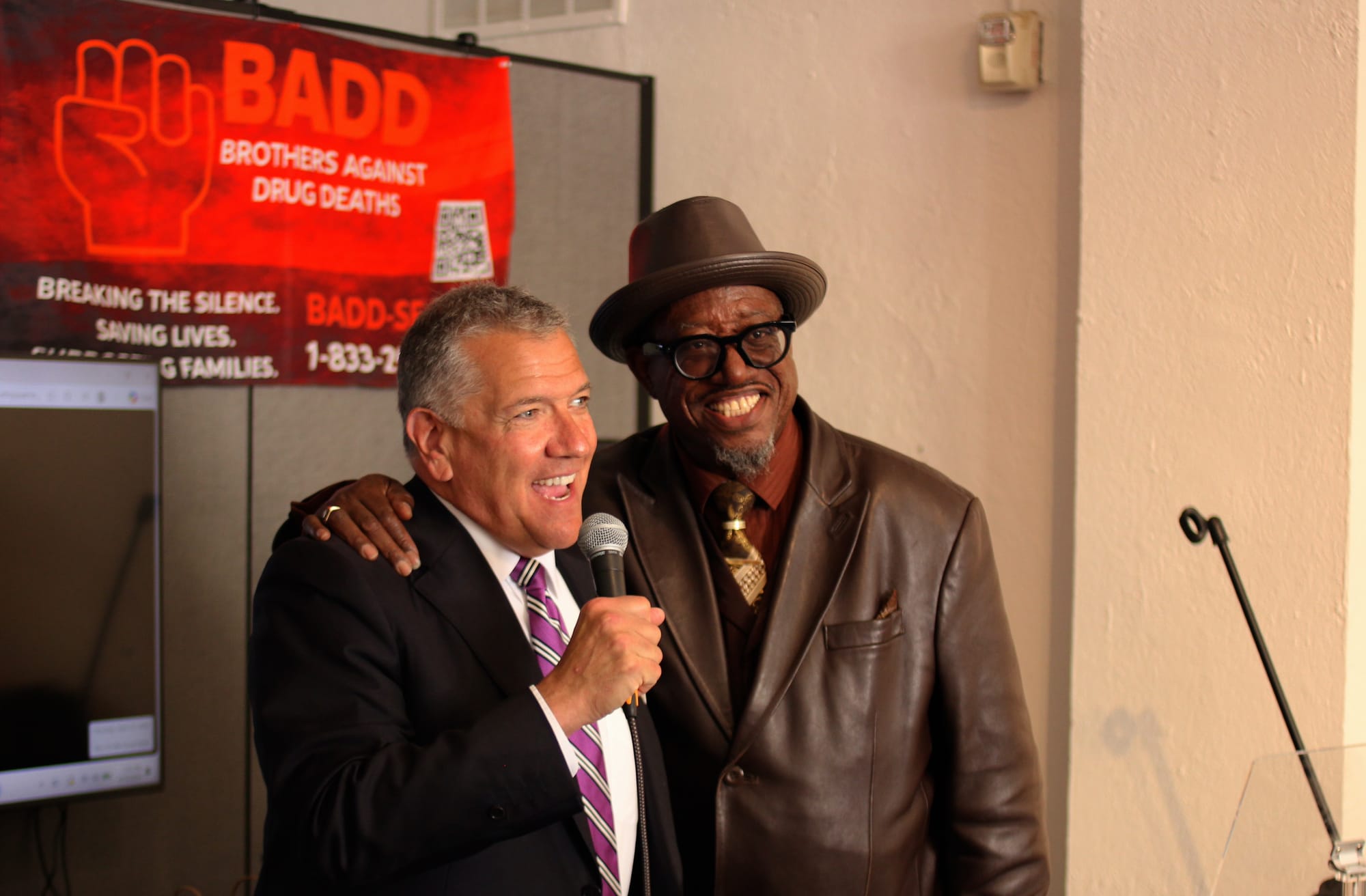
Coats acknowledged that he would not be doing this work were it not for his son’s death.
Theris Lee “TC” Coats II had long struggled with both mental illness and drug addiction. In March of 2025, Coats was on the cusp of finally getting help to his son. But then TC suffered a fatal overdose while in custody in a San Francisco jail. He was 33 years old.
TC’s devastated father sprang into action. Barely a month after his death, Coats and Beal founded Brothers Against Drug Deaths, or BADD, in honor of TC. They offer services to people facing addiction and mental illness. And through many approaches, including policy advocacy, they seek to support families trying to help their loved ones access treatment.
“It’s not enough to just have services offered, we need to help them go through that system to recovery,” said San Francisco Health Director Daniel Tsai.
In Beal, Coats has a co-founder who knows his way around the world of addiction services and treatment in San Francisco, and who is intimately familiar with the grave dangers posed by addiction. Beal himself is in recovery. He has lost two brothers to overdoses, as well as his first wife — who also happened to be Coats’ younger sister. Beal has earned more than half a dozen certifications in the substance-use support field, racked up countless awards and commendations, and is the director of recovery services for Tenderloin Housing Clinic. He has also published a book about his experiences, Recovering From The Game. And because he has been involved in policy work, he knows some major players in the political scene.
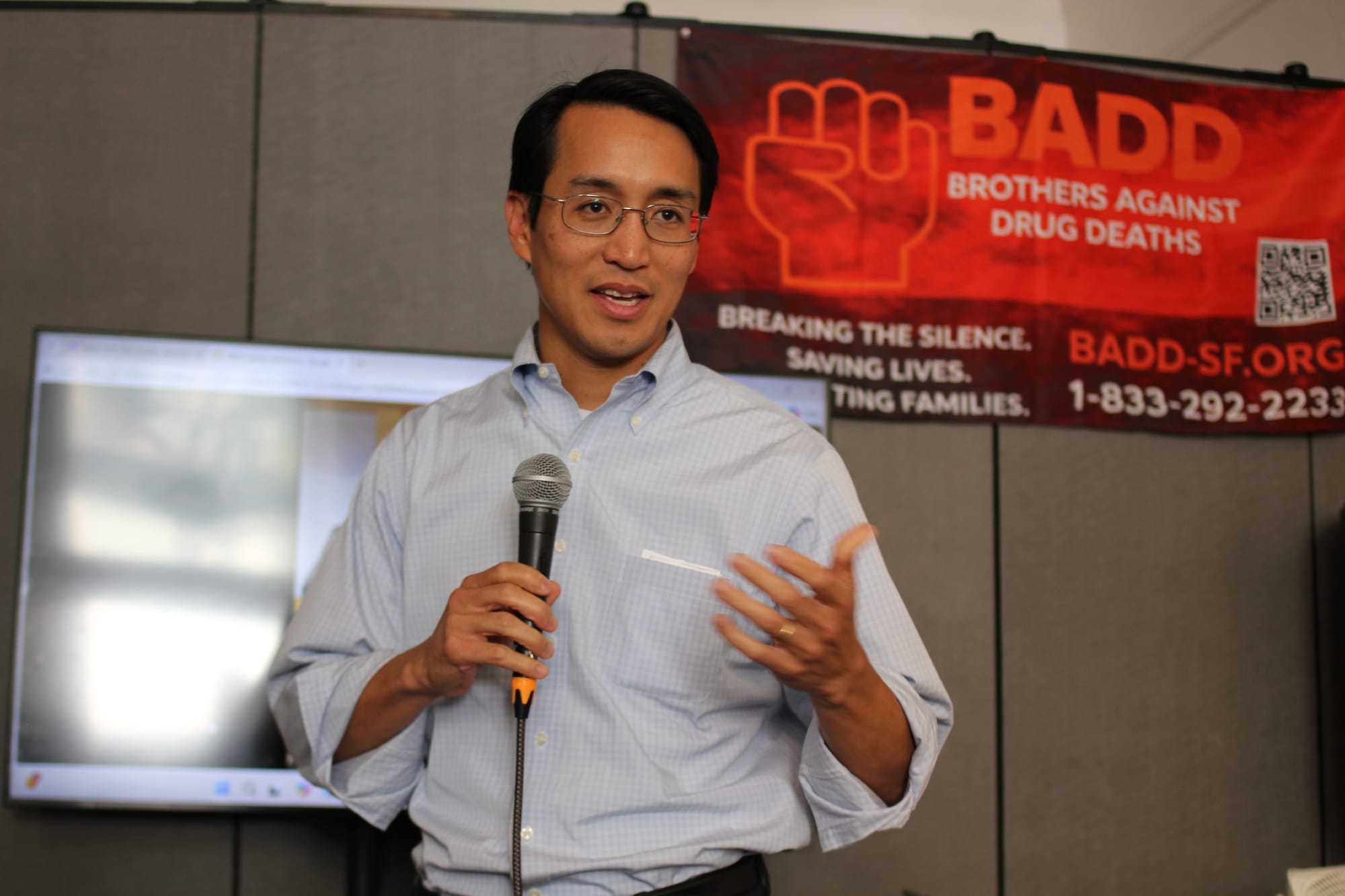
BADD’s focus is on Black and underserved communities. San Francisco’s overdose statistics have long shown deep racial disparities. Tsai said the rate of overdose deaths among Black San Franciscans is 5.5 times higher than that of the general population.
“That disparity hasn’t decreased along with the decrease in deaths,” he noted.
So it’s meaningful that the leaders of this organization are two Black men directly affected by the overdose crisis.
“Seeing this led by individuals rooted in our community is special,” said Theo Ellington, executive director of the Ruth Williams Bayview Opera House and a candidate for District 10 supervisor in the November election. “The harsh reality is that Black people are at the top of the list of [those affected by] every social ill in San Francisco. Simultaneously, the first programs to be cut are those that serve Black people.”
And of course, the Tenderloin is at the heart of the crisis. While neither of the co-founders live in the city, they both have deep roots here. Beal has decades of experience in the community — both providing and receiving services. That informs his policy stances, which favor an approach that prioritizes abstinence.
“I truly believe abstinence is the purest form of harm reduction,” Beal said. “You can’t reduce the harm no more than stopping.”

Since founding the organization, the brothers-in-law have moved at lightning speed. Before their first year was out, they applied for and were granted federal nonprofit status. They led the production of an original theatrical play with a plot inspired by TC’s death and the systems that failed him, and filled the Ruth Williams Bayview Opera House for two performances. They connected with community members and partner organizations at Recovery Day, an annual event celebrating recovery from addiction and offering attendees information and resources. They inked an agreement with the Department of Public Health to provide HIV, Hepatitis C, and other screenings, as well as information sessions.
And they worked with the staff of a state legislator to draft what they have dubbed Theris’ Law, a proposal to enable family members of someone incapacitated by drug use and mental illness to obtain a temporary, crisis-related conservatorship.
The proposed legislation is what Coats Sr. says would have allowed his family to save his son. Now that Theris’ Law is drafted, BADD is seeking a sponsor to shepherd it through the state Legislature.
BADD’s second year is shaping up to be no less ambitious. In addition to pushing for Theris’ Law, the pair also intends to bring the play back for a second round of shows. They have set a goal of distributing 800 recovery kits — small packages with hygiene essentials, fentanyl test strips, and the overdose reversal drug Narcan. They are launching Voices Unmuted, which will serve as a support group, mutual-education circle, and safe place for young men age 18 to 35. Its first sessions will be virtual, and are slated to begin this summer.
And BADD will offer direct help to families searching for loved ones languishing on the streets of San Francisco. Their soon-to-launch app, Lifeline SF, will allow a family member to submit the name and some photos of the person they’re concerned about. Coats, Beal, and their allies will look for the person and encourage them to get in touch with their family. Even without the app, BADD has already reconnected three people from other parts of the country with loved ones who were in active addiction on local streets.But most importantly, they are rolling up their sleeves to fundraise.
“They’ve been doing this work without the money,” Ellington said.
Funding is the biggest need among addiction-service providers right now, according to DeNay Ramsey. He is the president and CEO of Pathway Humanity, which runs both residential and outpatient recovery facilities in the East Bay.
“You could open 100 more facilities and it still wouldn’t be enough,” Ramsey said.
Government cutbacks are worsening an already dire situation, slashing support for not just African American but immigrant populations, Ramsey added.
“Oakland is a larger version of the Tenderloin,” he said. “The resources just aren’t there.”
Small grants and in-kind donations have helped Coats and Beal keep up the momentum.
“We’ve been scraping, scrimping, making ends meet so we can do some real work,” Coats said. Support from allies has buoyed him in his mission to help others avoid tragedy.
“It takes a whole community. Together, we can stop some of this from happening,” he said.

This article first appeared on MindSite News and is republished here under a Creative Commons Attribution-NoDerivatives 4.0 International License.
Northampton residents win 32‑month pause on data centers
by Will Atwater, North Carolina Health News
May 8, 2026
By Will Atwater
Earlier this month, Northampton County joined a growing list of North Carolina communities that are adopting data center moratoriums.
Commissioners approved a 32-month pause, but getting to that unanimous vote wasn’t easy.
Before the monthly meeting on May 4, word began to circulate that the meeting documents showed commissioners planned to vote on a proposed 12‑month ban, rather than first hearing residents’ push for a longer pause during the public comment portion of the meeting. That suspicion was confirmed when County Attorney A. Scott McKellar read the proposal aloud.
Northampton County resident and community activist Belinda Joyner pressed the commissioners on that point during the public comment period.
“Why are you saying you’re having a public hearing when you’ve already made your decision?” Joyner asked. “So what we say doesn’t make any difference.”
By the end of the evening, commissioners had come around to the community’s point of view that a longer pause was necessary.
In Northampton County, the vote capped a volunteer effort that culminated in Joyner delivering a pro-moratorium petition with about 300 local signatures to commissioners at the May 4 meeting. Many county residents say they have repeatedly been kept in the dark about major industrial projects and incentive deals. Now they’re watching to see whether commissioners follow through on promises of transparency — or repeat past mistakes made behind closed doors.
Northampton’s moratorium vote mirrors what’s happening across North Carolina — and across the country. Residents from counties as disparate as Stokes, Chatham, Durham — and now Northampton — are pressing local officials for more say over where data centers go, how much water and power they consume, and what communities get in return.
Transparency issues
Once commissioners opened the floor for public input, Southern Environmental Law Center attorney Kasey Moraveck told officials that a moratorium would give the county time to amend the zoning code to address data centers and to study their impacts and write rules that are “fair, transparent and aligned with community values.”
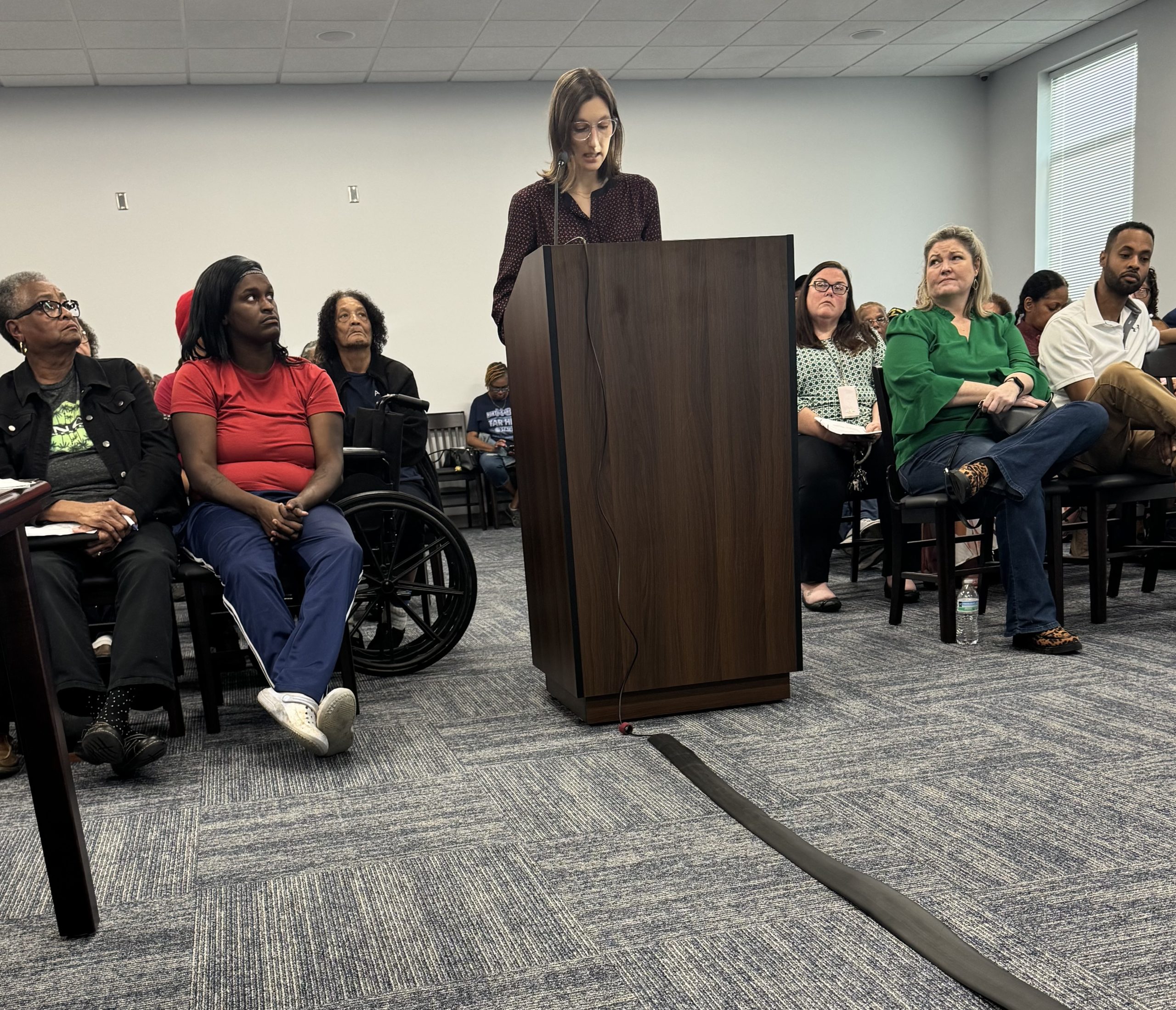
Moraveck pushed commissioners to require special‑use permits and to limit data centers to heavy industrial districts so residents and local officials, not developers, decide whether projects go forward and to ensure continuous noise, heavy resource use and warehouse‑style buildings don’t reshape rural or residential areas.
“This will help to isolate their impacts from Northampton County residents and will prevent the data centers’ massive warehouse buildings from transforming landscapes that are rural, agricultural or residential in nature,” she said.
Another speaker, retired judge Alfred Kwasikpui, said the idea of a community advisory board was welcome, but noted it had already been approved once and never created.
“This is why people have problems with transparency,” Kwasikpui said. “The Planning Board on March 11 approved a motion for a committee to be created to assist in the development of a data center ordinance.”
He added that by the April 18 meeting, the committee still didn’t exist, yet the planning director and a board member had already drafted ordinances “favorable toward the data center developers” and “not strong on protections for our county.” Kwasikpui said those drafts would allow clusters of data centers that could overwhelm local electrical substations and aquifers and envisioned a community benefits committee made up only of county officials, without citizen seats or independent experts. That approach, he said, would turn what should be firm, upfront standards into last‑minute deals to smooth over public anger.
Commissioner Melvetta Broadnax Taylor responded the moratorium “reads well” but questioned who would make sure the county actually carries it out this time.
She reminded colleagues that during an earlier moratorium on solar development, “we didn’t do due diligence,” and asked, “Who’s going to be in charge of making sure that this is implemented? I don’t want any gray areas.”
Keedra Whitaker, another commissioner, acknowledged missteps by public officials in the past that have contributed to residents’ distrust. She said she would not vote for a 12‑month moratorium and argued that commissioners should give people the longer pause they had asked for.
“I don't see the point in agreeing to a year [moratorium] that we’ll have to go back and extend,” Whitaker said. “I just believe in sticking to your word and listening to our citizens.
“We've had committees where our stakeholders weren't at the table. We dropped the ball, and we can't continue to do that,” she added.
Looking ahead
After the meeting ended, Whitaker explained why she pushed for a longer moratorium instead of the initially proposed 12‑month pause. “I'm very in tune with the citizens that we serve, and so as I hear their concerns, I do my research,” she said.
“The reason I felt that [the moratorium] needed to be extended is because we have to show our commitment, our trust, our transparency to the community that we serve in showing them that we are not wanting to bring any harmful industry to an area that is already distressed.”
Northampton County residents leaving the meeting applauded the commissioners’ vote and their pledge to establish an advisory committee that will include residents along with public officials during the moratorium. They expressed hope that the group will learn more about data centers and help draft guidelines that will benefit the community if and when an agreement to host a facility is reached.
“There's this question about, will these data centers be viable down the road?” Kwasikpui said after the 32‑month moratorium was approved. “What's going to be the impact on the community?”
He said he was pleased with the extended pause, “but we’ve gotta work during that time.”
Part of that work will involve rebuilding trust between the community and public officials, residents said. They’ve voiced disappointment over past decisions involving the county’s economic development office and the kinds of industry Northampton has attracted, including a solar farm project.
Several said nondisclosure agreements left them feeling shut out of negotiations between industry and the county.
It’s a tall order for rural counties to attract environmentally friendly employers that offer more than a handful of decent‑paying jobs that don’t require advanced degrees.
Northampton County Economic Development Director Derrick Bennett, who has held the post since 2023, said by email that some negotiations with potential industry partners must remain confidential under state law.
He noted nondisclosure agreements are meant to protect companies’ proprietary information and incentive offers so they can compete, not to hide deals from the public. From the county’s perspective, he added, sharing too many details too early could scare off potential investments and jobs, which is why state law allows some economic development talks to happen behind closed doors.
“While a non-disclosure agreement may be misconstrued as a lack of transparency, its main purpose from the county’s perspective is to safeguard competitive offerings to attract capital investment and job creation,” Bennett wrote. He noted that economic development contracts and agreements must ultimately be discussed and approved in open session, and that citizens can offer comments during public hearings before the board votes.
This article first appeared on North Carolina Health News and is republished here under a Creative Commons Attribution-NoDerivatives 4.0 International License.

In hard hats and picket lines, Dems woo union workers in US Senate primary
by Lauren Gibbons, Bridge Michigan
May 8, 2026
- Less than three months out, many influential unions haven’t endorsed in Michigan’s heavily contested US Senate Democratic primary
- Haley Stevens, Mallory McMorrow and Abdul El-Sayed have all voiced support for the labor movement, courted endorsements
- Union influence has waned some in recent years, and members have bucked party leadership in some races
Michigan’s labor movement has long played an outsize role in shaping Democratic politics, with backing from key union groups among candidates’ most coveted endorsements.
But with less than three months left before Michigan’s marquee 2026 Democratic primary — the three-way US Senate battle pundits say could shape the future of the party — union workers may be just as divided as everyone else.
Many of the state’s most influential unions haven’t yet backed a candidate in the Democratic race, where US Rep. Haley Stevens, state Sen. Mallory McMorrow and former public health official Abdul El-Sayed are locked in a tight race.
Politicians must “earn” the right “to have our endorsements now,” United Auto Workers Region 1 Director LaShawn English said earlier this year during a forum in which all three Democrats took member questions on issues like worker benefits and wages, artificial intelligence regulation and preserving union manufacturing jobs.
“If we don’t fight, we will continue to see workers get trampled on, we will continue to see rights be disregarded, violated, attacked,” English said.
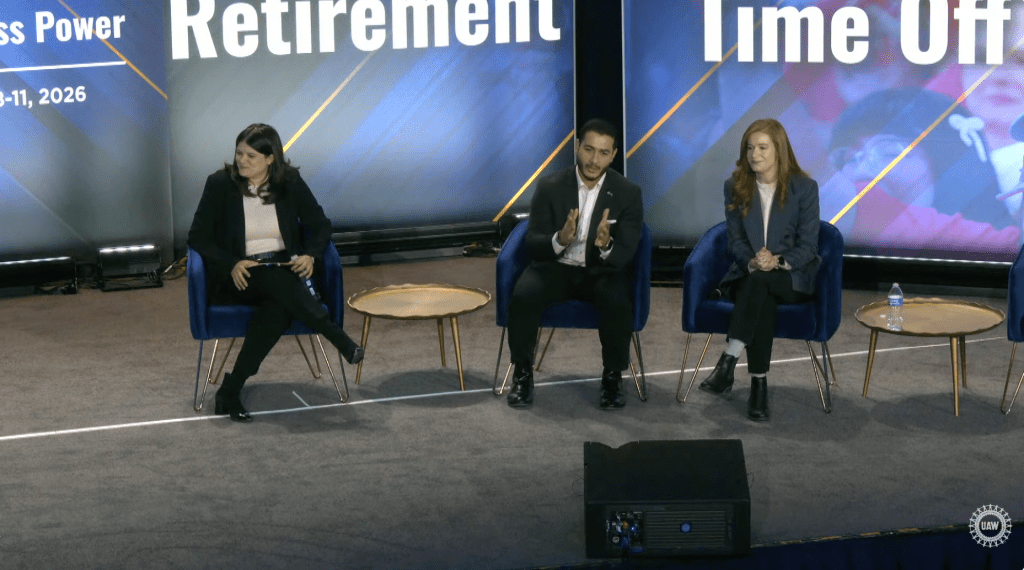
While the powerful union hasn’t formally weighed in on the race yet, UAW officials said in February that electing a candidate prepared to go to bat for workers’ rights is of utmost importance in 2026 as well-paying union jobs and labor protections come under threat.
In at least one instance, different branches of the same union have already reached different conclusions on who the best person for the job would be.
The International Association of Sheet Metal, Air, Rail, and Transportation (SMART) Workers Transportation Division endorsed McMorrow because “she has consistently stood with railroad workers and supported our priorities.” Meanwhile, SMART’s Local 292 chapter in metro Detroit picked Stevens, citing her support in Congress for union jobs, workforce training and fair wages and benefits.
Related:
- Medicare for All divides Democrats in Michigan’s US Senate race
- For Michigan Dems, a millennial showdown in Senate primary
- 6 major issues in Michigan’s US Senate race
“I think it would be a mistake to view the labor movement as monolithic,” said pollster Richard Czuba, whose recent poll for the Detroit Regional Chamber found nearly 40% of union-affiliated likely Democratic voters remain undecided.
Whoever wins the Democratic nomination is expected to face Republican Mike Rogers, who narrowly lost a 2024 US Senate bid and is facing little competition in the GOP primary. He was invited but did not participate in the UAW forum, which union members repeatedly noted at the event.
Union endorsements don’t guarantee victory or unequivocal support from rank-and-file members.
Republican President Donald Trump has directly appealed to the working class when unions endorsed his Democratic opponents. More recently, Michigan attorney general candidate Karen McDonald lost the Democratic nomination to Eli Savit at last month’s party convention despite picking up endorsements from nearly every major statewide union.
Michigan’s Democratic US Senate candidates are courting union voters and touting their support for the labor movement. But in a divisive statewide primary expected to come down to the wire, it’s unlikely any candidate can count on support from a fully united union voting bloc, observers told Bridge Michigan.
‘Meeting the moment’
While all three Democrats have picked up some labor endorsements, Stevens has leaned most heavily into the union vote, eschewing the large rallies and public Q&A sessions preferred by her opponents in favor of private meet-and-greets and tours of union shops.
Her campaign estimates she’s visited roughly 200 manufacturing businesses across the state. She has endorsements from 11 Michigan unions so far, including Teamsters Local 243, whose president Scott Quenneville said in a statement that Stevens doesn’t just talk when it comes to Michigan workers — “she shows up and gets results.”
During one April stop at the CRH Asphalt plant in Wixom, Stevens donned a hard hat and construction vest to sift through aggregates in the facility’s lab, climb into heavy machinery and speak to employees about how their work helps build Michigan roads and infrastructure.
“It begins with the rocks!” she joked with one employee as he demonstrated how the company’s material is tested.
The plant is staffed by workers from Operating Engineers Local 324, which later endorsed Stevens. William Miller, the union’s political director, said she has a “proven track record” of protecting Michigan’s manufacturing industry and supporting “policies that grow Michigan’s economy.”
The fourth-term Birmingham Democrat, who has deep connections in the automotive industry and served in the Obama administration as chief of staff to the US Auto Rescue Task Force, said her campaign’s heavy focus on meeting workers where they’re at is by design.
“I want to make sure that they know that I'm listening to them,” she said, later adding, “I'm going to keep showing up on job sites, keep meeting the moment for hardworking people who need to make sure and need to know that someone like me has their back in the halls of Congress.”
On the campaign trail, Stevens has criticized her opponents’ manufacturing stances, arguing that El-Sayed’s past tweets in support of the Green New Deal insinuated that Michigan manufacturing is a “dying industry” and that McMorrow’s push for a more diversified economy is “out of touch with what our state is all about.”
Czuba, the pollster, said Stevens does “extremely well” with skilled trades and manufacturing groups, but he noted wide differences remain between different elements of the trade movement. Teacher unions like the Michigan Education Association could become an important player in the race if they choose to endorse, he said.
His latest poll found 26% of union-affiliated respondents support Stevens, with El-Sayed close behind at 23.7% and McMorrow at 10.7%. Still, everything could change once candidates begin airing television ads in earnest, Czuba said, calling the current state of the race “campaign purgatory.”
The progressive pitch
El-Sayed, a former public health official widely considered the most progressive candidate in the race, has frequently highlighted his history as a union member on the campaign trail and believes his message of removing corporate influence on politics appeals to the labor movement.
“They want somebody who's unabashed about the role that management has played in crushing all of their movements,” El-Sayed said of union workers. “I’ve already told folks I’m on the side of working people.”

On the campaign trail, he’s argued every worker deserves the right to join a union and earn a fair wage. His policy platforms include investing in research and technology to build more economic opportunity in Michigan, as well as further regulation of artificial intelligence to protect workers from losing work to automated systems.
During a recent rally with US Sen. Bernie Sanders in Detroit, the campaign invited several local union leaders to speak, including Detroit Federation of Teachers President Lakia Wilson-Lumpkins, Teamsters Local 332 President Dan Glass and National Nurses United President Jamie Brown.
In her address to the crowd, Wilson-Lumpkins said teachers work around the clock planning, sacrificing, supporting their students and fighting against cuts to public education.
“There is a coordinated attack, not only on public education, but on the middle class and the essential services that we provide,” she said, adding that candidates like El-Sayed “understand the struggle of workers against the billionaire class.”
Carolyn Clemons, a nurse and Teamsters Local 332 member involved in a months-long strike at Henry Ford Genesys Hospital in Grand Blanc Township, told Bridge she’s supporting El-Sayed because “he’s been on the line with us” and she believes his commitment to protecting politics from corporate influence will ultimately save lives.
“America is falling slowly but surely by the wayside,” she said. “My kids, my grandkids … are going to have to try to rebuild slowly after this. Abdul is going to be the first person that we need to get in there that is able to help us get started in the right direction.”
El-Sayed’s messaging went over well at the recent Democratic state convention, where he received a standing ovation from a crowd that swelled with progressive activists.
Labor commentator Jake Altman, who recently opined on the convention’s shift left, said cultural fissures between different types of workers in the labor movement are on full display this election cycle. Whether unity under the Democratic Party umbrella is possible remains to be seen, he said.
“It's a fractious house right now,” he said, adding the progressive agenda pushed by some union groups “may or may not gel well with what more traditional unions and their members are advocating.”
On the picket line
Outside of Corewell Health’s Troy hospital campus Thursday, McMorrow joined members of Teamsters Local 2024, who were picketing ahead of a potential strike as nurses advocate for increased wages, safer working conditions and more affordable health insurance.
McMorrow said the labor movement is personal to her: her grandfather was a Teamster, and she said the wages and benefits he received allowed him to retire in his 50s and changed her family’s trajectory. That type of job is far harder to come by these days, she said.
“This is a moment where income inequality is greater than it's ever been, and in my mind, this is the opportunity for a labor revolution,” she said. “We should see unionization in tech jobs, in white-collar jobs. It is time for it, because people are getting crushed.”
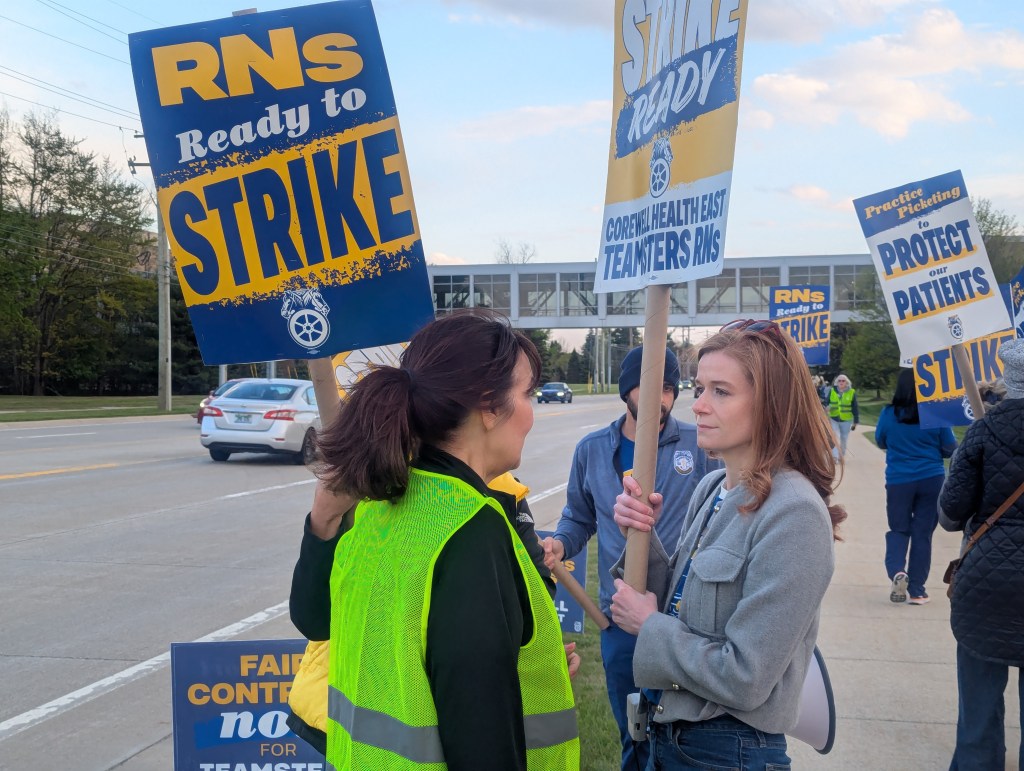
In the state Senate, McMorrow successfully co-sponsored legislation to repeal the Republican-backed “Right to Work” law that prohibited compulsory union dues or fees, as well as a restoration of prevailing wage rules requiring contractors to pay union-level wages on state projects.
The Right to Work law was passed in 2012 when Republicans controlled the Michigan Legislature and the governor’s office. Unions blamed the law for an overall drop in union membership and complained that colleagues who didn’t pay dues were still able to benefit from union bargaining.
Lori Blakely, a former teacher who is now a recovery nurse in the Corewell Health system, said she was impressed by McMorrow’s work to repeal the law and appreciates that she’s been active across the labor movement spectrum in Michigan.
“I see her as the most well-rounded, the most effective in getting things done,” she said.
In addition to her pro-labor positions, UA Local 370 Business Manager Dan Gaudet, whose Flint-area union unanimously endorsed McMorrow, said they appreciated McMorrow’s approachability and willingness to sit down with them to take questions.
“She's just a normal person…somebody you’d want to hang out with,” he said.
If elected, McMorrow said she’d continue to support pro-worker legislation in Washington, but also vowed to keep showing up on the front lines of the labor movement.
“That's the power that you have in these offices, is to use your platform to get the public behind you, because public perception is what moves policy, ultimately,” she said.
High stakes for workers
As the Democratic candidates hash out their differences in an increasingly contentious primary, some labor leaders are already focusing their attention on what’s next.
Whoever wins the Democratic nomination will face the GOP nominee in the November general election for the open Senate seat. That will most likely be Rogers, a former member of Congress who only narrowly lost his 2024 US Senate bid to Democrat Elissa Slotkin.
Rogers, too, has been making appeals to workers, launching a “Let’s Get to Work!” series highlighting various industries around the state.

Rogers has argued that Democratic representation has contributed to higher costs of living and inflation. If elected, he’s vowed to protect tax cuts passed in Trump’s One Big Beautiful Bill Act.
“That’s why we’re on the road, listening to and learning about the challenges facing Michigan families and workers all across the state,” Rogers said in announcing the job site visit initiative. “Michigan deserves real leaders who will keep more money in families’ pockets.”
The Michigan AFL-CIO, a federation representing more than a million union members across the state, hasn't endorsed in the Democratic US Senate primary, instead deferring to its affiliates, a spokesperson told Bridge.
But Michigan AFL-CIO President Ron Bieber was quick to criticize Rogers’ track record on the union’s legislative priorities while serving in Congress, arguing that workers need a senator willing to take action to address rising costs of living.
“In every race, from United States Senate to dogcatcher, we put our weight behind candidates that will put workers first,” Bieber said.
This article first appeared on Bridge Michigan and is republished here under a Creative Commons Attribution-NoDerivatives 4.0 International License.

This article was originally published by Votebeat, a nonprofit news organization covering local election administration and voting access.
The Supreme Court’s voting rights decision could reshape local government across Texas
Natalia Contreras, Votebeat
May 5, 2026 at 6:00am EDT
Votebeat is a nonprofit news organization reporting on voting access and election administration across the U.S. Sign up for Votebeat Texas’ free newsletter here.
Guillermo Ramos remembers seeing few elected leaders who looked like him while he was growing up in the 1980s in Farmers Branch, a fast-growing affluent suburb northwest of Dallas.
Over the years, Latino representation continued to lag, he said. In 2015, after he had become a lawyer, he decided to do something about it.
Ramos stepped forward as the plaintiff in a lawsuit against the Carrollton-Farmers Branch Independent School District, alleging that its at-large system of electing board members violated Section 2 of the Voting Rights Act by denying Latino voters the right to elect representatives of their choice. At the time, Latino voters made up 56% of the district, but every Latino school board candidate had lost since at least 1995, the lawsuit said.
The case settled, and as part of the agreement, Ramos was appointed as the board’s first Latino trustee. The settlement also replaced the at-large system — in which every seat was filled by districtwide vote — with what’s known as cumulative voting. The new system lets voters cast as many votes as there are seats on the board, but allows them to stack their votes on a single candidate or spread them across multiple candidates.
Ramos, now 51, won the next election to keep his spot on the board, which he said created a ripple effect that drew in more Latino candidates.
“They felt at this point that if they throw their hat in the ring, that they’re going to have actually a shot at getting elected. And that’s what happened,” Ramos said.
Changes like those in the Carrollton-Farmers Branch School District played out over decades on local governing bodies all over Texas, enabling representation of Latino and Black voters. Those changes were a direct result of claims brought under Section 2 of the Voting Rights Act, which prohibits voting practices or electoral maps that discriminate on the basis of race, color, or language minority status.
But a landmark U.S. Supreme Court decision last week weakened that key provision, and Ramos and others say it could make it harder and more uncertain for other candidates of color to follow the path he took to local office.
The effects of the decision, which struck down Louisiana’s congressional map, are reverberating around the country and setting off a new cycle of redistricting for partisan advantage. Experts say there is still a lot of uncertainty about how the decision will play out, especially at the local level and when it comes to nonpartisan local governmental bodies such as Texas school boards and city councils.
“The judges in the opinion are discussing congressional elections, not school board elections, even though that’s where Section Two has been applied probably more frequently,” said Christian Grose, director of the Democracy and Fair Elections Lab at the University of Southern California.
But whether it’s after the 2030 Census or sooner, he added, “I do think there are going to be challenges, even in nonpartisan elections, saying that Section 2 doesn’t need to be enforced anymore.”
Prior to the decision, plaintiffs could prove a claim under Section 2 by showing evidence of a disparate impact on minority voters, regardless of whether the mapmakers intended it. Now, they must be able to show a “strong inference that intentional discrimination occurred,” the high court’s conservative majority declared.
With the court having previously authorized maps to be drawn for partisan aims, dissenting Justice Elena Kagan wrote that the new standard under Louisiana v. Callais gives plaintiffs virtually no recourse under Section 2, as long as a mapmaker declares a partisan motive and leaves “no smoking-gun evidence of a race-based motive.”
Going back in time
The decision could quickly become a factor in ongoing litigation.
Though most local elections in Texas are nonpartisan, county commissioners courts are an exception, and last week’s opinion will likely give a boost to counties that are already citing partisan motives in defending their maps. Last year, for example, the Republican-majority commissioners court in Tarrant County redrew its district lines, prompting a challenge from a group of voters who alleged the new map illegally diluted the power of Black and Latino voters by packing them into a single precinct. But Republican commissioners argued they’d drawn the lines for partisan gain, and earlier this year, the Fifth U.S. Circuit Court of Appeals upheld the maps.
But Bill Brewer, the Dallas lawyer whose firm handled Ramos’ case in Farmers Branch, said he believes the ruling could actually help advocates win some challenges involving nonpartisan races.
Brewer, whose firm has filed at least 18 lawsuits against school districts and city councils in Texas under the Voting Rights Act, is representing a parent who sued the Keller Independent School District under Section 2, claiming the school district’s at-large system dilutes the votes of Latinos. The lawsuit was dismissed earlier this year and Brewer filed an appeal hours after the ruling to renew his push for a switch to cumulative voting. Brewer said the Callais ruling’s emphasis on intentional discrimination strengthens his claim for access to emails, meeting recordings and other evidence that could show intent.
“If they’re refusing to change because they intend to dilute opportunities for Hispanics or Blacks or Asians at the voting box, well, then you still have a claim under Section 2,” he said.
Keller ISD did not respond to a request for comment.
Ramos’ suit against the school board wasn’t the only Section 2 case brought in Farmers Branch. Its city council, too, was forced to switch from at-large to single-member districts in 2012, and the first Latino council member was elected in 2013. Council Member Elizabeth Villafranca, who was first elected last year, eventually became one of many Latino candidates to win a seat. The impact of the Voting Rights Act in the city has been “immeasurable,” she said.
But after the decision from last week, “I’m just horrified at the thought of having to go back in time,” Villafranca said. Still, she believes the community has come too far to revert to its old system. “You can see the incredible pride that there is when our residents see someone that looks like them, that speaks like them, that can represent them, and ultimately, that benefits everyone.”
Natalia Contreras covers election administration and voting access for Votebeat in partnership with the Texas Tribune. Natalia is based in Corpus Christi. Contact her at ncontreras@votebeat.org.
Votebeat is a nonprofit news organization covering local election integrity and voting access. Sign up for their newsletters here.
xAI now has 46 gas turbines without air permits. State officials are ‘evaluating the situation’
by Alex Rozier, Mississippi Today
May 11, 2026
Elon Musk's data center company, xAI, has more than doubled the number of unchecked natural gas generators at its Southaven facility since coming to Mississippi last summer.
The company uses the turbines to power its two data centers just across the state line in Memphis, and is also planning to build another large center in Southaven. XAI now has 46 "temporary-mobile" turbines at its Mississippi facility, according to the Mississippi Department of Environmental Quality, up from 18 turbines when it first arrived last year.
The NAACP, which filed a lawsuit against xAI last month over the turbines' lack of permits, last week requested an injunction after learning xAI had increased the number of temporary-mobile turbines to 33. MDEQ later confirmed to Mississippi Today that the actual number was 46.
Because the state considers them "mobile" turbines — they're attached to flatbed trailers — MDEQ allows xAI to run the generators without an air permit for up to a year. But Southaven residents and advocates have pushed back, expressing concerns over unchecked air emissions and constant noise from the generators. Without permits, the state has no way to measure the toxic releases coming from the facility.
Lawyers from the Southern Environmental Law Center, representing the NAACP in its lawsuit, argue Mississippi is misinterpreting the federal Clean Air Act by allowing xAI to bypass the permit process. Language from the law appears to support their argument that the turbines should be considered "stationary," and thus subject to permit requirements. It defines a stationary turbine as "not self-propelled or intended to be propelled while performing its function. It may, however, be mounted on a vehicle for portability."

MDEQ said xAI added 19 temporary-mobile turbines between March 25 and May 2. MDEQ told Mississippi Today on May 6 that xAI notified the agency of the additions "this week," but also said xAI is not required to tell the agency when it brings on more such generators.
When asked if there is any concern about the combined emissions from the growing cluster of turbines, MDEQ said it is monitoring the development.
"As indicated by the facility, all portable/temporary turbines are equipped with control technology to minimize emissions," agency spokesperson Jan Schaefer said via e-mail. "MDEQ is evaluating the situation and will make the facility aware as to when it can no longer bring additional portable/temporary turbines on-site."
In a press release last week, the Southern Environment Law Center said the turbines have the potential to "emit a staggering amount of toxic air pollution."
"Toxic emissions from the facility threaten to do long-lasting harm to nearby communities," the release said. "Pollution from gas turbines includes smog-forming nitrogen oxides, fine particulate matter and hazardous chemicals like formaldehyde. These pollutants are tied to increases in asthma, respiratory diseases, heart problems and certain cancers."
In addition to the temporary-mobile turbines, the state permit board in March approved air permits for 41 permanent gas generators at xAI's Southaven operation. The SELC appealed the decision last month, requesting a hearing on the matter.
This article first appeared on Mississippi Today and is republished here under a Creative Commons Attribution-NoDerivatives 4.0 International License.

Rent Freeze No Sure Thing in First Vote By Mamdani-Majority Board
The new mayor appointed six of the Rent Guidelines Board’s nine members.
by Lilly Sabella and Samantha Maldonado May 7, 2026, 8:37 p.m.

In its first vote under a new mayor, the Rent Guidelines Board left the door open for a rent increase despite Mayor Zohran Mamdani’s promise of a price freeze for a million rent-stabilized tenants in New York.
The board approved a range of possible rent levels in its preliminary vote: 0 to 2% for one-year leases and between 0 to 4% for two-year leases.
The nine-member Rent Guidelines Board — six of which had been appointed by the new mayor earlier this year — settled on those figures during a rowdy hearing at LaGuardia Community College in Long Island City on Thursday evening.
The vote was nonbinding. The board must by law take a final vote by the end of June.
Tenant groups and labor organizations that filled the auditorium loudly booed and demanded that the members roll back the preliminary vote that passed after all motions for a rent freeze failed.
They rallied before the vote took place outside the college, holding “Freeze the Rent” signs and demanding a halt on price increases for stabilized tenants.
Mamdani made a promised rent freeze a signature part of his campaign. The members of the board are charged to act independently from City Hall, but the rent freeze commitment looms over their vote.

Tenant-aligned board members attempted to pass a range that would have either rolled back rent or frozen it, with a proposed rent level of -3 to 0% on one-year leases and -4.5 to 0% on two-year leases. That measure failed. Afterwards, members aligned with landlords floated higher ranges: a 3 to 5.5% increase on one-year leases and 6 to 8% on two-year leases. That idea also failed to pass.
“I was very disappointed to hear the possibility that rent will still go up, particularly since we were promised a freeze,” said Douglas Ostling, 78, of Flushing, after the hearing. “I've lived in the city all my life. I love it, but I'm being priced out of it, and if something doesn't change quickly, I'm going to have to move.”
In the coming weeks, the RGB will host five sessions to hear testimony from the public on the proposed rent increases before taking a final vote on June 25.
In a statement delivered after tonight's preliminary vote, the mayor encouraged New Yorkers’ to participate in the upcoming sessions.
“New Yorkers are being crushed by the cost of living, and they need real relief,” the mayor said. “As the RGB begins its public hearings, tenants, owners and New Yorkers from every borough should make their voices heard and speak directly to what this housing crisis looks like in their lives.”
“I’m confident the board will weigh those perspectives carefully and arrive at a decision later this summer that reflects the urgency of this moment,” he continued.
In considering how much to jack up rent, the law requires the board members to take into account data on tenant and landlord finances.
According to reports prepared by board staff, landlord income was up 6% in 2024, the latest year for which it was studied, but varied widely based on the location and age of the building stock. At the same time, landlords’ costs outpaced inflation between 2025 and 2026.
On the tenants’ side, RGB research showed the median renter income grew by just 1.8% adjusted for inflation. Renters in all boroughs except The Bronx saw their incomes increase. More than half of renter households paid more than a third of their income in rent — placing them into a category known by housing experts as “rent-burdened.”
Historically, landlords have said that hikes approved by the RGB are not high enough to cover the expenses of maintaining their buildings, while tenants said they’re financially squeezed and can’t afford to pay more.
That played out last year, when the board voted on rent increases of 3% for one-year leases and 4.5% for two-year leases, after previously weighing hikes between 1.75% and 4.75% for one-year leases and 3.75% and 7.75% for two-year leases.
“We’ve been here every year, but this year feels different,” said Kit Klee, an organizer with the tenant group CAAAV: Organizing Asian Communities who lives in a rent-stabilized apartment in Astoria and appeared hopeful for a rent freeze before the vote took place.
Pittsburgh residents call for action on rising costs
by Sophia Lucente, Pittsburgh's Public Source
May 6, 2026
Pamela Henderson wiped tears from her eyes as she recalled moving her three sons into a friend's house after losing her job about 10 years ago. A year later, she opted to move into her mom’s home, a decision she thought would be temporary while she saved for a home of their own.
Today, she still lives in her mom’s Whitehall home, and she struggles to keep up with bills as she runs her own cleaning business.
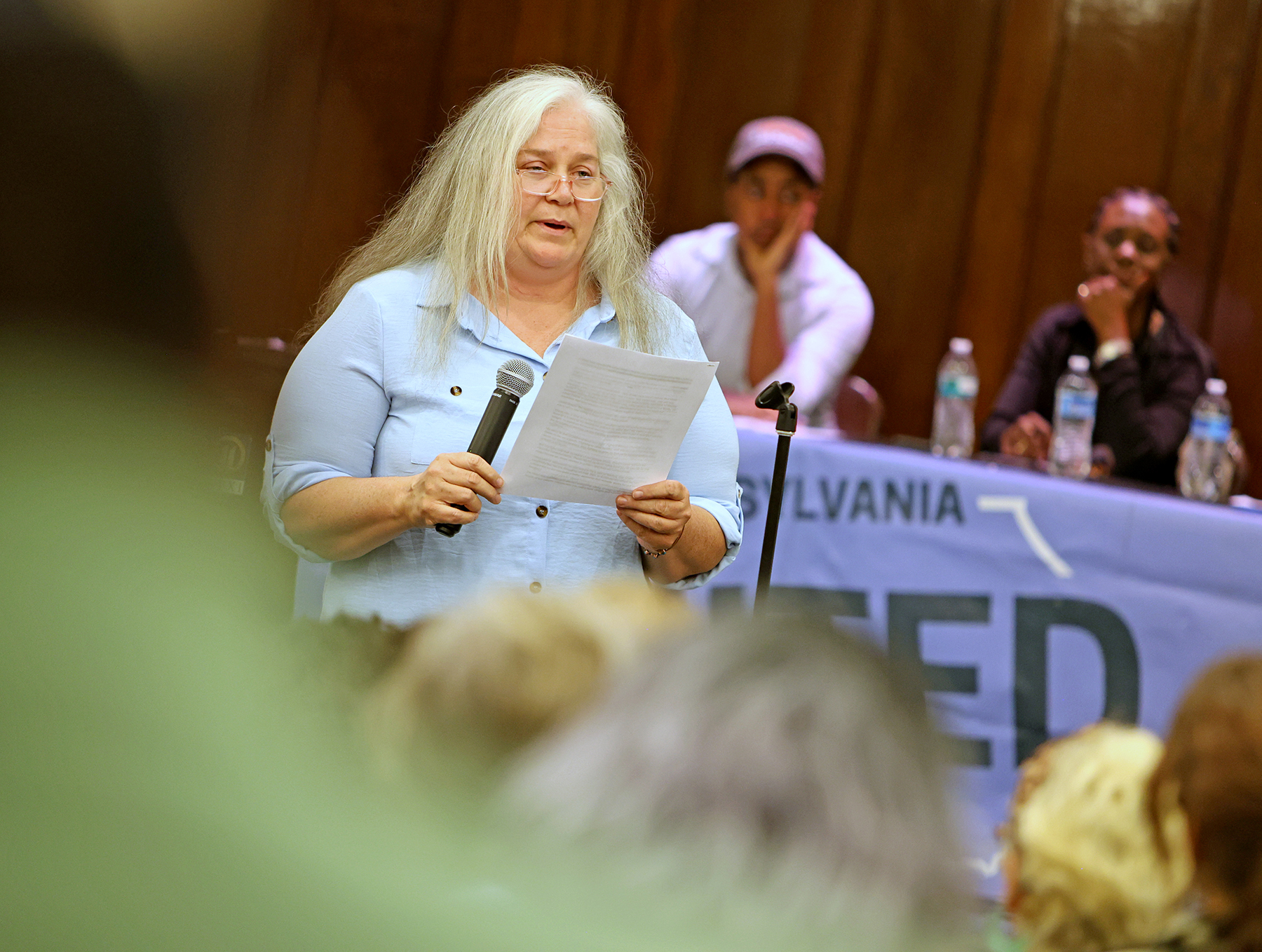
“There are four working adults living in this house, and none of us can afford to live without each other,” she said to a crowd of around 100 last week. “So, it just kind of feels hopeless as a single parent right now, I feel like I can't grow or chase after my dreams anymore."
Last Thursday, community members gathered to discuss the affordability crisis at a town hall event hosted by Pennsylvania United at the Carnegie Library of Pittsburgh’s Homewood branch. Several residents told their stories in front of the elected officials present, including state Rep. Abigail Salisbury, D-Swissvale, and Pittsburgh councilors Deb Gross and Barb Warwick.

Town hall participants — as well as social media commenters and respondents to a recent Pittsburgh’s Public Source request for reader input on prices — called for improved affordability in housing, groceries and utilities.
Inflation has been higher than normal since the COVID-19 pandemic. Tariffs and the U.S. attack on Iran, alongside changes to Medicaid and SNAP food benefits, have also raised the cost of living for many. The One Big Beautiful Bill Act of 2025 restricted eligibility for Medicaid and SNAP coverage, and provisions will also cut billions of dollars in funding for both programs over the next decade, resulting in millions losing health insurance coverage, according to the Congressional Budget Office.
Some residents said they are losing hope as they are forced to accept shared living arrangements, multiple full-time jobs and inadequate housing. Three proposed state House bills aim to help.
Joshua Malloy, one of the town hall organizers and director of Pennsylvania United's Pittsburgh chapter, said conversations with community members indicated a crisis. He heard from people whose insurance skyrocketed amid Affordable Care Act rollbacks and others frying flour and water for sustenance after losing SNAP benefits.
“I've knocked doors all over Pittsburgh and across the full spectrum of people, across all identities, and the commonality from everyone is that things are just too expensive,” Malloy said. ”People are frustrated, people are tired and people are angry.”

Wages down, beef and egg prices up
Over the past five years, the average electric bill for an Allegheny County resident has increased by 42%. Even with this increase, Allegheny County has some of the lowest electric bill rates in the state. Throughout the year, water bills will increase by 15% for the typical Pittsburgh Water customer.
Pittsburgh’s Public Source recently asked residents for their opinions. Community members wrote about their experiences with high electric bills, gas bills, and costs for transportation and groceries. Audrey Glickman of Greenfield wrote to Public Source that if wages increased at the same pace as housing, rent, tuition and cars, the rising costs would be “more palatable.” Real household income, though, has declined in the state since peaking in 2019.


Jean Givner, a Wilkins resident, was finally able to buy a house for her family during the COVID-19 pandemic, she said during Thursday’s town hall. Today, she works two full-time jobs to help support her kids and four grandchildren, and her family still struggles to make ends meet.
“We have absolutely zero margin for error on the financial side,” she said. “Any surprise cost, any emergency expense, big or small, and the bottom will fall out on my household.”
According to the U.S. Bureau of Labor Statistics, grocery prices have fluctuated over the past five years. The prices of tomatoes and bread have stayed relatively stable at around $2 per pound, while ground beef has substantially increased from $4.50 per pound in March 2021, to $6.68 currently.
“Every time I go to the grocery store I have to decide between buying healthy foods versus low-cost, lower-quality foods for my family,” Givner said. “I have to purchase clothing for my grandkids to share and hope the materials last long enough to be passed down to each other.”
Legislation seeks to level tax playing field
Henderson is hoping to eventually find housing in the city to give her kids their own space but feels like it isn’t possible on top of her bills. “I'll make enough money to get by, to pay for the car to get to the job, to where there's no money left at the end of the month,” she said. “I'm borrowing money to take my kids to the movie theater, so that they can have some kind of a normal life.”


As she called for solutions, such as taxing the wealthy, the crowd cheered, some attendees becoming emotional with Henderson.
At the end of the town hall, Malloy discussed three proposed state bills with the attendees:
- House Bill 1610 would, its sponsors argue, close loopholes for large Pennsylvania corporations which avoid paying taxes by operating companies out of state while profiting in Pennsylvania.
- H.B. 1678 would levy new taxes on big tech companies, like Google, Amazon and Meta, for profits made on digital advertising.
- H.B. 141 would increase taxes on earnings from passive income, such as revenue from stocks, real estate and trusts, to potentially fill gaps in funding for programs like Medicaid and SNAP.
The bills are supported collectively by the advocacy coalition Tax Billionaires, Fund PA which seeks to increase taxes on large corporations to redistribute money through state programs to help people of middle and lower incomes. Rep. Salisbury signed onto all three bills after Thursday’s town hall.
Apartments: Applications alone unaffordable
Teaira Collins sat on the town hall stage as she addressed the crowd. After Collins had two back surgeries in 2016, she lost her job and was denied disability. Two years later, her house went into foreclosure. Since moving into emergency Section 8 housing in 2018, she has struggled to find a permanent residence and a home to accommodate her disability and her son, Judah, who has Down syndrome.

During that time, she said, one place she moved into had stairs, which she struggled on with her back, and another charged her an unexpected amount of rent. Most recently, she found out her landlord is selling the house she rents in Greenfield, and she will have to move for the fourth time since her housing struggles began.
“When is the world going to wake up and actually start helping people become self-sufficient?” Collins asked during the town hall. “We only get to the first step, and then we get knocked back down to the bottom.”
While rent for a one-bed apartment in Pittsburgh is around $150 lower per month than the national average, application fees and security deposits prior to renting are holding Collins back from taking the next step.
“If I have to pay $50 to $100 application fee for each place, and I'm looking at 45 places, how can I afford to move?” Collins asked.

Earlier this year, Gov. Josh Shapiro proposed a housing plan that includes a statewide cap on rental application fees.
Collins hopes her next home will have a bathtub for her son, who struggles with sensory issues in a shower, but has little faith she will receive the help she needs.
“This system needs to be torn apart and rebuilt, and it needs to be rebuilt by the people that it serves,” Collins said.
Correction (5/8): Pittsburgh Water serves most of the City of Pittsburgh and a few surrounding neighborhoods. A prior version of this story mischaracterized the agency's service area.
Sophia Lucente is a freelance reporter and photographer in the Pittsburgh area and can be reached at sophia.lucente@outlook.com.
This story was fact-checked by Jamie Wiggan.
This article first appeared on Pittsburgh's Public Source and is republished here under a Creative Commons Attribution-NoDerivatives 4.0 International License.