Americans are saving the history the federal government is trying to erase
They voted for Donald Trump in 2024 and Scott Colom in 2026; No ill effects reported from Iowa lead detonation; Pardee abruptly closes Mills River ambulatory surgery center in WNC; Why Are People Becoming ‘Homeless’ in Alabama Prisons?

It's Friday November 27, 2026 and in this morning's issue we're covering: How Americans, including Minnesota librarians, are saving the history Trump is trying to erase, Hualapai Valley ruling preserves key tool for protecting Arizona groundwater, New carousel represents a ‘dream realized’ in New Orleans East, They voted for Donald Trump in 2024 and Scott Colom in 2026, No ill effects reported from Iowa lead detonation, Pardee abruptly closes Mills River ambulatory surgery center, Why Are People Becoming ‘Homeless’ in Alabama Prisons?
Media outlets and others featured: Minnesota Reformer, Arizona Center for Investigative Reporting, Verite News, Mississippi Today, Capitol News Illinois, Asheville Watchdog, Prison Journalism Project.
How Americans, including Minnesota librarians, are saving the history Trump is trying to erase
By Robert Ito (Minnesota Reformer) Published: November 26, 2026
Republished with permission from Capital & Main.
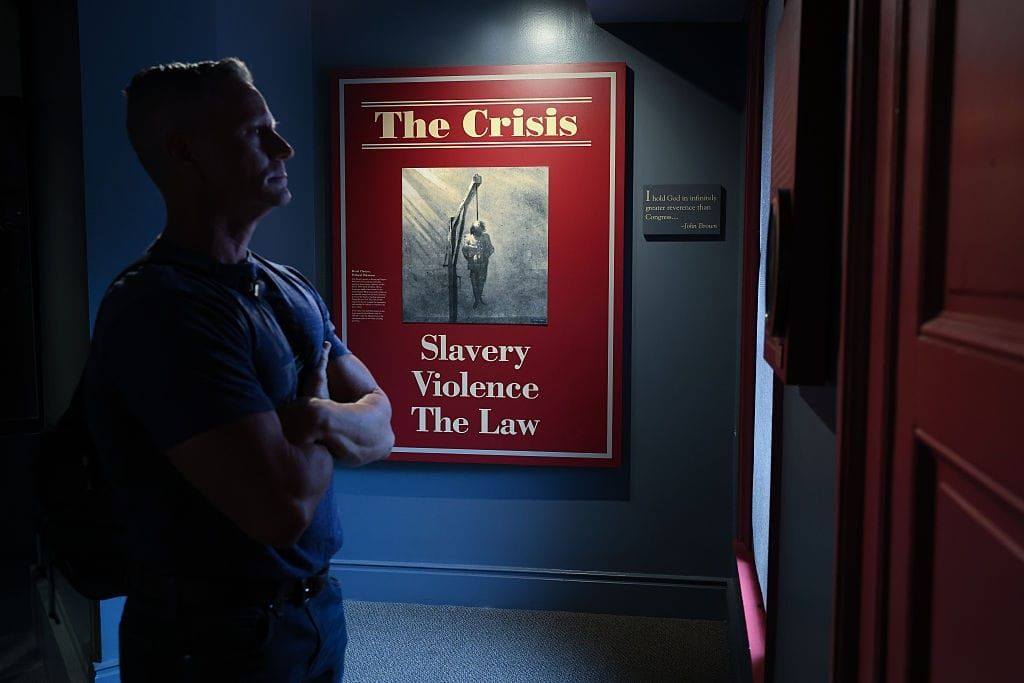
In January, park rangers removed 34 interpretive panels from a slavery exhibit at Independence National Historical Park in Philadelphia. The signs, which described the lives of the nine people George Washington enslaved at the presidential residence there, were unceremoniously taken down — in some cases leaving the dried glue in place — to comply with President Donald Trump’s Executive Order 14253, titled “Restoring Truth and Sanity to American History.” The order calls for the removal of signs that “inappropriately disparage Americans past or living” from the country’s national parks. Apparently, telling visitors about our first president’s slaves ran afoul of that.
When Trump issued the order in March 2025, Molly Blake, a social sciences librarian at the University of Minnesota, worried about the information that might be lost as a result. She began talking with colleagues at the university, including Jenny McBurney, a government publications librarian, about what they could do. Even if they couldn’t stop park rangers from tearing down the signs, maybe they could archive them for posterity. Within a few months, they would launch Save Our Signs, a nationwide effort to preserve what the government was trying to erase.
Blake and McBurney couldn’t go to all 63 national parks, of course, let alone the hundreds of historic monuments and sites overseen by the National Park Service. “We knew we had to get the public involved,” Blake said, so they invited parkgoers to photograph signs to be recorded in an online archive. The response has been overwhelming.
To date, members of the public have sent Save Our Signs more than 17,000 photos shot at 428 sites, from Ellis Island and the Japanese American internment camp at Manzanar to monuments dedicated to the memory of Emmett Till, whose killing helped spark the Civil Rights Movement. They’ve also sent reports and photos from parks where the signs have already been removed, which become part of the archive’s “Censorship Tracker.”
“The folks that we hear from are saying things like they love our parks, they support our parks, they want to maintain the really high-quality educational materials they’re seeing there,” McBurney said. “They want us to remember our history, the good and the bad.”
A daunting task
Even for the combined forces of the American public, however, there are a lot of parks and land to cover: More than 85 million acres across 50 states. And nobody knows where the government might strike next.
“They’re not hiding it,” said Alan Spears, senior director of cultural resources at the National Parks Conservation Association. “They’re also probably not putting out press releases saying that this stuff has happened. You can just show up on Monday or Tuesday of this past week, [and] the signs are gone.”
Because of the uncertainty, SOS encourages parkgoers to photograph everything. “One of the signs that was removed just noted that it’s a good idea to refill your water bottle because it’s better for the environment than using plastic,” Blake said. “I wouldn’t have guessed that that would have been targeted, but it was.”
Since the order was issued, park employees have removed or modified more than 100 signs at 41 National Park Service sites, from California’s Muir Woods National Monument (for mentioning climate change and the park founders’ connections to anti-immigrant policies) to Wyoming’s Grand Teton National Park (for calling attention to explorer Gustavus Cheyney Doane’s participation in a massacre of more than 150 Indigenous people).
Monitoring all those signs is as daunting for the Interior Department, which includes the Park Service, as it is for SOS. The department relies on park rangers and other employees at each site, instructing them to look for signs that might not be doing an acceptable job of reminding parkgoers of this country’s “unmatched record of advancing liberty, prosperity, and human flourishing,” as Trump’s order puts it. Park staff are expected to remove or alter such signs within 120 days of the executive order.
Snitch signs
A confidential Park Service database, leaked in March and containing internal communications among park staffers, showed rangers wrestling with difficult questions about what exactly the order requires. Did signage about the return of California condors from near-extinction disparage hunters? one ranger asked. Another wondered whether signs about graffiti at Utah’s Arches National Park violated the directive to emphasize the park’s “natural beauty.”
For SOS, the leak provided a list of parks that might be targeted for sign removals if they hadn’t been already.
“Right now, we have on our website a map of parks that, based on the leaked dataset of what might be targeted, are parks that are priorities for us,” Blake said. “It was called out on this leaked spreadsheet as a place that there might be censorship happening. We really want more photos there.”
One of the challenges for Save Our Signs is the ambiguity of Trump’s order as well as Secretarial Order 3431, which Interior Secretary Doug Burgum issued to implement the executive order. Consider the orders’ ban on “inappropriate disparagement” of Americans. Is it OK for signage at a Till site to disparage the men who tortured and lynched him? Can park signs at civil rights monuments in Birmingham, Alabama, and Little Rock, Arkansas, disparage the white supremacists who opposed the Civil Rights Movement?
“Inappropriate disparagement” of Americans is “a really confusing turn of phrase,” McBurney said. “Especially in the early days, nobody knew what that meant.”
The secretarial order also requires parks to post notices telling visitors how to report supposed violations, an effort that has largely been a bust. The QR-code-enabled notices, prescribed in a section of Burgum’s order titled “Encouraging Public Participation,” were soon dubbed “snitch signs” by detractors, thousands of whom submitted sarcastic comments and jabs at the Trump administration. “There are some people who reported, ‘I think there needs to be more about Indigenous history here,’” Blake said.
Legal conflicts
The watchdog group Public Employees for Environmental Responsibility (PEER) filed a Freedom of Information Act request last year to find out how the executive order was being implemented. The Interior Department never responded, so PEER sued to get the records in June.
Tony Irish, a longtime Interior attorney who left the department last year and joined PEER in May, said, “There’s a number of terms [in the order] that, even for me, with my background in Interior programs, isn’t clear.” He wonders how these orders might run afoul of federal law, including the National Park Service Organic Act of 1916, which created the service, and the National Historic Preservation Act of 1966. “There’s other sites, particularly ones like Little Big Horn, where Congress has specifically directed the agency to provide a viewpoint from the Native American tribes that were impacted by the events there,” Irish said.
It’s not just Park Service signs that are being removed and altered. Trump’s order calls for the removal of offending signs throughout all 500 million acres of Interior Department lands, comprising roughly one-fifth of the country. Park Service sites are getting most of the attention because Americans are more inclined to visit them, Irish said, but the Fish and Wildlife Service and Bureau of Land Management oversee even more acreage. PEER is suing the department for information about the order’s impact on those lands too.
There have been impacts on wildlife refuges and the Bureau of Land Management, Irish said. “Part of why we want to get these records is to see just to what extent.”
Insidious alterations
Little is known about the fate of many of the lost signs. When a district court judge told the Trump administration to provide an inventory of removed materials, the partial list from the Interior Department included 18 items that had been “discarded.”
Few parks employees are inclined to talk about where the old signs might be, let alone which others are slated for removal, Irish said.
“We’ve seen … circumstances where employees have made their personal feelings known that have led to swift reactions from the department,” he said. “So I would suspect there is some fear of being open about that.”
Some of the replacement signs sanitize or dilute the history laid out in the originals in ways that aren’t immediately obvious.
“These are really insidious,” said Save Our Signs’ Blake. “The differences are really subtle. In one case, a sign about Black soldiers during the Civil War, a reference to the fact that the military remained segregated until after World War II, that sentence was quietly taken out. So you could read something like that and not realize this has been censored.”
This whitewashing of history at park sites reverses decades of progress at the national parks, Spears said.
“We spent the last 30 years trying to raise up some of these untold stories so that we can have a better understanding of the contributions that all of us have made,” she said. Spears called the current shift “disheartening and anger-inducing.”
Save Our Signs continues to document the loss as signs across the country continue to come down. Blake said the effort is capturing an important moment in our history when an accurate telling of our past is itself under attack.
“Best-case scenario, the signs that have been censored will go back up, and this will be a way to study what happened,” she said. “Worst-case scenario, if this censorship continues, we want to be documenting it so that people can see what has been changed.”
Copyright Capital & Main 2026
Hualapai Valley ruling preserves key tool for protecting Arizona groundwater
by Brendon Derr, Arizona Center for Investigative Reporting
November 25, 2026
An Arizona appeals court has reversed a ruling that would have invalidated groundwater protections in the Hualapai Valley, preserving a key tool the state uses to curb agricultural expansion in areas with dwindling groundwater supplies.
The court on Wednesday sided with the Arizona Department of Water Resources, rejecting arguments by two out-of-state investment firms that the agency should have used the state’s standard rulemaking process to impose irrigation limits in the Hualapai basin.
ADWR established the limits in 2022 under a designation known as an Irrigation Non-Expansion Area, or INA, which prevents new farmland from being irrigated in the Mohave County basin. The investors' successful challenge in Superior Court centered not on whether the valley’s groundwater conditions warranted restrictions, but on the process ADWR used to implement them.
The appeals court found that in establishing the INA, the agency was applying existing law—issuing “a ruling, not a rule”—and therefore did not need to take the additional procedural steps. The majority described the process lawmakers had established for designating INAs as “comprehensive, distinct, and self-contained.”
The decision resolves broader uncertainty over how the state can establish similar protections elsewhere in Arizona. ADWR had warned that the lawsuit could hamper its ability to create future INAs, including one recently sought by farmers in southeastern Arizona’s San Simon Valley.
“The ruling affirms the existing data-driven process to establish new INAs that has been in place for almost 50 years,” said Christopher Kuzdas of the Environmental Defense Fund, which filed an amicus brief in support of ADWR. “It’s incredibly important the Arizona Department of Water Resources has the tools to respond effectively to local hydrologic conditions and unique community needs.”
Wednesday’s decision does not necessarily mark the end of the legal battle over the Hualapai Valley restrictions, however. The Court of Appeals sent the case back to Superior Court for further proceedings, leaving unresolved other claims by the investors concerning ADWR’s authority and the groundwater data it relied on. The investors could also ask the Arizona Supreme Court to review Wednesday’s ruling.
“We look forward to resolution of this matter so that the Department can continue its work with residents of the basin to protect their groundwater resources,” ADWR said in a statement following the decision.
An attorney for the investors did not immediately respond to a request for comment.
The Hualapai Valley restrictions came after a wave of investment by out-of-state agricultural interests, which now own or control 99% of cultivated cropland in the basin, according to a previous AZCIR investigation. With little authority to curb that development themselves, local officials sought an INA.
The two investment firms that contested the designation were themselves based outside of Arizona, and together had purchased thousands of acres in the basin. But unlike other landowners who drilled large wells and began irrigating before the restrictions took effect—allowing them to continue pumping under the INA—the investors had not begun irrigating in time.
Missing out on those grandfathered rights “eviscerated” the value of their land, attorney Adriane Hofmeyr told AZCIR in August. In the lawsuit, the investors argued that had ADWR followed Arizona’s standard rulemaking procedure, they would have had more time to dispute the state's groundwater data and provide input before the restrictions took effect.
ADWR countered that the Legislature had deliberately created a separate mechanism for the agency to make those decisions as quickly as possible to avoid prolonged uncertainty for landowners, the agency said.
In January, the Superior Court ruled for the investors, finding that ADWR should have used the process outlined in Arizona’s Administrative Procedures Act, including consideration by the Governor’s Regulatory Review Council. ADWR estimated that those additional steps could extend the time needed to establish an INA from three or four months to about a year.
The agency appealed in April, seeking to challenge the decision before a final order was signed. It insisted that a swift resolution was “necessary to avoid harms resulting from a possible rush to irrigate new lands in the Hualapai Valley Basin.” The agency also sought “clarity about how to proceed with INA designations” elsewhere in the state.
Mohave County similarly urged the appeals court to act quickly, claiming that additional irrigation had begun in the Hualapai basin immediately after the January ruling and warning that the activity risked undoing years of work to secure groundwater protections for the area.
The appeals court agreed to hear the case and, in June, put the Superior Court’s order on hold, keeping the INA restrictions in place during the appeal.
But it’s unclear whether any additional acres were irrigated in the months before the stay was granted, or whether any such land could qualify for grandfathered irrigation rights under Wednesday’s ruling. ADWR did not address AZCIR’s question about how it plans to handle any irrigation that occurred during that period.
The case also complicated efforts to establish similar groundwater limits in southeastern Arizona’s San Simon Valley, where longtime farmers have petitioned the state to prevent new agricultural development as groundwater levels decline.
ADWR formally acknowledged the petition in September, nearly a year after farmers submitted it, beginning a review that could lead to a permanent ban on irrigating new farmland.
The appeals court ruling clears the way for that process to move forward under the state's existing procedures.
This story was updated Nov. 25, 2026, to include a response from the Arizona Department of Water Resources received after publication.
This article first appeared on Arizona Center for Investigative Reporting and is republished here under a Creative Commons Attribution-NoDerivatives 4.0 International License.

New carousel represents a ‘dream realized’ in New Orleans East
by Robert Stewart, Verite News New Orleans
November 25, 2026
With the Christmas season fast approaching, Tangee Wall and some of her friends are racing to get a section of the Joe W. Brown Park decorated for their 17th annual holiday celebration.
Wall is the president of the local nonprofit organization, Friends of Joe W. Brown Memorial Park, and is hosting a holiday event in the park dubbed East of the North Pole, which is set to kick off on Dec. 12. While the celebration is a recurring event, the park’s new feature, a carousel, is a “dream realized” for New Orleans East, Wall said.
“I've always loved carousels. It goes back to childhood happiness and fantasy and amusements,” she said. “But a carousel had a special meaning after growing up and after Hurricane Katrina.”
Joe Brown Park is one of the city’s largest parks situated in New Orleans East off of Read Boulevard. The nonprofit, which Wall helped establish when she and her family returned to New Orleans after Hurricane Katrina, was set up to restore and preserve the park.
The carousel, a new development made possible by grant funding provided by the Mellon Foundation, is a historic addition that mirrors attractions in other area parks — Audubon and City parks in New Orleans and Lafreniere Park in Metairie all have carousels. Those involved say they hope it will be a source of entertainment and a place that can connect families across New Orleans. For others, it is a potential private-public partnership model that can be implemented elsewhere.
For Wall, the carousel is a comeback story.
“Displacement. It’s so hard to define what that’s like if you’ve never had to leave your home and not know if you’ll ever come back,” Wall said.
Wall moved to New Orleans East in the mid 80s, drawn to “the Glorious East,” for its large homes. She has fond memories of ice skating and shopping with her sisters at Lake Forest Plaza, which has since been demolished. After being displaced by the storm, she felt called on a personal quest to rebuild her life and replace cherished memories.
“Sometimes they’re not replaceable, but you find a way to move forward with something that you hope can be better,” Wall said.
The Friends of Joe W. Brown Memorial Park launched as a nonprofit in 2010 and has helped to restore a sense of community pride by hosting events like its annual “Back to Nature Heart Walk,” organizing an annual festival and advocating for economic and quality of life improvements. The group’s economic development committee, according to Wall, eventually turned into a separate nonprofit, the NOLA East Economic Development Focus Group, which is also known as New Orleans East Matters.
That group has advocated to stop illegal dumping and fought to tackle the chronic problem of illegally parked semi trucks.
The idea of a carousel had been years in the making. The project was entirely funded through grant support, Wall said. The Friends of Joe W. Brown Park secured roughly $2 million between 2023 and 2024 from the Mellon Foundation and worked with city officials to undergo all the necessary steps to pave the way for a public-private partnership, like figuring out the necessary permits and undergoing architectural reviews of the plans.
In May of last year, the city council passed an ordinance authorizing then-Mayor LaToya Cantrell to sign a five-year cooperative endeavor agreement between the city, the New Orleans Recreation Development Commission and the Friends of Joe W. Brown Park that would allow the latter to set up, operate and maintain the new carousel.
Former District E City Councilman Oliver Thomas worked with Wall and her group to ensure precursory measures were taken before introducing the public-private partnership ordinance. Thomas said the partnership creates a shared sense of responsibility between residents and government, particularly in a place like New Orleans East where some residents lack trust in the city.
“It helps to forge relationships where everybody has a stake,” Thomas said.
Thomas also said establishing more recreational opportunities in a predominately Black part of the city is an example of a policy that includes Black families who can sometimes be left out of policy decision making.
“Our community can't be whole if we're just focusing on half,” he said.
Wall and her friends, who were decorating in the park on Thursday (Nov. 19), shared their thoughts on the importance of the carousel project.
Beulah Anderson, a New Orleans East resident, said the new addition to the park brings back childhood memories of going to carousels in other parts of the city.
“We don’t have to drive so far for our children to be able to experience a beautiful carousel in this beautiful park,” she said.
Talmadge Wall Mead, Wall’s sister, said that the park is not only important for her and her grandchildren, but a hidden treasure that she wants everyone in the city to explore. She said oftentimes she meets New Orleanians who have never visited the park and don’t know about what it has to offer.
“What better to have a beautiful carousel for our area, but not just for us,’ Wall Mead said. “Hey City Park people and Lafreniere Park people, come on out here too. Let’s all enjoy this East.”
This article first appeared on Verite News New Orleans and is republished here under a Creative Commons Attribution-NoDerivatives 4.0 International License.

They voted for Donald Trump in 2024 and Scott Colom in 2026. Here’s why
by Michael Goldberg, Mississippi Today
November 23, 2026
In early September, as the nation turned its attention to Mississippi’s surprisingly competitive U.S. Senate race, Scott Colom walked into AC's Steakhouse in Hernando and sat down at a table with a group of Trump supporters.
The Democrat was locked in a tight battle with incumbent Republican Cindy Hyde-Smith in a state that President Donald Trump won by 23 points less than two years earlier. Colom wanted to ramp up his outreach to the president’s voters, so his campaign organized a small, in-person roundtable with Trump-supporting Republicans.
Over Cajun chicken tenders and fries, the group peppered Colom with questions about his views of capitalism, transgender participation in women’s sports and government spending. By the end of the meal, Colom had won them over.
As the dust settles from Mississippi’s historic Senate race, a Democratic victory in the heart of Trump country, many political observers have noted a massive Democratic turnout. Another factor that contributed to Colom’s victory was his ability to win over a small but potentially significant number of skeptical Republicans.
The lunch meeting took place in DeSoto County, a Republican stronghold that Trump won by about 24 points in 2024 and where Colom pulled off a stunning turnaround for Democrats in November, winning the county by about seven points.
Beyond DeSoto County, U.S. House results across the state suggest there were tens of thousands of voters who voted for Republican House members but not Hyde-Smith. GOP House candidates collectively won more than 20,000 more votes than Hyde-Smith.
In interviews with Mississippi Today, voters who supported Trump in 2024 and Colom in 2026, including some at that lunch meeting, cited Trump’s war in Iran, his failure to release the Epstein files and Hyde-Smith’s uninspired campaign as reasons they crossed over to support Colom.
A few weeks before the roundtable in Hernando, Colom’s campaign filmed an ad with Mark Vines, 50, a Southaven businessman who said he voted Republican for 20 years and supported Trump in 2024.
The ad, titled “Lost Her Way,” featured Vines explaining that he wouldn’t vote for Hyde-Smith because she voted to block the release of the Epstein files. Colom and Vines made strange bedfellows. In addition to Vines’ longtime Republican voting record, he had even criticized Colom on X shortly after the Democrat entered the race for “quoting platitudes.”
But Vines grew more and more dismayed over the push by Trump and his allies, Hyde-Smith among them, to conceal the Epstein files. He called Hyde-Smith’s office and wrote letters urging her to support the release of the files. He said he never got a response, not even a robo-email.
“The first thing they did was make a farce of the whole Epstein thing, which was probably the biggest piece of corruption. So that kind of set the tone that OK, this is not going to be the change that we voted for,” Vines said. “So we felt betrayed.”
Some elected Republicans in Mississippi have said that sentiment might be widespread. Rep. Jansen Owen, a Republican state lawmaker from Poplarville, wrote on X that Republicans should be clear-eyed about the political cost that came with congressional votes to block the release of the Epstein files.
“I’ve heard from a lot of constituents in my very Republican district who cite the Epstein file vote as their reasoning for going left, voting third party, or skipping the Senate race altogether,” Owen wrote.
Feeling alienated from the party he had supported for decades and the president he supported less than two years before, Vines decided to attend one of Colom’s town halls in Horn Lake. He was immediately struck by Colom’s work ethic and the way he made himself accessible to voters, even those who disagreed with him about various issues. He believed that stood in stark contrast to Hyde-Smith’s cloistered approach.
“She's a nepotism hire, she was appointed,” Vines said. “And then I looked at the history, and that's kind of been our history in the state. It's not really merit based, and that kind of flies against the whole fundamental principle of being a conservative.”
For some Republicans, Colom’s personal work ethic as a candidate and willingness to offer ideas beyond increasing spending on government programs seemed to embody an embrace of meritocracy they felt Democrats had abandoned in recent years. That’s how Chris Cook felt.
“You make your own way with meritocracy,” Cook said. “I'm more in line with that, which I know is less traditional, or at least in the past 5-10 years or so, less associated with the Democratic Party. But that's where I started to see a little bit of a moderate in him, and not just that extreme left sort of perspective.”
Cook, 60, who works for a financial advisory firm in Hernando, had been invited to the roundtable at AC’s Steakhouse by Vines. After filming the ad with Vines, Colom’s campaign asked him to help put together a group of Republicans who could meet with Colom and tell him what issues mattered to them.
Cook came to the lunch and said the attendees didn’t hold back on questioning Colom. He was struck by Colom’s overtures to Republicans and his willingness to incorporate their concerns into his campaign rather than dismissing them.
Cook voted for Trump because he doesn't like career politicians. He grew frustrated with political stagnation and had a sense that nothing substantive ever changed despite the grandiose promises of establishment politicians. Trump’s promise to “drain the swamp” of entrenched government bureaucrats appealed to him.
Cook also believed the Democratic Party swung too far left on some cultural issues under former President Joe Biden. Cook coaches youth soccer and was concerned about the prospect of trans girls competing against biological girls.
On the campaign trail, Hyde-Smith called Colom a “transgender defender” and attempted to cast the Democrat as an out-of-touch radical. But after Cook met Colom, those attacks fell flat.
He was open to pivoting away from Trump and the Republicans because he believed the president had shown himself to be unrestrained in his thirst for raw power, focusing on pet priorities such as renaming buildings while using the economic strain on Americans caused by his policies as a “bargaining chip” in his political battles.
Hyde-Smith refused to acknowledge those issues, and as a result seemed to be a creature of the same political machine Cook had initially supported Trump to dismantle, Cook said.
“I really chose Scott more so because it went back to the career politician thing with the senator that had been in place for so long, and stuff just wasn't really changing. And I didn't see anybody really doing anything to try to get my vote,” Cook said. “And I did see him.”
Cook believes he’s far from alone among voters on both sides of the aisle who will refuse to prioritize party loyalty over everything else.
“Myself personally, and I feel like a large part of the country are no longer just going to support a party because I'm a Republican and my father was a Republican, or I was a Democrat and my father was a Democrat,” Cook said. "I think people are now paying a lot closer attention to what's really going on.”
The demographic perhaps most likely to swing back and forth is younger voters.
Mississippi Today spoke with a 23-year-old Brandon woman who voted for Trump in 2024 and Colom in 2026. The woman, who works in marketing, asked for her name not to be used so she could discuss her political beliefs without professional consequences.
The woman, who was not at the lunch meeting in Hernando, was raised by Republican parents. She was a loyal Trump supporter and even attended his inauguration in 2024. But one of Trump’s campaign promises that appealed to her most was the president’s promise to limit America's interventions in foreign conflicts.
“These are topics that Trump ran on and then Cindy Hyde-Smith ran on, no more forever wars,” the Brandon woman said. “Not only did he not get out of the wars but he continues to perpetrate the wars, and it's American citizens' tax dollars that are going to the Middle East, to Israel.”
By contrast, Colom relentlessly criticized the war in Iran and vowed not to take money from the American Israel Public Affairs Committee. Some researchers have said support for Israel has become a generational chasm within the Republican Party.
A 2026 analysis by the Brookings Institution citing Pew data noted that unfavorable views of Israel among Republicans aged 18 to 49 shifted from 35% in 2022 to 50%, compared with a shift from 19% to 23% among Republicans aged 50 and older.
As the war in Iran dragged on and Hyde-Smith seemed to be a rubber stamp for Trump’s agenda, the Brandon woman decided that she could not vote for her. But she didn’t immediately decide to vote for Colom. Her mind was made up just days before the election, when she saw Colom strolling through the line outside Trump’s rally in Corinth, talking to the president's supporters. To her, that displayed a level of respect for voters and for the office that Hyde-Smith refused to muster.
“She wouldn't have a debate with Scott Colom,” the Brandon woman said. “She basically just assumed that because she was the Republican candidate and had an R next to her name that the Mississippi Senate race was hers.”
As Colom continues to receive national attention and plaudits from his historic win, he seems not to have shifted away from his decision to keep speaking with Republicans and voters who might disagree with him.
On Thursday, he announced that he would host a community conversation in Itawamba County this week, the county where he received his lowest percentage of the vote on election day.
“No matter where you live or how you voted, your voice matters, and I'll always show up for you,” Colom said. “That's what Mississippi deserves because Mississippi Matters.”
This article first appeared on Mississippi Today and is republished here under a Creative Commons Attribution-NoDerivatives 4.0 International License.

No ill effects reported from Iowa lead detonation
by Ben Szalinski, Capitol News Illinois
November 25, 2026
Article Summary
- No lead fallout was reported from a planned detonation at the Iowa Army Ammunition Plant on Wednesday morning.
- U.S. Environmental Protection Agency air sensors detected no lead downwind of the explosion and Army officials said the lead was destroyed on site with all mitigation measures being successful.
- The detonation happened following days of public uproar over the plans, which the Army projected could spread lead across some areas of Iowa and neighboring states.
This summary was written by the reporters and editors who worked on this story.
No effects from the detonation of the nation's stockpile of lead azide have been reported, according to U.S. Environmental Protection Agency and other government officials.
The blast of nearly 10,000 pounds of lead azide took place promptly at 9 a.m. Wednesday morning at the Iowa Army Ammunition Plant in Middletown about 10 miles across the Mississippi River from Illinois. TV cameras and other videos posted to social media captured two clouds from the explosions.
Wind patterns were predicted to keep any lead fallout away from Illinois as the plume was expected to travel southwest across parts of Iowa into Missouri. But as of mid-morning Wednesday, no lead fallout had been reported within that path or anywhere around the Middletown plant, according to EPA air monitors.
At a news conference Tuesday, government officials described the projected lead fallout map as a "worst case scenario" and said they were hopeful a variety of mitigation measures would keep any lead contained to the site of the blast.
Federal officials encouraged people living around the plant to evacuate or shelter in place, warning of possible lead dispersion and powerful explosions that could break windows in the area. No damage was reported, according to the Associated Press.
Illinois officials had put in place a variety of measures to keep an eye on the situation and monitor any effects in Illinois.
"The State of Illinois is still expected to be minimally affected by the detonation in Iowa, but we remain on alert," Gov. JB Pritzker said in a statement after the blast. "Protecting our people's safety and well-being is our top priority as we continue to monitor the conditions."
Iowa Gov. Kim Reynolds said in a statement that indications from her state agencies were that the detonation was successful.
In a video statement late Wednesday morning, Major Gen. Eric Shirley, the commanding general of the Army Sustainment Command, said the detonation exceeded expectations and all the lead azide was destroyed.
"I believe absolutely that we reduced as close to zero as is absolutely humanly possible the risk to the health and safety of the people of Middletown and the extended communities throughout Iowa," Shirley said.
Bureau of Alcohol, Tobacco and Firearms Director Rob Cekada said the blast was designed to direct itself into the ground and minimize particles that were released into the air.
Federal Emergency Management Director Cameron Hamilton said federal teams will continue to conduct testing over the coming days for extra peace of mind. NASA also deployed several aircraft to circle southeast Iowa to monitor air quality.
Plans for the detonation caused significant uproar among people in Iowa, Illinois and Missouri as many only learned about the plans and the possibility of lead traveling through a swath of the region just days before it was originally planned to be blown up on Friday.
The detonation was postponed multiple times as a bipartisan cohort of elected officials from the states wrote letters to the Army seeking more information, and Iowa environmental groups filed an unsuccessful lawsuit to stop the detonation.
Lead azide is an explosive substance used by the military to make ordnances, though it stopped using it more than a decade ago.
The nation's stockpile was moved to Iowa in 2009 but has grown dangerous over the years. An inspection in March found crystals forming on the outside of barrels it was stored in, which officials said made it unsafe to treat without risking an uncontrolled explosion.
Officials said Tuesday they explored all options, but determined a controlled detonation was the safest method to dispose of it. They said time was a critical factor as the substance becomes more volatile in cold weather.
Capitol News Illinois is a nonprofit, nonpartisan news service that distributes state government coverage to hundreds of news outlets statewide. It is funded primarily by the Illinois Press Foundation and the Robert R. McCormick Foundation.
This article first appeared on Capitol News Illinois and is republished here under a Creative Commons Attribution-NoDerivatives 4.0 International License.

 TED CLIFFORD
Pardee abruptly closes Mills River ambulatory surgery center
Employees surprised, frustrated by decision made late last month
by TED CLIFFORD November 20, 2026
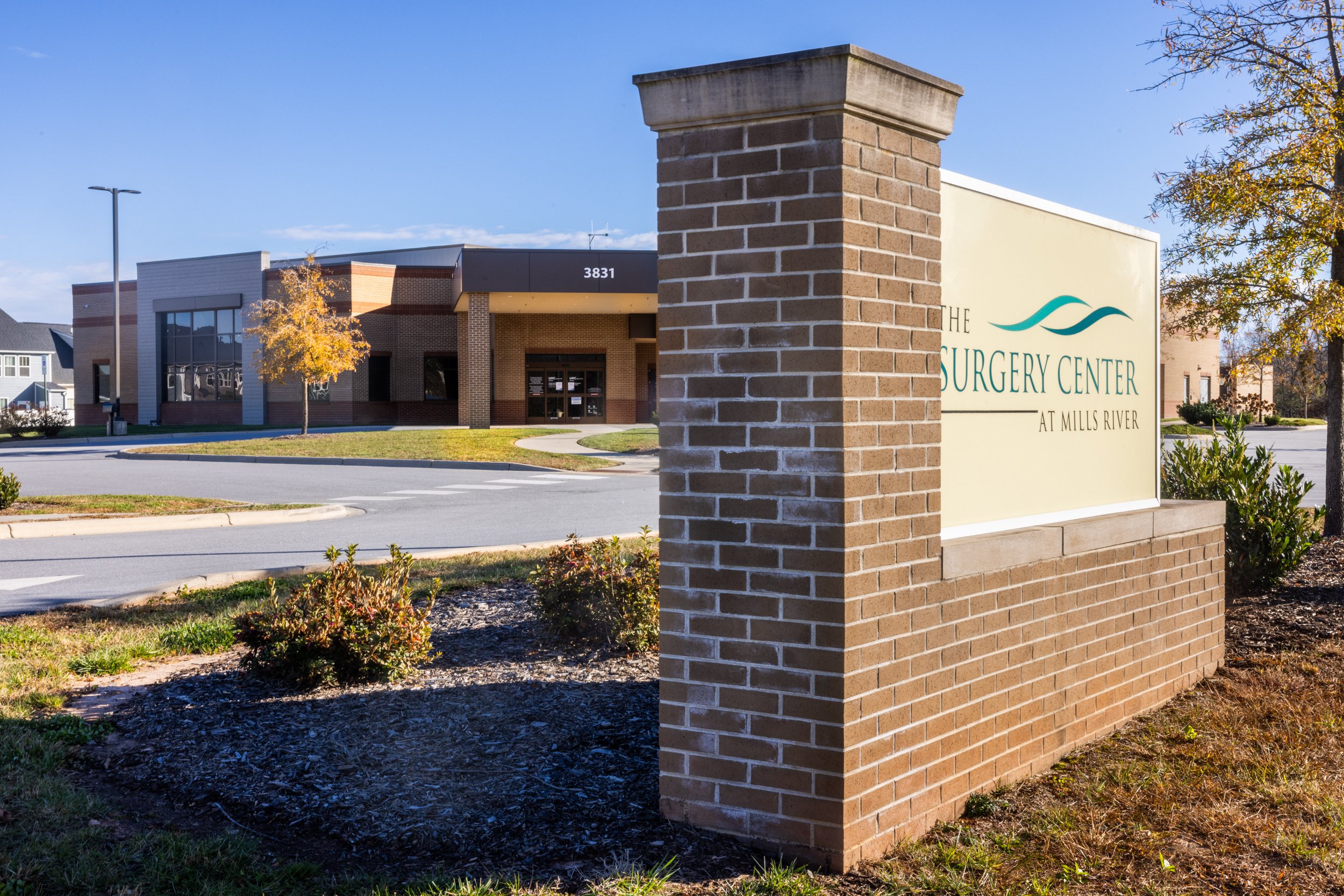
Inside University of North Carolina Health Pardee’s Ambulatory Surgical Center there were shock and tears. Standing in the center’s lobby on Oct. 27, a hospital vice president told the assembled nurses and staff that as of that afternoon they were indefinitely closing the surgical center.
“The decision, as of today, is we’re going to temporarily pause operations here,” Brian Leutner, Pardee’s vice president of clinical services, told the crowd.
The surgical center’s board had met earlier that day and voted to close the facility “at least until January, at a minimum,” after which the surgical center’s status would be reevaluated on a “week-by-week” basis, Leutner told the crowd in a video recording of the staff meeting shared with Asheville Watchdog.
The closure of the surgical center was a surprise to the roughly 38 employees, among them nurses, surgical and x-ray technicians, and front office staff. Doctors who practiced at the clinic had not yet been told, and while some employees were given the opportunity to apply for open jobs at Pardee’s main hospital in downtown Hendersonville, many were simply put out of work.
Several staff members told Asheville Watchdog that there was no warning for employees, patients, or doctors who practiced at the clinic. They asked that their names not be published because they feared being identified could hurt future employment prospects.
“It felt like being told ‘we’re going to throw you under the bus,’ ” one staff member said.
The closure is in contrast to the Hendersonville-based community hospital’s recent run of success. Since signing a management agreement with the UNCH system in 2011, Pardee has seen sustained regional growth. This year, the hospital opened a new office in neighboring Transylvania County and broke ground on a 60,000-square-foot medical office next door to the ambulatory surgery clinic in Mills River.
When initially asked about the closure by an Asheville Watchdog columnist, Jen Heatherly, a spokesperson for Pardee blamed the decision on this construction.
When a Watchdog reporter followed up after viewing the video recording of the staff meeting, hospital spokesperson Heatherly offered the “additional clarification” that the decision to close the center “followed a comprehensive assessment of the ASC’s operations; the decision was not based on a single factor.”
“The suspension of services allows us to align staffing resources with patient care needs and provide contractors with access to the site and work areas needed for upcoming construction,” Heatherly wrote in an email.
In a 26-minute talk with staff, Leutner offered a range of reasons for shutting down the surgery center. Construction was an issue, he acknowledged, but as of Nov. 19, construction had not begun at the site. Instead, the vice president of clinical services offered a wider set of causes.
“We always look at the financial piece … but safety first and foremost,” Leutner explained to the staff when asked about reasons for the closure.
Along with construction issues, shortages in staffing had led to questions about the ability of the facility to “safely run” their operating rooms.
But for much of his presentation, Leutner focused on the volume of surgeries.
The center did not have enough surgeries, or the right mix of surgeries to make it profitable, Leutner said. Currently, much of the surgery volume is taken up by eye surgeries, especially surgery for cataracts and glaucoma, he said. Hospital leadership wanted to see a higher mix of the more profitable orthopedic surgeries, like hip and knee replacements, according to the video recording.
There is reason for some optimism, he told the staff. Crucially, in 2027 the UNCH system will become the preferred provider for the North Carolina state insurance plan, meaning the hospital hopes to see an uptick in procedures booked by state employees.
But speaking to the Watchdog, several former employees of the surgery center questioned Leutner’s characterization and expressed puzzlement over the reasons for the sudden closure. Staffing was in safe limits, the construction was manageable, and the number of surgeries had seemed fairly consistent, they said.
Heatherly confirmed in her response that there is not a specific date for reopening the surgery center. “The suspension will continue until further notice as we evaluate our future operational needs,” Heatherly wrote.
The surgery center began operating in early 2023. Pardee had originally run it in partnership with a group of physicians. But in February of this year, they took over the clinic. Staff worked hard to get it up to Pardee’s standards, including adjusting to new charting software.
For many nurses, a job at the ambulatory surgery center was more than just good money, it was predictability. Unlike jobs at a hospital, they weren’t expected to be on call, which often required living within thirty minutes of the hospital. The center’s location in Mills River also meant less driving for anyone who lived north of Hendersonville.
“We worked really hard to get that facility up and running the way that they wanted us to, and to go by their guidelines and to put all this new stuff into play, and then for them to just discard us like we’re trash,” one employee said in an interview.
Leutner told staff that patient satisfaction ratings at the surgery center were high. In a recent survey of 108 patients over just one month, 98% said they would want to come back, Leutner said during his remarks.
“We don’t see those kinds of numbers in other departments,” he said.
The strong relationship with patients helps explain part of the shock of the center’s closure, but part of the problem seemed to be uncertain messaging from leadership.
The weeks leading up to the closure were chaotic, staff members said. Management had stopped approving new jobs and some employees quietly discussed whether it might be a good idea to start polishing their resumes. With little warning, the administration told staff to cancel surgeries for the week before the meeting.
But the week of Oct. 26 there was no indication from hospital management that the center was on the verge of closure. Staff had gone back to work after the weeklong shutdown and were preparing for surgeries later in the week.
One new nurse was even being onboarded, according to staff members. The new employee had left another job, received their hospital orientation on Monday and on Tuesday they were fired along with the rest of the staff.
A staff member speaking at the meeting said that they were hired around a month before the terminations. “It’s very frustrating,” said the staff member. “I would just like to know when the decision was made.”
Responding to the question, Leutner said the board, which normally met every other month and had been following the situation, voted that morning.
One staff member said she wished that instead of weeks of uncertainty, that hospital leadership had communicated earlier that closing the center was a possibility.
“That would have been one thing,” said one staff member, speaking to The Watchdog anonymously. “We’re adults, we can handle the truth.”
The sudden decision upended the stability that much of the staff had come to rely on as part surgery center life.
When the closure was announced, one employee in tears said she didn’t know how she could drive more than an hour to Pardee’s main hospital every day. Another, who had just been hired, said she was “at her limit” for her mileage.
Pardee declined to comment on the details of the severance that was offered or how many staff members took positions at the main hospital, citing confidentiality in personnel matters.
For staff, their anxiety about the fallout of the center’s sudden closure wasn’t limited to their jobs. With little notice, doctors and patients were left scrambling trying to find a place to perform, or even complete their surgeries.
Staff members who spoke with The Watchdog said they were especially concerned about how the sudden closure would impact their primarily elderly patients.
Heatherly said that “patients with procedures affected by the transition have been contacted regarding their care, and physicians and their offices have been engaged in the transition and rescheduling process.”
Attempts to reach several doctors who practiced at the clinic were unsuccessful.
One doctor’s voicemail offered an impact of the closure: His outgoing message said that it would take him four to six weeks to be credentialed at another surgery facility.
“It’s just this huge snowball effect of what they’ve done to this community,” said one nurse.
Asheville Watchdog welcomes thoughtful reader comments on this story, which has been republished on our Facebook, Instagram, and TikTok. Please submit your comments there.
Asheville Watchdog is a nonprofit news team producing stories that matter to Asheville and Buncombe County. The Watchdog’s local reporting is made possible by donations from the community. To show your support for this vital public service go to avlwatchdog.org/support-our-publication/.

Why Are People Becoming ‘Homeless’ in Alabama Prisons?
by Destry McKinney and Wyatt Stayner, Prison Journalism Project
November 18, 2026
For a brief time in 2022, Michael Pearson was homeless inside prison.
Four men robbed Pearson of all of his belongings, including his sleeping mat. He believed his cellmate was a co-conspirator because the cellie asked Pearson to return to the cell just before the robbery occurred.
“I did not feel safe, and I couldn’t trust nobody,” Pearson told me during an interview in the summer of 2025 at William E. Donaldson Correctional Facility in Bessemer, Alabama.
Shaken by the experience and concerned for his safety, he filled out a request to move to a new cell and vacated his assigned living area that same day. He decided it would be safer to sleep in the dayroom, a shared recreation space, while he waited for a transfer to be approved.
At that point, he became effectively “homeless” in prison — a designation that has no official tally in Alabama’s state prison system and appears not to be reported on or officially tracked in prisons across the country.
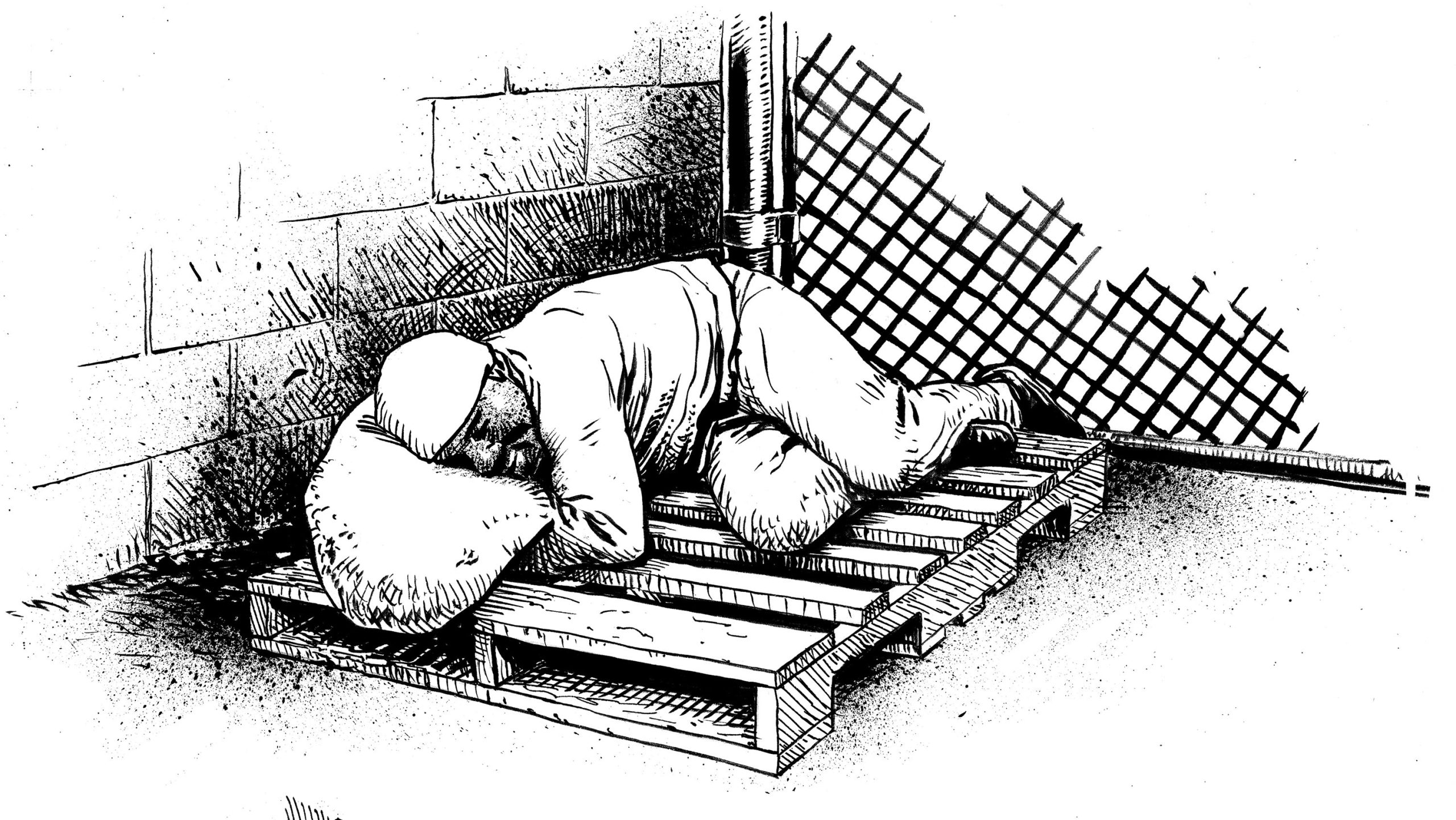
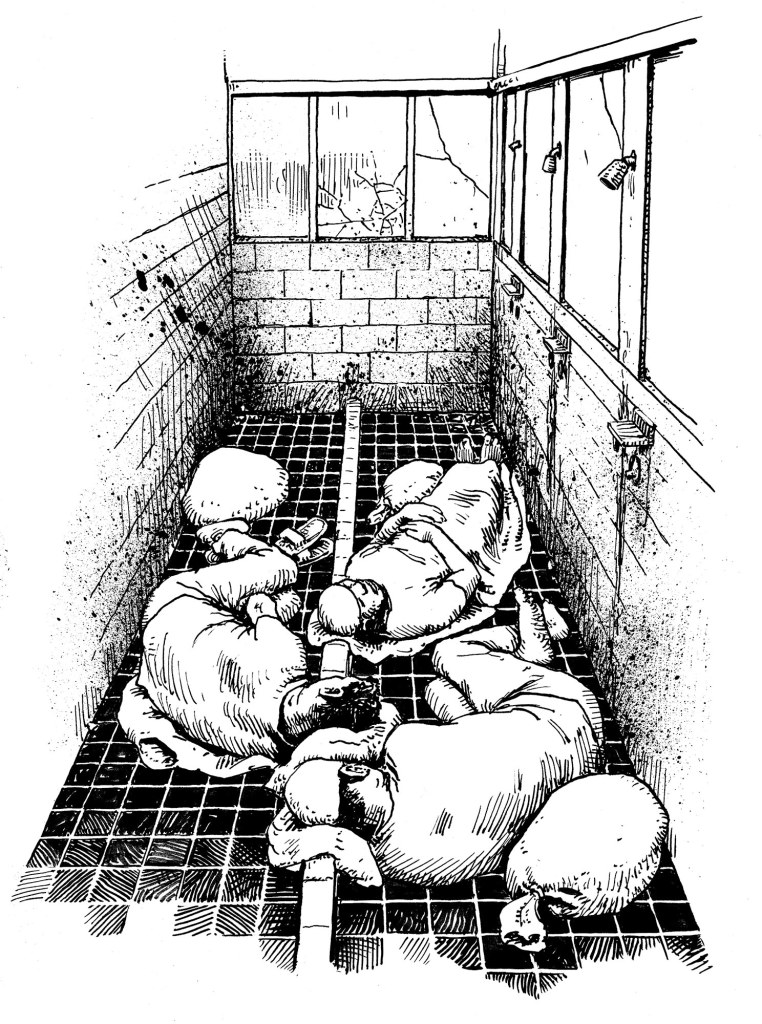
While Pearson waited to hear back about the transfer, he continued to sleep on a padded mat in the dayroom and even under staircases. A week later, he said, he received news that his cell transfer was denied. So he kept sleeping in the dayroom and sometimes in an unused shower stall.
"I started to feel like I was worthless. I started blaming myself. If no one cared about the fact I slept on the sidewalk in prison, then why should I?
Michael peARSON
"I never imagined I would have to fight just for somewhere to sleep in prison,” Pearson told me during a follow up interview this month.
During this precarious period, Pearson said he was pulled into a stranger’s cell and attacked. Afterward, he appealed directly to one of the prison’s wardens to help him find housing. The warden assigned him to L-Dorm, an open-floor dormitory where around 120 people sleep in single beds, but the prisoners in L-Dorm refused to let him enter.
Pearson said a representative of L-Dorm harbored animosity against him and convinced other representatives to likewise deny Pearson entry. There was nothing official about these dorm agents. But in prison it is common for informal but powerful political hierarchies to take shape.
Outside the L-Dorm entrance, Pearson said he reported the issue to a guard, who simply told him to “find somewhere” to live. Already outdoors, Pearson found a spot behind the prison kitchen — about 10 yards from a guard post, in its direct line of sight, he said. He slept there unbothered on a wooden pallet. On one occasion, he had to temporarily move his bedding inside a hallway to try to keep it dry from a heavy rainstorm. It also got so cold at night that it made it hard to sleep, he said. After two weeks, a guard finally moved him into a bed in another dormitory.
Hear from our reporter inside: "What It Took to Report on Prison ‘Homelessness’ in Alabama"
"It started out like a camping trip, but then I started to feel alone and unwanted," Pearson said. "I started to feel like I was worthless. I started blaming myself. If no one cared about the fact I slept on the sidewalk in prison, then why should I?"
The Alabama Department of Corrections did not respond to a list of detailed questions sent by Prison Journalism Project editors.
Alabama’s prison system has come under intense scrutiny in a years-long investigation by the federal government, which has accused ADOC of failing to protect prisoners from violence and subjecting them to conditions that violate the Eighth Amendment’s prohibition against cruel and unusual punishment.
The case, which could go to trial on Nov. 30, has drawn attention to overcrowding, understaffing and widespread physical and sexual violence. But one problem that has received far less attention is “homelessness” within prison walls.
In a 2021 complaint, the Justice Department alleged that ADOC had failed to “supervise prisoners and enforce classifications and housing assignments.”
'Three hots and a cot'
Prison is fundamentally intended to house people. In here, you are supposed to be provided with at least “three hots and a cot,” as the old military and prison saying goes. In theory, no one should be experiencing homelessness behind bars. But there are men living in situations here that bear a striking resemblance to the kind of homelessness people encounter on the streets.
Four years after I was transferred to Donaldson, in 2019, the first such “homeless” person I encountered was a young man sleeping on top of the mailboxes. They were bolted to the wall near the entrance to the dining area, at the end of a hallway. The man was curled up on top of the mailboxes, sound asleep, during breakfast.
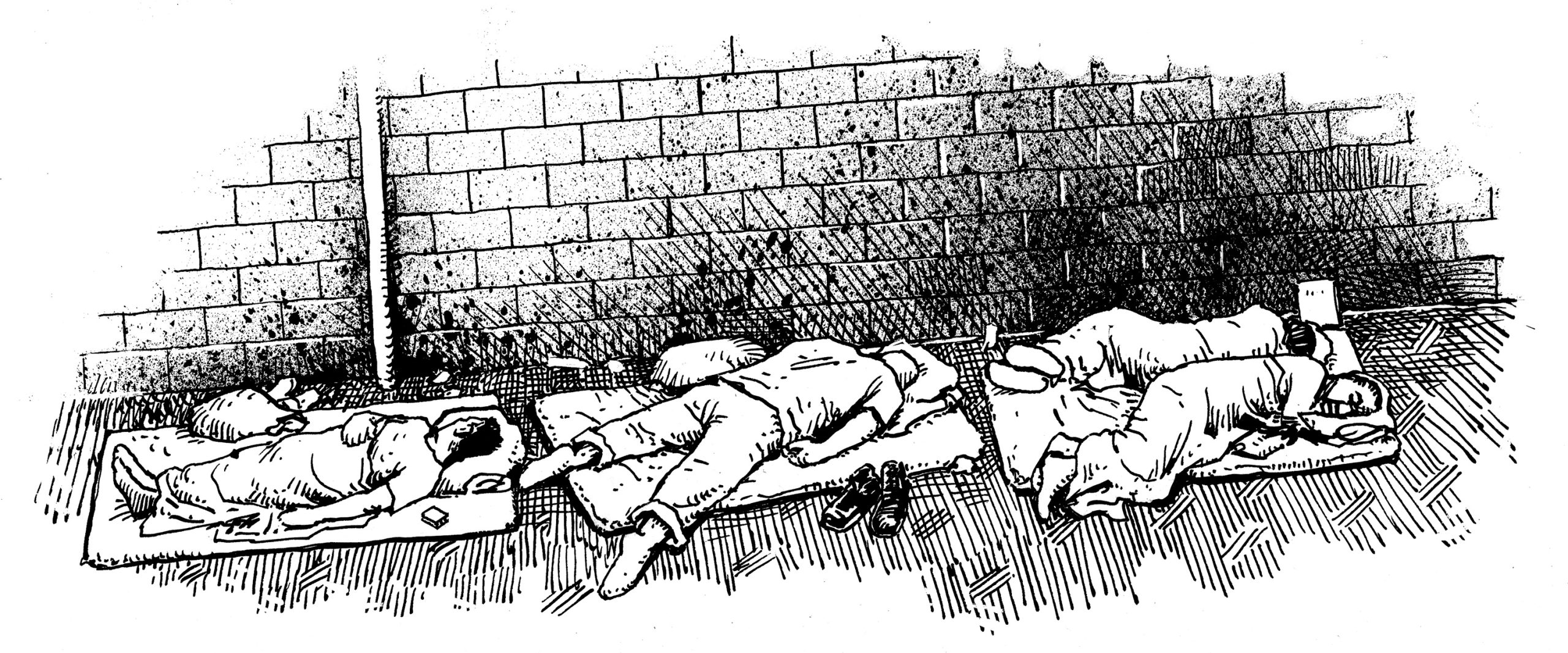
Later, while walking outside during a late night “movement,” which is allowed for medication pick up, medical visits or the snack line, I observed a second person asleep on the recreation field. Then, in Y-Block, where I used to facilitate a weekly workshop, I started witnessing more people sleeping on mats around the dayroom, in shower stalls and under the stairs.
Last summer, a 37-year-old man named KP told me he didn’t receive money from home. He decided to sell his cell space to his then-cellie for a cigarette pack, worth a little more than $3 here. KP, who struggles with substance abuse disorder, had been desperate for a fix.
After selling off his space, KP slept in a shower stall. He said he tried to avoid unsafe situations by staying on his mat and reading novels. “It sucks and it’s depressing,” said KP, who has since transferred to a new prison. “It’s loud and puts you in people’s way. I had to make a set of earplugs just to sleep. It’s hard to avoid being in the middle of conflicts.”
The scope of the problem
In June 2025, I tried to make sense of the scale of this problem at Donaldson prison, which then housed around 1,400 people, according to a state prison system population report from that month. I asked people I knew across the facility’s five cellblocks to count the “homeless” people they saw in their wings of the prison.
A total of 30 people, across the entire prison, were experiencing some version of out-of-cell homelessness at that time, according to the tallies. When I asked my contacts to conduct the tally again this summer, almost a year later, they came back with similar numbers.
Outside of prison, Alabama has a relatively low homelessness rate. The point-in-time count from January for the three biggest counties in the Birmingham metro area tallied 940 people living unhoused. That put the percentage of homeless people around 0.10% of the population earlier this year. The rate at Donaldson prison, based on my own point-in-time count for 2025, was just over 2%.
The phenomenon is common enough at Donaldson that one man told me people without a cell have used discarded bulk-sized food cans to pee in — what he called “piss cans” — to avoid conflict that can arise from asking to use the toilet in another person’s cell.
To see if and to what extent prison homelessness existed beyond Alabama, PJP editors surveyed writers in 20 states. Most had never encountered it in their prisons.
Writers in Tennessee and New Jersey said they had seen people live outside cells in jails, but never in prisons. In Arizona and Michigan, writers recounted situations in which people were forced out of a cell by a cellmate for a few hours or all day, but were typically permitted back at night to sleep.
In Georgia, one writer said she had experienced a more acute form of out-of-cell or out-of-bed homelessness at a previous prison. She said that people slept in the dayroom after selling their bed space or leaving it for fear of being bullied.
In a 2022 interview that appeared in the now-defunct news outlet Filter, a man, also incarcerated in Georgia, said encampment-like formations had appeared in the hallways, common areas, shower stalls and recreation yards of his medium security prison.
Why guards tend not to interfere
The majority of people at Donaldson sleep in either a shared cell, a personal cell or in an open-bay dormitory filled with beds. General population cellblocks at the prison have 48 one-man cells, but when the prison is over capacity, each single-man cell is shared by two people. In my time at Donaldson, cellblocks often squeeze in 96 people instead of 48.
In the dormitory units, it’s easier to understand how people end up out of bed, since they are not locked in a cell. But in the cell setups, the behavior of guards seems to imply that they tolerate this type of out-of-cell living as a means of keeping the peace. Staff see it happening, but in my experience they are not likely to interfere if the behavior is not increasing violence — or if they believe interference could increase violence.
When guards announce it is time for count, which occurs during the day and at night, everyone finds a cell while guards run the roll call. Once every prisoner is accounted for, the “homeless” men return to their sleeping spots.
“The number one deterrent for this activity and resolving it is an officer that cares — you know, the presence of an officer that gives a damn, who will write up the situation
a FORMER CAPTAIN IN THE ALABAMA DEPARTMENT OF CORRECTIONS
After the final nighttime count, all cells are supposed to be locked; same with the main block entrances. But according to Richard “Corey” Fox, another PJP writer at Donaldson, it's common for cell doors to be broken and not lock properly at Donaldson. He said he can open his cell door at any time if he wants. The cell door next to his also is broken.
In September, federal attorneys filed a 260-page motion for summary judgment, aiming to convince a judge to decide the Justice Department’s case against the Alabama state prison system. Unless the judge intervenes, the trial is set to begin the Monday after Thanksgiving.
According to the motion, Jon Hamm, who led the state agency until late April, testified to hearing reports of prisoners “sleeping in dorms they’re not assigned to, selling their racks [beds], and being homeless.” Hamm said he did not talk to wardens about those issues.
Later, the motion said, “Alabama does not enforce bed or housing assignments, prisoners lose their assigned beds to stronger prisoners or due to debts/disagreements with other prisoners, becoming essentially ‘homeless’ — sleeping on the floor, in day rooms, or even outside.”
A former ADOC captain, who worked at multiple state prisons and spoke to a PJP editor on the condition of anonymity to not risk alienating himself from the department, said that prison homelessness was a common problem during his more-than-a-decade tenure. At its worst, the former captain said, there would be 10 to 12 people, or roughly 10%, of a 120-person dorm living in dayrooms or under staircases.
He ascribed much of the phenomenon to the prison drug trade. Prisoners sold cell or bed space for currency they could then use to purchase drugs, or dealers bought space to stash drugs, making it harder to connect the contraband to them if it was discovered, the former captain said.
“The number one deterrent for this activity and resolving it is an officer that cares — you know, the presence of an officer that gives a damn, who will write up the situation,” he said. “The problem at this point is you have so many that don't care. They're scared to do their job, or they're so short on manpower that sometimes they don't go in the dorms.”
A 'homeless' shelter in prison
In early May, outside an honor dorm, I spoke with my friend Roy Burgess Jr., whom I’ve known since 2005. Burgess said he and his cellie had run a “homeless shelter” out of his cell for two years.
The two men welcomed people who fled their own living spaces because of gang intimidation or other threatening situations. They also took in guys who sold their spaces to men who wanted to live alone. Some took the money to obtain substances. Others just needed income.
Burgess felt bad for the evicted men. The guards didn’t seem to care as long as people found a cell to be in during count time, he said.
“I was disgusted by the conditions,” Burgess said. “Men were sleeping on the floor of the dayrooms, or on the out-of-service shower floors. It pissed me off.”
Burgess’ shelter concept began when men without a cell started asking him and his cellie if they could stand in their cell during count, or to use the bathroom. Eventually people asked to sleep on the floor of their cell. There could be as many as four people crowded in there at one time, Burgess said. He tried to take in people who were getting abused the most.
Burgess’ shelter system ended when he moved to dorm housing earlier this year; he has since transferred to a different prison.
“One of the most well-known names for prison is ‘The Big House,’” Burgess told me before he left. “How can you be homeless in ‘The Big House?’”
This article first appeared on Prison Journalism Project and is republished here under a Creative Commons Attribution-NoDerivatives 4.0 International License.