Fairfax Co. Police say Former Virginia Lt. Gov. Justin Fairfax kills wife, then himself Thursday morning
Under bill passed by state Senate, New Orleans’ elected court clerk might not be able to take office

It's Friday, April 17, 2026 and in this morning's issue we're covering: Former Virginia Lt. Gov. Justin Fairfax kills wife, then himself, police say, Under bill passed by state Senate, New Orleans’ elected court clerk might not be able to take office, What Is the Economic Impact of Data Centers? It’s a Secret, Tug-of-war for NC mountain hospital beds takes a turn, A new immigration strategy shakes agro-industrial rural towns, ‘Language lost. Culture lost’: In Milwaukee, a race to keep Rohingya language alive in exile, Disaster loans and mitigation bills signed into law.
Media outlets and others featured: Virginia Mercury, Verite News, Inside Climate News, Carolina Public Press, Investigate Midwest, Wisconsin Watch, Mississippi Today.
Editor’s note: The following link before the story is about the life of Dr. Cerina Fairfax, a dentist who attended Duke University and Virginia Commonwealth University from Richmond, Va. CBS affiliate WTVR-TV.
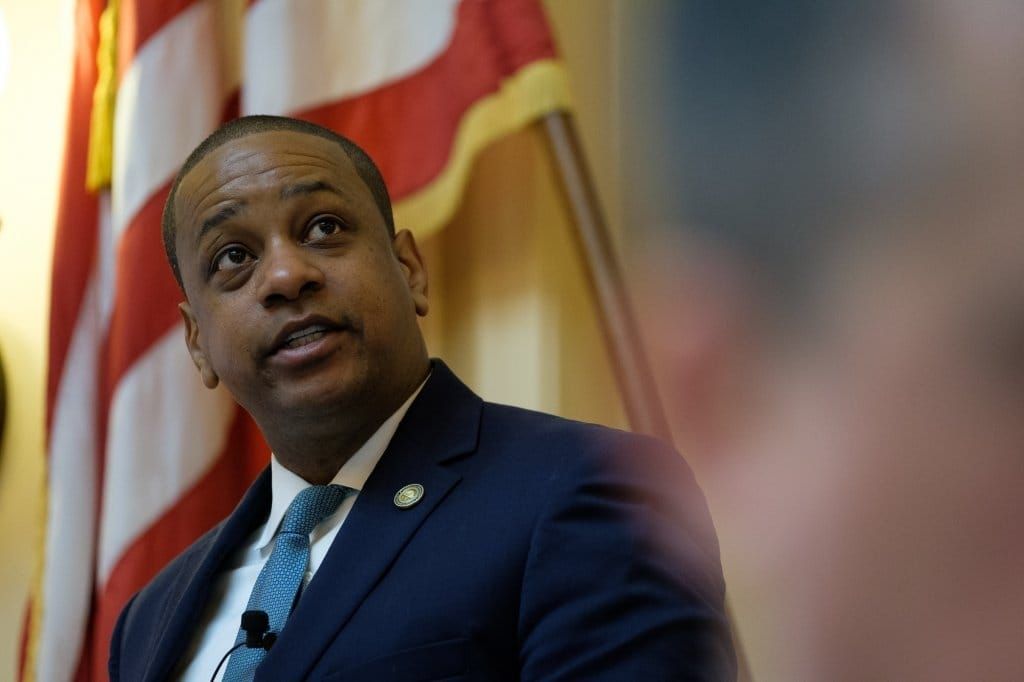
Former Virginia Lt. Gov. Justin Fairfax kills wife, then himself, police say
By Markus Schmidt (Virginia Mercury) Published: April 16, 2026
Former Virginia Lt. Gov. Justin Fairfax fatally shot his wife, Cerina Fairfax, before taking his own life early Thursday at the family’s home in Annandale, Fairfax County police said, in what authorities described as a sudden and tragic act of domestic violence amid a pending divorce.
Officers responded to the home just after midnight after one of the couple’s teenage children called 911, Fairfax County Police Chief Kevin Davis said during a morning news briefing. Both of the couple’s children, who are in high school, were inside the home at the time of the shooting.
“One of the children was the 911 caller,” Davis said, adding that the son described events that investigators have since corroborated through interior home surveillance cameras.
Police said Cerina Fairfax was shot and killed before Justin Fairfax took his own life. Davis said the violence unfolded quickly, with little or no gap between the shooting and the 911 call.
“If there was a window, it was a very short window,” Davis said. “I think it all kind of happened at once. It all happened pretty spontaneously.”
Authorities gather evidence, cite domestic strain in shooting
Authorities are executing a search warrant at the home to recover evidence, including the firearm used in the shooting and any additional weapons.
Davis described the case as both “high profile” and deeply tragic, noting Fairfax’s once-prominent political standing.
“At one point in time, I think it’s fair to say that Justin Fairfax was a rising star politically, not just in Northern Virginia, but in Virginia,” Davis said.
“So it’s high profile in nature. It’s tragic in nature, certainly a fall from grace for a relatively high-profile family that seemingly had a lot of things going in their favor.”
The couple had been separated but continued living in the same home in separate bedrooms, Davis said.
Divorce proceedings were underway, with court appearances scheduled in the near future. Fairfax had recently been served legal paperwork related to the case, which investigators are examining as a possible factor.
“That may have been a spark … that led to this tragedy,” Davis said, while cautioning that detectives are still working to determine a definitive motive.
Police said the department had previously been called to the home once, in January, after Fairfax alleged that his wife assaulted him. Investigators reviewed footage from cameras installed inside the residence and determined that no assault had occurred, Davis said.
The cameras later helped corroborate the sequence of events described by the 911 caller, he added.
Davis emphasized that authorities are prioritizing support for the couple’s children, who lost both parents in the incident.
“Our victim services division is leaning into the family, the surviving relatives, the children in particular,” he said. “We’ll do everything we can for them.”
He also noted the broader emotional toll of domestic conflict, particularly during separations.
“Half of America probably goes through divorce proceedings at some point in time, and very, very rarely, thankfully, does it ever end up like this,” Davis said. “It is very sad for this community.”
Virginia leaders react with shock, grief over Fairfax deaths
A wave of shock and grief rippled through Virginia’s political community Thursday, with officials expressing condolences and focusing on the Fairfax family’s children.
Former Gov. Ralph Northam said he and his wife Pam were “devastated by this heartbreaking news.”
“I had the privilege of getting to know the Fairfaxes while our families served together. We are praying for Cameron, Carys, and the entire Fairfax family during this incredibly difficult time,” he said.
Lt. Gov. Ghazala Hashmi said the news had shaken the commonwealth and that she was awaiting more details.
“Virginia woke up this morning to the devastating news regarding Cerina Fairfax and former Lieutenant Governor Justin Fairfax. My thoughts are with their children, loved ones, and numerous friends,” she said.
House Speaker Don Scott, D-Portsmouth, called the killings “an unspeakable tragedy.”
“Our hearts are with the family, especially the children and loved ones whose lives have been forever changed by this devastating loss,” he said.
House Minority Leader Terry Kilgore, R-Scott, said, “There aren’t words to describe this tragedy. My prayers are with their children and their extended family.”
U.S. Sens. Mark Warner and Tim Kaine said in a joint statement they were praying for the family “as we all process this shocking and horrifying news.”
Fairfax, 45, served as Virginia’s lieutenant governor from 2018 to 2022. A Democrat, he was elected alongside Northam and was once viewed as a potential future statewide candidate.
Fairfax’s political career was derailed in 2019 when two women publicly accused him of sexual assault. Fairfax denied the allegations, and no criminal charges were filed.
The accusations sparked national attention and calls from some Democratic leaders for his resignation, which he resisted.
Before entering politics, Fairfax worked as a federal prosecutor and later in private legal practice. After leaving office, he returned to practicing law, Davis said, though details about his recent employment were not immediately available.
The investigation into Thursday’s fatal shooting remains ongoing. Authorities said they are continuing to collect evidence and interview witnesses as they work to piece together the final hours leading up to the killings.
This is a breaking news story that will be updated as more information becomes available.
SUBSCRIBE: GET THE MORNING HEADLINES DELIVERED TO YOUR INBOX
Under bill passed by state Senate, New Orleans’ elected court clerk might not be able to take office
by Robert Stewart, Verite News New Orleans
April 9, 2026
Calvin Duncan, the clerk-elect for Orleans Parish Criminal District Court, won his seat in November 2025 by a wide margin — with 68% of New Orleans voters casting their ballots for him. But under a bill that passed the state Senate on Wednesday (April 8), he may never be sworn in.
Senate Bill 256, authored by Sen. John “Jay” Morris, R-Monroe, would merge the offices of Orleans Parish Criminal District Court clerk and Orleans Parish Civil District Court clerk, eliminating the position Duncan won decisively in November. Under the proposal, the consolidated clerk’s office would be run by Civil District Court Clerk Chelsey Richard Napoleon.
On Wednesday, SB 256 passed the Senate 25-11. The bill, which would only affect New Orleans, passed along party lines without a single New Orleans-based senator voting in favor. It now heads to the state House.
The bill as currently written would take effect upon Gov. Jeff Landry’s signature. So if it clears the House and is signed into law before Duncan’s inauguration in early May, he will not be able to assume office.
As SB 256 headed toward passage Wednesday evening, Sen. Royce Duplessis, a New Orleans Democrat, cast SB 256 as an attempt by white Republicans to seize power from Duncan — a Black Democrat from a majority-Black city — drawing on the state’s history of impeding Black elected officials from serving in office.
Standing at the lectern, Duplessis brought up the history of John Willis Menard, a black man who won election in 1868 to represent Louisiana’s 2nd congressional district. But after a lengthy challenge to his victory, he was never seated to the position.
“This will be recorded a century from now, two centuries from now,” Duplessis said. “What side are you on?”
Duplessis’ last-ditch effort to lessen the impacts of the bill — an amendment that would delay its effective date until May 4, 2030, the end of Duncan’s term — failed.
Morris argued that the scenario from the 1800s was “horrendous” but not applicable to his bill.
“That isn't what's happening here. The surviving clerk is African American herself, and she's a woman,” Morris said.
SB 256 is one of a number of bills under consideration in the legislature that seek to remake the New Orleans courts, which Landry has identified as a priority. Another bill sponsored by Morris — Senate Bill 217, which is scheduled for Senate floor debate next week — would cut the number of judges in New Orleans courts and strip Criminal District Court judges of their power to nominate and appoint magistrate commissioners. Nominations would instead be made by a committee appointed by the governor. A third Morris bill — Senate Bill 197, which would eliminate two judges in the state appeals court that has jurisdiction over the city — passed the Senate on Wednesday. Like SB 256, it did not receive any support from the New Orleans delegation.
And in the lower chamber, House Bill 911, sponsored by Baton Rouge Republican Rep. Dixon McMakin, would consolidate the criminal, civil and juvenile courts in the city. It is scheduled for debate on the House floor next week.
The measures have all gotten pushback from New Orleans elected officials, both in the legislature and in local offices, who accuse Republican state officials of attempting a power grab in the overwhelmingly Democratic city.
“Stripping Orleans Parish of its duly elected officials does not make our justice system more efficient or our streets safer; it makes our constituents less represented,” said New Orleans City Councilmember Aimee McCarron in a written statement.
‘Otherwise, we’d probably have to pay him for four years’
Morris has defended his bills as increasing efficiency and reducing costs for the city’s courts. During the debate over SB 256 on Wednesday, he argued that the two clerk positions are redundant and that by consolidating them, the state and New Orleans could save money and enhance efficiency of the courts.
Morris, who had originally introduced SB 256 to go into effect in August, successfully pushed an amendment to the bill on Tuesday so the law would go into effect immediately upon Landry’s signature. During floor debate Wednesday, he said the amendment was specifically designed to make sure Duncan did not get into office.
“Otherwise, we'd probably have to pay him for four years,” Morris said.
Duncan’s transition team, however, believes that Landry and Attorney General Liz Murrill are behind the move.
“Governor Landry and his lackeys want to overrule the voters and dictate what happens to us. It’s a slap in the face not only to the people who elected me, but to every voter across Louisiana,” Duncan said in a press release.
Landry’s office did not respond to a request for comment.
“That bill is not part of my Legislative package and I have had no involvement with the bill,” Murrill said of SB 256.
During last year’s clerk election, Murrill was highly critical of Duncan because of his past. Duncan was wrongfully convicted of murder and sentenced to life in prison in 1985. Following years of legal battles, he was released from prison in 2011 after pleading guilty to a lesser charge. A judge vacated that conviction in 2021.
His opponent in the race, incumbent Darren Lombard, accused Duncan of misrepresenting his exoneration, suing Duncan to attempt to stop Duncan from airing campaign ads declaring himself “exonerated” of the murder conviction. (Despite the contentious race, Lombard has said he hopes Duncan is able to take office, urging legislators to reject SB 256.)
Murrill piggybacked off of Lombard’s accusation that Duncan was misrepresenting his exoneration, and even wrote him a letter requesting he cease representing himself as “exonerated” to avoid further action from her office. His supporters pointed to that letter during recent arguments against SB 256.
“One cannot help but wonder, is this the action that she was describing,” said Emily Ratner, a co-chair on Duncan’s transition team, during a committee hearing on the bill.
Robert Collins, professor of urban studies and public policy at Dillard University and columnist for Verite News, pointed out that while it's impossible to know the intentions of the people who created the bills, civil rights and voting rights advocates are raising an alarm, because the effect of the bill is essentially removing elected officials who were elected in by a majority Black constituency.
“The result is going to be less Black public officials in the state of Louisiana, because you targeted the particular parish that has the highest proportion of black elected officials in the state,” Collins said.
Collins also said that an additional point of concern for some people is in the partisan nature of the bills. Some, he said, see the moves as an attempt by a Republican super majority in the legislature to get rid of Democratic elected officials in the city of New Orleans, weakening the power of the Democratic Party in the state.
“All of the offices that they're shutting down are Democrats,” Collins said. “I mean, all of them.”
This article first appeared on Verite News New Orleans and is republished here under a Creative Commons Attribution-NoDerivatives 4.0 International License.

What Is the Economic Impact of Data Centers? It’s a Secret.
N.C. Gov. Josh Stein wants state lawmakers to rethink tax breaks for data centers. The industry’s opacity makes it difficult to evaluate costs and benefits.
By Lisa Sorg
April 10, 2026
This article originally appeared on Inside Climate News, a nonprofit, non-partisan news organization that covers climate, energy and the environment. Sign up for their newsletter here.
Tax breaks for data centers in North Carolina keep as much as $57 million each year from state and local government coffers, state figures show, an amount that could balloon to billions of dollars if all the proposed projects are built.
Despite these generous subsidies, data center owners are legally allowed to shield many of their financial details from state oversight. They aren’t required to prove their ongoing eligibility for the tax exemptions unless they are audited by the state Department of Revenue. Lawmakers enacted sales and use tax breaks for data centers in 2010 and expanded them in 2015.
“At that time, no one could have predicted the explosive growth of data centers and how much energy they consumed,” Gov. Josh Stein told his Energy Policy Task Force, which met this week. “And because data centers at that point were a brand-new industry, they benefited from financial incentives to induce capital to invest. Those days are long gone.”
Consumers pay sales and use taxes on food, clothing, furniture, utility payments, general merchandise and other goods.
In North Carolina, data centers don’t pay sales tax on certain equipment—heating and air conditioning, computer hardware and software, and electrical infrastructure—if they meet county wage standards, provide health insurance to full-time employees and invest $75 million in private funds in a project within five years.
Sales and use taxes are the second-largest source of revenue for local governments, behind property taxes, according to the Department of Revenue. And a third of the state’s general fund comes from these taxes.
Nor do qualifying data centers pay taxes on electricity use. Under that exemption, a large project that consumes 100 megawatts of energy avoids paying as much as $2.2 million a year, state Commerce Department figures show. Because utility Duke Energy might negotiate project-specific terms with very large customers, this number could vary.
Data center operators don’t have to report the amount of exemptions they’ve claimed. Nor must they provide information that would allow an independent evaluation of the financial impact of their projects. In some cases, data centers contractually require local governments to keep electricity and water usage secret.
“State agencies have a limited view of the sector’s energy use and economic activity,” the Commerce Department wrote in a report to the energy policy task force.
Inside Climate News asked Microsoft and Google, two of the largest data center operators in North Carolina, to disclose the amount of their sales and use tax exemptions. Microsoft directed ICN to its website that lists general economic investments; Google did not respond.
Sen. Julie Mayfield, a Buncombe County Democrat who sits on the energy policy task force, said the legislature should reconsider tax breaks for data centers, consistent with its repeal of several clean energy incentives.
“If the original purpose was to incentivize data centers to come here, you could argue that the objective has been met,” she said.
The Commerce Department said it did not calculate the economic benefits of data centers because it doesn’t have the information it needs to do so. Lawmakers would have to change the reporting requirements “to know the true value of the exemptions.”
Scott Mooneyham, a spokesman for the NC League of Municipalities, said the group hasn’t taken a position on the tax exemptions. For some member cities and towns, data centers, when appropriately sited, “have been seen as a huge boost to property tax revenues,” he said. “Others have been concerned about proposals that, based on the potential sites, could create quality of life issues for residents and damage surrounding home values.”
Google has operated a large data center since 2007 in Lenoir, a small town in Caldwell County at the foothills of the Blue Ridge Mountains. The company says it has invested $600 million in the project and plans a $1 billion expansion.
Yet it’s difficult to know how Google’s presence has influenced the county’s economy. Caldwell is a Tier 1 county, a Commerce Department designation for those most economically distressed.
In media reports, the company has said 400 people work at the data center, but the precise number of employees is a “trade secret,” according to an agreement signed in 2024 with the county and city. Google’s energy, water and sewer use is also confidential.
Caldwell County and Lenoir also gave Google property tax incentives, contingent on the company’s financial investments for the expansion, which includes the creation of 30 additional jobs. Google paid roughly $5.2 million in property taxes last year, county records show, nearly 10 percent of the county’s total property tax collection.
At the energy task force meeting, Rep. Pricey Harrison, a Democrat from Guilford County, asked commerce officials to include two metrics if they can eventually analyze the costs and benefits of data centers: residents’ health impacts and quality of life.
“It’s not all numbers,” she said.
Tug-of-war for NC mountain hospital beds takes a turn
by Lucas Thomae, Carolina Public Press
April 10, 2026
When AdventHealth broke ground on its long-awaited Weaverville hospital on March 26, the Florida-based health system envisioned a hospital with hundreds of beds — one which could eventually rival that of HCA-owned Mission Hospital, which currently dominates the Asheville market.
That plan, however, was thrown into doubt last week when the state Department of Health and Human Services chose to award 95 additional acute care beds to Mission rather than the new Weaverville hospital.
In all there were 129 acute care beds up for grabs, which HCA, AdventHealth, Novant and UNC Health jockeyed over in a competitive review process.
[Subscribe for FREE to Carolina Public Press’ Daily, Weekend and Election 2026 newsletters.]
AdventHealth made those beds a key part of its expansion plans for the new Weaverville hospital, and had good reason to think they’d get them after besting HCA in two previous certificate of need applications.
Ultimately, the state bucked that trend and gave most of the beds to HCA to expand Mission Hospital, bringing that facility to a total of 828 beds. DHHS gave the 34 remaining beds to Novant to build a new community hospital in Arden, which will serve southern Buncombe County.
Critics of the decision said that DHHS failed to consider Mission’s ongoing issues with immediate jeopardy citations, which have led the federal Center for Medicare and Medicaid Services to go as far as to threaten pulling crucial federal funds from the hospital.
In 2019, Tennessee-based HCA purchased the regional Mission Health chain, which until that point operated as a nonprofit. Since then, the group’s flagship hospital in Asheville has struggled with staffing issues and poor marks from inspectors, while the entire group faces regulatory action and litigation from the NC Department of Justice over service since the acquisition.
A survey by federal regulators at Mission Hospital last year uncovered preventable death, unsafe patient transport and harmful infection protocol.
Aaron Sarver, a spokesperson for Reclaim Healthcare WNC, a nonprofit focused on holding HCA accountable in its operation of Mission Health, told Carolina Public Press that the region remains reliant on Mission Hospital as its primary tertiary care facility and only trauma center.
However, many residents in need of medical care now seek alternative facilities when possible because of Mission’s noncompliance issues, he said.
“It’s safe to say that our community has lost trust in Mission,” Sarver said.
“By not adequately considering the enforcement history at Mission and the need for real competition in the region, DHHS has failed (Western North Carolina) with this decision.”
More certificate-of-need battles on horizon
The first phase of AdventHealth Weaverville is a 67-bed facility which company leaders said will create 1,300 jobs and fill the health-services gap that currently exists in northern Buncombe, Madison and Yancey counties.
Getting the certificate of need required to begin construction was a battle in itself because of a years-long appeals process by HCA, who wanted those beds for Mission.
In December, the North Carolina Supreme Court refused to hear HCA’s final appeal, allowing AdventHealth to finally begin work on the hospital.
During his remarks ahead of the groundbreaking ceremony, Gov. Josh Stein said the Weaverville hospital would “increase competition among hospitals in Western North Carolina, which ultimately benefits patients by lowering cost and improving quality.”

But further legal fights await AdventHealth, which has ambitious plans to continue adding beds in Weaverville.
In 2024, DHHS awarded AdventHealth 26 more acute care beds to expand its planned Weaverville hospital. HCA appealed that decision too, and AdventHealth spokesperson Victoria Dunkle told CPP that they expect a ruling from an administrative law judge in the coming weeks.
“These beds are an important addition to the 67 beds already approved for AdventHealth Weaverville,” Dunkle said.
Meanwhile, AdventHealth is considering whether to flip the script on HCA and appeal DHHS’ most recent decision to award 95 beds to Mission Hospital. Dunkle said AdventHealth is “evaluating appeal options that honor the community's needs and voice.”
“Based on the recent health care access and quality concerns in our region, we do not believe the decision is in the best interest of our community and will have profound impacts,” she added, making a veiled reference to Mission’s multiple immediate jeopardy citations.
DHHS disregards HCA compliance issues
In its findings from the competitive review, DHHS seemed to favor Mission because of its broader scope of services.
The findings briefly touched on Mission’s troubles with federal regulators in a section which required applicants to prove that “quality care has been provided in the past.”
In its application, HCA admitted that Mission Hospital had recently received an immediate jeopardy citation that had yet to be officially resolved, although corrective actions had been taken.

Despite that, DHHS determined that HCA had done enough to show “sufficient evidence” of quality care across all six facilities it operates in North Carolina. No further mentions of quality of care concerns at Mission Hospital appeared in DHHS’ findings.
Another factor DHHS considered was geographic accessibility, in which it gave the edge to Novant for its proposed facility in Arden. In the end, the state divided the 129 beds between HCA and Novant, cutting AdventHealth out completely.
While HCA’s Mission Health group is a major presence in the region and Florida-based AdventHealth operates hospitals in nearby Hendersonville and Columbus, Winston-Salem-based Novant has not had a big presence in the state’s mountain region previously, though it is a major player in the hospital industry across North Carolina.
Why not Weaverville?
While the DHHS decision put a damper on AdventHealth’s plans in Weaverville, mayor Dee Lawrence told CPP he’s optimistic that future certificate of need applications will open up and allow the hospital to keep growing.
“We have to respect the process that the state has,” he said. “We hope that they would start believing that it's better to give the public more options than less.”
For now, 67 beds is a good start in a region that Lawrence described as a “health care desert.”

An emergency department serving northern Buncombe County, which is more easily reachable by residents of neighboring counties like Madison and Yancey, is a welcome development, Sarver agreed.
“It’s important for people not from (Western North Carolina) to understand that the geography means that it can easily take more than an hour for an ambulance to reach Asheville where Mission is located,” he said.
“Giving those folks a closer option for care is important, as evidenced by the broad support Advent had from representatives of those local governments.”
This article first appeared on Carolina Public Press and is republished here under a Creative Commons Attribution-NoDerivatives 4.0 International License.

A new immigration strategy shakes agro-industrial rural towns
by Mónica Cordero, Investigate Midwest, Investigate Midwest
April 8, 2026
Eliseo Affholter noticed a car following him, moving slowly as he walked through the streets of Milan, Missouri.
Walking was his wind-down routine after work at a Kraft Heinz plant, where on Feb. 24, he had just finished a 12-hour overnight shift.
As he walked along East Grand Avenue, he saw flashing lights and vehicles lined up behind a stopped car, including patrol cars, an SUV and a pickup truck.
As Affholter stepped closer, he raised his phone to record.
One agent identified himself as an officer with U.S. Immigration and Customs Enforcement (ICE) and asked in Spanish what country Affholter was a citizen of. “From here,” Affholter replied.
“Do you have papers? …Are you legally in the United States?” the agent asked, as two others stood nearby.

He stopped recording when an officer grabbed the phone from his hand, according to Affholter.
When he asked why he was being detained, he said one agent responded in English: “We have the right to assume that you're an illegal alien.”
That same day, federal immigration agents arrested three people in Milan, including two men from Senegal and another from Guatemala.
Over the past year, President Trump’s deportation campaign has reached deep into agricultural regions that rely heavily on immigrant labor, including raids on farms and at meat-packing facilities.

Milan, a north Missouri town of about 1,800, is home to a large Smithfield Foods pork processing plant. The Kraft Heinz plant, where Affholter worked, is 33 miles east in Kirksville.
But the February arrests in Milan did not take place inside the local meatpacking plant; they occurred along nearby roads and in residential areas where workers live and travel to and from their shifts.
“They may not be going into the plant, but they’re in the community,” said Axel Fuentes, executive director of the Rural Community Workers Alliance, a worker advocacy organization that supports immigrant and refugee food industry workers in rural Missouri.
Any immigration enforcement expansion within agricultural communities could have been aided by a September 2025 U.S. Supreme Court decision that broadened the scope of what agents can consider “reasonable suspicion.” Arrests appeared to increase after the decision, which allowed agents to consider a mix of factors, including apparent race or ethnicity, language or accent, location, and type of work, when making stops.

“Some would say that the Supreme Court, in effect, encouraged ICE to engage in racial profiling in immigration enforcement,” said Kevin R. Johnson, a law professor at the University of California, Davis School of Law. “The truth of the matter is, I think that’s accurate.”
Johnson said such practices have long been permitted under Supreme Court precedent. In a 1975 decision, United States v. Brignoni-Ponce, the Supreme Court ruled that immigration agents cannot stop someone based solely on “Mexican appearance,” but may consider it as one factor among others.
Affholter, 36, is a U.S. citizen of Maya descent, born in Guatemala. He arrived in the United States at 13 and was later adopted by a white American man. He has lived here for most of his life.
In a statement, an ICE spokesperson said Affholter “deliberately interfered” with a federal operation and “verbally” assaulted agents, prompting officers to question him about his immigration status and request identification.
“I feel like I’m an animal, like I’m worthless,” Affholter said. “Like I don’t deserve to be here… because of my skin color, because of the language I speak. I speak Spanish, English and Mayan.” Affholter was referring to Mam, an Indigenous Mayan language spoken in the western highlands of Guatemala and the state of Chiapas, Mexico.
Across Milan, residents told Investigate Midwest that there is fear immigration enforcement will not only target workplaces but also neighborhoods and streets.
In the first months of his presidency, Trump sent federal agents to farms and agricultural operations, drawing backlash from some supporters who said the actions made it harder to hire undocumented workers, who make up 44% of all farm workers, according to U.S. government surveys.
Trump announced a temporary pause on raids in the agriculture and meat-processing sectors, only to reverse the decision days later.
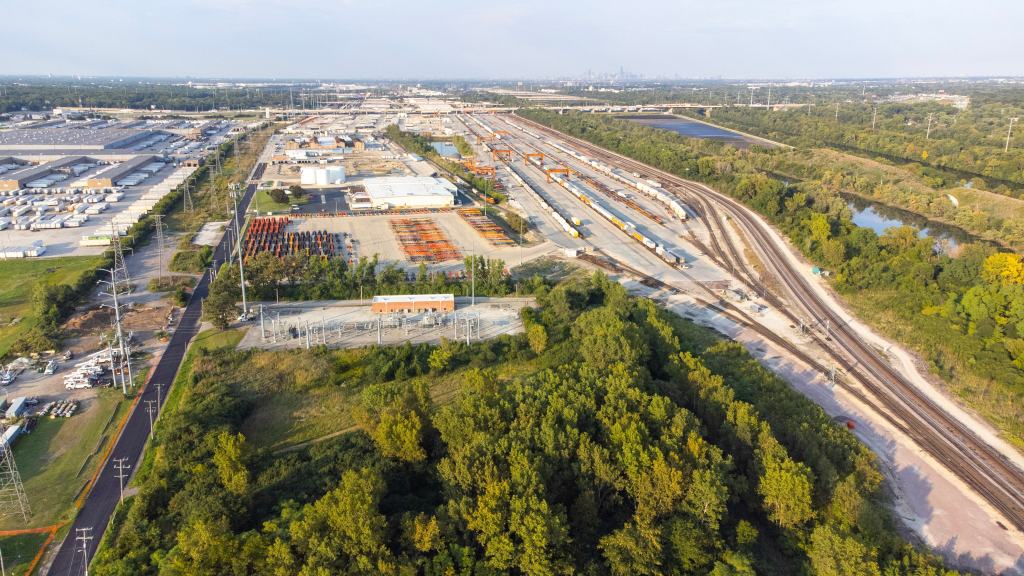
By early February 2026, more than 68,000 immigrants were being held in ICE detention nationwide, according to the Transactional Records Access Clearinghouse at Syracuse University. Most were arrested by ICE, and nearly three-quarters had no criminal conviction, often only minor offenses like traffic violations.
Although there is no publicly stated directive establishing a formal shift in strategy, advocates and residents say enforcement is increasingly occurring outside plants.
“Since last year, we’ve seen arrests following routine court appearances, such as for traffic violations, where people are then transferred into federal custody,” Fuentes said.
A family divided and displaced
One of the people arrested by ICE in Milan was Victorino Martínez-Chávez, 46, a Guatemalan national, who worked a cleaning shift at the Smithfield meat-processing plant, the town's largest employer, according to state workforce data.
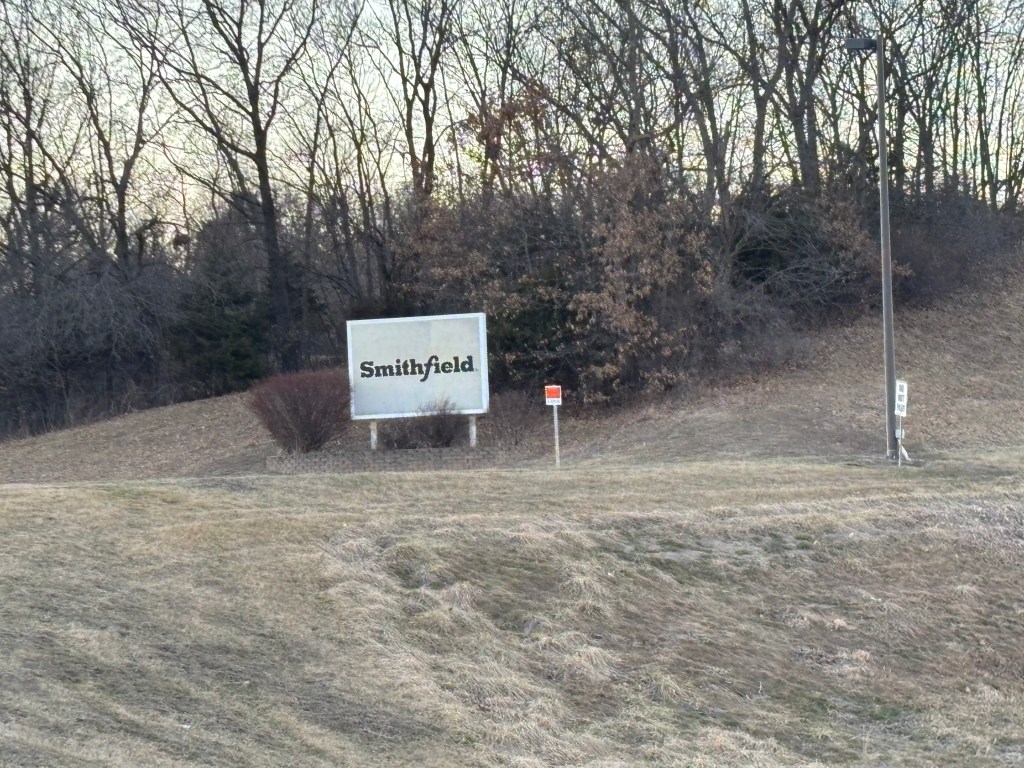
In a statement, an ICE spokesperson said Martínez-Chavez, who had previously been deported, was arrested during a targeted enforcement operation and had “refused to obey lawful commands to exit his vehicle, threatening officer safety and forcing officers to remove him from the vehicle.” The spokesperson added that Martínez-Chavez had previously been deported and reentered the United States, which is a felony offense.
Affholter’s video of the arrest, which was reviewed by Investigate Midwest, shows the driver’s side window of Martínez-Chávez’s vehicle already broken when ICE agents left the scene.
Two other men — Serigne Ciss, 33, and Thierno Amar, 33, both from Senegal — were also arrested, according to ICE. The agency said they had entered the United States after crossing the “border illegally” during the Biden administration, according to an ICE email.
Minutes before his arrest, Martínez-Chávez had dropped off his daughter and other children at school.
At home, his wife, who asked not to be identified for fear of retaliation, was waiting for him to return home when she received a call from her stepdaughter, who said Martínez-Chávez had been detained.
“I started crying,” the wife, 42, recalled. “Who’s going to take care of me now?”

Martínez-Chávez was the sole breadwinner. His wife does not work outside the home and cares for the three youngest children, including one who is just 18 months old. She does not speak English and speaks limited Spanish; her primary language is Mam.
The wife moved to the United States three years ago to join her husband, who was already living in the community. That morning, beyond the fear, they faced immediate uncertainty: a pending paycheck and a week of vacation time they were unsure would be honored.
Days before the arrest, Martínez-Chávez’s wife learned she was pregnant. Although she wants to return to Guatemala to reunite with her husband, who has already been deported, an error on her baby’s birth certificate has prevented her from obtaining a passport to take him out of the country, leaving her effectively trapped.
A workplace under pressure
Over the past several decades, the meatpacking industry has shifted from major urban centers to smaller rural communities closer to livestock production, driven by larger-scale plants and changing supply-chain economics. Access to labor remains critical everywhere.
There are more than 7,000 inspected meat, poultry, and egg processing plants operating across the country, with more than one-fifth in rural and nonmetropolitan areas, according to the U.S. Department of Agriculture. Missouri ranks 14th among states in the number of meatpacking plants.
This shift has brought new economic life to many small towns, including Milan.
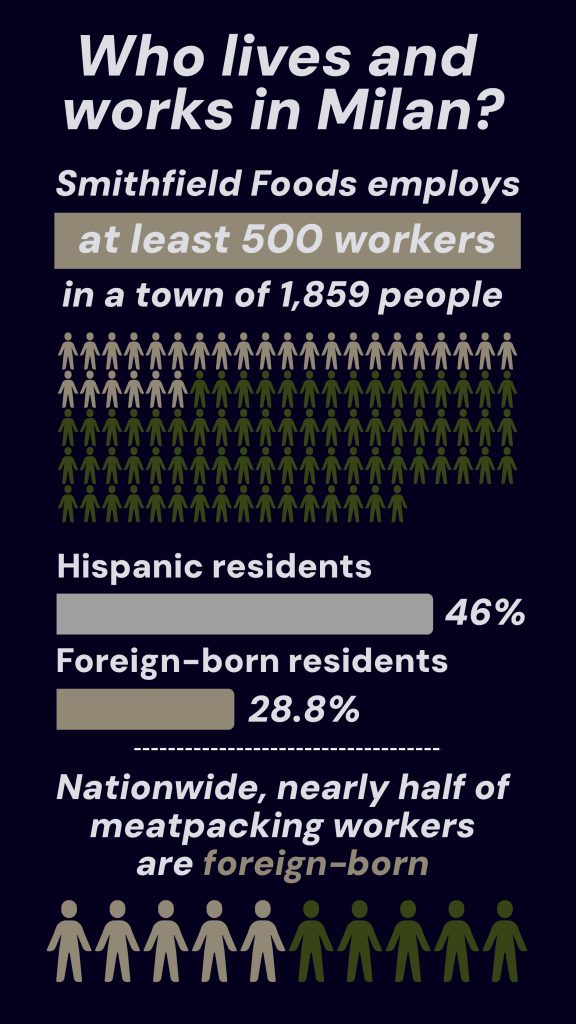
The Smithfield facility in Milan is classified as a large plant, employing at least 500 workers, a workforce equivalent to more than a quarter of the town’s residents.
Nearly half of residents identify as Hispanic, and more than a quarter were born outside the United States, more than double the rate in Missouri.
Nationwide, nearly half of meat-processing workers are foreign-born workers, according to a 2022 report by the American Immigration Council.
“The American economy, and particularly the American food system, is entirely dependent on various forms of immigration, both legal and not so legal,” said Elizabeth Cullen Dunn, a geography professor at Indiana University who studies migration and labor.
She said enforcement actions are often designed to be visible without disrupting production.
“They don't want to shut the meatpacking plants down,” she said. “That would cost the meatpacking companies millions of dollars a day.”
While Milan’s Smithfield plant was not raided in February, the effects of area arrests were felt the following day.
Ray Atkinson, senior director of external affairs at Smithfield, said in an email that “there was no interruption to our business on Tuesday and we have not had any staffing issues,” referring to the day of the ICE arrests.
Workers described a different reality.
Four plant workers, who asked not to be identified for fear of retaliation, said operations began later than usual on Wednesday because several overnight sanitation workers failed to report for work. Some were afraid to leave their homes after the arrests, according to the workers.
The burden shifted onto those who showed up.
A man in his 50s who has worked at the Smithfield plant for about two decades said the pace of repetitive hand movements had increased, raising the risk of injury.
“With the faster pace, you could cause an accident or cut a coworker… our hands are constantly moving, and we’re working with knives.”
A woman in her late 40s said that with fewer workers, breaks have become harder to take. She said employees are typically allowed to use the bathroom twice per shift.
Atkinson did not respond to a follow-up email seeking comment on the reported disruptions.
While the workers described short-term disruption, the company has warned investors about broader labor shortages, particularly in rural areas where some of its operations are located.
In its latest annual filing, Smithfield said that new immigration legislation could increase the costs of recruiting, training and retaining employees, as well as compliance costs related to reviewing workers’ immigration status, and could lead to employee shortages. The company also said that increased enforcement of existing immigration laws by government authorities could disrupt portions of its workforce or operations.
In poultry plants, workers may process as many as 140 birds per minute, said Navina Khanna, executive director of the HEAL Food Alliance, a national coalition that works with food system workers. In pork processing facilities, workers can repeat the same cut up to 9,000 times a day.
The risks are not new, but they can intensify when fewer workers are on the line. A recent study by the U.S. Department of Agriculture found that 81% of poultry-processing workers and 46% of pork-processing workers face an increased risk of musculoskeletal disorders, conditions typically characterized by pain and limitations in mobility and dexterity, that can limit a person’s ability to work and participate in daily life.
Concerns about working conditions in meatpacking plants have surfaced in other parts of the country. Last month, at a JBS beef plant in Greeley, Colorado, workers went on strike, citing unsafe conditions, fast line speeds and limited breaks, according to The Associated Press.
With fewer workers on the line, there is less oversight to ensure “any kind of safety,” forcing employees to work “faster” and “longer,” Khanna said, adding that the combination of staffing shortages and increased line speeds is making conditions “more dangerous” for workers.
Economic effects in a rural town
In many rural communities, immigrant workers are not only part of the labor force but also a key source of economic stability. Research shows they contribute more in taxes than they receive in public benefits and help offset population decline, a trend that has become especially important in small towns across the Midwest.
In congressional testimony in 2023, David Bier of the Cato Institute, a Washington-based public policy research organization, said immigrants “generate, in inflation-adjusted terms, nearly $1 trillion in state, local, and federal taxes, almost $300 billion more than they receive in government benefits.”
At the center of Milan is the courthouse. On the surrounding four blocks, at least one business on each corner is tied to the town’s Latino community.
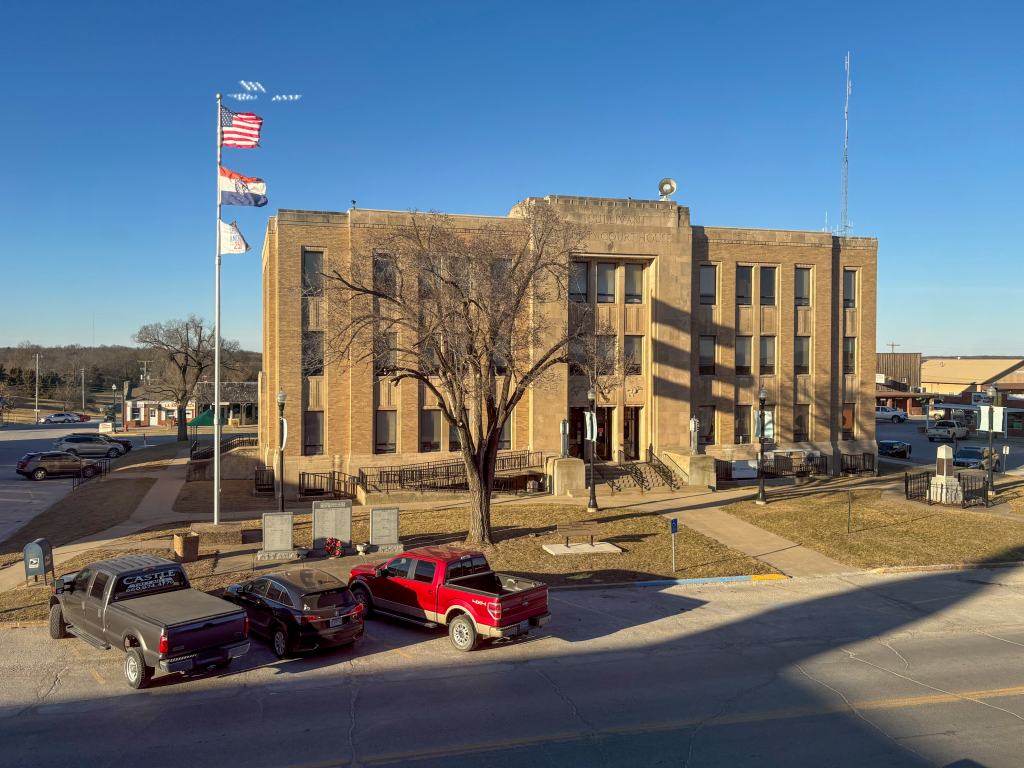
“It’s very, very difficult,” said an immigrant from Guatemala who has lived in Milan for nearly two decades. “It makes my stomach turn to think that you keep fighting and fighting, and the problems don’t go away.”
The woman, who asked not to be identified for fear of her immigration status, owns a restaurant and a small grocery store that operate out of the same space. She said she started her own business so she would not have to rely on false documents to work and so she could contribute to the town’s economy.
She said fear in the community over current immigration policies has hurt her business.
“They’re pushing us into a corner,” she said. “You feel like sooner or later, it’s your turn.”
On a good day, she said, she used to make about $1,000. Now, her sales can sometimes drop to around $100.
She also operates a money-transfer service. She said weekly money transfers, called remittances, once reached about $40,000 but dropped to roughly $6,000 in the last week of February.
She said the decline in sales began in 2025 and has forced her to reduce inventory. She used to travel to Kansas four or five times a month to restock products. Now she goes twice, sometimes only once.
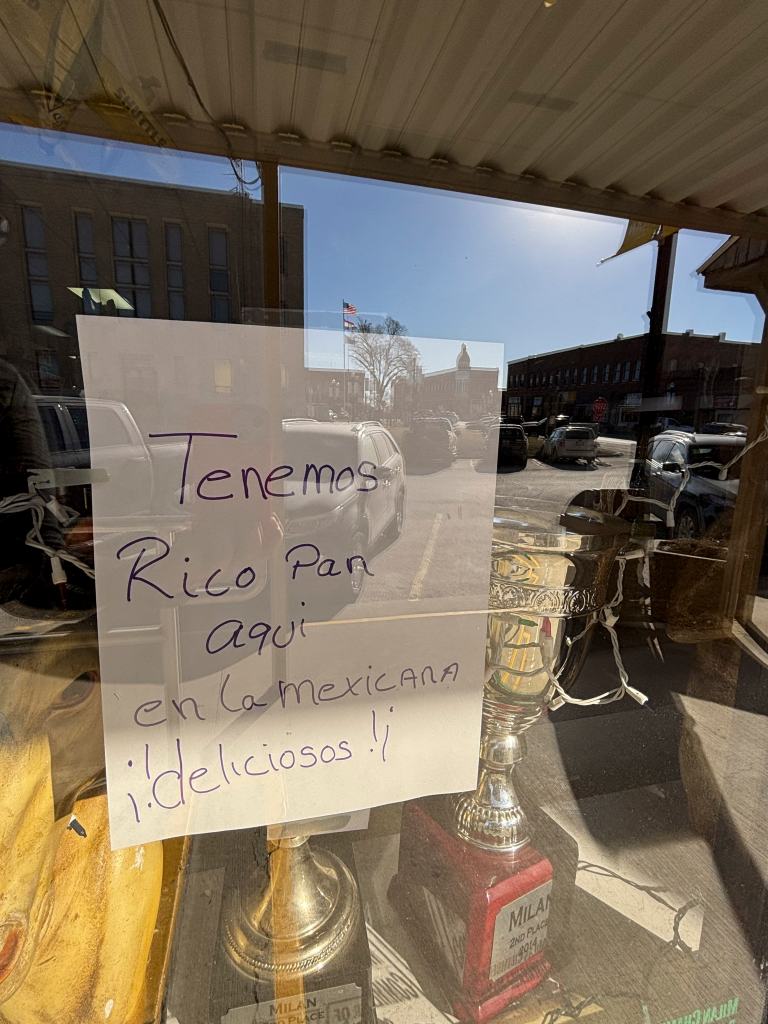
At another store in downtown Milan, money-transfer services have dropped by about half. The owner said she now carries about 15% of the goods she once stocked.
“You can’t start rounding up and deporting people, and terrorizing, and getting people to self-deport, when they make up about 20% of the workforce without expecting major negative impacts on the economy,” said Daniel Costa, director of immigration law and policy research at the Economic Policy Institute, a Washington-based think tank.
Meat and poultry processing employs about 560,000 workers nationwide, with a combined payroll of $30 billion, underscoring how deeply local economies depend on the industry, according to the Economic Policy Institute.
The economic effects extend beyond daily routines and local businesses.
Another woman, who also asked not to be identified because of her immigration status, said fear has reshaped even the most routine parts of her family’s life.
She avoids going to Walmart on weekends, she said, because the nearest store is a 45-minute drive — and she worries she could be stopped along the way.
She has two children, ages 7 and 9. The younger child is autistic. Weekend outings, once a regular activity, have largely stopped. The family used to go to Pizza Hut, something the children looked forward to.
Her older daughter has begun to grasp the situation.
“She says that when she grows up, she hopes she’ll be able to fix our papers so we don’t have to live with this fear all the time,” the woman said.
Affholter, the Kraft Heinz employee temporarily held in Milan, has lived in the U.S. for roughly two-thirds of his life. But the possibility of being stopped on the street because of his appearance has made him question his place in a country he considers his own.
“What I am experiencing now is not normal. I can’t accept that this is normal,” he said. “Because that’s not the America I know.”
Asked what he meant, he paused.
“That we are all equal,” he said. “That we are all free. No matter your roots, no matter your color, no matter what language you speak.”
This article first appeared on Investigate Midwest and is republished here under a Creative Commons Attribution-NoDerivatives 4.0 International License.

‘Language lost. Culture lost’: In Milwaukee, a race to keep Rohingya language alive in exile
by Paul Kiefer / Wisconsin Watch and Joe Timmerman / Wisconsin Watch
April 7, 2026
Highlights from the story:
- Decades of repression and ethnic cleansing in Myanmar have driven most Rohingya from their western Myanmar homeland.
- Several forms of written Rohingya have emerged in the diaspora, but none has reached widespread use among a scattered population.
- A small group in Milwaukee, home to what may be the country’s latest Rohingya population, is testing whether teaching a written form of Rohingya can help preserve the language.
- Advocates face a major hurdle: persuading families to prioritize learning Rohingya alongside work, school and resettlement.
- Similar efforts among Hmong refugees in the Midwest suggest a written language can take hold — but only with sustained community buy-in.
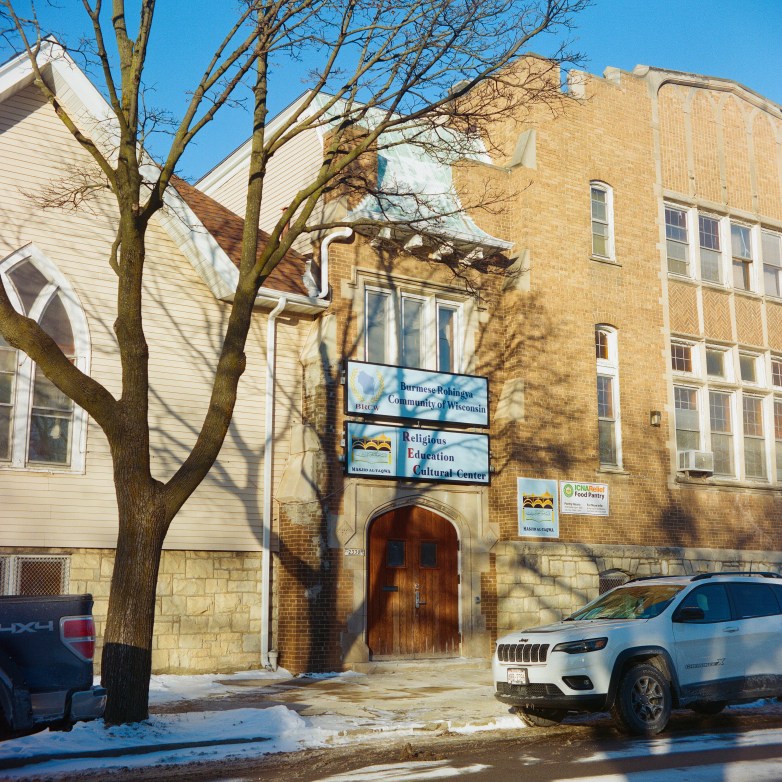
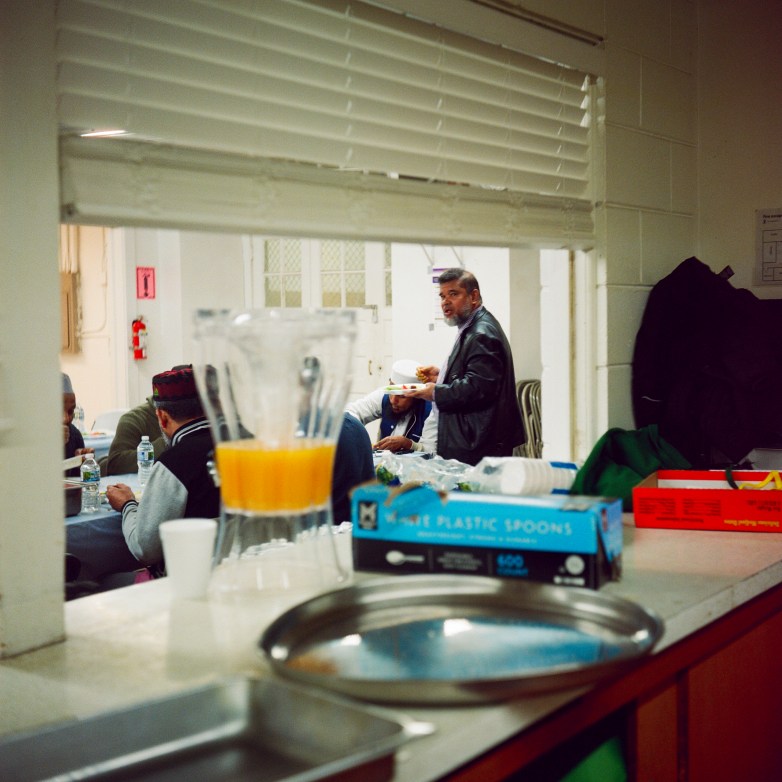
A dozen fasting teenagers filed into the basement of a community center on Milwaukee’s South Side in mid-February to mark the first night of Ramadan around folding tables. The building belongs to the Burmese Rohingya Community of Wisconsin (BRCW), a bare-bones nonprofit serving hundreds of local Rohingya refugee families. Brand-new carpets muffled the sounds of worshippers in the mosque one floor up.
Nearly everyone in the nonprofit’s Clarke Square community center spoke Rohingya, but not a single printed word in the language appeared on the whiteboards in the center’s classrooms where recent arrivals study English and prepare for citizenship exams. Flyers advertising a food giveaway were in English, as were posters listing prayer times and an illuminated sign over the center’s front entrance.
Printed Rohingya words could be found only in a small stack of children’s books and loose-leaf dictionaries in an office just off the prayer hall — raw materials for an experiment in cultural preservation.

Hardly anyone passing through the community center can easily read a sentence in Rohingya.
Decades of state-sanctioned repression and ethnic cleansing have driven most Rohingya from their western Myanmar homeland. Several forms of written Rohingya have emerged in the diaspora, but none has reached widespread use among the scattered diaspora. Without an agreed-upon alphabet or enough people literate in Rohingya to teach it, community leaders worry the language will wither, taking with it a core part of a culture already frayed by displacement and state-sanctioned violence.
Milwaukee is now a proving ground for Rohingya literacy. If this community center with a tiny volunteer staff can build an audience for Rohingya language education — in the city likely home to the country’s largest Rohingya population — momentum could spread, boosting the language’s chances of surviving in exile.
It’s a big if.
What does it take to preserve a language that’s rarely written down? The center’s indefatigable co-founders, a Dallas-based linguist and an international network of Rohingya scholars are trying to figure it out.
From Myanmar to Milwaukee
Mohamed Anwar is always on the move. Even while juggling a half-dozen jobs, the BRCW co-founder leaves a few gaps in his schedule to help refugee families navigate their new country.
He, too, came to Milwaukee as a refugee.
Anwar grew up on a knife’s edge. Since gaining independence from Britain in 1948, Myanmar’s government has chipped away at the rights of the Rohingya, a Muslim ethnic group in a majority-Buddhist nation. In 1982, when Anwar was 7, the Myanmar government stripped the Rohingya and other disfavored groups of citizenship, leaving millions stateless.
Anwar managed to secure a high school diploma and an undergraduate degree — the latter a rare accomplishment for a Rohingya student of his generation. But with prospects dimming and the threat of state-sponsored violence mounting, Anwar set aside his graduate studies and fled, joining thousands of other Rohingya refugees risking death and enslavement to reach Malaysia.
He remained in Kuala Lumpur for over a decade, initially surviving on low-wage jobs until he eventually crossed paths with United Nations outreach workers.Recognizing his talents, the U.N. brought him on as a translator.
When the State Department approved his family for resettlement in the U.S. as refugees in 2015, Anwar landed in Milwaukee, where a few friends had already begun putting down roots.

Even a decade ago, the city’s Rohingya community was large enough for Aurora Health Care to require interpreters. Anwar was a natural fit for the job.
Like other specialists, health care interpreters must pass a certification course. “They had no one to test me in Rohingya,” Anwar recalled. Without an agreed-upon alphabet, a written test was also off the table. His examiners took his time with the U.N. as proof of his fluency, and he has since taken charge of recruiting and training new Rohingya interpreters for the hospital system.
Milwaukee becomes a magnet
BRCW estimates more than 4,000 Rohingya live in the Milwaukee area -- an educated guess, but a difficult one to confirm. Roughly half of the more than 13,000 refugees resettled in Wisconsin since 2012 came from Myanmar, but the State Department resettlement statistics do not distinguish between Rohingya and other refugees from the country.
The city has become a magnet for Rohingya refugees who first settled elsewhere in the United States, drawn by cheaper housing, abundant jobs for immigrants with limited English, a strong support network and private Islamic schools. That pattern shows up in BRCW outreach data: 17% of phone numbers collected by 2020 had out-of-state area codes — some belonging to families whom the nonprofit helped relocate from as far away as New Hampshire.
Most Rohingya families have settled on Milwaukee’s South Side and southern suburbs, with a growing number purchasing homes within walking distance of BRCW’s community center. Anwar himself owns a few nearby properties, renting them to Rohingya newcomers finding their footing in the city.
The city’s public institutions are trying to keep pace with the community’s growth. Milwaukee Public Schools began translating notices for parents into one version of written Rohingya at least five years ago and has published a Rohingya translation of this year’s parent handbook. In mid-January, a Milwaukee Health Department official called BRCW to ask whether the agency should offer Rohingya translations using a Latin script, a script derived from Arabic and Urdu or audio recordings.
BRCW co-founder Andrew Trumbull says audio recordings are the only viable means of reaching most new arrivals, at least for now.
The nonprofit offers English classes, but many Rohingya adults have little free time between long shifts and family responsibilities. Parents often rely on their children as interpreters, but translating technical terms into Rohingya is a stretch for children who have never formally studied the language.
A volunteer effort takes shape
Trumbull sticks out in the halls of the BRCW community center. He doesn’t speak Rohingya, doesn’t pray in the center’s mosque and has no family ties to Rohingya Milwaukee, but he’s been there from the start. A decade after helping get the nonprofit off the ground, the self-described weekend warrior spends much of his scarce free time applying for grants and managing English-language communications in the cluttered office he shares with Anwar.

The pair met through Anwar’s brother, for whom Trumbull acted as a tutor and Milwaukee tour guide as the former settled into his new city. They soon launched BRCW, with Anwar managing community affairs and Trumbull managing relationships with government agencies and nonprofit peers — both as volunteers.
Trumbull’s enthusiasm for Rohingya language preservation is partially motivated by his own feelings of cultural loss. He spent most of his childhood in Germany, but after moving to the U.S. at age 11, he refused to speak his grandparents’ language. “I wanted not to be different, so I did not speak German,” he said. While he doesn’t compare his experience to those of refugees, he’s watched similar assimilatory pressures play out among Rohingya children in Milwaukee.
“All of the Rohingya parents know that the Rohingya language is dying,” he said. “The question is what they can do about it.”
For now, a small selection of children's books and a Rohingya-to-English dictionary offer the closest thing to a Rohingya literacy curriculum in the U.S. Trumbull hosts a digital version of the dictionary on the center’s website; the physical copies in his office are the leftovers from a pile passed out to families. Without a grant to support a more structured distribution program, Anwar and Trumbull are “field-testing” the materials by handing them out whenever they can and seeking feedback.
An episode of the Sesame Workshop International series "Playtime With Noor & Aziz," which was introduced to refugee children after field testing in Milwaukee.
Another source of Rohingya-language learning aids: “Sesame Street.”A series of episodes starring puppet siblings Noor and Aziz — characters introduced in 2022 for refugee children in Bangladesh — also went through field-testing in Milwaukee with the help of Anwar, Trumbull and BRCW.
Searching for a written form
The written Rohingya materials on display at BRCW are the product of decades of work by Rohingya linguists.
An earlier form of written Rohingya died out roughly 200 years ago, said Dallas-based linguist Miranda Kuykendall; the reasons for its extinction remain unclear. Revival efforts took off in the 1980s, when a Rohingya academic in Bangladesh developed the Hanifi script by adapting the alphabet family used to write Arabic and Urdu.
By the turn of the century, a Rohingya engineer in Saudi Arabia introduced a Latin alphabet alternative — a more straightforward option for standard keyboards.
“Different pockets of the Rohingya population prefer different scripts for different reasons,” Kuykendall said. For Rohingya students familiar with Arabic through religious education, the Hanifi script may be more approachable, and pilot programs in Bangladesh teach the script to some refugee children. The Latin-based script is familiar to the growing Rohingya diaspora in North America, the United Kingdom and Malaysia, where the primary languages rely on the Latin alphabet.


Kuykendall, the Rohingya language program manager for Texas nonprofit International Literacy and Development, helped roll out the Rohingya-to-English dictionary and partnered with nonprofit publisher Books Unbound to release a picture dictionary for younger audiences. The same network of collaborators is now developing a Rohingya translation app.
Though her team included multiple Rohingya scripts in the dictionary, Kuykendall noted that children of Rohingya parents born or raised in the U.S. typically find the Latin script version of the language, also called “Rohingyalish,” far easier to pick up.
That isn’t necessarily the case for Rohingya-speaking adults — even those already literate in several other languages. “It’s difficult for me to read,” said Anwar, squinting at a page of a picture dictionary. “I never got a chance to learn.”
Kuykendall and BRCW say boosting adult literacy could be transformative for Rohingya refugee communities, with written Rohingya serving as a useful counterpart for teaching English.
But in Anwar and Trumbull’s view, children and young adults are more likely to have time for the Rohingya literacy materials now in the informal testing process in Milwaukee.
For some young people, the pitch might be practical: Learning written Rohingya could help teenagers translate technical language and complicated documents for their parents. For others, the draw could be more existential. “When they become preteens and teenagers,” Trumbull said, they might “grasp the importance of what it means to have lost their language.”
Even if the nonprofit can muster a critical mass of interested young people interested in Rohingya literacy, Trumbull noted, BRCW lacks money and bandwidth to organize formal classes.
The nonprofit seeks grants to support structured outreach, including its earlier work with “Sesame Street.” If all goes well, Anwar and Trumbull hope to offer Rohingya language lessons through BRCW’s after-school religious classes. Aside from Kuykendall’s smaller-scale work with students in Dallas, a BRCW Rohingya language class would be the first of its kind in the country.
‘I am concerned that my kids will never learn’
Those offerings would need buy-in from Rohingya parents like Umi Salmah and Mohammed Rafik, a couple raising three children in Milwaukee.
Rafik, 43, still thinks of Anwar as his teacher. Back in Myanmar, Anwar offered English lessons to young people in his home village — Rafik included.
After fleeing to Malaysia as a young man, Rafik spent early adulthood as a landscaper in Kuala Lumpur. Many of his relatives stayed behind long enough to witness a 2017 ethnic cleansing campaign that killed thousands and drove more than half of Myanmar’s remaining Rohingya into crowded refugee camps in Bangladesh, where Rohingya children are barred from attending public schools. U.S. State Department officials later described the attacks as acts of genocide.Those who remain in Myanmar are now caught in the crossfire of the country’s civil war, and the country’s military has begun conscripting Rohingya men even while denying them citizenship.
More than a dozen members of Rafik’s immediate family drowned while en route to Bangladesh in 2024, as have hundreds of other refugees fleeing Myanmar by boat.
“Everything’s lost,” he said, clasping his hands together. “Language lost. Culture lost. People lost. Village lost.”
Rafik’s formal education ended after seventh grade. Salmah, on the other hand, completed high school in Myanmar before leaving for Malaysia, where the couple married. The military has since burned her home village.
They relocated to Milwaukee after six years in Dallas, where they initially settled after securing refugee status. Both are naturalized citizens; their children were born in the U.S.
Though the couple speaks Rohingya at home, their children “can’t speak back,” Salmah said. “Now I am concerned that my kids will never learn.”
Salmah is unusually well-positioned to teach her children to read Rohingya. She completed a degree in early childhood education at Milwaukee Area Technical College, and she has a knack for languages. Aside from English and Rohingya, Salmah can also speak and read in Burmese and Malay.
But even if she had the time to teach her children to read Rohingya — she’s currently working on a degree in phlebotomy — Salmah would first need to teach herself. Flipping to a page of a children’s book in the BRCW office, Salmah sounded out a passage letter by letter. “I have to pay so much attention to read that,” she said.
Rohingya literacy education “is not going to work at home” for most Rohingya families, Rafik said. Most parents have little to no formal education of their own, so many would need to learn to read as adults before they could teach their children.
People fluent in both Rohingya and English are often already busy providing translation services, and asking those ideal candidates to volunteer their time is a tall order. Like Salmah, any teaching candidate must also learn the Rohingya script alongside students. “I (need to) start from the beginning,” Anwar said. “From the ABCs.”

Precedent in Hmong experience
If BRCW’s efforts gain traction, Milwaukee’s Rohingya community would not be the first group of refugees in the Midwest to give a struggling written language a new lease on life.
The century-old church that now houses BRCW previously belonged to a Hmong Christian congregation — the last community to pull off this feat.
Thousands of Hmong refugees settled in the upper Midwest beginning in the late 1970s, when the U.S. withdrawal from Vietnam made allies, including many Hmong working alongside American forces in Laos, targets for retaliation. Fifty years later, Hmong refugees still outnumber any other refugee group in Wisconsin. More than 60,000 Wisconsinites identified as Hmong in 2020 — the third-largest Hmong population in the country behind Minnesota and California.
Like more recent Rohingya arrivals, Hmong refugees arrived in the U.S. without a widely used written language. Christian missionaries in Laos developed a version of Hmong in the Latin script in the 1950s, but that system “did not stick,” said Bee Vang-Moua, the director of the Hmong language program at the University of Minnesota.
The mass displacement of thousands of Hmong in the 1970s became a catalyst for Hmong literacy’s rise, Vang-Moua explained. Hmong refugees in the U.S. and in refugee camps in Thailand initially communicated by recording messages on cassette tapes, but that system was difficult to sustain. “It was very expensive,” she said, “so everyone that could learn (to write) tried to learn.”
The introduction of cellphones slowed the uptake of Hmong writing, but only briefly. “Social media has boosted the need to read and write Hmong,” Vang-Moua said, because online networks connected Hmong speakers in the U.S. with Hmong speakers in Southeast Asia or Europe — primarily on text-based platforms like Facebook. The Latin-based script used by American Hmong speakers is now replacing versions of written Hmong developed independently in China and Vietnam, she added, because of the cultural influence of the diaspora in the U.S.
The emergence of Hmong language immersion schools further boosted the written language, Vang-Moua added. Milwaukee’s Hmong American Peace Academy, the first of its kind in Wisconsin, opened in 2004 with 200 students; Appleton’s Hmong American Immersion School opened last year.
Meanwhile, some Hmong groups have begun using the script to preserve community elders’ oral traditions in written form.
Given the unpredictable trajectory of Hmong literacy, Vang-Moua noted that the project underway in Milwaukee’s Rohingya community still has time to find its footing. “I’ve often wondered how it all felt” in the early stages of Hmong language education,” she said. “Here we are, talking about the same things, just with a different community.”
Can the effort last?
A Rohingya charter school is a distant goal for Anwar and Trumbull. An after-school Rohingya class would serve as a trial run, and it could give teenagers a chance to test using written Rohingya in their everyday lives.
But BRCW must also contend with parents’ priorities. Rafik and Salmah, for instance, say Rohingya language education can’t distract from other classes, including religious education.
They aren’t alone. Mohamed Ibrahim, owner of a Rohingya restaurant and grocery store on Milwaukee’s South Side, sees a practical use for written Rohingya. Though he is Rohingya by ancestry, he grew up speaking Burmese in Yangon, Myanmar’s former capital. Rohingya-language educational materials could help him communicate more easily with his Rohingya-speaking customers, Ibrahim said, but he doesn’t have time to study it.

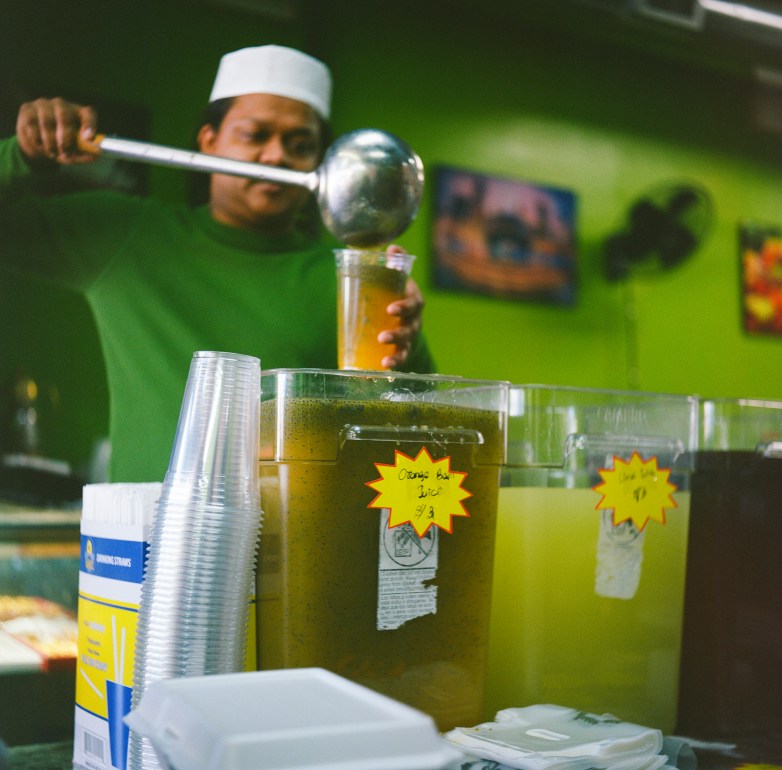

Ibrahim has similar reservations about adding Rohingya language lessons to his children’s routines. “They live in the United States now,” he said. “We have to support our kids in English.”
Meanwhile, Milwaukee’s Rohingya face a new set of hurdles.
The Trump administration’s January 2025 decision to largely end refugee resettlement halted Salmah’s efforts to bring several family members from refugee camps in Bangladesh to Milwaukee. Last year, Anwar sent voice notes to the nonprofit’s WhatsApp group reminding refugees of their rights during run-ins with federal immigration authorities. And last year, U.S. Citizenship and Immigration Services began reopening the cases of thousands of refugees admitted under the Biden administration — a policy that could impact many in Milwaukee’s Rohingya community.
Under the circumstances, Anwar and Trumbull aren’t bullish on their project’s short-term prospects. “But when you make things, sometimes they don’t go away,” Trumbull said.
Editor's note: This story was updated from its original version to add clarifying details.
This story is part of Public Square, an occasional photography series highlighting how Wisconsin residents connect with their communities. To suggest someone in your community for us to feature, email Joe Timmerman at jtimmerman@wisconsinwatch.org.
This article first appeared on Wisconsin Watch and is republished here under a Creative Commons Attribution-NoDerivatives 4.0 International License.

Disaster loans and mitigation bills signed into law
by Alex Rozier, Mississippi Today
April 14, 2026
With the approval of Gov. Tate Reeves, bills aimed to help Mississippians both recover from and prepare for natural disasters are now in effect.
Winter storm recovery
Cities and counties recovering from Winter Storm Fern will now be able to apply for loans from the state as they await reimbursements from the Federal Emergency Management Agency. Local entities across north Mississippi are facing strains on their budgets, largely to pay for debris removal, as officials anticipate a monthslong wait before they see funding from FEMA's Public Assistance program.
House Bill 1646 will offer loans to recovering areas at a 3% interest rate. An earlier proposal passed by both chambers had just a 1% interest rate, but Reeves vetoed the measure because, in part, he expected the bill to have a 12% interest rate. The interest rate, though, will only apply if areas borrow more money than they receive from FEMA.
Lawmakers allocated $125 million for the program. Sen. Scott DeLano, a Republican from Biloxi, estimated in March that cities and counties had tallied over $350 million in damages to public infrastructure.
The law allows loans to be issued through the program until July 2027. The loan program took effect once Reeves signed off on the bill last week.
FEMA has so far approved 38 counties for Public Assistance to recover from the storm. Separately, the federal agency also just approved Individual Assistance for 36 counties.
As part of its disaster recovery spending, the Legislature also approved $20 million for Mississippi's Disaster Assistance Trust Fund, which DeLano said will help cover the state's share of the Public Assistance grants. FEMA covers 75% of those costs, while the state and local governments are each responsible for 12.5%.
Also last week, the governor approved Senate Bill 3229, which allows the state to borrow money on behalf of electric utilities, such as Entergy Mississippi, to pay for power grid damages caused by the storm. The idea is to borrow money at a lower interest rate to minimize impacts to utilities' ratepayers. The measure does not include electric power associations.
Mitigation
Also last week, Reeves approved a bill to create the Strengthen Mississippi Homes Program. The measure, which took effect after passage, marks the farthest lawmakers have gotten in a near 20-year effort to better prepare homes in the state for natural disasters.
The program, which the state Department of Insurance will administer with the help of an advisory council, will offer grants of up to $10,000 to replace roofs to meet FORTIFIED standards set by the Insurance Institute for Business and Home Safety to reduce water damage and increase wind resistance.
Applicants must have wind insurance, and if in a flood zone, flood insurance as well. Only single-family, primary residence homes are eligible.
The mitigation spending will be funded through fees the Insurance Department collects from insurance agents across the state. A separate appropriations bill allows the agency to "escalate" up to $15 million for the program.
This article first appeared on Mississippi Today and is republished here under a Creative Commons Attribution-NoDerivatives 4.0 International License.