When the Crowd Gets Quiet: The Hidden Pressure of College Athletics

By Natalie Dempsey (Queens University News Service)
Publication Date: March 19, 2026
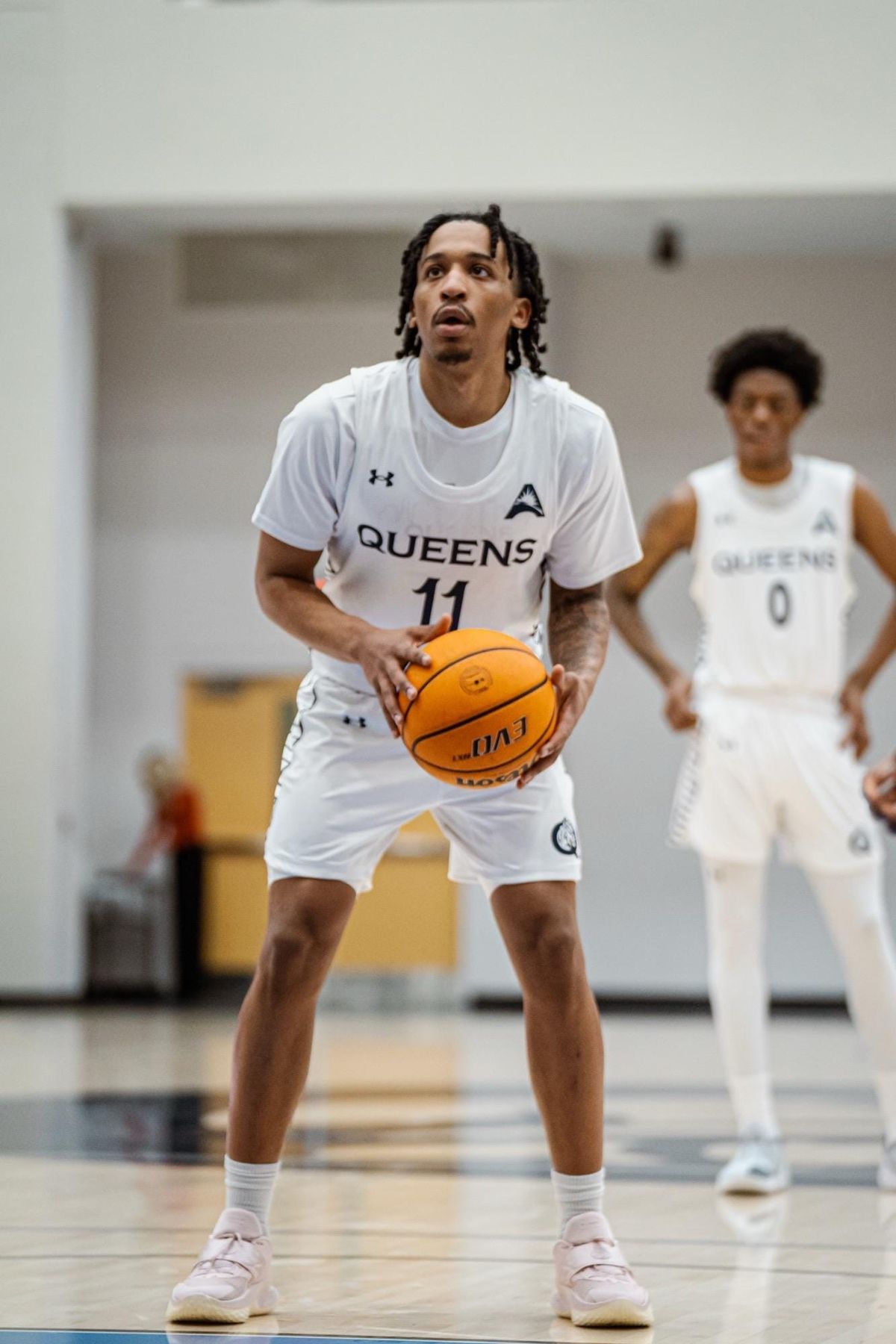
On game nights at Queens University of Charlotte, Curry Arena is alive. Students jump to their feet, music pumps through the gym and every made 3-pointer is met with a cheer. That energy was even higher earlier this month as guard Chris Ashby made 10 3-pointers and scored 34 points, leading Queens University to its first Atlantic Sun Conference Tournament title since joining Division I in 2022. That win secured a spot in the NCAA Men’s Basketball Tournament that started this week. Queens Royals will face Purdue at 7:35 p.m. on Friday in St. Louis.
From the outside, college basketball looks exciting, effortless even.
But for graduate guard Ashby, the reality is far more complicated. The cheers, the applause, the flashes from cameras, they’re energizing, but it’s the quiet after the crowd leaves that the weight of Division I basketball hits.
“I’m proud,” Ashby says about breaking Queens’ all time 3-pointer record. “Coming from junior college, where not many people believed in me, to have this record… it feels amazing. But it can also be a lot of pressure every game.”
Ashby was named the ASUN Preseason Player of the Year and is a finalist for the 2025-26 Nolan Richardson Award, presented annualy to a Division I player who is “the heart and soul of his team and a leader on and off the court.”
Ashby’s path in basketball was not straightforward. After high school, the Houston, Texas native played at a junior college, largely overlooked by four year programs. Queens University, then transitioning from Division II to Division I, was the only school to offer him a full scholarship. “They trusted me,” he recalls. “That meant a lot. That relief … it sticks with you.”
Since arriving, Ashby has adapted to tougher competition, longer travel schedules and increased visibility. Recognition followed. Yet even in moments of celebration, the pressure never fully disappeared. “Now people expect more, “he says. “To some point, yeah, it feels like every shot has to go in.”
The mental demands of college athletics are constant. Ashby visualizes plays, defensive rotations and teammates’ positions before each game. Conference matchups bring a sharper focus – a heightened urgency to win. “When you’re in a conference game, it hits differently,” he says. “You really want and need to win – even when shots aren’t falling.” He has learned to stay level headed, contributing in all areas of the team. “It’s not the end of the world,” he admits. “You just keep playing and pushing.”
Much of Ashby’s mental resilience comes from his family. His father started coaching him when he was 3 years old. Through the years, he has offered guidance on and off the court. His mother, a former guidance counselor, emphasized balancing academics and athletics. “At Queens, I’ve had to take summer classes because of travel and missed labs,” he says. “Trying not to fall behind can be hard.”
Off the court, routines like video games, quiet evenings and time with teammates help him recharge.
Basketball has defined Ashby’s identity for most of his life. Structured routines, year round training and public expectations shape the player he has become. The thought of life after basketball is intimidating. “It’s scary to think about that,” he admits. “I haven’t done anything else. Basketball’s been my everyday life.”
Dr. Eddie O’Connor, a sports psychologist who works with student athletes, explains why this is so common. “Athletes tie their identity closely to performance,” he says. “That’s normal, but it can become risky if your self-worth depends on stats, playing time or wins.”
O’Connor’s own experience as a track athlete helped shape his career. “I trained hard, disciplined myself and peaked at 2:11 in the 800 meters, but I remember finishing races and not feeling satisfied. I realized my identity was wrapped up in hitting numbers,” he says.
It is about more than mental toughness in sports. There are skills that athletes can work on to navigate thoughts, emotions and the pressures in life, not just in sports. The pressures student athletes face are both internal and external.
“We grow up with narratives about who we are, reinforced by social environments,” O’Connor says. “Athletes live in constant emotional and physiological contexts. Injuries, slumps, or even life stress can make this heavier.”
Social media adds another layer. “Athletes are more visible than ever. There’s more awareness but also more overwhelm. Comparison and perfectionism are everywhere,” adds O’Connor.
Even with these challenges, both Ashby and O’Connor emphasize growth and coping strategies. “Seeing athletes develop mentally, not just perform, is incredible,” O’Connor says. “When they graduate with skills to manage emotions, interact with their thoughts, and take action on what matters, that’s real success.”
“You just keep playing and pushing,” says Ashby. He has learned to manage the mental side of games, while also focusing on scoring for the team.
Despite the pressures, there’s reason for optimism. More money and resources are going toward mental health support and O’Connor says that more professionals are entering the field.
“We’re trending in the right direction,” he says.
For student athletes, the loudest moments are not always the ones that define a season. It’s the unseen hours, the quiet reflection and the mental resilience that form the backbone of success, on the court and in life.
“Queens believed in me,” says Ashby. “That trust has carried me this far.”
Queens University News Service stories are prepared by students in the James L. Knight School of Communication with supervision and editing from faculty and staff. The James L. Knight School of Communication at Queens University of Charlotte provides the news service in support of local community news.