First frieght train rolls into Asheville since Helene in 2024
NC lawmakers give initial OK to Medicaid bailout bill; VA voters back redistricting; 298 days: Iranian asylum seeker released after judge rules ICE violated his rights; Georgia’s ACA enrollment plunges, raising concerns for rural hospitals


It's Friday, April 24, 2026 and in this morning's issue we're covering: First freight train rolls into Asheville from Old Fort since Helene, America doesn’t depend on the Strait of Hormuz — but rural Alaska does, NC lawmakers give initial OK to Medicaid bailout bill amid concerns over provisions, Virginia voters back redistricting after months of legal and political battles, Illinois Farm Bureau sees ‘moral obligation’ to protect livestock from extreme weather. It opposes temperature standards for workers, Nearly one in five New Orleanians — and one in three children — are food insecure, 298 days: Iranian asylum seeker released after judge rules ICE violated his rights, Georgia’s ACA enrollment plunges, raising concerns for rural hospitals.
Media outlets and others featured: Carolina Public Press, Alaska Beacon, NC Newsline, Maryland Matters, Investigate Midwest, Verite News, El Paso Matters, The Current GA
First freight train rolls into Asheville from Old Fort since Helene
by Lucas Thomae, Carolina Public Press
April 20, 2026
Freight trains westbound toward Asheville are back on the tracks for the first time since Tropical Storm Helene ravaged railroad infrastructure in the North Carolina mountains, bringing with them a welcome boost to local economies and a revived hope that passenger service may finally return to the region.
On Saturday, April 18, Norfolk Southern’s NS 9900 train carrying freight departed Hickory shortly after 8 a.m. and rumbled into the Asheville rail yard around 2:30 p.m. With 59 cars carrying cement, paper, plastic pellets, hops and barley malt, it was the first revenue train to complete that route since the devastating floods, Norfolk Southern spokesperson Heather Garcia told Carolina Public Press.
A crowd of rail enthusiasts gathered at the historic train depot in Old Fort, close to where the final repairs had taken place, to celebrate Norfolk Southern’s return and to watch the train roll by.
[Subscribe for FREE to Carolina Public Press’ Daily, Weekend and Election 2026 newsletters.]
Damage from the storm had especially impacted a winding, 15-mile section of rail which includes the “Old Fort Loops,” an impressive feat of engineering which guides trains up a steep ascent through a network of tunnels as they approach the Blue Ridge mountains.
The loops were the last section on the Asheville-Salisbury line to come back online after a massive rebuilding effort. Without them, the connection between industry in the North Carolina mountains and the rest of the state had essentially been severed.
Rebuilding the loops was no easy task, said Norfolk Southern’s chief engineer of design and construction Alan Johnson.
“It is a fascinating piece of railroad to say the least,” Johnson said.
“We really had to be strategic,” he added, “to combat this unforgiving mountain.”
In some areas, the rail bed had completely washed away, leaving tracks floating in the air with nothing to support them underneath. Crews had to navigate steep and rocky terrain with very few access points just to get to the sections that needed repairs.
In all, it took nearly a full year to get the tracks operational again. On April 7, Norfolk Southern ran a test car through the loops with no issue, signaling that the railroad was ready to fully reopen to freight.
Watching that first train car on the rebuilt tracks felt “fantastic,” Johnson said.
“We see destruction, but dealing with hurricanes in mountainous areas is not something you deal with very often,” he said.
“It was just amazing to think about October of ’24, (the destruction) we saw with our eyes, and then just the ability to rebuild this area is just extraordinary.”
‘Welcome back’ rally draws dedicated Old Fort crowd
Cathy Moore, an Old Fort native and volunteer caretaker for the railroad museum there, organized the rally at the historic train depot, which drew close to 300 people.
Onlookers waved miniature North Carolina and American flags and held signs that read “Welcome Back!” Arriving around 10:30 a.m., the crew stopped the train en route to Asheville to get off and take pictures with the crowd.
“I don’t know if I could have written a better script,” Moore said.
The importance of restoring freight rail went beyond the economic impact that it provides, she added. It’s also a cultural bedrock of her hometown.
“The thing about Old Fort is the railroad is such a significant part of the town and the community's DNA,” Moore said.
“We were worried that we were going to lose a part of who we were.”
The restored connection between Asheville and Salisbury also means that the dream of bringing back passenger rail to the region is still alive. For more than 20 years, advocates like Moore have pushed the state and federal government and railroad operators to return passenger service between the two cities, which ended in 1975.
Those advocates formed a nonprofit organization, the WNC Rail Committee, to work toward that goal. They had begun to make progress in recent years. In December 2023, the Federal Railroad Administration identified the proposed Asheville-Salisbury route as worthy of further planning and development, and it provided funds to advance that work.
However, Helene’s destruction of the tracks along that line 10 months later threatened to bring that momentum to a screeching halt.
“Passenger rail cannot exist without freight,” Moore explained.
That’s why she became such a cheerleader for Norfolk Southern in the wake of the storm. The company, in turn, appreciated the encouragement they received from locals during the course of the arduous rebuild.
“That support definitely went a long way, and it was incredibly important to the team and really had a positive impact on this project,” Johnson said.
With freight back on track, are passengers next?
With the Old Fort Loops repaired, rail infrastructure is mostly back to normal in Western North Carolina.
Florida-based CSX Transportation, which is the only other Class 1 railroad operator in the region, completed repairs on its line between Spruce Pine and Erwin, Tenn., in September.
Short-line railroads like Blue Ridge Southern Railroad, which hauls freight from Asheville to Sylva and Hendersonville, and the Great Smoky Mountains Railroad, an excursion railway which takes passengers through the scenic national park, are also open for business.
With Helene-related repairs in the rearview, all eyes are on the future of rail in the region, according to WNC Rail Committee co-chair Ray Rapp. For him, that means continuing to advance passenger rail’s comeback.
The proposed Asheville-Salisbury route would connect to the Charlotte-Raleigh line that moved a record 740,000 passengers last year.
Development of the route would cost $665 million, but 80% of that cost would be covered by the federal government if they were to give the OK on the project.
Jason Orther, the head of NCDOT’s rail division, confirmed to state legislators in an oversight hearing earlier this month that the state and federal government were still working on evaluating seven proposed passenger rail expansions across the state, including the Asheville-Salisbury line.
Rapp, who in a previous life was a state representative for parts of Haywood, Madison and Yancey counties, said the Asheville-Salisbury corridor was “at the top of the list” among those seven proposed routes.
“We're way ahead in the corridor development planning stages,” he said.
An economic impact report from NCDOT estimated that the project would be well worth the cost by producing more than $80 million in annual economic output, employee earnings and tax revenue.
“It's not just, ‘it's a nice idea’ or ‘wouldn't it be a nostalgic trip?,’” Rapp said. “We're talking about important job-providing opportunities, as well as investment opportunities along these lines.”
This article first appeared on Carolina Public Press and is republished here under a Creative Commons Attribution-NoDerivatives 4.0 International License.

America doesn’t depend on the Strait of Hormuz — but rural Alaska does

By Gwen Holdmann, Benjamin Mallott (Alaska Beacon)
Published: April 23, 2026
All over the world, nations are grappling with the ripple effects of the war in Iran and the blockade of the Strait of Hormuz, a critical artery for the global oil market. In the United States, however, President Donald Trump has emphasized that the country imports little oil through the strait, arguing that it “doesn’t need it.”
At a national level, that’s largely true. The United States consumes roughly 20 million barrels of oil per day and imports only a small fraction through that chokepoint. But for diesel-reliant communities in Western Alaska, the story looks very different. The supply chains that vendors rely on are often tied to refineries in Asia, and those routes are deeply exposed to disruptions in and around the Strait of Hormuz.
It may come as a surprise that much of the fuel consumed in rural Alaska is not from Alaska. This reflects both the state’s limited refining capacity and the constraints of global shipping routes and tanker availability. There are some exceptions. Yukon River communities, for example, receive fuel sourced from the Petro Star refinery and delivered by companies like Ruby Marine, providing a more stable and predictable supply. Much of Southeast Alaska, meanwhile, is supplied from refineries in Canada.
But in much of Western Alaska — including the Aleutians, Alaska Peninsula, and Bering Sea coast — nearly all fuel has, at least in the recent past, been refined in Asia and shipped thousands of miles to reach its final destination, often on voyages that can take more than 40 days. These deliveries must occur within a narrow summer window, when sea ice retreats just long enough to allow access.
And planning for those shipments is happening now.
At a recent community meeting in Kotzebue, fuel suppliers laid out a sobering reality due to the recent market turmoil. Voluntary export controls in Japan and South Korea have introduced significant uncertainty into the availability of fuel for Western Alaska — regardless of price.
Vendors like Crowley are now pivoting to Canadian suppliers, but those markets are under strain as well. Tom Atkinson, the chief executive of Kotzebue Electric Association, said that fuel quotes for the cooperative are roughly double what they were last year. Fuel is by far the largest cost driver in rural electric systems, and when it rises, everything else follows.
Even so, Mr. Atkinson expects he will be able to secure supply for the cooperative. Prices will be high, but the fuel should arrive. He is far more concerned about smaller, upriver communities with fewer resources and even less flexibility. Their costs will almost certainly be much higher.
State programs like the Bulk Fuel Revolving Loan Fund can help communities finance fuel purchases, but they do little to shield them from the underlying volatility of global markets.
Even more concerning is the cost of heating oil. In Kotzebue, Atkinson said residents are already paying around $8 a gallon — a price that is quickly becoming untenable for many households.
In more remote areas, such as the Kusilvak Census Area further south along the coast, households spent on average about 16 percent of their income on electricity alone even before this impending crisis. When heating oil is included — essential in a region with few trees or other options for heating — that share can rise to as much as 45 percent. That is among the highest energy burdens anywhere in the United States. And that was last year.
At the same time that residents are bracing for a sharp increase in costs, the Trump administration has proposed, in its latest budget plan, eliminating funding for the federal Low Income Home Energy Assistance Program, or LIHEAP, which helps offset heating costs for low-income households. For many communities in Western Alaska, that support is not supplemental — it is essential.
But the more troubling possibility is not just higher prices or the loss of assistance — it is supply itself. If deliveries are delayed or fall short, some communities could face shortages in the depths of winter, when a fuel shortage would become a true emergency.
This is not the first time rural Alaska has been disproportionately exposed to global events.
Consider the war in Ukraine. For years, fuel deliveries to Western Alaska quietly depended on a surprising player: Russia.
Shipping routes serving Western Alaska often fall under the International Maritime Organization’s Polar Code, which establishes safety and environmental requirements for vessels operating in Arctic waters. Depending on the route and conditions, this can include ice-class design, specialized equipment and additional crew training. These requirements add cost to already expensive supply chains, particularly in remote regions with limited shipping options. Compounding the challenge, ice-strengthened tankers are relatively scarce worldwide, with Russia maintaining one of the largest fleets.
As a result, fuel bound for Western or northern Alaska communities was often carried on Russian-built or Russian-operated vessels, sometimes under foreign flags, traveling from Asian refineries to the Alaskan coast. The system was largely invisible, but it worked. In 2012, for example, the Russian ice-capable tanker Renda, escorted by the U.S. Coast Guard cutter Healy, delivered an emergency winter fuel shipment to Nome after early sea ice and fall storms cut off the community — an event that made the national news.
That system began to unravel after Russia’s invasion of Ukraine. Sanctions sharply curtailed access to Russian-linked vessels, and almost overnight, the availability of Polar Code-compliant tankers tightened. Shipping costs rose dramatically. And that additional cost is not limited to transporting fuel to Western Alaska. These vessels are often stationed offshore for extended periods, effectively serving as floating tank farms while smaller barges shuttle fuel to individual communities along the coast and river systems. The expense is therefore not just delivery, but time — standby charges of many thousands of dollars a day that accumulate quickly and are ultimately passed on to customers. Those costs rose several-fold after the invasion and they have not come back down.
This is what energy insecurity looks like in America.
If there is a lesson here, it is not simply that global events matter. It is that Alaska is not insulated from them — especially in the places that can least afford it.
We have built an energy system in rural Alaska that depends on long, fragile supply chains stretching across oceans and geopolitical fault lines. For decades, this system has held together. But it is becoming more expensive, more uncertain and more exposed with each passing year.
This reality should shape how we think about energy policy in this state. Reducing fuel use, diversifying local energy systems and maintaining the programs that help households afford basic energy services are not abstract goals — they are essential to keeping communities viable in the long run.
In the short term, there are also practical steps the state can take: increasing the loan cap in the Bulk Fuel Revolving Loan Fund, ensuring adequate support for the Alaska Heating Assistance Program and preparing for potential shortfalls in the Power Cost Equalization program.
These steps are not precautionary — they are necessary. When global systems falter, it is not the Lower 48 — or even more urban places in Alaska — that feels it first or most acutely. It is communities like Kotzebue, Emmonak, and Hooper Bay.
The lesson is not simply that global events matter. It is that our energy system is far more interconnected — and far more unequal in how it distributes risk and cost — than we tend to acknowledge.
SUPPORT: YOU MAKE OUR WORK POSSIBLE
NC lawmakers give initial OK to Medicaid bailout bill amid concerns over provisions
By Brandon Kingdollar, Christine Zhu (North Carolina Newsline)
Published: April 22, 2026
North Carolina House and Senate lawmakers voted nearly unanimously Wednesday to approve a measure that bails out the state’s Medicaid program, which was on the verge of running out of money after it was underfunded last year.
But the bailout bill, House Bill 696, comes with a long list of policy changes and “anti-fraud” measures. Bill supporters from both parties say the provisions are needed to make sure the state can maintain its expanded Medicaid program in the face of federal changes. But advocates say some changes are unnecessarily harsh and will have unintended consequences.
Republicans in the House and Senate failed to agree on a bill last year that would have provided the full funding the North Carolina Dept. of Health and Human Services said Medicaid would require for the year. Some Republicans doubted that the $319 million figure was accurate. But House and Senate Republican leaders said Tuesday they had agreed on the figure.
NC lawmakers will fill Medicaid funding gap, but larger state budget issues remain unresolved
However, House Speaker Destin Hall said Tuesday the funding bill would also include provisions to control costs. He said the increasing cost of Medicaid is unsustainable: “We’ve got to get our arms around it.”
The legislation adds oversight measures to mitigate waste and abuse. These include requiring county-level officials to more frequently review eligibility, changing monitoring from quarterly to monthly.
The bill also raises copays for inpatient hospital care to $25 per visit, the maximum allowable amount under federal Medicaid requirements. It also implements a three-month “lookback period” for work requirements, also the federal maximum, meaning applicants must demonstrate 80 hours of work, educational, or community service activities per month over the three months prior to be eligible for coverage.
John Broome, the government relations director for the American Cancer Society Cancer Action Network North Carolina, said the bill will place an especially heavy burden on cancer patients, who must receive frequent inpatient care.
“This bill creates unnecessary red tape for patients seeking cancer treatment as well as anyone needing access to screenings by adding extra layers of bureaucracy and increasing patient costs,” Broome said in a statement.
However, both Democrats and Republicans said the changes will maintain the state’s eligibility for the maximum 90%/10% federal funding match for the Medicaid program.
“I want you all to make sure you understand – 700,000 people got picked up on the Medicaid expansion,” said Rep. Carla Cunningham (D-Mecklenburg). “We were attempting not to lose as many as possible, even by putting the federal guidelines in place.”
A major source of concern for immigration advocates is a provision that requires workers at the North Carolina Department of Health and Human Services to refer any Medicaid applicant or recipient for whom “citizenship or satisfactory immigration status could not be verified” to the Department of Homeland Security for investigation.
Undocumented immigrants are ineligible for Medicaid benefits, with the exception of pregnant individuals, who may receive emergency Medicaid covering prenatal care, labor and delivery, and post-partum care.
Rep. Maria Cervania (D-Wake) said she was concerned about how the changes would affect pregnant women, children and their families. She predicted some would skip preventive care and wait until they’re very ill to seek care in emergency rooms instead.
“They love North Carolina, and those people may be facing the loss of access to basic health care coverage because of these new requirements,” she said. “Those costs don’t disappear just because we ignore them.”
According to news outlet The 19th, the Trump administration deported more than 300 pregnant, postpartum, and nursing immigrants between January 2025 and February 2026.
“By forcing our county workers to act as federal informants, the state is making every child in our community less safe,” advocacy group Siembra NC Co-Director Kelly Morales said in a statement. “North Carolina Republican Party leadership should present a clean Medicaid funding bill that provides care, not fear, to all North Carolinians.”
The bill also empowers the state auditor to conduct a “performance audit” of the state Medicaid program, providing the office with $500,000 to do so. This is among the measures that Hall said Tuesday are aimed at “cutting out waste, fraud, and abuse.”
“We’re going to ask the state auditor to do an audit of the program to look for areas of efficiency and where we may be inefficiently spending our resources,” said Rep. Tim Reeder (R-Pitt). “We’ve heard a lot in other states about fraud and waste and abuse, some really egregious examples.”
But House Democratic Leader Robert Reives (D-Chatham) said on Wednesday that the provision serves only to undercut North Carolina Attorney General Jeff Jackson, who has authority over prosecuting Medicaid fraud.
He likened it to overhauls that shifted responsibility over the state Board of Elections and other regulatory entities from the governor’s administration to the auditor.
“There’s this office that we’ve got that presently still has its same duties, and we call it the attorney general,” Reives said. “I am confident that voters made a decision of who they wanted for attorney general, who they wanted for governor, who they wanted for state auditor, based on the definitions that were provided at the time.”
Nonetheless, Reives and every other House Democrat except Rep. Pricey Harrison (D-Guilford) voted in favor of H696. It passed the House by a vote of 112-1, and passed 48-1 in the Senate, with Sen. Michael Garrett (D-Guilford) the lone “no” vote there.
The bill is scheduled for a final vote in both chambers April 28. It then goes to Gov. Josh Stein for his signature.
SUPPORT: YOU MAKE OUR WORK POSSIBLE
Medicaid breakthrough comes with unexpected immigration mandates
by Anne Blythe, Ashley Fredde and Rose Hoban, North Carolina Health News
April 23, 2026
By Anne Blythe, Ashley Fredde and Rose Hoban
Lawmakers voted for a $319 million package on Wednesday to fully fund the state’s Medicaid program through the end of the fiscal year, settling a monthslong feud with the governor over how much it will cost to avert a projected shortfall in May.
While the funding is designed to prevent cuts and maintain the current level of care for the more than 3 million beneficiaries of the subsidized health insurance program for low-income people, the bill adds mandates that immigrant rights advocates say could have “a chilling effect” and jeopardize the health of U.S.-born children in immigrant families — and others in those households who have legal status to be in the country.
The bill, which must get final votes in both chambers before it can be sent to the governor for a thumbs up or down, won bipartisan support in the state House of Representatives and Senate.
While Democratic members of both chambers overwhelmingly voted in support — with a single nay vote in each chamber, several members on the floor noted that because of time constraints they’d reserve their comments for the bill’s next vote on April 28.
Ahead of the bill’s introduction in both chambers, the House Democratic Caucus criticized the lack of collaboration or even advance notice from Republicans crafting the bill when it came to Medicaid and the budget.
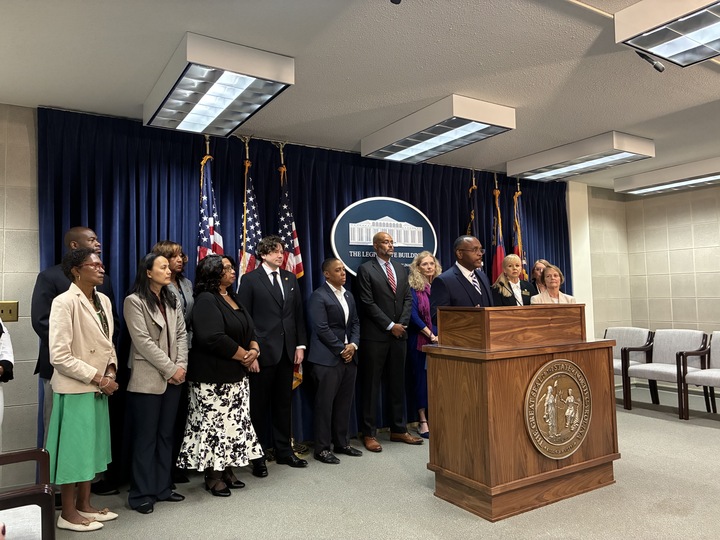
“We're not told who put the budget together, still don't know who wrote what. We don't know where anything came from in the budget, and we're going from there,” House Democratic Leader Robert Reives (D-Goldston) said during a news conference before the vote.
“The House passed a clean rebase bill last year, so I'm glad to see that everybody else in the building is coming along,” Reives said. “This bill has things in it that I need to look at, comparing our bill to the requirements that the federal government has now, and seeing what's been stuck in there that was just stuck in there.”
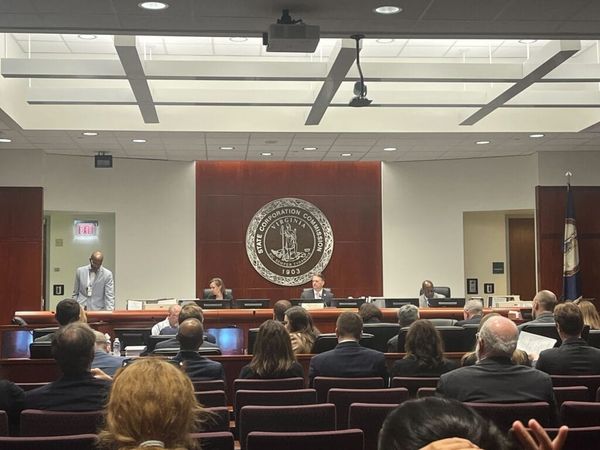
Feud between two branches
The need for the bill stems from a debate that began last summer over the annual Medicaid “rebase” — the budget adjustment made each year to account for enrollment changes, inflation in medical costs and any other changes to reflect the true program costs.
At the time, Republican leaders in the state House and Senate could not reach agreement on spending priorities for the biennium that started July 1, 2025. That led to a standoff that has shown no signs of abating, leaving North Carolina as the only state that has yet to pass a comprehensive budget for the two-year period.
Amid that backdrop, lawmakers approved a “minibudget” in late July that allocated $500 million toward the annual rebase for the fiscal year that ends June 30. Several weeks later, Democratic Gov. Josh Stein sent lawmakers a letter noting that what had been approved was $319 million short of what was needed to fully fund Medicaid for the year.
Republican lawmakers disputed that amount, citing legislative analysts who put the additional cost needed to get through the fiscal year closer to $119 million.
For many months, it looked like the two branches of government were playing fiscal chicken. The governor initiated Medicaid rate cuts in October, saying he had done so begrudgingly because lawmakers had not provided what was needed to make it through the fiscal year. In December, after several lawsuits against his administration resulted in a judge reversing cuts for autism therapy and personal care providers, Stein rolled all the cuts back.
Republican lawmakers accused Stein of playing politics, arguing that they wanted to dig deeper into his estimates and would come through with the needed funding before services had to be cut.
Ultimately, though, Stein’s early estimate was the one lawmakers went with in the bill this week.
Resolving Medicaid funding impasse
Lawmakers started signaling a few weeks ago that they’d reached an agreement over the amount needed to fund Medicaid and would prioritize the funding when they returned this week for the opening of their short session.
They also needed to make changes to the program to conform to new work requirements in the One Big Beautiful Bill Act, the federal budget approved last July. Those new federal requirements will affect the nearly 700,000 people who qualified for Medicaid when the state expanded the program to include more beneficiaries in 2023.
Traditional Medicaid recipients — low-income children, some parents of those children, low-income seniors and people with disabilities — won’t be subject to the work requirements.
One of the complicating factors of Medicaid funding was the possibility that changes in the funding formula could unwind the state's long-fought expansion of Medicaid to about 700,000 new enrollees. But the bill makes changes to how hospitals — which have paid the state’s 10 percent portion of the costs for the expansion population — could continue contributing those funds even as the federal bill limited the way that states could tax Medicaid revenues.
‘Gateways’ to immigration checkpoints?
Immigrant rights advocates flagged parts of the bill on Wednesday, saying one section in particular would transform “local healthcare gateways into immigration checkpoints.”
The bill requires the state Department of Health and Human Services or county social service departments to “promptly refer any applicant or recipient for which citizenship or satisfactory immigration status could not be verified” to the U.S. Department of Homeland Security “or any other appropriate federal authority for investigation and enforcement.”
The referrals should be made, according to the bill, not only if someone’s immigration status cannot be determined, but also if someone has stayed beyond an authorized period for being in the country.
Immigrant advocates have said that the law doesn’t just target immigrants; they contend it potentially targets the stability of families that have immigrant members.
“This isn’t about eligibility; it’s about terrorizing parents who just want to take their kids to a doctor,” said Kelly Morales, co-director of Siembra NC, grassroots organization that works to support immigrant and working-class Latino communities across the state. “By forcing our county workers to act as federal informants, the state is making every child in our community less safe.”
Morales called on legislative Republicans to present a “clean” Medicaid funding bill without the immigration language.
Immigration restrictions debated
After the vote, House Rep. Tim Reeder (R-Ayden), an emergency medicine physician at the East Carolina University Brody School of Medicine, said he didn’t believe that the provisions in the bill would dissuade families with immigrant members from seeking care.
“I think that what you're referring to is not in the bill,” he told NC Health News.
But a KFF survey of immigrants in the early days of the second Trump Administration found that the share of immigrant adults who said they avoided applying to a government program that helps with food, housing or health care in the past year because they “did not want to draw attention to their or a family member’s immigration status” went from 8 percent in 2023 to 12 percent in 2025, with the largest portion being those who are likely undocumented (from 27 percent to 46 percent).
Part of respondents’ reluctance to get care is their concerns about health care professionals sharing information with immigration enforcement officials — half (51 percent) of immigrant adults overall and about eight in ten (78 percent) of those who are likely undocumented say they are “somewhat” or “very” concerned about that.
In the past, North Carolina has extended Medicaid coverage to noncitizen children and pregnant women, but the One Big Beautiful Bill Act restricted many noncitizens from accessing health care, even if they are in the country legally. Some states have limited how much noncitizen Medicaid enrollee information they share with the Department of Homeland Security; they sued the federal government and got an injunction that allows them to withhold that information.
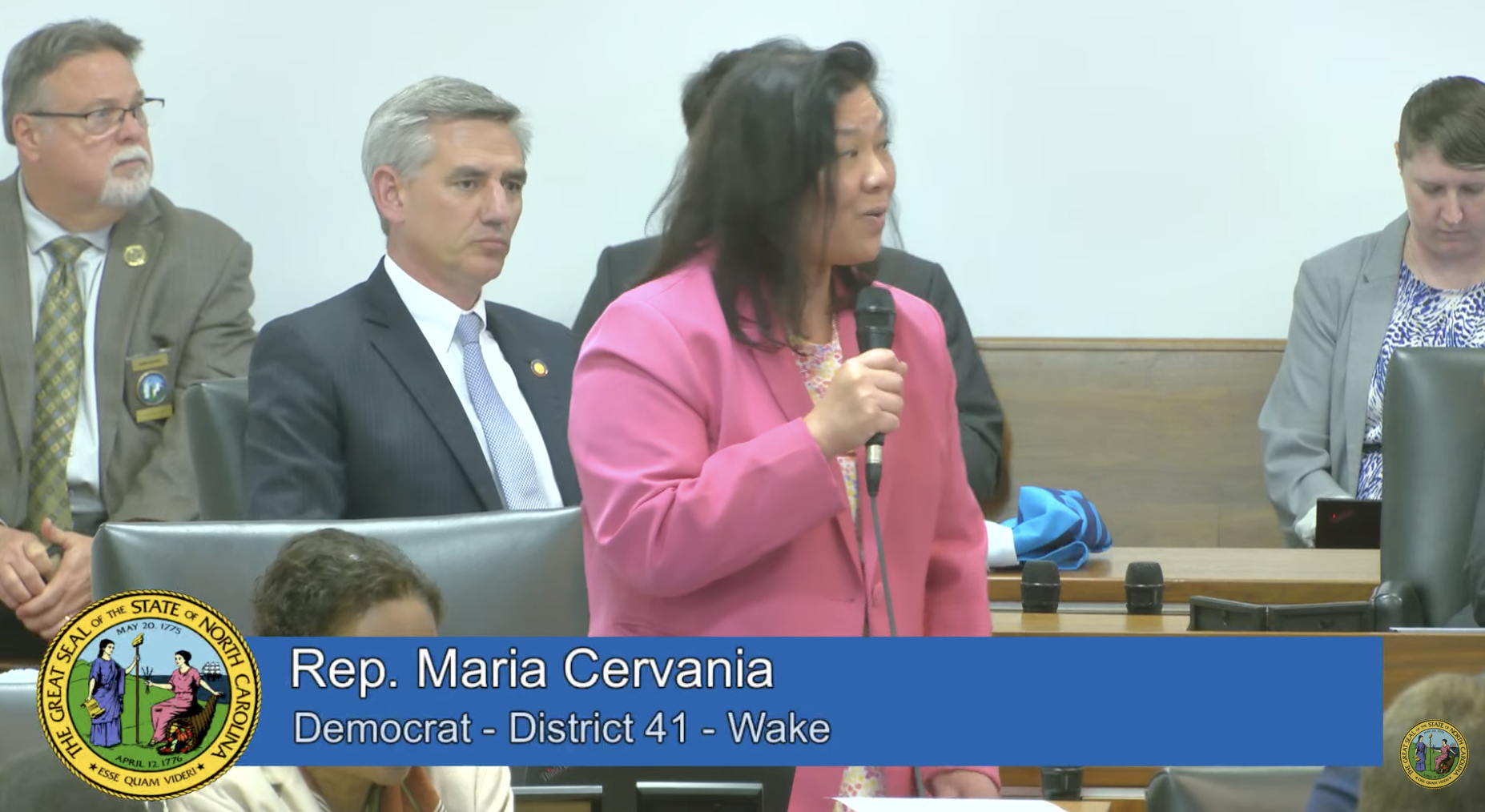
Rep. Maria Cervania (D-Cary), did speak on the floor Wednesday about her concerns that the North Carolina Medicaid rebase changes could have a negative impact on pregnant women and their families.
“When coverage is disruptive, the need doesn't go away,” Cervania said. “That doesn't mean you don't have less health needs.”
People might wait to get care until they have to go to an emergency room. Federal law requires hospitals treat people seeking emergency care regardless of their ability to pay, and if a hospital cannot properly treat a patient they must arrange safe and appropriate transfer to a facility that can.
“They'll have higher risk pregnancies because they don't go to perinatal care,” Cervania said. “They'll be showing up when children should be getting preventive care that they know would cost.”
“We know it costs less to do preventive care than have people show up in the emergency room,” Cervania added. “So ultimately, like I say, those costs don't disappear just because we ignore them. They shift off into our hospitals, our counties, our communities and, honestly, it shifts to every single North Carolinian here in our state.”
This article first appeared on North Carolina Health News and is republished here under a Creative Commons Attribution-NoDerivatives 4.0 International License.


Virginia voters back redistricting after months of legal and political battles
By Markus Schmidt (Maryland Matters)
Published: April 22, 2026
Virginia voters on Tuesday approved a constitutional amendment allowing mid-decade congressional redistricting, a move expected to dramatically reshape the state’s political map and potentially shift its congressional delegation from a closely divided 6-5 split to a heavily Democratic-leaning 10-1 advantage.
By 8:50 p.m., the measure passed by a vote of 50.7-49.3% out of 2.5 million ballots cast, according to unofficial results from the Virginia Department of Elections, clearing the way for lawmakers to redraw district lines outside the traditional once-a-decade census cycle. The winning margin continued to increase throughout the night as more votes were tallied.
Supporters argued the amendment gives Virginia flexibility to respond to aggressive redistricting efforts in several Republican-led states at the urging of President Donald Trump, while critics warned it opens the door to partisan gerrymandering and undermines long-standing constitutional guardrails.
Gov. Abigail Spanberger said in a statement Tuesday evening that voters “approved a temporary measure to push back against a president who claims he is ‘entitled’ to more Republican seats in Congress,” adding that Virginians “responded the right way: at the ballot box.”
She said she plans to campaign with candidates across the commonwealth ahead of the midterms and emphasized her commitment to restoring the state’s bipartisan redistricting commission after the 2030 census.
Senate leader calls latest redistricting effort from House a nonstarter
Virginia Senate Majority Leader Scott Surovell, D-Fairfax, said the results reflect what he described as a reaffirmation of democratic principles, arguing that voters “answered a question about the nature of our democracy … in favor of the people.”
He said Virginians acted in response to what he called “unprecedented gerrymandering in other states,” adding that “fairness won” and “accountability won,” and that the outcome shows “the people will decide.”
Virginia House Speaker Don Scott, D-Portsmouth, said the outcome sends a national signal, arguing that voters rejected efforts to “rig our democracy” and instead affirmed that “power belongs to the people.” He said the vote could shape the 2026 midterms, adding that Virginians “stepped up and leveled the playing field for the entire country” and that “when the stakes are highest, we lead.”
Heather Williams, president of the Democratic Legislative Campaign Committee, said the vote delivers “a massive blow to the GOP plot to rig control of Congress,” praising Virginia voters for what she described as answering a national call to protect democracy.
At the same time, she cautioned that “the fight is far from over,” arguing that redistricting battles will continue to play out in state legislatures and that upcoming elections will be critical in determining who draws maps and holds power in the years ahead.
Virginia House GOP Leader Terry Kilgore, R-Scott, said Tuesday’s outcome was “not unexpected,” arguing the process was “tilted” by what he described as “misleading ballot language and a massive spending advantage.”
He said legal challenges will continue, adding that “the ballot box was never the final word here” and that Republicans will keep pushing for “fair maps, transparent process, and equal representation for every Virginian.”
Special session sparks fast-moving redistricting push
The effort to change Virginia’s redistricting rules began abruptly in late October, during a special legislative session that had been called to address budget matters but quickly veered into a broader political fight.
On Oct. 27 — days before the Nov. 4 statewide elections — Democratic lawmakers unveiled plans to pursue a constitutional amendment allowing congressional maps to be redrawn outside the traditional post-census cycle.
FULL COVERAGE: Virginia redistricting referendum
Within hours, the proposal ignited a sharp debate over timing, process and political intent.
Scott, the speaker, framed the move as a response to national redistricting battles, saying at the time, “I think we have an opportunity now to send a message to the rest of the country that we’re not going to stand by while you rig this election. We will do everything in our power to level the playing field we were talking about.”
Republicans, meanwhile, questioned both the substance and the setting. Del. Michael Webert, R-Fauquier, said the special session had been called for budget work, not constitutional changes.
“We went into a special session to solve a very specific problem. It was not meant to be used as a tool to continuously identify issues and keep what they’re doing,” Webert said. “We shouldn’t (have been) in two sessions at the same time (and) because of that confusion, I believe … it delegitimizes specific legislative processes.”
The session’s temperature rose further when Senate Democrats blocked the reading of a communication from then-Gov. Glenn Youngkin, who had sharply criticized the effort.
“I am disappointed to see the General Assembly reconvening this week to ram through a constitutional amendment on redistricting only seven days before the close of our 2025 statewide and House of Delegates election and with over one million voters already casting their ballot,” Youngkin wrote.
On the Senate floor, Sen. Bill Stanley, R-Franklin, appealed to what he described as Virginia’s past bipartisan approach to redistricting reform.
“Sometimes we must overcome our partisan desires and do what is right for the commonwealth as a whole,” Stanley said. “We looked Virginia voters in the eye, and promised them something fundamental, that Virginia would pick their representatives, and not the other way around. What message do we send to them if we walk away now?”
Despite the divisions, lawmakers moved quickly. On the same day, Democrats released the amendment’s language, outlining a framework for mid-cycle redistricting subject to voter approval.
The House advanced the measure the following day, and the Senate approved it on Oct. 31 in a party-line vote, sending it forward in the multi-step constitutional process. That process required the amendment to pass again in a subsequent legislative session.
All across Virginia, people made their voices heard – and they said “YES” to a stronger, fairer future.
Wins like these are what’s possible when people organize and mobilize to defend democracy. Thank you to our neighbors in Virginia for showing up in droves!
— Wes Moore (@iamwesmoore) April 22, 2026
When lawmakers reconvened in January, the proposal moved forward — but soon became entangled in a series of legal challenges.
Legal battles complicate road to the ballot
In late January, a Virginia court struck down the amendment that had been slated for the April ballot, casting uncertainty over whether voters would ultimately weigh in.
In a 22-page ruling, Tazewell County Circuit Court Judge Jack C. Hurley found that the legislature acted unlawfully in approving the redistricting amendment during a special session just days before the Nov. 4 election. Hurley concluded that lawmakers exceeded the scope of that session, violated their own procedural rules and failed to comply with constitutional and statutory requirements governing amendments to the Virginia Constitution.
The state’s highest court soon reversed that trajectory. In February, the Supreme Court of Virginia allowed the referendum to proceed, clearing the way for the issue to appear on the ballot.
“Certainly the General Assembly was clear with the amendment process they put forward, and now it’s up to voters,” Spanberger said at the time, mere weeks after taking her oath of office.
At the same time, Democrats began outlining what new congressional lines could look like.
A proposed map released in early February would significantly reshape district boundaries and was widely seen as favoring Democrats across most of the state’s 11 congressional districts.
Republicans escalated their opposition later that month, filing an emergency lawsuit seeking to block the vote and challenging the amendment process itself — a move that the same Tazewell County judge granted but that only applied to his jurisdiction.
Once again, the Supreme Court of Virginia stepped in, granting a petition for review of the case and staying the temporary restraining order, which allowed the election to move forward statewide.
However, the justices emphasized their decision does not resolve the underlying legal claims about whether the General Assembly followed proper procedures in advancing the amendment.
Meanwhile, the referendum drew national attention, with prominent Democrats — including former President Barack Obama — voicing support while Virginia Republicans intensified their warnings as the campaign entered its final stretch.
SUPPORT: YOU MAKE OUR WORK POSSIBLE
On Tuesday evening, Obama praised the outcome on X, writing, “Congratulations, Virginia! Republicans are trying to tilt the midterm elections in their favor, but they haven’t done it yet,” and thanking voters for “showing us what it looks like to stand up for our democracy and fight back.”
Campaign messaging grew increasingly contentious in March, particularly after mailers opposing the amendment invoked civil rights era imagery, prompting backlash and public criticism.
Some Republicans defended the mailers, adding to the broader political dispute surrounding the vote.
Early voting data added another layer of uncertainty, with turnout showing strength in Republican-leaning areas even as both parties ramped up efforts to mobilize voters statewide.
In the final weeks, Spanberger balanced her governing responsibilities with public support for the amendment, while Youngkin returned to the campaign trail urging voters to reject it and continued to press for court intervention.
In her statement Tuesday, Spanberger said that she remained “committed to ensuring Virginia’s bipartisan redistricting commission gets back to work after the 2030 census, and to protecting the process Virginians voted to create.”
— Virginia Mercury is part of States Newsroom, a nonprofit news network supported by grants and a coalition of donors as a 501c(3) public charity. Virginia Mercury maintains editorial independence. Contact Editor Samantha Willis for questions: info@virginiamercury.com.
Illinois Farm Bureau sees ‘moral obligation’ to protect livestock from extreme weather. It opposes temperature standards for workers.
by Sky Chadde, Investigate Midwest, Investigate Midwest
April 22, 2026
Key takeaways
- No federal heat protection standards exist. If signed into law, the legislation would make Illinois the eighth state to implement requirements for employers related to extreme heat. It would make Illinois just the third state to have standards related to cold temperatures.
- Extreme temperatures affect workers across Illinois’ food system, from crews detasseling corn in rural areas to sanitation workers cleaning frozen pizza factories in Chicago.
- Organizations representing employers across Illinois’ food system have argued the legislation’s requirements, such as paid water breaks at a certain temperature, could impact supply chains.
Since last year, worker advocates and industry representatives in Illinois have negotiated over a potentially groundbreaking piece of legislation that would require employers to protect laborers from extreme temperatures.
In private discussions, the Illinois Farm Bureau, a powerful lobbying organization for the state’s agricultural industries, voiced concern that the bill would impede farmers' ethical duty to care for their livestock. But, to some participants, one thing seemed to be missing: No mention of workers.

As climate change makes the weather hotter and more volatile, worker advocates have pushed to pass temperature standards into law this year. The legally binding standards in House Bill 3762, such as paid water breaks, are necessary to protect workers’ health and safety — and prevent death — in a rapidly heating world, advocates argue. The bill, introduced by Chicago Democrat Rep. Edgar Gonzalez, is currently being debated in committee.
No federal standard exists to protect workers from extreme heat. The Biden administration began implementing one, but its fate is unclear under the Trump administration, which, in its first term, removed federal webpages linking extreme heat to human health. If the Illinois proposal were to become law, the state would be just the eighth to implement temperature standards.
But the Illinois Farm Bureau has opposed the state proposal since its introduction last year. During negotiations and in a statement to Investigate Midwest, the Farm Bureau argued the legislation would “severely limit” farmers’ ability to care for their animals. The statement did not mention workers.
“Agriculture is already extremely weather reliant,” said Chris Davis, the Illinois Farm Bureau’s director of state legislation. “Adding additional, artificial weather-related restrictions on a farm operation could cripple their ability to manage operations. Farmers have a moral and legal obligation to care for their animals in extreme weather. It is critical that farmers feed, water and protect their animals in extreme weather conditions.”
Extreme heat can have devastating effects on livestock. Illinois ranks fourth in hog production, 20th in cattle production and 23rd in dairy production, according to the 2022 agricultural census. Heat stress in livestock has been linked to low fertility, smaller animals and death, all of which directly affect producers’ bottom lines.
Academic research suggests livestock may be more susceptible to heat stress than humans in the same conditions. Hogs, for instance, lack sweat glands, which inhibit their ability to cool down on their own. To keep livestock healthy during heatwaves, researchers at the University of Nebraska-Lincoln suggest feeding animals at night, installing sprinklers in pens and providing enough water.
But the researchers also emphasized the importance of keeping employees safe. “Maintaining feedlot employee health during a heat crisis is critical,” the researchers wrote in a 2015 paper. “If they are suffering, they can’t do their best to care for the (animals), and managing heat stress can’t be accomplished.”
Data showing heat-related illnesses in specific agricultural industries does not exist, but extreme heat regularly leads laborers to visit hospitals. Across all industries in Illinois between 2017 and 2024, more than 700 workers suffered heat-related injuries or conditions on the job, according to an analysis of hospital data by Brett Shannon, a researcher at the University of Illinois Chicago’s School of Public Health.
The U.S. Occupational Health and Safety Administration has not recorded a case of an Illinois feedlot employee suffering heat exhaustion over the past two decades. But heat illness can be misdiagnosed, and, sometimes, symptoms can be difficult to notice during the workday. In summer 2019 in Missouri, a feedlot employee finished a full shift, according to OSHA records. Then, at 2 a.m., he began experiencing symptoms and checked himself into a hospital.

Other lobbying organizations that represent employers in the agriculture and food industries stressed, unprompted, to Investigate Midwest in statements and interviews that caring for workers was essential to their businesses. The Farm Bureau did not.
The Farm Bureau declined to grant an interview. Investigate Midwest asked over email if the organization saw a “moral and legal obligation” to workers or, just in general, if it agreed worker safety was “critical.”
“At this time, we will defer to the statement that we initially sent you,” a Farm Bureau spokeswoman said.
Extreme temperatures affect workers across Illinois’ food system
From corn fields in central Illinois to frozen pizza factories in Chicago, workers across the state’s food system contend with extreme temperatures.
Illinois ranks second in corn acreage, according to the U.S. Department of Agriculture, and a major corn processor, Archer Daniels Midland, is headquartered in the state. Among other processed food ingredients, ADM produces the high fructose corn syrup in Coca-Cola’s soft drinks.
As temperatures soar in the summer — with heat indexes sometimes exceeding 100 degrees Fahrenheit — crews detassel corn stalks. The process allows corn companies, such as corporate behemoths Bayer and Corteva, to control pollination, an essential step in crafting high-yield seed varieties.
Yet farmworkers also risk being fired for taking breaks. “I’ve had bosses who, if they see you resting for a few minutes under a tree to recover yourself, think you’re wasting your time and send you home without pay,” a crew leader told Investigate Midwest in 2023.
And water availability is not consistent. Last June, an Illinois state inspector found an employer failed to provide adequate access to drinking water for its crew: “no cooler with cold water with disposable cups for the workers in remote field areas,” according to state records.
At the time, Illinois was in the midst of one of its hottest Junes on record. The specific location of the farmworkers is redacted in the records, but, statewide, the month’s average temperature was more than 2 degrees Fahrenheit above the historical average, according to the Illinois State Climatologist.
The bill would require employers to provide paid breaks and cold water once the National Weather Service’s heat index reading for the area hits 90 degrees Fahrenheit.
The legislation would also implement cold-weather standards, making Illinois the third state to do so. According to the legislation, once the outside temperature reaches a wind chill index of 10 degrees Fahrenheit, employers must provide adequate attire and allow breaks to warm up.
Dairy and nursery workers are some of the most affected by working in Illinois’ wintry conditions because the work is year-round, said Gabriela Gracia, a researcher at the Great Lakes Center for Farmworker Health and Wellbeing at the University of Illinois Chicago. Many workers have to bring their own garments to keep warm, which they may not have or need in their home countries, she said.
“It’s incredibly difficult working in those conditions, especially when they’re coming from Mexico and they come directly into our coldest part of winter,” she said. “They’re outside for eight-to-10 hours a day with little-to-no protection.”
Across all industries in Illinois between 2017 and 2024, just under 200 employees suffered cold-related injuries at work, according to the analysis by Shannon, the University of Illinois Chicago researcher.
In Chicago, workers in the city’s many food manufacturing warehouses also face extreme temperatures, according to worker advocates.
For indoor work, the proposed legislation would require employers to provide protections when the ambient temperature — the air temperature in a given space — is at or below 65 degrees Fahrenheit and at or above 90 degrees Fahrenheit.
Sanitation workers can be exposed to both extremes during the same shift, said Andrew Herrera, with the Chicago Workers Collaborative. At a frozen pizza factory, for instance, a laborer could start cleaning the flash freezer before cleaning an industrial oven that was recently turned off.
“You’ll move from an environment where you’re in sub-zero to above 130 degrees, from one room to the next, which causes a very particular strain on the body,” Herrera said.
In some cases, according to worker advocates, food products might have more protections than employees. Workers of a food production facility that uses apples told Arise Chicago that, when it’s really hot in the summertime, there are rooms dedicated to keeping the fruit chilled.
“The workers are not provided that same accommodation,” said Adam Kader, Arise Chicago’s public policy director. “And the ones that are working in those cooling rooms are not provided with anything to wear.”
Employers worry about effects on supply chain
Organizations representing employers said they were concerned that the legislation could affect supply chains.
Growing hogs and cattle require a regular supply of feed, which Illinois’ grain processors produce. When a train arrives at a grain elevator, the product needs to be loaded on time, said Jeffrey Adkisson, the executive vice president at the Grain & Feed Association of Illinois.
“No matter what the weather is, you got to get that train loaded in a certain period of time or face significant financial penalties,” he said. “We still care for our people. We still stress staying warm, being safe, staying cool when it’s hot, having appropriate clothing.”
Adkisson pointed to another scenario that could slow down a company’s production. Grain elevator operators often clean their bins — the large metallic cylinders dotting rural Illinois — in the summer, which means the temperature inside the bin is hotter than outside.
“You’re getting down to the bottom, and you’re almost done (cleaning): ‘Well, gee, we’ve got to take a break,’” he said. “You just add so many inefficiencies into that system.”
The proposed legislation would also require employers to develop worker safety plans that address extreme temperatures. Industry groups oppose the measure.
Many workplaces already have such plans in place that work for their individual facilities, said Donovan Griffith, the executive vice president and chief strategy officer with the Illinois Manufacturers’ Association, which represents many food production plants.
Employers “understand their employees, they understand their workplace atmosphere, they understand the conditions in which their employees work,” he said. “Giving them the authority to create safety plans and implement them is, we think, the best direction to go.”
The legislation would also implement fines for violating the temperature regulations. First offenders face up to $5,000, and another violation within three years could result in a $15,000 fine.
Under the proposal, employees would also be able to sue companies over not providing a safe work environment related to temperature. Currently, with no legal standard, workers cannot.
“That’s the heart of the problem,” said Kader, with Arise Chicago. “There really isn’t recourse for when people suffer temperature-related injuries.”
This article first appeared on Investigate Midwest and is republished here under a Creative Commons Attribution-NoDerivatives 4.0 International License.

Nearly one in five New Orleanians — and one in three children — are food insecure. What can City Hall do to address this?
by Katie Jane Fernelius, Verite News New Orleans
April 20, 2026
Before sunrise, volunteers at the Second Harvest Food Bank are already plating senior meals and loading trucks bound for pantries across South Louisiana. The food bank, which is located at a warehouse in Harahan, is the largest in the state and oversees a slew of initiatives that feed children in after-school programs, supply groceries to low-income seniors and help residents navigate applications for food benefits — all in addition to providing food across 23 parishes. It is, by any measure, an enormous and impactful operation. But it still isn’t enough.
New Orleans is one of the hungriest cities in one of the hungriest states in the country. Approximately 70,000 New Orleanians — or almost one in five residents — are considered food insecure, meaning they lack easy access to fresh and affordable food. For children, that number increases to nearly one in three. That outpaces the national average of 13.7% and, according to local public health and food access experts, ranks New Orleans among the more food-insecure cities in the country, despite its reputation as a culinary hotspot.
Food-insecure families rely on a patchwork of local, state and federal programs, from school lunches to food pantries, in order to make ends meet. But many of those programs, especially the Supplemental Nutrition Assistance Program (SNAP) — considered the most significant anti-hunger program in the United States — have been a political football in recent years, resulting in severe cuts and restrictions across the board. In Louisiana, nearly 50,000 residents lost SNAP benefits between July and December of last year following the passage of federal legislation that cut the program by $187 billion over a decade and imposed new work reporting requirements.
With state and federal support on shaky ground, the New Orleans Health Department is stepping into the fray to address food insecurity in the city — while also acknowledging the limits of what City Hall can actually do.


“A lot of this has to be policy work,” said Dr. Jennifer Avegno, the deputy mayor of Health and Human Services in an interview last week. “How do we make food systems better so that more people can access fresh, healthy food?”
Food cost is likely the biggest obstacle to food security in New Orleans. The city's poverty rate hovers around 23 percent — more than double the national average.
Meanwhile, the average cost of a meal in Orleans Parish is$4.59, according to a Health Department report. That is 28 percent above the national average, a gap that compounds quickly for families already stretched thin. Geography makes it worse. Large swaths of the city — New Orleans East, the Lower Ninth Ward, parts of Central City — are what the Health Department has designated a “food swamp,” an area thick with fast food and dollar stores but sparse on full-service grocery stores.
And then there's the enrollment gap: the city’s own data found that only 65 percent of income-eligible New Orleanians are enrolled in SNAP, meaning tens of thousands of people who qualify for food assistance aren't receiving it.
For all these reasons, food access was named as one of the city’s public health priorities in the Health Department’s 2022 Community Health Improvement Plan, also known as CHIP, and, more recently, was listed among Mayor Helena Moreno’s priorities in her 100-day plan.
The Health Department has pursued a variety of initiatives to address food insecurity: In 2023, the department used American Rescue Plan Act dollars to fund programs such as the Top Box produce prescription initiative, which delivered curated boxes of fresh fruits and vegetables to participants dealing with chronic health issues. ARPA dollars also helped fund the development of a fresh produce market in the Lower 9th Ward.
The Health Department also hired a dedicated food access specialist — the first time the city had a staff member whose sole job was connecting residents to nutrition assistance.
Luke Felty, who was hired into the position in 2024, rotates through community centers across town, helping residents enroll in — or stay enrolled in — SNAP. The city also runs a website and phone line (211) where residents can be connected with enrollment assistance.
"People tend to be somewhat sensitive about admitting that this is something they experience,” Felty said. “A lot of people don't want to admit that they struggle with accessing food, because it feels very personal. But it's not a personal failing; it's a failing of the system we live inside of."
According to Felty and others who work on food policy and access, enrollment assistance matters because SNAP is, by a wide margin, the most powerful food benefit available to low-income New Orleanians.
For every meal a food bank provides, SNAP provides nine — a statistic Lindsay Hendrix, the chief impact officer at Second Harvest, said she repeats in virtually every room she enters.
"It's a much better program than waiting in line for an hour or longer to receive a $25 box of food,” Hendrix said. “SNAP allows for a sense of dignity and choice."
Felty echoed the point.
“SNAP is one of the most helpful tools that people can have just because it’s consistent and reliable,” Felty said. “We can have a greater impact if we’re able to connect people to those programs, because the ultimate amount of money that they’re going to be able to have for food is more than we would be able to provide through grocery deliveries. The economics of it just works out better.”
But SNAP is under mounting pressure.
Louisiana introduced new SNAP restrictions in February that bar recipients from purchasing soft drinks, energy drinks and candy. State legislation is also adding new paperwork requirements to the application process.

Last year, when a federal government shutdown led to the brief suspension of SNAP payments in the state, Hendrix said that food banks across the state heard the same unhelpful suggestion from some officials: "Just reach out to your food bank."
"All of the people who work in food banking were like, 'Yeah, you can come to us, but we will run out of food,'" Hendrix said.
That is why making sure people are enrolled in SNAP is so important, she said. However, SNAP is only helpful insofar as people have easy access to supermarkets where they can buy healthy food.
So the city is also working to bring grocery stores into "food swamps.” Food swamps, a variation on “food deserts,” are neighborhoods with an abundance of unhealthy food options, such as fast food chains, but little or no access to grocery stores. Grocery chains operate on notoriously thin margins, and opening a new store in a low-income neighborhood can be a hard case to make without public incentives, Avegno said.
“How do we work with economic development partners to get food options in spaces like the Lower 9th Ward?” Avegno said. “Like, why am I getting a Trader Joe’s next to the Rouses down the street from a Whole Foods when the Lower Ninth can’t get anything?”
Absent brick-and-mortar grocery stores, one solution that has worked elsewhere in the region is a mobile market. Second Harvest's "Makin' Groceries" truck has been serving communities in Jefferson Parish — accepting SNAP and offering reduced prices on fresh produce — since early 2025. But bringing the same service to Orleans Parish has proven unexpectedly difficult due to food truck permitting guidelines, which restrict the length of mobile food trucks.
"Our ‘Makin’ Groceries’ mobile market does not fit into current city ordinance and guidelines," Hendrix said. "Our vehicle is too long. And just the way that the ordinance is written is being interpreted as, 'Oh, nope, can't do it.' From what I understand, what we would have to do is just change the ordinance in order for it to work, which is crazy."


Samantha Fleurinor of the Louisiana Food Policy Council, who works with the city on food access initiatives, said the contrast between the two parishes when it comes to Second Harvest’s mobile market truck has become a cautionary tale about well-intentioned regulations that get in the way of solutions.
"They had a very difficult time navigating the permitting process despite having city employees helping them," she said. "But they were able to easily attain permitting right over in Jefferson Parish."
Fleurinor wants to see the city take a more proactive role: streamlining permitting for food businesses, investing more money in the Health Department and supporting more robust public transportation to help residents get to grocery stores and farmers’ markets around town. None of these, she noted, require enormous sums. But when food access advocates bring these ideas to City Hall, she said, they keep hitting the same wall.
"When advocates have presented ideas on how to move the needle forward, the first response is, 'We don't have money,'" Fleurinor said. "And I'd like to invite them to think about, 'OK, what can we do now?'”

The Health Department is also pursuing more strategies for tackling food insecurity, though they are longer-term. The city recently received a grant that will fund a collaborative Urban Agriculture and Food Access Plan, involving the Health Department, Louisiana Food Policy Council and the City Planning Commission, among others. The community-driven process is intended to produce a policy roadmap for the city's food system.
The Health Department is also working with City Council on a food waste ordinance that would require grocery stores to donate non-salable but still-edible food to food banks — a step toward shoring up pantries that have been strained by recent federal cuts.
But Hendrix, of Second Harvest, said that the city still lacks the coordinated, whole-government approach that she thinks the problem demands.
"For the city government as a body to really look at this across departments — I feel like that would be a really cool thing," she said.
When asked what support would be most helpful to expanding food access and mitigating food insecurity, Avegno said the most durable fix would require the city to look beyond grants altogether to fund Health Department initiatives.
"Can I say a millage?" she joked — referring to a dedicated property tax that would give the department a stable funding stream. (Such a proposal, which is not currently in the works, would require a City Council vote and a citywide election.)
Hendrix, who has spent 11 years at Second Harvest, acknowledged that resources are shrinking and no single ordinance change or grant will close that gap. Still, she believes every effort counts.
“It always feels so big," she said. "But every little step in the right direction is still a step in the right direction."
This article first appeared on Verite News New Orleans and is republished here under a Creative Commons Attribution-NoDerivatives 4.0 International License.

298 days: Iranian asylum seeker released after judge rules ICE violated his rights
by Cindy Ramirez, El Paso Matters
April 19, 2026
It took 298 days.
“Almost 10 months – 10 months,” said 27-year-old Argam Nazarian, an Iranian national who was detained by Immigrations and Customs Enforcement while on his way to work in Los Angeles last summer. He spent most of that time detained in El Paso before being transferred to New Mexico in early March. “Almost a year of my life.”
Nazarian was ordered released Thursday by a New Mexico federal judge, ruling that his months-long ICE detention violated his Fifth Amendment right to due process. On Friday morning, he was dropped off by two “really kind” ICE agents at Albuquerque International Sunport who shook his hand and wished him good luck.
“I feel like I’m in a dream. I don’t believe everything that happened to me and I can’t believe I’m out now,” Nazarian said in a phone call with El Paso Matters from the airport. “I don’t feel like I’m free yet.”
Nazarian first came to the United States with his family as a child in 2008, escaping religious persecution in Iran because they are Christians of Armenian descent. His father, who converted to Islam, forced the family back to Iran.
Later, as an adult, Nazarian unsuccessfully sought asylum in Russia. He crossed into the United States unlawfully from Mexico in 2021, requested asylum, and was released on his own recognizance and allowed to remain and work in the United States pending an immigration hearing.

On his way to work repairing air-conditioning units last June – just after the United States conducted military strikes on three Iranian nuclear facilities – he was approached and detained by ICE agents. He had been held without bond since, even after an El Paso immigration judge ordered him released in August.
“I’m very grateful for everyone who helped me,” Nazarian said, noting the Texas Civil Rights Project that challenged his detention through a habeas corpus petition. His immigration case is still pending.
U.S. District Judge Sara M. Davenport granted the petition Thursday, stating in court documents that ICE used the wrong legal authority to detain him. The government, she wrote, treated Nazarian like someone seeking entry when he had been living in the United States for years.
Under President Donald Trump’s immigration policy, those apprehended at the border are immediately detained without bond and put on a fast-track removal process. The administration has tried to expand mandatory no-bond detention to immigrants living in the country’s interior – a practice being challenged in the courts.
LEARN MORE: El Paso, West Texas federal courts deluged with challenges to immigration detention
Davenport wrote that Nazarian should have been eligible for a bond hearing.
She ordered Nazarian released within 24 hours – and barred ICE from detaining him again without a hearing before an immigration judge. She also barred ICE from sending him to a third country unless it first follows constitutionally required legal steps.
Davenport said the government failed to justify his continued detention, stating in her ruling that prolonged detention without that process cannot be indefinite and becomes unconstitutional over time.
ICE didn’t immediately return a request for comment Friday. But in an April 9 email response to El Paso Matters about Nazarian’s case, ICE said removal to a third country is “evaluated on a case-by-case basis and that DHS considers all relevant factors before determining removal destinations for individuals subject to removal.” The statement said the Trump administration is using “all lawful options to carry out the largest deportation operation in history” just as the president promised.
Nazarian’s case is representative of what is happening nationwide, though the timing of his detention was more unique, said Charlotte Weiss, a staff attorney with the Beyond Border program under the Texas Civil Rights Project.
“Many of the individuals are being arrested, detained and then denied the opportunity to have a bond hearing were already ordered released previously by the government and had been establishing a life here in the United States,” she said. She added that many like Nazarian had been determined not to be a flight risk or danger to the community.
“What is singular and what is more unique about Argam’s case is his identity as an Iranian national,” Weiss said. “And as the social and political conflict in Iran continues to escalate, his life is more and more in danger without the opportunity for him to remain in the United States.”
Nazarian, who flew to Los Angeles on Friday afternoon, will need time to adapt to his “new old life,” family friend Andy Chalikyan said.
“Strong emotions are always going to be there, because it's been almost 10 months that he's been in detention and all the stuff he went through,” Chalikyan said. “In the beginning it’s going to be kind of hard trying to fit in again with everybody. It's going to take some time, and I'm sure he will, slowly but surely, you know, start adapting again.”
Through Chalikyan, who helps translate between English and Armenian, Nazarian’s younger brother said he can’t wait to go fishing with him again.
“I cannot believe he is being released and coming home,” Argishti Nazarian, 23, said, his voice cracking slightly. “Everyone is happy.”
Argam Nazariam said he couldn’t pinpoint what he wanted to do when he got home – take a long shower, sleep in a comfortable bed, eat homemade food. He’ll be reuniting with his wife, whom he met and married in Russia, as well as his mother, brother and church community.
“I just want to hug everyone, that’s it, that’s all,” he said. “I don’t know how it’s going to be for me … I lost my feelings – I don’t know what to feel.”
The first thing he did when he got to the airport, he said, was buy a charger for his cellphone and a change of clothes. He bought a cold drink and just sat thinking of everything and nothing, he said.

One thing he will do, he said, is continue to pray not just for himself but for the thousands of other detained immigrants who have not been as fortunate to have had a favorable court ruling – however long it took to get his.
He was detained in Los Angeles on June 23, 2025, and transferred to El Paso. He was held at the ICE tent facility in Northeast for about two weeks, then transferred to the El Paso ICE Processing Center off Montana Avenue near the airport. He was moved to the Cibola County Detention Center in New Mexico near Albuquerque on March 10, though it’s unclear why.
Immigration detainees in Texas face stricter limits on release than those in New Mexico, largely due to different federal court rulings. In February, the Fifth Circuit Court of Appeals, which covers Texas, upheld mandatory detention without bond, while the 10th Circuit, which includes New Mexico, has previously ruled that such detention is unlawful.
Outside of the immigration and judicial systems, Nazarian believes there might have been a “higher power” involved in his release.
For months while in detention, Nazarian had wanted an Armenian Bible. He finally requested one and Weiss, his attorney, secured one for him in March. Because it was hardbound, ICE officers had to remove its cover. Still, it brought him peace, he said.
“And after two days, everything just changed. I was transferred to (New Mexico). Everything just changed, finally started moving,” he said. “I was always a believer. I believe in my God. But after all of this happened, my belief grew stronger.”
This article first appeared on El Paso Matters and is republished here under a Creative Commons Attribution-NoDerivatives 4.0 International License.

Georgia’s ACA enrollment plunges, raising concerns for rural hospitals
by Ariel Hart/The Current GA, The Current
April 20, 2026
Editor's Note: Story updated Wednesday, April 22, to include statement from Gov. Brian Kemp's office.
More than half a million Georgians have dropped health insurance coverage amid stiff premium price hikes for federally subsidized Affordable Care Act plans, according to data obtained by The Current GA and Georgia Recorder.
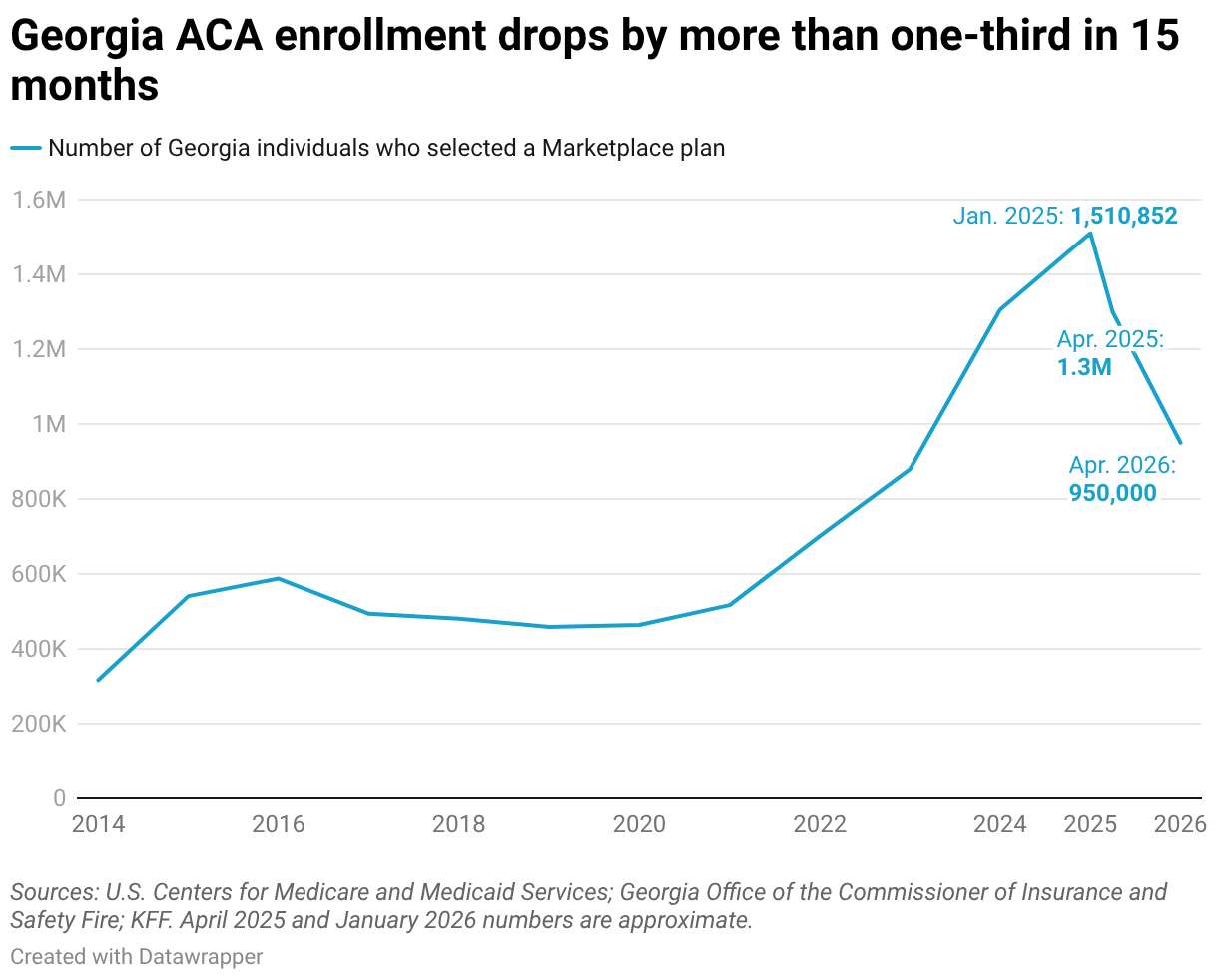
The 37% enrollment drop — from 1.5 million Georgians in January 2025 to 950,000 as of April 17, 2026 — dwarfs any previous decline in the state since the launch of so-called Obamacare health insurance plans in 2014.
Rising prices for health insurance policies bought on Georgia’s health care marketplace occurred after the U.S. Congress and President Donald Trump decided against extending Covid-era “enhanced” health insurance subsidies, which sunset Dec. 31, 2025.
Preliminary data released in January about the number of Georgians enrolled in ACA plans hinted at a sizable decline of 190,000. The more complete numbers have been adjusted after those people who had been reenrolled automatically at the start of 2026 failed to make their first premium payments.
The Georgia Office of the Commissioner of Insurance and Safety Fire released the data to The Current following a public records request. It will be reported by the federal government this summer.
The steep decline sparked immediate concern from the organization that advocates for Georgia’s rural hospitals about the financial viability of these vital institutions should the data signify that Georgia’s uninsured rate has soared after years of edging down.
“I don’t know what we’re going to do, honestly” said Monty Veazey, president of the Georgia Alliance of Community Hospitals, when informed of the data by The Current. “It’s a larger number than I anticipated,” he said of the enrollment drop.
He said he was meeting with Gov. Brian Kemp next week and hoped to ask for his plans.
THE HISTORY, FACTORS
The Affordable Care Act was passed in 2010 and the Marketplace launched in 2014. Under the ACA, the federal government mandates basic levels of care such as for prescriptions, mental health and maternal care; and it also subsidizes premiums for certain income groups. Georgia also began its own subsidies in 2022. Starting with 2025 coverage, Georgia took over the ACA enrollment system at GeorgiaAccess.gov.
Factors influencing whether the numbers of enrollees rise or fall have included how well the system is operating, how much outreach and enrollment assistance the government enacted, and above all, how expensive coverage was. President Trump in his first term pulled back on enrollment assistance, and in his second term has allowed massive pandemic-era subsidies to expire.
Drop negates recent achievements
Kemp came to office in 2019 promising to tackle Georgia’s adult uninsured rate, one of the highest in the nation. He has touted changes he oversaw to the state’s insurance market as well as the rollout of a state-based ACA marketplace called Georgia Access as solutions to this problem.
The new enrollment figures, however, raise questions about how durable those gains will be. Both Kemp and Insurance Commissioner John King did not immediately comment on the enrollment figures.
On Wednesday, after leading Georgia Democrats started calling the enrollment dropoff a crisis, Kemp's office provided a written statement saying that the numbers of people accessing federally subsidized health care remained higher than in 2019. "More people are covered today in Georgia than what was promised by the one-size-fits-none, bloated government approach Democrats have promoted in every election cycle," said Kemp spokesman Carter Chapman.
Georgia’s enrollment drop dwarfs many other states’, according to partial ACA enrollment data first reported last week by The Wall Street Journal.
Fluctuations in enrollment for so-called marketplace plans are routine. But year over year comparisons for April also project a stark picture. In April 2025, enrollment in Georgia’s marketplace plans had already dipped to 1.3 million, according to state officials. The April 2026 data still represents a 27% drop from that level.
“It’s a really large shift in the market,” said Emma Wager, a senior policy analyst on the ACA at the health research nonprofit KFF.
There is currently no data showing whether the Georgians who dropped their marketplace insurance are now completely uninsured, or whether they took up a new kind of insurance. Some of those previously enrolled could have gotten new jobs with employer-sponsored health care, but it’s likely large numbers of them had no better options, said health policy researchers.
In general, said Matt McGough, a policy analyst at KFF, people relying on Obamacare plans “really have nowhere else to turn.”
Wager, who emphasized that she herself had not seen the latest Georgia enrollment figures, said if the result in disenrollment ends up with a spike in the uninsured rates, then hospital finances across the state will be affected.
“A larger uninsured population means that hospitals have to provide more uncompensated care. And we also know that people who are uninsured are more likely to delay or forgo medicare care…they may have severe needs by the time they actually see a doctor.”
Georgia has traditionally had among the three worst uninsured rates, along with Texas and Oklahoma. But lower premium prices during the pandemic helped lead to a surge of Georgia patients getting insured.
U.S. lawmakers including former Rep. Marjorie Taylor Greene said that Congress’s decision last year to allow extra subsidies to expire would put insurance out of reach for many. Extending the enhanced subsidies another 10 years would have cost $350 billion.
Democrats in Congress shut down the federal government last fall in a fight over the health insurance subsidies, but Congress did not renew the funding.
Since those extra subsidies expired, Georgians who make above a certain amount— around $64,000 for a single person — no longer get any federal assistance and must pay the full market price for health insurance. For some Georgians, the cost of premiums more than tripled.
Health providers expect hit
The loss of enrollment will send shock waves through Georgia’s health care industry. The state’s health sector was expected to lose more than $3.5 billion this year as a result of the expiring subsidies, as uninsured patients forgo care or show up in emergency rooms but can’t pay.
Georgia’s expected loss of health sector revenue from that change would be among the three largest in the nation, behind only Florida and Texas, according to the study by the Robert Wood Johnson Foundation and the left-leaning Urban Institute.
Dr. Ben Spitalnick, a Savannah pediatrician, said the premium hikes presented a budget crisis for some of his patients’ parents.
“I know patients who, this year it's doubled for them,” Spitalnick said. “It's insane to consider having to drop your health insurance,” he said. “If you're, sort of solo employed or a very small business, and don't have the comfort of either Medicaid or have a very large employer who has a large health plan, the exchange was a great option. Now it's super expensive.”
McGough, the KFF researcher, said the ACA tends to insure people who are juggling hourly jobs or are self employed. Self employed often means doing gig work like driving Uber. More than a quarter of farmers and beauticians were insured through the ACA marketplace as of 2023, according to KFF.
This article first appeared on The Current and is republished here under a Creative Commons Attribution-NoDerivatives 4.0 International License.