Memphis advocates call on private airport to stop servicing ICE detention flights
Two more face federal charges with making threats in Nolan Wells’ death investigation


It's Friday August 7, 2026 and in this morning's issue we're covering: Memphis advocates call on private airport to stop servicing ICE detention flights, Two more face federal charges with making threats in Nolan Wells’ death investigation, ICE says Forest Service requested cooperation in Wilson Creek operation, NC lawmakers send two big election bills to governor, Why truckers always seem to be on the phone while they drive on the highway, From shelters to medical care, three young West Virginians want the state to change how it confronts homelessness, Nearly 15 years after student discipline reform, school suspensions in Mass. are falling. Are emergency removals taking their place?
Media outlets and others featured: Tennessee Lookout, Mississippi Today, NC Local, Carolina Public Press, CalMatters, Mountain State Spotlight, CommonWealth Beacon.
Memphis advocates call on private airport to stop servicing ICE detention flights
By Anita Wadhwani (Tennessee Lookout) Published: August 5, 2026
Memphis advocates on Tuesday called on a privately-run aviation company to stop servicing flights that transport detained immigrants out of the state.
Volunteers with Vecindarios 901, a Memphis mutual aid organization that coordinates a “rapid response” network to help immigrants impacted by Immigration and Customs Enforcement, said they have tracked 51 flights since March transporting detainees from Wilson Air Center. Using publicly available flight tracking data, the group has traced most of these flight destinations to Alexandria, Louisiana, where ICE has established a large detention facility.
Maria Oceja, Vecindarios 901 co-founder, urged owners of the Wilson Air Center, located on the site of the Memphis International Airport, to “reconsider your role” in the Trump administration’s mass immigrant detention and deportation operations.
“The Trump administration has separated parents from their children, wives from their husbands and families from their communities,” said Oceja, citing increased detentions as a result of ICE’s participation in the Memphis Safe Task Force and an uptick in detentions statewide that have brought hundreds of immigrants to a detention center in the city of Mason, located about 40 miles from the airport.
“Before they can even contact an attorney to fight their case in court they’re immediately flown out of this airport to a detention center in Louisiana, Alabama or another detention center in another part of the United States.” she said.
“By flying them out they are losing the opportunity to fight their case in Tennessee so they can stay with their families,” she said. Advocates on Tuesday also raised safety concerns over the use of restraints during flights that could place individuals at risk during air emergencies.
Wilson Air Center did not respond Tuesday to a request for comment.
ICE Air Operations, a division of Immigration and Customs Enforcement, coordinates the majority of flights via contracts with airline companies to transport detained immigrants to detention centers within the U.S. and on deportation flights outside the country.
In a statement received after publication, a spokesperson for ICE noted that ICE Air Operations provides “a network of air transportation to Enforcement and Removal Operations (ERO) 25 field offices to facilitate the movement of illegal aliens within the United States and their removal to destinations worldwide via air charter and commercial charter services.”
The transportation of detainees between facilities is routine, for reasons that include “capacity, security or logistical needs,” the spokesperson said.
Individuals are fully restrained during the flights per ICE policy, the spokesperson said.
“Detainees transported by ICE Air aircraft will be fully restrained using handcuffs, waist chains, and leg irons” during the flights, the spokesperson said. They are also provided meals and drinks.
“ICE is committed to the safety and welfare of those in custody throughout the entire transfer and removal process. Allegations of inhumane treatment or attempts to hide information is categorically false,” the spokesperson said.
In June, there were a total of 1,889 immigration enforcement flights — a 59% increase from June 2025, according to ICE Flight Monitor, which tracks flights using publicly available data.
SUBSCRIBE: GET THE MORNING HEADLINES DELIVERED TO YOUR INBOX.
- 8:44 am This story was updated with a response from ICE received after publication.
Two more face federal charges with making threats in Nolan Wells’ death investigation
by Mina Corpuz, Mississippi Today
August 4, 2026
Federal investigators have charged at least two more out-of-state people with allegedly threatening a witness and state court employees authorities believe are connected to the Nolan Xavier Wells’ death investigation.
Ohio resident Michelle Edwards and Illinois resident Edward Porter each face a federal charge of transmitting threatening communication to kill or injure. Court records do not state what the maximum penalty would be if convicted, but the portions of federal law under which they are both charged carry sentences between five and 20 years.
The court unsealed their charges Friday, the same day a California man was arrested for allegedly sending a bomb and death threat to a Mississippi Gulf Coast chancery judge who is the stepmother of a friend who went to Horn Island with Wells and others on July 4. A park ranger discovered Wells’ body on the island on July 6, after his friends had already returned home.
Investigators from an FBI task force said Edwards called in bomb threats to the George County Chancery Clerk’s Office and the Jackson County Sheriff’s Department the afternoon of July 23. The Jackson County Sheriff’s Department is leading the death investigation, and George and Jackson counties are both in the chancery judge’s district.
Edwards allegedly used a blocked phone number when she called the clerk’s office 21 times between 1:34 and 1:42 p.m., according to the criminal complaint. During the calls, she said, “Do not go outside,” “the clock is ticking,” and “die.”
She also allegedly called the sheriff’s office twice using the *67 function, which makes the caller ID appear as private, unknown or blocked. Those calls led law enforcement to place the building on lockdown and use a bomb detection dog to sweep the area.
Investigators submitted disclosure requests to telephone companies, which identified an Ohio number. A Cash App account and law enforcement records listed the phone number under Edwards’ name. Cell site information from July 23 included an area in Cincinnati where Edwards had two listed addresses.
The complaint accuses Porter of threatening to kill a witness in the Wells death investigation and another person in Mississippi on Friday morning; in both cases, Porter threatened to kill the person’s family members.
He allegedly told the witness, who is identified in court records as “W-1,” that he knew where they live and provided proof by texting the witness their address. Porter told the other person, identified as “W-2,” that he would cut them up and put them into a suitcase. Then, investigators say Porter called the witness back to say he was outside their home to kill them.
The threats came from a Gulfport-area text free number, which allows people to make calls and send texts over the internet. Agents requested information from a company called Pinger about the number, and the company provided two IP addresses tied to Porter, which included a Chicago-area number and a Maywood, Illinois, address.
Agents found that the Pinger account used to make the threats was created the same day the threats were sent. Cell site information placed an iPhone under Porter’s name at his residence in Berwyn, Illinois.
Wells’ disappearance and death have captured national attention, which has included the spread of theories and misinformation on social media and threats made against people believed to be involved.
The FBI is investigating threats received by friends of Wells, their families, Wells’ parents and local and state public officials working on the case. So far, none of the threats against Wells’ family has resulted in an arrest.
Wells, 18, traveled by boat with a group of friends to Horn Island off the Mississippi Gulf Coast to celebrate the Fourth of July. He did not return to Ocean Springs and was reported missing.
His death remains under investigation and a cause of death has not been released. The case is expected to be presented to a grand jury once the investigation is complete.
This article first appeared on Mississippi Today and is republished here under a Creative Commons Attribution-NoDerivatives 4.0 International License.

ICE says Forest Service requested cooperation in Wilson Creek operation. Here’s how law enforcement in national forests works.
by Lilly Knoepp, NCLocal
August 6, 2026
A popular swimming hole in the Pisgah National Forest became the site of an Immigration and Customs Enforcement (ICE) operation late last month, raising questions about when and how law enforcement partners with federal immigration enforcement officers in North Carolina.
This is the first time ICE has partnered with the U.S. Forest Service in the state in recent years, ICE spokesperson Lindsay Williams told NC Local. The initial request for the operation came from Forest Service Law Enforcement, not ICE, he said.
“I believe in this case they reached out to us along with the Caldwell County Sheriff's Office and they asked us to assist them and we set up this operation,” Williams told NC Local. The Forest Service declined to confirm who initiated the action.
The Department of Homeland Security, which oversees ICE, said it arrested 13 people who were illegally in the United States during the operation in partnership with the Caldwell County Sheriff’s Office and the Forest Service. Conservation groups and local advocates questioned why Forest Service officials worked with federal immigration authorities.
Following the incident, Siembra, a Latino advocacy organization, hosted a vigil near the spot of the raid. Organizer Andreina Malki asked why this immigration operation happened in the Pisgah National Forest.
“A question that you know that I have, as someone that loves and appreciates the national forests, is, ‘Why is that a place of immigration enforcement?' That is a place where families go to rest, where families go to enjoy a perfect summer day,” Malki said. “That is not a place where one would expect this to happen.”
But the cooperation between federal law enforcement agencies is not unusual.
“This cooperation is part of how we keep recreation areas safe and sustain the health of the forests,” a Forest Service spokesperson said in an email.
The Forest Service pointed to a 2025 law enforcement operation when officers seized 425lbs of illegally harvested ramps in the Nantahala National Forest as an example of law enforcement's regular operations in the national forest.
The Forest Service, which covers 154 national forests and 20 national grasslands, confirmed that its Law Enforcement & Investigation division “routinely partners with Federal, State, Tribal and local police—daily in most places.”
This typically includes joint work on resource‑protection patrols, traffic safety on forest roads, search‑and‑rescue support, wildfire‑cause investigations, arson, drug violations, or theft of forest products.
“Forest Service law enforcement is dedicated to keeping the national forests safe and secure for the American people. While our law enforcement officers have no authority to enforce immigration law, they collaborate with other federal and local law enforcement agencies,” a Forest Service spokesperson said in an email.
Forest Service law enforcement officers are independently managed and fall outside the direct supervision of local Forest Service units. Officers report to the local Patrol Captain, who in turn reports to the regional Special Agent in Charge and regional Patrol Commander.
Each of the Forest System’s 10 regions is divided into zones where special agents and uniformed officers are “stationed by workload and supported by patrol command and administrative staff.”
The regional law enforcement officers do not report to the forest supervisors who oversee all the other forest service activities. The Patrol captain in the region will advise forest supervisors on law enforcement matters occurring in a national forest.
The Forest Service also has criminal investigators assigned to each region who conduct criminal investigations into violations of federal law involving National Forest System lands.
The Forest Service declined an interview request and declined to confirm how many Forest Service law enforcement and investigation officers are employed in North Carolina, citing “officer safety.”
While Forest Service law enforcement has long functioned in the state, the Wilson Creek immigration operation marked a unique partnership. Williams said it’s the first time in his almost eight year tenure with ICE that he remembers the agency working with the Forest Service in North Carolina.
Williams said ICE has recently worked with the Forest Service in South Carolina and Georgia, though NC Local found no public references to these operations. In 2025, it was reported that ICE questioned people about their immigration status at a swimming hole in Arkansas.
Williams did not specify the reason for the Wilson Creek operation but underscored the authority of ICE to detain people without documentation.
“Obviously they encountered aliens, and we're the only agency for the most part that has the authority and the information to determine alienage, so that's why they called us,” he told NC Local.
ICE declined to share the names of the 13 people they say were arrested on July 26. NC Local spoke with one family member who said her nephew was detained.
Increasing cooperation with ICE
While ICE has always had relationships with other local, state and federal law enforcement, the volume of cooperation has “skyrocketed” under the Trump Administration, an NBC analysis earlier this year showed.
“There are 1,168 agencies with officers signed up to help ICE, up from 135 during the Biden administration and 150 at the end of Trump’s first term,” the report stated.
“I would categorize it as a whole of government approach,” Williams said.
Increased funding for ICE also enabled the expansion. In January, ICE’s budget increased from $10 million to $85 million, NPR reported.
Local and state law enforcement agencies may enter into agreements, called 287(g) agreements, with the federal government to collaborate on immigration enforcement.
Some local governments in Colorado, California and Illinois have pushed back against cooperation with ICE, according to the Migration Policy Institute.
In North Carolina, state leaders embraced expansion of federal cooperation, citing the re-election of President Trump as a clear communication from North Carolina voters of “their strong desire to create a safer country through increased border security and stronger immigration policies" in a new law requiring state law enforcement agencies to cooperate with ICE.
Governor Josh Stein vetoed the measure, called the North Carolina Border Protection Act. In June, Republican lawmakers overrode the veto. The new measure requires state law enforcement agencies, such as the State Bureau of Investigation and Highway Patrol, to enter 287(g) agreements with ICE.
At the end of last year, 25 law enforcement agencies in NC had 287(g) agreements. The Caldwell County Sheriff’s Department, which collaborated on the Wilson Creek operation, entered an agreement with federal authorities in 2020. The ACLU reports there are currently 28 active agreements in NC.
The Sierra Club, a national environmental group, condemned the Wilson Creek incident and framed it as part of a pattern of increased immigration action.
“Bringing immigration enforcement into public recreation areas undermines the sense of safety and belonging that these spaces provide and could discourage people from visiting national forests and other outdoor spaces altogether,” the organization said in a press release following the Wilson Creek operation.
The Sierra Club warned that the expansion of 287(g) agreements across the country and increased ICE funding could “bring similar operations to more communities and public recreation areas.”
This article first appeared on NCLocal and is republished here under a Creative Commons Attribution-NonCommercial 4.0 International License.

NC lawmakers send two big election bills to governor
by Sarah Michels, Carolina Public Press
August 4, 2026
After a year of work, North Carolina lawmakers agreed on a pair of wide-ranging election bills Tuesday evening that would shorten the primary early voting period, allow challenges of early voted ballots after Election Day and extend some ballot counting and curing deadlines, among other policy changes.
Now, the power is in Gov. Josh Stein’s hands. He can sign the election bills into law, veto them or allow them to become law without his signature. Stein indicated late Tuesday that he would indeed veto the more controversial of the bills.
The first of the two election bills, House Bill 834, passed with some Democratic support in a vote of 74-35. The second, House Bill 958, fell along party lines, in a 62-46 vote.
[Subscribe for FREE to Carolina Public Press’ Daily, Weekend and Election 2026 newsletters.]
Consequently, Republicans would likely have enough votes to override a veto of HB834. However, Stein has not indicated he would veto that one. The closer margins on HB958, which Stein has said he would veto, suggest it would be difficult for Republican legislators to override the governor's veto of that bill.
House Speaker Destin Hall, R-Caldwell, told reporters he doubts lawmakers will come back to override any vetoes before the November election. They’ll have to wait until the planned post-election session.
“Hopefully we don’t have to worry about that, and the governor just signs it and doesn’t veto it,” he said Tuesday prior to Stein's indication of his plans.
Hall added that the pair of bills make elections more transparent and clarify who can and cannot vote in North Carolina.
“Folks who are legally authorized to vote should be able to vote,” he said. “And the reality is, nobody has a difficult time voting in this state who’s eligible to vote.”
Controversial election bill House Bill 958
One of the election bills was more controversial: HB958. All Democrats and unaffiliated lawmakers voted against the bill, including some frequent swing voters.
Early voting period: While a provision to shorten the primary early voting period from 17 to 10 days is new to House Bill 958, it’s not a novel idea. This session, several lawmakers proposed cutting early voting days to some degree.
County election directors told Carolina Public Press that they were prepared for any outcome, but preferred that the general election early voting period stay intact. Some said lower turnout during primary elections would make a 10-day early voting period manageable.
Meanwhile, voting advocates argued that a longer early voting period gave people more time to decide how they wanted to vote and more opportunities to cast a ballot, while keeping lines shorter.
Rep. Pricey Harrison, D-Guilford, noted that a “significant portion” of elections in North Carolina are decided in the primary.
“Most of us in this chamber are here because we won a primary,” she said. “I think cutting back on primary days, you need to think about that piece of the calculus, and I think that's a bad move.”
Hall said two weeks of primary early voting is “plenty of time,” considering the lower turnout.
Challenging early voted ballots: If House Bill 958 becomes law, anyone could challenge an early voted ballot up to three days after Election Day.
Under current law, challenges must happen at the time ballots are cast, with the exception of absentee ballots.
Rep. Phil Rubin, D-Wake, called the provision “the Griffin,” referring to 2024 failed state Supreme Court candidate Jefferson Griffin, who challenged tens of thousands of ballots in an attempt to overturn his loss.
Rubin said it was dangerous to allow candidates to wait to see election results before deciding whether to pursue ballot challenges.
“You don't want candidates strategically filing challenges just to try and win an election,” Rubin said. “We should win elections at the ballot box, not in the courtroom.”
After bipartisan negotiations, the final House version of the bill only allowed challenges up to the close of the polls, but the Senate brought the extension back.
Other Democrats took issue with the Senate undoing some of the bipartisan work that led to the final House bill. Rep. Amber Baker, D-Forsyth, encouraged lawmakers to vote against the bill, and send a message as a House chamber that “we stand united on the work that we’ve done.”
Due process for dead voters: This spring, the State Board of Elections announced that it found about 34,000 potentially dead voters on the state’s voter rolls using the federal Systemic Alien Verification for Entitlements (SAVE) system.
That would be about 0.46% of North Carolina’s registered voters. State election officials have been using the SAVE system to crosscheck the state’s voter rolls with several federal databases to root out ineligible voters. That could include noncitizens, voters who have moved from one jurisdiction to another or dead voters.
Every week, the state Department of Health and Human Services sends the election board a list of people who have died so that they can be removed from the voter rolls. So, it’s likely that many of the 34,000 voters identified by SAVE did not notify North Carolina election officials before moving, and subsequently, dying.
HB958 requires the State Board executive director to distribute the names of dead voters identified by the SAVE system to county boards within a week of getting the information. Then, county boards must remove those voters from the rolls.
However, there is no process to confirm whether the identified dead voters are actually deceased. There’s no notice or challenge hearing before the voter is removed.
Rubin said lawmakers should include due process, especially considering the databases that SAVE uses are known to be incomplete and imperfect.
“It will lead to lawsuits,” he said. “It violates constitutional protections, and this bill could have guaranteed them.”
Late Tuesday, Gov. Stein posted to X that he would indeed veto this bill.
"Your vote is how you make sure that your government actually works for you and your family," Stein wrote. "I will always defend your right to vote. I will veto House Bill 958 because it makes it harder for you to vote, introduces unnecessary chaos into our elections, and invites sore losers to overturn an election they lost.
"The bill passed with only Republican votes. Thank you to every single Democratic and Unaffiliated house member for standing against this bad bill. Now, I ask you to call your legislators and urge them to uphold the veto. Because in this democracy, the power rests with you — the people. Let’s keep it that way."
More bipartisan support for House Bill 834
The other of the two election bills received bipartisan support.
It includes extended deadlines for counting provisional and absentee ballots, and fixing certain ballot issues, from three days after Election Day to five business days.
The bill outlines the process for securing ballots and electronic vote records between the end of the early voting period and Election Day. It clarifies that if a voter dies between casting their ballot and 11:59 p.m. on the day before the election, their vote does not count. There’s also a provision extending the time certain expired Class C driver’s licenses can count as valid voter IDs to the end of 2027.
Finally, HB834 allows people who want to challenge State Board decisions in court to either choose Wake County Superior Court, where all challenges occur now, or the superior court in their home county.
While Harrison said she appreciates the deadline changes, she doesn’t like the ability to sue outside of Wake County. It will lead to “judge shopping,” a process where plaintiffs try to file lawsuits wherever they think they’ll find the most sympathetic judge.
“That's going to prove to be a real problem for fair judicial treatment of election issues,” she said.
Editor's note: This article was revised to reflect news developments after it was initially posted.
This article first appeared on Carolina Public Press and is republished here under a Creative Commons Attribution-NoDerivatives 4.0 International License.

Why truckers always seem to be on the phone while they drive on the highway
By Gagandeep Singh, CalMatters

This story was originally published by CalMatters. Sign up for their newsletters.
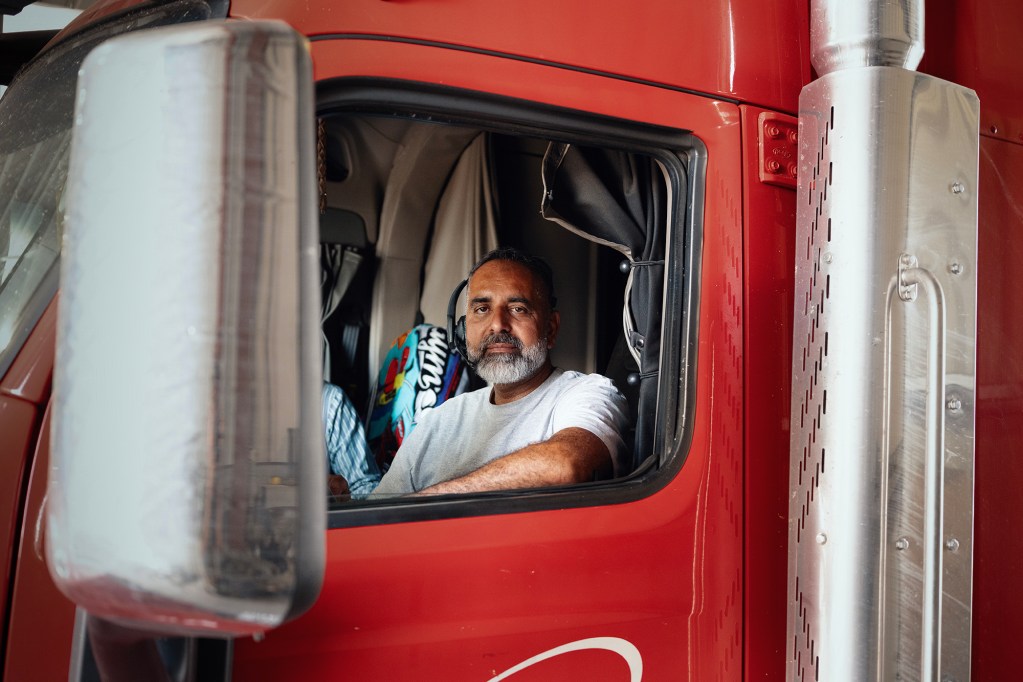
The calls started rolling in nonstop to Fresno trucker Gurinderjit Singh as he prepared for an out-of-state delivery earlier this summer. Some congratulated him on his son’s recent engagement while others were fellow drivers inviting him to join a conference call.
He climbed into his Peterbilt, clipped his headset, joined the call, and settled into an hourslong conversation with friends around the world.
Singh, an Indian origin trucker who is something of a social media influencer, spends at least eight hours a day on the phone while hauling freight, Monday to Saturday. He described the custom as a “call of empathy” — a ritual that gives him a jolt of positive energy and keeps him awake while behind the wheel.
It’s a habit that he and many other truckers share as they plug into conversations that cross continents and time zones, building a kind of rolling community that travels with them down the highway.
They say it helps them take care of their mental health in a career marked by long hours sitting alone in vehicles without access to exercise.
“There is a lot of stress on truck drivers in the United States,” Singh said. “I think the long call is a meaningful method that can reduce this level of stress, social isolation or loneliness in the truck by sharing feelings with others.”
Of course it’s illegal to drive while handling a cellphone and drivers make a point to keep one ear free on their headsets to comply with state laws. They are also aware that distracted driving can be deadly, and several of them told CalMatters they end their calls when they hit heavy traffic.
There is something at stake every time a driver picks up that call: control of an 80,000-pound machine, highway safety, and a commercial driving license that doesn’t come back easily if something goes wrong. The California Department of Motor Vehicles evaluates drivers’ physical and mental health during license renewals, and they can be suspended.
Yet, California has neither conducted a statewide study on truck drivers’ mental health, nor offered a program to support rehabilitation if a trucker faces mental health issues. They’re on their own to get an attorney and fight for a license renewal if an issue gets the state’s attention.
Lindsey Bryan is the health & wellness manager at Project 61, a nonprofit focused on truck drivers’ health. “We see that drivers face social isolation daily,” Bryan said. “They’re away from their loved ones, and also lacking many of the things that you and I might do on a day-to-day basis that help us reduce our stress.”
Academic researchers have found the solitude truckers experience makes them unlike other workers when it comes to social media and online communication. A 2016 paper, titled “Work Strain, Social Isolation and Mental Health of Long-Haul Truckers,” noted social media has been linked to feelings of isolation for online adults.
But not for truckers. Social media, such as WhatsApp and FaceTime, has the opposite effect for them while on the road, giving them a sense of community.
“These (social media) opportunities would provide truck drivers much-needed social connections during layovers, while waiting to load/unload their trucks, any other non-driving periods, or during emergencies,” the authors wrote.
'Until she starts snoring'
The calls may sound like a distraction, but truckers say they often help drivers stay focused.
“The reason, even in my car today, I talk on my cell phone, via hands-free or bluetooth and it keeps you alert,” said Joseph Rajkovacz, a retired executive for Western States Trucking Association. “It's no different than turning on your radio and singing along to a song you like. Even though nobody wants to hear your singing. So it does help keep you alert, too.”
That’s why Gerald Bailey, 53, says he spends 27 hours on the phone every week with his wife and brothers, chatting at all times of the day and night. It's become a routine for him once he’s behind the wheel.
He was talking on the phone with his wife at a truckstop in Lodi earlier this summer while he waited for a mechanic to fix his truck’s air conditioning.
“I stay on the phone with my wife until she starts snoring,” Bailey said while smiling. “Then I let her have a well-deserved sleep and I don’t want to disturb her.”
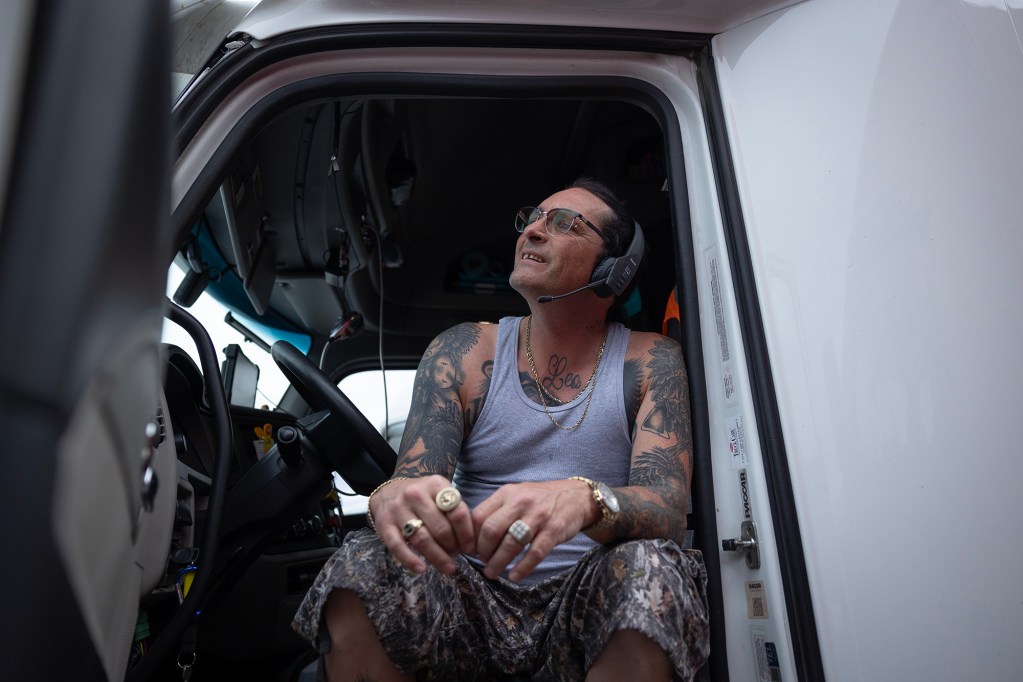
Some truckers, however, are prohibited by their employers from talking while driving. They’re monitored with cameras in the cabs, too.
“It’s against company policy,” said driver Peter Andrews, 62, of Texas as he walked through a truck stop near Sacramento. “I have to pull over the truck to call someone. They’ve put camera equipment with artificial intelligence right on my face, so I can’t use my phone.”
Health risks on the road
According to Project 61 data, 70% of truck drivers in the United States are obese — twice the rate of U.S. adult workers. They also experience heart disease and depression at twice the rate of the average U.S. worker, and diabetes at twice the rate of the general population.
Raman Dhillon, chief executive officer of the North American Punjabi Trucking Association, knows the toll personally. When he was driving the truck, he put on weight then learned he had diabetes and high blood pressure.
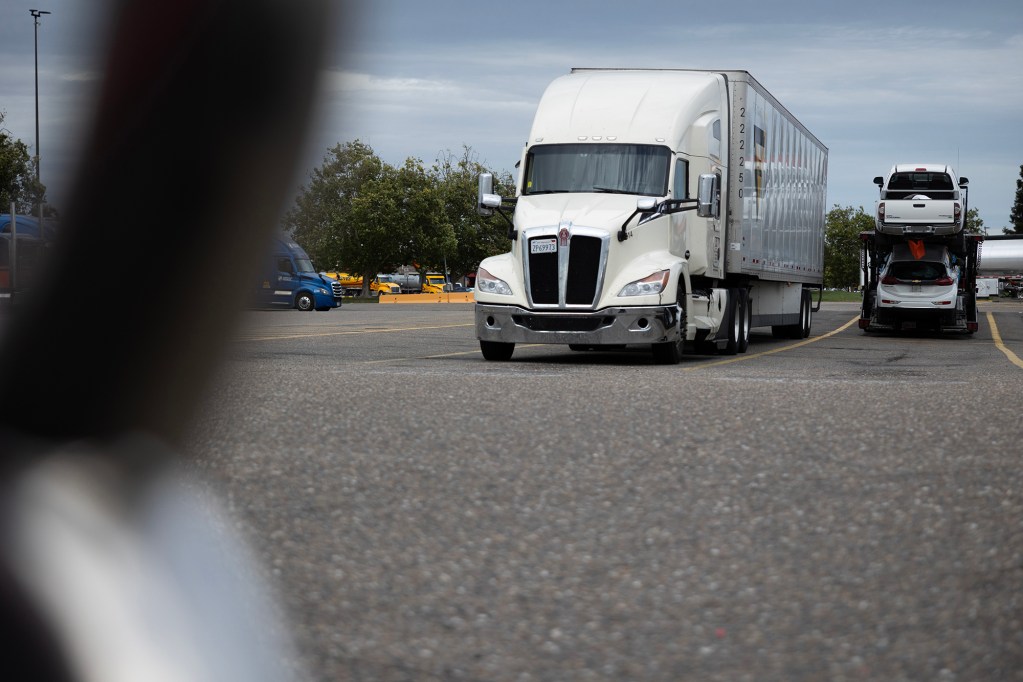
Truckers are “on the road. They are quarantining in that 10-by-10 cab, and loneliness at that time is intense,” Dhillon said. “You have 11 hours of driving, three hours of break, and 10 hours of sleep, and it’s constantly going on. I think a lot of drivers cope with this through phone calls.”
Singh, the Fresno driver, views those physical health risks as connected to mental health isolation. He notes that drivers feel more isolated when they eat poorly. That’s why his wife, Harjinder Kaur, a nurse, packs two or three delicious Indian curries, along with wheat breads, for his deliveries.
Truckers say they also endure what they describe as a kind of discrimination that weighs on them as they travel, including businesses denying them access to restrooms. The complaint reached Congress last year when a Republican lawmaker introduced legislation that would require retailers and warehouses to allow truckers access to bathrooms. The bill has not moved forward.
“They don’t allow us to use restrooms,” said Brenda Johnson, 58, who drives a truck out of Oregon along with her husband. “There’s no structure. And these companies where we deliver treat us as less than human.”
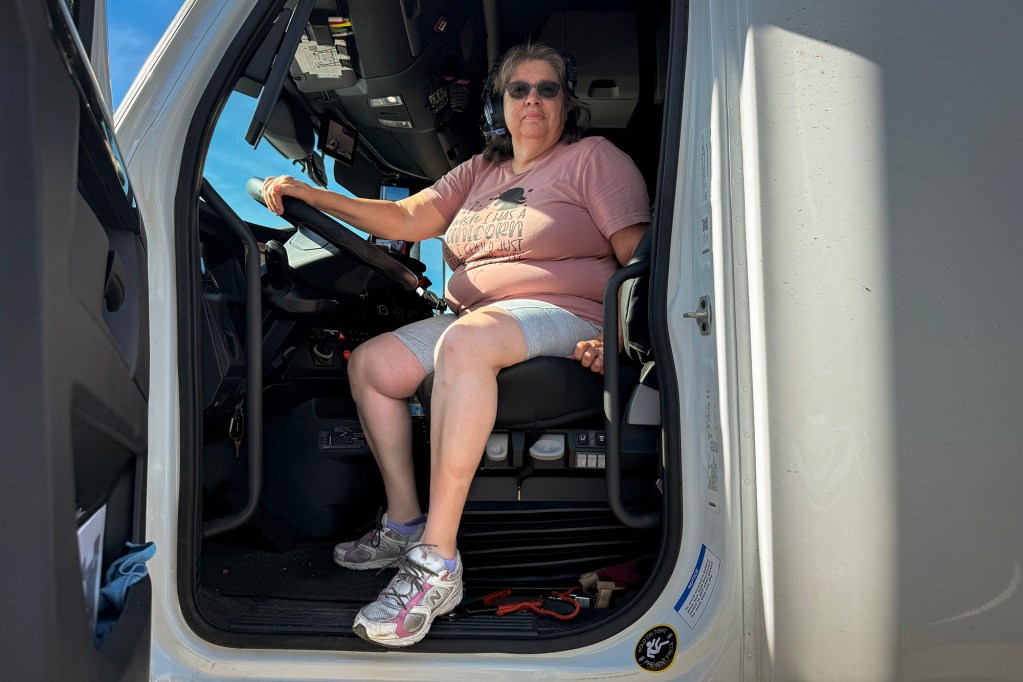
Exercise is its own obstacle. “We don’t really have any safe place to exercise,” Johnson said at a truckstop near Interstate 80 in Sacramento. Do you want to walk around a parking lot with trucks going in and out? You’re dodging all kinds of things. There’s no real safe place for exercise.”
Fighting loneliness
The constant companionship of her husband hasn’t solved Johnson’s loneliness. “Even though my husband rides with me and is constantly with me, I can still be alone and not be alone,” Johnson said, who has been driving since 2005. “Because we’re together all the time, we don’t really have anything to talk about.”
Johnson instead leans on her two girlfriends in the trucking industry, and some immediate family members. On a typical day, she may spend about an hour on the phone outside of company-related calls though that figure can swing sharply.
“My five hours would jump close to 25 hours in a week when I am in a good mood,” Johnson said. “When I’m depressed, though, I isolate myself. I don’t want to talk to anybody. I just don’t want to deal with anything.”
Long-haul trucker Jose Martinez, 50, was resting at a truck stop near Stockton when he described a similar rhythm. He has struggled with the guilt he feels for missing time with his family while he’s working. Now he calls family or friends whenever he feels lonely during a 10-hour shift.
"It's basically the whole time, and it's a positive thing to talk to people," Martinez said.
Talking through emergencies
For immigrant drivers, the cellphone calls offer an immediate connection to their home country that wasn’t possible in the Citizens Band (CB) radio era.
The U.S. trucking industry has long benefited from immigrant labor. Between 2000 and 2021, the number of foreign-born truckers more than doubled, rising from 316,000 to over 720,000 drivers. Today, about 18% of U.S. truck drivers are foreign-born. According to North America Punjabi Trucking Association, nearly 35% of Punjabi truckers of Indian origin contribute to the California trucking industry.
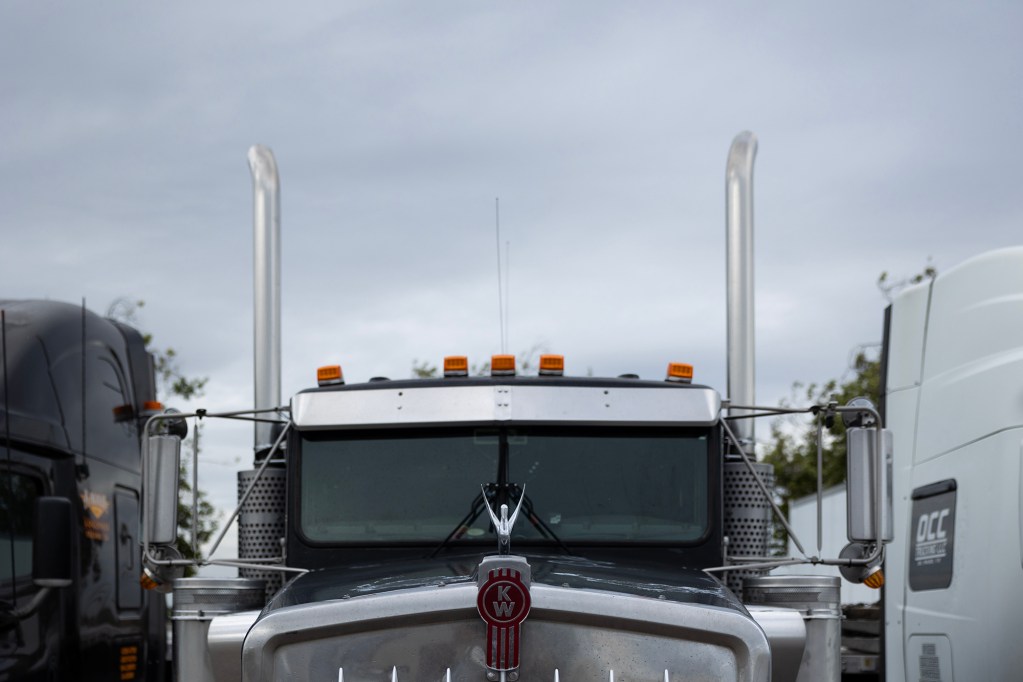
Singh, the Fresno driver, has a side hustle hosting a weekly TV show on Punjab politics. He’s publishing a book called “Ameriki Trucknama,” which translates to “American Truck Saga.” He also has 19,000 followers on Facebook, where people come for his political insights.
As he drove to Kansas City earlier this summer, his fellow Punjabi drivers asked his thoughts about who’d win in upcoming legislative assembly elections in Punjab, the northern Indian state that most of them call home.
Back on the highway, Singh points to more concrete benefits of the calls. They have helped drivers manage roadside emergencies.
Two years ago, he was on the phone with a friend when his friend’s truck’s fuel line burst somewhere in rural Texas. Panicked, Singh stayed on the call while his friend tracked down a local mechanic.
“Eventually, if he had not been on the call, we don't know what (would have) happened,” Singh said.
This story was produced jointly by CalMatters & CatchLight as part of our mental health initiative.
This article was originally published on CalMatters and was republished under the Creative Commons Attribution-NonCommercial-NoDerivatives license.
From shelters to medical care, three young West Virginians want the state to change how it confronts homelessness
by Eva Altizer, Mountain State Spotlight
August 2, 2026
On one winter night at the beginning of 2025, more than 1,900 people in West Virginia were staying the night in shelters or on the streets.
That number comes from the federally mandated Point in Time count, an annual census conducted near the beginning of the year by volunteers. It does not include unhoused people who are “couch surfing” or living with friends or family.
And some of the people affected by homelessness are kids. More than 15,000 students in the state experienced homelessness at some point during the 2024-2025 school year according to the state’s Department of Education.
Confronted with unsheltered people, some of the state’s municipalities, including Morgantown, Clarksburg, Parkersburg and Wheeling, have implemented bans on camping in public places. And though critics have roundly condemned those policies, arguing that they criminalize homelessness, legislators have introduced state-wide bans in the last two legislative sessions.
Mental illness and substance abuse are among the key causes of homelessness according to a study of the state’s homeless population completed by the Department of Health Services in 2024. But other challenges that people face include the lack of affordable housing and employment.
Homeless advocates and some who have experienced homelessness themselves say those with few housing options need more shelter, more information about resources and expanded public health strategies that reduce the harm of addiction.
Spending time with people
Niamh Coomey, 26, was a journalist-turned-bartender from the Twin Cities area in Minnesota when her cousin offered her a vacant bedroom in her new Wheeling apartment.
She took the opportunity, and began working again as a reporter at The Wheeling Intelligencer, where she was later assigned to cover the city’s camping ban. Writing about unhoused peoples’ displacement made her realize how much she cared about it.
As Coomey began volunteering with the unhoused population, she realized she wanted to do more for the disenfranchised people in her community. So she switched jobs and became the editor-in-chief of the Mustard Seed Mountain Street Paper.
The street paper is based in The Mother Jones Center for Resilient Community, or the “MoJo House” in Wheeling and describes itself as “biased for the poor, working, and misunderstood.”
Some of its recent stories include first person accounts from victims of the Triadelphia flood in 2025, convicted felons, and people who have achieved sobriety. The goal of the paper is to create understanding for the underprivileged, and help unhoused people find work and dignity while they’re at it.

The paper works with a system of unhoused vendors who buy each paper for a quarter and sell them for a dollar or more, keeping the profits to support themselves.
One of the vendors is a woman who has struggled with mental illness and is writing her autobiography. Coomey said the paper is a “little spot of hope” for her.
Coomey herself sometimes struggles with making ends meet.
“Rent is expensive. Groceries are expensive. Having a car is expensive. I don't have a car right now. I can't afford a car,” she said.
She has taken financial assistance from Ohio Valley Mutual Aid, a nonprofit. But she considers herself privileged because she can rely on her family for help, unlike many of the vendors and people she works with for the paper.
Living in Wheeling for only two years, Coomey does not want to speak for the community, but she considers the treatment of homeless people by the city, and how they’re perceived by the public, to be dehumanizing.
On a snowy December morning last year, she was helping campers pack up their belongings as the last safe camping spot for homeless people closed. She said the experience was traumatizing for the campers, and there weren’t really places for them to go.
Coomey believes there should be more.
“They can't get into public housing. A lot of times they can't get into shelters. At that point, there's really no option for them,” she said.
Coomey said spending time with the people themselves makes a difference. She said the comments she has heard from city officials demonstrate a real lack of understanding of the causes of the problem and how the community got here.
“I don't think a lot of them are actually trying to have conversations with these people that they want to discuss so much and talk so poorly of,” she said.
Someone in their corner
When Skylar Sams was in seventh grade, life with her parents became chaotic. Eviction notices came in the mail, the bills weren’t being paid and she was only eating when she went to school. So she took it upon herself to move in with her grandma.
Things started to go well after that — she graduated from high school and started college at WVU Parkersburg studying elementary education.
But Sams lost the Pell Grant and her financial aid when she didn’t perform well her first semester. She dropped out of college and got jobs working in restaurants, but things went downhill again when her grandma passed away.
Without housing, Sams was living in her boyfriend’s car. A friend named Jack Comeau, known locally by the stage name Moon King, was involved in many nonprofit programs in the Parkersburg area. He told her about a transitional living program with the Children’s Home Society of West Virginia.
Sams got involved with the program immediately, and three weeks later, she had an apartment.

“When I was stressing out about if I was either gonna have to crash at my mom's house or live in my boyfriend's car with him, I felt like I had nobody,” Sams said. “It was nice knowing that I had a group of people, who I had only met once, willing to help me find an apartment — help me get set up, so that I'm not a young adult just being thrown into the waters and being told ‘swim.’”
Now 22, Sams said making ends meet is still a struggle. She has a fulltime job at a local daycare and a paid weekend job taking care of her mom. Her boyfriend works 40 hours a week, but they both still rely on food stamps, medicaid, and the ongoing assistance given to them by the transitional living program to make it.
“I have to sit there, budget my paychecks and be like, ‘okay, well, this one can go towards rent. This one can go towards the electric bill. Oh — phone bill’s due — gotta pay that.’ After everything's paid, I got like 20 bucks for food,” Sams said.
Coming from a family that lived paycheck to paycheck, Sams thinks that it is very difficult to be a successful young adult without coming from a middle or upper class family.
Sams had friends in high school who were homeless but didn’t know about the youth programs that could have helped them. Many of them feared talking to school officials because they could be put back into foster care or their bad home lives. The resources need to be more advertised, to struggling youth in particular she said.
“(They need) someone to just be in their corner. To have a support system and know that they can go to someone. And feeling like they aren't throwaways — basically knowing that they are wanted,” she said.
‘You deserve so much more than this’
Now in her fourth year as a medical student, Abby Mitchell, 29, has been volunteering in street medicine, taking basic medical care and consultation to shelters and people living on the street, since her second year.
First, she worked with the student organization, MUSHROOM, the Multidisciplinary UnSheltered Homeless Relief Outreach Of Morgantown.
Now on the WVU School of Medicine’s Charleston Campus, she volunteers for CHASM, the Charleston Homelessness and Street Medicine Mission.
Alongside her medical school rotations, it adds up to a lot of time with people down on their luck.
“They have people who love them. They have family members. They have dreams,” Mitchell said. “These folk are just so overly appreciative of the smallest things. And sometimes that's heartbreaking because I'm like, ‘you deserve so much more than this.’”
The student organizations she has worked with have had varying abilities to provide care that reduces the harm of drug addiction, and it frustrates Mitchell.
She would like to provide more consistent harm reduction care, such as handing out testing strips for fentanyl and xylazine, exchanging needles, and providing doses of naloxone.

“There's a lot of conversation about not understanding why we do harm reduction. But a lot of times when you treat people who are facing substance abuse disorders with kindness and nonjudgment, that helps them have self-motivation and also helps them build trust with the medical community,” she said.
She said that can eventually lead to less drug use and sobriety.
“The issue is systemic and the root is that these people need resources and support,” Mitchell said.
Once, while doing a street round in Morgantown, Mitchell and other student volunteers had to perform wound care in the dark, pouring rain, with their headlights on, to treat a man with xylazine burns.
The patient clearly felt shame about his situation — at first, he told the volunteers that he had been pushed into a fire. Mitchell wants street medicine to break down the barriers to care and reduce shame.
“This patient was in excruciating amounts of pain,” she said. “And I think that was a really visceral moment where I’m like, this community is really sick and they need a lot of help, and there's no access to it.”
Correction Aug. 3, 2026: This story has been updated to correctly identify the college where Skylar Sams studied elementary education.
This article first appeared on Mountain State Spotlight and is republished here under a Creative Commons Attribution-NoDerivatives 4.0 International License.

Nearly 15 years after student discipline reform, school suspensions in Mass. are falling. Are emergency removals taking their place?
by Hallie Claflin, CommonWealth Beacon
August 4, 2026
IN 2012, after child advocates spent years trying to reduce punitive suspensions in schools, Massachusetts passed sweeping education reforms under Chapter 222, kickstarting a longstanding policy shift away from exclusionary discipline methods.
The law came as the nation moved away from the Zero-Tolerance policies of the 1990s and toward efforts to dismantle the school-to-prison pipeline. Chapter 222 established new due process and data reporting requirements for school districts regarding the discipline and exclusion of students. The underlying principle was to make exclusionary methods like suspension a last resort and require those who are removed from the classroom to continue receiving access to learning materials.
Around the time the law was passed, many out-of-school suspensions were for non-criminal, non-violent, non-drug-related offenses, and that broad, discretionary, catch-all category was where some of the greatest racial disparities existed. Students of color were removed from school for minor offenses at disproportionately higher rates than white students, as were students with disabilities compared to their peers.
In 2022, the state took it a step further by passing Chapter 177, requiring school districts to attempt alternative methods like restorative justice, counseling, and mediation before resorting to exclusionary discipline.
Nearly 15 years after that initial policy shift, out-of-school suspensions are falling. From 2018 to 2025, they dropped from nearly 28,500 statewide to less than 22,000, according to data reported by school districts and collected by the Department of Elementary and Secondary Education (DESE). In that same timeframe, the number of students receiving any form of disciplinary action in Massachusetts schools decreased by nearly 24 percent. In-school suspensions declined as well.
Yet, while only impacting a small percentage of students, emergency removals — a mechanism allowing school administrators to immediately remove a student from school due to severe behavior for up to two days before the child receives a legally-mandated hearing — have substantially increased, from nearly 1,500 in 2018 to more than 3,900 in 2025. The number of emergency removals dipped during the 2020-2021 school year but has increased every year since 2022.
The state’s 26 Gateway City school districts — which are responsible for educating some of the most disadvantaged student populations in Massachusetts — reported more than half of all emergency removals in 2025, despite making up just 28 percent of the state’s total public school population. In those districts alone, emergency removals collectively grew by 78 percent while suspensions decreased by 23 percent.
What’s behind the increase? The answer isn’t simple.
The trend has racial justice and education advocates sounding the alarm, suggesting that school districts may be circumventing suspensions (and the alternative discipline methods they are legally required to employ) and instead opting for emergency removals as a quick fix to behavioral issues. Those removals are amounting to lost learning that advocates say is ultimately contributing to the state’s staggering racial and socioeconomic achievement gaps.
“We’ve had all of these changes, but there's not a lot of teeth,” said Jenny Chou, executive director of the Children’s Law Center of Massachusetts, a legal services and advocacy group representing families and children. “The more you're not in school, the worse off you are, and now we have this whole system where it's seemingly justified to put you out.”
Teacher advocates and school officials say they haven’t been provided with the necessary level of resources or training to deploy alternative discipline methods, calling Chapter 177 an “unfunded mandate" amid a chronic shortage of special education professionals. Others say the increase can be at least partly attributed to an uptick in more violent, volatile classroom behavior due to youth mental health struggles brought about by the pandemic.
“The sad outcome of that is that schools are overusing emergency removals so they don't have to comply with our harder out-of-school suspension laws, and also so they don't have to use the alternatives that our state isn't providing them funding or training for,” said Matthew Cregor, an education attorney at the Mental Health Legal Advisors Committee, which offers legal representation to people with mental health challenges.
Research has long shown that exclusion from school is linked to poorer academic outcomes, higher risk of dropout, and increased contact with the criminal justice system. A 2018 study found that suspended youth were 40 percent more likely to be arrested within five years and 94 percent more likely to have been arrested as a minor. More recent studies have shown that these disciplinary practices negatively affect young people’s emotional and mental well-being.
The modest decline in out-of-school suspensions in Massachusetts has been celebrated by education advocates on all sides. But even though suspension rates have decreased for students of color and students with disabilities, both groups continue to be suspended at higher rates than their peers. In 2025, those with disabilities were suspended out of school at 2.5 times the rate of those without disabilities, according to data collected by DESE. Hispanic students were suspended 2.5 times as often as white students, while Black students were suspended nearly three times as much as white students.
The disparities persist when it comes to the use of emergency removals. Those with disabilities were removed at more than three times the rate of those without disabilities in 2025. Hispanic students experienced emergency removals nearly three times as much as white students, while Black students were removed more than four times as much as white students.
“If districts were meaningfully deploying approaches like restorative justice, mediation, and conflict resolution, they'd be able to act in a proactive manner to address student conflict and student misbehavior,” said Leon Smith, executive director of Citizens for Juvenile Justice, a nonprofit advocacy organization. “They'd be able to get to the root of some of these behaviors, and they’d be able to de-escalate conflicts before they result in fights and things of that nature. In the absence of that, you have continuing behavior that, unfortunately, is still falling into exclusion.”
Jay Blitzman, a former juvenile court judge and former director of Massachusetts Advocates for Children (MAC), said any kind of disciplinary exclusion contributes to the school-to-prison pipeline.
“This adversely affects public safety, quite candidly,” he said. “Educational continuity is essential. Doing everything we can to keep youth in school is obviously good for them, but it’s also part of being smart on crime.”
“It's easy to react and blame kids, but we as adults have to assume some systemic accountability,” he added. “These problems are historic, and they aren’t going away.”
Chapter 222 required districts to provide students and families with notice and a hearing prior to an out-of-school suspension, except during emergency circumstances, in which the child can receive their hearing after being removed.
Emergency removals were established as an official disciplinary category in 2014. Districts may finally be reporting them with some accuracy, Cregor said, which could help explain the spike in removals.
But some advocates, including Jennifer White, an education attorney at MAC, suspect that school officials are utilizing informal removals that are not being officially reported as emergency removals to the state.
She told CommonWealth Beacon she has worked with parents that have received mid-day calls from school officials requesting that their child be picked up after one or more behavioral incidents. Yet some are allowed to return to school the next day without ever receiving the mandated hearing that is supposed to accompany an emergency removal.
Chou said she has seen similar cases. “As if that's some time-out that they're allowed to do,” she said.
Beccah Griffith, president of the Malden Education Association and a special education teacher, said many districts are reluctant to use formal discipline measures for students on Individualized Education Program (IEP) plans out of fear of invoking a manifestation determination — a legal meeting required by the Individuals with Disabilities Education Act to decide if a student's misbehavior was caused by their disability or a failure to follow their education plan. It is triggered when a school plans to suspend a student with a disability. This could account for the uptick in the use of emergency removals, as well as the disproportionate use of removals against students with disabilities, Griffith said.
A 2025 Stanford research study published by a journal of the American Educational Research Association found evidence that schools in California, after being sanctioned for disproportionately suspending Black students, began using informal ways to remove students from learning, such as sending children home early or isolating them in hallways, often without recording the action as a form of discipline. Researchers found more broadly that these practices occur when mandates to reduce formal suspensions “are not paired with adequate resources for alternative restorative behavior management approaches.”
Because of the budget crunches around hiring ancillary service providers like social workers, behavior analysts, and speech therapists, many districts have only been able to hire staff for legally mandated services, like math and science teachers, rather than additional supports, Griffith said.
“There is resentment and dislike towards these alternative discipline strategies because they're not being resourced properly,” she added “If we have the requisite, expertly trained staff and the time, space, and resources, it works. But I don't know any educator in Massachusetts that has all of those things.”
In addition to staff and funding, advocates say implementing alternative discipline practices requires long-term training, programming, oversight, and technical assistance. DESE’s Rethinking Discipline Initiative, for example, coaches school districts on data reporting and assists in the reduction of disparate rates of suspension for students with disabilities and students of color.
“The Department of Elementary and Secondary Education continues to work with districts to develop the supports and practices that educators need to reduce the inappropriate or excessive use of emergency removal and other types of suspension,” a DESE spokesperson said in a statement provided to CommonWealth Beacon.
In 2025, there were 3,915 reported emergency removals in Massachusetts schools. Much like suspensions, 42 percent of those removals were for offenses labeled as non-drug, non-violent, and non-criminal — something advocates say is inherently contradictory.
Some say the problem lies in the language of the law, which allows an emergency removal when a student’s continued presence poses a danger to other people or property, “or materially and substantially disrupts the order of the school.” A principal may immediately remove a student if “there is no alternative available to alleviate the danger or disruption,” according to statute.
Advocates have questioned what constitutes a "disruption," and whether there are circumstances in which a disruption warrants an emergency removal rather than a formal suspension process or another type of discipline. Since 2022, districts have increasingly cited the non-drug, non-violent, non-criminal offense category for emergency removals, rising from 37 percent of all emergency removals in 2022 to 42 percent in 2025. Because the behavior in this category is undefined, it is difficult to determine what students are doing to be removed from school on this basis.
“The pandemic and the tremendous toll it took on student mental health resulted in more disruption and dysregulation in schools, and as a result, we are seeing a swing back toward removing students from school,” Cregor said. “But I think there's some reasonable fear that districts are calling things emergency removals that are not emergencies.”
Since the pandemic, teachers and administrators in Massachusetts and beyond have spoken out about an uptick in violent, explosive behavior in the classroom. Gerald Koocher, former president of the American Psychological Association, said this behavior can be linked to feelings of loneliness and disconnectedness that arose during the pandemic, which did not go away when students returned to school.
“It put them in social isolation, it put them under stress, and it weakened their connection with school,” Dr. Koocher said of the pandemic. “There has been a broader pattern of youth violence, which includes firearms, especially among teenagers, and particularly in urban areas.”
But the state's disciplinary data shows that some of the most common violent offenses occurring in schools, including physical attack (battery), threat of physical attack, and physical fights, have either returned to their pre-covid levels or slightly decreased. But, when it comes to emergency removals, these categories have been increasingly cited as the offense type.
For instance, the number of reported emergency removals administered for offenses labeled “physical attack” increased from 387 instances in 2018 to 1,133 instances in 2025. Yet, the total number of reported physical attacks in schools across the state decreased slightly from 8,136 in 2018 to 7,991 in 2025.
Chelsea Public Schools superintendent Almi Abeyta said six years after the pandemic hit, educators and administrators are still grappling with students’ social and emotional issues.
“At the end of the day, we don't want children to be out of school,” she said. “But we're seeing more dysregulation with our younger children — pre-K through grade 5 — than what we've noticed in the past. We have little kids that will just destroy an entire classroom.”
In 2024, legislation that would have prohibited the use of suspensions and expulsions on pre-K through Grade 3 students advanced out of the education committee. While the move was celebrated by child and student advocates, the Massachusetts Association of School Superintendents opposed the bill, arguing that school administrators require flexibility when making disciplinary decisions. The bill ultimately died in the House, though there is a current version that is again awaiting legislative action after passing out of the Joint Committee on Education.
Abeyta said school staff do everything they can to intervene before suspending or removing a child. She said educators recognize the critical role that counselors, clinicians, and other behavioral support staff play. Yet budget cuts last year forced the district to reduce staff by more than 50 full-time employees.
“I left it up to the principals to decide, and none of them cut social workers or counselors,” Abeyta said.
Abeyta said emergency removals are mostly reserved for safety issues, though in 2025, nearly 44 percent of Chelsea’s emergency removals were for non-drug, non-violent, non-criminal offenses. In 2025, the district had the third highest emergency removal rate of the 26 Gateway City school districts, after Fitchburg and Holyoke. The number of removals in Chelsea grew from 20 in 2022 to 151 in 2025.
Massachusetts Teachers Association (MTA) president Matt Bach said the trend in emergency removals is a symptom of “deeper issues” regarding districts’ ability to provide the best services to students, adding that schools are facing both a funding and staffing crisis.
“Is [the trend] paralleling the reduction in education professionals across the board? Is it paralleling a reduction in public education investment? Is it paralleling substandard curriculum products, which are choking school budgets and intensifying student disengagement?” Bach said. “The ratio between professionals and students in these districts is what's going to matter most for student outcomes and behaviors.”
He said the MTA has encouraged restorative practices like increased recess time and reduced screen time, which have been shown to benefit dysregulated students. The association has also pushed for Gov. Maura Healey’s recent proposal to direct an additional $100 million to public school districts across the state. The funding would help communities manage growing financial challenges ahead of the new school year. The proposal, which must be approved by the Legislature, would add to the more than $7 billion already appropriated for K-12 education in the fiscal 2027 state budget.
The hope, Bach said, is that some of that funding could be used by districts to rehire staff that might have been laid off in the spring due to budget shortfalls around the state. Educators like Griffith say that without an adequate number of behavioral support staff, districts won’t be able to reduce their exclusionary discipline rates.
“When there is one social worker for 75 to 100 students with complex emotional needs, you're not able to be proactive in supporting them,” she said. “Educators want to be proactive to try to prevent a crisis that could result in emergency removal. That's the way we're trained, but it's often not what we're able to do.”
This article first appeared on CommonWealth Beacon and is republished here under a Creative Commons Attribution-NoDerivatives 4.0 International License.