NC Governor Stein signs $319M Medicaid funding plan
Bill that would eliminate Calvin Duncan's court clerk position in New Orleans heads to Louisiana governor

It's Friday, May 1, 2026 and in this morning's issue we're covering: Stein signs $319M Medicaid funding plan, US Supreme Court Callais decision just weakened the Voting Rights Act. What happens next in Mississippi?, Bill that would eliminate Calvin Duncan’s court clerk position heads to Landry, Judge clears ICE’s path to deport asylum-seeker from Iowa to Congo, No more slip ups. Rocky Mount trying to avoid a full LGC financial takeover, Data Center Tax Exemption Changes Still Holding Up Virginia Budget, New Arizona guidelines aim to protect workers from heat, but fall short of enforceable standards, Georgia’s ACA enrollment plunges, raising concerns for rural hospitals.
Media outlets and others featured: NC Newsline, Mississippi Today, Iowa Capital Dispatch, Carolina Public Press, Inside Climate News, Cronkite News, The Current GA.
Stein signs $319M Medicaid funding plan, extending healthcare coverage in NC
By Christine Zhu (North Carolina Newsline) Published: April 30, 2026
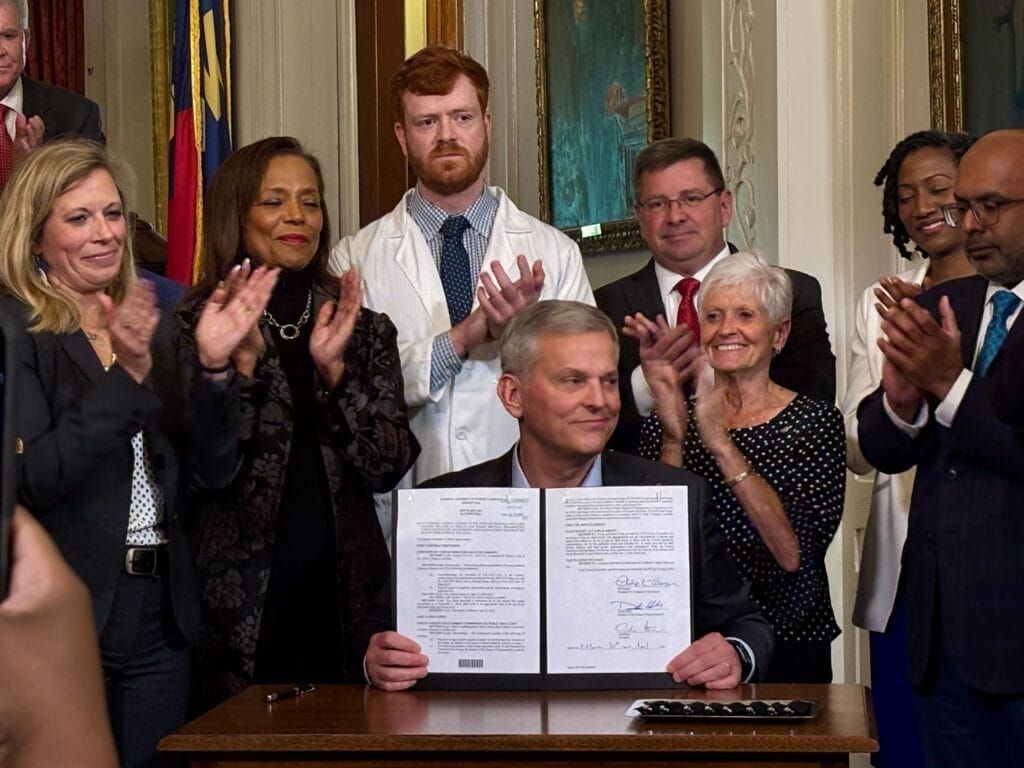
Gov. Josh Stein signed a bill Thursday approving $319 million in Medicaid funding, ending months of uncertainty over the program’s future.
More than 3 million North Carolinians rely on Medicaid for healthcare. Without a state budget, N.C. Health and Human Services Secretary Dev Sangvai warned the program would run out of money by the end of May.
Stein urged state lawmakers to supply adequate recurring funding next year to keep the program stable.
“For months, the status of Medicaid in North Carolina has been in unnecessary jeopardy,” Stein said before signing the document. “I’m relieved to say that the bill that I will be signing will provide certainty and care that the people and the providers of this state need and deserve.”
House and Senate lawmakers voted nearly unanimously to pass House Bill 696, “Medicaid & HHS Adjust./Other Critical Needs,” earlier this week.
Three Democrats in each chamber voted against it, saying it would deny Medicaid coverage to 27,000 pregnant women and their children due to their immigration status. The group includes victims of human trafficking, green card holders, refugees and other immigrants with legal status, as well as undocumented immigrants who are pregnant or who have recently given birth.
Stein said he was concerned with that part of the bill, but noted the urgency of funding the program before it runs out of money.
“Depriving these vulnerable women and children healthcare converge is wrong,” Stein said. “Fortunately, based on conversations we’ve had, I believe that it is the General Assembly’s intention to fix this.”
But that’s not the only provision in the bailout bill causing concern. H696 also creates new copays for Medicaid at the maximum amount allowable by federal law.
A coalition of 14 nonpartisan organizations representing patients with serious and chronic health conditions, including the American Cancer Society Cancer Action Network, urged policymakers to reconsider the copay amounts.
“Research has shown that even low levels of cost-sharing and copayments deter patients from seeking care,” the coalition said in its statement.
H696 also includes some of the nation’s most restrictive requirements for eligibility. Federal law requires a minimum one-month lookback period, which is the timeframe for checking work-requirement eligibility for benefits like Medicaid. But H696 requires Medicaid to verify three months of work eligibility before applicants receive approval.
“There may be people who are eligible for Medicaid that are denied benefits because of this longer lookback,” Stein said.
Looking ahead, the program has a $1 billion rebase, or increase in costs, for the upcoming fiscal year, according to Sen. Benton Sawrey (R-Johnston), co-chair of the Joint Legislative Oversight Committee on Medicaid. That’s larger than the expected surplus in the state budget.
With rising prices, Sawrey said Medicaid costs have increased by more than 90% over the past five years in North Carolina.
“House Bill 696 takes important first steps in giving our Medicaid partners important tools in order to manage that cost,” Sawrey said. “I’m proud of the work that we did to get this across the finish line, but I don’t have any illusions that this is the current solution that’s going to fix everything going forward.”
North Carolina General Assembly gives final approval to $319M in Medicaid funding
Josh Dobson, president and CEO of the North Carolina Health Association, said the law provides relief for providers in addition to patients. The funding supports the providers and teams who make healthcare possible.
Healthcare workers are stepping up while managing workforce challenges and significant financial pressure, he said.
“Through all of that, they continue to deliver high quality care in every single corner of North Carolina,” Dobson said. “They stayed engaged, worked in good faith and helped move forward an approach that supports patients while strengthening the system for the long term.
SUPPORT: YOU MAKE OUR WORK POSSIBLE
The law also contains measures to target waste and abuse in Medicaid. The House Select Committee on Oversight and Reform grilled Sangvai and Attorney General Jeff Jackson earlier this month over allegations of fraud.
Some critics said the measure moved jurisdiction over fraud away from the attorney general to the state auditor’s office, but bill sponsors said that’s not the case.
Sangvai lauded the push for agencies to work together to identify and address cases of waste and abuse.
“One of the other opportunities that’s come out of this process is collaboration in the state,” he said.
Stein isn’t worried about the potential power shift, he said, since the attorney general — a position he previously held — partners with the governor’s office against Medicaid fraud.
“The government is really focused on it, because we want every healthcare dollar to go to make someone healthy,” he said.
US Supreme Court Callais decision just weakened the Voting Rights Act. What happens next in Mississippi?
by Taylor Vance, Mississippi Today
April 29, 2026
ABERDEEN — A federal judge in Mississippi will soon decide if she should go forward with adopting a new Mississippi Supreme Court district map now that the nation’s highest court has significantly weakened the federal Voting Rights Act.
Mississippi Republican Gov. Tate Reeves, at the same time, wants lawmakers to create new state Supreme Court election maps, in a special session of the Legislature he has ordered to happen May 20, now that the U.S. high court has ruled in a landmark Louisiana v. Callais redistricting case.
Also, politicians in Mississippi and across the South are pondering whether the U.S. Supreme Court ruling will allow them to redraw lines along party affiliation for this year's midterms now that racial safeguards appear to have been weakened. That might prove a difficult task in Mississippi, since it has already held midterm congressional primaries and its congressional lines already greatly favor the GOP, which holds all but one of six congressional seats.
But Mississippi is set to deal with state Supreme Court districts in the short term.
Senior U.S. District Judge Sharion Aycock held a hearing Tuesday in Aberdeen, weighing whether she should quickly craft a new map for at least some of the state judges to run in possible November special elections or wait for guidance from the nation’s highest court.
“It is a balancing act,” Aycock said.
But now that guidance has arrived.
The U.S. Supreme Court on Wednesday, a day after Aycock’s hearing in northeast Mississippi, struck down Louisiana’s second majority Black congressional district in a decision that could open the door for Republican-led states to eliminate Black and Latino electoral districts that tend to favor Democrats and affect the balance of power in Congress.
“That map is an unconstitutional gerrymander,” Justice Samuel Alito wrote for the six conservatives.
The court’s conservative majority found that the district relied too heavily on race and weakened the landmark voting rights law’s protections against discrimination in redistricting.
But the Mississippi case involves three Mississippi Supreme Court districts and is different from the Louisiana congressional district case, something that Aycock acknowledged during Tuesday’s hearing.
“I do think they’re very different cases,” Aycock told attorneys.

The Mississippi litigation started in April 2022 when the American Civil Liberties Union, the ACLU of Mississippi, the Southern Poverty Law Center and private law firms, on behalf of a group of Black Mississippians, sued the state because they believed Black voters in certain parts of the state couldn’t elect a candidate of their choice.
Aycock ruled in August 2025 that the districts illegally dilute Black strength and needed to be redrawn. She allowed the Legislature to come up with a new map during its 2026 session earlier this year, but it declined to do so.
Aycock justified the ruling by noting that no Black person has ever been elected to the Mississippi Supreme Court without having first obtained an interim appointment from the governor.
But the conservative Mississippi Legislature was unpersuaded. Since the lawmakers didn’t adopt new maps, attorneys were back in court on Tuesday to argue about how the judge should proceed.
The plaintiffs proposed three different redrawn maps for consideration, while state officials asked Aycock not to adopt any map until the U.S. Supreme Court's Callais decision
Ari Savitzky is an attorney for the plaintiffs, and he argued that Aycock should move forward quickly with adopting a new map to prevent Black votes from being diluted any longer.
“The remedy must end vote dilution by increasing political opportunity for Black voters,” Savitzky said. “That’s the bottom line.”
Bill Cooper, a redistricting expert for the plaintiffs, created the three new maps that Aycock could implement: one called the race-blind plan, another called the least-change plan and a final one called the regional plan.
Cooper testified that he did not use racial demographics to craft any of the proposals. Instead, he used data such as sustained poverty rates in certain counties to create a uniform district.
But Michael Wallace, an outside attorney representing the state, pointed out that a disproportionate number of Black Mississippians are impoverished when compared to white citizens. So he could use poverty as a proxy for racial data.
Wallace also cast doubt that Cooper’s maps could truly be race-neutral because he’s previously done redistricting work in Mississippi.
“Didn’t you tell the court when you testified here before that you’ve done a lot of work here in Mississippi, so you understand the state by race?” Wallace asked.
Mississippi Supreme Court races generally receive less voter participation than other races, but the state’s highest court has ruled on several vital issues in recent years, such as the state’s ballot initiative and allowing the Legislature to give money to private schools.
If Aycock still believes a new map should be implemented after the Callais decision, she could adopt one of the maps the plaintiffs presented, tweak one of the plaintiffs’ maps or employ an outside expert to help her craft a map.
Another complication for the future of the state Supreme Court’s district lines is how Mississippi politicians respond to the Callais decision.
Reeves has ordered lawmakers to return to Jackson in three weeks to redraw the state Supreme Court districts, even though those same lawmakers declined to redraw the districts in response to Aycock’s initial order.
It’s unclear how lawmakers will respond to the Callais case and how Aycock would respond to a potential new map from the Legislature.
She asked attorneys in court if she should tell the Legislature that she preferred they adopt a certain map or if she should wait for the Legislature to act before she adopts a map. The attorneys responded that Aycock has wide latitude to decide how to proceed.
Justin Matheny, an attorney with the Mississippi Attorney General’s Office, told Aycock that she should not adopt a map until after the Callais ruling because the Legislature could choose to adopt a competing plan to her plan, which would then likely prompt a new round of litigation.
"We would be here in three or four months or however long it would be and in an even bigger mess than we’re in right now,” Matheny said.
This article first appeared on Mississippi Today and is republished here under a Creative Commons Attribution-NoDerivatives 4.0 International License.

Bill that would eliminate Calvin Duncan’s court clerk position heads to Landry
by Robert Stewart, Verite News New Orleans
April 29, 2026
A bill that is set to eliminate the elected role of clerk for the Orleans Parish Criminal District court and consolidate the civil and criminal clerks into one position is heading to Louisiana Gov. Jeff Landry’s desk.
On Wednesday (April 29), the Louisiana Senate approved the amendments sent over by the House on Senate Bill 256 that would consolidate the two clerk’s offices. The Senate voted along party lines with 25 Republicans in support of the legislation and 11 Democrats opposed. No member of the Orleans delegation voted for the bill that specifically targets the Orleans Parish clerks offices.
Calvin Duncan, who served 28 years in prison on a murder conviction for which he was later exonerated, won the election to run the criminal district court by 68% of the vote in November. Duncan said he felt the state slid back with the development.
“It’s a sad thing to see the state government repeating what happened to Black public officials during Reconstruction,” Duncan said.
Today’s vote in the Senate was the last step the legislature needed to take before sending the bill to Landry, who has previously said that he would sign the bill.
Landry did not respond to a request for comment.
Sen. Jay Morris, R-West Monroe, introduced the legislation in the Senate in March.
Democrats in both the state House and Senate voiced fierce opposition against the bill.During floor debates in the House, some lawmakers were concerned the bill could face legal challenges.
Duncan, who campaigned as a former jailhouse lawyer who later went to law school and fought for greater transparency in the courts, said he intends to enjoy “every minute” he has left as the clerk-elect.
“They will do what they do,” Duncan said, “and I will do whatever I have to do to vindicate the voters of New Orleans and make sure that what happened to me, never happens to anybody else.”
This article first appeared on Verite News New Orleans and is republished here under a Creative Commons Attribution-NoDerivatives 4.0 International License.


Judge clears ICE’s path to deport asylum-seeker from Iowa to Congo
By Clark Kauffman (Iowa Capital Dispatch) Published: April 28, 2026
A federal judge has cleared the way for ICE officials to deport a Bolivian asylum-seeker from Iowa to the Democratic Republic of Congo.
Noting that José Yugar-Cruz is part of a class of people for whom the Supreme Court has twice issued orders lifting injunctions that prohibited such deportations, U.S. District Judge Stephen H. Locher ruled this week that he had “little choice” but to deny Yugar-Cruz’s motion to have the court block his removal from the United States.
Court records show that Yugar-Cruz, who is from Bolivia, entered the United States on July 8, 2024, at the Arizona border and immediately surrendered himself to law enforcement and was taken into custody.
In October 2024, Yugar-Cruz applied for asylum, citing a threat of torture in his home country. In December 2024, an immigration judge issued a “withholding of removal” order under the Convention Against Torture, based on the torture Yugar-Cruz had previously faced in Bolivia and likely would face again if returned to that country.
Although the federal government did not appeal the immigration judge’s ruling, it opted to keep Yugar-Cruz detained in jail while it searched for another country that would accept him if he were to be deported.
For 17 months, U.S. Immigration and Customs Enforcement kept Yugar-Cruz jailed while the agency tried without success to remove him to Argentina, Chile, Paraguay, Mexico and Canada.
In December 2025, Yugar-Cruz took ICE to court, seeking his release and arguing that his indefinite imprisonment was a violation of his rights given his lack of criminal history. The U.S. Department of Justice agreed Yugar-Cruz should be released from the Muscatine County Jail, subject to his continued supervision by ICE.
With his asylum case pending, Yugar-Cruz is detained again
With his asylum application still pending, Yugar-Cruz was released from jail. Days later, the Trump administration finalized a “Third-County Removal Agreement” with the government of the Democratic Republic of Congo, which pledged that deportees sent there from the United States would not be subject to persecution or torture.
On March 9, 2026, ICE officials learned Congo had formally agreed to accept Yugar-Cruz for third-country removal. On April 8, 2026, Yugar-Cruz was taken into custody during what he expected to be routine, address-verification visit to an ICE field office in Cedar Rapids.
On the day his deportation flight was scheduled to leave the United States, Yugar-Cruz won a temporary stay in the proceedings by arguing the federal government could not legally deport him.
As part of that case, attorneys for Yugar-Cruz argued their client was a member of a certified class in the case D.V.D. v. U.S. Department of Homeland Security. In that case, a Massachusetts court had entered a preliminary injunction blocking the government from removing noncitizens to third countries without first providing those individuals an opportunity to be heard on the matter.
In Monday’s ruling on Yugar-Cruz’s deportation, Locher wrote that the Massachusetts decision is “unquestionably favorable to Yugar-Cruz’s position … The problem for him, however, is that shortly thereafter the United States Supreme Court took the unusual step of granting a stay of the injunction.”
So, although the Massachusetts case is still pending, ICE’s process for deporting individuals to third countries remains legally valid, Locher noted.
“This is all but fatal to Yugar-Cruz’s claim,” Locher wrote. “He is a member of a class of people for whom the Supreme Court has twice issued orders lifting injunctions that prohibited third country removals like the one (the federal government is) attempting to carry out here. In other words, when a different district court tried to do what Yugar-Cruz is asking this court to do, the Supreme Court intervened twice to stop it … The court cannot award relief on a one-off basis that the Supreme Court would not allow to be awarded en masse.”
Some human rights organizations have objected to the United States’ deportations to Congo, citing the armed conflicts, yellow fever outbreaks and widespread poverty in the area.
Two weeks ago, 15 South American migrants and asylum seekers deported from the United States to the Democratic Republic of Congo claimed to be facing pressure to return to their countries of origin where they fled persecution or torture.
Some of the 15 told the Reuters news agency that since being deported, they’d been given no viable options other than going back to their home countries, and are currently stranded in Kinshasa, a city of 15 million people, with no money and no passports.
SUPPORT: YOU MAKE OUR WORK POSSIBLE
No more slip ups. Rocky Mount trying to avoid a full LGC financial takeover.
by Mackenzie Thomas, Carolina Public Press
April 27, 2026
Reeling from a state audit last month that highlighted financial mismanagement, the city of Rocky Mount now faces a potential takeover of finances by the Local Government Commission should the city’s budget “slip” again.
City leaders met with the Local Government Commission on April 1 to discuss the current state of finances and how they plan to move forward, according to a press release from the State Treasurer.
“It almost never gets this bad,” State Treasurer Brad Briner said in the meeting. “When it does, it's usually because it's terminal. It’s usually because a business has moved or a large population base has left and it’s not going to be fixed. This is not that. This is simply a failure of will, and we are here to help impose that will today.”
[Subscribe for FREE to Carolina Public Press’ Daily, Weekend and Election 2026 newsletters.]
The commission issued an official notice and warning to the city during the meeting, which is the highest level of warning the commission can give to a municipality.
If leaders are unable to keep a handle on city finances, the LGC has threatened to take over, potentially making it the commission’s largest financial takeover of a municipality to date, according to the press release. During its 94 years of operation, the LGC has taken over finances for 12 towns in the state, according to its website.
Current situation and changes made so far
Initially, the city was projecting cash flow through June to the end of the fiscal year, but upon closer inspection, noticed there would be no cash left by the end of July if changes weren’t made, said Cheryl Spivey, finance director for Rocky Mount, during the meeting.
The city has started making those changes. In February, the City Council adopted an ordinance to revise the budget for fiscal year 2026 by cutting appropriations by $29.6 million. This cut included a 10% layoff of full-time employees, Spivey said in the meeting. Earlier this month, she said they also increased utility rates on electricity, gas, water and more. Daniels noted improvements in account reconciliations as well.
Cornelius Jordan, assistant city manager and public information officer for Rocky Mount, said the city is also providing regular financial updates to the LGC twice a month.
Elton Daniels, city manager for Rocky Mount, said the hiring of Spivey as the new finance director has helped immensely. She’s not the only addition the city has made to its finance staff. On Thursday, the city announced the appointment of Kimberly Leonard as its new chief budget and strategy officer, a position that will focus on developing the annual budget and improving efficiency and sustainability.
“Kimberly brings exceptional local government experience, strong fiscal judgment, and a proven ability to align strategy with execution,” Daniels said in the press release.
“At a time when disciplined planning, accountability, and thoughtful resource allocation are more important than ever, this position will play a critical role in strengthening how the City develops its budget, evaluates priorities, and measures results.”
Concerns arose during the meeting about how the city plans to ensure the accuracy of revenue projections moving forward, given the inaccuracy of past ones. While Daniels can’t speak to the years prior, since he wasn’t overseeing the budget then, he said, they’re now trying to be more conservative on revenue projections and look at the previous year actuals.
“I have a multi-pronged approach with regard to the budget projections,” Daniels said during the meeting. “Before, I think it was the responsibility of possibly one individual. Now, I have multiple people involved in that step, including myself, and that’s just not within the organization. I have experts outside the organization that’s also been willing to assist us, including big organizations like the League of Municipalities.”
To increase revenue, the city is considering raising taxes, Daniels said. Questions were raised during the meeting about how city officials would explain these tax increases to Rocky Mount citizens, since they would primarily be due to the city’s own “poor management.”
Sandy Roberson, mayor of Rocky Mount, said they would just need to be honest with citizens, and that a tax increase wouldn’t be the only option.
“We just have to be honest, we just have to tell the truth,” Roberson said. “The auditor’s report has outlined that very well. … It has been as clear as you can possibly make it. This has been mismanagement. This is where the money’s gone. It’s gone for stuff, and it’s gone for people.”
What would LGC takeover look like?
Should the LGC be forced to take over Rocky Mount, the state commission would essentially become the city’s governing body as it relates to finances, LGC staff said. According to NCGS 159-181(c), the commission would be “vested with all of the powers of the governing board as to the levy of taxes, expenditure of money, adoption of budgets, and all other financial powers conferred upon the governing board by law.”
Every takeover is different, LGC staff said.
“A unit’s financial conditions can change quickly,” LGC staff said. “That’s especially true with a unit like Rocky Mount whose problems are primarily caused by budget failures. If the LGC were to take control of Rocky Mount’s finances, staff would assess the condition of the City’s financial management at that point in time, and the Secretary and staff would act quickly as needed to stabilize the unit and ensure that debt service payments are able to be made.”
Staff said Rocky Mount is unique because while most other towns in trouble struggle with finance issues, this city is plagued with budget issues and has simply spent too much money.
“Typically, the LGC avoids telling units to make specific spending decisions; rather, we point to the overall trend (expenditures greater than revenue, in this case) and direct the unit to make its own decisions about what to cut,” LGC staff said. “Regardless of what expenditures the City cuts or what revenue streams it chooses to increase, the City’s delay in taking aggressive enough action led the City to this point.”
If events force the LGC to come in and take control of city finances, State Auditor Dave Boliek said he would consider it a failure of city leadership.
“You (have) got to make these tough decisions,” Boliek said during the meeting. “It’s not easy, I know, but you know what you signed up to do … People elected you to make those decisions. We also don’t want a precedent on this board, when a municipality gets into financial trouble, they run to the LGC, and then the LGC has to make the tough decisions on finances, when we weren’t specifically elected to make those decisions for the members of the public in that town.”
However, Daniels stressed that they find themselves in this situation now partly because of prior unqualified finance personnel. The state auditor’s report last month highlighted high turnover in the finance department, with the city having gone through five finance directors since fiscal year 2021. Now that the city has hired Spivey as their new finance director, Daniels said he feels “100% confident” in her ability.
“We are going in the right direction, even though we have a large mountain to climb,” Daniels said in the meeting. “But I think step one was having someone that’s qualified in that position.”
Next steps for Rocky Mount
Despite the current financial situation, city leaders are still “confident” that they will make it to the end of the fiscal year due to the work that’s already been done with the fiscal year 2026 budget.
“We haven’t really got into the fiscal year ‘27 budget, which I anticipate will have further cuts, reductions across the board, including a restructure of the entire organization, which could easily save the city anywhere on the low end from $1.5 million on up,” Daniels said in the meeting.
Overall, Daniels said the city has adopted an “all-hands-on-deck” approach.
“Forget about titles. We have to fix this together,” Daniels said in the meeting. “Ideas don’t just come from the top, they come from the bottom, they come from the side, they come from the public. And we try to put something together that we understand is not going to be popular to everybody, but we understand that it’s what it’s going to take to get us out of this current situation.”
The city is still working on the financial audit from fiscal year 2025, which was originally due on Dec. 31, according to the press release from the State Treasurer, Jordan said, adding that they plan to finish it in the coming days.
The top priority for the commission right now is making sure the city will have enough cash for debt-service payments, which amount to more than $3.3 million for the remainder of fiscal year 2025-2026 and $8.7 million for fiscal year 2026-2027, according to the commission’s notice and warning. Other concerns involve being able to pay staff and crafting a “responsible” budget for fiscal year 2026-2027, LGC staff said.
“If we saw concerning trends on any of these items, this could necessitate the LGC taking further action,” they said.
When asked by Carolina Public Press what actions would be necessary from the town to remove the threat of a financial takeover, LGC staff said: “If the city were to take the actions summarized in the Notice and Warning, the city would be on much stronger financial footing. The commission and staff will continue to assess the financial condition and will notify the city when the commission feels the risk of immediate takeover has passed.”
The city’s next scheduled meeting with the LGC is May 5, when city leaders will return to discuss further progress they’ve made, Jordan said. City officials will also submit a draft of their fiscal year 2026-2027 budget in May, according to the commission’s notice and warning. An updated draft will be submitted in June before the City Council officially adopts it, and the commission has asked city officials to attend the June 9 meeting as well.
This article first appeared on Carolina Public Press and is republished here under a Creative Commons Attribution-NoDerivatives 4.0 International License.

Data Center Tax Exemption Changes Still Holding Up Virginia Budget
A Democratic senator wants to end the $1.9 billion handout. The industry doesn’t want to cede that much.
By Charles Paullin
April 24, 2026
This article originally appeared on Inside Climate News, a nonprofit, non-partisan news organization that covers climate, energy and the environment. Sign up for their newsletter here.
RICHMOND, Va.—Virginia’s Democratic lawmakers failed to make a deal on the budget again on Thursday due to disagreements over whether data centers should continue to receive tax breaks on their computer equipment.
Lawmakers gaveled in and out of a one-day special session that was set to vote on a budget that they failed to pass in March at the end of the 2026 legislation session.
“Let’s take our time and do this thing right,” Senate President Pro Tempore Louise Lucas, D-Portsmouth, said in a brief interview Wednesday when no deal had been made.
Lucas and many Senate Democrats want to end a $1.9 billion tax exemption for data centers to generate revenue for social programs. Their counterparts in the House and newly elected Governor Abigail Spanberger, a moderate Democrat, are more beholden to the industry’s desires to keep the exemption so Virginia remains attractive as the data center capital of the world. An option to tie the exemption to clean energy requirements still exists.
At issue is ending a sales and use tax on data centers’ computer equipment that is waived for a data facility when $150 million is invested and 50 jobs are created in a community. The tax ranges from 5.3 percent to 7 percent, depending upon the locality.
Created in 2008 after the housing crisis, the incentive intended to lure the industry to the state to stimulate economic development. At the time, lawmakers forecast an estimated $1.5 million in tax revenues would be waived.
Now, Virginia has bloomed into the data center capital of the world, with more of the server farms than any other state or country. Residents’ electricity bills have been rising, and environmental groups are concerned about water availability and air quality. Meanwhile, in 2025, the industry reported the state waived $1.9 billion in sales taxes from data centers.
With rising land values in Northern Virginia where many data centers want to build, and a need to buy replacement computer equipment typically every three to five years, the state’s exemption is beneficial to improving tech companies’ bottom lines.
Lucas wants to end the exemption in January, eight years before it’s set to expire in 2035. She initially asked for the $1.9 billion in revenue the industry would have to pay for an array of social programs. Now, she’s lowered that request to $1.6 billion.
“There’s not going to be a cap, I want it to be perpetual and ongoing,” Lucas said of the revenue from data centers. Other states, she said, “are going to feel the same way we do about them taking money from the voters and giving it to these large, large corporations.”
“We got the infrastructure, we got the water, we got the land. Where are they going?” Lucas said. “They’re not going to go anywhere.”
House Speaker Don Scott, D-Portsmouth, urged more caution.
“We have to make sure that we do everything that we can to help Virginia keep its competitive advantage,” Scott said. “We are the leader in the world, not only the country, in the world. Texas and others, they want to have what we have.”
The Senate’s plans for spending the data center tax revenue across the next two years include $1.1 billion for general fund programs, with about $440 million for education. About $300 million would go toward transportation, $324.1 million would be remitted to localities and about $190 million would go toward other regional needs.
Broader initiatives in the budget include making up for less federal funding for the food assistance program known as Supplemental Food Nutrition Assistance Program, or SNAP, and health care under Medicaid. Those losses resulted from President Donald Trump’s One Big Beautiful Bill Act, which also gave tax breaks to the wealthy.
For their part, leaders of the data center industry contend that Lucas is asking for too much and say companies could easily spend funds to quickly move projects to other parts of the country. Data centers still pay local tax revenue, and trade unions covet the steady stream of temporary construction jobs they create.
Since negotiations began in February over the data center tax exemption, a compromise put forth by the industry has been through several iterations. The industry wants to only contribute $1.1 billion over two years, which is what Senate budget documents said would go to the state’s general fund. In March, industry representatives, including government relations specialists from Microsoft and Amazon, and Josh Levi, the Data Center Coalition president, met in closed-door meetings with lawmakers.
The industry and Lucas haven’t come to an agreement on how much revenue could be provided to the state. Those industry representatives declined to comment Thursday during a gathering in the Virginia General Assembly Building.

State Del. Terry Kilgore of Wise County, the House minority leader, said he wants to keep the exemption but is interested in more revenue from data centers. Rural communities in Virginia starving for economic development want to remain competitive, he added.
“We need data centers in the commonwealth,” Kilgore said. “My issue with all this is we’ve made promises to these data centers when they came here to have this tax credit. We as Virginians need to fulfill our promises.”
Democrats in the House of Delegates and officials in the governor’s office remain concerned about how ending the exemption could harm the state’s business-friendly reputation by going against awarded contracts granting the exemption. Beyond the data center debate, the party is worried about federal workforce cuts made early in President Trump’s second term by Elon Musk and his Department of Government Efficiency (DOGE) upending the Northern Virginia economy that serves to lift the entire state.
The House came closer to alignment with Lucas in the Senate after Del. Luke Torian, D-Prince William, joined her in March to say it’s up to the industry to come back to lawmakers with an acceptable budget contribution, whether it’s from a change in the tax exemption or some other new mechanism. Scott, the House speaker, told Inside Climate News in a brief interview at the end of the regular session that “we’re all on the same page, we’re going to be able to claw back.”
Spanberger, though, appears more dug in. At an April 9 groundbreaking for a manufacturer of data center computer racks, Spanberger said “the fact that Virginia is a reliable partner matters as much as the incentives we put on the table, and we intend to protect that reputation aggressively.”
In a session with reporters Wednesday morning, after previously suggesting an electricity consumption tax to have data centers pay their “fair share,” she reiterated that it’s up to budget negotiators to come up with an agreement on a plan, including the amount of revenue from data centers, to present to her.
“At this step, I’m actively engaging, but…I’ll defer to them to answer that question,” Spanberger told Inside Climate News.
The governor has vetoed a gambling measure expected to generate revenue, and wanted to delay until the next year the establishment of a legal retail marijuana market, which could also provide revenue. But the legislature sent the bill on marijuana back to the governor without the delay. Spanberger has until May 22 to make any final signatures or vetoes on bills.
A politically tense Congressional redistricting fight has also taken up oxygen in the legislative process. Virginia voters settled the debate on Tuesday by voting yes to change Virginia from having a 6-5 Democratic majority in the U.S. House of Representatives to one with an expected 10-1 Democratic majority, pending a legal challenge. Negotiations on the budget may soon be more streamlined. Scott, the speaker, said a deal could be hashed out by June.
“I’m going to see what she’s going to do,” Lucas said, referring to the governor’s action on bills. “At this point it could cause us to probably lose some money in the budget, so I want to wait until she’s done.”
Lost in the data center debate is an alternative included in the House of Delegates budget proposal to keep and possibly extend the data center tax exemption, and tie it to banning the use of fossil fuels as a primary source of power, matching energy needs with clean energy sources, transitioning from diesel backup generators to batteries, and using energy more efficiently. Data centers that chose to avoid those clean energy requirements in favor of fossil fuel energy sources would forego the tax exemption, thus generating some tax revenue for the state. Illinois has a tax credit for data centers that are carbon neutral or have a green building certification.
Asked if there’s interest in placing the clean energy requirements on the exemption, Lucas said, “I have not had that conversation with my caucus so I can’t answer that.”
New Arizona guidelines aim to protect workers from heat, but fall short of enforceable standards
by Sophia Braccio, Cronkite News
April 20, 2026
PHOENIX – Arizona is implementing new workplace heat safety guidelines as summer approaches. They address shade, breaks and water access, but advocates say without enforceable standards, they fall short of protecting workers.
The state has experienced longer periods of extreme heat, putting Arizonans at greater risk for heat-related illness, emergency room visits and death, according to the Arizona Department of Health Services.
Last May, Gov. Katie Hobbs directed the Arizona Division of Occupational Safety and Health, or ADOSH, to establish a Workplace Heat Safety Task Force made up of medical experts and workers’ rights advocates and representatives across Arizona.
(Audio by Sophia Braccio/Cronkite News)
The task force submitted final recommendations on Dec. 31, 2025, and the Industrial Commission of Arizona, the state agency that oversees ADOSH, voted to approve and roll out those guidelines on April 9.
The new recommendations call on employers to establish a heat illness prevention plan, which includes access to cool water and shade, rest, training and gradual exposure to intense heat.
Members of the governor’s task force represented industries impacted by the heat, including construction, agriculture, first responders and hospitality.
Trina David, a crew chief for an airline at Phoenix Sky Harbor International Airport who spoke during public comment before ADOSH and the Industrial Commission, said during her 18 years at the airport, she has seen workers collapse from heat-related illness.
“These are lifelong illnesses for us,” she said.
According to Banner Health, pavement temperatures can be 40 to 60 degrees hotter than the air temperature, and the tarmac is no exception.
The physical demands compound the risk, David said: “You are talking about exertion levels because each back is 50 pounds or more.”
If breaks are not required, she said, many workers feel they can’t take them.
“If you leave it ‘as needed’ people won't take the breaks because they feel retaliation is real,” David said.
The new guidelines build on existing workplace safety measures; they do not create protections from scratch.
ADOSH operates its own workplace safety program under a state plan approved by the federal agency OSHA, which sets baseline standards for workers protections, said Amber Pappas, an occupational safety and health consultant and facilitator on the task force.
OSHA launched a National Emphasis Program specific to heat hazards in 2022, directing enforcement agencies to focus inspections on heat-related risks.
Arizona followed in 2023 by adopting a State Emphasis Program through ADOSH. However, that program includes general guidance, rather than enforceable, heat-focused rules. Pappas described the requirements as “catch all standards,” adding that the state relies on an overarching standard, often referred to as the general duty clause, for enforcement.
“All employers are legally required to provide a place of employment free from potential or recognized hazards that could cause serious injury, illness or fatality,” she said. “Currently under state emphasis, all we have is that general duty clause.”
The task force’s new recommendations will be added to the 2023 emphasis program, offering detailed guidance for employers, and are expected to be revisited regularly, Pappas said.
The guidelines have a broad reach for industries across the state, including agriculture. Heat-related mortality rates for U.S. crop workers are 20 times higher than other industries, according to the Environmental Defense Fund.
Jazmin Moreno-Dominguez, an organizer and co-founder of Agave Community Threads, surveyed agricultural workers in southern Arizona. She said she’s heard stories of workers who have to walk long distances to get to water stations and seek shade in hazardous places like behind tractor tires.
Moreno-Dominguez is part of the Arizona Heat Standards Coalition, a group of community members who called on the state to implement enforceable heat safety rules as quickly as possible.
“The task force, while it is a great start, in our opinion, is just continuing to delay actual policy on paper and put protections on the ground,” Moreno-Dominguez said.
Fifteen of the 24 task force members called on ADOSH to support binding and enforceable heat safety rules including defining hazardous temperatures and minimum rest periods. Ultimately, the final recommendation approved by the entire task force did not include enforcement provisions and the commission moved forward with the guidelines without launching a rulemaking process.
According to Maxwell Ulin, staff attorney for the UNITE HERE Local 11 union, the Arizona guidelines give employers best practices for heat safety. This also aids state enforcement to “a limited degree” by helping investigators assess whether a business is doing enough to keep workers safe.
Still, Ulin believes this is not enough protection.
“We will continue to be struggling to enforce what is an otherwise very broad, nonspecific standard for safety and health until workers get hurt or until there is substantial risk of injury to workers,” Ulin said.
Five states currently have varying forms of heat standards, according to OSHA. Colorado’s heat standard only applies to agricultural workers, while Minnesota’s only applies to indoor places of employment. California has a Heat Illness Prevention Standard that applies across industries and is triggered when temperatures reach 80 degrees.
A Health Affairs study found that California saw an estimated 33% decrease in heat-related deaths among outdoor workers after it intensified enforcement of its heat standard in 2010, and a 51% reduction after revisions were made to the standard in 2015.
Industrial Commission Chair Dennis Kavanaugh said Arizona should study how heat standards worked elsewhere, considering more evidence and budget impacts before initiating rulemaking.
“Today's not a once and done. This is the beginning of our process as commissioners to deal with this issue,” Kavanaugh said during an industrial commission meeting.
The commission ordered a report on the effectiveness of the new guidelines by the end of the year.
This article first appeared on Cronkite News and is republished here under a Creative Commons Attribution-NoDerivatives 4.0 International License.

Georgia’s ACA enrollment plunges, raising concerns for rural hospitals
by Ariel Hart/The Current GA, The Current
April 20, 2026
Editor's Note: Story updated Wednesday, April 22, to include statement from Gov. Brian Kemp's office.
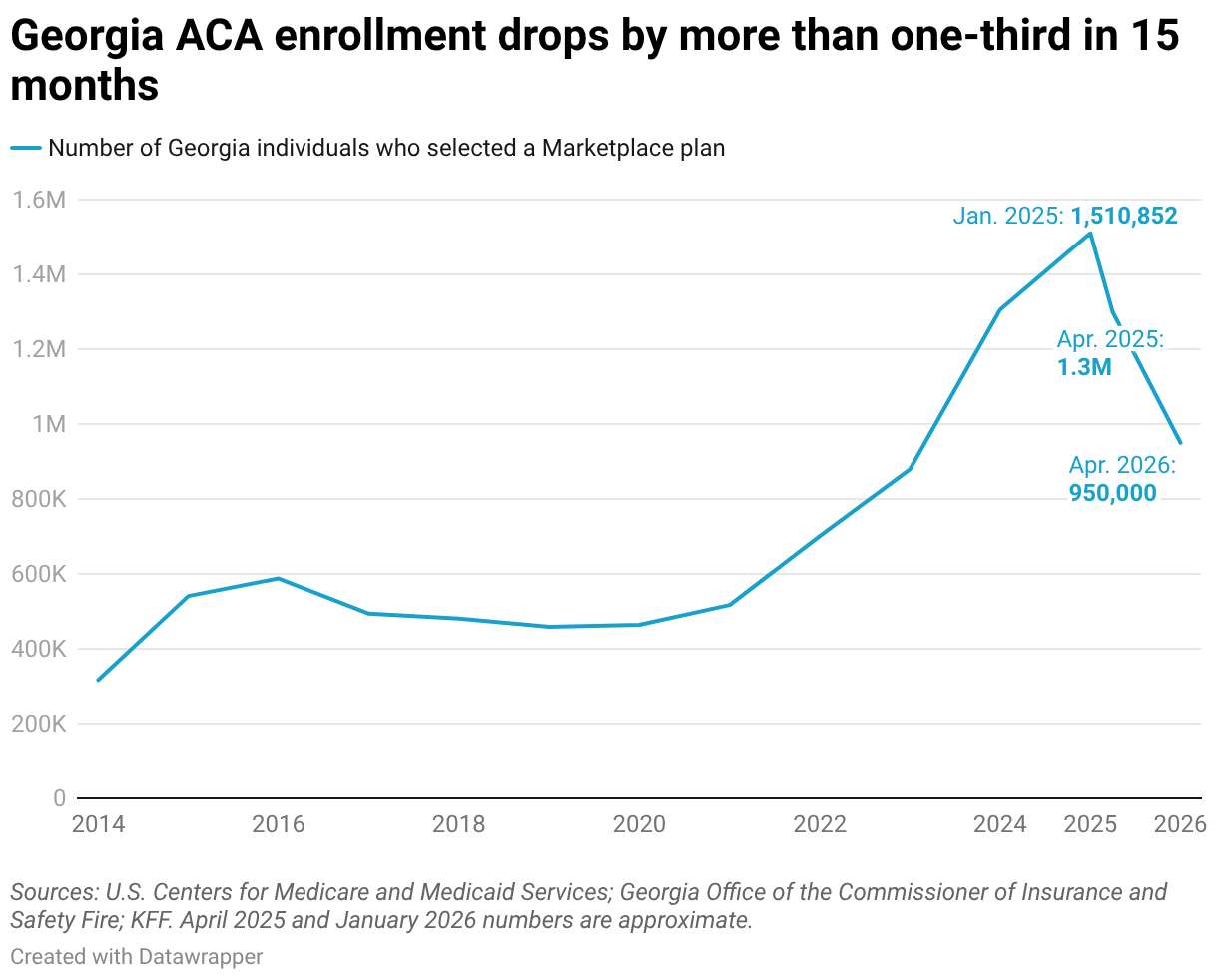
More than half a million Georgians have dropped health insurance coverage amid stiff premium price hikes for federally subsidized Affordable Care Act plans, according to data obtained by The Current GA and Georgia Recorder.
The 37% enrollment drop — from 1.5 million Georgians in January 2025 to 950,000 as of April 17, 2026 — dwarfs any previous decline in the state since the launch of so-called Obamacare health insurance plans in 2014.
Rising prices for health insurance policies bought on Georgia’s health care marketplace occurred after the U.S. Congress and President Donald Trump decided against extending Covid-era “enhanced” health insurance subsidies, which sunset Dec. 31, 2025.
Preliminary data released in January about the number of Georgians enrolled in ACA plans hinted at a sizable decline of 190,000. The more complete numbers have been adjusted after those people who had been reenrolled automatically at the start of 2026 failed to make their first premium payments.
The Georgia Office of the Commissioner of Insurance and Safety Fire released the data to The Current following a public records request. It will be reported by the federal government this summer.
The steep decline sparked immediate concern from the organization that advocates for Georgia’s rural hospitals about the financial viability of these vital institutions should the data signify that Georgia’s uninsured rate has soared after years of edging down.
“I don’t know what we’re going to do, honestly” said Monty Veazey, president of the Georgia Alliance of Community Hospitals, when informed of the data by The Current. “It’s a larger number than I anticipated,” he said of the enrollment drop.
He said he was meeting with Gov. Brian Kemp next week and hoped to ask for his plans.
THE HISTORY, FACTORS
The Affordable Care Act was passed in 2010 and the Marketplace launched in 2014. Under the ACA, the federal government mandates basic levels of care such as for prescriptions, mental health and maternal care; and it also subsidizes premiums for certain income groups. Georgia also began its own subsidies in 2022. Starting with 2025 coverage, Georgia took over the ACA enrollment system at GeorgiaAccess.gov.
Factors influencing whether the numbers of enrollees rise or fall have included how well the system is operating, how much outreach and enrollment assistance the government enacted, and above all, how expensive coverage was. President Trump in his first term pulled back on enrollment assistance, and in his second term has allowed massive pandemic-era subsidies to expire.
Drop negates recent achievements
Kemp came to office in 2019 promising to tackle Georgia’s adult uninsured rate, one of the highest in the nation. He has touted changes he oversaw to the state’s insurance market as well as the rollout of a state-based ACA marketplace called Georgia Access as solutions to this problem.
The new enrollment figures, however, raise questions about how durable those gains will be. Both Kemp and Insurance Commissioner John King did not immediately comment on the enrollment figures.
On Wednesday, after leading Georgia Democrats started calling the enrollment dropoff a crisis, Kemp's office provided a written statement saying that the numbers of people accessing federally subsidized health care remained higher than in 2019. "More people are covered today in Georgia than what was promised by the one-size-fits-none, bloated government approach Democrats have promoted in every election cycle," said Kemp spokesman Carter Chapman.
Georgia’s enrollment drop dwarfs many other states’, according to partial ACA enrollment data first reported last week by The Wall Street Journal.
Fluctuations in enrollment for so-called marketplace plans are routine. But year over year comparisons for April also project a stark picture. In April 2025, enrollment in Georgia’s marketplace plans had already dipped to 1.3 million, according to state officials. The April 2026 data still represents a 27% drop from that level.
“It’s a really large shift in the market,” said Emma Wager, a senior policy analyst on the ACA at the health research nonprofit KFF.
There is currently no data showing whether the Georgians who dropped their marketplace insurance are now completely uninsured, or whether they took up a new kind of insurance. Some of those previously enrolled could have gotten new jobs with employer-sponsored health care, but it’s likely large numbers of them had no better options, said health policy researchers.
In general, said Matt McGough, a policy analyst at KFF, people relying on Obamacare plans “really have nowhere else to turn.”
Wager, who emphasized that she herself had not seen the latest Georgia enrollment figures, said if the result in disenrollment ends up with a spike in the uninsured rates, then hospital finances across the state will be affected.
“A larger uninsured population means that hospitals have to provide more uncompensated care. And we also know that people who are uninsured are more likely to delay or forgo medicare care…they may have severe needs by the time they actually see a doctor.”
Georgia has traditionally had among the three worst uninsured rates, along with Texas and Oklahoma. But lower premium prices during the pandemic helped lead to a surge of Georgia patients getting insured.
U.S. lawmakers including former Rep. Marjorie Taylor Greene said that Congress’s decision last year to allow extra subsidies to expire would put insurance out of reach for many. Extending the enhanced subsidies another 10 years would have cost $350 billion.
Democrats in Congress shut down the federal government last fall in a fight over the health insurance subsidies, but Congress did not renew the funding.
Since those extra subsidies expired, Georgians who make above a certain amount— around $64,000 for a single person — no longer get any federal assistance and must pay the full market price for health insurance. For some Georgians, the cost of premiums more than tripled.
Health providers expect hit
The loss of enrollment will send shock waves through Georgia’s health care industry. The state’s health sector was expected to lose more than $3.5 billion this year as a result of the expiring subsidies, as uninsured patients forgo care or show up in emergency rooms but can’t pay.
Georgia’s expected loss of health sector revenue from that change would be among the three largest in the nation, behind only Florida and Texas, according to the study by the Robert Wood Johnson Foundation and the left-leaning Urban Institute.
Dr. Ben Spitalnick, a Savannah pediatrician, said the premium hikes presented a budget crisis for some of his patients’ parents.
“I know patients who, this year it's doubled for them,” Spitalnick said. “It's insane to consider having to drop your health insurance,” he said. “If you're, sort of solo employed or a very small business, and don't have the comfort of either Medicaid or have a very large employer who has a large health plan, the exchange was a great option. Now it's super expensive.”
McGough, the KFF researcher, said the ACA tends to insure people who are juggling hourly jobs or are self employed. Self employed often means doing gig work like driving Uber. More than a quarter of farmers and beauticians were insured through the ACA marketplace as of 2023, according to KFF.
This article first appeared on The Current and is republished here under a Creative Commons Attribution-NoDerivatives 4.0 International License.