NC lawmakers look into Rocky Mount family’s death after city cut off electricity
Thanks to new evidence, Durham man cleared in robbery after serving time; New Study: Black Lung Disease Rate in Appalachia Is the Worst in 50 Years as Coal Miner Protections Stall; What It’s Like in Prison Just Miles Away From Washington State’s Destructive Fires

It's Friday August 14, 2026 and in this morning's issue we're covering: NC lawmakers look into Rocky Mount family’s death after city cut off electricity, State Rep. Jennifer Balkcom is taking U.S. Rep. Chuck Edwards’ place on the NC-11 ticket, Thanks to new evidence, Durham man cleared in robbery after serving time, Civil rights leaders sound alarm over city’s potential application for grant from Trump’s Justice Dept, New Study: Black Lung Disease Rate in Appalachia Is the Worst in 50 Years as Coal Miner Protections Stall, What It’s Like in Prison Just Miles Away From Washington State’s Destructive Fires
Media outlets and others featured: NC Newsline, NC Local, Carolina Public Press, Verite News, Public Health Watch, Prison Journalism Project
NC lawmakers look into Rocky Mount family’s death after city cut off electricity
By Laura Leslie (North Carolina Newsline) Published: August 10, 2026
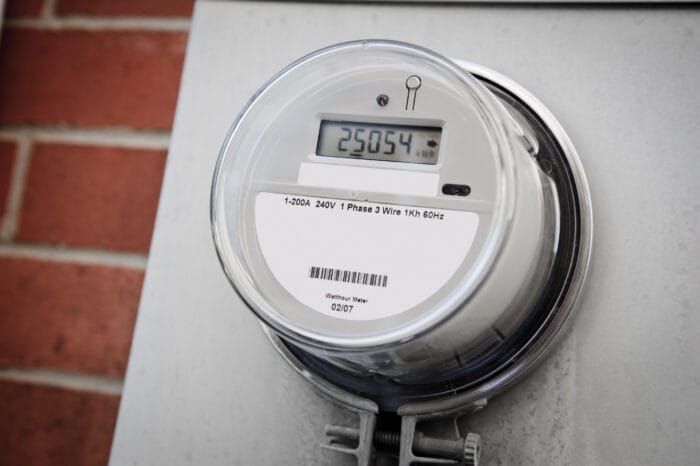
North Carolina state lawmakers are asking Rocky Mount officials for answers after a family of three was found dead in their mobile home not long after their electricity was cut off due to an unpaid bill. The family was reportedly using a generator in the home, according to relatives.
Assistant city manager C J. Jordan told Newsline Monday the investigation is still ongoing and the state medical examiner has not yet released an official cause of death for Kenny and Tracey Swann and Mahala Scurlock. The three were found dead on Aug. 3.
Relatives told local news outlets that the Swanns offered the city utility a partial payment to try to avoid having their power cut off, but city policy requires full payment or a plan to pay the entire balance within three months to prevent disconnection, so the city refused the family’s offer.
I would hope that we would dream of a world where no one dies simply because they're behind on their energy bill.
– N.C. Sen. Natalie Murdock, D-Durham
Sen. Natalie Murdock said hearing about the tragedy “honestly gave me chills.”
Murdock, D-Durham, and Sen. DeAndrea Salvador, D-Mecklenburg, filed a bill earlier this year that would ban utility companies from shutting off power for nonpayment during periods of high heat.
“I would hope that we would dream of a world where no one dies simply because they’re behind on their energy bill,” Murdock said. “That’s just not acceptable.”
Senate Bill 1027 was never given a hearing by Republican legislative leaders, and no Republicans signed onto the measure.
Unlike in many North Carolina communities, electricity in Rocky Mount is supplied by a city-owned utility. The utility, which handles water, gas and trash as well as power, already charges higher prices than other utility service providers. It has had problems with billing mistakes and delays that have left some city customers owing thousands of dollars, facing disconnection, and unable to contact the utility by phone for help.
The utility delayed shutting off power for several months, but recently resumed disconnections.
A federal program known as LIHEAP — the Low-Income Home Energy Assistance Program — is available to help low-income people pay their utility bills. But Murdock said the program is cumbersome for people to navigate, and its funding has been reduced under the Trump administration. She said the Swanns’ case illustrates the growing need for help.
“When you simply do not have the money when it is extremely cold or extremely hot, and you have these cut-offs, it could literally cost people their lives,” Murdock said. “Now you have three human beings who are no longer with us.”
Rep. Allen Chesser, R-Nash, represents part of Rocky Mount. He declined to be interviewed for this story, but said in a statement he’s been in contact with city leaders about the deaths.
“The investigation is ongoing so I will resist the urge to speculate before it is complete,” Chesser said, adding that his prayers are with the Swann family.
Chesser said Rocky Mount’s city manager and mayor have told him they are “in the process of reviewing how residents actually experience the utility billing process — not just what the written policy provides, but whether a customer in trouble can reach a person, understand their options, and get on an arrangement in time for it to matter.”
“They’re evaluating their procedures against best practices to build in more flexibility where it’s needed, and my office will be following up to check on the progress,” Chesser wrote.
Sweating that next electric bill? NC Senate Democrats say these bills could help.
Murdock said she doesn’t understand why the family’s attempt to make a partial payment wasn’t enough to forestall disconnection.
“We know that there are folks that are operating in good faith. They simply don’t have it,” Murdock said. “They’re making decisions between buying groceries, paying for their medication, paying for increased healthcare, or skipping debt because they know they have a power bill that they can’t afford.”
“When you get to where bills are $1,000 plus in arrears, you’ve got to work with folks because it will take them a long time to dig themselves out of that hole,” she added.
In the meantime, Murdock said she plans to follow up with the city and utilities to look for solutions to the larger problem of rising energy bills in a state that experiences hotter summers every year.
“I will be going directly to the utility, following up with these co-ops to see what can be done, and that includes Duke Energy, I will be asking them what else can we do to assist low-income ratepayers that just simply cannot afford to keep up,” Murdock said. “We just can’t leave them hanging.”
SUPPORT: YOU MAKE OUR WORK POSSIBLE
State Rep. Jennifer Balkcom is taking U.S. Rep. Chuck Edwards’ place on the NC-11 ticket. Here’s what that means for her state House seat.
by Lilly Knoepp, NC Local
August 11, 2026
There is a new candidate on the November ballot vying to represent the 11th congressional district in Congress.
On Monday night, Republicans shared that Jennifer Balkcom, who has served two terms representing the 117th House district in the North Carolina General Assembly, will replace U.S. Rep. Chuck Edwards on the ballot.
“I’m blessed to receive the Republican nomination for the 11th Congressional District. Western North Carolina is where I was born, raised, and chose to raise my own family,” Balkcom said in a press release after the decision.
“It has been an incredible honor to fight for Henderson County in Raleigh, and I will take that fight to Washington and work every single day to make life more affordable for working families, improve community safety, support our farmers, and ensure we have the resources we need to continue to recover from Hurricane Helene.”
Edwards announced he would not continue his re-election campaign following an ethics committee investigation which alleged sexual harassment and a toxic work environment. He trailed his challenger, Democrat Jamie Ager, three-to-one in fundraising. Despite the fundraising advantage, pundits expected a tough race for the Republican-leaning 11th district which covers fifteen and a half counties, an area bigger than the state of Rhode Island.
Before the vote, Balkcom wrote in an August 9 statement that it was time for her to step up.
“I hadn’t planned to go to Washington. But I’ve learned throughout my life that when your community needs you, you don’t sit on the sidelines; you step up,” Balkcom, a mortgage loan officer, said.
Her voter registration showed Balkcom voted in Democratic primaries until 2016. She addressed the change in her statement Monday evening.
“Like many Americans, the Democrat Party left me behind when they abandoned their values and embraced extremism. We’re seeing that extremism play out across the country, as their party nominates radical socialists who want to raise taxes, open our borders, and do away with our way of life,” Balkcom said in her statement. “We must prevent that radical agenda from reaching our government, and that starts right here in the Eleventh District.”
In the state House, Balkcom advocated for parents’ rights, Helene recovery and school choice. She was the primary sponsor on bills including Back the Blue Pay Act, and the Sentence Enhancement/Immigration Related Crimes measure. She also sponsored the Women’s Safety and Protection Act which defined biological sex and gender and included specifications such as legally requiring the sex on a person’s drivers license to match their birth certificate.
How was Balkcom chosen?
The NC-11 GOP committee that selected Balkcom included 61 representatives from each county GOP party in NC-11. Analysis of the committee members showed the majority were from Buncombe County, the county with the largest population in the district.
A similar process happened earlier this year when Rep. Mike Clampitt died, and Republican leaders selected current-Rep. Anna Ferguson.
“Representative Jennifer Balkcom is exactly the kind of leader Western North Carolina needs fighting for us in Washington,” Merry Guy, the 11th District’s Republican chair, told the News & Observer. “She understands the people and communities of this district, and she is ready to stand up for our families, protect our values, and fight for the issues that matter most to Western North Carolina.”
Recent campaign finance reporting showed Edwards with less than $1 million funding, trailing Ager who raised more than $3 million. The Edwards campaign is not required to move the funds to Balkcom’s campaign. Edwards did not respond to questions about the funding.
In her race to keep her seat in the state House, Balkcom’s campaign showed almost $68,000 cash on hand, with $55,500 dollars from Balkcom’s personal loans.
What happens in NC-117?
Balkcom can finish her term in the state House while she campaigns for higher office. Because she won the Republican primary for her state seat, state law requires the district executive committee of the political party - in this case Henderson County - to appoint another candidate to fill the vacancy.
According to state law, the committee must make its selection at least 75 days before the general election, which would be August 20.
A few names of Republicans are already being floated to take the NC-117 spot. Chris Wilson who lost to Balkcom in the primary could revive his campaign.
Edneyville farmer Linda Odom Pryor declared her desire for the candidacy in a social media post on Tuesday morning. Former Henderson County manager Steve Wyatt could also be under consideration.
The Republican candidate will face Democrat Lynne Russo. A relative newcomer to WNC, Russo has been campaigning with Jamie Ager and his brother, N.C. House Rep. Eric Ager, particularly around the rebuilding of Bat Cave and Gerton after Hurricane Helene.
Following the Balkcom announcement, Russo shared on social media that she is ready to run regardless of the GOP’s pick.
“While Republicans scramble to choose a new candidate and build a campaign, we'll keep doing exactly what we've been doing: showing up, listening, and working for the people of Western North Carolina,” Russo wrote. “We are organized. We are ready. And we have an extraordinary opportunity to flip this seat in November.”
Russo received a $500 fine for failure to submit campaign finance reports on time at the end of May, according to documents from the State Board of Elections. The campaign submitted a waiver to dispute the claim that was denied by the State Board of Elections in July.
In the most recent report filed in July, Russo's campaign had almost $22,000 in cash on hand with about $38,000 coming from individual campaign contributions. There are no personal loans listed in the report.
State Republican leaders rally behind Balkcom
With less than 90 days before the election, North Carolina Republicans are rallying behind Balkcom as she kicks off her campaign.
N.C. House Speaker Destin Hall endorsed Balkcom on Monday afternoon before the committee meeting.
“Jennifer is a principled conservative, a tireless advocate for her district, and a leader who gets things done,” Hall wrote in a statement. “I know she’ll take that same determination to DC and fight for the people of WNC. She’s the right person at the right time, and she will win in November.”
U.S. Sen. Ted Budd endorsed Balkcom on Monday evening.
“Jennifer Balkcom fights every day for the people of WNC, whether it’s disaster recovery, supporting farmers, or standing up for women & girls. I’m endorsing Jennifer because she’ll bring the values & strength of WNC to D.C., work to grow our economy, & always stand up for NC-11,” Budd wrote in a statement.
Following Balkcom’s announcement, the National Republican Congressional Committee also sent out a statement in support of her campaign.
“Congratulations to Jennifer Balkcom! As a North Carolina State Representative, Jennifer is ready to hit the ground running and deliver results for Western North Carolina. In Congress, Jennifer will help Republicans deliver a strong economy, support North Carolina farmers, and maintain a secure border,” NRCC Spokesman Reilly Richardson said in a statement.
This article first appeared on NCLocal and is republished here under a Creative Commons Attribution-NonCommercial 4.0 International License.

Thanks to new evidence, Durham man cleared in robbery after serving time.
by Mackenzie Thomas, Carolina Public Press
August 13, 2026
Anthony Tyrone Brown went on trial for armed robbery in October 2014 following an incident at a dollar store in Durham several months prior. Brown always insisted he was innocent, but based on the evidence available at the time he was convicted by a jury and sentenced to nine and a half years in prison. He was released in February 2021.
Ever since his initial conviction, Brown has been working with the North Carolina Center on Actual Innocence to try and clear his name. After filing motion after motion for years without success, newly discovered evidence — a previously unidentified fingerprint — has completely changed the game.
[Subscribe for FREE to Carolina Public Press’ Daily, Weekend and Election 2026 newsletters.]
This new evidence led the court this month to vacate Brown’s conviction and dismiss the original charge against him.
However, the case brings to light potential issues with how agencies like the Durham Police Department are handling biological evidence under the existing state statute.
What happened?
Just before 7 p.m. on Jan. 28, 2014, a Black man was captured on a surveillance camera walking near the checkout lanes of a dollar store on Guess Road in Durham. He got the attention of an employee, Brittany Evans, who came over to the checkout area to help him, according to later court records.
After placing a pack of gum on the conveyor belt at the checkout, the man made Evans aware that he had a gun and demanded the money from the register. Kristin Hunt, an assistant manager, was called over by Evans to help open the register. Once it was opened, Hunt put the money in a plastic bag and the man grabbed it before leaving the store, the May 2025 motion said.
Officers from Durham police responded a little after 7 p.m. and talked to the employees about what they saw. Both had somewhat similar descriptions of the suspect, with Hunt describing him as “stocky,” while Evans described him as “pudgy in the face.” The incident report described the man as a “Black male, age 35-45, height 6' to 6'2", weighing 200 to 220 Ibs., with a muscular build,” the May 2025 motion said.
Officers pulled eight fingerprints from the crime scene, seven of those coming from the front doors and one from the pack of gum the suspect picked up, the May 2025 motion said.
A match to Brown was made six days later from a left palm print on one of the doors, the May 2025 motion said.
Following this, officers put together a photo lineup of seven Black men — including Brown — and presented it to the store employees. Evans and Hunt both reviewed the photos twice, but while Evans was ultimately unable to identify the suspect, Hunt only identified Brown after choosing someone else first. Even then, she only had “80% confidence” it was Brown and said “he didn’t have facial hair when he came in,” since Brown had a full beard in the lineup photo, the May 2025 motion said.
Brown also had this full beard in an arrest photo for unrelated charges a few days after the store robbery. In addition, the described weight and height range of the suspect from the incident report was different from Brown’s, the May 2025 motion said.
On February 6, 2014, Brown was arrested for the store robbery and the robbery of another convenience store, the May 2025 motion said.
That October, Brown was tried for both armed robbery charges, never faltering in his belief that he was innocent and insisted “he worked a full-time job and owned a $40,000 car and did not need to rob dollar stores.” He pleaded not guilty to the charges, despite the possibility of lesser ones had he taken a deal, the May 2025 motion said.
While he was cleared in the other robbery, the jury ultimately found him guilty of the one at the dollar store, the case in which prosecutors presented the left palm print match and Hunt’s identification of Brown as the strongest evidence against him, the May 2025 motion said.
However, the fact still remained that Evans never identified Brown as the robber and even said he was a regular shopper at the store, the May 2025 motion said.
Christine Mumma, executive director at NCCAI who has also been representing Brown, said he ended up serving seven years in prison before he was released for good behavior. Ever since his conviction, Brown has submitted motions to try and appeal his conviction to no avail.
Before he was sentenced, the motion described Brown making one final plea to the court: “It wasn't me, Your Honor. I don't know why she said it was me, but I had a full-time job and custody of my son,” he said.
“I worked there all the time. I don't understand. I went to the store all the time. Thank you, sir.”
New evidence
At one point, after a string of unsuccessful motions by Brown, Durham police became aware of “deficiencies” in the work of Clinton Babb, one of the department’s latent print examiners at the time, according to a July 2025 motion. He worked for Durham police from December 2013 to June 2016 and was the same examiner that pulled prints the day of the dollar store robbery, an October 2025 order said.
Carolina Public Press reached out to Durham Police to ask how they came to question Babb’s work, but the department declined to comment at this time.
Mumma said the department sent more than 2,000 of Babb’s cases to independent examiners to be reviewed. The review revealed instances where Babb claimed prints “did not have evidentiary value,” yet another examiner said otherwise of those same prints, the July 2025 motion said.
A finding of “no evidentiary value” basically means there’s “not enough detail to compare to someone to identify them,” Mumma said.
In the dollar store case, Babb had described the print from the pack of gum and four other prints from the scene as having “no evidentiary value,” the July 2025 motion said. While Mumma acknowledged there wasn’t enough detail on the print from the gum for an identification, there was enough for an exclusion.
“Had they looked at that print, it would show that there was a whorl pattern,” she said. “Anthony Brown does not have a whorl pattern.”
This could have served as “powerful evidence of his innocence,” the July 2025 motion said.
Even more frustrating was that when Durham police sent Babb’s cases off to be reviewed, they only included cases that were still unsolved, Mumma said.
“They didn't care if somebody had been convicted based on his bad work,” she said. “They only cared if someone hadn't been convicted.”
In March 2026, Brown’s counsel requested the full 2014 fingerprint database search included in Babb’s report, a June 2026 motion said. The Durham Police’s counsel responded two weeks later and said they didn’t have that information, nor did they believe they still needed to have it. They didn’t provide a status on the prints in the database when asked either, the motion said.
At that point, Brown’s counsel reached out to the North Carolina State Bureau of Investigation, which is in charge of the SAFIS fingerprint database. They were able to confirm Brown’s prints were still there and that Durham police had even accessed the prints at the end of March, the June 2026 motion said.
A motion for discovery was filed by Brown’s counsel on April 15, 2026, to try and gain access to digital copies of the three prints that were still being kept in the database, as well as other materials, but the motion was met with opposition. Even so, once it became an order from the court, Durham Police agreed to run the prints through the database for comparison and provide the report to Brown’s counsel, the June 2026 motion said.
That report would change everything.
Released on June 2, it revealed that one of the previously unidentified prints from the robbery matched with another man. Not only that, an analyst noted the match to him was stronger and of better quality than that of Brown’s print match, the June 2026 motion said.
Because no police agency has publicly identified this person as a suspect in the dollar store robbery, CPP is not naming him at this time.
In 2009, this man was arrested for carrying a concealed weapon. He is described as 6 feet tall and weighing 235 pounds — much closer to eyewitnesses’ description of the dollar store robber, the June 2026 motion said.
Why didn’t this individual pop up until now?
The report indicated that although Babb uploaded the prints he collected to the database back in 2014, he never actually performed a search like he said he did, the June 2026 motion said.
At the very least, this discovery points to this man as “a more likely suspect than Mr. Brown,” the June 2026 motion said.
If the prints were run in 2014, the match to this other individual would have been discovered and “provided an important investigative avenue for law enforcement,” the motion said.
Armed with this new information, Brown filed yet another motion on June 26 to have his conviction vacated and his charge dismissed. This time, the Court had a different response.
“In summary, the newly discovered evidence of fingerprints other than those of the defendant and an updated analysis present a reasonable probability that someone else could have participated in or was in fact the individual who committed the offense,” the court said in its response on July 20.
Ultimately, Brown’s conviction was vacated and his charge was dismissed, according to a consent order filed on Aug. 4.
“Being cleared after seven years is something I prayed for and hoped for every single day.
It’s an overwhelming feeling of relief, gratitude, and peace to finally have my name cleared,” Brown said in a statement to CPP.
“At the same time, it’s emotional because no decision can give me back the years I lost or erase everything my family and I endured.”
Problematic evidence handling statute
G.S.§ 15A‑268 is the existing statute that covers how biological evidence in a criminal case should be handled. As the statute reads now, whenever evidence is introduced at trial and enters the custody of the clerk of court’s office, the judge determines who collected the evidence and whether it’s biological in nature. Biological evidence is considered any item that contains blood, hair, saliva, fingerprints and more.
If the evidence is biological, it should receive a special designation in court records. This designation is important because it sets it apart from other kinds of evidence, which can be destroyed by the clerks with limited notice following a trial, Mumma said.
Biological evidence, on the other hand, must always be preserved unless proper notice and destruction procedures are followed that “give the defendant an opportunity to be heard,” Mumma said.
The statute also says that, “upon conclusion of the clerk’s role as custodian,” the clerk returns biological evidence to the agency that first collected it.
However, two problems with this exist that relate to Brown’s case.
First, sometimes, the process for identifying biological evidence isn’t properly followed. This is what happened in Brown’s case.
After NCCAI took on Brown’s case in 2020, it tried to perform DNA testing on the prints pulled from the crime scene.
“Sometimes fingerprint examiners are not correct,” Mumma told CPP.
“There is an error rate in fingerprints, but DNA, as long as it's a strong enough profile, it doesn't have an error rate.”
But at that point, the prints were “no longer available” for testing. A notice of intent to destroy evidence went out in June 2019, but that should’ve only covered non-biological evidence, Mumma said.
“Good example of the judge, prosecutor, and defense not identifying the prints as biological even though the law required it as of 2009, and even though the statute says fingerprints are biological, the clerk not keeping them because no one else followed the law,” Mumma said in an email to CPP.
“The statute is cumbersome, which happens when legislation is done piecemeal.”
As a result, the physical print cards from Brown’s case couldn’t be used for any further testing. Had they been available in 2020, Brown could’ve been exonerated sooner, Mumma said.
“The clerk said they wouldn't have destroyed them, they would have sent them back to law enforcement,” Mumma said.
“Law enforcement said they didn't have them. So we, to this day, don't know what happened to the prints. We just know they're not where they're supposed to be.”
While Durham Police have maintained that the print cards were destroyed, Mumma said she’s not convinced.
“A similar thing happened in Kevin Johnson's case, who was exonerated in June 2023,” she told CPP in an email.
“DPD said the prints had been destroyed, but they were miraculously found once someone conducted a thorough search. It takes someone who wants to find the evidence to find it.”
The second issue with the statute is that the rule regarding designation wasn’t added to it until 2009, meaning there is a lot of evidence in the clerk’s custody that lacks designation but is biological, Mumma said.
“That doesn't help them with what is currently in their evidence rooms, and they have taken the position … that if it doesn't say ‘biological’ on it, they don't have to preserve it, which is ridiculous,” she said.
“Because that means biological evidence from cases in the early 2000s, which would benefit the most from DNA testing, could be destroyed. It defies logic.”
Adhering to the statute and returning biological evidence to the collecting agency is important because those agencies are often the best equipped at handling it, Mumma said.
“Law enforcement is the best long-term custodian of biological evidence because they have to be trained in how to collect it and preserve it and are more up to date in advancements in science because they use them in current investigations,” Mumma told CPP. “They have the space and training (that) clerks do not.”
The solution is to make the statute clearer so there’s no room for confusion for the clerks, Mumma said.
Instead of indicating that only biological evidence should be returned to law enforcement after trial, Mumma recommends changing the statute to require that all evidence collected by law enforcement be returned to them after trial and labeled as a trial exhibit. She also recommends getting rid of the judicial process that designates evidence as biological.
“This would simplify the process and eliminate room for error,” Mumma said.
From there, the law enforcement agency can look to existing guidelines to determine what should be destroyed or not, she said.
Potential problems at DPD
Aside from the issues with the statute, there could be issues at Durham Police that go beyond the work of just one print examiner in one case. Mumma said she thinks a “complete independent audit of the Durham Police Department's latent print section” is warranted.
“Babb was supervised by somebody,” Mumma said. “Somebody was signing off on his work, so that is for an independent auditor to determine.”
Mumma said she is also suspicious of how “they hid the evidence from us for so long.”
“Two months ago I asked the Durham Police Department to objectively look at the evidence in this case, and they responded that they thought the conviction was good,” she said.
“It wasn't until we were issuing subpoenas for law enforcement to be called to the stand that the state consented.”
Those subpoenaed officers, including Babb and two other examiners at the department, didn’t end up having to testify at the evidentiary hearing on Aug. 4 because the district attorney’s office agreed to vacate the conviction before then, Mumma said.
Brown’s is not the first exoneration to come out of Durham either. In fact, his is the fifth case since 2022 to be exonerated by NCCAI, Mumma said.
Brown applied to NCCAI in 2020 to have them look into his case, but other exonerations were the result of something called the Durham DA Project. Brown’s case was worked into the project later on, Mumma said.
The project started in 2018 under former District Attorney Roger Echols. NCCAI had concerns about cases in Durham following the disbarment of former district attorneys Mike Nifong and Tracey Cline, Mumma said.
Because of this, Echols signed a memorandum of understanding with NCCAI agreeing to “work cooperatively” as their organization looked into Durham cases, Mumma said.
“That didn't mean agreeing to anything. It meant if we found a credible claim of innocence, that he would provide us with access to files to review the evidence in the cases,” she said.
“No commitment to agree, but just to cooperate in investigations if there was a credible claim of innocence.”
NCCAI looked for these cases by sending out more than 1,000 questionnaires to inmates in the Department of Corrections who had been convicted in Durham, screening out cases “that were not likely candidates for postconviction relief,” Mumma said.
The string of exonerations resulting from this work points to a “larger issue,” Mumma said.
“Just because I have not pursued a case where there's a claim of innocence from that time frame, does not mean there's not a valid claim of innocence,” Mumma said.
“There's procedural bars that would keep us under the law from going forward, but it would not keep the state from having an interest. ... I'm limited by the law.”
Echols left office in 2019 and his successor, District Attorney Satana Deberry, took office that same year.
Deberry signed a memorandum of understanding with NCCAI when she took office as Echols did, but Mumma said she “never followed through on the terms of it.”
CPP reached out to Deberry’s office for comment, but they did not respond prior to publication.
“They have authority to not be limited by the law, which Satana DeBerry has exercised within her office,” Mumma said. “So the question is, will she exercise it to look at old convictions that may be unjust?”
While there’s no expectation for her to do that, the exonerations should inspire others to take action, Mumma said.
“If those don't cause people with a moral and ethical compass to initiate their own objective reviews, then the MOU doesn't matter,” she said.
What’s next?
The case now has new evidence and the work of a former department latent print examiner has been called into question. But the way forward from here is currently unclear.
Durham Police also declined to comment at this time regarding if it’s done any further investigation into Babb.
“I'm sure they will not on their own go back and look at cases from Mr. Babb or anybody else,” Mumma told CPP. “Because that might open them up for criticism, even if someone was convicted who shouldn't have been.”
Brown told CPP he now has “a chance to move forward.”
“My plans are to rebuild my life, spend time with my loved ones, work hard, and appreciate every opportunity that comes my way,” he said.
“I don’t take freedom or time for granted anymore because I know how quickly both can be taken away.”
If people take away anything from his experience, Brown said he hopes they understand the importance of “a fair process” and always pursuing the truth.
“Even when things seem impossible, and it feels like no one is listening, you can’t give up,” he said.
This article first appeared on Carolina Public Press and is republished here under a Creative Commons Attribution-NoDerivatives 4.0 International License.

Civil rights leaders sound alarm over city’s potential application for grant from Trump’s Justice Dept.
by Katie Jane Fernelius, Verite News New Orleans
August 11, 2026
New Orleans Mayor Helena Moreno’s administration is considering applying for a competitive grant from the U.S. Department of Justice through its Model Cities Initiative that, if awarded, could provide tens of millions of dollars to support public safety programs and strategies at a time when the city is in desperate need of additional money.
But it appears that in order to receive the grant, the city would have to agree to align with Trump administration priorities, including supporting federal immigration authorities and enforcement of bans on public camping, squatting and loitering, among others — causing some local civil rights and housing advocates to sound the alarm over the effort.
The Model Cities Initiative, which was announced in June, is poised to grant $300 million to two to four American cities — to be used on a wide variety of public safety initiatives, from professional development for law enforcement officers to equipment and technology, such as license plate readers and small drones, to services for those struggling with mental health and substance use issues.
Still, advocates feel that the costs — namely, the city needing to enter into a cooperative agreement with the Department of Justice and agreeing to align with its stated priorities — are too high.
“The ACLU of Louisiana has serious concerns with the Model Cities Initiative and strongly encourages the city of New Orleans not to apply,” said Sarah Whittington, advocacy director at the ACLU of Louisiana. Whittington said the politics of the Trump administration appear to be baked into the grant program.
She referenced the DOJ’s call for applicants, which begins, “In cities across America, violent crime and public disorder have surged over the past few years” and goes on to criticize “policies that have weakened and demoralized law enforcement [and] limited the prosecution of crimes.”
In fact, violent crime has dropped in cities across the country over the past few years, including in New Orleans, where violent crime is at its lowest level in decades.
“From the first sentence describing the purpose of the funding, it reeks of partisan propaganda that doesn’t match the realities of public safety in our city,” Whittington said. “And while the framework for funding could support and develop strong initiatives in New Orleans, it comes at much too high a cost.”
‘Dangerous strings attached’
According to an informational powerpoint, the Model Cities Initiative is intended to build off of recent law enforcement activities in Memphis and Washington D.C., where the federal government, alongside state agencies, engaged in hypervigilant policing and aggressive prosecution, including deploying the National Guard. Trump has declared that the enforcement operations have been successful at curbing violent crime, while local leaders and community advocates have had mixed responses to the activity.
According to the call for applications, Model Cities funding will encourage “common sense policing” and “the adoption of new technologies—including drones and artificial intelligence,” in addition to support for “whole-of-community” approaches, such as building up capacity in prosecutors’ offices, reducing recidivism and supporting those with substance use or mental health challenges.

While the funding can be used for a wide variety of programs, the grant itself requires applicants to ensure that their initiatives align with the DOJ’s priorities, which include supporting immigration enforcement, combatting violent crime and enforcing prohibitions on urban camping, loitering and squatting, among others.
Jonah Gilmore, Moreno’s director of communications, confirmed that the city is gauging interest in submitting an application from community partners, city agencies and law enforcement about the Model Cities Initiative grant, in addition to other federal grant opportunities.
“The Model Cities grant takes a ‘whole-of-city’ approach to violence reduction, and in line with the proposal, the city is interested in focusing on prevention, intervention, enforcement, and reentry,” Gilmore said in an email. “The city has made historic reductions in violence and is reviewing opportunities through this grant to continue this work and ensure that we are able to sustain and further reduce violence in our community.”
A representative for Orleans Parish Sheriff Michelle Woodfork also confirmed that her office was working with the city and other public safety partners on a potential application. However, neither Gilmore nor the representative for Woodfork answered questions as to what specific programs or initiatives they were hoping to potentially fund with the federal money.

Still, it’s not yet clear whether the city will ultimately choose to apply for the money.
The New Orleans Police Department for years operated under a policy that strictly limited officers’ ability to aid federal immigration enforcement officers or engage in immigration enforcement activities themselves. The policy, which was adopted as part of the department’s long-running federal consent decree, was rescinded earlier this year, several months after the consent decree was dissolved.
But there are still limits on NOPD’s ability to work with U.S. Immigration and Customs Enforcement and other immigration enforcement agencies.
Earlier this year, Moreno issued an executive order prohibiting city officials from entering into any 287(g) agreements, which would delegate and deputize law enforcement officers to perform immigration enforcement duties.
But the Model Cities grant, if awarded, could put the city at odds with that policy.
“This grant comes with dangerous strings attached,” Whittington told Verite News. “It would require the city of New Orleans to enter a cooperative agreement with this Department of Justice and allow for substantial involvement in this project and all public safety initiatives here.”
'All money is not good money’

Edith Romero, an organizer with the anti-surveillance organization Eye on Surveillance, echoed Whittington’s concern. She is worried that the Model Cities Initiative would not only risk ramping up local surveillance technologies that her organization is already concerned about but would also put vulnerable communities at greater risk of being subjected to enforcement.
“We’re appalled that this is even being considered,” Romero told Verite News. “If the city moves to apply for this funding source, it is just Helena Moreno abandoning the communities of New Orleans, especially immigrant communities.”
For Andreanecia Morris, president of the Greater New Orleans Housing Alliance, the prospect that Moreno’s administration might apply for the grant feels at odds with the city’s stated policies and priorities — especially its current work to help unhoused people access short- and long-term housing.
“The city has said it has no intentions of criminalizing homelessness, but it is going after dollars that would require it to do so,” Morris told Verite News. “All money is not good money. … We have got to be discerning and careful.”
Some local governments around the country have challenged the premise of the Model Cities funding. Consideration of the grant was was recently rejected by city councils in San Bernardino, California and Billings, Montana. Two city council members in Las Cruces, New Mexico, last month wrote an op-ed calling the funding a “Trojan horse,” bribing local governments to participate in programs “steeped in fear and surveillance,” under the guise of public safety.
New Orleans leaders, however, are facing a serious budget crunch and cash flow issues — with few avenues for immediate relief — and just dealt with weeks of contentious back-and-forth with Attorney General Liz Murrill and Governor Jeff Landry following a grand jury indictment of the state’s top prosecutor, which was later thrown out.
The city is also already familiar with navigating outside agencies: Troop NOLA of the Louisiana State Police has been stationed in the city since January 2024, and the National Guard has had an ongoing presence since late last year.
This article first appeared on Verite News New Orleans and is republished here under a Creative Commons Attribution-NoDerivatives 4.0 International License.

New Study: Black Lung Disease Rate in Appalachia Is the Worst in 50 Years as Coal Miner Protections Stall
It’s now as bad as it was in the 1970s, with thousands of miners sick and dying.
 Howard Berkes/Public Health Watch, Justin Hicks/Kentucky Public Radio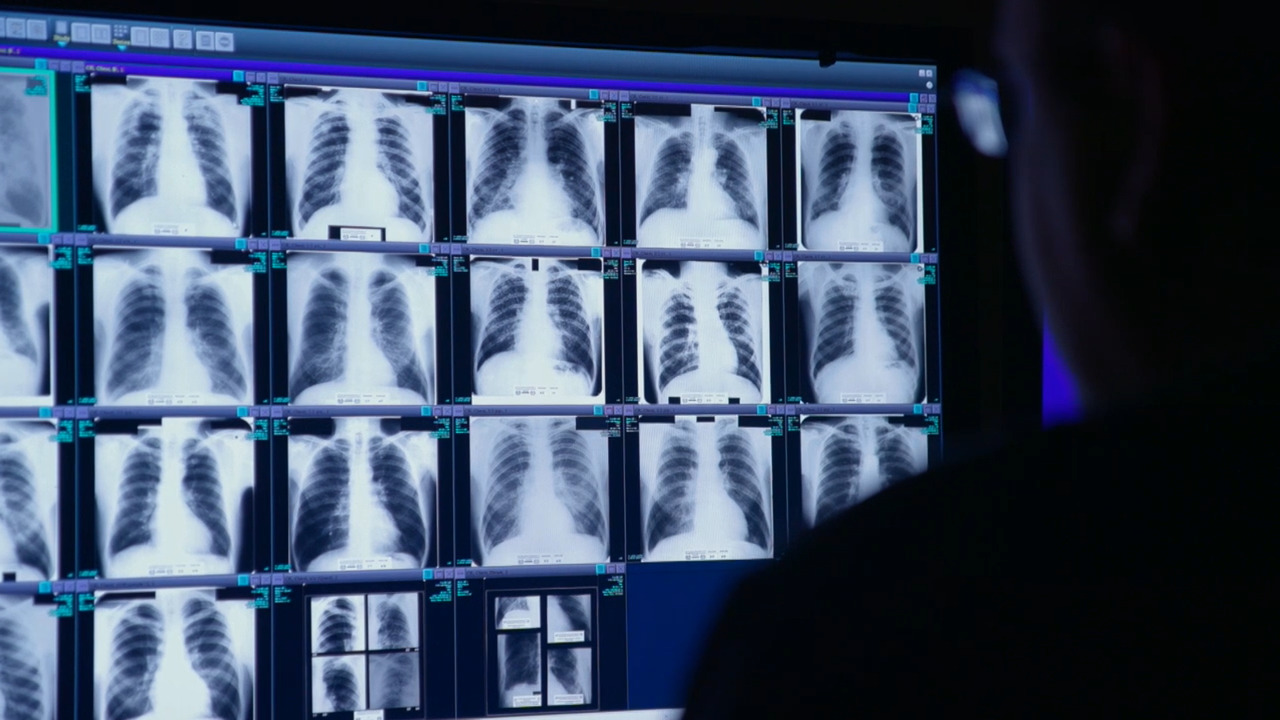
This article was originally published by Public Health Watch, a nonprofit investigative news organization. Find out more at publichealthwatch.org.
by Howard Berkes/Public Health Watch and Justin Hicks/Kentucky Public Radio August 5, 2026
Respiratory therapist Marcy Freeman doesn’t need a research study to confirm for her a return to the dark days of coal mining. She finds evidence in a stack of more than 150 funeral programs, all for former patients at her pulmonary rehabilitation clinic in Norton, Virginia.
“Each one of these represents a life that’s gone because of black lung,” Freeman explained as she flipped through the programs, recognizing names and images.
“These are husbands. These are brothers … These men were just hard-working men and the only thing they did was go to work and provide for their families. And it cost them everything … This is the aftermath of black lung.”
The aftermath is more dire than even black lung clinicians and researchers expected, according to new data published Wednesday in the American Journal of Respiratory and Critical Care Medicine.
The data appears in a peer-reviewed research letter from the National Institute for Occupational Safety and Health, or NIOSH, a federal research agency.
Public Health Watch, Kentucky Public Radio and NPR obtained a draft of the NIOSH research letter before publication.
NIOSH researchers found that working veteran underground coal miners in central Appalachia are suffering from the incurable and fatal lung disease at the highest rates in nearly 50 years.
Miners working in Kentucky, Virginia and West Virginia who’ve had at least 25 years underground have the worst rate of coal workers’ pneumoconiosis, or black lung disease. One in three — 32.5% — tested positive in X-rays conducted by NIOSH during the last five years.
The last time the rate of disease was that high for miners with the same work history was 1978. In 2018, when NIOSH last reported rates of the disease, the rate was 20.6%.
The new research shows that even miners with as few as 15 years underground have higher rates of black lung — rates not seen in nearly 40 years.
“I’m disgusted,” said Dr. Scott Laney, a NIOSH research epidemiologist who is the lead author of the research letter.
“This is not going to get better because of all the disease that’s already in the pipeline. These guys are being treated like disposable widgets, not human beings … We’re watching them die right before our eyes.”
More than 1,700 coal miners died from black lung from 2020 through 2023, according to an earlier NIOSH study.
Kentucky Public Radio and its reporting partners provided the federal Mine Safety and Health Administration, or MSHA, a summary of the NIOSH findings, but the agency declined to comment or respond to questions before seeing the published report.
‘Coal miners are no better off‘
The new findings “should stagger and shock anyone who has compassion for … hard-working people,” said Celeste Monforton, a former federal mine safety regulator and workplace safety academic and advocate.
“This is the consequence of their work and the consequence of us wanting cheap electricity,” Monforton added. “We’re back where we were [nearly 50 years ago] … Coal miners are no better off than they were [then].”
The newly published findings do not include the number of miners tested or diagnosed in the five-year period used to determine the rate of disease. But in response to questions from Public Health Watch and Kentucky Public Radio, NIOSH said it screened 280 working veteran underground miners in central Appalachia in the past five years, with 91 testing positive for black lung. The agency used that sample to estimate a rate for all similar miners in the region, an approach used since 1974.
“The overall process” NIOSH researchers applied here “is valid in my opinion,” said Dr. Akshay Sood, a clinical and research pulmonologist specializing in occupational lung diseases, including black lung, at the University of New Mexico School of Medicine. Sood reviewed a draft of the NIOSH research letter at the request of NPR, Kentucky Public Radio and Public Health Watch.
The NIOSH study “reinforces prior observations that disease prevalence continues to increase despite modern dust-control regulations,” Sood concluded.
The NIOSH researchers also wrote that “multiple external indicators … demonstrate patterns consistent” with their findings, including thousands of new cases of disease diagnosed by black lung clinics in the last decade.
The new estimated rate for the veteran central Appalachian underground miners is more than a fourfold increase since the prevalence of disease hit a low point: just 7% in 1999. That was 30 years after Congress imposed strict limits on exposure to the coal mine dust that causes black lung.
Since then, the dramatic plunge has reversed, especially in Appalachia, where thousands of miners are suffering from early, advanced and fatal stages of disease, according to data gathered from clinics testing and treating miners. Unlike NIOSH, which focuses on working miners, the clinics tend to see retired and laid-off miners who seek lung exams while trying to obtain state or federal black lung benefits.
The clinics have been inundated with miners in the wake of coal mine closures. More than 15,000 workers across the country lost coal mine jobs in the last decade, according to employment data from the U.S. Bureau of Labor Statistics.
“It’s awful,” said Dr. Brandon Crum, a radiologist in Coal Run Village, Kentucky, who specializes in detecting signs of black lung in X-rays. In 2016, Crum first documented an alarming spike in severe black lung — and rapid progression of disease — among younger and younger coal miners. NIOSH researchers and an NPR investigation confirmed his findings.
The new NIOSH research indicates to Crum that the trend continues.
“It’s just another thing that proves what we’ve been saying for the last 10 years,” he said. “And this may be even worse than what we thought it was going to be.”
The National Mining Association, or NMA, the leading industry trade group, was also provided a summary of the NIOSH findings. NMA noted that the rates of disease reported by NIOSH in miners tested in the last five years — and the new cases diagnosed at clinics — do not stem from current silica dust exposures in coal mines because it can take years for disease to develop and for disease to be diagnosed.
“This means that the incidences discussed in these studies cover miners whose initial exposure dates back years and, in many cases, decades,” Ashley Burke, a spokeswoman for NMA, wrote in an emailed statement. “These incidences do not reflect the conditions, practices, protections or regulations that are in place today.”
Still, miner advocates are concerned that high rates of disease will continue because of a major change in coal mining that’s causing dangerous dust exposure.
‘If it’s silica, it’s not just dust‘
In recent decades, the biggest coal seams in Appalachia were mined out. Mining companies turned to the thinner seams that remained, digging through mountains to reach and then mine them. That requires cutting lots of rock, and in Appalachia that rock typically contains quartz, which is rich in silica. The result is clouds of both coal dust and highly toxic silica dust.
“Excessive inhalation of coal mine dust is the sole cause of [black lung] in coal miners,” the new NIOSH research letter said. “Substantial evidence shows that exposure to the respirable crystalline silica component of coal mine dust plays an important role in contemporary disease patterns.”
Laney said the link between silica dust and black lung disease is strong, based on exposure data and radiographic data, which shows abnormalities “suggestive of silica exposure.” And he says researchers have inspected lungs removed in autopsies and after transplantation and “we can see the silica in these lungs.”
Silica dust is 20 times more toxic than coal dust alone and contains fine particles that are easily inhaled. Silica particles cause lungs to fight back with fibrotic tissue that builds and builds, severely inhibiting the ability to breathe.
Coal miners who’ve worked underground in the last 25 years witnessed the changes that led to more silica dust exposure.
“The thickness of the coal is not there,” explained Tim Balthis, a former miner and mine foreman in Kentucky and Virginia. It’s not like the days when the “grandpas” mined the big coal seams, he said. “So you’re having to take more rock, which in turn creates silica dust.”
Balthis spoke at New Beginnings Pulmonary Rehab, one of four black lung clinics owned and operated by respiratory therapist Marcy Freeman. The clinics help miners ease symptoms of the incurable disease.
At 57, Balthis has what is called complicated black lung, the advanced and fatal stage. He tried to describe for non-miners what it’s like working around silica dust in an underground coal mine.
“It’s like opening your front door and letting the sunshine [in]” with dust particles floating in the light. “And then multiply that by ten billion times … It’s like a fog,” Balthis recalled.
‘Thousands of opportunities for disease’
The National Mining Association cites government data that shows increasing compliance with silica dust exposure limits in the last 10 years, with mining companies nationwide meeting those limits more than 90% of the time. Last year, the compliance rate hit 97%.
But a high rate of compliance doesn’t mean miners are fully protected. The small percentage of overexposures has translated to thousands of instances in which miners are put at risk.
Kentucky Public Radio and Public Health Watch analyzed MSHA silica dust sampling data, and found that coal miners were exposed to excessive levels of silica dust more than 5,000 times since 2014. Silica particles are so toxic, so easily inhaled and so easily embedded in lungs that “thousands of exposures equate to thousands of opportunities for disease,” said former regulator Monforton.
In fact, an NPR and FRONTLINE investigation in 2018 documented 21,000 instances of overexposure to silica dust in a review of 30 years of federal data. The news organizations also documented a growing number of retired and laid-off miners stricken with complicated black lung, a count that now exceeds 4,000 since 2010.
‘A love affair with the black rock‘
NIOSH first recommended tougher limits on silica dust exposure in coal mines in 1974. But for 50 years, both Democratic and Republican administrations failed to act. That finally changed in 2024, when the Biden administration succeeded in establishing a new silica dust regulation for mining. It made the exposure limit twice as restrictive. It also provided, for the first time, a direct regulatory response to overexposure, including imposition of even tougher exposure restrictions, and possible fines, for noncompliance.
But the mining industry sued, agreeing with the tougher exposure limit but not the enforcement mechanism.
Federal courts responded to the industry lawsuits, which also cite other issues, with an indefinite delay in enforcement of the tougher silica exposure limits. The Trump administration did not oppose the delay, announcing it too would put enforcement on hold.
And the Trump administration is trying to boost coal mining. In early June, Trump announced close to $700 million in federal spending to sustain coal-burning power plants and to support exports of coal.
“Coal’s a great business,” Trump said at the time. “In terms of power, there’s nothing like it.”
Monforton said the administration seems to have “a love affair with the black rock, and not a love affair or compassion or concern for coal miners.”
Mining companies are required to control dust exposure with robust ventilation underground. Mining machines must also have water sprays that tamp down dust. But sometimes they don’t work well enough to keep the dust down.
The coal mining industry wants to be able to require the use of dust masks so that miners could still work when other control measures fail.
“When other controls do not adequately reduce exposure levels, those extensive controls will be supplemented with respirators, which is no different than any other profession that requires the use of masks to ensure air quality safety.” the NMA’s Burke said.
But federal law treats underground coal mining differently from other industries. The Mine Safety and Health Act requires coal mining companies to prevent “unsafe and unhealthful conditions” and to make sure miners can work their entire careers in working conditions “sufficiently free of respirable dust” so they don’t fall victim to black lung.
Dust masks and respirators have also been problematic. Many miners interviewed by NPR complained that masks impair communication in a dangerous and noisy environment, become clogged with dust, are too hot to work in and fail to screen out finer particles. Lawsuits against dust-mask companies have resulted in multimillion-dollar verdicts and settlements.
Even more modern devices have issues, including helmets that push fresh air down across the face and behind a clear shield. MSHA noted in its 2024 silica dust regulation that the helmets “are not a permanent solution” because they make it difficult to communicate effectively, and may limit peripheral vision and situational awareness, which can make work hazardous.
Dr. Drew Harris, a University of Virginia pulmonologist who is also medical director at the Stone Mountain black lung clinics in Virginia, is direct about delayed protections for coal miners.
“We need to act and we need the will to act,” Harris asserted. “We need to enforce the protections that we know will work to make this disease go away.”
‘Folks that don’t have a voice’
Harris’ black lung clinics in southwestern Virginia, Stone Mountain Health Services, see more miners and diagnose more cases of disease than any clinic in the country. Miners from coal counties across Appalachia flock to Stone Mountain because it provides testing, treatment and legal help with black lung benefits claims.
Harris called the new findings from NIOSH “outrageous.” But they’re not surprising based on what he’s been seeing in the clinics. In just the past five years alone, Stone Mountain has diagnosed 2,400 new cases of black lung.
“If you imagine one out of every three school teachers were getting an incurable lung disease because of something they were exposed to at work, the whole country would put their hands up screaming and stop whatever this exposure was immediately,” Harris said. “[But] this is largely impacting rural Appalachian folks that don’t have a voice, that don’t have a country to unite behind them.”
‘God’s not done with me yet‘
The growing rate of disease has resulted in a steady stream of miners seeking state and federal benefits for living and medical expenses. More than 26,000 miners or their surviving dependents drew $175 million from a federal black lung trust fund in 2024, according to a Labor Department report to Congress.
Mining companies contributed more than $23 billion to the fund, according to NMA, but bankruptcies and underinsurance shift some of the burden to taxpayers. The fund owes more than $6.5 billion to the U.S. Treasury.
Public funds pay for most of a growing number of lung transplants, which cost as much as $2 million each, and are mostly for miners in central Appalachia, according to a NIOSH study.
The black lung burden for miners like Tim Balthis makes life itself challenging. Even the simplest tasks are difficult as fibrotic tissue builds up in his lungs. Breathing becomes more and more labored. He knows it will only get worse. He’s likely to die from it unless he qualifies for a lung transplant. But even that, for coal miners, comes with a median survival rate of less than seven years.
“It’s like a cut in your manhood.” Balthis said, noting that he carries and uses an “emergency inhaler” to get more than a few minutes of playing time with his grandchildren or even singing at church.
“I’ve had several doctors say that I should already be dead … And I tell them this … ’God’s not done with me yet.’ I’ve been obedient to Him, and now He’s giving me back to my grandbabies … He’s not finished with me.’”
Howard Berkes reported for: Public Health Watch, an independent nonprofit investigative newsroom focused on public, environmental and occupational health; NPR; and the PBS series FRONTLINE. Justin Hicks reported for: Kentucky Public Radio; the Appalachia + Mid-South Newsroom, a collaboration of public radio stations in Kentucky, Tennessee and West Virginia; and NPR.

What It’s Like in Prison Just Miles Away From Washington State’s Destructive Fires
by Jeffrey McKee, Prison Journalism Project
August 5, 2026
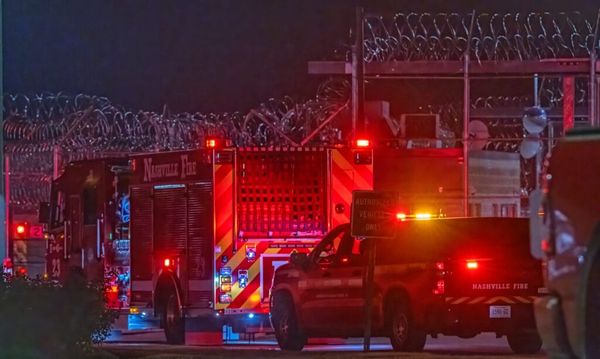
On Aug. 1, smoke was visible in the distance as I walked to the chow hall for lunch at Airway Heights Corrections Center near Spokane, Washington, where the Old Trails Fire is now burning just a few miles away (see map estimate here).
Over the course of the afternoon, the wall of smoke encroaching on the prison from the northeast grew. By the time I walked that same path to dinner only a few hours later, the clouds of smoke dwarfed the five aerial water tankers dropping fire retardant in a futile attempt to suppress the fast-moving flames.
The Old Trails Fire, one of three major fires in what’s referred to as the Spokane Complex fires, has destroyed hundreds of homes in the Airway Heights area, about 9 miles west of Spokane. Collectively, the fires have burned over 10,000 acres, and roughly 65,000 people remain under evacuation orders, according to The Spokesman Review, a local newspaper.
As of Wednesday morning, the evacuation zone closest to the prison — just over a mile northwest of the facility — was considered Level 2, which indicates "significant danger” to the area and encourages residents to evacuate voluntarily or “be set” to leave at a moment’s notice, according to Spokane Regional Emergency Communications.
Those of us incarcerated in the Spokane area face the same dangers as other residents, but without the ability to make the same choices about our health or safety. Over the past few days, as the fire has continued to burn and heavy smoke pollutes the air around the prison, I and others around me have weighed our limited options, trying to protect ourselves as best we can.
The morning after the fire began, I was already feeling the effects of smoke inhalation. My throat was sore and full of phlegm, my eyes itched and my lungs ached. At 52 years old, smoke from the increasingly frequent wildfires near my facility is affecting my breathing and sinuses more and more.
Outside my window, the sun was a blood-red orb on the horizon and dark clouds of smoke filled the air. Yet, despite the obvious danger, no action was taken on Sunday to protect the health of the incarcerated population at Airway Heights. Our sole communication from the facility that day was a kiosk message stating the facility was not under an evacuation order and remained "safe to operate." However, the message announced that visitation and volunteer programming would be canceled through the weekend. The message went on to state the facility was "closely monitoring the air quality."
In an email to a Prison Journalism Project editor Tuesday afternoon, Chris Wright, a spokesperson for the Washington State Department of Corrections, said the prison remained safe to operate. “We have set up an Incident Command Post that is closely monitoring the fire’s behavior, weather conditions, air quality and any potential impacts to facility operations,” Wright wrote.
He added that an evacuation was unlikely, but should it occur residents would be relocated to another facility, as happened in 2022 when a fire forced the evacuation of Larch Corrections Center in southwest Washington.
A 42-year-old incarcerated individual who goes by the nickname Casper said on Saturday that he felt the prison was not doing enough to protect the incarcerated population. "There is no notification about mask availability. No education [on] what we can do to reduce the effects."
On Monday, we received the first indication of protective measures. Two HEPA 500 DefendAir air scrubbers were set up in the living area of my unit, followed by a kiosk message announcing that N95 masks were available by request from staff members.
The accommodations did little to ease people’s discomfort, especially those with chronic conditions. Even after the air filter and masks were provided, Robert P., a 48-year-old man with asthma, reported that his breathing hadn’t improved. "Every breath I take it feels sour, ashy. Burns. Feels like I'm going to vomit," P. said.
When asked if he sought help from the prison's medical staff, P. said he would not, based on previous experiences with the prison's medical staff and fear of reprisals from the Indeterminate Sentencing Review Board, Washington state's parole equivalent. The DOC, he said, had “broken” his spirit.
"I don't want to stand up for myself. I have had issues with medical, kites getting ignored, months to respond, doctors leave, keeping my files in limbo,” he said.
Although N95 masks are available, as of Tuesday morning only a handful of people were using them.
This article first appeared on Prison Journalism Project and is republished here under a Creative Commons Attribution-NoDerivatives 4.0 International License.