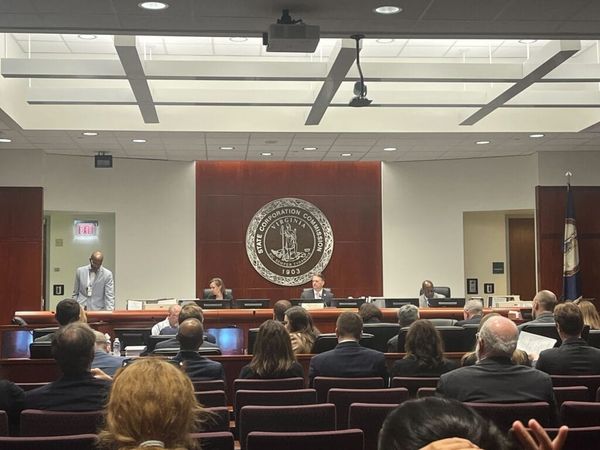
NM investment in mental health has yet to create an impact
FBI probe of Ohio voting rights group expands to include an affiliated national advocacy network; Extreme heat could be a player during this summer’s World Cup; Small Water Systems Lose Ground as Federal Support Wavers

It's Friday June 19, 2026 and in this morning's issue we're covering: NM spent nearly $844M on behavioral health, but ‘investment is not yet matching the outcome’, Oregon governor declares state of emergency over wildfire threat, FBI probe of Ohio voting rights group expands to include an affiliated national advocacy network, Union urges Maryland university board to reconsider decision to lay off employees, Massachusetts court blocks high-stakes income tax cut question from the November ballot, Record crowds, hot stadiums: Extreme heat could be a player during this summer’s World Cup, Broke and On Their Own: Small Water Systems Lose Ground as Federal Support Wavers.
Media outlets and others featured: Source New Mexico, Idaho Capital Sun, Votebeat, Maryland Matters, CommonWealth Beacon, North Carolina Health News, Circle of Blue.
NM spent nearly $844M on behavioral health, but ‘investment is not yet matching the outcome’
By Joshua Bowling (Source New Mexico) Published: June 18, 2026
New Mexico has spent $843.5 million since 2022 to rebuild the state’s behavioral health system, but some residents still face issues scheduling behavioral health appointments and New Mexico was one of just seven states to see an increase in overdose deaths last year, according to a new state report.
State analysts in a Legislative Finance Committee report wrote that the investments are paramount as New Mexicans, particularly youth and teenagers, report some of the poorest life outcomes in the nation. From 2024 to 2025, overdose deaths nationally fell by nearly 14%, while they rose in New Mexico by nearly 22%, the report says.
LFC analysts presented their findings alongside officials from the Administrative Office of the Courts and the state Health Care Authority’s Behavioral Health Services Division before a panel of lawmakers in Ruidoso Thursday morning.
“There are a number of concerning areas that may merit additional, really strong legislative guidance,” Rep. Nathan Small (D-Las Cruces), who chairs the interim Legislative Finance Committee, said during Thursday’s hearing. “I think across a wide range of areas, the investment is not yet matching the outcome.”
Many behavioral health providers pulled out of New Mexico more than 10 years ago after former Republican Gov. Susana Martinez accused several of fraud and froze their Medicaid payments.
Gov. Michelle Lujan Grisham in 2025 signed the Behavioral Health Reform and Investment Act, which sought to rebuild the system and established into law 13 “behavioral health regions” across the state. Leaders in each of the 13 regions are tasked with identifying the behavioral health needs in their communities and submitting plans to address those to the state. The districts have until June 30 to submit those plans.
As of Thursday, regions 1 and 2 — which represent Rio Arriba and Santa Fe counties and Bernalillo County, respectively — have already submitted and finalized their plans. Five others have submitted draft plans to the state but have yet to finalize them. Two have requested extensions beyond the June 30 deadline, according to the LFC report.
While the law establishing the behavioral health regions was intended to give local leaders control over issues unique to their counties, tribes and Pueblos, by creating their own behavioral health plans, the lack of uniformity has become something of an issue, Administrative Office of the Courts Deputy Director Sarah Jacobs said at Thursday’s hearing.
“The behavioral health investment and reform act does not outline any sort of governance structure for the regions themselves, so we have a lot of varying politics at the local level,” she said.
Rep. Rebecca Dow (R-Truth or Consequences) said she was dismayed at the level of progress since passing the Behavioral Health Reform and Investment Act in 2025.
“I guess I was under the impression that we’d be further along than we are,” she said.
Nick Boukas, director of the Health Care Authority’s Behavioral Health Services Division, responded that regional behavioral health plans, in particular, are actually moving along on schedule.

Oregon governor declares state of emergency over wildfire threat
By Alex Baumhardt (Idaho Capital Sun) Published: June 18, 2026
While Oregon’s first 2026 heatwave was winding down Tuesday, heat and drought are expected to worsen through the summer and will heighten wildfire risks across Oregon, spurring Gov. Tina Kotek to declare a state of emergency.
Kotek made the declaration Tuesday in an executive order, which will make it easier for local and state fire authorities to access “all available resources” including various firefighting crews, aerial support, ground resources, and emergency personnel to prevent and respond to fires. The emergency will last until the end of the year or the end of the fire season, which is expected to last through October.
Idaho Gov. Little says state is preparing for challenging wildfire season as fund drops to $0
Sign up here to receive email and text emergency alerts, including evacuation orders.
“Increasing heat, dry vegetation and shifting winds continue to align and create dangerous conditions that demand immediate action,” Kotek said in a statement. “Throughout the summer, it will get hotter and drier. Oregon has record-setting low snowpack and nearly half of our counties are facing persistent drought conditions. On average, 70% of wildfires in Oregon are human-caused. Prevention starts with every Oregonian — at home, at work and out and about enjoying our great state.”
Kotek also advised Oregonians to sign up for the statewide emergency alert system OR-Alert, to have an evacuation plan and to have an emergency “go kit” ready.
Since March, Kotek has declared drought in 17 of Oregon’s 36 counties, mostly in southern and eastern Oregon. More than 400 wildfires so far this year have burned more than 8,000 acres, and several caused temporary evacuations.
The declaration directs state agencies and the National Guard to collaborate on wildfire response and prevention by sharing personnel, equipment and resources. It also directs those agencies and Guard troops to meet requests coming from the state’s primary fire agencies — the Oregon Department of Forestry and the State Fire Marshal — and local and tribal governments.
Oregon Capital Chronicle, like the Idaho Capital Sun, is part of States Newsroom, a nonprofit news network supported by grants and a coalition of donors as a 501c(3) public charity. Oregon Capital Chronicle maintains editorial independence. Contact Editor Julia Shumway for questions: info@oregoncapitalchronicle.com.
This article was originally published by Votebeat, a nonprofit news organization covering local election administration and voting access.
FBI probe of Ohio voting rights group expands to include an affiliated national advocacy network
Dion Nissenbaum, Votebeat
Jun 17, 2026 at 6:55pm EDT
Votebeat is a nonprofit news organization reporting on voting access and election administration across the U.S. Sign up for our free weekly newsletter to get the latest.
Update, June 17, 6:55 p.m.: This story has been updated with a statement from America Votes.
Federal officials have served a subpoena on one of the nation’s leading nonprofit voter outreach groups, which has financially supported the Ohio election advocacy group at the center of a deepening investigation by the Trump administration, according to a source familiar with the probe.
The FBI served the subpoena on America Votes, a Washington-based organization founded by prominent Democratic leaders that works to turn out voters nationwide, the sources said.
America Votes, which has given the Ohio Organizing Collaborative at least $500,000 in recent years, according to its tax filings, issued a statement Wednesday confirming it had received a subpoena “asking for basic records related to funding of the Ohio Organizing Collaborative. We have been informed America Votes is not a target of the investigation.”
The subpoena signals a broader FBI investigation into the Ohio Organizing Collaborative, a statewide nonprofit group founded in 2007 that works on voting rights efforts. The Ohio Organizing Collaborative’s sister organization, Ohio Organizing Campaign, said it registered nearly 160,000 Ohio voters in 2024, describing the effort as the largest independent voter registration program in the country.
Prentiss Haney, an Ohio Organizing Collaborative board member and former director of the group, said the FBI appeared to be seeking information from America Votes and other voting rights groups that worked with his organization.
“This is very far reaching,” he said. “They seem to be fishing for any- and everything related to civil rights and voting rights infrastructure.”
The FBI and Justice Department did not respond to emails seeking comment. Last week, FBI special agents searched the Ohio Organizing Collaborative’s offices and questioned staff members and volunteers about potential voter registration fraud, according to Haney and others familiar with the investigation.
Haney said he did not know the full extent of the FBI investigation.
The FBI probe comes amid rising concerns ahead of the November midterm election about Trump administration efforts to question the legitimacy of voting in America. Trump has repeatedly claimed, without evidence, that voter fraud cost him the 2020 presidential election. Most recently, he accused Democrats, again without evidence, of rigging results in the California primary earlier this month.
FBI agents have seized ballots from the 2020 presidential election in Fulton County, Georgia, and secured election records in Maricopa County, Arizona.
Ohio Secretary of State Frank LaRose, a Republican, has been at the forefront of efforts among elections officials to scrutinize potential voter fraud. Last year, LaRose referred more than 1,200 cases to the Justice Department for criminal investigation, largely related to alleged unlawful voter registration of voting activity. LaRose said he found more than 1,000 noncitizens who had registered to vote, including 167 noncitizens who appeared to have voted in federal elections between 2018 and 2024.
But the figures represent allegations, not yet proven cases. Previous batches of LaRose voter-fraud referrals have produced few prosecutions: AP reported that of 621 criminal referrals sent to Ohio’s attorney general, prosecutors secured indictments against only nine people for voting as noncitizens over a decade.
Voter fraud is exceedingly rare across the country and studies, audits, and court cases have found no evidence that it occurs at anything close to the scale needed to alter modern statewide or federal election outcomes except in very unusual cases.
Dion Nissenbaum is Votebeat’s senior national reporter and is based in Houston. Contact Dion at dnissenbaum@votebeat.org.
Votebeat is a nonprofit news organization covering local election integrity and voting access. Sign up for their newsletters here.
Union urges university board to reconsider decision to lay off employees
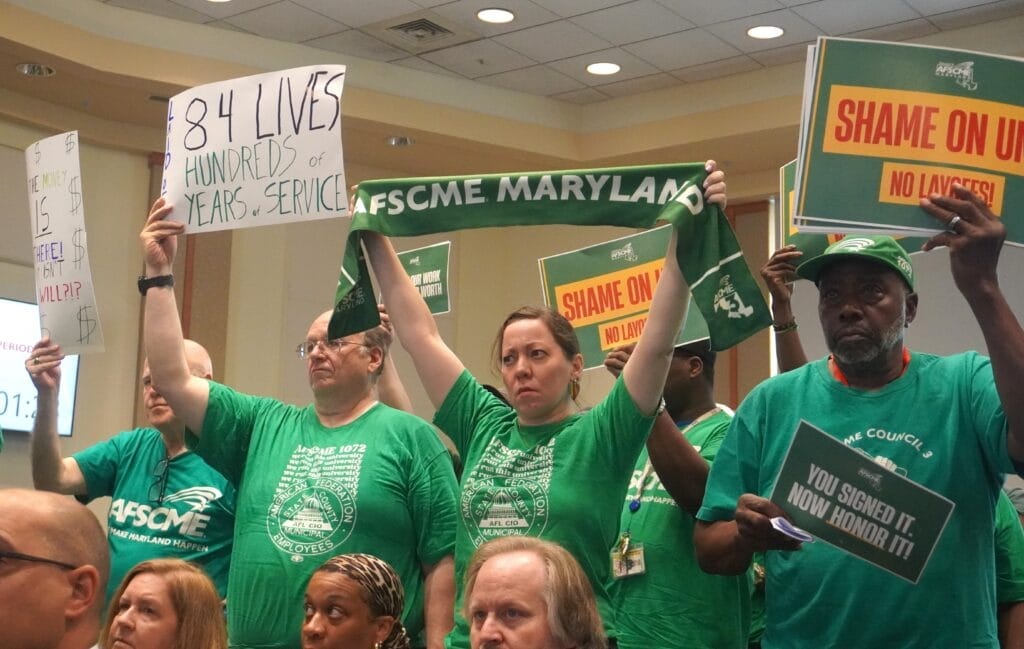
Members of the state’s largest public employees union rallied at the University System of Maryland Board of Regents meeting Friday, calling on it to reverse more than 100 layoffs announced recently as state campuses struggle with tight budgets and higher costs.
By William J. Ford (Maryland Matters) Published: June 13, 2026
Members from the state’s largest public employees union had a message Friday for University System of Maryland leadership: Rescind the employee layoffs.
More than 100 members of the American Federation of State, County and Municipal Employees (AFSCME) rallied in support of workers at the University of Maryland, College Park, where 73 union members were recently laid off, and at Bowie State University, where 21 members lost jobs. And the union said at least one layoff notice was issued from the University of Maryland, Baltimore County.
The rally was held about a week after College Park officials announced layoffs during a “period of uncertainty.”
“I’m not sure why we’re being laid off when there’s other options that they could have explored, and we’re really angry about it,” said Emily Leak. She worked as an integrated care specialist the University of Maryland, College Park, to help keep students from committing suicide.
“We’re worried about the safety of our students at the University Health Center in College Park because we need more mental health services,” Leak said at the rally. “I had no opportunity to transition services, very unethical from a licensed perspective. I am just appalled that UMD would treat their dedicated employees like this.”
The union rallied 30 minutes before Friday’s meeting of the University System of Maryland Board of Regents, which oversees academic and financial operations and crafts policy for the 12 institutions and three regional higher education centers that are part of the university system. UMCP, Bowie State and UMBC fall under the regents’ umbrella.
Union members were joined at their rally Friday at the University of Maryland, Baltimore, by Senate President Bill Ferguson (D-Baltimore City).
Ferguson noted that voters will be able to vote on a referendum question during the Nov. 3 general election that he said would ensure a layoff like the latest one “doesn’t happen in the near future.”
It’s based on the Arbitration Reform for State Employees Act of 2026, approved during this year’s legislative session. The bill, sponsored by Sen. Cory McCray (D-Baltimore City), would require, that “a neutral arbitrator” be selected in labor-management disputes with state workers, if the measure is approved by voters this fall.
Ferguson also said money was approved in the fiscal 2027 budget for the university system that would provide raises, cost-of-living and merit increases.
SUPPORT: YOU MAKE OUR WORK POSSIBLE
The system agrees that a 1.5% cost-of-living increase was provided for all 40,000 system employees, but “no additional funds were provided for merit pay for any employees, including those covered under the AFSCME contract,” USM spokesperson Michael Sandler said in a statement Friday afternoon. He added merit pay is awarded only if it is funded by the state.
Sandler said institutions in the system “are facing budget challenges for a number of reasons.”
“First, our base funding from the state is 10% lower because of cuts from the previous two budget cycles,” he said. “Furthermore, when you factor the impact of inflation and changes in federal policies that have affected research funding, we are seeing reduced funding at our institutions while also experiencing higher costs. All of that is contributing to greater budget challenges.”
A representative from the University of Maryland, College Park, deferred to the system’s statement. In a campus message dated June 4, College Park leaders announced that about 84 state-funded employees were being laid off.
A statement from Bowie State University echoed the system’s remarks. The university’s statement also added that about 23 employees were laid off to address budget challenges.
“At the same time, we recognize that these decisions have had a real and deeply personal impact on members of our campus community,” the Bowie statement says. “We are especially mindful of the employees and families directly affected by the layoffs, and we extend our sincere concern and appreciation for their service to Bowie State.”
But union leaders such as AFSCME Council 3 President Patrick Moran said the university system, UMD and Bowie State have large endowments. In addition, Moran asked during the Board of Regents meeting why system and college leaders didn’t assess any “costly contracts you have with vendors?”
“Would you cut the basketball coaches or the football coaches pay after you have a contract? So, why are you taking it out on the backs of working people? Shame on you,” he said.
Before union members left the meeting, the continued fight to rescind those layoffs was declared in a chant: “USM, do what’s right! Maryland staff are ready to fight!”
Massachusetts court blocks high-stakes income tax cut question from the November ballot
by Chris Lisinski and Jennifer Smith, CommonWealth Beacon
June 18, 2026
VOTERS WILL NOT have a $5 billion question to answer after all.
The state’s highest court on Thursday tossed a measure seeking to trim the income tax rate by one-fifth from the November ballot, stopping in its tracks a bruising, months-long political fight that would have carried major implications for both household budgets and public services.
Justices on the Supreme Judicial Court ruled that the attorney general’s office erred in its summary of the question, rendering the measure ineligible to appear before voters in November.
It’s a massive decision that cuts the fuse of a revenue bomb that had top Democrats in the House, Senate, and corner office sweating. Independent analysts estimated that reducing the income tax rate from 5 percent to 4 percent, once fully implemented, would trim more than $5 billion from the state’s coffers, likely forcing cuts to public spending.
Justice Serge Georges, Jr., writing for a unanimous court, said the official summary produced by Attorney General Andrea Campbell’s team “misstates the petition’s impact” by incorrectly stating the rate cut would not impact taxes on long-term capital gains.
“The summary’s contrary statement is not a minor imprecision. It is significantly misleading and likely to influence voters,” Georges wrote, concluding that the AG’s office therefore did not provide a sufficiently “fair” summary.
A business-backed coalition led by the Massachusetts High Technology Council, the Pioneer Institute, and the Massachusetts Competitive Partnership pitched the question as a way to relieve residents from the state’s high cost of living and stem the long-running flow of outmigration.
The coalition is also behind a separate ballot question that would overhaul a tax-cap law, often known as Chapter 62F, to make it much more likely that Beacon Hill needs to refund money to taxpayers at the end of each budget cycle. That measure did not face a legal challenge and remains on track to be decided by voters this fall.
Colin Reed, a spokesman for one of the proponent groups, the Massachusetts Opportunity Alliance, called the decision an “unprecedented ruling” that “prevents Massachusetts voters from weighing in on a popular proposal to address the state’s cost-of-living crisis.”
“It does not change the underlying reality: Massachusetts remains one of the most expensive states in the nation, with too many residents leaving in search of greater opportunity and a lower cost of living,” Reed said in a statement. “Today’s court decision does not eliminate the urgent need for action.”
Jim Stergios, executive director of the Pioneer Institute, lamented that an error by the attorney general’s office, not the campaign itself, proved fatal.
“The larger issue is whether voters should lose the opportunity to decide an important economic question because of a drafting error in a government-prepared summary,” Stergios said in a statement. “No ballot question has ever been removed due to a minor drafting mistake. Today’s decision means that a technical defect in a summary prepared by the government can prevent voters from considering a question that otherwise qualified for the ballot.”
Labor groups who opposed the measure — and who four years ago led the successful charge to impose a surtax on wealthy households, to the chagrin of some business groups like the Massachusetts High Technology Council — cheered the decision.
“This tax cut campaign was never about delivering real relief for working class families facing an affordability crisis,” said Harris Gruman, chair of the opposition campaign and executive director of the SEIU Massachusetts State Council. “Even the income tax cut they proposed was about sneaking through a tax break for ultra-rich investors. And their true goal all along was to leverage the initiative into a deal to secure more tax breaks for ultra-rich investors and wealthy heirs, along with massive giveaways to profitable corporations.”
The benefits from the question would be far more significant for high-earning taxpayers. Households with incomes between $75,000 and $200,000 would receive an average tax cut of $1,267, while those that make more than $1 million would get an average cut of $37,421, according to the Center for State Policy Analysis at Tufts University, which neither supported nor opposed the measure.
Opponents, including lawmakers and the plaintiffs who brough the matter to the high court, argued that reducing state tax revenues by billions of dollars would force cuts to social services so severe they would offset the benefits for most residents except the wealthy.
For a time, nervous legislators were content to bash the ballot initiative while holding out hope that the SJC would take the matter off their plates.
Lawmakers will no longer face pressure to negotiate with proponents on more modest tax cut alternatives to the ballot question, and top Democrats get to avoid spending the coming months campaigning against lowering taxes, achieving the outcome they want while keeping their hands more or less clean. Plus, the potentially record field of ballot initiatives — many of which are united by an undercurrent of frustration with legislative inertia — shrinks again.
“A $5 billion annual loss in state revenue would’ve meant significant cuts to services and programs that Massachusetts residents rely on, while doing little to bolster competitiveness and address the affordability challenges facing the Commonwealth,” House Speaker Ron Mariano said in a statement. “I’m grateful that this irresponsible initiative petition won’t appear on the ballot in November.”
The decision came less than two weeks before the Secretary of State’s office needs to have certified signatures in hand to begin printing out the ballot question guide for voters.
At oral arguments before the SJC in May, Justice Scott Kafker said the summary was “bothersome to me, because my reading of that is capital gains is not included. It’s not just a material omission, in [the plaintiff’s] view, it’s a material misrepresentation.”
The court used almost that exact language in its final decision.
In a statement after the ruling, a spokesperson for the AG's office said, “we respect the SJC’s decision and will continue to work diligently to ensure that ballot initiatives are summarized fairly and transparently.”
There seemed to be little dispute before the high court that the written description was inaccurate, though the measure’s proponents argued that the attorney general is not required to describe every downstream effect of a ballot measure in its summary.
One option — to force a correction to the summary and have the campaign collect the tens of thousands of signatures all over again — was dispensed with quickly by justices. Constitutionally set timeframes for submitting the bulk of signatures had already passed, they noted.
Those fighting the measure, and even the attorney general's office defending its work, agreed that the entire thing should be struck from the ballot if the summary is “so unfair to the voters,” as the AG’s office put it.
“Allowing a new summary at this stage would create a different constitutional sequence from the one [the state Constitution] prescribes,” Georges wrote. “It would also call into question the validity of the more than 85,000 signatures already gathered on forms bearing the unfair summary.”
Not all legal minds agreed that this was the best course of action. Robert Cordy, a retired associate justice of the SJC, wrote in an op-ed for CommonWealth Beacon that the high court should keep the question on the ballot.
“Removing the initiative from the ballot just because critics object to the phrasing of a summary could undermine public confidence in the initiative process itself,” he warned.
The high court last Friday gave the green light to a dark money-backed ballot measure seeking to roll back recreational cannabis legalization. In its decision, the unanimous SJC said the measure could proceed to the ballot despite complaints about the attorney general’s summary. The summary did not introduce a clear error and “is not the only source of information for voters,” the court wrote in that ruling.
Just six days later, the SJC declared the summary error for the income tax ballot question essentially unfixable. Campaign materials could not “cure” the error, Georges wrote, nor could the already published "yes" and "no" statements from the Secretary of State’s office describing what a vote for or against would do. The statements do not mention capital gains.
And the way voters would encounter the summary along with the actual text of the measure would make things even more confusing.
“A voter reading the petition and the summary together would see a summary that expressly excludes capital gain income and a petition that says nothing to contradict that statement,” Georges wrote.
The decision trims the field of ballot questions remaining in the mix for November from 11 to 10, which would set a record. That could change soon: The court is still weighing legal challenges to two other ballot questions, one seeking to revive rent control with a strict statewide cap, and the other to replace partisan primary elections with a single, “all-party” primary featuring every candidate regardless of party.
Those decisions are expected to arrive in the coming days.
This article first appeared on CommonWealth Beacon and is republished here under a Creative Commons Attribution-NoDerivatives 4.0 International License.

Record crowds, hot stadiums: Extreme heat could be a player during this summer’s World Cup
by Anne Blythe, North Carolina Health News
June 12, 2026
By Anne Blythe
As the largest FIFA World Cup in history kicks off across North America, the most menacing wild card for the 48 competing countries might be the stifling summer heat.
Over the monthlong marathon leading up to the July 19 championship match in New Jersey, relentlessly high temperatures and humidity will put millions of soccer enthusiasts at risk. While elite athletes endure at least 90 minutes on the pitch, spectators, match officials and workers in many of the 16 stadiums across the U.S., Mexico and Canada could be highly vulnerable to heat-related illness and exacerbation of chronic health conditions.
Teams from Norway, Scotland and Germany have gotten a taste of the “wet blanket” extreme heat here at their base camps and training sites in Greensboro, Charlotte and Winston-Salem.
When Norway opened its practice to the public on June 10 at the UNC Greensboro soccer stadium, temperatures climbed close to 90 degrees Fahrenheit that afternoon. The next day, the National Weather Service issued a heat advisory, which is based primarily on the heat index, or the “feels-like” temperature that takes humidity into account too.

As Ashley Ward, director of the Heat Policy Innovation Hub at the Duke University Nicholas Institute for Energy, Environment & Sustainability, will tell you, though, there’s a lot more than the number on an analog thermometer and humidity level to consider when thinking about heat safety. For years, Ward has been advocating for use of the wet bulb globe temperature, developed and used by the military for decades, as the standard measure for public heat safety.
“It incorporates not only air temperature and humidity, but also wind speed and solar radiation, and because of that it gives us a better predictor of when conditions outside are particularly dangerous to humans,” Ward told NC Health News. “It’s not just about getting hot. It’s also about how humid it is. Is the wind blowing or not blowing? Are there clouds in the sky, not in the sky? Are we standing on asphalt? Or are we standing on grass, and so forth?”
Is FIFA’s heat policy adequate?
FIFA, the worldwide governing organization for soccer (or football as most countries call the sport), uses wet bulb globe temperature to set parameters for postponing matches. Delays are considered when the wet bulb temperature hits 32 degrees Celsius, or 89.6 degrees Fahrenheit — a threshold that’s caused controversy among some scientists and players’ unions.
In an open letter to FIFA on May 13, 21 doctors, climate researchers and scientists from universities and research institutes here and abroad said FIFA’s heat safety protocols were highly inadequate and put players and spectators at severe risk. They wrote that science had shown more accurate wet bulb globe safety thresholds to be 25 degrees Celsius (77 degrees Fahrenheit) for high exertion, 28 degrees Celsius (82.4 degrees Fahrenheit) for moderate exertion, 30 degrees Celsius (86 degrees Fahrenheit) for light work and 33 degrees Celsius (91.4 degrees Fahrenheit) at rest.
FIFA protocols also rely on two mandatory three-minute hydration breaks midway through each half, but the scientists contend that neither that nor a wet bulb protocol that entrusts match postponement decisions to competition organizers are sufficient protections.
The scientists acknowledged that though professional athletes are likely to have “higher resilience compared to the baseline population,” it still “is impossible to justify” FIFA’s heat policy as adequate for health safety.
“We respectfully urge FIFA to adopt heat-management protocols that prioritize prevention over response, and that align with contemporary exercise physiology, occupational health principles, and duty-of-care standards expected in elite sport,” the scientists wrote.
The hydration breaks aren’t long enough, they contend, to sufficiently cool core body temperatures and therefore “the risk of exertional heat illness increases sharply.”
“Player health and safety must remain the non-negotiable foundation of football governance, and the heat risks for the upcoming World Cup make this question more urgent than ever,” the scientists added.
Although FIFA did not respond directly to the scientists’ letter, according to The New York Times, a spokesperson wrote in a statement the organization is “committed to protecting the health and safety of all players, referees, fans, volunteers and staff.”

‘Lean into it’
Ralph Vuono, chief business officer for the North Carolina Courage, the National Women’s Soccer League professional team based at WakeMed Soccer Park in Cary, knows firsthand what it’s like to have to address extreme heat issues from the spectator side.
When Vuono moved to North Carolina from New Jersey about four years ago, he hadn’t yet started working for the Courage. But he quickly heard about the recent years’ record-setting extreme heat.
“All my neighbors, and the folks that I met when we moved down here, all said the same thing: ‘It’s ridiculously hot here in the summer,’” Vuono said. “It’s beautiful in the spring. It’s awesome in the fall. We get a little bit of a winter for about a month or so, but then the summer is really hot.
“So that narrative, that seed, was planted with me pretty early on.”
When he started working for the Courage about a year later, people in the organization had the same message: “It gets really hot here during the summer,” they told him. “Our stadium,” he said, “we don’t have the traditional canopies that you see at other soccer facilities. We don’t have concourses and things like that. So having shade and things like that was a bit of a challenge.”
Instead of acknowledging what everybody knew during his first full season in 2024 — that some game days would be scorchers — the organization avoided that narrative. That didn’t work.
“We ended up having not a great summer in attendance perspective,” Vuono said. “We had a really good spring. We came out strong. Then summer happened and we fell off a cliff. Then we had a rally, and we ended up having a really strong fall.”
Things had to change, though, and Steve Malik, the Courage owner, made a suggestion that would launch a new course.
“His message to me was we’ve got to stop hiding from it because it’s never not going to be hot in the summer in North Carolina,” Vuono recalled. “We’re always going to have games in the summer; there’s not going to be a time when we don’t have games in the summer.”
Even if the team were to move into new facilities, they wouldn’t have a dome like five of the 2026 World Cup stadiums have. Players and fans would inevitably be exposed to the heat and elements. So Vuono turned to a different kind of venue for tips.
His family visits Disney World multiple times a year, he said, and one of the weeks they typically go is in mid-June. “Orlando’s hot in the summer, but the parks are packed.”
While summer visitors might save money by not going during peak periods, Disney offers other amenities too — free access to a water park at hotel check-in and cooling merchandise like freezable neck rings that can make a stay more comfortable.
“They do all these little things to not hide from it, to lean into it,” Vuono said.
That lesson played into the launch of the Courageously Cool Summer initiative, which leans into the obvious.
“It is hot and we know that, but we can’t let the weather or the temperature dictate when we support these players,” Vuono said. “If we’re going to support this team — if we’re going to be on the forefront of advancing women’s sports — it can’t be contingent on everything’s got to be perfect.
“Rain or shine, 95 degrees or 65 degrees, we’re showing up and supporting this team,” Vuono added. In addition to developing different ticket bundles, the organization provided shade cooling zones and misting zones around the stadium. They allow fans to bring empty water bottles and fill them free of charge at hydration stations. They sell Courage-branded cooling merchandise and hold special events like Margaritaville Night and summer-themed halftime shows with dunking games.
“We did that last year, and we ended up having the largest attended summer in club history,” Vuono said.
FIFA didn’t ask the Courage for advice, but had the organization reached out, Vuono would have told them: “Don’t try to hide from it. There is an advantage that the games are played at world class venues and stadiums that have canopies over a lot of the sections. There’s shaded concourse areas. There’s a lot of advantages that they have that we don’t necessarily have at the current venue, but lean into it.”
Get more people talking
Ward, whose research at Duke focuses on the health impacts of climate extremes and community resilience, said it will be important for FIFA to make sure the athletes and conditions for play are safe.
It also will be paramount to give as much attention to the safety of support staff and the fans, she added. “Those are people who are not, in fact, at their physical peak, most likely.
“They also have maybe been consuming alcohol at the match, which makes them more vulnerable,” she said. “They are not in a position where they have access to perhaps shade and other kinds of structures that mitigate heat exposure.”
Given that extreme weather driven by climate change has become more common, Ward said, “you’re seeing more and more different types of athletics facilities that are building in things like big fans that keep wind moving. They’re paying attention to artificial shade. And they have water stations everywhere to make sure people are continuing to be hydrated.”
There’s been more awareness about climate extremes recently in part because of record hot years and media attention to that, Ward said, but also because sports venues and other institutions have had to adapt to keep fan numbers from dropping.
Still, there’s room for improvement, she said.
“I wish more institutions, like our sports institutions, would be much more out front about heat safety and delivering heat safety messaging and even have things like posters and making announcements during the game — you know, ‘Don’t forget, it’s hot outside and if you’re not feeling well you can go here,’” she said. “And when more people are talking about it, it normalizes it as part of what everybody thinks about.
“It’s a great thing when you have an organization that has such a large following that’s thinking about heat, talking about it and hopefully raising awareness among their fan base.”
This article first appeared on North Carolina Health News and is republished here under a Creative Commons Attribution-NoDerivatives 4.0 International License.

Broke and On Their Own: Small Water Systems Lose Ground as Federal Support Wavers
by Brett Walton, Circle of Blue
June 11, 2026
The country’s most severe drinking water problems, from high levels of contaminants and foul-smelling water to pipe breaks, low water pressure, and expensive rates, are generally found in the thousands of small systems that serve dozens of people up to a few thousand.
These systems are public health crises waiting to emerge, said Denise Schmidt, director of water at the Environmental Policy Innovation Center, a group that works with water utilities on infrastructure funding.
Though some are perpetually struggling, small water systems, especially those serving low-income communities, are encountering a fresh set of economic and political hurdles in their quest for safe drinking water.
In recent industry surveys, small utilities report that accessing financing to repair and upgrade their systems is becoming increasingly difficult. Their credit ratings are deteriorating, making borrowing more expensive. The rates they charge customers are not covering the cost of providing water service, thus digging a long-term financial hole. Extreme weather is burdening them with unexpected and daunting repairs to their reservoirs, treatment plants, and pipe networks. Federal water quality mandates for PFAS and lead pipe replacements, though both providing public health benefits, are an added cost.
Small systems, in effect, are walking a precarious path. They are trying to survive today while also staring at a gathering wave of necessary replacements to aging pipes and treatment plants.
The Trump administration and Republican allies in Congress, meanwhile, are casting more obstacles. The White House’s tariffs have increased the price of equipment and materials. And the House’s fiscal year 2027 budget would cut the main federal water infrastructure program by about a quarter.
“I don't think people realize how big this wave is and how much it's going to cost,” said Blake Anderson, president and founder of Mogollon Water Management, a company that operates and maintains 11 small water systems in northeast Arizona. “The utilities that were built in 1970 now are 56 years old. There was a lot of development that happened back then. And all of these waves are going to start crashing.”
Negative Outlook
Crashing sounds are gaining strength.
Last year, for the first time, S&P Global, a credit rating agency, lowered the financial outlook for small water and wastewater utilities from stable to negative. Large and medium utilities remained stable.
The increased pessimism for small water utilities is due to stiffening financial headwinds, said Malcolm D’Silva, an associate director at S&P, which rates roughly 1,700 water and wastewater utilities. Ninety-one percent of the agency’s credit downgrades last year were for small systems, he said. Credit downgrades increase the cost of borrowing.
D’Silva narrated a story in two parts. One is the “expense squeeze.” Costs are rising across the board. First from the post-Covid inflation and supply chain shortages, and now from the Trump administration’s tariffs. Half of the utilities that responded to the American Water Works Association’s annual survey said that tariffs had “moderate or considerable” pressure on equipment and materials costs. At the same time, revenue is not keeping up. In the same survey, only 43 percent of utilities said they charged customers enough to fully cover service costs.
The second part is managerial. Small systems typically do not have the technical expertise, staff, or budget to analyze their infrastructure and apply for funding in the way that larger utilities do. Some might keep only paper records of their pipe networks. The smallest systems have volunteer board members or staff that might also oversee the fire department and run a business.
The positive news is that last year might have been the bottom for small systems, D’Silva said. S&P is seeing some improvement in the first half of 2026, with the rate of downgrades slowing. More utilities have instituted rate increases to fill budget holes, D’Silva said.
Federal Question Mark
Just as one hole is closing, however, another might be opening.
Every year the White House lobs a spending plan toward Capitol Hill and members of Congress decide whether those numbers are a good idea. For fiscal year 2027, the Trump administration proposed a roughly 90 percent cut to the two state revolving funds, the main federal sources of water infrastructure funding.
Congress usually sustains the state revolving funds, which have broad support. But this budget cycle could be different.
A House spending bill cuts the revolving funds by about 24 percent combined. The House Appropriations Committee approved the bill on June 3.
The bill provides $1.2 billion for the Clean Water State Revolving Fund (27 percent cut) and $911 million for the Drinking Water State Revolving Fund (19 percent cut). The Senate has not yet introduced its version.
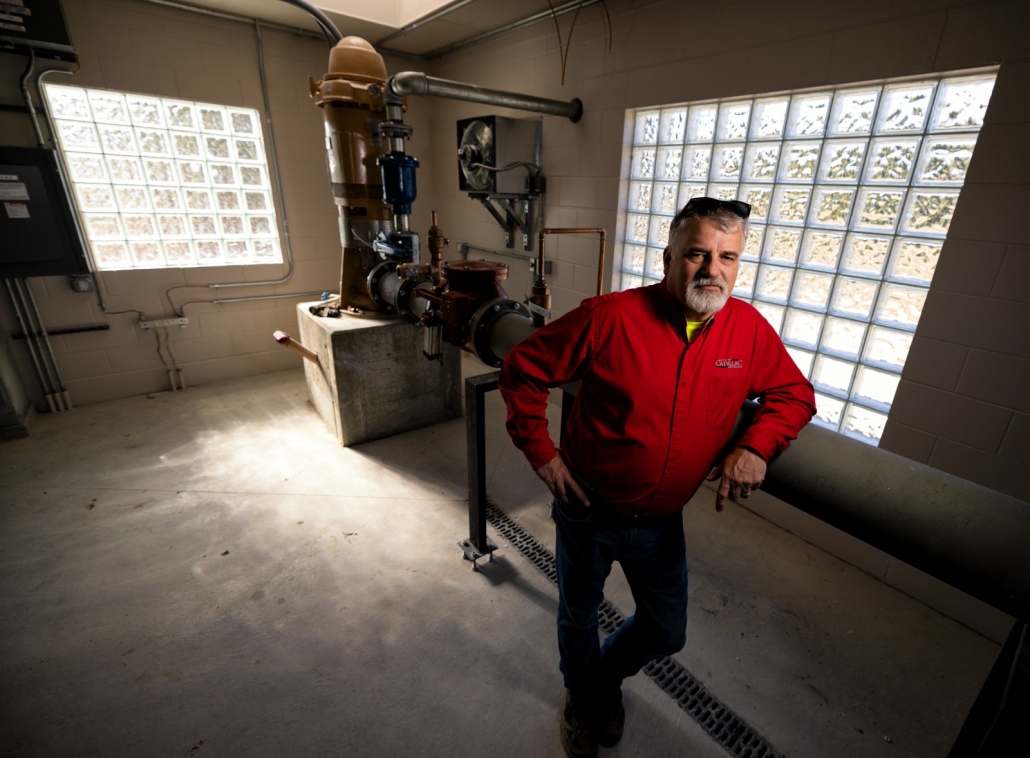
The Environmental Policy Innovation Center, or EPIC, tracks state revolving fund expenditures and project proposals in 15 states. At Circle of Blue’s request, EPIC analyzed small system and very small system requests for drinking water funding. By EPA’s definition, small systems serve fewer than 10,000 people and very small systems fewer than 3,300.
The data indicate high demand from these systems. Some 61 percent of projects seeking drinking water funding were small or very small. However, only about a third of these proposed projects advanced to the next step in the funding process. This “highlights significant unmet infrastructure needs,” EPIC analysts wrote.
Water infrastructure funding needs and the status of the revolving funds were a point of discussion during a House Energy and Commerce Committee hearing on May 20.
Jessica Kramer, the head of the EPA Office of Water, defended the administration’s proposed cuts. Her justification: the states have $14.8 billion in uncommitted state revolving funds, those sitting in coffers for more than a year without being allocated. That money should be distributed first, she argued.
“It doesn’t do any good to get the money to the states if the states aren’t actually getting it out to the communities that need it,” Kramer said.
Schmidt, the EPIC water director, had a different view. Two issues are being wrapped into one, she said. If state administrative capacity to review and approve applications is the problem, then focus on that. But don’t use it to rationalize disinvestment in an otherwise successful decades-long infrastructure program.
“Uncommitted does not mean unneeded,” Schmidt said. “Cutting moves us farther from the solution.”
The View from Arizona
The financial pressures that populate D’Silva’s and Schmidt’s spreadsheets are the on-the-ground reality for Blake Anderson.
Anderson is the president and founder of Mogollon Water Management, a company that operates and maintains 11 small water systems in the White Mountains of northeastern Arizona. Mogollon oversees the smallest of the small – systems ranging in size from 29 service connections to roughly 1,100.
These are not the sophisticated, professionally managed systems that you would see in Phoenix or Flagstaff.
“They're volunteer board members and they're aware that there's some sort of money for water out there but they don't know where it is, or if they do know, they aren’t sure how to go about applying and accessing it,” Anderson said, describing the challenges for small systems in securing grants and loans.
“Most of them have never done a capital improvement project over $50,000,” he added. “And so there is not institutional knowledge in how do you manage a federally funded program or a state funded program? How do you go about securing engineers or contractors? What are the proper procurement practices?”
One school of thought for solving the small systems problem is that there should be fewer of them. By connecting with larger systems or forming regional partnerships, small utilities could grow into medium-sized utilities with favorable economics: more customers to cover expensive infrastructure costs, better credit ratings, money to hire knowledgeable staff.
Research from Manny Teodoro at the University of Wisconsin indicates that the target size for utility consolidations should be about 20,000 service connections, or about 60,000 people. At that point the most serious water quality violations become far less common and operating costs become more reasonable.
Where might funding for consolidations come from? States like California have dedicated programs, though even those are facing funding shortfalls. Another source is federal: the state revolving funds that House Republicans want to cut.
Lead image: Kevin Sonnichsen, water commissioner, right, and Alan Novacek, backup operator and sewer commissioner, left, gaze into the Creighton water treatment facility in this file photo from 2021. Built in 1993, the facility uses reverse osmosis to remove nitrate. Creighton was the first community in Nebraska to use reverse osmosis to remove nitrate in drinking water. Photo © J. Carl Ganter/Circle of Blue
This article first appeared on Circle of Blue and is republished here under a Creative Commons Attribution-NonCommercial-NoDerivatives 4.0 International License.