S.C. early voting starts with high turnout
Federal rural health fund meets healthcare desert in eastern NC; Union group wants to bolster Kansas City's affordable housing by investing pension money; After Sarah T. Reed H.S. closure, NOLA teachers worry that school closures will become the new normal

It's Friday, May 29, 2026 and in this morning's issue we're covering: SC early voting begins with record-breaking turnout. Many voters say redistricting is why, Budget cuts, looming deadlines put family caregivers in a ‘complete tailspin', Federal rural health fund meets healthcare desert in eastern NC, Lawmakers target hospitals – and Atrium Health in particular – in reform bills, Union group wants to bolster KC’s affordable housing by investing pension money, Rights for sexual assault survivors at stake in proposed NC legislation, Bayer promises to suspend ‘unfair provisions’ in seed contracts for several years, federal government announces, As Sarah T. Reed High School shutters, teachers worry that school closures will become the new normal.
Media outlets and others featured: South Carolina Daily Gazette, Maryland Matters, KFF Health News, North Carolina Health News, The Beacon, Carolina Public Press, Investigate Midwest, Verite News.
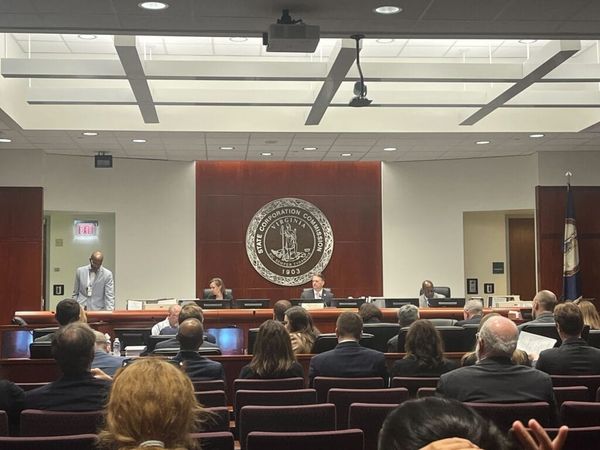
SC early voting begins with record-breaking turnout. Many voters say redistricting is why.
By Skylar Laird (South Carolina Daily Gazette) Published: May 26, 2026
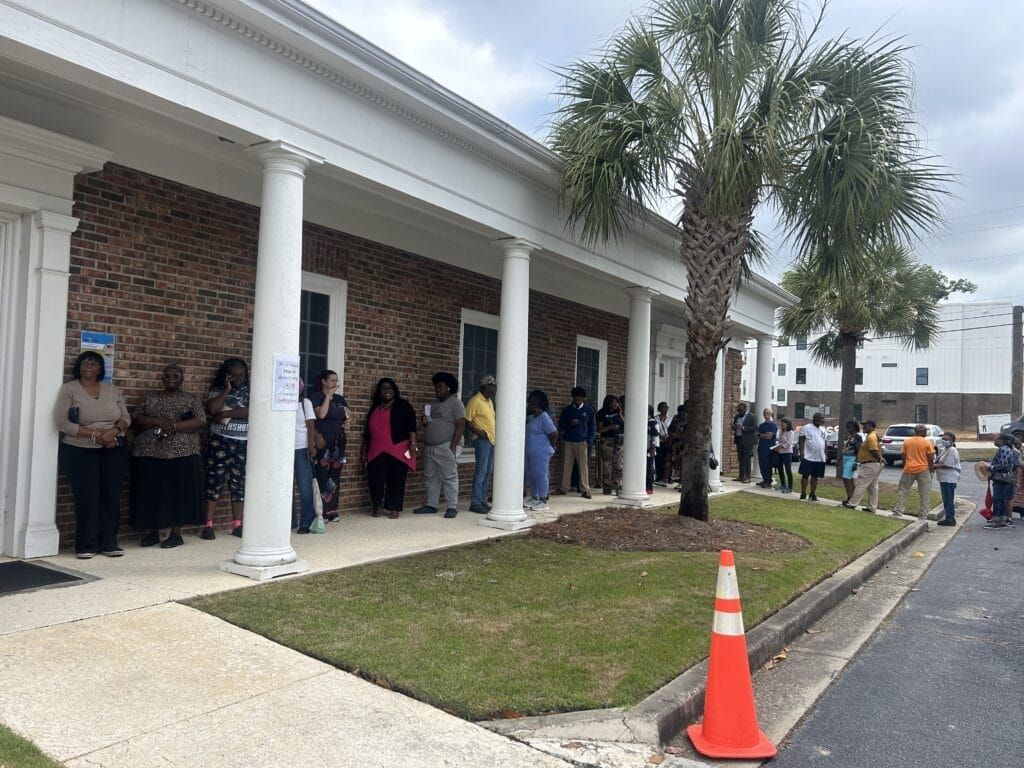
ORANGEBURG — A record number of people cast their ballots Tuesday, the first day of early voting for South Carolina’s party primaries, with many saying they hoped to reduce the chances of a bill redrawing the state’s congressional maps becoming law.
Those voters got their wish.
Senators effectively killed the redistricting bill Tuesday afternoon, ending a GOP mad dash to draw new lines following a U.S. Supreme Court decision about Louisiana’s map.
Some Republicans who changed their positions pointed to the number of early votes for congressional candidates they would have to throw out as the reason why.
As of 3 p.m., 44,600 people had voted in-person, nearly doubling the previous record for a single day of early voting in a primary election. Just over 23,000 people cast their ballots on the final day of early voting in June 2024, according to the State Election Commission. In addition, the agency had received nearly 4,200 mailed absentee ballots as of Tuesday.
Polling places are open from 8:30 a.m. to 5 p.m. every weekday through June 5. Election day is June 9.
Among those casting their ballots Tuesday at the Orangeburg County Voter Registration Office was U.S. Rep. Jim Clyburn, the state’s only Democrat in South Carolina’s congressional delegation.
The safely blue seat Clyburn has held since his first election in 1992 was at the center of the redistricting debate, as a map endorsed by the White House aimed to send seven Republicans to Washington — an effort some warned could make some races more competitive.
The proposed map would have drawn Clyburn’s home in Santee out of the 6th District and into the 2nd, potentially setting up a general election contest with U.S. Rep. Joe Wilson, who’s held that seat since 2001. Clyburn said he would file to represent whatever district his Orangeburg County home fell into.
Clyburn lambasted the effort Tuesday. He accused Republican legislators who voted “yes” of bowing to the White House instead of doing what’s best for the people of South Carolina. He also thanked the Republican senators who stayed steadfastly opposed.
“Nothing has made me more incensed than to see this kind of imposition on the people of South Carolina,” Clyburn told reporters soon after he voted, which was hours before senators ended the debate.
The 86-year-old said he normally votes early — that the timing wasn’t due to the redistricting debate — and he encouraged other voters to do the same. From a practical standpoint, he said, no one knows what sort of catastrophe might strike the day of the election to keep a person from voting.
“But it took on an added meaning this time,” Clyburn said.
Clyburn echoed the pleas of Statehouse Democrats last week: “Vote early. Make them throw your vote out,” as Clyburn put it.
That message seemed to reach voters. More than a dozen of the hundreds of people who showed up to vote in Orangeburg, St. Matthews, West Columbia and Columbia on Tuesday told the SC Daily Gazette that’s the reason they came to the polls early.
Orangeburg
Rev. Derrick Cattenhead, a pastor at North Orangeburg United Methodist Church, got in line to vote just after 10 a.m. He wanted to get his ballot cast before the Senate gaveled in at 11 a.m. to discuss the redistricting bill, he said.
“I believe if we get out and vote in droves, we can still make a difference,” the 53-year-old said. “That’s the only way I think that we can really make a difference, especially in this climate, at this stage of trying to steal our votes and steal our rights and have no voice.”
Early voting
Hours: 8:30 a.m. to 5 p.m. weekdays through Friday, June 5
Locations: Each county has between one and six early voting centers. Pick the location most convenient to you in the county where you’re registered. Click here for a list of options by county.
Your sample ballot: To preview the choices on your ballot, click here, provide your information, then select which party’s ballot you want to see.
Cattenhead voted early in previous years, but he made sure to show up earlier than usual Tuesday to “to let (legislators) know that, ‘Hey, we are here. We’re here, and we’re watching, and we’re listening.'”
Chris Samuelson, a 66-year-old retired nurse from Branchville, has voted early, absentee and on Election Day, but Tuesday marked the first time she’d come to the polls on opening day, she said. She, too, wanted to get her vote in before the Senate returned to the Statehouse, in the hopes of swaying Tuesday’s decision.
“Votes have already been cast,” Samuelson said. “Ballots have already been sent out, and votes have been received back. So, the election has started. I just feel like it’s wrong for them to disregard all of that and start it all over.”
Redoing the congressional election in August, as the bill would have done, would likely cause mass confusion among people who had already cast their ballot in that race, said Lacella Williams, a retired South Carolina State University administrator. She wasn’t sure whether she would return for a second primary if that did happen, she said.
“Once I put my vote in, I think that should be enough,” the 78-year-old said.
West Columbia
More than 200 people had cast ballots before 11 a.m. at the West Columbia early voting center, located in Lexington County, a GOP stronghold and home to Wilson.
“I’ve been hearing a lot of talk about redistricting, and it made me a little nervous,” said Katie Mixon, a 46-year-old high school teacher from Cayce.
“I didn’t quite understand why this was necessary,” Mixon added. “So, I wanted to come out and see if there was any chance that my voting today could help make that not happen.”
The redistricting debate certainly motivated Ellen White and Nora Murray to turn out for early voting in West Columbia.
“I’m out because I want to see a change in politics. I would like to see more Democrats in this area,” said White, an 82-year-old retired human resources professional from Cayce.
The same was true for Murray, whose son, Joe Madge, is running as a Democrat to challenge Republican state Rep. Micah Caskey for the Statehouse seat he’s held since 2017.
Murray, an 80-year-old retired psychologist from Cayce, said South Carolina has long been a state known for its independence.
“It’s not what the people want. We know it’s all political,” she said of the redistricting push.
Columbia
At the Columbia Place Mall, home of Richland County’s elections office, a line of cars stretched half the length of the mall with voters waiting for curbside voting. Others clustered under umbrellas waiting to vote inside despite the rain. Several said redistricting wasn’t the only reason they showed up Tuesday, but it often made the list.
Thomas and Donna Harris, retirees living in Columbia, said their biggest concerns were rising prices for groceries and gas, but they didn’t like the redistricting effort much, either.
“We just want to exercise our rights,” 73-year-old Thomas Harris said, adding that he would be happy to see any Democrat elected.
For Columbia-based therapist Michelle Clay, casting her ballot is an important civic duty. Black women like her fought for decades to guarantee their rights to vote, she said. Redistricting only added to her sense of urgency.
Effort to redraw SC voting lines fails amid record start to early voting
“It’s incumbent upon me to make sure I vote every time there’s an opportunity to vote to honor” those who fought for voting rights, Clay said.
The proposed map divided Richland County, a Democratic stronghold, into three districts, the most splits of any county. It’s currently split between the 2nd and 6th districts.
Other voters showed up Tuesday for scheduling reasons. Sean Hall, who recently graduated from Winthrop University with a degree in psychology, didn’t really keep up with the redistricting debate because he was busy with school, he said.
Hall knows voting is important, though, and Tuesday was the only day he could make it to the polls.
“That’s what brought me out here, so I can make sure who I want is there when it’s time to vote” in the November general election, Hall said.
When that day comes, Clyburn said, he hopes to see people voting in the same numbers and with the same enthusiasm they had Tuesday.
“The key to all of this is not just to turn out votes on election day but to sustain them, and I think that is what’s going to tell the story this year,” Clyburn said.
Senior reporter Jessica Holdman contributed to this report.
SUPPORT: YOU MAKE OUR WORK POSSIBLE
Budget cuts, looming deadlines put family caregivers in a ‘complete tailspin’
By Danielle J. Brown (Maryland Matters) Published: May 26, 2026
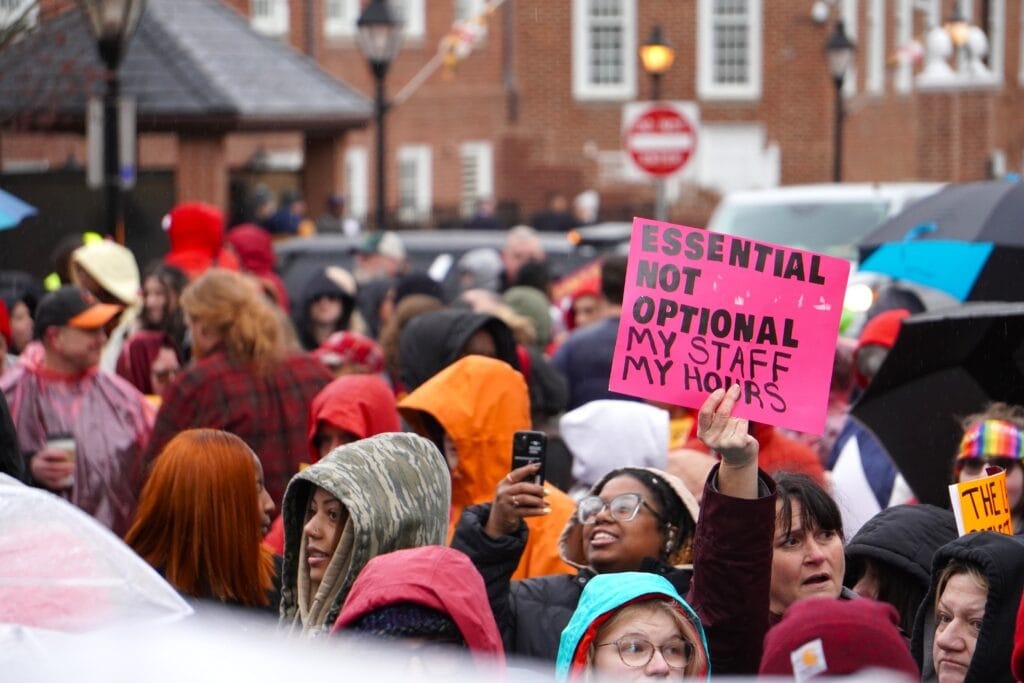
Advocates for people with developmental disabilities warn that upcoming rule changes and wage cuts this summer will be detrimental – particularly for those who self-direct their Medicaid services and have family members help with care.
“The entire self-directed community right now is in a complete tailspin and are overwhelmed,” according to Carin Smith of the Concerned Citizens for Self-Direction Advocacy Group. “Stressed, anxiety — they don’t know what they’re going to do.”
Smith’s comments follow several webinars hosted by the Maryland Department of Health this month seeking public input on how the state can better implement new restrictions and wage reductions required under the state budget approved this year.
That budget includes broad rate reductions and wage cuts across the board. But he self-directed community feels that new restrictions on how family members can provide care for their loved ones with developmental disabilities will be particularly challenging, especially as the workforce for these services faces a shortage.
That’s the worry for Tracie Feron, a Baltimore County resident who testified against the budget cuts this session with her son, Connor.
“When these wages are cut, who is going to be there besides family as staff?” Feron said. “We can’t just hire anybody to come in with his complex needs, and with the cuts from last year, it is already a strain on this community to find qualified people.”
With many of these changes taking place over the summer, advocates worry that there will not be enough time to comply, according to a Friday statement from the Self-Directed Advocacy Network of Maryland, Inc.
“SDAN is deeply concerned that the short implementation timeline does not provide enough time for providers and participants to successfully complete the required process and maintain uninterrupted services,” the statement said. “As a result, many individuals risk losing critical supports beginning July 1.
“SDAN is urging the State of Maryland to consider the severity and real-life impact of these sudden changes on people with developmental disabilities who depend on stable, uninterrupted services every day,” the statement said.
It’s the second year in a row that the Moore administration and lawmakers slashed DDA funding to offset what state officials say is unsustainable cost growth at the agency. Last year, the state cut $164 million from the DDA budget.
The General Assembly this year cut $126 million in state funding to the DDA, which oversees the Medicaid waiver that helps provide services to people with significant medical or behavioral needs due to their disabilities. Once federal matching dollars are factored in, the cuts total more than $250 million.
People with the Medicaid waiver, or a designated guardian, are able to “self-direct” their care, hiring and firing their own support staff, rather than joining a community provider. About 3,900 people in Maryland self-direct their Medicaid services.
Right now, people self-directing their care can hire family members to provide services just as they would someone outside the family – and pay the same wage. But family members who are employed under the Medicaid waiver will be particularly affected by some of the cuts.
There is also a process called “wage exceptions” which let people in certain circumstances pay their staff more. For example, one of categories of services, called “personal support,” currently has a maximum wage of $32.45 per hour, but that can grow to $37.01 an hour with a wage exception. Providers in certain counties can get an additional wage boost.
The new budget eliminates the wage exception process, capping pay for personal supports at $30 an hour for non-relatives, and $24.14 an hour for family members working as “personal supports.”
Those wage reductions and others will begin July 1.
Advocates worry that the wage cuts for nonrelatives will lead to people leaving the field entirely, at a time when support services already face a workforce shortage. That would mean that more family members would have to step in for less pay – except the new budget also restricts the hours family members can get paid for their services.
Under the new rule, an individual family member taking care of a loved one could only be paid for 40 hours a week, and the maximum number that all family members could be paid for is 60 hours a week. That new rule, if approved by federal officials, will take effect on Sept. 1.
How those hours are distributed is up to the waiver recipient. It could split between two family members who work 30 hours each, three members who work 20 hours a week, one parent who works 40 hours while the other works 20, and so on.
Nonrelative providers will need to make up the difference, which will be hard if more workers choose to leave disabilities services for a job that pays more.
“We are jeopardizing the health and safety of these individuals by allocating dollars, state and federal match dollars based on their need – and then not giving them the services to support the need,” Feron said.
The new restriction will need approval from the Centers for Medicare and Medicaid Services, along with other changes under the proposed waiver amendment that will usher in the budget cuts.
Shari Dexter, also with Concerned Citizens for Self-Direction, said that advocates are contacting CMS as well as state officials to urge a reconsideration of the cuts, noting that family members who provide self-directed services have made significant life decisions based on the current wages.
“There are parents who gave up their jobs,” Dexter said. “And now they’re taking a pay cut. And especially when you have a participant who lives with you — you’re not getting payment for your house, you’re not getting payment for electricity. People still have real daily needs of supporting the participant with clothing, with food … all those things.
“Regardless of whether you’re shopping at Target or you’re going to the gas pump, all of these things have gotten more expensive,” she said.
But even after hearing public comments from the self-directed community, state health officials stand by the need to cut from the DDA, to contain “unsustainable” program growth.
“Costs for this federal Medicaid waiver program have grown by over $920 million in State General Funds over the last five years, representing an increase of more than 144%,” the Maryland Department of Health said in a written statement Friday. “The FY 2027 budget passed by the Maryland General Assembly includes sustainability measures to slow cost growth and align Maryland’s program more closely with federal guidance and best practices.
“DDA is committed to working with participants and families, providers, case managers, and advocates to ensure all needed, eligible services are available for participants,” the statement said.
SUPPORT: YOU MAKE OUR WORK POSSIBLE
Trump’s $50B Rural Health Bet Meets a Healthcare Desert in North Carolina
By Sarah Jane Tribble and Amanda Seitz
May 22, 2026

WILLIAMSTON, N.C. — Two years after her brother’s death, Debra Pierce still wonders whether the 50-year-old would have survived his heart attack if her local hospital hadn’t closed.
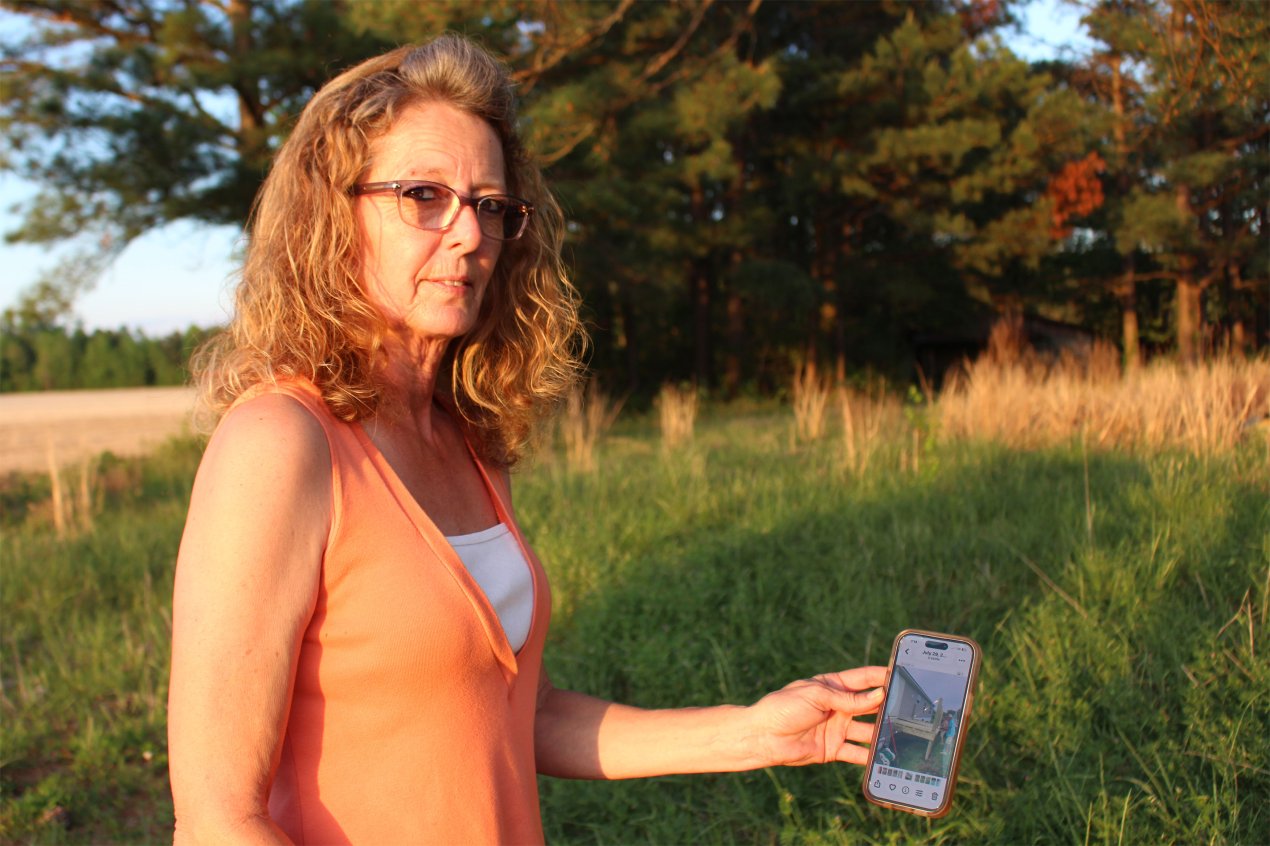
“The sad thing is we’ll never know if he could have been saved that night or not, because we don’t have a higher level of care in this county,” Pierce said as she stood outside the mobile home where she last hugged her brother.
Emergency crews from a neighboring town worked on Stanley Sears for a half hour but couldn’t revive him for the long drive to the closest hospital, records show.
In the tall grass — which would be mowed if Sears were still alive — Pierce swiped through the photos on her phone. She stopped at a picture that showed Sears smiling. Pierce chuckled and then sighed: “Bless him.”

The local hospital had closed a year before Sears’ death, leaving behind a gutted healthcare system. Martin County does not have paramedics on its ambulances, and it can be 20 miles or more to the closest — and often overcrowded — emergency rooms.
The healthcare gaps in Martin County illustrate the finite reach of a $50 billion rural health fund that Republicans crafted to strengthen support for President Donald Trump’s signature tax and spending measure, the One Big Beautiful Bill Act, last year. Though the cash has not been doled out, Republican candidates in competitive midterm elections — including the closely watched battle for the congressional district that encompasses Martin County — are casting the fund as a lifeline that will shore up critical rural health services across America.
The money has been highly anticipated in North Carolina, where most residents live in rural counties. Pierce, a Republican who blames county officials for the hospital closure, said she has faith Trump will help them. “Old man’s doing his job up in there,” she said.
On paper, Martin County — home to about 22,000 people — looks like a top contender to receive at least some of the $213 million that’s been earmarked for North Carolina.
Yet County Manager Drew Batts said it won’t be the answer for his residents.
“The $50 billion is not something that is specifically going to help our situation,” Batts said as he walked into the shuttered hospital in April. “It’s not going to help us get this place reopened.”
Martin County won’t get direct relief from Trump’s rural health fund — because its hospital isn’t open. North Carolina is distributing the money among existing health and social service organizations. Plus, federal regulators set limits on how much can be spent on construction and building renovations.

‘We Can Only Pray’
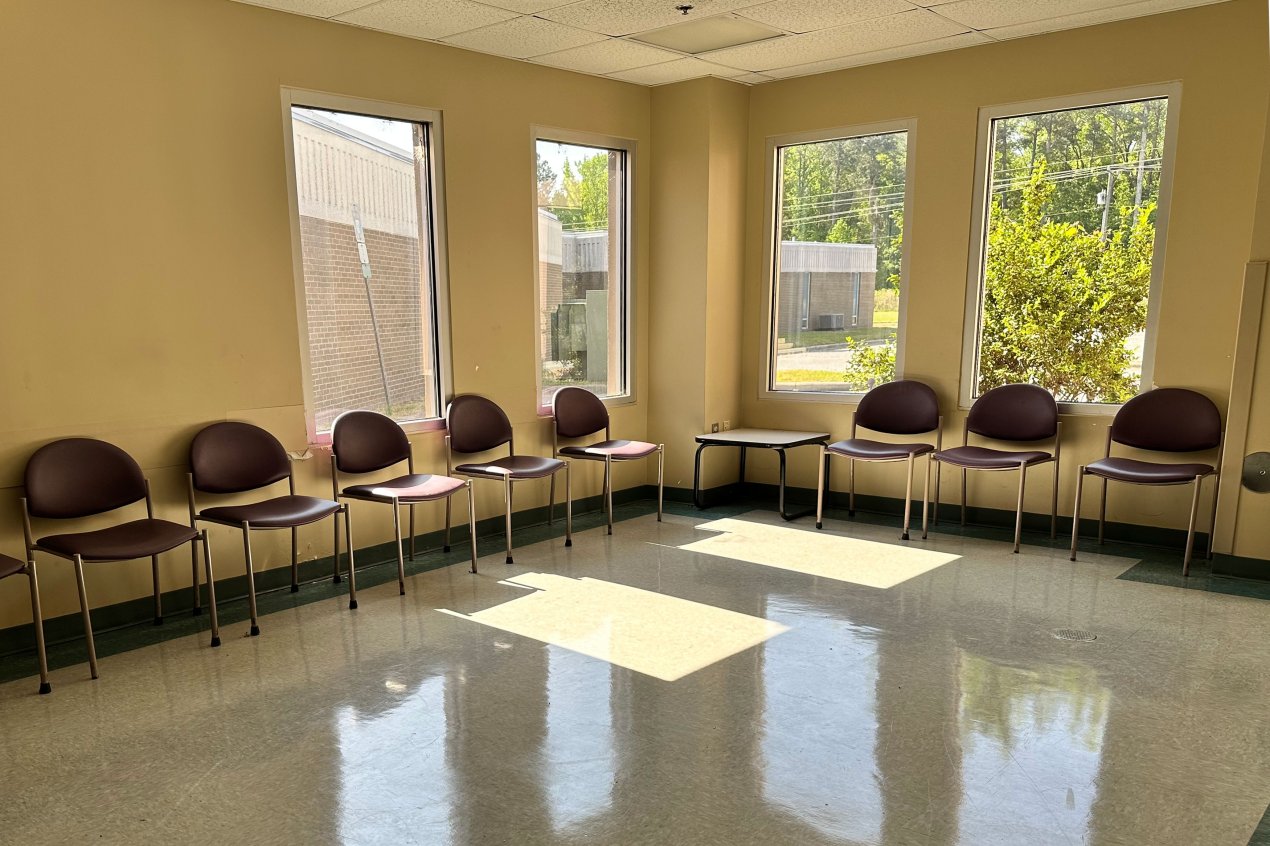
Martin General Hospital closed abruptly in 2023, surprising employees and shocking patients, who had to be wheeled out on stretchers and transported elsewhere to finish treatment. The closure even stunned local elected leaders, who say the company operating the county-owned hospital, Quorum Health, did not notify them it intended to shut down operations and file for bankruptcy. Quorum spokesperson Lisa Anderson said the company had told county commissioners of the hospital’s ongoing financial challenges.
Politicians have spent the years since trying to reopen the hospital, with county taxpayers pouring an estimated $2.9 million into maintenance, utilities, and other costs in the hopes of resuming operations, Batts said.
The county is now considering spending at least $1.5 million, he said, to create two higher-level paramedic units with quick-response vehicles, specially equipped with electrocardiogram equipment or other “advanced lifesaving support.”
Pierce said she is praying the county can add paramedics and reopen the hospital.
“There’s some answered prayers happening every day,” she said. “So, we can only pray and hope, you know?”
‘They Just Want To Not Die’
With its nine hospitals, the region’s largest health system is ECU Health, connected to East Carolina University. The system has become a de facto safety net for 29 counties. Batts and Brian Floyd, the Greenville-based system’s chief operating officer, have lobbied state and federal lawmakers, walking them through the shuttered hospital and asking for help.
“It’s a real healthcare crisis that has already proven itself to have lost lives that perhaps didn’t have to be lost,” Floyd said. “They just want to not die because there’s nowhere to go when you have an emergency.”
Eleisa Ann Evans drove 2½ hours from a small town near the Outer Banks on a recent evening so her aunt could get care at an ECU Health ER in Greenville. Once there, Evans said, staff told her to leave her 79-year-old aunt in the waiting room and wait outside because of capacity issues.
Evans said she was outraged at the way the staff treated her. She said she had been standing behind her aunt’s wheelchair while inside and “wasn’t using nobody’s chair.”
With Martin General gone, all the surrounding counties are “also in jeopardy,” Floyd said. “No one knows what to do” with that large of a healthcare “desert,” he said.
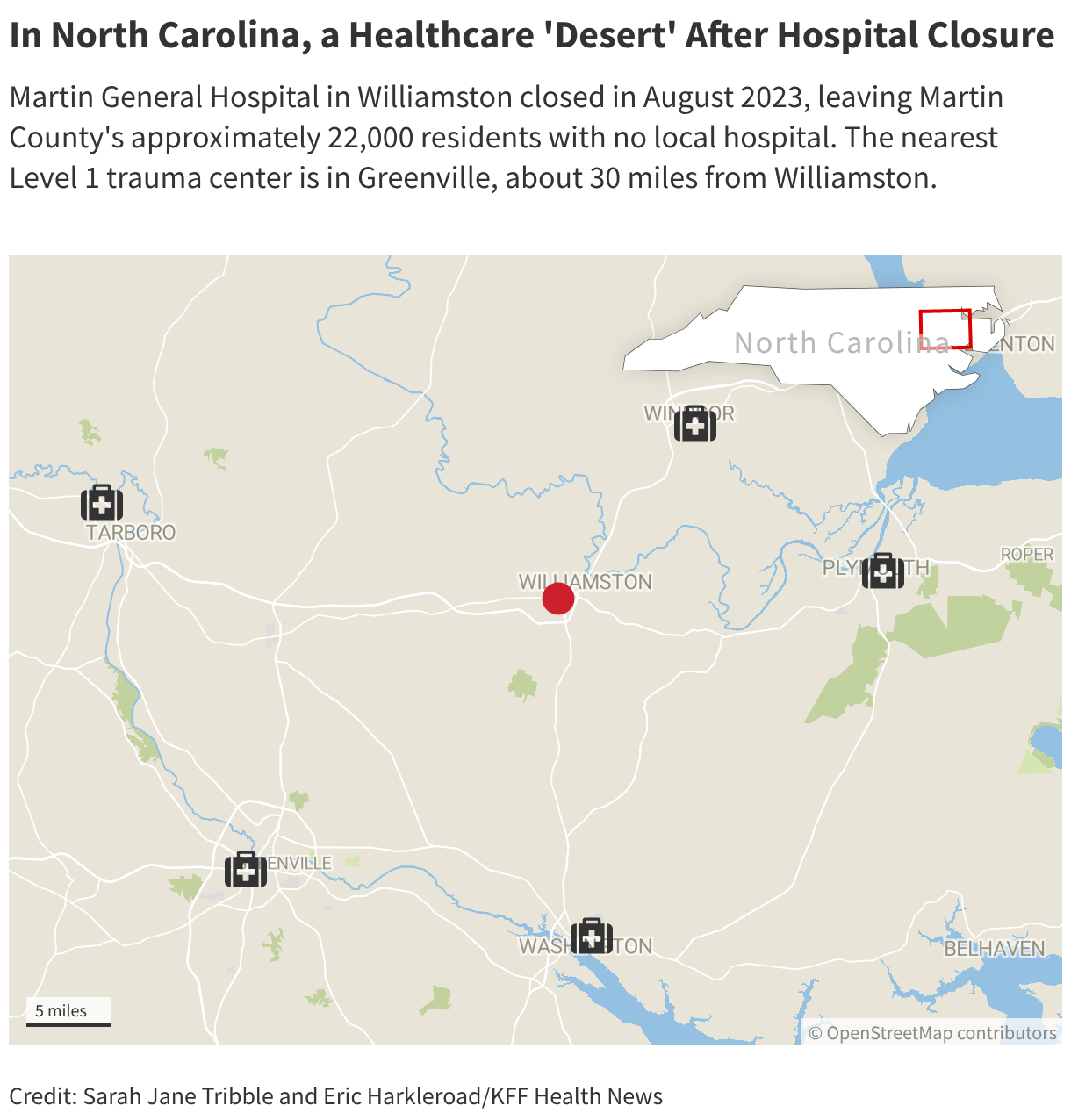
What healthcare is left in the county includes one urgent care center, run by a private company, and a nonprofit health clinic, operated by Agape Health Services, which accepts patients from five counties and plans to build another primary care clinic to meet demand.
ECU Health signed a letter of intent last year to reopen Martin General as a rural emergency hospital that would provide outpatient care as well as an ER. Under the terms of the deal, Martin County would pay to refurbish the hospital, and the North Carolina General Assembly would have to give ECU Health $210 million, of which $150 million would pay for the construction of a new inpatient tower at ECU’s Beaufort Hospital.
The health system, through its affiliate Access East, won a portion of North Carolina’s $213 million first-year payout from the rural fund. But the federal money can’t be used to reopen Martin General, Floyd said.
The five-year Rural Health Transformation Program is slated to be delivered in $10 billion annual increments to states, which applied and competed for the money.
North Carolina’s plan creates a hub-and-spoke model that allots money to six large regional leads, including nonprofits such as Access East. Those hubs will distribute money to local entities and coordinate broad initiatives such as improving primary care and fortifying the healthcare workforce, as well as developing “digital solutions,” according to the state’s hub application.
An Election Issue
The lack of emergency care in the region has emerged as a top talking point in a close U.S. House race between Rep. Don Davis, a Democrat who represented the district when Martin General closed and is seeking his third term, and Republican Laurie Buckhout.
The rural health fund was added at the last minute in 2025 to win votes for the One Big Beautiful Bill Act, which is expected to reduce federal Medicaid spending by more than $900 billion over a decade — cuts that are projected to hit rural hospitals and clinics especially hard. Rural health executives say the fund won’t come close to offsetting those losses.
Matt Mercer, a spokesperson for the North Carolina Republican Party, called the rural fund a “once in-a-generation opportunity” for the state.
But U.S. Sen. Thom Tillis, who was one of three Republican senators to vote against the bill — and who announced shortly before the final vote that he planned to retire from Congress — warned of devastating consequences ahead for healthcare in his state.
Buckhout, who declined an interview, plans to attack Davis — a vulnerable incumbent whose district was recently redrawn to favor GOP candidates — for voting against the bill.
“Martin County lost its hospital on his watch, and he still opposed the funding meant to help communities like it,” Buckhout campaign spokesperson Stephen Gallagher said in a statement to KFF Health News. The campaign did not respond to additional queries about her plans for healthcare access, if elected.
Davis, who signed a letter from lawmakers in support of North Carolina’s rural health fund application, said the money “is essentially putting a band-aid on a much, much broader situation that needs dire help.” He has introduced legislation that would increase Medicaid reimbursements for rural hospitals, though it has not moved forward.
During recent testimony on Capitol Hill in Washington, ECU Health CEO Michael Waldrum said his system expects to lose a billion dollars over the next 10 years from the looming Medicaid cuts.
Overnight Waits for Emergency Care
The region’s emergency rooms offer a stark glimpse of a healthcare system in crisis.
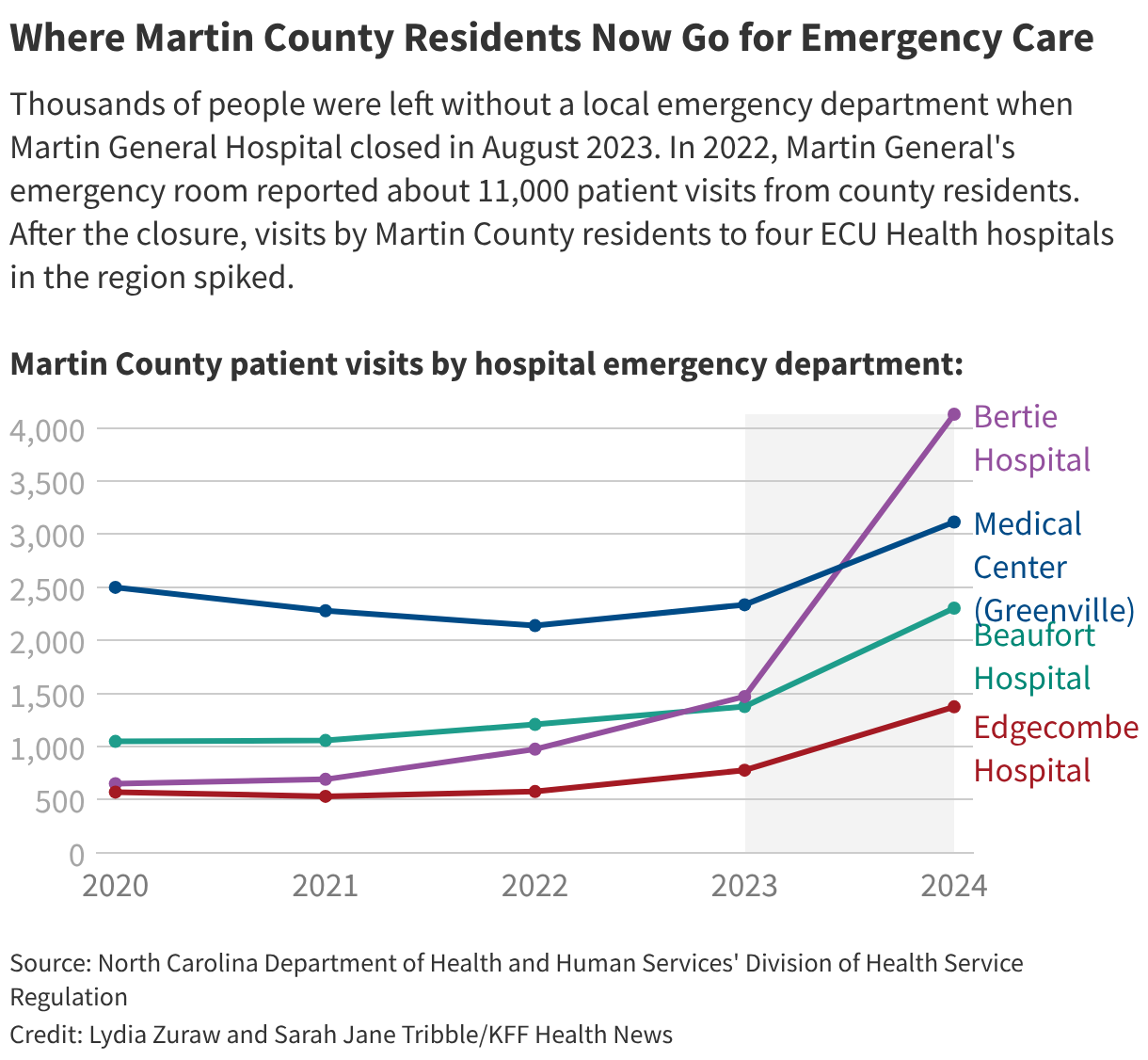
Martin General’s ER treated about 11,000 patients annually before it closed, according to state data. A sign still hangs in the staff break room showing that 23 patients were seen in the ER the day it closed.
ECU Health, which owns all but one of the rural hospitals around Martin General, reported a 132% increase in its daily ER visits since the hospital’s closure. The company's nearly 1,000-bed hospital in Greenville, about 40 minutes from Williamston, is the state’s only Level 1 trauma center east of Raleigh.
The Greenville hospital’s median patient ER wait and treatment time was nearly 4½ hours, according to the most recent federal data. That’s longer than 96% of thousands of hospitals reporting nationwide. The wait times “don’t reflect poor care,” ECU Health spokesperson Brian Wudkwych said in an emailed statement. He said the system’s ERs treat nearly 300,000 patients annually.
While the system has seen an increase in Martin County patients, the wait times primarily stem from shortages of inpatient and behavioral health beds, Wudkwych said.
Floyd, the ECU Health chief operating officer, said many rural patients who arrive at the system’s ERs have multiple chronic conditions that require longer visits. Often doctors start treating one problem and then find the patient’s “blood sugar is out of control, your hypertension is far out of control,” he said.
ECU staff encourage people who are not too sick to skip Greenville and, instead, seek care at one of the system’s community hospitals, which aren’t as busy, Floyd said.
A security officer guarded the Greenville emergency department’s doors on two nights in April. The “capacity notice” sign near the entrance meant family members of patients had to wait in cars or on benches outside.
“We’ve only been here six hours,” Tonya Miles said after bringing her mother for a potential blood clot in her leg. The family had left the day before after waiting for two hours, because her mom “wasn’t prepared” for such a delay in treatment, Miles said.
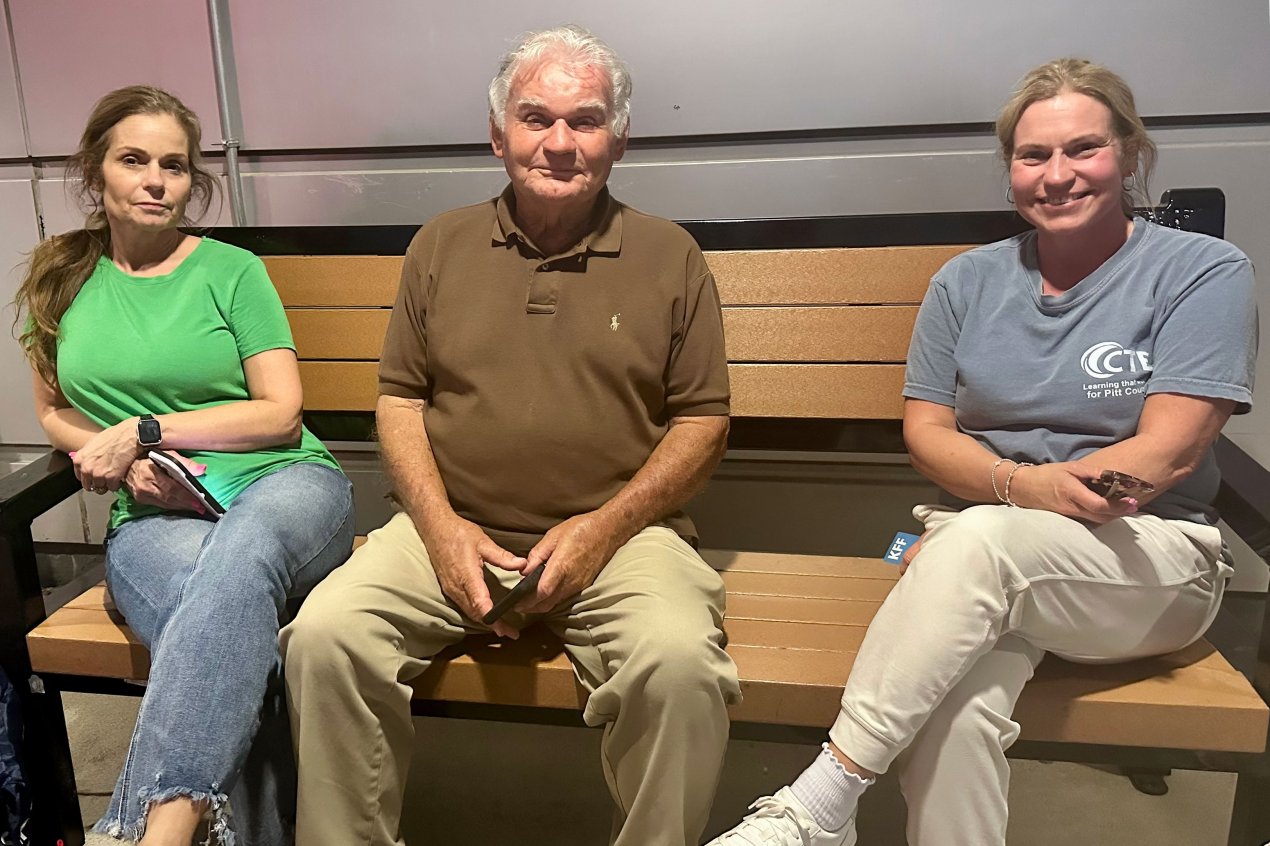
On another evening, Olivia Lewis said she had brought her mother two nights previously and left without care after their wait stretched from 10:30 p.m. to 7 a.m.
“She tore off her hospital bracelet and said: ‘I’m out. I’m done,’” she said. Now, they were back.
On a recent Friday in Martin County, Vannessa Little was sitting at a McDonald’s with her kids just down the street from the closed hospital. Little pointed to one of her girls and wondered how her care would have been different if the hospital had been open.
Her daughter, then 6, suffered severe burns over 30% of her body in 2024, and the journey to treatment was “just crazy,” Little said. An ambulance arrived at her Williamston home from neighboring Bertie County to transport them to ECU’s Greenville ER.
“That was a long time,” Little said of the 30-mile drive. The girl was ultimately airlifted more than 100 miles to Chapel Hill. Little said she hadn’t heard of Trump’s rural health investment. “The only changes that people are making is they’re taking away everything.”
She voted against Trump in 2024 and said she didn’t think she would vote this year.
“It’s a waste of my time.”
KFF Health News is a national newsroom that produces in-depth journalism about health issues and is one of the core operating programs at KFF—an independent source of health policy research, polling, and journalism. Learn more about KFF.
This article first appeared on KFF Health News and is republished here under a Creative Commons Attribution-NonCommercial-NoDerivatives 4.0 International License.

Lawmakers target hospitals – and Atrium Health in particular – in reform bills
by Michelle Crouch and Charlotte Ledger, North Carolina Health News
May 22, 2026
By Michelle Crouch
Co-published with The Charlotte Ledger
Atrium Health would have to add four local elected officials to its board under a North Carolina state Senate bill — one of several proposals this session taking aim at the growing power of large hospital systems.
The bill, SB 961, would also require any meeting of county hospital authority board members to comply with North Carolina open meetings laws, a provision that appears to address concerns that Atrium Health conducts much of its substantive business behind closed doors.
Atrium operates both as part of Advocate Health, a $39 billion multistate nonprofit hospital giant, and as the Charlotte-Mecklenburg Hospital Authority, a public body. Legislative interest in Atrium has intensified in the wake of its proposed combination with Raleigh-based WakeMed Health & Hospitals, a deal that has drawn scrutiny from state leaders.
Atrium is one of only two county hospital authorities in the state. The other is CarolinaEast, a small system in eastern North Carolina.
Sen. Jim Burgin (R-Angier), who sponsored the bill and co-chairs the Senate Health Care Committee, said he is concerned that hospital authorities enjoy the benefits of a public entity — such as tax exemptions and eminent domain powers — without enough public accountability. It’s an issue previously examined by The Ledger/NC Health News.
“I talked to a number of people about how authorities are set up, and I think one of the problems is: Are they really governing? Who's on [the board], and are they really taking that position seriously and asking the tough questions?” Burgin said. “I think there needs to be some different people on there — people who represent local government, citizens and everybody — so that it's not a closed system.”
A second legislative proposal, SB 978, would give the state auditor, attorney general and state treasurer new authority to review and potentially challenge major hospital transactions. It would also add whistleblower protections for healthcare workers, limit hospital noncompete clauses and cap nonprofit hospital CEO pay at 400 times the lowest-paid full-time worker’s compensation.
Atrium did not respond to multiple requests for comment on the bills.
A spokeswoman for the North Carolina Healthcare Association, which represents hospitals, said their group is reviewing both bills. In an email, she said, “Given the significant challenges facing North Carolina hospitals, particularly those serving rural and underserved communities, our hope is that policymakers will support solutions that strengthen hospitals’ ability to care for North Carolinians rather than create additional barriers to delivering that care.”
The measures may face a tough road during this year’s short legislative session, especially since they would need approval by the House of Representatives, which has historically been more aligned with hospital interests. But their introduction is a sign that lawmakers are more willing than before to challenge hospitals.
“Healthcare is one of our most expensive and fastest-growing costs,” Burgin said. “We’ve got to do something about it.”
Questions about closed-door meetings
The Charlotte Ledger/NC Health News has raised questions about whether Atrium meets the spirit of North Carolina’s open meetings laws, as it is required to do as a public entity.
Although the hospital authority’s quarterly board meetings are open to the public by statute, the board does not allow the public to attend committee meetings — where most substantive discussion occurs.
The hospital has long argued that its committee meetings are not “official meetings” that must be open to the public, an interpretation some open government experts dispute.
Amanda Martin, supervising attorney at the Duke University School of Law First Amendment Clinic, said the proposed wording in the bill — requiring “any meeting of the commissioners” to be open — would strengthen the argument that committees composed of commissioners would have to be open to the public.
Burgin said public entities should conduct as much business as possible in the open and use closed sessions only in limited circumstances. He said he was concerned when he heard that Atrium had planned an unusually long four-hour closed session for April 29.
“There were multiple hours of discussion in closed session,” he said. “Closed session is not intended for that. That's open discussion. It’s very narrow the things that they can do in a closed session.”
A Ledger/NC Health News reporter attended the April 29 meeting in a conference room at The Pearl, Atrium’s new medical innovation district near uptown Charlotte. It began in open session, as required by law, before the public was ushered out for the closed session.
Speakers during the open portion referenced topics to be covered that did not obviously fall under the statutory exceptions cited for closing the meeting. For example, the board chair, Angelique Vincent, told members that the meeting would cover “items you all have raised questions about, or asked for additional information on.” She added, “We have built in time so that we can have a conversation and a dialogue, versus you all just hearing lectures from our speakers.”
Another speaker said, "You’ve heard about all the virtual care. We’re going to talk about that today.”
Atrium has stressed that it is complying with the law.
Standoff on Atrium board nominees
There has also been growing tension in Charlotte over the makeup of Atrium’s board.
Under current law, the only direct authority local government officials have over the hospital authority is that the chair of the Mecklenburg County Board of Commissioners, Mark Jerrell, must approve nominees to its board.
For the most part, chairs of the board have routinely approved Atrium’s nominees. But earlier this year, in a rare rebuke, Jerrell rejected Atrium’s proposed slate, the first such rejection in decades.
Jerrell said at the time he wanted broader representation, particularly voices tied to low-income and underserved communities.
Atrium did not try to find candidates that addressed Jerrell’s concerns but instead opted to continue operating with the existing board members. When asked about that decision, an Atrium lawyer cited a state law that allows board members to remain in office until successors are appointed and qualified.
A proposal to cap CEO pay
Burgin said the hospital CEO compensation cap is aimed at nonprofit hospitals that pay their executives like large private corporations.
“Not-for-profits, I think they’ve got to control it,” Burgin said. “I think when a hospital CEO gets to a certain point, people need to say, ‘Wait a minute, you're not-for-profit.”
Advocate Health CEO Gene Woods took home $25.8 million in 2024. Advocate’s hourly minimum wage is $18.85/hour, so a bill capping compensation at 400 times that amount could potentially cap Woods’ compensation at about $15.7 million annually — a 39 percent pay cut.
Last week, the intergovernmental committee of the Mecklenburg County Board of Commissioners discussed the hospital authority bill. Although the committee did not take a formal vote, six commissioners said they would support including the bill on the county’s legislative agenda.
“The power here is incredible, and it’s very disturbing,” said commissioner Susan Rodriguez-McDowell. “In my view, this is the most profitable nonprofit, and there are no reins to the power.”
NC Health News reporter Ashley Fredde contributed to this story.
This article is part of a partnership between The Charlotte Ledger and North Carolina Health News to produce original health care reporting. You can support this effort with a tax-deductible donation.
This article first appeared on North Carolina Health News and is republished here under a Creative Commons Attribution-NoDerivatives 4.0 International License.

Union group wants to bolster KC’s affordable housing by investing pension money
by Thomas White, Beacon: Kansas City
May 19, 2026
Cameron Seip describes his job as being a connector.
As the executive director of Mo-Kan LECET — the Western Missouri and Kansas Laborers-Employers Cooperation and Education Trust — he tries to make “connections that make sense” among union workers, contractors, developers and governments. All so the union members and contractors he represents are able to create more work opportunities.
Many of the people he deals with in Kansas City are increasingly focused on the area’s lack of affordable housing. Seip has a possible solution in mind.
“The thing I want to focus on — that I feel we can bring opportunity to — is to create the affordable housing that the city keeps talking about,” Seip said. “And do it in a way that we can help people find careers and opportunity that has longevity.”
So for the past couple of years he’s been trying to make a surprising connection that he says may help solve several pieces of the affordable housing puzzle. He’s been trying to introduce Kansas City builders to union pension investors.
“It’s basically to introduce all the various investors that we have for our (union) pensions … to developers and people who want to build projects,” he said. “But do it in a way that we can ensure that the project can be used for workforce development for the community at the same time.”
Takeaways
- A Kansas City labor leader pitches union pension investments as a new funding source for affordable housing projects.
- The proposal would require union labor on related projects while creating apprenticeship and workforce training opportunities for local residents.
- The Kansas City Housing Authority has had early-stage discussions about whether the model could support its $2.6 billion redevelopment plan.
This has been done in cities across the country for decades, but would be unique in Kansas City. Union pensions can be harnessed to finance hard-to-fund affordable housing projects. A developer or agency owns and oversees the project, the construction crews swinging hammers are trained from within the community and earn union wages. When the building is completed, rents pay back loans or bonds, community members have learned a valuable trade, and the pension — supported by hours worked on projects — is a little healthier than before.
Seip says he’s floated the idea to several parties, but one is known to have shown early interest. The Kansas City Housing Authority has started early discussions exploring a potential partnership to train community members, fund and work on its ambitious 10-year, $2.6 billion housing development plan.
The talks with organized labor were first acknowledged publicly May 1. Mayor-appointed Housing Authority Commissioner Tate Williams — also a community housing banker for the Central Bank of Kansas City — described discussions during a Greater Kansas City Regional Housing Partnership forum.
“The Housing Authority has begun forming a relationship with the laborers union,” Williams said. “It’s a really creative partnership that we’re discussing … possibly even financing through pension investments, some of the projects that the laborers union would then construct. And as part of that, would develop a workforce partnership with the residents of the complex in which they’re working.”
Nothing is set in stone. A handful of preliminary conversations, by Seip’s account, do not add up to a deal. But they do present an intriguing possibility that could address several community needs.
Kansas City needs affordable housing, it needs funding for affordable housing, and it will need more trades workers as construction booms locally.
Pension funds tied to organized labor have helped fill funding gaps — in exchange for union labor working on the projects they fund — for affordable housing in cities like Boston, Chicago and St. Louis. The projects trained locals in the trades, and the workers left with union benefits including higher wages, healthcare and a pension.
Here’s how it might work in Kansas City.

Size of the problem(s)
The local affordable housing need is well documented.
The Mid-America Regional Council estimated that the region was short 63,828 affordable rental units in 2023. The Kansas City Housing Authority reported 14,347 applications on its public housing waitlist and 27,523 on its housing voucher waitlist in their 2026 annual plan.
Meanwhile, the money to chip away at that shortage lags well behind the need.
Because financing for affordable housing is difficult to find, Kansas City voters approved an additional $50 million for the city’s Housing Trust Fund in 2022. Since 2021, it has helped finance the construction or preservation of more than 2,000 units — a small fraction of the local shortfall.
At a February Keystone housing forum, Local Initiatives Support Corp. Greater Kansas City Executive Director Geoff Jolley put the gap between that funding and the demand in stark relief.
“The city has received over $1 billion dollars in requests for the Housing Trust Fund for $75 million worth of funding,” Jolley said. “The need is out there.”
The question of who would build all that housing is its own problem.
Nate Zier, executive director at the National Institute for Construction Excellence, was blunt about it at a May 1 housing forum put on by the Greater Kansas City Regional Housing Partnership.
“The biggest constraint right now isn’t land. It’s not materials — though the prices of materials are certainly cause for concern at times,” Zier said. “A big part of it, if you ask around, it’s the workforce.”
Citing national data, Zier said about 41% of construction workers are set to retire by 2031. He noted that while there are now some strong programs to bring young workers into the fold, the pipeline of qualified professionals behind those about to retire isn't keeping pace.
“It’s not just a shortage,” he said. “It’s a mismatch between the skills we need and the pipeline that we’ve built.”
The structure of the housing construction industry also doesn’t help.
Residential construction is fragmented compared to commercial construction. Small businesses, subcontractors and independent crews stitch residential jobs together, which means people doing the work have less stability and less access to things like healthcare, retirement and formal training pathways.
“Workforce development isn’t just about keeping people in or getting people in,” Zier said. “It’s about creating a system where they can stay employed and stay active.”
Seip is pitching the union pension funding solution to address all three challenges — a lack of affordable housing, the need for funding and a high demand for a workforce to build it — at the same time.
How union pension-funded housing works
To understand how Seip’s proposal could work, look at South Boston.
Old Colony, originally built in 1940, was one of the Boston Housing Authority’s largest properties, spanning 16 acres and 22 buildings. When the city went to rebuild it, conventional financing wasn’t enough.
Starting in 2010, the Boston Housing Authority partnered with the state housing finance agency and a private developer to redevelop the site in phases. The financing they leaned on came in large part from the AFL-CIO Housing Investment Trust. The trust pools portions of union member pensions and public employee retirement plans across the country and invests in housing construction.
The AFL-CIO Housing Investment Trust has put more than $240 million into redeveloping hundreds of housing units in the Old Colony project so far. Since the trust began in 1984, it has helped finance 632 projects that produced 248,600 jobs and 217 million hours worked nationwide.
“Cities across our country face an affordability crisis only made worse by the pandemic. In Boston, union capital and union labor are proactively addressing that need,” said AFL-CIO Housing Investment Trust Chief Executive Officer Chang Suh in a 2023 release.
The money came with one condition: Every project funded by union pensions had to be built by 100% union labor. Over the course of the project nearly 2.4 million hours of union labor went into the project.
“If our (union pension) money is involved in any way, then part of that agreement is that the work will be done with signatory contractors who participate in our apprenticeship and employ our members,” Seip said.
There are currently 31 projects under construction funded in part by the AFL-CIO Housing Investment Trust nationwide, totaling just under $1 billion dollars from union pensions. Due east down Interstate 70 in St. Louis, the housing investment trust has invested $614.2 million in 32 projects over 30 years.
Seip told The Beacon that his group of laborers unions could tap pension funds beyond the AFL-CIO Housing Investment Trust to fund housing projects in Kansas City. He said there are also the Laborers International Union of North America’s pensions, largely held by Fengate Capital, and a series of smaller diversified funds from varied union trades and regions. He says the exact funding source that could be used would depend on the specific project.
“Imagine the Mississippi, it’s a huge river and that’s the main source but you also have lots of little rivers flowing into it,” Seip said. “We do these things collectively and that’s how we find these opportunities of strength.”

Workforce development engine
Those investments don’t just build housing.
Boston paired the construction with a nonprofit pre-apprenticeship workforce development program that gave Old Colony residents a path into the construction trades. Residents were also given the first crack at the jobs rebuilding their neighborhoods.
The structure of the workforce pipeline associated with a union pension-funded project in Kansas City hasn’t been finalized, but there are options. In addition to other training programs, East High School is expected to have classes mirroring those of the laborers union’s training center starting this fall. Those classes would allow graduates to enter the union’s apprenticeship at a more advanced stage, not too differently than taking college credits while in high school.
While pre-apprenticeship does not have a union requirement, the next step of apprenticeship would require signing on with a union contractor to work on pension-funded projects. Seip said that is partially because training is paid for by signatory contractors based on the number of hours worked. The same is also true for the union’s healthcare and the pension itself.
“If we’re the funding device, we’re priming our own pump,” Seip said. “And there’s good reason for (developers) to be interested in that, because the quality of work, the workforce development we do for the community, the way that we combine with the community, it’s really just a lot of upside.”
The Kansas City International Airport is a glimpse of what that training and support could look like. A three-week pre-apprenticeship training program run with construction trades and paid for by the project’s developer graduated about 200 students across 10 classes. About 65% were people of color and roughly 70% remained in construction after they graduated.
Seip stressed that the union was open to everyone, and they would seek to have as many local residents working on these proposed projects as possible.
“The point of hiring local is so that locals can feel the employment,” Seip said. “When you have people that live here, get their paychecks from contractors here, buy their groceries here, you actually feel it within the economy, you feel it through income taxes, it helps the school system, it helps it all.”

Could a partnership in Kansas City work?
“We’re looking at all relationships everywhere,” Seip said. “If somebody wants to meet with us and learn about what our pension investors need for us to all strike a deal, then I welcome all conversations.”
While they are the first to be tied publicly to the idea — at least in early discussions — the Kansas City Housing Authority did not reply to requests for comment.
A partnership could make sense given the housing authority’s stated goals and desire to find unconventional solutions for the ambitious set of projects.
In November, housing authority commissioners approved a $2.6 billion plan to redevelop all of the city’s existing public housing over 10 years. The multiphase project would result in 7,159 units of new and rehabilitated mixed-income housing. For a project that size, the housing authority’s Executive Director Nona C. Eath said in an interview with LISC in March that it would take some creative partnerships.
“It is going to take everybody. It’s not just a specific group. We anticipate partnering with local, state and federal agencies,” Eath said. “We’re looking at development partners locally, businesses and entrepreneurial groups to see what opportunities exist. We’re talking to resident groups and neighborhoods. We’re talking with financial partners. So, it’s everybody.”
Two other things about the housing authority’s situation make Seip’s pitch line up more closely than it might first appear.
The first is wage law. The housing authority’s federally subsidized projects will almost certainly be bound by the Davis-Bacon act, which requires workers on such projects to be paid prevailing wage. The cost premium often associated with fully union jobsites is negated when prevailing wage is already required by federal law.
Hiring law also points to alignment of ideas. Federally funded projects have mandated hiring preferences for low-income workers and residents of public housing. Seip has described this as key to the union’s mission to invest in the community.
“The idea is to look at the communities within Kansas City, find the ones that would benefit from the most opportunity,” Seip said. “And figuring out a way to inject wages as the opportunity into the community.”
Limitations and unknowns
The first limitation is that the idea is in its infancy in Kansas City, with only conversations and no flagship deals or details just yet.
“This would look like something that we haven’t seen before,” Seip said. “So we have to be ready to pivot in the moment.”
Another challenge is likely to be the 100% union requirement on pension-funded projects. Even setting aside anti-union bias, there is no formal homebuilders’ union in Kansas City. The pool of union signatory contractors in general is also not as deep as in cities like Boston or Chicago. Spreading awareness of the potential opportunity to local contractors and people interested in the trades is a high priority.
“Our membership should have a wide variety of all of the people who are interested in being builders,” Seip said. “We are certainly not gatekeepers. And the only thing that we ask is show up with readiness to join in.”
Political headwinds may also be building as President Donald Trump has proposed a $10.7 billion cut to federal housing programs, including Community Development Block Grants and rental assistance.
What happens next depends on someone, a developer or agency, taking the leap. Seip has a handful of possibilities, but no firm commitments just yet.
For now, the work is focused mostly on introductions — the meetings, the explanations, making the case for a model that has built tens of thousands of homes elsewhere and none in Kansas City. Whether any of it results in concrete and steel will come down to a decision made by a developer or agency.
That choice has not yet been made. But the pieces are in place to make it possible. Pension capital is sitting in trusts that already invest in housing, just not here. A workforce pipeline is being assembled while a housing crisis is deepening by the year. And a man whose job is to make introductions keeps walking into rooms in Kansas City, looking for the person willing to be first.
“To me, it’s the builders of our community trying to solve the problems that we hear everybody talk about, and very few coming to the table with solutions,” Seip said. “The reason that we’re at the table trying to make sure that these projects happen is because everyone benefits when the whole community has the basic needs for what this life requires.”
This article first appeared on Beacon: Kansas City and is republished here under a Creative Commons Attribution-NoDerivatives 4.0 International License.

Rights for sexual assault survivors at stake in proposed NC legislation
by Sarah Michels, Carolina Public Press
May 28, 2026
Editor’s note: This article mentions sexual assault.
Witlee Ethan may finally get some semblance of justice.
Next week, the state Senate may take up a bill that includes certain rights for sexual assault survivors. It’s taken Ethan years to get this far.
Ethan reported in 2021 that she had been raped in 2020, according to the Cornelius Police Department incident report.
But when she went to the Cornelius Police Department, they didn’t seem to believe her, she told Carolina Public Press. Local police took 110 days — 65 days past the legal deadline — to send her sexual assault evidence collection kit, commonly referred to as a rape kit, to the State Crime Laboratory, she said.
By the time the state lab found male DNA in her rape kit, Ethan was told her case had been closed. Police would not bring her perpetrator in for questioning, and they would not get his DNA for a comparison.
A day later, she decided to write a bill.
[Subscribe for FREE to Carolina Public Press’ Daily, Weekend and Election 2026 newsletters.]
The Cornelius Police Department did not respond to questions about the case prior to publication.
If approved, the bill would allow sexual assault survivors to request information about the location and testing status of their rape kit. They would also be able to request written notice 60 days before their rape kit is set to be destroyed and have the right to ask to preserve the evidence longer. Survivors would be allowed to have an advocate or support person to accompany them during court proceedings. Finally, the attorney general would have to publish a clear list of victims’ rights online and distribute it to hospitals.
It’s not everything Ethan wanted; it’s not even close. But over the course of the past six years, Ethan has made scores of phone calls to attorneys, the police, lawmakers and anyone who might be able to help. She’s heard “no” more often than not. To finally hear a “yes” would send a message to her perpetrator: “You didn’t win.”
Witlee’s story
Ethan says she was sexually assaulted at a location in Cornelius over a period of more than 10 hours on Jan. 6, 2020, according to the police report.
She told CPP that the attacker was a man she had met on a dating site, who held her hostage and assaulted her many times.
Shortly after the man released Ethan, she got an examination. While the police had her rape kit, she was in survival mode and wasn’t ready to file a police report.
“I knew it would automatically be ‘he said, she said,’ and I just still wasn't in a state where I could be interrogated and made to be like this is somehow your fault,” Ethan said.
In November 2021, she did officially file a police report. Ethan said police told her that when they spoke with the man about the accusations, he lawyered up and was not brought in for questioning.
By April 2023, the Cornelius police got her tested rape kit back from the state lab. Male DNA was found inside. Still, Ethan’s case would not move forward. The Cornelius PD chose to close it, and the Mecklenburg County district attorney’s office did not take it up.
Ethan felt like law enforcement assumed she was lying, and didn’t take her seriously.
“I don't think that the police are getting the proper training on how to interact with victims and survivors,” she said.
Legislative hurdles
Ethan knows she will likely not ever get full justice in her case. Nonetheless, she’s fought tooth-and-nail for the past two years for a small piece of justice, not only for her, but for millions of other sexual assault survivors.
In mid-2024, Ethan got in contact with Skye David, staff attorney for the North Carolina Coalition Against Sexual Assault. It was too late in the year to file a bill for the 2024 session, so with the help of David, Ethan focused on getting meetings with lawmakers across the aisle and chambers to drum up support for the 2025 legislative session.
Eventually, Rep. Allen Buansi, D-Orange, agreed to draft the bill. At first, it was much broader.
Under the original bill, when someone reported a sexual assault, they would be assigned a victim advocate to work with law enforcement on their behalf and accompany them to court proceedings. Suspects would immediately be brought in for questioning and law enforcement would collect a DNA sample from them, by warrant or a district attorney order, if necessary. Law enforcement officers dealing with sexual assault cases would have to undergo trauma-informed sensitivity training on how to interact with victims.
It would have required further review before accused perpetrators could file defamation suits against victims to try and protect victims from retaliation. It would also bar survivors’ medical, mental health and sexual history from being used to discredit them during these proceedings.
Finally, it included several provisions dealing with rape kits.
Buansi brought several stakeholders to the table, including CASA, the North Carolina Department of Justice, the Conference of District Attorneys, rape crisis centers and sexual assault nurse examiners.
What resulted from those conversations was a series of sexual assault victim rights:
- Victims can request information about the location of their rape kit, and whether it has been tested;
- Victims can request written notice of the destruction of their rape kit at least 60 days in advance;
- Victims can request that their rape kit be preserved longer as evidence;
- Victims may have an advocate or support person present during court proceedings; and
- The attorney general must publish a “plain-language” list of victims’ rights online and distribute it to hospitals.
“They stripped it bare, pretty much,” Ethan said.
Buansi told Carolina Public Press that if he had it his way, the bill would include much more.
“One thing that I've said at the outset of that process is that the bill itself, it's a start,” he said. “It's not the end of what all needs to be done to empower survivors and victims to bring people to justice who commit these sorts of crimes.”
He can’t quite remember what the opposition was to some of the abandoned provisions. Ethan recalled concerns over violating the due process rights of perpetrators, and the amount of work it would take to implement some of the changes.
“I was like, can we at least give them something, because I know I had to keep calling, and I had to keep trying to wait for answers,” she said. “I even called the State Crime Lab, and they're like, we can't talk to you, you have to talk to the police, and it's like, well, what do you do if the police won't talk to you?”
Eventually, the sexual assault victims’ rights provisions were added to a bill, House Bill 771. In April 2025, it passed the House easily, in a 111-3 vote. Then, it got stuck in the Senate Rules Committee for a year.
Awaiting hope for sexual assault survivors
Ethan’s bill wasn’t a priority, she was told. It wasn’t going to make it in the 2025 session, and the 2026 session would be mostly focused on the budget and amendments. There probably wouldn’t be interest in moving her bill forward.
“I think there's a larger issue with bills that are good ideas that are passed by the House that are not moving,” Buansi said. “And then, on the flip side, on the Senate side, I know that there have been some good bills passed on the Senate side that haven't moved on the House side.”
So, Ethan decided to focus on drumming up support for her original bill, which she is now calling the HOPE Act, to refile in 2027.
In a twist of fate, things changed last month. Her bill was added to a different bill, House Bill 308, which passed the House last year and is now in the Senate. The Senate Judiciary Committee and the Senate Rules Committee approved the bill, which also includes a series of other criminal law provisions.
Ethan said she’s been told lawmakers will vote on it next week.
Still, nothing is guaranteed. Before she can celebrate, she has to jump over a few more legislative hurdles.
First, the Senate has to actually vote to pass the bill. Then, the state House must approve the changes made to the bill since the last time its members voted on it, including the sexual assault victims’ rights provisions.
If they do, the bill will go to Gov. Josh Stein’s desk to sign. If they cannot agree, a small group of lawmakers from each chamber will get together behind closed doors to negotiate a final version, which may or may not include the sexual assault victims’ rights provision.
This is a stepping stone for Ethan. Whether she succeeds or not, she plans to fight for her bill again next session.
“I'm just hoping and praying that my story will help do that — protect and save as many lives as possible — because then it just makes it a lot easier to accept that this happens,” she said. “Because the wrongs have been righted and something good came from something so bad.”
This article first appeared on Carolina Public Press and is republished here under a Creative Commons Attribution-NoDerivatives 4.0 International License.

Bayer promises to suspend ‘unfair provisions’ in seed contracts for several years, Trump administration announces
by Sky Chadde, Investigate Midwest, Investigate Midwest
May 22, 2026
Loyalty programs have been part of the seed and chemical industry — typically, the seeds and pesticides required to grow commodity crops are sold together — for decades. Some have termed them “velvet handcuffs” that are designed to fend off generic competitors, which sell cheaper options to resellers.
Major seed and chemical companies have argued they spend years and millions of dollars producing their products and then the patent ends. When that happens, generics can undercut their profits. Companies have also sued generic companies when they try to enter the market, alleging copyright infringement.
Bayer has agreed to suspend for seven years pillars of its loyalty programs, which Trump administration officials called “unfair provisions” that “pose a danger to competition,” the U.S. Department of Justice announced Wednesday.
The agreement relates to how Bayer sells the seeds it produces through years of research and development. Bayer sells corn and soybean seeds to middlemen who then sell to farmers. To maintain the middlemen’s loyalty, Bayer implemented incentives that prevented resellers from seeking out potentially cheaper alternatives, according to the DOJ.
Loyalty programs in the chemical and seed industries have led to higher prices for farmers, federal authorities have said.
The DOJ did not immediately respond when asked why the agreement was for seven years.
Bayer did not respond when asked by Investigate Midwest if it planned to reinstate the provisions after the agreement ended, but the company said in a general statement that it accepted the agreement because it believes “these changes made sense” for Bayer and its resellers.
With few specifics of the agreement public, it’s hard to judge how effective the deal will be at lowering prices for farmers, said Bill Freese, the science director at the Center for Food Safety, which has studied the effect of seed industry concentration on farmers.
“While vigorous antitrust actions are needed in the seed-pesticide sphere,” he said, “these modest agreements with Bayer do not go nearly far enough to help American farmers suffering from Trump’s anti-farmers policies.”
The DOJ said Bayer’s loyalty program was a “key subject” of the department’s Antitrust Division’s ongoing investigation into the corn and soybean seed markets.
Under the program, Bayer required resellers to meet sales targets for both corn and soybean to qualify for discounts from Bayer. This arrangement “raised concerns that Bayer was anticompetitively tying corn seed and soybean seed,” the DOJ said in its announcement.
The company dropped the connection for the 2025 planting year, according to the DOJ.
Another aspect of Bayer’s loyalty program involved incentives that the DOJ said might limit resellers’ willingness to purchase seeds from Bayer’s competitors. The incentives are not detailed in the DOJ’s announcement, and the DOJ did not respond to a request for comment asking what they were.
Loyalty programs have been part of the seed and chemical industry — typically, the seeds and pesticides required to grow commodity crops are sold together — for decades. Some have termed them “velvet handcuffs” that are designed to fend off generic competitors, which sell cheaper options to resellers.
Major seed and chemical companies have argued they spend years and millions of dollars producing their products and then the patent ends. When that happens, generics can undercut their profits. Companies have also sued generic companies when they try to enter the market, alleging copyright infringement.
The seed and chemical industry is highly concentrated. The first Trump administration oversaw three mergers, including Bayer’s purchase of Monsanto, that further consolidated the marketplace.
Just two companies, Bayer and Corteva, sell more than half of all corn and soybean seeds in the U.S., according to 2023 U.S. Department of Agriculture research. The companies also own the vast majority of patents related to corn and soybeans.
When the Biden administration took over in 2021, officials at the U.S. Department of Agriculture created a working group — along with the U.S. Patent Office, the Federal Trade Commission and the DOJ — to address the industry’s concentration.
A USDA spokesperson said the working group’s “activities have wound down,” but the department “continues to coordinate” with the patent office on “seed and plant variety protection issues.”
Part of the Biden administration’s initiative was creating a new Farmer Seed Liaison to receive complaints from farmers about potentially anti-competitive practices. The complaint page is still on the USDA’s website.
In 2025, Trump officials at the USDA and the DOJ signed a memo stating they would maintain their “cooperative relationship” to protect farmers from high input costs. The DOJ’s announcement said the agreement with Bayer partly grew out of this relationship.
Also under Biden, the FTC sued two major industry players, Corteva and Syngenta, over their loyalty programs related to pesticide sales. The FTC alleged the programs limited competition, which then raised chemical prices for farmers.
The FTC cited internal emails from Corteva employees where they discuss preventing sales from other companies. “Our team truly has done an A+ job blocking generics,” one email read.
The FTC’s lawsuit is ongoing. A class-action lawsuit with similar allegations is also ongoing. Bayer is not a subject of either lawsuit.
Both Trump administrations have generally been lenient with corporations who faced government investigations over alleged wrongdoing. In his first term, the USDA hamstrung an independent agency tasked with investigating unfair market practices in the meat industry.
Since taking office again, the administration has canceled enforcement actions against 153 companies, according to Public Citizen. The DOJ’s antitrust division has also lost hundreds of attorneys and employees that could help build cases against industry behemoths.
This article first appeared on Investigate Midwest and is republished here under a Creative Commons Attribution-NoDerivatives 4.0 International License.

As Sarah T. Reed High School shutters, teachers worry that school closures will become the new normal
by Safura Syed, Verite News New Orleans
May 26, 2026
Teacher Younne Reid learned that his school would be closing while watching the news. Rumors that Sarah T. Reed High School would close had been swirling for months by the time the board of Einstein Charter Schools, the nonprofit that operates Reed, voted in November to close it at the end of the school year. But until he saw the news report, Reid had given those rumors little credence.
After the word was out, Reid, who teaches physical and environmental science and is the school’s head track coach, said he saw the school community change as the reality of the impending closure sank in.
“You could see the sadness on the kids’ faces,” Reid said. “I probably felt the pain from the students point of view, because … you don’t want to put students in a situation where they have to think about relocation. Everybody understands how devastating it was to relocate from New Orleans during Hurricane Katrina, so it's the same situation.”
The board cited declining enrollment, below-average academic performance and poor facilities for the decision to close Reed. At the same November meeting Einstein board members also voted to consolidate three of its primary schools into one campus, a move that would bring all of its K-8 students into one facility.
Though the vote took him by surprise, Reid said he was grateful for the timing of the announcement, which would give teachers enough time to plan for the future and find other jobs.
While the decision originated with Einstein, the NOLA Public Schools district — which regulates the dozens of nonprofit charter operators that make up the city’s educational landscape — has encouraged those groups to consider closing and consolidating their schools as the city’s population declines, and fewer children fill seats in classrooms.
But the Einstein vote left parents and students with questions, and teachers with the reality of having to find new jobs. Einstein, shrinking its footprint from four schools to one, planned to lay off 81 employees, according to a notice it submitted to the Louisiana Workforce Commission. Reed has around 50 employees, and around 25 of them are teachers, said principal D’Lacie Monk. Monk was a principal at the school between 2019 and 2024 before briefly moving to Einstein’s central office. She was brought back to Reed earlier this school year to oversee the school’s transition.

“It was hard, it really was, to know that for one, the school is closing and people will be without jobs, but that’s education now,” Monk said. “The money’s not going to education the way it's supposed to be. And that’s just how it is now, it's so unfortunate.”
Enrollment decline in public school is a nationwide problem, according to experts like Josh Bleiberg, an assistant professor of education policy at the University of Pittsburgh.
“Almost every school district is dealing with this challenge, or at least considering, whether or not schools need to be closed, and it’s a very complicated one to solve,” Bleiberg said. “I think it’d be pretty tricky for anyone to know with confidence today whether that choice is right, even though there are probably a lot of places where it is the right choice.”
The New Orleans charter system relies on school closure for its accountability system to function. Low-performing schools are closed for poor academic performance or for otherwise failing to live up to the obligations outlined in their charter contracts. But recently, more schools have chosen to voluntarily relinquish their charters.
In nearby Jefferson Parish, Black and Hispanic students were most likely to be affected by school closures when the district elected to close 6 schools in 2023. Nationwide, school closures are more likely to affect students of color, as they are often placed in under-resourced schools due to racial inequity and disinvestment.
The same is true in New Orleans, where the overwhelming majority of public school students are Black while less than one in 10 are white. In the city, 60% of youth under 20 are Black, 23% are white and 12% are Hispanic, according to The Data Center. But students at New Orleans public schools are 74% Black, 9% white and 13% Hispanic, according to the most recent state counts. The five schools with the highest proportion of white students all have “A” performance scores from the state and are therefore likely safe from a district-imposed closure. But this year saw one high-rated majority-Black school close voluntarily. In March, KIPP New Orleans announced that Frederick A. Douglass High School, an A-rated school, would be absorbed by John F. Kennedy High School.
English teacher Brad Arsenaux is working through his second school closure in the past three years. He was working at Grace King High School when it was closed by Jefferson Parish three years ago, before coming to Reed. He said dealing with closures is going to be the new normal in education.

“There was a lot of sleepless nights where I was like, ‘What the hell am I going to do now?’” Arsenaux said. “It took me this long to find this job. Now I got to go find another job in a system where jobs are shrinking daily?”
Even with the teacher shortage in Louisiana, Arsenaux said many open positions might not be attractive to those seeking employment. He’s been working in schools for the past 15 years, and has a pension plan through the Teachers' Retirement System of Louisiana, which many charter schools in the city don’t offer. Collegiate Academies, the charter system that operates Livingston High School — which will take on Sarah T. Reed’s name next fall — doesn’t offer TRSL. Einstein, its current operator, does. That creates a difficult choice even for those Reed educators interested in preserving their school’s legacy.
Arsenaux wasn’t alone in his anxiety about the future. Meeting minutes from a board meeting last November, when members voted to shrink Einstein, noted, “Teachers reported concerns about job security, benefits/retirement implications, and the need for clearer timelines and transition guidance; the committee noted increased anxiety and uncertainty among staff.”
‘Never given a chance’
Despite the school’s deteriorating conditions, teachers that Verite News spoke with lamented the closure, saying that Reed had potential to grow. The decision to close the school came weeks before school performance scores for the previous school year were released. Reed received a “C,” a bump from a previous “D.”
“I believe that we were doing a phenomenal job as teachers and educators in terms of what was given to us to work with,” Reid said. “When you're in a situation where you have diverse kids, [English learner] kids — kids from different countries that doesn't speak English — it takes a little while for you to get going with them.”
The school’s diversity is what attracted some of the teachers that Verite News spoke with to the school, along with its tight knit sense of community. It's different from other New Orleans schools, said math teacher Thai Nguyen, who has worked at Reed since it opened under Einstein in 2016.

“It is truly a neighborhood school, because we have [Einstein’s Village De L'Est Elementary] right down the street, the elementary, we have middle school upstairs, high school downstairs, so we actually get to see the siblings and the family,” Nguyen said. “They walk to school, the students, the kids, they live right around the corner, we know the parents and the family, so that's what makes Reed unique.”
Close to half of the students at Reed and Village De L'Est Elementary are Hispanic. And the schools have among the highest percentages of English learners in the city — with 30 and 45 percent of their total enrollment, respectively, having limited English proficiency. The closure exacerbated instability in students’ and parents’ lives at a time when many were already dealing with anxiety surrounding immigration crackdowns in the area, said Christen Fields-Carr, a teacher of English learners at Sarah T. Reed, who mostly teaches underclassmen. Many children stopped coming to school altogether.
“They tried their best with everything that was going on, because first they're freshmen, then you had the closure of the school, then you had ICE on top of it, so I feel like they did amazing,” Fields-Carr said.
Fields-Carr said she had to help students navigate through emotions and tangible threats to their livelihoods during the “Catahoula Crunch” immigration crackdown in the city late last year. She expressed frustration at how the planned closure was having an outsize effect on children who are already vulnerable. Her students have extreme potential, she said, but suffer from a lack of investment in their schools and surrounding neighborhood in New Orleans East. Although the East has a high population of school-aged children relative to the rest of the city, its schools are more likely to be underenrolled.
Reed hasn’t had major upgrades since Hurricane Katrina, according to reporting from WWNO. It opened in 1988, and after the storm was taken over by the state-operated Recovery School District. The school closed in 2014 for poor academic performance, then reopened under Einstein Charter in 2016. Teachers said that lots of work needed to be done to fix up the campus. Fields-Carr said she was shocked when she entered the school for the first time and didn’t see any smart boards in classrooms. Other teachers said the school lacked textbooks, and that some resources only started coming in as the school was gearing to close.

Over the past three years, the district has spent almost $900,000 for two capital improvements at Reed — roof and boiler replacement and exterior door replacement. But that wasn’t enough for some teachers.
“It got a really bad paint job, and that's about it,” Arsenaux said. “We've got ports in the classrooms that don't work. Reed, to me, reminds me of New Orleans. New Orleans has a saying, it's the ‘city that care forgot,’ and Reed is the school that New Orleans forgot.”
Fields-Carr believed that the school could have fixed some of its enrollment and academic problems had administrators listened to teachers. Both Fields-Carr and Arsenaux described lack of consistency and care in leadership at the school. Einstein Charter has had three CEOs in the past four years, and Reed has had three principals just this school year, Arsenaux said. The school, teachers said, needed investments to uplift its diverse population, increase scores and bring more students through the doors. The school was “never given a chance,” said Fields-Carr.
Monk said she couldn’t speak to those claims as she has only been back at the school for a short while. As for administrators not listening to teachers, “that didn’t happen,” Monk told Verite News. Monks said Einstein’s interim CEO, Nicholas Bijou, had been guiding the school well through the transition — a sentiment echoed by some Reed teachers interviewed by Verite News. Fields-Carr said she felt more “at peace” under Bijou’s leadership.
Despite Reed’s problems, it was care for the students that brought teachers back every day, said Nguyen.
“The students, their energy, their positivity, their joy, their happiness … That's why we keep coming back,” Nguyen said. “Well, that's why I come back every day, just like, ‘The next day is gonna be better.’”
With the school closing, many members of the community that made it will scatter. A couple of teachers are moving from Reed to Livingston, Monk said, along with most of the school’s English learner population. But Reid said students will lose culture and camaraderie when they leave the building on Michoud Boulevard, which first opened in the late 1980s. and that history will be lost when the school closes.
School leaders at Einstein and Collegiate Academies, as well as the NOLA Public Schools district, insist that the legacy will continue. Along with changing the name of the school operating within it, Collegiate Academies has asked to rename Livingston’s district-owned building from the Milton J. Becnel facility, named after the founding principal of George Washington Carver High School, to Sarah T. Reed High School. The renaming would come after a public engagement process.
Irajuan Cooley, treasurer of the Sarah T. Reed alumni association, who graduated from the high school in 2023, believes that the transition of Sarah T. Reed to Collegiate will be a positive for the school’s name and its students.
“We want to make sure that our kids have access to everything that Collegiate has to offer,” Cooley said.
Stacy Martin, the president of Collegiate Academies, asked the Orleans Parish School Board to consider renaming the facility during a board meeting last month. The name change would drive stability and enrollment, Martin said, while carrying on a “living” legacy of the name of Sarah Towles Reed, who “dedicated her life to the teaching of Black children.”
In her appeal to the board, Martin did not mention what Sarah Towles Reed is probably most well-known for: organizing the city’s first teachers union, and labor rights advocacy for Black and white teachers that drew the ire of district leaders at the time.

But in the process of passing the torch, many teachers are left out, Arsenaux said. For Nguyen, the change signals a shifting chapter in the history of Sarah T. Reed, which had been so tied with the neighborhood that surrounded it, like public schools had been before Hurricane Katrina. Nguyen will move to Livingston this fall to support his students through the transition.
“Some of these students and kids, they’ve been on Michoud all their life,” Nguyen said. “I'm going over there to help, just kind of bring a little comfort and familiarity for them.”
Wednesday (May 20) was the last day of school for Reed students. Faculty members ended their school year on Friday (May 22).
Christiana Botic contributed reporting.
This article first appeared on Verite News New Orleans and is republished here under a Creative Commons Attribution-NoDerivatives 4.0 International License.